

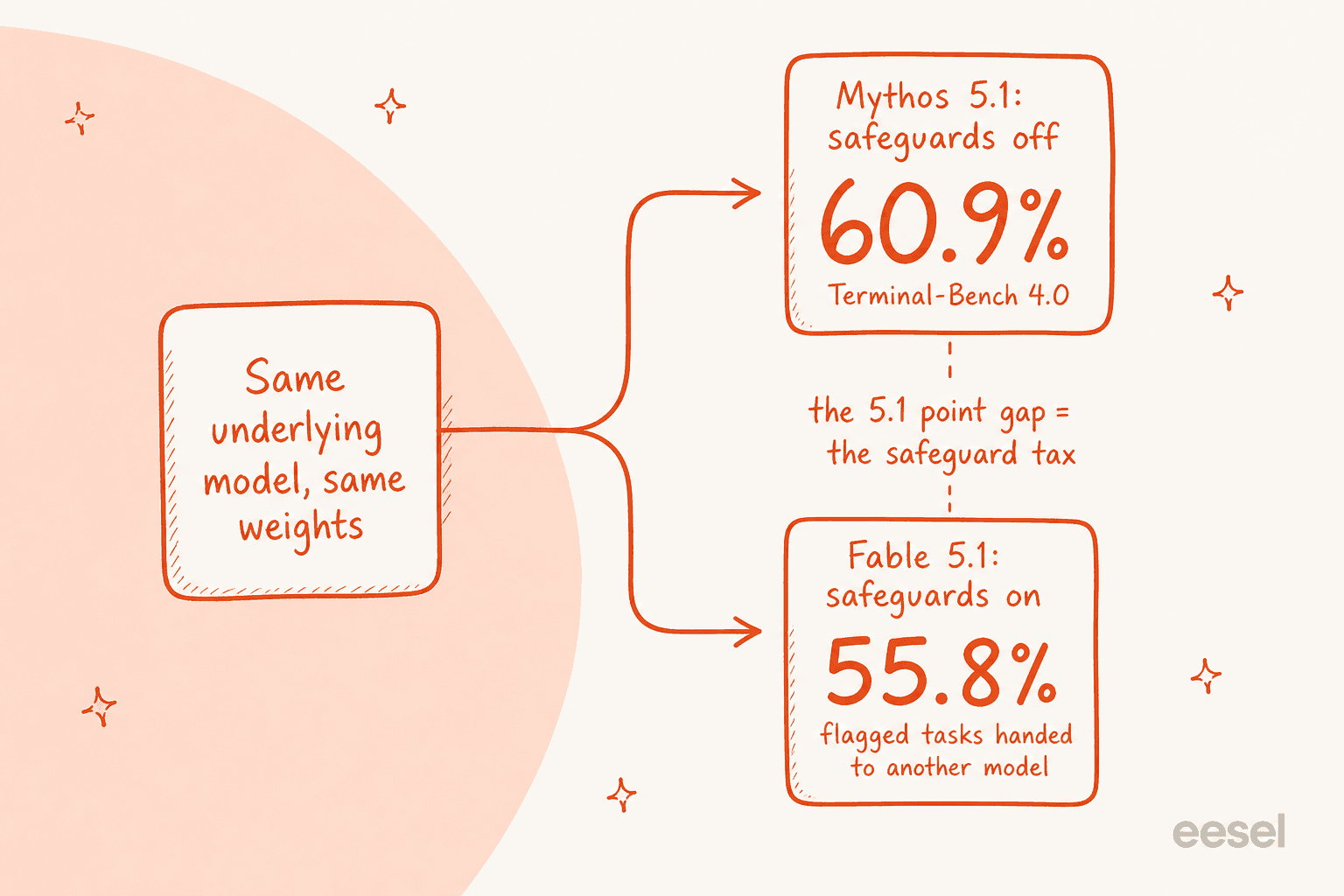
Claude Mythos 5.1 is Anthropic's least-restricted frontier model, and almost no one can actually call it. It shipped on September 1, 2026, alongside Fable 5.1, and the single fact that reframes the whole review is this: they are the same underlying model. Mythos is benchmarked with production safeguards off; Fable is the same weights with safeguards on. So the benchmark gap between them is not a capability difference, it is a safeguard tax.
For pricing, the base rate is unchanged at $10 in / $50 out per million tokens. The real news is the cache read, which drops to $0.25 per million tokens, a quarter of every other Claude model. That alone makes typical workloads about 25% cheaper and highly agentic ones about 45% cheaper.
Access is the catch. Mythos 5.1 is US-scoped and gated behind the Cyber Verification Program (not live yet), an invite-only Life Sciences beta, or your account team, and using it means accepting 30-day data retention. My verdict: for 99% of readers the model worth reviewing is Fable 5.1, because it is the same brain you can actually run today. If your goal is putting a Claude model on a live support queue, the model is the easy part, and a platform like eesel is what turns it into a teammate.
I spent two years doing SEO before I started building, so I read a launch like this the way a buyer searching "claude mythos 5.1 review" would: can I run it, is it better, and what does it cost. Here is what I found when I actually went looking, having spent the last three-plus years watching my team put AI agents on live support queues where a confident wrong answer costs a real customer.
What Claude Mythos 5.1 actually is
Anthropic released Claude Mythos 5.1 on September 1, 2026, with the model ID claude-mythos-5-1. It is a frontier model aimed at verified security and life-sciences work, and Anthropic has said Claude Security itself now runs on it.
The thing to internalise before any benchmark chat: Mythos 5.1 and Fable 5.1 are the same weights. The only thing that differs is the safeguard layer. Fable 5.1 is the version benchmarked and shipped with production safeguards switched on, and when a safeguard fires it hands the task to a different model (cyber work routes to Opus 4.8, biology to Opus 5). Mythos is the same model measured with those safeguards off. That relationship is the whole story, so I will keep coming back to it.
Mythos 5.1 vs Fable 5.1: the gap is a safeguard tax
Here is the number everyone quotes out of context. On Terminal-Bench 4.0, Mythos 5.1 scores 60.9% and Fable 5.1 scores 55.8%. It looks like Mythos is the smarter model. It is not. Fable's lower score is what happens when safeguards intercept a task and hand it off, and an intervened task can score a flat zero. The 5.1-point gap is the cost of the safeguards, not a difference in the underlying brain.
This tripped up plenty of readers at launch. As one commenter on Hacker News put it:
"Wait, so it's literally the same model but scores higher because you turned the seatbelt off? That's not a new model, that's a benchmark footnote."

Anthropic itself expects the gap to shrink as the safeguards get more precise, which is a tacit admission that the delta is the safety layer and not model quality. So if you are comparing Mythos and Fable on raw capability, stop: they are equal. Where Fable earns its keep is the safeguard work itself. It can now identify software vulnerabilities in source code, it fires roughly 60% fewer cyber-safeguard interventions per Claude Code session, and its biology safeguards trigger 85% less often on benign requests. Pen testing, exploit generation, and binary vulnerability scanning still route to Opus. Both models sit alongside the rest of the range, so if you want the family map, the Claude Opus 5 and Claude Sonnet 5 writeups cover the tiers below.
For the record, here is how Fable 5.1 (your practical stand-in for Mythos) lands against the field on the published numbers:
| Benchmark | Fable 5.1 | Fable 5 | Opus 5 | GPT-5.6 Sol |
|---|---|---|---|---|
| Terminal-Bench-Science 0.1 | 52.6 | 24.7 | 29.0 | 22.4 |
| GDPval-AA v2 | 1853 | 1723 | 1824 | 1711 |
| AutomationBench | 31.4 | 17.1 | 26.9 | 19.6 |
| CursorBench 3.2.0 | 73.4 | 70.5 | 70.0 | 67.2 |
| HLE with tools | 65.0 | 63.8 | 63.6 | - |
The jump on Terminal-Bench-Science, from 24.7 to 52.6, is the one I would actually flag to a buyer. For a head-to-head with the OpenAI side, the GPT-5.6 Sol and GPT-5.6 vs Claude breakdowns go deeper than a single row can.
The real headline is the $0.25 cache read
If you only take one number from this review, take this one. Fable 5.1 and Mythos 5.1 price a cache hit at $0.25 per million tokens, which is 0.025x the base input rate. Every other Claude model charges 0.1x, so $1.00. This is a model at twice the base price of Opus 5 serving a cache read at half of Opus 5's ($0.50).
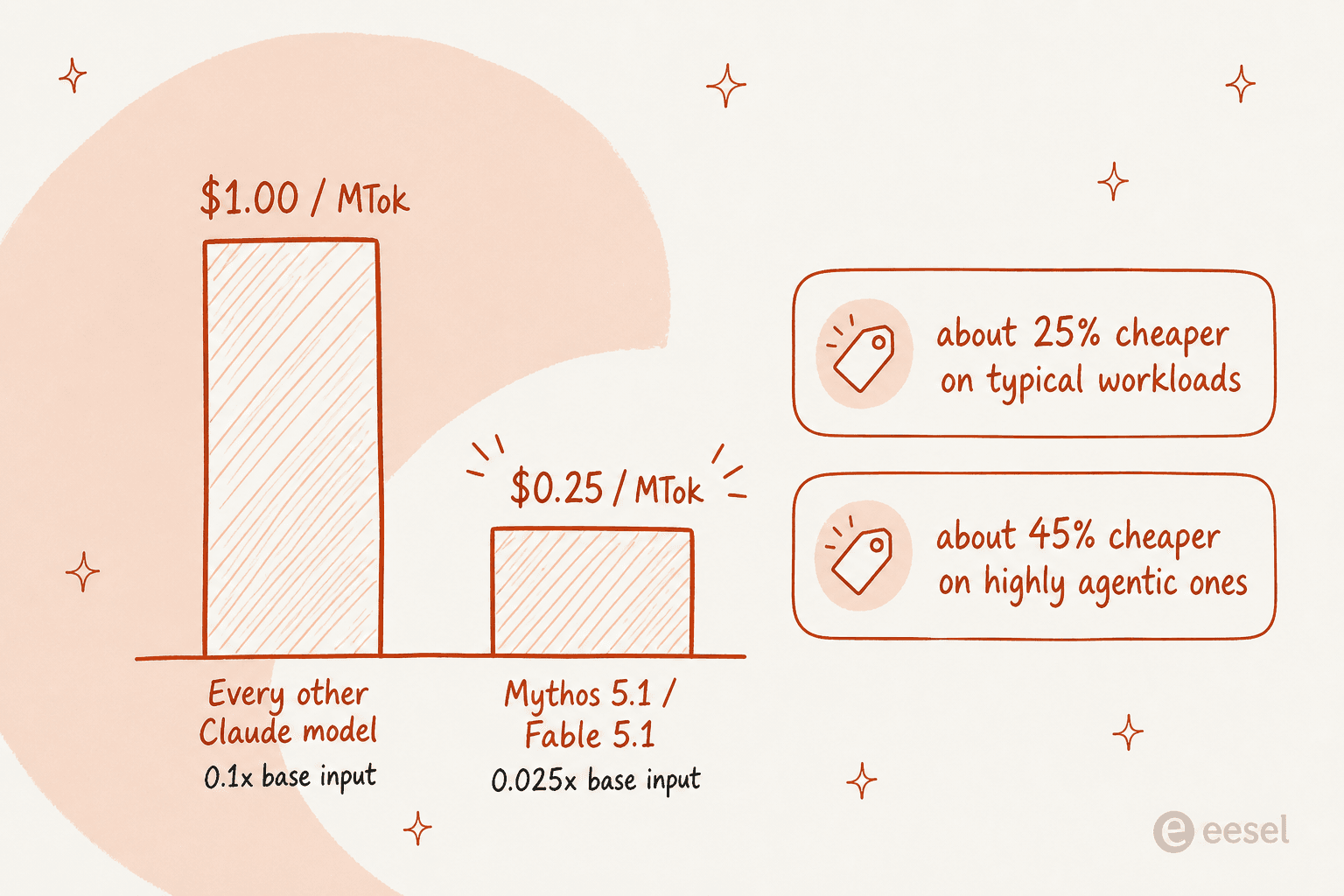
Anthropic measured the effect across four weeks of August 2026 usage: about 25% cheaper on typical workloads and about 45% cheaper on highly agentic ones. The base rate ($10 in / $50 out) is unchanged, batch is $5 / $25, the five-minute cache write is $12.50, and the one-hour write is $20. If you run long-context agents that re-read the same knowledge base on every turn, this is the number that actually moves your bill, far more than the base rate does. A Hacker News commenter did the math out loud:
"The 0.025x cache read is wild. At a 95% hit rate the effective input cost is basically the cache price, so you're paying pennies to keep a huge context warm."
For how cache economics play out in a real agent stack, the Anthropic API pricing guide and the Claude Code pricing breakdown are the ones I would read next.
Who can actually run Claude Mythos 5.1
This is where the review turns practical, and a little deflating. Mythos 5.1 is not something you flip on with an API key. Access is US-scoped today and runs through one of three gates: the Cyber Verification Program (Anthropic says Mythos access is coming "in the near future," so it is not live yet), an invite-only Life Sciences Program beta built with the US government, or a direct conversation with your Anthropic, AWS, or GCP account team. On top of that, using Mythos 5.1 requires accepting 30-day data retention by default.
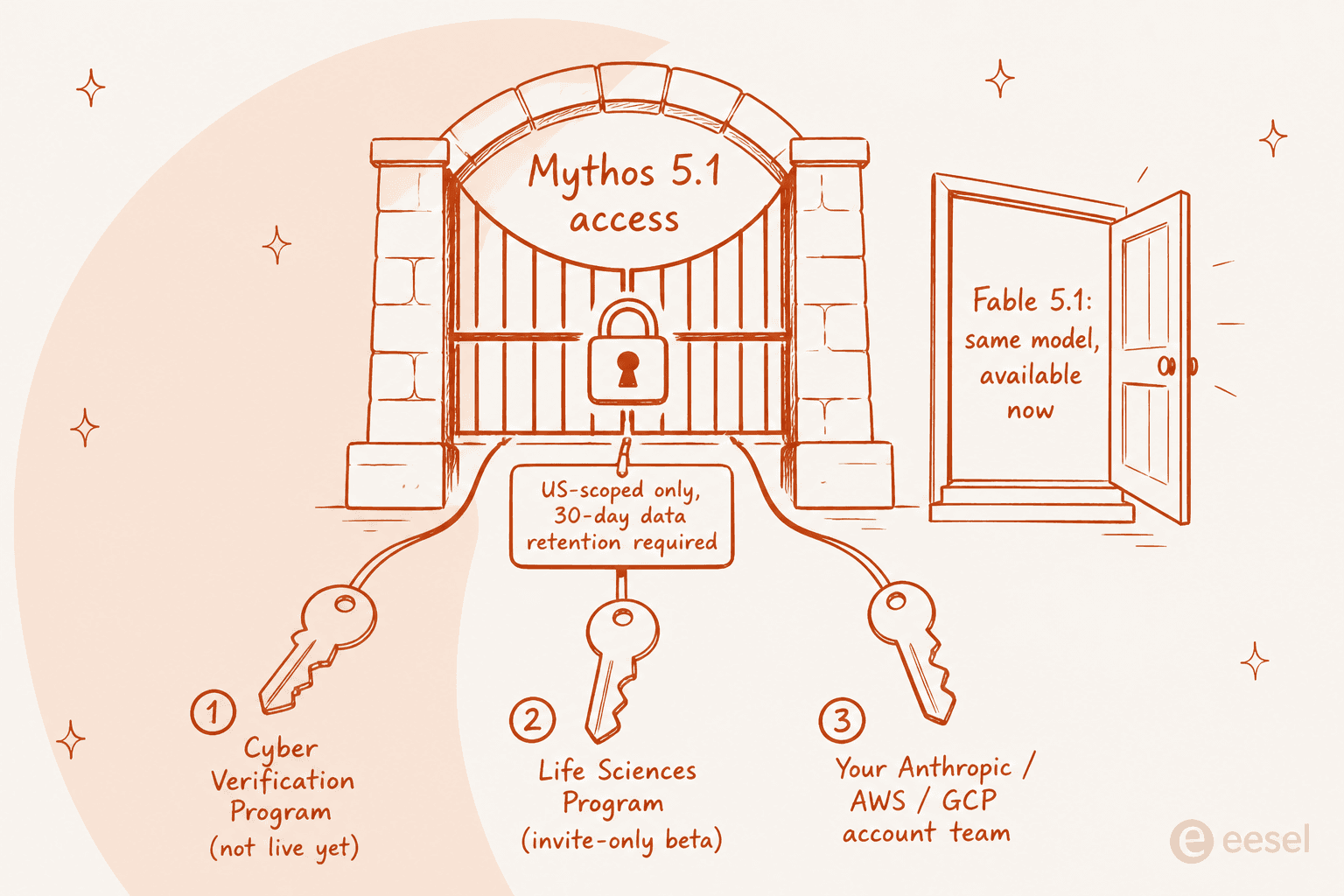
So the honest answer to "should I run Mythos 5.1" is that for almost everyone it is not on the table, and the version you can run, Fable 5.1, is the same model. That is not a knock on the model, it is a reason to point your evaluation at the sibling you can actually deploy. If you are choosing a Claude model for a real workload today, the Claude alternatives and best AI model for support tickets guides are the pragmatic reads.
The spec sheet
For the buyers who want the numbers in one place, here is what Mythos 5.1 (and therefore Fable 5.1) ships with:
| Spec | Value |
|---|---|
| Context window | 1M tokens |
| Max output | 128K tokens |
| Thinking | Adaptive, always on; default effort high |
| Knowledge cutoff | June 2026 |
| Latency | Slower |
| Modality | Text + images to text |
| Platforms | Claude API, Amazon Bedrock, Google Cloud, Microsoft Foundry |
| Retirement | Not sooner than September 1, 2027 |
Two developer-facing changes are worth knowing before you build. There are three breaking API changes that hit both models: forced tool use now returns an error, thinking blocks are tied to the model that produced them, and new API accounts created from launch day cannot edit prior context while preserving the thinking transcript, an anti-distillation move. There is also an EU AI Act wrinkle: models released after August 2, 2026 carry an invisible text watermark, with a detection API in private preview. That watermark drew the most heat in the launch discussion. If you are wiring a Claude model into your own stack, the Claude Code model selection notes and Claude managed agents writeup are the practical follow-ups.
What I'd actually run
Here is my take after sitting with the launch. Mythos 5.1 is a great model you probably can't use, wrapped around one genuinely great pricing change you can. The move is not to chase the invite. It is to run Fable 5.1, pocket the $0.25 cache read, and treat the whole Mythos-versus-Fable framing as the safeguard footnote it is.
And there is a bigger point hiding in "the model is the easy part." A frontier model, Mythos or Fable, is infrastructure. It is not a support agent, a researcher, or a teammate on its own. Dropping a raw Claude API key next to your helpdesk gets you a very smart text generator that does not know your refund policy, cannot see your last 10,000 tickets, and has no way to be tested before it talks to a customer. Closing that gap is the actual work, and it is the same work whether the model underneath is Mythos, Fable, or Opus 5.
Try eesel for the part the model doesn't do
If your reason for reading a Claude Mythos 5.1 review is that you want a smarter AI on your support queue, this is the honest handoff: the model is not the bottleneck, the plumbing around it is. That is exactly what eesel is for.
Think of it the way you would a new hire. eesel is an AI teammate platform, and the AI helpdesk teammate joins your existing queue already trained on your past tickets, help center, and macros, so the model's raw intelligence is pointed at your actual company context instead of the open web. Before it ever answers a live customer, you can simulate it against your historical tickets to see exactly what it would have said, which is the single habit that has saved my team from shipping a confident wrong answer more times than I can count. It connects to your helpdesk in minutes, whether that is Zendesk, Freshdesk, Front, Gorgias, or Help Scout.
And because a fair number of people reading a model review are engineers, it is worth saying eesel is not dashboard-only. There is a real eesel CLI plus an MCP server, so you can operate the same teammate from a terminal, script it into your own workflows, or let a coding agent like Claude Code drive it. It is the same teammate whether you point-and-click it or run it headless. You can try eesel free, and if you would rather see it on your own tickets first, book a demo.
Frequently Asked Questions
What is Claude Mythos 5.1?
Claude Mythos 5.1 is Anthropic's frontier model released on September 1, 2026, benchmarked with production safeguards off. It shares the same underlying weights as Fable 5.1, which is the safeguards-on version most people actually run. See the full Claude Mythos explainer for the family background.
How is Claude Mythos 5.1 different from Fable 5.1?
They are the same model with a different safeguard layer. In my Claude Mythos 5.1 review the only measurable gap is that Fable hands flagged tasks to another model, which drops a handful of benchmark points. For a deeper look at the sibling, read the Claude Fable 5.1 review.
How much does Claude Mythos 5.1 cost?
Base pricing is $10 per million input tokens and $50 per million output, the same as Fable 5.1. The headline is the cache read at $0.25 per million tokens. The Claude Fable 5.1 pricing breakdown and the wider Claude pricing guide cover the rest.
Can anyone use Claude Mythos 5.1?
Not yet. Access is US-scoped and runs through the Cyber Verification Program, the Life Sciences Program, or your Anthropic, AWS, or GCP account team, and using it requires accepting 30-day data retention. If you want a Claude model you can run today, see the Claude alternatives and best AI model for support tickets guides.
Is Claude Mythos 5.1 good for customer support?
The model is strong, but a raw model is infrastructure, not a support agent. To put a Claude model on your queue you still need retrieval, guardrails, and testing, which is what connecting Claude to your helpdesk and AI customer service software like eesel handle for you.