

Anthropic API pricing in 2026: every rate and the real cost levers

Kurnia Kharisma Agung Samiadjie
Written by

Kurnia Kharisma Agung Samiadjie

Katelin Teen
Reviewed by

Katelin Teen

Last edited August 12, 2026

Expert Verified
Two people reviewing token meters, per-million-token price cards and a long printed bill

The full Anthropic API rate card

Everything below is from Anthropic's own detailed pricing docs, checked 13 August 2026. Prices are USD per million tokens, which the docs shorten to MTok. Worth knowing before you copy a URL: platform.claude.com/docs/en/pricing is a redirect stub that returns nothing, and the real page lives under /about-claude/pricing.

ModelInputOutput5m cache write1h cache writeCache readBatch inBatch out
Claude Fable 5$10$50$12.50$20$1$5$25
Claude Mythos 5$10$50$12.50$20$1$5$25
Claude Opus 5$5$25$6.25$10$0.50$2.50$12.50
Claude Opus 4.8$5$25$6.25$10$0.50$2.50$12.50
Claude Opus 4.7$5$25$6.25$10$0.50$2.50$12.50
Claude Opus 4.6$5$25$6.25$10$0.50$2.50$12.50
Claude Opus 4.5$5$25$6.25$10$0.50$2.50$12.50
Claude Sonnet 5$2$10$2.50$4$0.20$1$5
Claude Sonnet 4.6$3$15$3.75$6$0.30$1.50$7.50
Claude Sonnet 4.5$3$15$3.75$6$0.30$1.50$7.50
Claude Haiku 4.5$1$5$1.25$2$0.10$0.50$2.50
Claude Opus 4.1 (retired)$15$75$18.75$30$1.50$7.50$37.50
Claude Haiku 3.5 (retired)$0.80$4$1$1.60$0.08$0.40$2

Three things in that table are worth pausing on.

Five generations of Opus are priced identically. Opus 5, 4.8, 4.7, 4.6 and 4.5 all bill at $5 in and $25 out. If you are still pinned to an older Opus for reproducibility reasons, you are not saving money by doing it, and the retired Opus 4.1 is the only one still on the old $15 and $75 card.

Sonnet got cheaper, which is not how this usually goes. Sonnet 5 lands at $2 and $10 against $3 and $15 for Sonnet 4.6, a 33% cut on both meters in one generation. For most production traffic that makes Sonnet 5 the obvious default rather than a compromise.

Fable 5 at $10 and $50 is exactly 2x Opus 5. Hold that number, because it comes back when we get to fast mode.

If you want the Claude models capability context alongside the prices, the specs line up like this:

Fable 5Opus 5Sonnet 5Haiku 4.5
API IDclaude-fable-5claude-opus-5claude-sonnet-5claude-haiku-4-5-20251001
Context window1M1M1M200k
Max output128k128k128k64k
Knowledge cutoffJan 2026May 2026Jan 2026Feb 2025
LatencySlowerModerateFastFastest

Anthropic's own steer is to start with Claude Opus 5 for complex agentic and enterprise work, and treat Fable 5 as the reach model rather than the default.

Work out your own number

The rate card only becomes a budget once you put your own traffic through it. Set the four inputs below and it will price the month, then show you what the same workload would have cost with no caching and no batch discount.

Move the cache slider and watch the total, because that single control moves the number more than switching model tier does on an input-heavy workload. That is the whole argument of the next section.

Four multipliers decide the bill, not the rate card

Anthropic publishes the per-token price prominently and the multipliers quietly. The multipliers are where the money is.

Prompt caching is the biggest lever, and the short cache is the cheap one

Caching has three prices, all expressed against the model's base input rate: a 5-minute cache write costs 1.25x, a 1-hour write costs 2x, and a cache hit costs 0.1x. Setting the breakpoints themselves is free. The steady-state ceiling is a 90% discount on whatever prefix you reuse.

The break-even arithmetic is where people get it wrong. Each hit saves 0.9x base, so the 5-minute cache pays for itself after one hit, and the 1-hour cache needs two. Write plus one hit on the 1-hour TTL comes to 2.1x against 2.0x for not caching at all, so a single-reuse prompt on the long cache is actively worse than leaving caching off.

Bar chart comparing the input cost of ten requests reusing the same 10,000-token prefix on Claude Opus 5: $0.500 with no caching, $0.108 on the 5-minute cache, $0.145 on the 1-hour cache

Anthropic's own guidance is to stay on the 5-minute cache for anything hit more often than every five minutes, because it refreshes at no additional charge every time it is used. The 1-hour TTL is for gaps: a long side-agent run, or a user who might not reply for ten minutes.

Then there is the part almost nobody prices in. Cache reads are not deducted from your input-token rate limit. Anthropic's worked example is a 2,000,000 ITPM limit paired with an 80% cache hit rate, which lets you push 10,000,000 input tokens per minute through the same account. Caching is not only a discount, it is a 5x throughput multiplier, and it is the cheapest way to raise a ceiling you would otherwise have to ask Anthropic to raise for you.

Two capacity bars showing the same 2,000,000 input-tokens-per-minute rate limit carrying 2M tokens per minute with no caching and 10M tokens per minute at an 80% cache hit rate

Haiku 3.5 is the documented exception where cache reads do count against the limit, and it is retired on the first-party API anyway.

This is also why headline token counts mislead so badly. One practitioner correcting someone else's cost estimate on Hacker News put it about as clearly as it can be put:

"i run a bunch of claude agents for automation and like 85% of input tokens end up being cached reads -which cost 1/10th of the sticker price. so your $200k number is probably closer to $25-30k in real cost"

Hacker News

Several people running production automation independently report 85% to 92% of input tokens landing as cache reads. If you price a token count at the sticker rate, you are overstating a real bill by roughly 10x.

The minimum cacheable prefix is the trap underneath all of this, because it does not move in a straight line across generations:

Minimum cacheable tokensModels
512Opus 5, Fable 5, Mythos 5
1,024Opus 4.8, Sonnet 5, Sonnet 4.6, Sonnet 4.5
2,048Opus 4.7, Haiku 3.5
4,096Opus 4.6, Opus 4.5, Haiku 4.5

Opus 5 caches from 512 tokens. Haiku 4.5 needs eight times that. Fall short of the threshold and caching silently does nothing and returns no error at all, which is why a bill that refuses to drop after you "turned caching on" is usually a prompt that never qualified. Both cache_creation_input_tokens and cache_read_input_tokens sitting at zero in the response is the tell.

A few more mechanics that quietly cost money. The read lookback window is 20 blocks, so a turn that adds more than 20 pushes past your last write and misses. Modifying tool definitions invalidates the whole cache, since the hierarchy runs tools, then system, then messages. And the documented common mistake is putting the breakpoint on a block containing a timestamp or the incoming user message, which buys a fresh write on every single request and never a read.

Batch is a flat 50%, with two exclusions

The Batch API takes 50% off both input and output on every active model, and it stacks with caching. Limits are 100,000 requests or 256 MB per batch, most complete inside an hour, and the hard ceiling is 24 hours.

The billing detail I like: errored, canceled and expired requests are not billed at all. Only successes cost money, which makes batch a low-risk place to run a large classification job. The counterweight is that a batch can go slightly over your configured spend limit because of concurrent processing, so it is not a hard budget fence.

Two exclusions to plan around: batch does not combine with fast mode, and the discount does not apply to Managed Agents sessions.

Effort is the default nobody sets

output_config.effort controls how many tokens Claude spends, and it covers text, tool calls and thinking alike, so it bites even with thinking off. The levels run low, medium, high, xhigh, max.

The default is high on every model Anthropic documents, which is the second-most-expensive setting on the ladder. Anthropic's own best-practice list opens with "set effort explicitly", which is a polite way of saying the out-of-the-box behaviour is not the one you want for volume work.

No token multipliers are published for any level, so treat it as a dial to measure rather than a discount to claim. The one comparable anchor Anthropic gives is that Sonnet 5 at medium is roughly Sonnet 4.6 at high. Two gotchas worth knowing before you start tuning: changing effort between requests invalidates your cached prefixes, so the two levers fight each other, and on Opus 5 lower effort shortens the thinking rather than the visible answer, so prompt for length if brevity is what you were after.

The two surcharges hiding in the docs

Fast mode gives Opus 5 and Opus 4.8 up to 2.5x faster output at $10 in and $50 out, exactly 2x standard. Which produces the buying decision I find most interesting on the whole card: fast-mode Opus 5 costs precisely what standard Fable 5 costs. If you are reaching for fast mode on a hard problem, price the more capable model at the same rate before you commit. Fast mode is first-party API only, and it does not combine with batch.

The quieter one is data residency. Pinning inference to the US with inference_geo: "us" on Claude 4.6 and later applies a 1.1x multiplier to every token category, and that includes cache writes and cache reads, not just input and output. It is a 10% surcharge on the entire bill, it is easy to set once and forget, and global routing is the standard-priced default.

Stack all four levers and the spread on a single model is larger than the gap between model tiers:

Vertical price ladder for one million input tokens on Claude Opus 5: $0.50 as a cache read, $2.50 on batch, $5.00 standard, $10.00 in fast mode, bracketed as a 20x range

The tool and agent costs that sit on top of tokens

Server-side tools bill separately, and these are the lines that surprise people reading a monthly invoice for the first time.

ItemChargeThe detail that matters
Web search$10 per 1,000 searchesEach search counts as one use regardless of how many results come back. Errored searches are free. Results then bill as input tokens in that turn and every later turn.
Web fetchNo extra chargeTokens only. Anthropic sizes a typical page at roughly 2,500 tokens and a research PDF at roughly 125,000.
Code execution$0.05 per container-hourFree entirely when paired with web search or web fetch, and free under 1,550 hours a month. Five-minute minimum, and attached files bill runtime even if the tool never runs.
Managed Agents$0.08 per session-hourMetered on running only, to the millisecond. Idle time waiting on your next message is free. Tokens bill on top.
Tool-use system prompt286 to 675 input tokensAdded to every tool-enabled request, on top of your own schemas.

That last row deserves a note, because it moves the right way. Opus 4.7 carried the worst fixed tool overhead on the card at 675 tokens with auto, and Opus 5 cut it to 286. If you run a heavy MCP tools setup with thousands of small requests, that is a real 58% reduction in a cost line you never chose.

Anthropic publishes its own worked example for a one-hour Managed Agents coding session on Opus 5, and it is the cleanest caching-ROI figure available anywhere in the docs:

LineNo cachingWith caching
Input$0.25$0.05 uncached plus $0.02 cache reads
Output$0.375$0.375
Session runtime$0.08$0.08
Total$0.705$0.525

That is a 25.5% cut on the whole session from caching alone, on a workload where output dominates and caching can only touch part of the bill.

There is no long-context premium anymore

This is the change most third-party pricing posts still get wrong. Claude 4.6 and later include the full 1M token window at standard rates, and the pricing docs state it plainly: a 900k-token request is billed at the same per-token rate as a 9k-token request. Caching and batch discounts apply across the whole window too.

Two caveats stop that being a free lunch. Anthropic itself warns that accuracy and recall degrade as the token count grows, so paying for a fuller window can buy you worse answers. And overflow behaviour changed on Claude 4.5 and later: if input plus max_tokens exceeds the window, the request is accepted and stops with stop_reason: "model_context_window_exceeded" partway through, and you pay for whatever was generated before it stopped.

How Anthropic API pricing compares

Here is the honest head-to-head against the other frontier APIs, taken from each vendor's own page on the same day. If you want the deeper version, we have a full three API providers breakdown and a direct Anthropic API comparison.

TierModelInputOutputCached inputBatchLong context
FrontierClaude Opus 5$5.00$25.00$0.5050%No premium
Frontiergpt-5.6-sol$5.00$30.00$0.5050%$10 / $45, threshold unpublished
FrontierGemini 3.1 Pro$2.00$12.00$0.2050% on tokens only$4 / $18 above 200K
Frontiergrok-4.6$2.00$6.00$0.50None$4 / $12 at 200K, all tokens
MidClaude Sonnet 5$2.00$10.00$0.2050%No premium
Midgpt-5.6-terra$2.00$12.00$0.2050%$4 / $18, threshold unpublished
MidGemini 3.6 Flash$1.50$7.50$0.1550%None
CheapClaude Haiku 4.5$1.00$5.00$0.1050%No premium
Cheapgpt-5.6-luna$0.20$1.20$0.0250%$0.40 / $1.80
Cheapdeepseek-v4-flash$0.14$0.28$0.0028NoneNone

Read that table fairly and Claude is not the cheapest anything. Gemini pricing undercuts Sonnet 5 on input at the mid tier, grok-4.6 is dramatically cheaper on output at the frontier, and deepseek-v4-flash is in a different universe entirely at $0.14 and $0.28, with a cache-hit rate roughly 50x below its miss rate.

Where Anthropic wins is predictability, and at scale that is worth real money.

Start with long context, since no current Claude model carries a premium there while Gemini 3 publishes a doubled rate above 200K. xAI's version is harsher: its long-context rate applies to all tokens in the request once the prompt crosses 200K, so one token over repriced the entire call. Then compare the shape of the bill. Anthropic meters four things, input, output, cache writes and cache reads, plus a small set of named tools. xAI's page lists five separately-billed token types, six priced tool invocations, file and collection storage, egress, and a $0.05 fee on any request that trips its usage guidelines. Batch parity is a myth too: OpenAI discounts every meter, Google keeps context caching at standard rates on its Pro batch rows, and xAI gives grok-4.6 no batch discount at all.

There is also a wrinkle worth knowing if you are shopping on price. DeepSeek publishes an Anthropic-format base URL at api.deepseek.com/anthropic, which means the SDK you wrote against Claude will mostly point at a much cheaper model with a base-URL change. DeepSeek's own page also warns of a significant price increase coming, so treat today's figure as a floor rather than a plan. If the bill is the reason you are reading this, our Claude alternatives roundup is the place to start. The cheaper open-weight end is covered separately, with per-model rates for Qwen and for Kimi K2.5.

Why public Claude API bills disagree by four orders of magnitude

If you go looking for what the Anthropic API costs in practice, you will find numbers that cannot possibly describe the same product. It is worth understanding why before you take any of them as a benchmark.

Almost all the loud figures come from developers pointing a coding agent at a raw API key. Here is the shape of that:

"At API prices it's incredibly easy to burn cash. I ran through my Claude Max 20x last week and had $100 credit from when Anthropic banned OpenClaw, so I decided to use it to get some chores done. Three hours of very light work on Sonnet cost me $55."

Reddit

Note that is Sonnet, not Opus, and he describes the work as very light. In the same thread another developer reports a peak burn rate of about $50 an hour, and someone else lost $300 in twelve hours to an unattended overnight run. One commenter names the specific failure mode that produces those numbers: $20 gone to an agent stuck in a tool-call loop, which is an argument for spend caps and loop guards rather than an argument about price.

Now the same API, in the same thread, doing bounded work:

"I'm using the API to relevance classify hundreds of articles a day. Been running for 2 ish weeks, I think I'm almost up to $2 in cost"

Reddit

Fifty dollars an hour and two dollars a fortnight, on the same rate card. The variable is not the price list, it is whether the workload has a bounded prompt and a bounded output or an agent loop that decides for itself how much to spend. Almost every "the Claude API is expensive" claim you will read is measuring the second thing, and almost every server-side product integration is the first.

The practical read: ignore per-hour figures entirely when you are sizing a normal integration, and model your own token shape instead.

What the bill looks like at three real workloads

Sticker prices do not tell you much until you attach them to a job. All three below use published rates and the arithmetic is the same one the widget above runs.

A support triage classifier. 50,000 tickets a month, Haiku 4.5, a 3,000-token instruction block reused on every call plus 400 tokens of ticket text, and 150 tokens out. That is $170 of input and $37.50 of output, so about $208 a month, or four-tenths of a cent per ticket. Batch it and halve that again. This is the workload where the raw API really is close to free, and it is why per-ticket pricing on a support tool has to earn its keep against something this cheap.

A coding agent. 2,000 sessions a month on Opus 5, 60,000 input tokens per session with 80% served from cache, and 12,000 output tokens. Input works out to $120 uncached plus $48 in cache reads, and output at $600. Call it $768, with output carrying 78% of it. On agentic workloads the output meter is the bill, so caching helps far less than the discount headline suggests. That is the single most useful thing to know before you model an agent's cost.

A one-off document backfill. 200,000 documents, Sonnet 5, 5,000 tokens in and 800 out, run through batch. Input is $1,000 at the $1 batch rate and output is $800 at $5, so $1,800 for the run against $3,600 synchronously. Nothing to cache here, since every document is different, and this is exactly the shape batch exists for.

The pattern across all three: caching wins on input-heavy repetitive traffic, batch wins on anything you can wait for, and neither does much for an agent that writes a lot. Match the lever to the shape of the work.

Where the raw API stops being the cheap option

Everything above prices tokens. It does not price the system around them, and that is where most build-versus-buy arithmetic quietly falls over.

I have spent the last few years putting AI agents on live support queues, and the pattern in sales calls is consistent enough to be predictable. A prospect runs a test afternoon, watches the call counter move, and cannot extrapolate. One email-security company on Freshdesk, scaling toward 20,000 tickets a year, burned 200 API calls in a single test day and came back worried entirely about what 9,000 interactions a month would do to the number, not about whether the answers were any good. Another operator heading toward 150,000 tickets a month did the arithmetic at roughly 20 cents a ticket, landed on about $30,000 a month, and stalled there.

Neither of those is a token-price problem. Both are unit problems. Nobody forecasts in millions of tokens, and a per-token meter turns every capacity conversation into a modelling exercise rather than a budget line.

The counterargument is real too, and I would rather quote it than talk around it:

"We switched to a system that is working well at half the cost. But long term we will just build our own, which is so possible now with AI. I think you have a decent system for now, but we are probably too large of a customer for this."

A Canadian firearms-accessories brand running Zendesk with 2,190 synced docs, from eesel's internal sales-call records

That reader is right that the models are now cheap enough to make building tempting, and frameworks like AgentKit have made the scaffolding cheaper too. What the token bill leaves out is retrieval over your help centre, a helpdesk integration that survives an API change, escalation rules, a way to test against historical tickets before you point it at customers, and someone whose job it is to keep all of it running. We have watched a confident-sounding bot give wrong answers in production, which is why every rollout now gets simulated against real past tickets first, and simulation is not a line item you can buy on a rate card.

The honest version of the trade: if you need a classifier or a summariser, build it on the API and enjoy a bill measured in cents. If you need something answering customers, price the AI agent cost end to end, including the AI hallucinations risk and the maintenance nobody budgets for.

Then compare that against cost per resolution on something already built. Our chatbot cost breakdown works through the same arithmetic, and the AI helpdesk software roundup covers what you would be comparing against.

A last practical note on governance, since it is the thing people ask about after their first surprising invoice. Spend caps run $500 on Start, $1,000 on Build, and $200,000 on Scale, with Custom removing the cap entirely. Tiers are assigned on usage history rather than purchased, and new organisations can start in an Evaluation tier below the published limits. Hitting the cap pauses usage until the next calendar month, which works the same way as OpenAI rate limits if you have hit those before.

Console's usage page exposes your cache hit rate directly, which is the number to look at first, and it is worth instrumenting properly with LLM tracking tools if the bill matters. One structural note for anyone comparing routes: on the enterprise plan, seats are $20 a month each plus usage at these same API rates, so this rate card is the enterprise usage bill. That is a different calculation from Claude Pro, where a flat subscription absorbs the usage instead.

Try eesel for support automation

If the reason you are pricing the Anthropic API is a support queue, the unit is the thing to fix before the rate. eesel charges $0.40 per ticket with no seats and no platform fee, which is a number you can put in a forecast without modelling token counts per conversation. It plugs into Zendesk, Freshdesk or Gorgias in a few minutes, trains on your existing help centre and past tickets, and simulates against your ticket history before it ever replies to a customer, so you see the projected resolution rate and cost before going live.

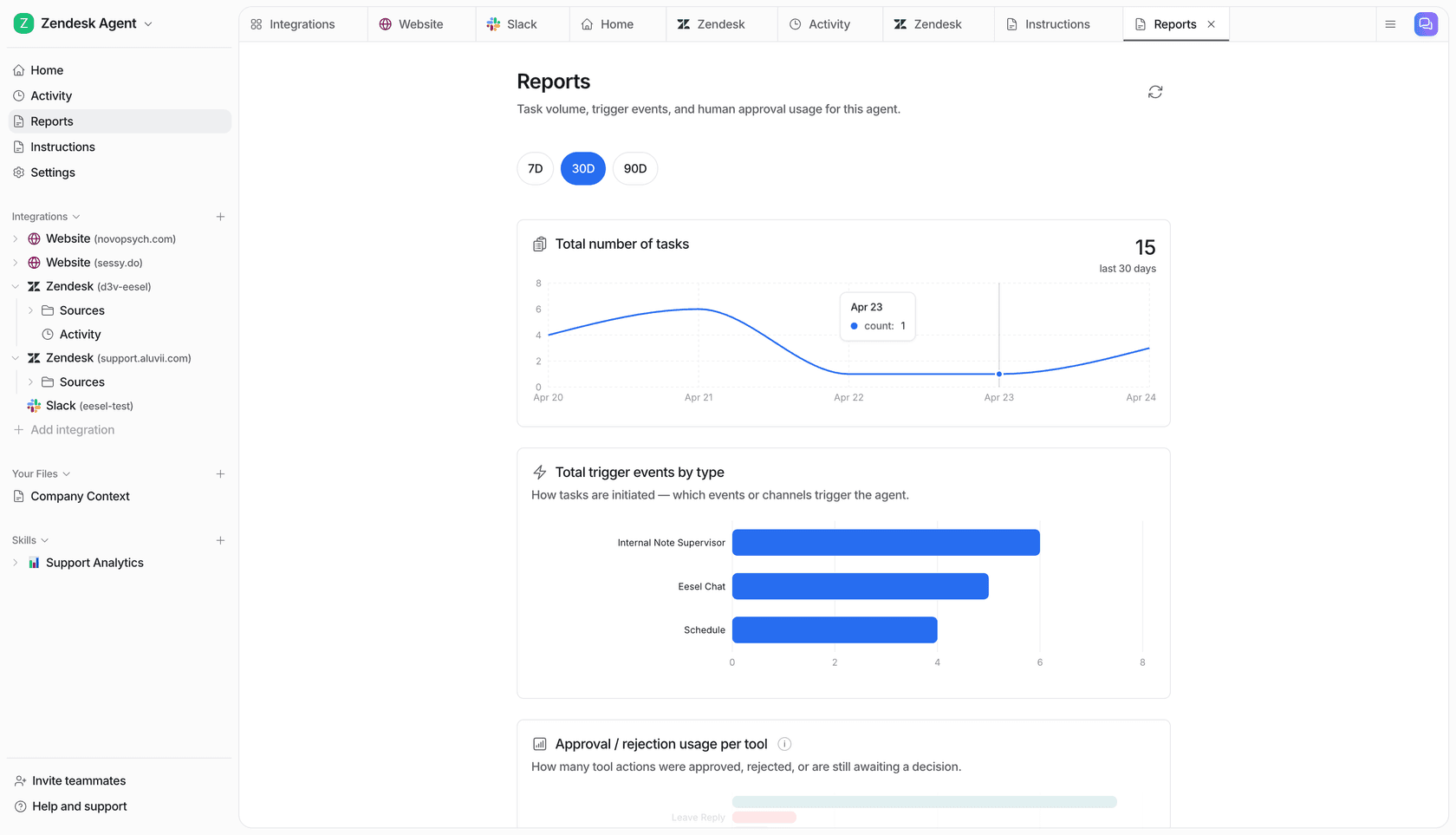
eesel AI reports dashboard showing task volume, trigger events by type, and approval and rejection usage per tool

You still get the per-action visibility a raw API build would make you construct yourself, which is usually the first thing teams miss when they estimate the build. Free to try, and you can see the projected numbers before you commit to any of it.

Frequently Asked Questions

How much does the Anthropic API cost?
It is billed per token, per model. Claude Opus 5 is $5 per million input tokens and $25 per million output tokens, Claude Sonnet 5 is $2 and $10, and Claude Haiku 4.5 is $1 and $5. Claude Fable 5 sits at the top at $10 and $50. There is no seat fee and no minimum, so the whole bill is usage. For a comparison against the subscription side, see our breakdown of Claude pricing.
What is the cheapest way to cut an Anthropic API bill?
Prompt caching, by a wide margin. A cache read costs 10% of the base input rate, so a reused prefix settles at a 90% discount, and it pays for itself after a single hit on the 5-minute cache. The Batch API adds a flat 50% off on top for anything you do not need answered right now.
Does Anthropic API pricing charge extra for the 1M context window?
No. Claude 4.6 and later include the full 1M token window at standard rates, and Anthropic states that a 900k-token request bills at the same per-token rate as a 9k-token one. That is a real difference from Google and xAI, which both publish higher rates above 200K. Our three API providers comparison covers the rest.
Is Claude Opus 5 or Claude Sonnet 5 better value on the API?
Sonnet 5 is 2.5x cheaper on both meters and got cheaper than the model it replaced, so it is the default for production traffic. Reach for Opus 5 when the task genuinely needs it, and note that lower effort on Opus 5 does not shorten the visible answer, only the thinking. See model selection for how to pick.
What hidden costs are there in Anthropic API pricing?
Three worth budgeting for: web search at $10 per 1,000 searches, a 1.1x multiplier on every token category if you pin inference to the US, and the tool-use system prompt that adds fixed input tokens to every tool-enabled request. Managed Agents also add $0.08 per session-hour of runtime on top of tokens.
Is there a free tier for the Anthropic API?
Anthropic gives new users a small amount of free credits to test with but publishes no dollar figure, so treat it as a trial rather than a tier. If you need genuinely free capacity for prototyping, our roundup of free AI APIs is the better starting point.
Is building on the Anthropic API cheaper than buying a support tool?
On raw tokens, almost always yes. Once you add retrieval, a helpdesk integration, escalation logic, and someone maintaining it, the arithmetic usually flips. We break the comparison down in cost per resolution and chatbot cost.

Share this article

Kurnia Kharisma Agung Samiadjie

Article by

Kurnia Kharisma Agung Samiadjie

Kurnia is a software engineer and writer at eesel AI with two years of SEO experience, writing about AI tools, helpdesk software, and customer support. He pairs a developer's understanding of how these products are built with search-driven research into what actually ranks and resonates with the people searching for them.

Related Posts

All posts →
Illustration of a person weighing a small low-cost AI model against a larger caped flagship model on pedestals
Trending

Claude Opus 5 vs Fable 5: which should you actually run?

Fable 5 costs exactly double Opus 5. I went through both system cards, the docs and the independent benchmarks to work out when that second dollar buys anything.

Rama Adi NugrahaRama Adi NugrahaJul 27, 2026
Grok 4.6 pricing 2026: every rate, and what teams actually pay
Trending

Grok 4.6 pricing 2026: every rate, and what teams actually pay

Grok 4.6 lists at $2 input and $6 output per million tokens. OpenRouter's measured effective input price is $0.74. Here is every meter on the bill, and which door you should buy through.

Kurnia Kharisma Agung SamiadjieKurnia Kharisma Agung SamiadjieAug 13, 2026
Illustration of a Claude Opus 5 pricing breakdown showing cost per million tokens
Guides

Claude Opus 5 pricing in 2026: API costs, plans, real bills

Anthropic kept Opus 5 at Opus 4.8 prices, but thinking is now on by default. Here is what a Claude Opus 5 run really costs once effort and caching are in.

Rama Adi NugrahaRama Adi NugrahaJul 27, 2026
Illustration of a very long cat stretching beside two people reviewing a scorecard, with the LongCat logo
Trending

LongCat 2.0 review: a real workhorse with one hard blocker

I graded LongCat 2.0 on seven things a buyer actually cares about, using Meituan's own files and the people who ran billions of tokens through it. It scores well on six.

Alicia Kirana UtomoAlicia Kirana UtomoAug 4, 2026
Illustration weighing Alibaba's Qwen 3.8 Max against DeepSeek V4 Flash
Trending

Qwen 3.8 Max vs DeepSeek V4 Flash: price, specs, real verdict

One model costs 21x more per output token than the other. That is the least interesting thing about this comparison, and here is what the specs actually decide.

Alicia Kirana UtomoAlicia Kirana UtomoAug 3, 2026
Editorial illustration of Claude Opus 4.8, Anthropic's flagship AI model
Guides

What is Claude Opus 4.8? A clear-eyed look at Anthropic's flagship model

Claude Opus 4.8 is Anthropic's latest flagship model. Here's what changed, what it costs, and what a smarter model actually means for AI customer support.

Riellvriany IndriawanRiellvriany IndriawanJun 17, 2026
Illustration of a developer at a laptop watching an agentic coding loop run through code, checks and a bot
Trending

Claude Opus 5 review: near-frontier coding at half the price

A hands-on Claude Opus 5 review: what the benchmarks actually say, the hallucination rate that went up, and whether it belongs on a live support queue.

Alicia Kirana UtomoAlicia Kirana UtomoJul 27, 2026
Illustration comparing a heavyweight reasoning model against a fast balanced model on cost and capability
Trending

Claude Opus 5 vs Sonnet 5: which one should you use?

Claude Opus 5 costs 1.7x Sonnet 5 per token and still finishes some jobs cheaper. Here is the head-to-head on price, benchmarks and real cost per task.

Rama Adi NugrahaRama Adi NugrahaJul 27, 2026
Two people reading a large usage meter and adjusting a stack of billing dials, in Meta's blue brand colour
Trending

Meta Muse Spark 1.1 pricing: the bill has four meters

Muse Spark 1.1 lists at $1.25 in and $4.25 out per million tokens. Four separate meters decide your real bill, and the sticker is the smallest of them.

Rama Adi NugrahaRama Adi NugrahaAug 5, 2026

Ready to hire your AI teammate?

Set up in minutes. No credit card required.

Get started free