


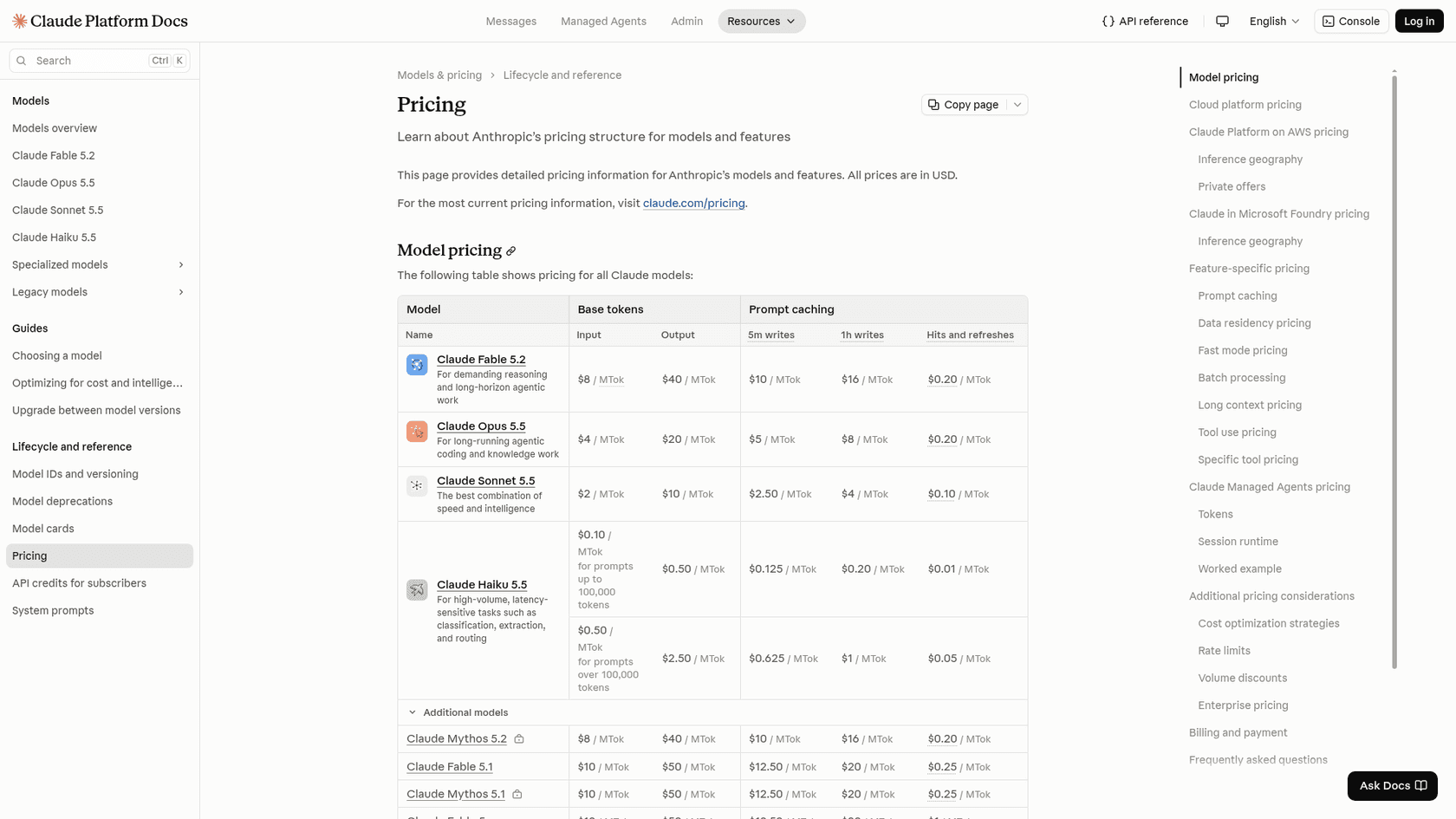
Claude Fable 5.2 costs $8 per million input tokens and $40 per million output, 20% less than Fable 5.1 and exactly twice Opus 5.5. Cache reads are $0.20, batch halves everything, fast mode doubles it.
My take: the per-token price makes Fable look like the expensive choice, but per task it can be the cheaper one. Anthropic measured Fable 5.2 at High effort matching Opus 5.5 at Max for about half the cost per task. The traps are elsewhere: a high default effort, separate and lower rate limits, and plan rules that put Fable on usage credits for Pro. For support queues, eesel picks the model for you, and the eesel CLI lets a coding agent load your help docs and test answers before launch.
What does Claude Fable 5.2 cost?
Anthropic released Fable 5.2 on November 9, 2026. Here's the full rate card from its pricing page:
| Meter (per million tokens) | Claude Fable 5.2 | What it's for |
|---|---|---|
| Base input | $8 | Fresh prompt text |
| Output | $40 | Everything the model writes, thinking included |
| 5-minute cache write | $10 | Storing a prompt prefix for short reuse (1.25x input) |
| 1-hour cache write | $16 | Storing it for long sessions (2x input) |
| Cache read | $0.20 | Re-reading a stored prefix (0.025x input) |
| Batch input / output | $4 / $20 | Async jobs, 50% off |
| Fast mode input / output | $16 / $80 | Up to 2.5x faster output |
| US-only inference | 1.1x on every meter | inference_geo: "us" |
The model ID is claude-fable-5-2 on the Claude API, Google Cloud, Microsoft Foundry, and Claude Platform on AWS, and anthropic.claude-fable-5-2 on Amazon Bedrock. You get a 1M token context window at the same rate for every request size, 128K max output, always-on adaptive thinking, and a June 2026 knowledge cutoff.
I build integrations at eesel, which means I spend more time than I'd like reading API invoices line by line. The pattern is always the same: the rate card tells you almost nothing until you know how many tokens the model actually spends on a job. Fable 5.2 is a good example, because its per-token price and its per-task price point in opposite directions.
How much cheaper is Fable 5.2 than Fable 5.1?
20% on every meter, with the same tokenizer. Anthropic lowered the base price and kept the multipliers:
| Per million tokens | Fable 5 | Fable 5.1 | Fable 5.2 |
|---|---|---|---|
| Input | $10 | $10 | $8 |
| Output | $50 | $50 | $40 |
| 5-minute cache write | $12.50 | $12.50 | $10 |
| 1-hour cache write | $20 | $20 | $16 |
| Cache read | $1 | $0.25 | $0.20 |
| Batch input / output | $5 / $25 | $5 / $25 | $4 / $20 |
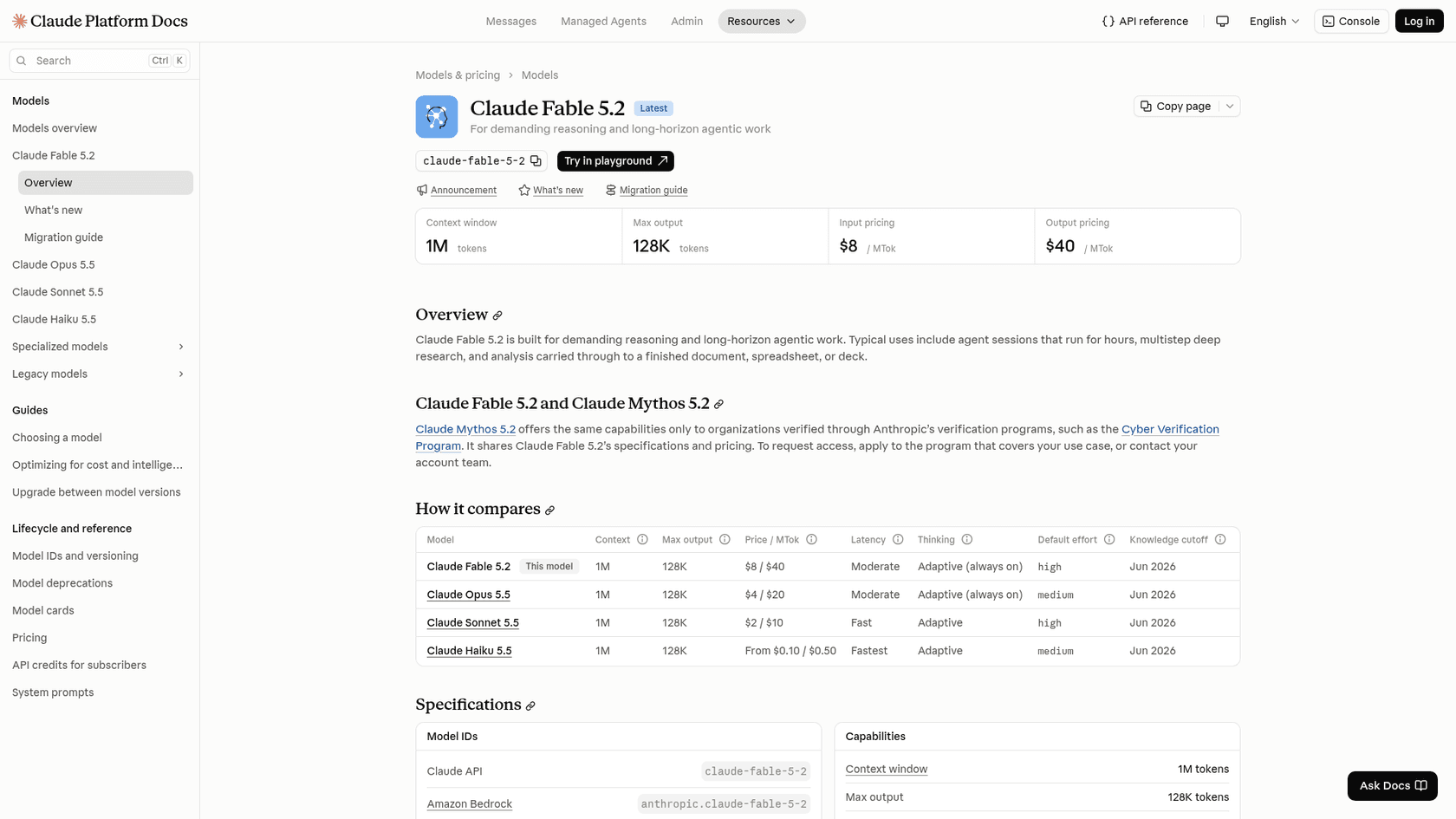
The big structural change happened one release earlier, when Fable 5.1 pricing cut the cache read from 10% of input to 2.5%. If you're still on Fable 5, the jump is larger: a cache hit falls from $1 to $0.20 per million, so cache-heavy agent work costs a fraction of what it did.
Anthropic also says Fable 5.2 generates output up to 30% faster than 5.1, and the migration guide calls the move "mostly drop-in." Mostly. Four API changes can break code, including a prefix check that now applies to every account. My colleague's Fable 5.2 review goes through each one.
Why can Fable 5.2 cost less per task than Opus 5.5?
On paper, Opus 5.5 is half the price: $4 input and $20 output. But the bill is price times tokens, and the two models don't spend the same number of tokens to reach the same answer.
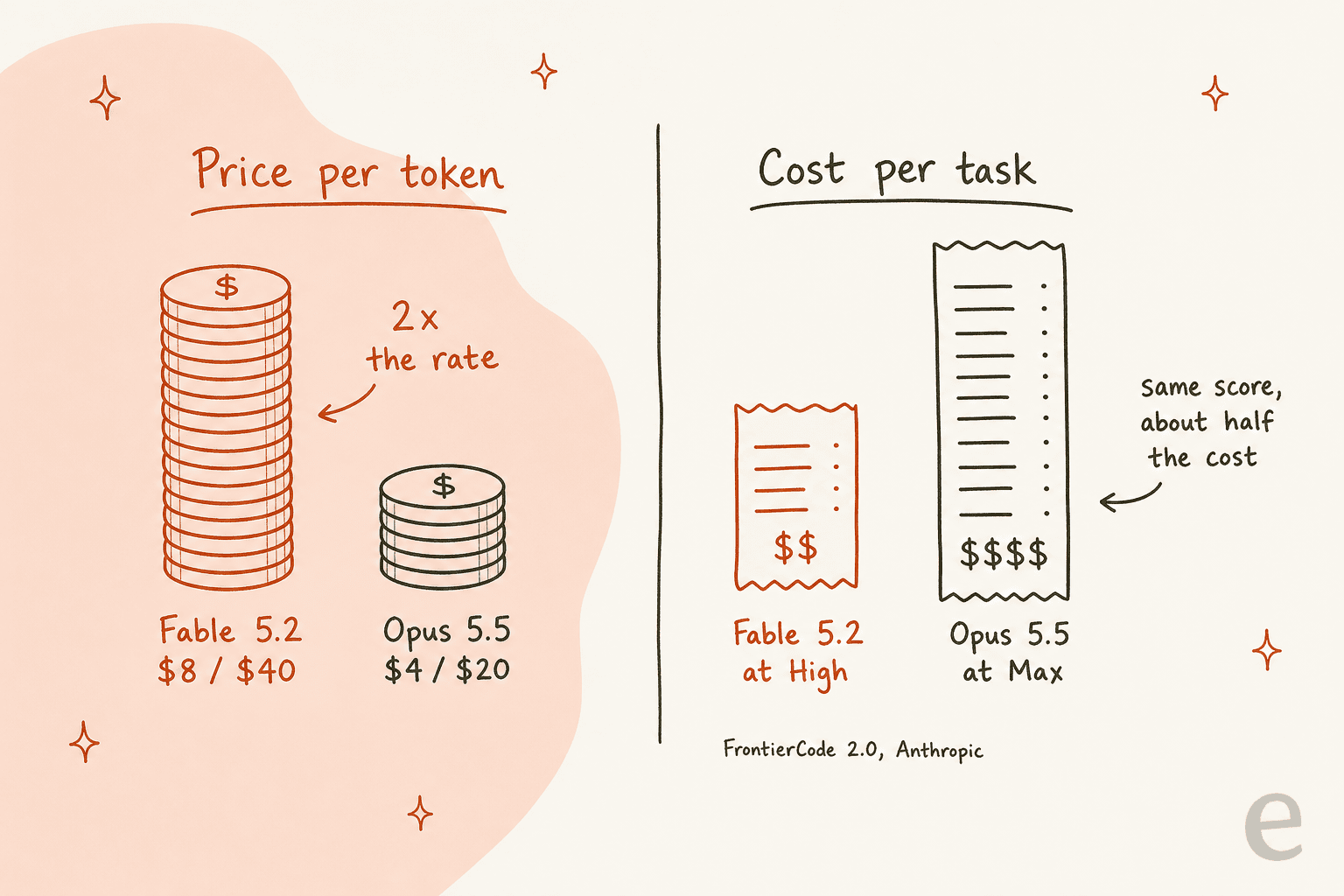
Anthropic's launch post gives two data points:
- FrontierCode 2.0: Fable 5.2 at High effort scored about level with Opus 5.5 at Max effort, for roughly half the cost per task.
- Chartography: Fable 5.2 at Medium scored
66.4%, ahead of Opus 5.5 at Max (64.4%), for less than one-tenth of the cost per task.
The reason is effort. To reach Fable's quality, Opus has to think at its highest setting, and thinking tokens are billed as output. Fable gets there at a lower setting with fewer tokens. These are Anthropic's own evals, so treat them as a starting hypothesis to test on your workload, not a guarantee.
There's a simple way to see the break-even. Take one long agent session: 2M input tokens, 90% served from cache, 200K output tokens.
- Fable 5.2:
$9.96. Output is$8.00of it. - Opus 5.5, same token count:
$5.16. - Opus 5.5 break-even: Opus has to spend about
2.2xas many output tokens before it costs more than Fable.
So the question isn't "which is cheaper?" It's "does Opus need more than twice the tokens to do my job as well?" For hard reasoning, long-horizon agent work, and chart reading, Anthropic's numbers say it can. For routine coding and drafting, where Opus at Medium already does the job, it usually won't, and Opus wins on cost.
Anthropic itself still recommends starting with Opus 5.5 for most workloads. I agree, with one change: run your hardest 10% of tasks on both and compare cost per finished task, not per token.
How do batch, fast mode, and US-only inference change the bill?
Each modifier stacks on the base rates. Here's the same session priced every way:
| Mode | Cost for the session | Use it when |
|---|---|---|
| Batch API | $4.98 | The job can wait (up to a day) |
| Standard | $9.96 | Normal interactive or agent work |
| Standard, US-only | $10.96 | Data residency rules require it |
| Fast mode | $19.92 | A person is waiting on long output |
| Fable 5.1, standard | $12.45 | (for comparison) |
| Fable 5, standard | $13.80 | (for comparison) |
A few details worth knowing before you flip any of these on:
- Batch can't be combined with fast mode. Caching still applies inside a batch, so cache hits land around
$0.10per million. - Fast mode speeds up output, not the first token. It's up to
2.5xmore output tokens per second. It has its own rate limit, separate from standard, and the Start, Build, and Scale usage tiers get a default one without asking. It's not available with a Priority Tier commitment. - Fast mode is a different model name on Foundry. On Microsoft Foundry you deploy
claude-fable-5-2-fastinstead of settingspeed: "fast". On Google Cloud (Google managed), Google sets its own fast mode prices. - US-only adds 10% to everything, including cache reads and fast mode.
The cheapest Fable 5.2 bill is a batched, cache-heavy job with short output; the most expensive is fast mode at max effort with US-only routing. On the same work, that's roughly a 4x spread.
Plug in your own volumes here. The last field lets you test the break-even: set how many times more output tokens Opus would need to match Fable's result.
What are the hidden costs of switching to Fable 5.2?
The rate card is public. These five things aren't on it, and each one can move your bill more than the 20% price cut:
- The default effort is
high. Opus 5.5 defaults tomedium. A request that leaves outeffortruns one level higher on Fable, which shows up only as more thinking tokens at$40per million. Anthropic's migration guide says to set effort explicitly and re-run your effort sweep. - Prompt lines don't stop it thinking anymore. A line like "answer directly without deliberating" usually worked on Fable 5.1. In Anthropic's testing, it didn't stop Fable 5.2 from thinking at
mediumand above. Lower the effort instead, and raisemax_tokens, or a request can run out of room before any text. - It may hire its own reviewers. At
xhighandmax, Anthropic saw Fable 5.2 starting subagents to check its own work, something 5.1 didn't do on the same tasks. Subagents can account for a large part of what a session costs. - Model switches cost a turn. If a router or refusal fallback moves a conversation from Fable 5.2 to Opus 5.5 or Fable 5.1, the API drops the thinking blocks the other model can't read. You aren't billed for the dropped tokens, but the next turn runs without that reasoning, which can raise cost and latency.
- Separate, lower rate limits. Fable 5.2's limit is separate from Opus 5.5's, with lower token limits at each tier. Check the rate limits page before moving production traffic, or you'll pay in 429s instead of dollars.
There's also a data cost. Fable 5.2 is a "Covered Model" that requires 30-day retention for safety monitoring, unless you're an eligible enterprise customer using Enterprise Frontier Safeguards. For teams with strict zero-retention policies, that's a procurement conversation before it's a pricing one.
How do Claude plans meter Fable 5.2?
No separate price exists for subscriptions. What changes is whether Fable draws from your plan or from usage credits, per Anthropic's Fable models on your plan article:
| Plan | How Fable 5.2 is billed |
|---|---|
| Pro, Team standard seats | Usage credits only (not in plan limits) |
| Max, Ultra, Team and Enterprise premium seats | Included up to 50% of weekly limits, then credits or another model |
| Enterprise standard seats | Usage credits, if the org turns them on |
| Usage-based Enterprise, Claude API | Standard API rates |
Launch week changes this for a few days. From November 9 to 16, 2026, Pro and Team standard seats can use up to 50% of their weekly limits on Fable models at no extra cost, plus one Fable limit reset, according to the launch promotion. Max, Ultra, and premium seats get one to three resets based on subscription length: one under six months, two for six to 12 months, three for longer. Those resets expire on March 8, 2027.
A reset gives back the weekly usage you spent on Fable and refills the five-hour window. It doesn't raise your limits. And Anthropic warns that Fable models use your limits faster than other Claude models, so the 50% goes quicker than it sounds. Our Claude pricing guide covers the plans themselves. If you mostly use Fable through the terminal, the Claude Code pricing post explains how coding sessions draw down those limits.
The launch thread on Hacker News had the usual split on whether a subscription is the cheap way in:
"Really? A $200/mo plan gives you an enormous amount of inference on this model."

"200$USD is a lot of money for a lot of people. It might explain why DeepSeek Flash v4.1 1017 is the most popular model at OpenRouter."
Both are right. If you code with Fable most days, a plan that includes it beats paying API rates. If you need cheap volume, a smaller model wins, which brings us to the rest of the lineup.
How does Fable 5.2 compare with the rest of the lineup?
| Model | Input / output (per M) | Cache read | Default effort |
|---|---|---|---|
| Claude Fable 5.2 | $8 / $40 | $0.20 | high |
| Claude Mythos 5.2 | $8 / $40 | $0.20 | high |
| Claude Opus 5.5 | $4 / $20 | $0.20 | medium |
| Claude Sonnet 5.5 | $2 / $10 | $0.10 | high |
| Claude Haiku 5.5 | from $0.10 / $0.50 | from $0.01 | medium |
Two things stand out. First, Fable 5.2 and Opus 5.5 have the same $0.20 cache read, so the more of your prompt you can cache, the smaller the gap. On a job with 5M input, 98% cached, and only 20K output, Fable costs $2.58 and Opus $1.78: 1.45x, not 2x. Second, Mythos 5.2 is the same model at the same price with lighter safeguards for verified security and biology teams, so there's no reason to pay for it unless Fable's filters block your work.
Outside Anthropic, the closest frontier comparison is GPT-6.1 Sol pricing. Google's answer is covered in our Gemini 4 Carbon pricing breakdown.
For cheap volume, look at GPT-6 Luna pricing. DeepSeek is even lower, per our DeepSeek V4 Flash numbers.
The Anthropic API pricing guide has every Claude rate in one place. For options beyond Anthropic, see Claude alternatives.
How do you keep a Fable 5.2 bill down?
- Set effort on every request. Start at
highfor hard work andmediumfor the rest, then sweep on your own evals. Never rely on the default. - Cache the stable prefix. System prompts, tool definitions, and long documents belong in the 1-hour cache. At
0.025x, a hit costs almost nothing. Our LLM optimization notes cover prefix design. - Batch anything that can wait. Nightly evals, bulk document analysis, and backlog cleanup at half price add up.
- Route by difficulty. Send the hard 10% to Fable and the rest to Opus 5.5 or Sonnet 5.5. One model doesn't need to run your whole pipeline.
- Cap subagents. At high effort, tell the model when not to delegate. The Claude Code best practices post shows how.
What should support teams take from Fable 5.2 pricing?
Mostly that model choice isn't where support costs are won. A ticket reply rarely needs Fable's reasoning ceiling, and when a support bot gets something wrong, it's usually missing knowledge, not a weak model. Paying $40 per million output tokens to draft "where's my order?" replies is money spent in the wrong place.
That's the gap eesel fills. eesel is an AI teammate platform where you hire ready-to-work teammates for specific jobs, and the AI helpdesk agent is the one for support. It joins your existing helpdesk, learns from your past tickets and help center, and is simulated against your ticket history before it answers a customer. You don't choose models, tune effort, or count cache reads. Our AI teammates explainer and best AI teammates roundup cover how that differs from building on raw models.
Here's what it looks like at two very different volumes:
- smava, a German consumer loan comparison platform, runs support for two brands out of one Zendesk. In a month, eesel handled about
27,000tickets, categorized14,600of them, and prepared15,300draft replies in German from820macros and help center articles kept apart by brand. - Xap, an education software company, uses an agent on Freshdesk tickets that drafts ready-to-send referrals for misdirected student requests. It answers from
880past tickets and canned responses.
At smava's volume, the token bill would be a real line item if the team were running frontier models directly. With eesel, the model choice and cost tuning happen behind the teammate. The Zendesk AI and Freshdesk AI draft replies posts show the drafting flow on each helpdesk.
If you'd rather have a coding agent do the setup, the eesel CLI lets Claude Code, Codex, or Cursor upload approved knowledge like exported help articles and macros, adjust the teammate's instructions, and ask test questions to check its answers before anything goes live. Connecting the helpdesk itself still needs someone with admin access to approve it. The AI agent CLI post explains why that matters.
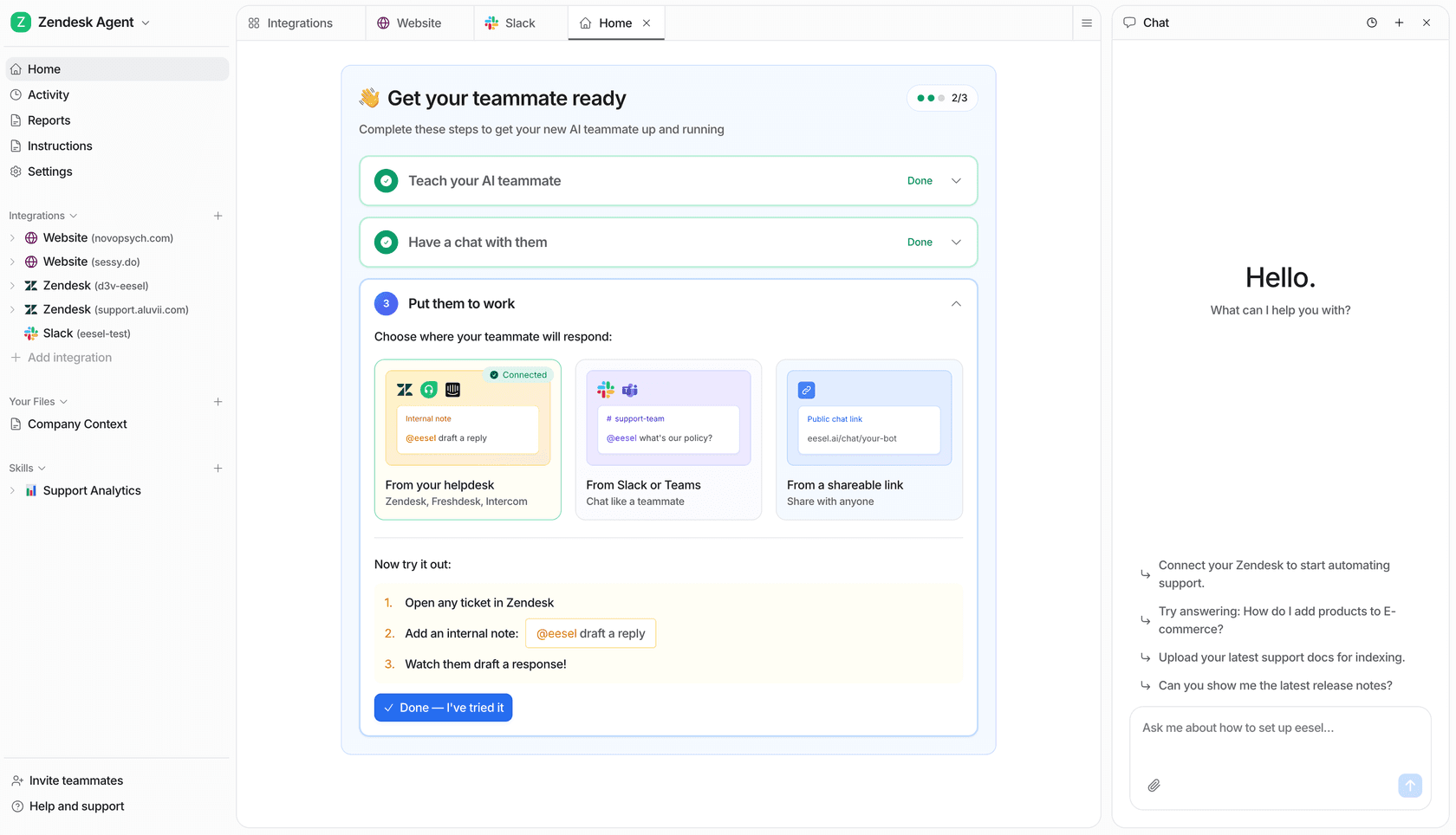
Weighing Fable against Opus for your support queue? eesel's helpdesk teammate handles the model choice, plugs into Zendesk or Freshdesk in minutes, and shows you how it would have answered your past tickets before a customer sees a reply. Try eesel free.
The bottom line on Claude Fable 5.2 pricing
Fable 5.2 is $8 in, $40 out, and $0.20 for cache reads: 20% cheaper than Fable 5.1 and twice Opus 5.5 per token. Batch halves it, fast mode doubles it, and US-only adds 10%.
The number that matters is cost per finished task. On hard reasoning and long agent runs, Anthropic's own tests show Fable at High matching Opus at Max for about half the cost, so the expensive model can be the cheap one. On routine work, Opus 5.5 at Medium still wins. Set effort explicitly, cache aggressively, check the separate rate limits, and test both on your hardest tasks before you commit. For the full model story, start with our Claude Fable 5.2 overview.