


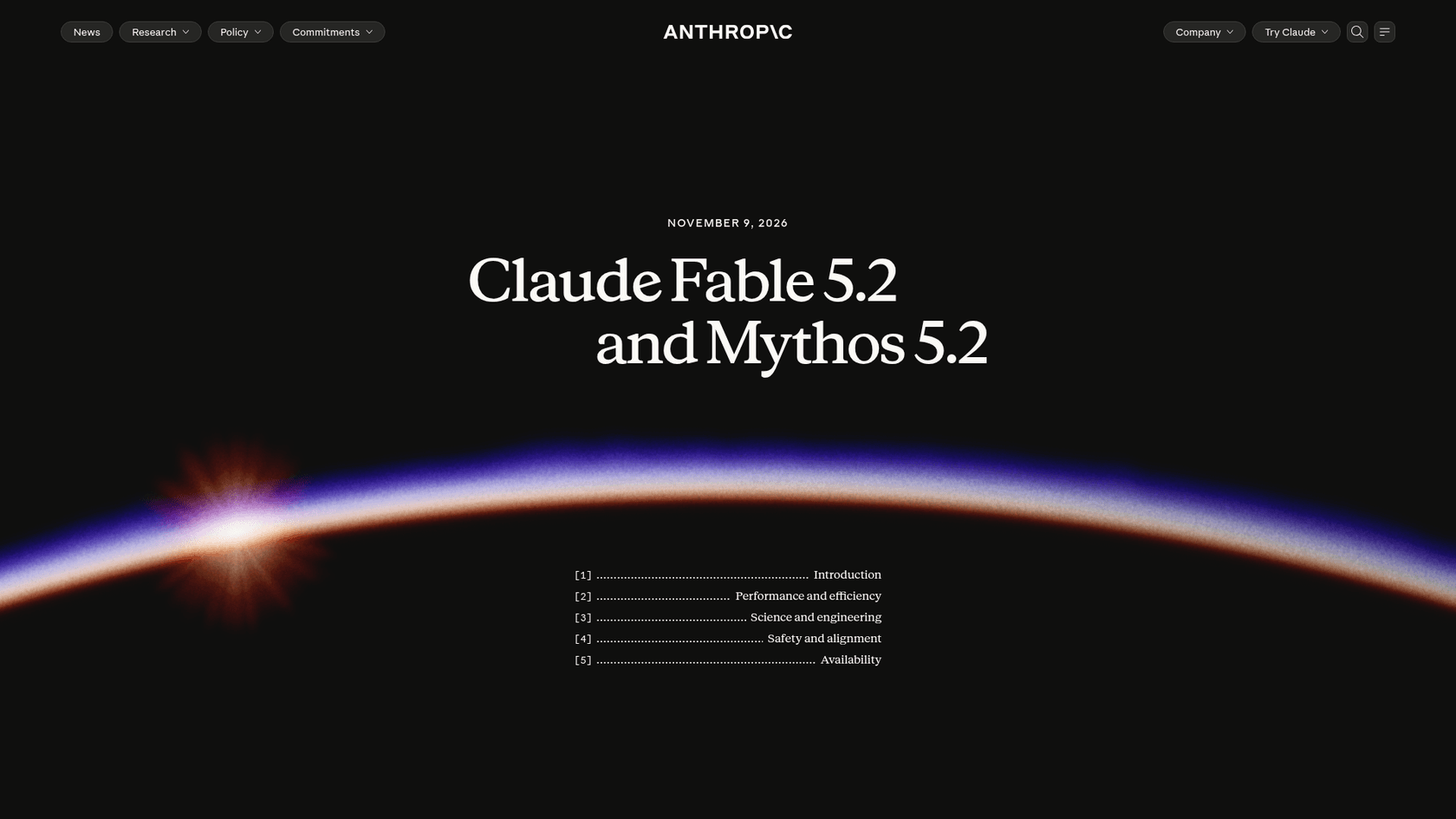
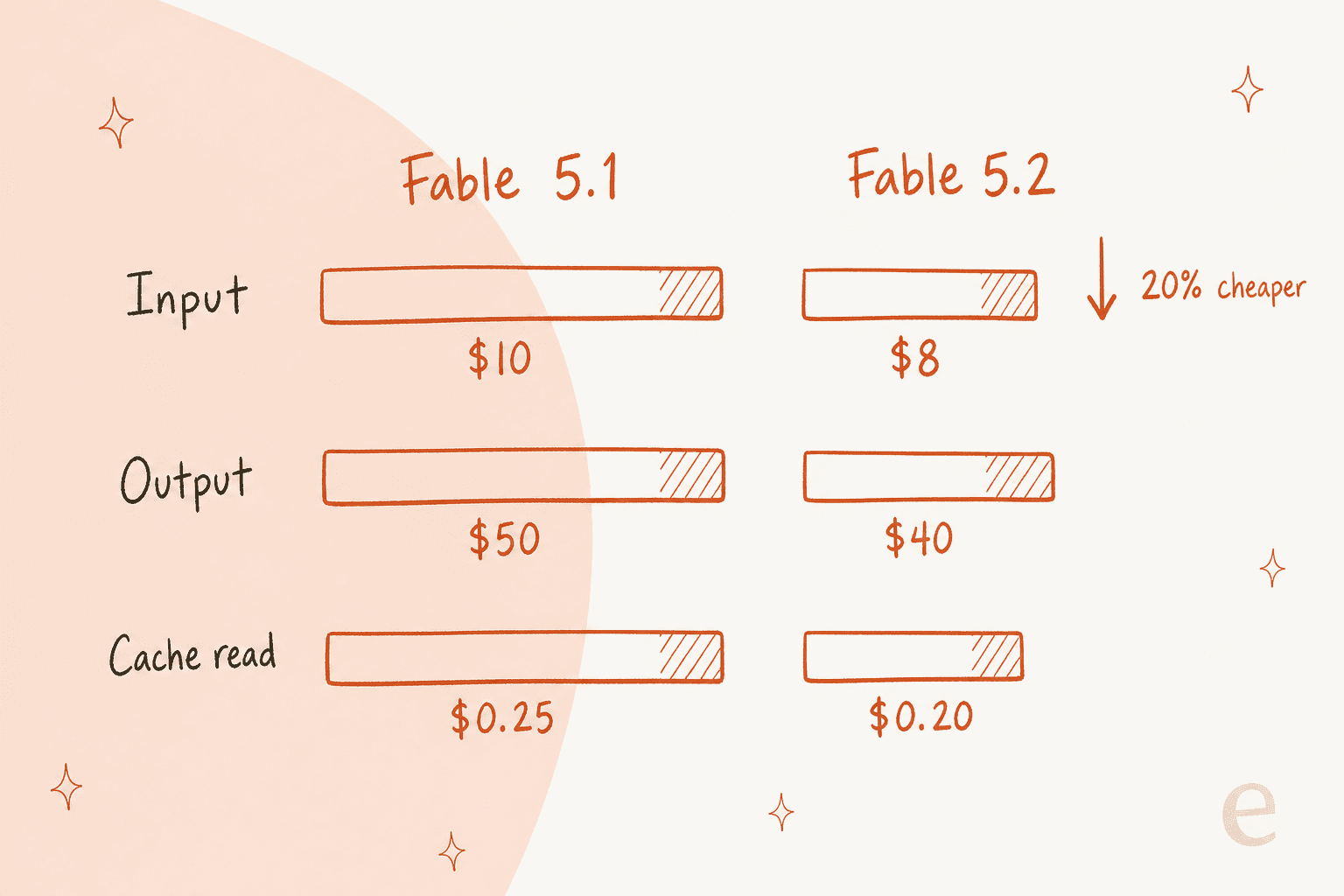
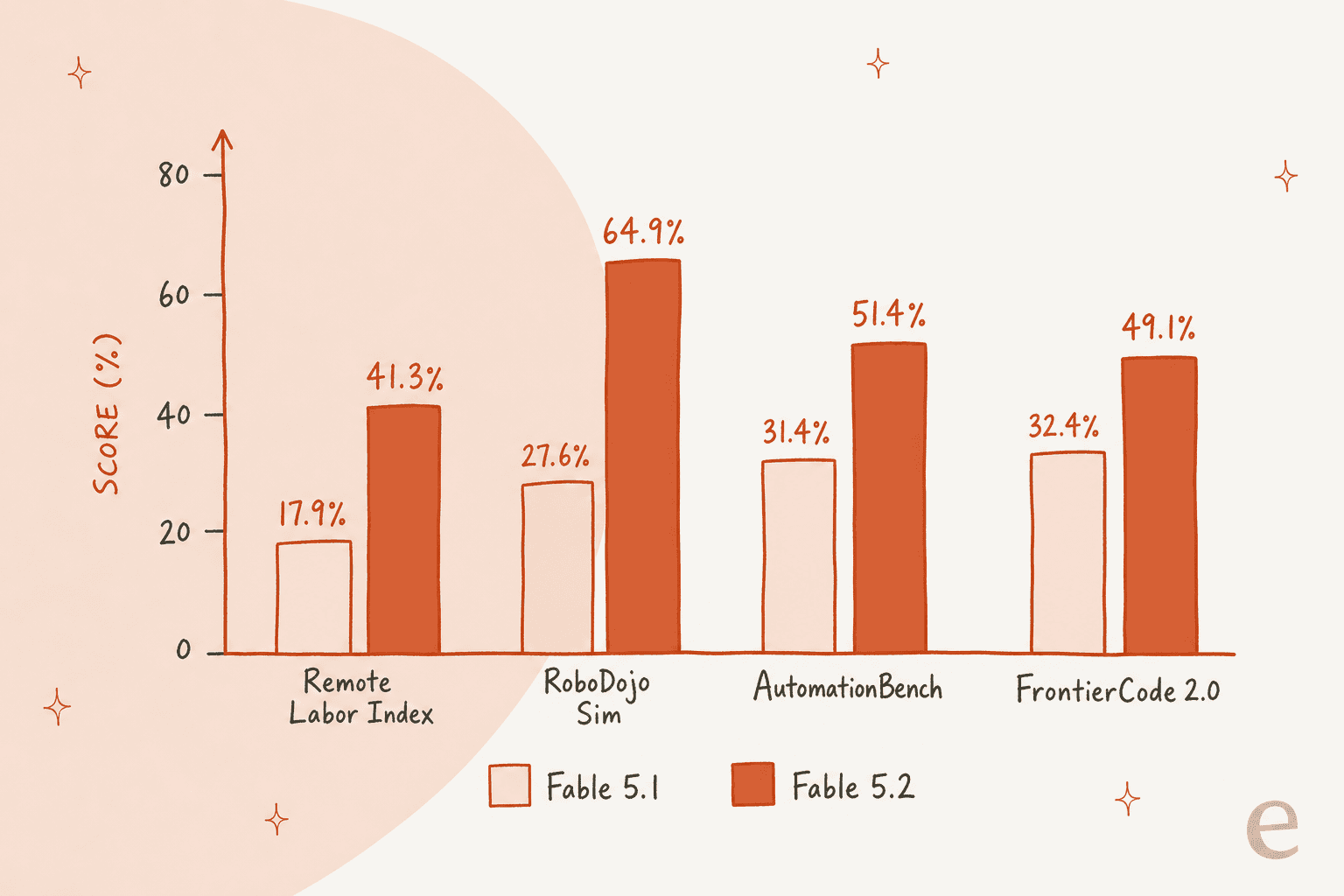
Claude Fable 5.2 is Anthropic's new top model, released November 9, 2026, and it costs 20% less than Fable 5.1: $8 per million input tokens and $40 per million output, with cache reads at $0.20. It's up to 30% faster and posts big jumps on long agentic work, like 41.3% on the Remote Labor Index versus 17.9% for Fable 5.1.
My take: start with Claude Opus 5.5 at half the price, and step up to Fable 5.2 only when your own tests on Opus fall short. Anthropic says the same thing. For support teams, eesel picks the model for you and tests its answers on your past tickets before it replies to anyone. With the eesel CLI, a coding agent can load your help articles and run test questions first.
What is Claude Fable 5.2?
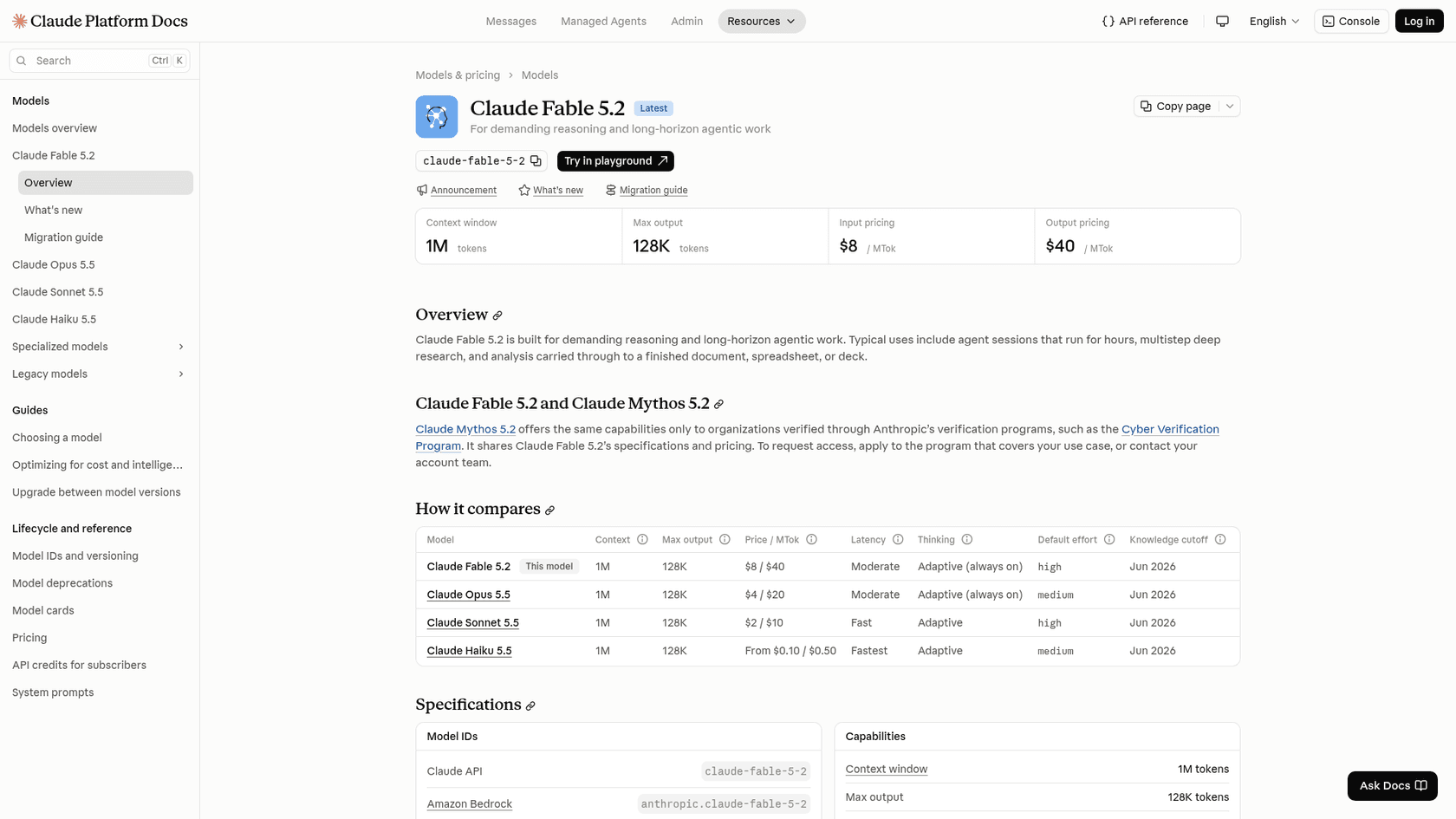
Claude Fable 5.2 is the newest model at the top of Anthropic's lineup, above Claude Opus 5.5, Claude Sonnet 5.5, and Claude Haiku 5.5. Anthropic's model overview describes it as built for "demanding reasoning and long-horizon agentic work": agent sessions that run for hours, deep research, and analysis carried through to a finished document or spreadsheet.
I've spent two years on the SEO side of eesel, and a model launch always brings the same three searches: what does it cost, is it better, and should I switch. This post answers those three in that order.
The short facts:
- Model ID:
claude-fable-5-2on the Claude API,anthropic.claude-fable-5-2on Amazon Bedrock - Context window:
1Mtokens, with128Kmax output - Thinking: adaptive thinking is always on; you control depth with the effort setting (default
high) - Knowledge cutoff: June 2026
- Released: November 9, 2026, with retirement no sooner than November 9, 2027
Claude Fable 5.2 and Claude Mythos 5.2 are the same underlying model. The difference is the safeguards. Fable blocks most cybersecurity and research-biology tasks so it can be sold to everyone. Claude Mythos 5.2 drops those blocks, and access is limited to organizations approved through Anthropic's Cyber or Life Sciences Verification Programs. Both share the same specs and the same price.
How much does Claude Fable 5.2 cost?
Fable 5.2 is the first Fable release to cut the base price. Claude Fable 5.1 kept Fable 5's $10 / $50 rate and only discounted cache reads. Fable 5.2 lowers everything by 20%.
| Price per million tokens | Claude Fable 5.1 | Claude Fable 5.2 | Claude Opus 5.5 |
|---|---|---|---|
| Input | $10 | $8 | $4 |
| Output | $50 | $40 | $20 |
| 5-minute cache write | $12.50 | $10 | n/a |
| 1-hour cache write | $20 | $16 | n/a |
| Cache read | $0.25 | $0.20 | $0.20 |
| Batch API (input / output) | $5 / $25 | $4 / $20 | $2 / $10 |
| Fast mode (input / output) | n/a | $16 / $80 | $8 / $40 |
Prices from Anthropic's pricing page; our Anthropic API pricing guide covers the rest of the family. Cache reads on Fable 5.2 are 0.025x the input price, the same multiplier Fable 5.1 used. On Opus 5.5 the multiplier is 0.05x, which lands on the same $0.20.
To make that concrete, take a long agent session that sends 2 million input tokens (90% of them cache hits) and writes 200,000 output tokens:
- Fable 5.1: about
$12.45 - Fable 5.2: about
$9.96 - Opus 5.5: about
$5.16
Output tokens drive most of the bill, so the 20% cut on output is the part that matters. Our LLM optimization notes cover how caching shapes these numbers. Opus 5.5 is still roughly half the cost for the same token count, which is why the "which model" question below matters more than the price drop.
Fast mode is new for Fable. Anthropic's fast mode docs say it delivers up to 2.5x more output tokens per second at double the price. It's available on the Claude API, Google Cloud, Microsoft Foundry (as claude-fable-5-2-fast), and in Claude Code.
On subscriptions, Fable 5.2 is in the Claude apps on paid plans that include Fable. For launch week, Anthropic says eligible subscribers get one to three Fable usage resets, and Fable can use up to 50% of weekly limits on Pro plans and standard Team seats. Our Claude pricing guide covers the plan tiers.
Not everyone thinks the price is low enough. One Hacker News commenter compared per-task costs on a third-party index:
"GPT-6.1 Sol costs $1.27 per task, whereas Fable 5.2 is $26.54 per task -- a ~21x price difference. Fable 5.2 is not 21 times better than GPT 6.1 Sol, I find it hard to justify this."

That's a fair point for everyday tasks. For a cheaper frontier option, see our GPT-6.1 Sol pricing breakdown.
How much better is Claude Fable 5.2?
On Anthropic's own table, Fable 5.2 scores above Fable 5.1 on every benchmark listed, and above Opus 5.5 on almost all of them. The biggest jumps are in long, multistep work, the kind where a model has to keep going for hours.
| Benchmark (what it tests) | Fable 5.2 | Fable 5.1 | Opus 5.5 | GPT-6 Astra | Gemini 4 Carbon |
|---|---|---|---|---|---|
| FrontierCode 2.0 (agentic coding) | 49.1% | 32.4% | 45.5% | 42.8% | 41.1% |
| FrontierSWE v2 (agentic coding) | 69.9% | 56.3% | 62.3% | 65.5% | 61.2% |
| AutomationBench (business workflows) | 51.4% | 31.4% | 42.5% | 41.4% | 53.9% |
| Remote Labor Index (knowledge work) | 41.3% | 17.9% | 21.3% | 20.8% | n/a |
| OSWorld 2.1 (computer use) | 89.3% | 83.5% | 87.2% | 79.5% | 81.5% |
| Humanity's Last Exam, with tools | 74.2% | 65.6% | 67.7% | 57.2% | n/a |
| Chartography (reading charts) | 73.4% | 44.8% | 64.4% | 71.0% | 72.5% |
Scores from Anthropic's launch post, with safeguards on and each model at its highest available effort unless noted. Two things worth knowing before you quote them:
- Gemini 4 Carbon still leads on AutomationBench, the business-workflow test (
53.9%vs51.4%). If your work is mostly app-to-app workflows, see our Gemini 4 Carbon post. - The effort settings aren't always matched. The FrontierCode score is Fable 5.2 at Xhigh against Gemini 4 Carbon at Medium. A Hacker News commenter on the launch thread raised exactly that.
The efficiency numbers are the better story. Anthropic says Fable 5.2 at High effort scored about level with Opus 5.5's best FrontierCode result (45.3% vs 45.5%) for roughly half the cost per task. At Low effort it matched Opus 5.5's top Humanity's Last Exam score for less than a tenth of the cost. So the sticker price is higher, but on hard tasks Fable 5.2 can need fewer, cheaper attempts.
Anthropic's launch stories lean on scale. A team of 1,000 Fable 5.2 agents formalized the proof of Fermat's Last Theorem in 30 hours, and in another test one engineer had it coordinate over 1,000 subagents for eight days to build a working prototype operating system. Early testers echo the long-run point. Uber's Andrew Mager describes a 10-12 hour security audit where it sent out about 170 reviewer agents, and says it "works until the job is actually complete instead of stopping at a plausible checkpoint."
What changed in the API?
Anthropic's what's new page lists four changes from Fable 5.1 that can break code:
- Editing earlier turns invalidates thinking blocks on every account. If your code changes the system prompt, the tools, or an earlier message, a request that sends old thinking back returns a 400 error. Fable 5.1 only enforced this for newer accounts.
- Only Fable 5.2 and Mythos 5.2 can read Fable 5.2 thinking blocks. Switch to Opus 5.5 mid-conversation and the reasoning from the Fable turns is dropped.
- The older
computer_20251124tool returns an error on every platform except Amazon Bedrock. Move to the newer computer use toolset. - An advisor paired with a Fable 5.2 executor must also be Fable 5.2 or Mythos 5.2. Anything else, including Fable 5.1, returns a 400.
Two rules carry over from Fable 5.1: adaptive thinking can't be turned off, and forced tool use (tool_choice set to any or a named tool) still returns a 400. If the Claude Code app, claude.ai, or the Agent SDK builds your requests, nothing changes for you. Our Claude Code best practices guide covers that setup.
Anthropic also lists a few behavior changes you'll see without touching code. Fable 5.2 keeps thinking even when your prompt asks it not to at Medium effort and above, it sometimes ends a long task with a list of what's left instead of finishing, and it follows style rules so closely that a hard sentence-length limit can make its writing choppy. If you carry prompts over from Fable 5.1, re-test them.
Safeguards got lighter. In early testing across claude.ai, Claude Code, and Cowork, Anthropic saw about 55% fewer blocks than Fable 5.1 (60% fewer in cybersecurity, 40% fewer in biology). Blocked requests still fall back to an older model: Opus 4.8 for cyber and Opus 5 for biology. Fable 5.2 also needs 30-day data retention unless Anthropic approves zero data retention, so check this with your security team first.
Should you switch from Opus 5.5?
Anthropic's own advice is unusually direct: start with Opus 5.5 for most coding and knowledge work, then move up to Fable 5.2 only for the most ambitious, open-ended jobs. Fable 5.2 can also sit above smaller models as an advisor or orchestrator, handing simpler steps to Sonnet or Haiku. Our Opus 5.5 review covers what the default model handles well.

Early users on Hacker News mostly agree. This comment from the launch thread is the clearest summary I found:
"Fable is good, but you really have to push the ambition of your prompt in order to see proper separation from Opus 5.5. I personally have a hard time telling the difference between Fable 5.2 and Opus 5.5 for ordinary coding tasks."
The same commenter said Fable 5.2 is "way faster and more reliable" than Fable 5.1, which had been slow and often hit max output limits. Another user running Opus 5.5 at xhigh effort on a 125,000-line project asked whether everyday developers need Fable at all.
Here's how I'd decide:
- Pick Fable 5.2 for multi-hour agent runs, big migrations, research that has to end in a finished report, and work where one failed attempt costs more than the token bill.
- Stay on Opus 5.5 for daily coding, writing, and analysis. It costs half as much, and on ordinary tasks people struggle to tell the two apart.
- Drop to Sonnet 5.5 or Haiku 5.5 for high-volume, short tasks like classification, routing, and quick replies.
If you're comparing beyond Anthropic, our Claude alternatives and GPT-6 Astra posts cover the other frontier options.
What does Fable 5.2 mean for support and content teams?
A smarter model doesn't fix a wrong source. One eesel prospect, a vehicle-telematics team running Zendesk, saw their bot tell customers "yes, we support your car model" for brands they didn't support, because the help center said they supported "all models." A better model reads that sentence more fluently. It doesn't know the sentence is wrong. That's why every eesel rollout gets tested against past tickets before the agent answers anyone, whatever model sits underneath. I'd rather catch that in a dry run than in a customer's inbox.
So for most teams, the question isn't Fable 5.2 vs Opus 5.5. It's how the model gets your knowledge, how its answers get tested, and how it hands off to a person. Frontier models are the engine; an AI teammate is the employee built on top of one. Our best AI teammates roundup compares the options.
That's the gap eesel fills. eesel is an AI teammate platform where you hire ready-to-work teammates for specific jobs: an AI helpdesk agent that answers tickets inside Zendesk, Freshdesk, Gorgias and other helpdesks, and an AI blog writer for researched, long-form posts. You don't pick token prices or effort levels. The teammate learns from your past tickets and help center, and you run it against your history before it goes live.
Two customers show what that looks like in practice:
- SE Ranking runs one agent per product (SE Ranking, Planable, and SE Visible) on three Zendesk connections, handling about
4,650conversations in a month, including2,100live chats answered first by eesel. - SamCart runs one agent on Freshdesk tickets and another on its website chat, answering from
280help center articles.
If you want an agent to manage that setup, the eesel CLI lets Claude Code or another coding agent upload approved knowledge, update the teammate's instructions, and run test questions before anything goes live. Connecting the helpdesk itself still needs an admin to approve it. Our AI agent CLI post explains the idea in more depth.
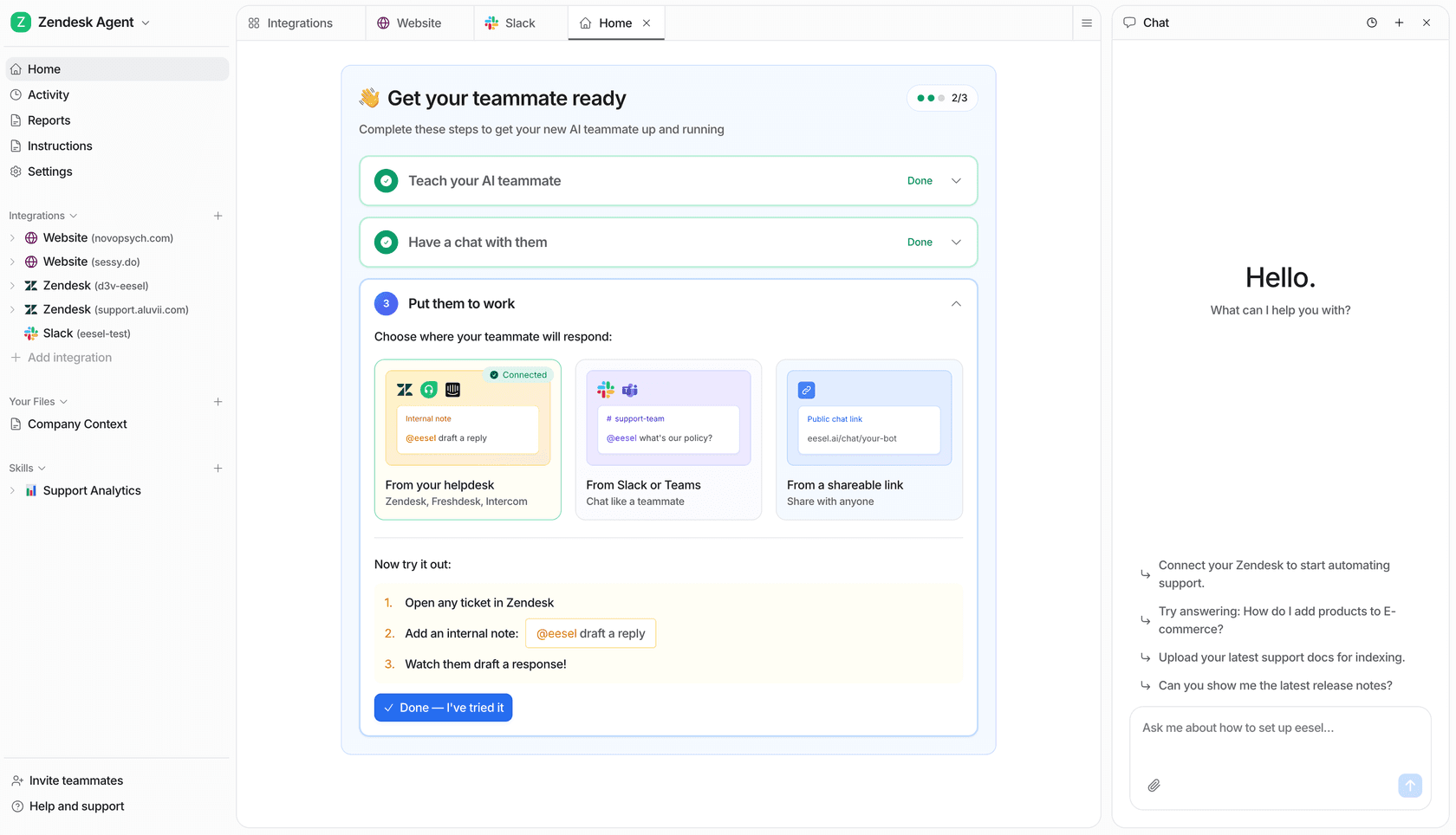
Want frontier-model answers on your support queue without wiring up the API yourself? eesel's helpdesk teammate plugs into your existing helpdesk in minutes, learns from tickets you've already solved, and shows you how it would have answered them before it goes live. Try eesel free.
The bottom line on Claude Fable 5.2
Fable 5.2 is a real upgrade: cheaper than Fable 5.1, faster, and much stronger on long, multistep work. The price cut doesn't change Anthropic's own advice, though. Opus 5.5 is still the default, and Fable 5.2 is what you reach for when Opus runs out of road.
For more on the family, see our Claude Fable 5.1 review, Opus 5.5 pricing breakdown, and Claude Code pricing guide.