


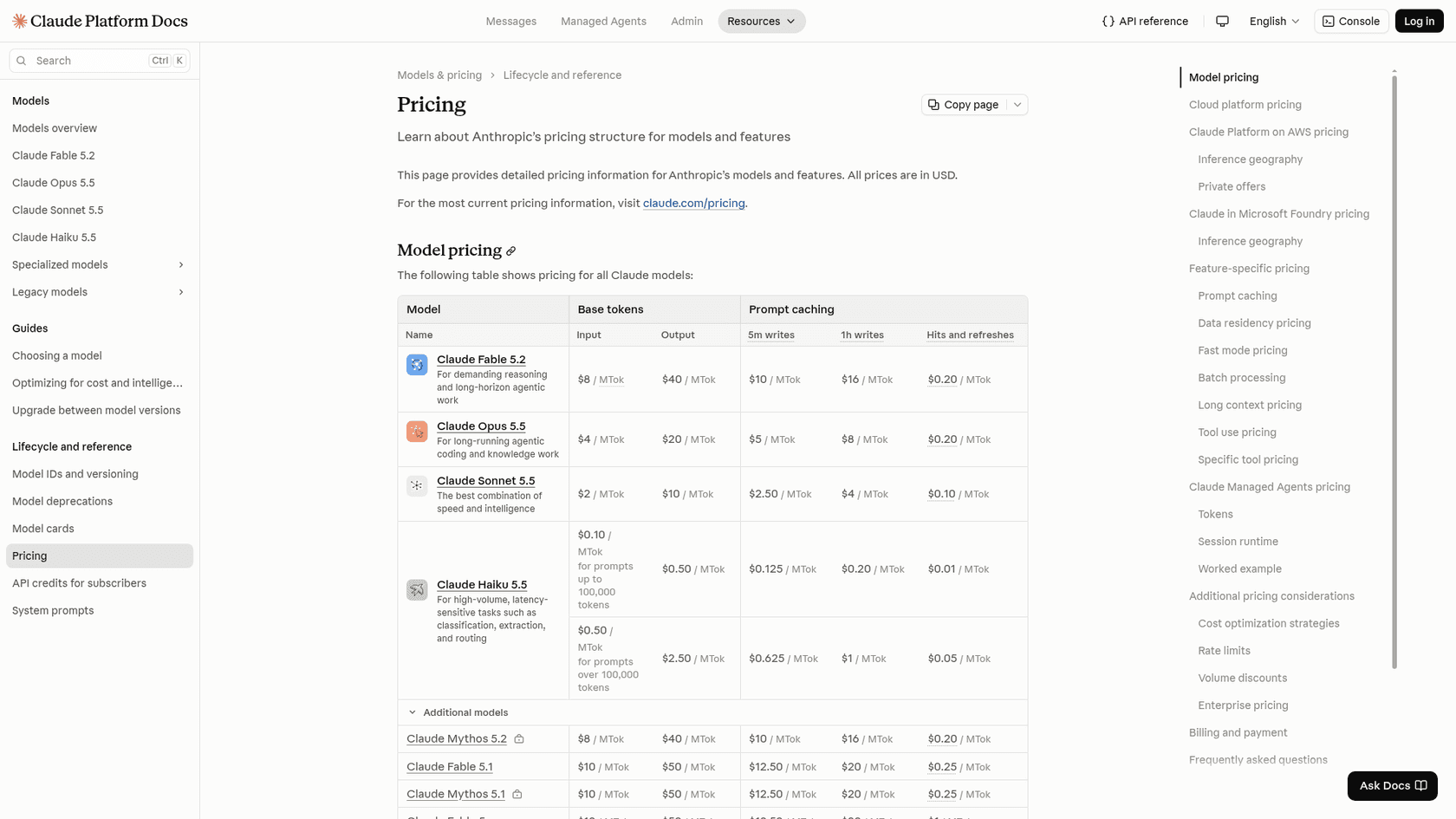
Claude Mythos 5.2 costs $8 per million input tokens and $40 per million output, exactly what Fable 5.2 costs and 20% less than Mythos 5.1. Cache reads are $0.20, batch halves everything, and fast mode doubles it.
My read: the rate card is the easy part. The real price of Mythos 5.2 is getting approved to use it: verification, 30-day data retention, new login rules by December 15, and cloud access that lags approval by about a week. If you aren't a vetted security or biology team, you pay the same for Fable 5.2, or half for Opus 5.5. For support work, eesel runs frontier models on your helpdesk, and with the eesel CLI a coding agent can load your help docs and test answers before launch.
What does Claude Mythos 5.2 cost?
Here is the full rate card from Anthropic's pricing page, released alongside the model on November 9, 2026:
| Meter (per million tokens) | Claude Mythos 5.2 | What it's for |
|---|---|---|
| Base input | $8 | Fresh prompt text the model hasn't seen |
| Output | $40 | Everything the model writes, thinking included |
| 5-minute cache write | $10 | Storing a prompt prefix for short reuse (1.25x input) |
| 1-hour cache write | $16 | Storing it for long sessions (2x input) |
| Cache read | $0.20 | Re-reading a stored prefix (0.025x input) |
| Batch input / output | $4 / $20 | Async jobs, 50% off |
| Fast mode input / output | $16 / $80 | Up to 2.5x faster output |
The model ID is claude-mythos-5-2 on the Claude API, Google Cloud, and Microsoft Foundry, and anthropic.claude-mythos-5-2 on Amazon Bedrock. Specs match Fable 5.2 one for one: 1M context, 128K max output, adaptive thinking that is always on, high as the default effort, and a June 2026 knowledge cutoff.
No seat fee, no plan tier, no minimum. It's billed purely per token, which means your real cost depends on three things: how much fresh text you send, how much the model writes, and how much of your prompt you can serve from cache.
I write a lot of these pricing posts at eesel, and the search behind "Mythos 5.2 pricing" is rarely about the rate card alone. People want to know two things: can I actually get it, and what will a real job cost me? The rest of this post answers both.
Why does Mythos 5.2 cost exactly the same as Fable 5.2?
Because it's the same model. Anthropic's model overview says Mythos 5.2 "has the same specifications and pricing as Claude Fable 5.2." The weights are shared. What differs is the safeguard layer: Fable 5.2 blocks pen testing, exploit generation, binary-based vulnerability scanning, and most research biology, and hands those requests to an older Opus model. Mythos 5.2 lifts those blocks for organizations Anthropic has verified.
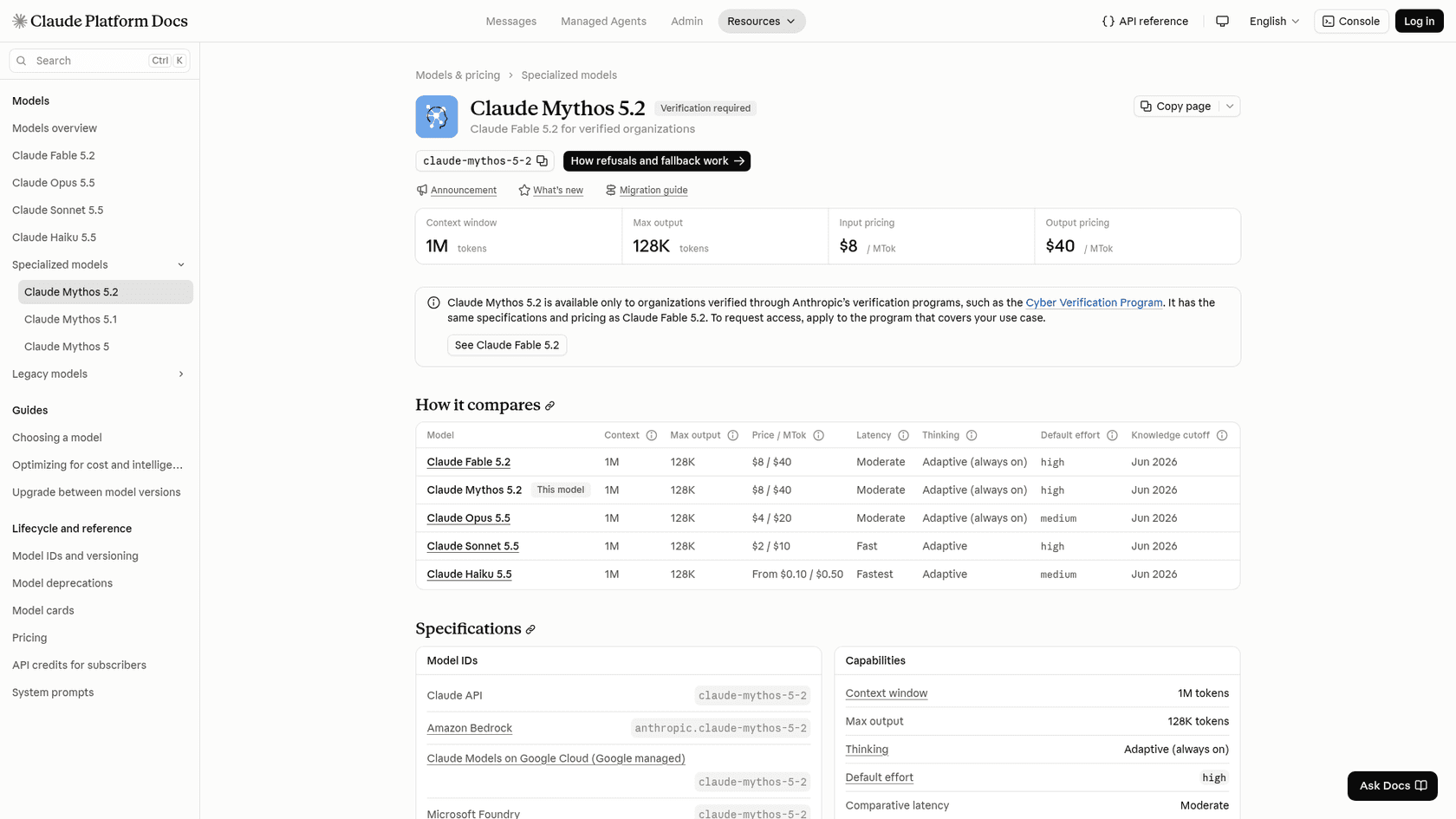
So you aren't choosing between two price points. You're choosing between two permission sets at one price. That has a cost angle people miss: on Fable 5.2, a refused request still counts against your rate limits, and whether a refusal that arrives before any output is billed depends on its category, per Anthropic's refusals docs. Fallback to Opus 4.8 or Opus 5 then runs the request again on a second model. For a security team whose daily work keeps tripping Fable's cyber filters, Mythos avoids that refuse-then-retry loop at no extra per-token cost.
For the full story on what changed in the model itself, my colleague's Mythos 5.2 overview and the Fable 5.2 review cover benchmarks and safety results.
How much cheaper is it than Mythos 5.1?
20% on input and output, and 20% on cache reads. The multipliers didn't change. Anthropic just lowered the base:
| Per million tokens | Mythos 5 | Mythos 5.1 | Mythos 5.2 |
|---|---|---|---|
| Input | $10 | $10 | $8 |
| Output | $50 | $50 | $40 |
| 5-minute cache write | $12.50 | $12.50 | $10 |
| 1-hour cache write | $20 | $20 | $16 |
| Cache read | $1 | $0.25 | $0.20 |
| Batch input / output | $5 / $25 | $5 / $25 | $4 / $20 |
The big structural cut happened one release earlier, when Mythos 5.1 pricing dropped the cache read from 10% of input to 2.5%. Mythos 5.2 keeps that 0.025x multiplier and shaves the base. Anthropic also says the 5.2 generation writes output up to 30% faster, which matters for wall-clock time but not the bill.
One thing that did not change: the tokenizer. Both generations use the tokenizer introduced with Opus 4.7, so the same prompt costs the same number of tokens on 5.1 and 5.2. The 20% saving is a real 20%, not one eaten by token inflation.
There is a catch for Mythos 5.1 users, though. Mythos 5.2 shares one combined rate limit with Mythos 5.1 and Mythos 5, so moving traffic over doesn't give you new headroom. Fable 5.2, by contrast, has its own limit.
What does a real Mythos 5.2 job cost?
Per-token prices are hard to feel. So here is one job priced five ways: a long code-scanning session that sends 2M input tokens, 90% of them cache hits, and gets 200K output tokens back.
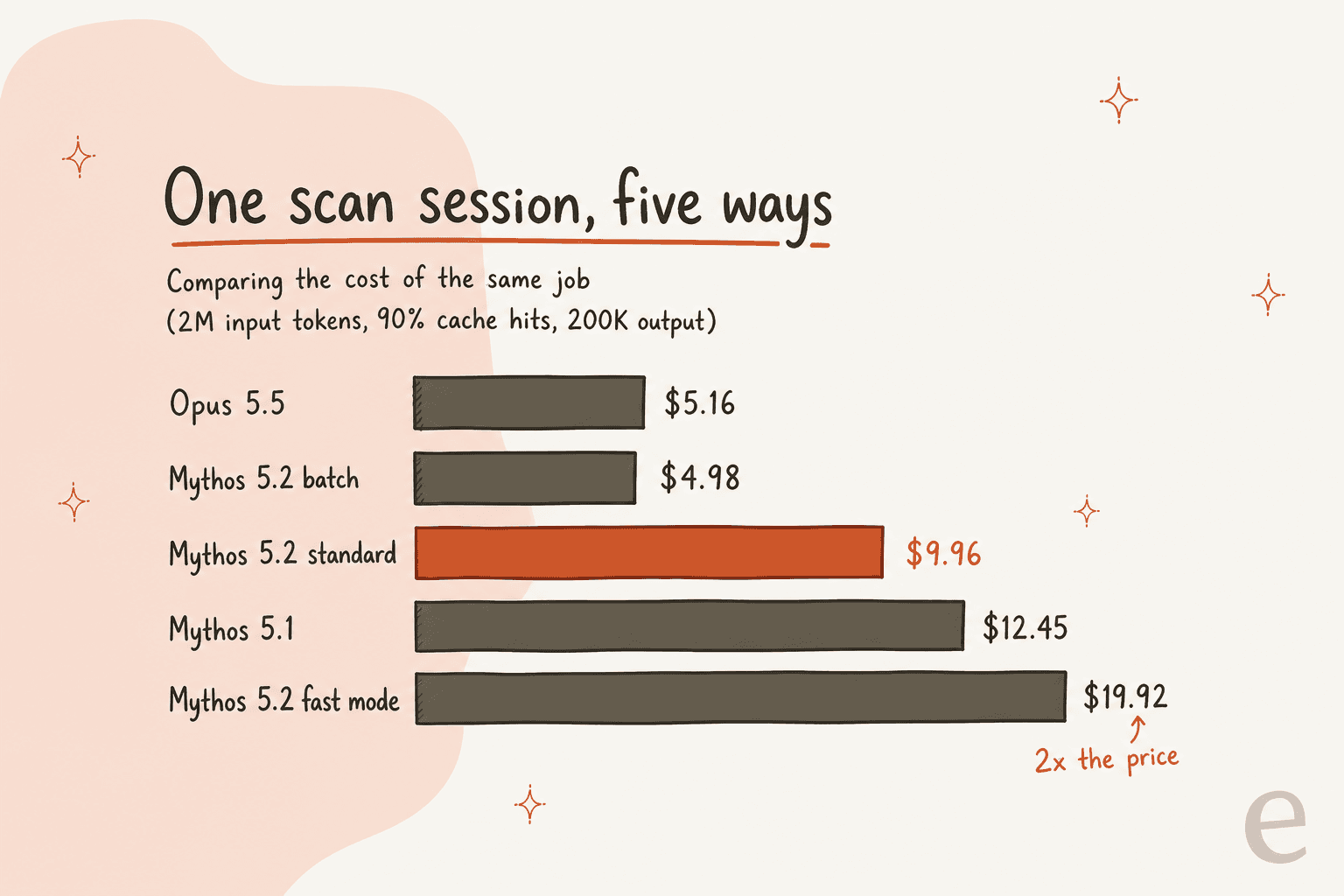
- Mythos 5.2 standard:
$9.96. Output is$8.00of it. - Mythos 5.2 on the Batch API:
$4.98, if the job can wait. - Mythos 5.2 in fast mode:
$19.92, double for faster output. - Mythos 5.1:
$12.45for the same work. - Opus 5.5:
$5.16, the default Anthropic recommends.
Output tokens drive about 80% of that bill. That's why the input cut barely moves the needle on agent work and the output cut does most of the lifting. It's also why effort matters so much: Mythos 5.2 defaults to high, and stepping up to xhigh or max means more thinking tokens billed at $40 per million. Anthropic's own advice in the migration guide is to start at high, since most of the capability gain is already there.
Plug in your own volumes here:
When do batch, fast mode, and US-only inference make sense?
Each modifier stacks on the base rates, and each one has a clear use:
- Batch API (50% off). Overnight scans across many repos, bulk triage of old findings, anything that can wait up to a day. Caching multipliers still apply, so cached reads in a batch job land around
$0.10per million. You can't combine it with fast mode. - Fast mode (2x). Live incident response, where a person is waiting on the model's output. You get up to
2.5xmore output tokens per second, but not a faster first token. It has its own rate limit; the Start, Build, and Scale usage tiers get a default one without asking. On Microsoft Foundry it's a separate model,claude-mythos-5-2-fast. - US-only inference (1.1x). Setting
inference_geo: "us"adds 10% to every meter, including cache reads and fast mode. Teams with data residency rules pay it on everything; for the scan session above, that's$10.96instead of$9.96.
The cheapest Mythos 5.2 bill is a batched, heavily cached job with a short output. The most expensive is a fast-mode session at max effort with US-only routing. The gap between them on the same work is roughly 4x.
What does Mythos 5.2 cost on Claude subscriptions?
There is no separate price. Mythos follows Fable's usage rules, per Anthropic's Cyber Verification Program article, once your organization is approved:
- Pro: Mythos runs only on usage credits. It doesn't draw from the plan's included usage, so credits have to be turned on. See our Claude Pro pricing breakdown for what the plan includes.
- Max and Ultra: Mythos and Fable share one allowance of up to 50% of your weekly limit, not one each. It also counts toward your normal plan limit. After that, it's usage credits or a different model.
- Team and Enterprise: an admin assigns the program to workspaces or a custom role. Enterprise customers can also reach Mythos indirectly through Claude Security, the code-scanning product in public beta.
The Life Sciences program is stricter: it only accepts Team, Enterprise, and API organizations, and Free, Pro, Max, and Ultra plans aren't eligible. Our Claude pricing guide and Claude Code pricing post cover how those plans meter usage in general.
What are the hidden costs of using Mythos 5.2?
This is where Mythos 5.2 differs from every other model on the price list. The token rates are public; the cost of being allowed to pay them isn't on the rate card.
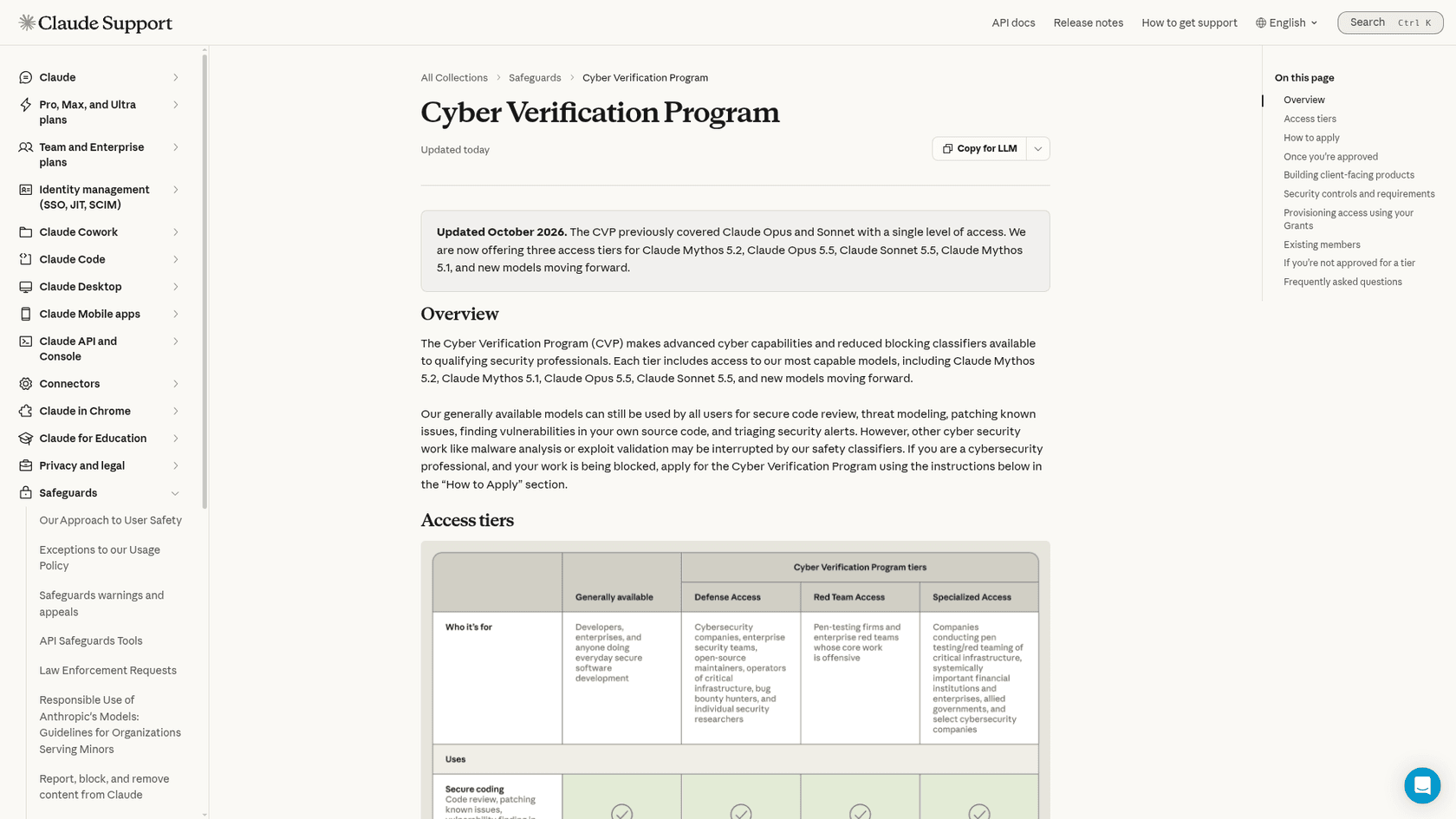
- Verification time. You apply through the Verification Portal for one of three Cyber tiers (Defense, Red Team, Specialized) or register interest in the Life Sciences program. Anthropic aims to answer Cyber applications in about seven business days, and you can't edit an application once sent. Individuals can apply for Defense Access only, and only on a paid plan.
- Cloud lag. Access on Bedrock, Google Cloud, Foundry, and Claude Platform on AWS trails approval by about five business days. If you buy through a committed contract, you also have to accept a private marketplace offer before your discount applies.
- Required data retention. Mythos 5.2 is a "Covered Model" that needs 30-day retention. Requests from a workspace without it return a
400, unless Anthropic has approved zero data retention for you. For a security team handling client code, that's a procurement conversation, not a toggle. - Login changes by December 15, 2026. Defense Access organizations must move to phishing-resistant multi-factor authentication and stop using API keys. Until then, API keys expire every seven days. Anthropic recommends Workload Identity Federation, which is engineering time you should budget for.
- Bedrock limits. On Amazon Bedrock, the Cyber program is only open to customers with a data retention exemption for Fable 5.2 or 5.1 until Enterprise Frontier Safeguards ships. Everyone else on AWS goes through Claude Platform on AWS.
None of these show up as a line item, but together they decide whether the $8 and $40 apply to you at all. The early reaction in the Hacker News launch thread focused on the price cut itself:
"Honestly incredible that they've managed to beat all benchmarks, while making it cheaper. Always happy to see improvements offered at lower costs."

That's fair for Fable 5.2, which anyone can call. For Mythos 5.2, the cut only reaches the teams that clear the steps above.
How does Mythos 5.2 compare with the models you can actually buy?
If you don't qualify for Mythos, here's what the same budget gets you elsewhere in the lineup:
| Model | Input / output (per M) | Cache read | Access |
|---|---|---|---|
| Claude Mythos 5.2 | $8 / $40 | $0.20 | Verified orgs only |
| Claude Fable 5.2 | $8 / $40 | $0.20 | Everyone |
| Claude Opus 5.5 | $4 / $20 | $0.20 | Everyone |
| Claude Sonnet 5.5 | $2 / $10 | $0.10 | Everyone |
| Claude Haiku 5.5 | from $0.10 / $0.50 | from $0.01 | Everyone |
Two things stand out. First, Opus 5.5 has the same $0.20 cache read as Mythos 5.2 at half the base price, so on cache-heavy agent work it's roughly half the bill. Second, Fable 5.2 gives you identical weights and pricing with no approval step, so for anything outside security and biology, Mythos adds nothing you'd pay for.
Outside Anthropic, OpenAI's GPT-6 Cyber is the closest gated rival for security teams, and our GPT-6.1 Sol pricing and Gemini 4 Carbon posts cover the general-purpose alternatives. For the rest of Anthropic's family, the Anthropic API pricing guide has every rate in one place, and Claude alternatives covers options beyond it.
How do you keep a Mythos 5.2 bill down?
Most of the savings come from the same few habits:
- Cache your stable prefix. System prompts, tool definitions, and the codebase snapshot are perfect for the 1-hour cache. At
0.025x, a cache hit costs almost nothing next to fresh input. Our LLM optimization notes walk through prefix design. - Watch the effort setting. Thinking is billed as output at
$40per million. Run an effort sweep starting athighbefore you pay forxhighormaxby default. - Batch what can wait. Nightly scans and backlog triage at half price add up fast.
- Mind subagents. Anthropic notes that subagents can account for a large part of what a session costs when your harness invites delegation. Our Claude Code best practices post covers how to keep that in check.
- Route by task. Send verified-security work to Mythos and everything else to Opus 5.5 or Sonnet 5.5. One gated model doesn't need to handle your whole pipeline.
What should support teams take from Mythos 5.2 pricing?
Mostly that this isn't their model. A helpdesk doesn't need exploit generation, so paying Fable-level rates for Mythos's extra permissions buys nothing. Even Fable 5.2 is overkill for most ticket replies, where the quality of your help articles and how well the agent is tested matter more than the model's ceiling.
That's how I'd think about it after watching how teams actually adopt AI at eesel. eesel is an AI teammate platform where you hire ready-to-work teammates for specific jobs, and the AI helpdesk agent is the one for support. It joins your existing helpdesk, learns from your past tickets and help center, and is simulated against your ticket history before it answers a customer. You don't pick a model, count cache reads, or apply for verification. Our AI teammates explainer and best AI teammates roundup compare the options.
Two customers on Freshdesk show what that looks like in practice:
- Timengo, a Danish secure email and Digital Post company, gets technical support tickets drafted in Danish from about
5,300past tickets and help center articles. In a month, eesel prepared about300Freshdesk tickets, with180draft replies and around260internal notes for the team. - Qontro, an ERP software company, has every Freshdesk ticket arrive with a draft reply and the help articles already linked. It answers from
9,800past tickets and articles, and ran about400knowledge searches across190tickets in a month.
If you want an agent to handle the setup, the eesel CLI lets Claude Code or another coding agent upload approved knowledge like exported help articles and macros, adjust the teammate's instructions, and ask test questions to check the answers before anything goes live. Connecting the helpdesk itself still needs someone with admin access to approve it. Our AI agent CLI post explains the approach, and Freshdesk AI draft replies shows the drafting flow.
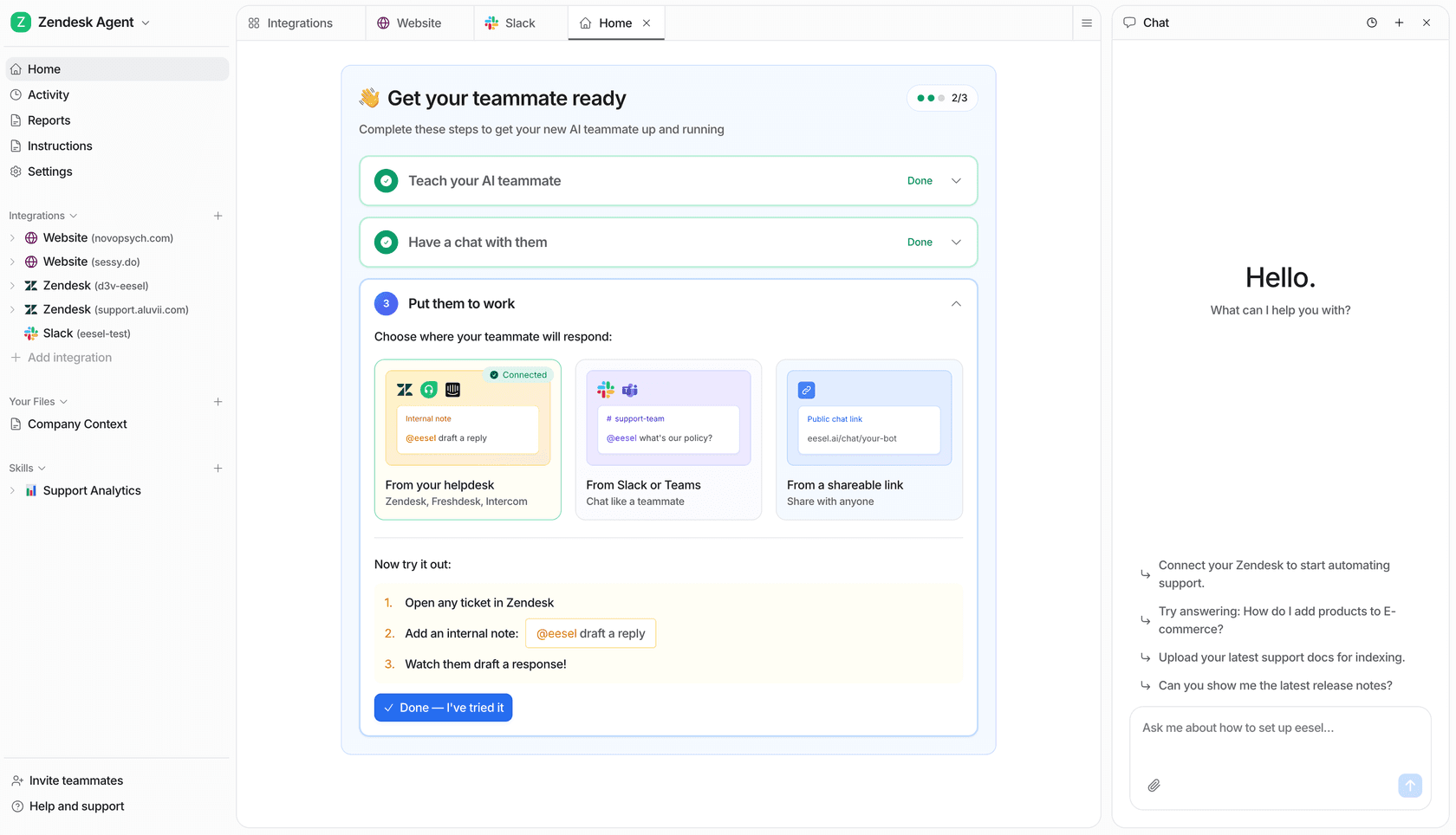
Pricing out frontier models for your support queue? eesel's helpdesk teammate runs on frontier models, plugs into your helpdesk in minutes, and shows you how it would have answered your past tickets before a customer sees a reply. Try eesel free.
The bottom line on Claude Mythos 5.2 pricing
Mythos 5.2 is $8 in, $40 out, $0.20 for cache reads, and the same as Fable 5.2 on every meter. It's 20% cheaper than Mythos 5.1 with the same multipliers, so cache-heavy work stays cheap and output still drives the bill.
The real decision isn't the price. It's whether your work needs Mythos's permissions badly enough to go through verification, retention, and the December login changes. If it does, budget for batch on anything that can wait and keep effort at high until your evals say otherwise. If it doesn't, Fable 5.2 costs the same with no gate, and Opus 5.5 does most jobs for half.