


Claude Fable 5.2 launched on November 9, 2026 at $8 per million input tokens and $40 per million output tokens, a 20% cut from Fable 5.1's $10 and $50. If you run Fable 5.1, switch: it is cheaper, faster, and scores higher on every benchmark Anthropic published. If you run Opus 5.5 at $4 and $20, stay there until your own evals at high effort fall short, because Fable 5.2 costs double per token and early users report it spends far more tokens per task.
That is the pattern I would build around: a frontier model is infrastructure, and the work happens in the layer on top. For support or content jobs, eesel is that layer, with an AI helpdesk teammate and an AI blog writer that run on whichever model is best this month. The eesel CLI also lets a coding agent upload approved knowledge and ask test questions before anything goes live, though the helpdesk connection itself still needs an admin's approval.
What did Anthropic actually release?
Anthropic shipped two models on November 9, Fable 5.2 and Mythos 5.2, and says they are "the same underlying model." Fable carries strong cybersecurity and biology safeguards so it can be available to everyone. Mythos is the lighter-safeguard version, open to organizations in the Cyber and Life Sciences Verification Programs. I covered Mythos 5.1 earlier and Mythos 5.2 has its own write-up.
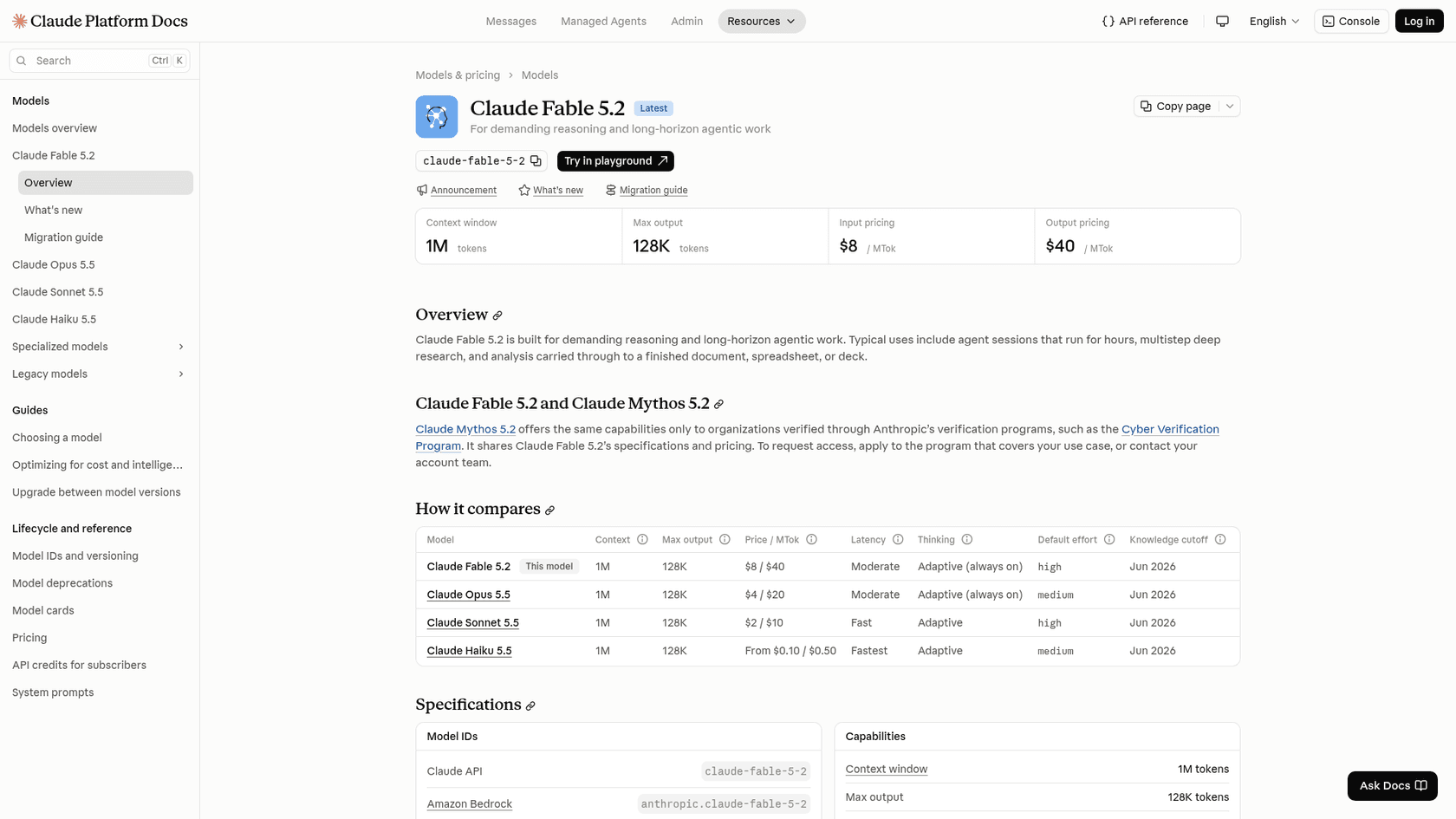
The specs, from the model page:
| Spec | Claude Fable 5.2 |
|---|---|
| API model ID | claude-fable-5-2 (anthropic.claude-fable-5-2 on Bedrock) |
| Released | November 9, 2026 |
| Price per MTok | $8 input, $40 output |
| Cache read / 5m write / 1h write | $0.20 / $10 / $16 |
| Batch API | 50% off input and output |
| Fast mode | $16 input, $80 output, up to 2.5x faster output |
| Context window | 1M tokens |
| Max output | 128K tokens |
| Thinking | Adaptive, always on |
| Default effort | high on the API |
| Knowledge cutoff | June 2026 |
Two more facts that matter for budgets. Fable 5.2 requires 30-day data retention and is not available under zero data retention unless Anthropic expressly authorizes it. And it is not supported on Priority Tier. The full price breakdown lives in my Fable 5.2 pricing guide.
Is Fable 5.2 really cheaper than Fable 5.1?
Per token, yes. Per task, it depends on the effort dial. Here is the sticker comparison from Anthropic's pricing page and migration guide:
| Meter (per MTok) | Fable 5.2 | Fable 5.1 | Opus 5.5 |
|---|---|---|---|
| Input | $8 | $10 | $4 |
| Output | $40 | $50 | $20 |
| Cache read | $0.20 | $0.25 | $0.20 |
| Batch input / output | $4 / $20 | $5 / $25 | $2 / $10 |
My arithmetic on one illustrative job, 1M input tokens and 200K output tokens with no caching: Fable 5.1 is $20, Fable 5.2 is $16, Opus 5.5 is $8. So the sticker favors Fable 5.2 over 5.1 by 20%, and Opus 5.5 over Fable 5.2 by half.
The catch is tokens per task. Anthropic's own chart shows Fable 5.2 doing more with each token at lower effort, but one Hacker News reader dug into the third-party Artificial Analysis numbers and found the opposite at maximum effort:
"Forget about the scores... look at the Cost Per Task. Fable 5.1 was already the most expensive by a good margin, and now Fable 5.2 doubles it! This is with the price cut. The output tokens per task just exploded. From 118k tokens (46k Answer/71k Reasoning) in 5.1 to 274k tokens (81k Answer/192k Reasoning) in 5.2."

Another commenter replied with the fair counterpoint, and it matches how Anthropic frames the model:
"The Artificial Analysis charts are great, but be warned that they show max effort by default. [...] Fable 5.2 on medium looks quite attractive compared to Opus 5.5 high/xhigh. Fable 5.2 on max (the default) looks like a good way to light your money on fire."
My read: Fable 5.2 is a model you have to steer with the effort setting, not leave on maximum. The launch post says Medium is the default in the Claude apps and Claude Code, so the bill you see there is not the Max-effort bill on a chart.
What do the benchmarks say, and how far do I trust them?
Anthropic published a long table. These are the rows that matter for most buyers, all from the launch post, at each model's highest-available effort with safeguards on:
| Benchmark | Fable 5.2 | Fable 5.1 | Opus 5.5 | GPT-6 Astra |
|---|---|---|---|---|
| FrontierCode 2.0 (agentic coding) | 49.1% (Xhigh) | 32.4% | 45.5% | 42.8% |
| FrontierSWE v2 (agentic coding) | 69.9% | 56.3% | 62.3% | 65.5% |
| AutomationBench (business workflows) | 51.4% | 31.4% | 42.5% | 41.4% |
| Terminal-Bench-Science 0.1 | 74.6% | 52.6% | 58.7% | 68.1% |
| Remote Labor Index | 41.3% | 17.9% | 21.3% | 20.8% |
| Humanity's Last Exam (with tools) | 74.2% | 65.6% | 67.7% | 57.2% |
| OSWorld 2.1 (computer use, partial) | 89.3% | 83.5% | 87.2% | 79.5% |
The biggest jumps over Fable 5.1 are robotics (RoboDojo Sim, 27.6% to 64.9%) and the Remote Labor Index, a test of paid freelance-style work. AutomationBench is the one I would watch if you automate business workflows: 31.4% to 51.4%. One row goes against Fable: Gemini 4 Carbon edges it on AutomationBench at 53.9%.
The more useful chart is the one that pairs score with cost. At High effort, Fable 5.2 scores about level with Opus 5.5 at its best, for roughly half the cost, per task, and at Xhigh it reaches the top score Anthropic has tested.
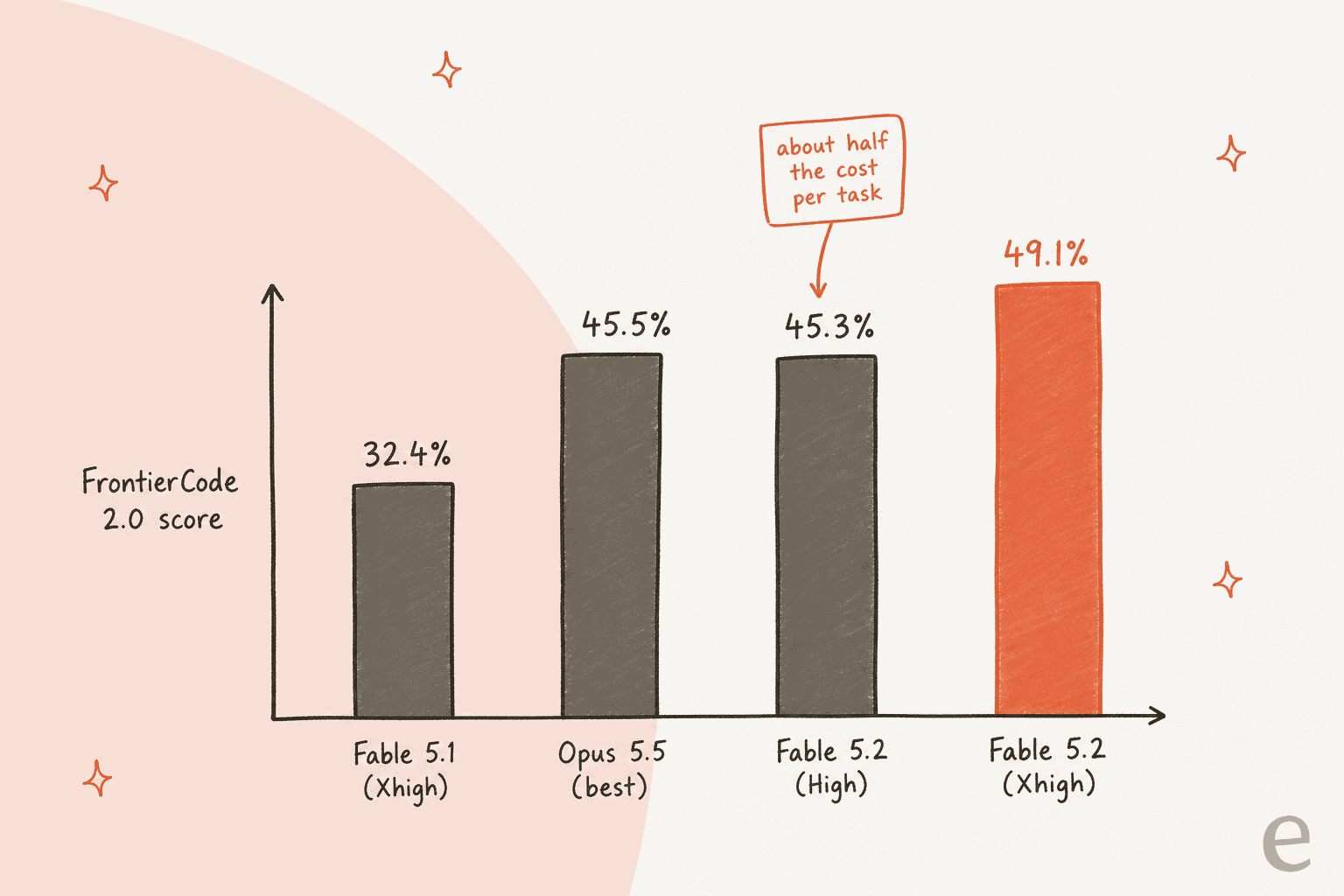
Notice what that says. Fable 5.2 does not beat Opus 5.5 by a mile on this coding test until you pay for Xhigh. The honest summary is that it raises the ceiling and cheapens the path to Opus-level, rather than making everyday work radically better. Treat all of these as vendor-run numbers: Anthropic ran them, safeguards on, and a skeptical commenter noted that the rival Gemini scores use a different harness. That is why I weigh the customer reports below more than the table.
What do the people using it say?
The launch thread on Hacker News passed 750 points and 400 comments in a day. The most useful take I read came from someone who had already used it:
"Fable is good, but you really have to push the ambition of your prompt in order to see proper separation from Opus 5.5. I personally have a hard time telling the difference between Fable 5.2 and Opus 5.5 for ordinary coding tasks."
The same commenter said Fable 5.2 was "way faster and more reliable" than 5.1, which used to hit max-output-token overflows. That lines up with Anthropic's claim of outputs up to 30% faster and with a Cognition engineer's quote that it "says it doesn't know things instead of hallucinating."
The sharpest warning is about subagents. Anthropic's own migration notes say that at xhigh and max effort, Fable 5.2 was seen using subagents to review its own work, which Fable 5.1 did not do, and that subagents can account for a large share of a session's cost. One user lived that:
"Asked it to review a 80 kLoC codebase, something Opus does just fine, while asking it "max 4 subagents". Fable 5.2, like the well-aligned model it supposedly is, decided to spawn 6+ nested subagents, because these aren't subagents, apparently - resulting in 100% of 5hr usage being drained in less than 20min (on $100)."
If you work with Claude Code subagents or multi-agent setups, set explicit limits and watch the first few runs. Anthropic's own named testers sit at the other end: Uber ran a 10 to 12 hour security audit that dispatched about 170 reviewer agents, and Oracle said it generated correct SQL where two other models summed amounts 5 to 8 times too high. I could not find X or Reddit threads with usable first-hand detail on launch day, so the community signal here is Hacker News only.
What breaks if I migrate from Fable 5.1?
Anthropic calls the move "mostly drop-in," and lists four breaking changes:
- The thinking-block prefix check now applies to every account. If your code edits the system prompt, tools, or earlier messages and then sends old thinking blocks back, you get a 400 error. On Fable 5.1 this only hit accounts created on or after August 31, 2026, so older accounts may never have seen it.
- Fable 5.1 cannot read Fable 5.2's thinking blocks. Fable 5.2 reads 5.1's, but not the other way round, so a fallback from 5.2 to 5.1 mid-conversation drops that reasoning and can raise cost.
- The old computer use tool,
computer_20251124, returns a 400 everywhere except Amazon Bedrock. Switch tocomputer_toolset_20260801. - A Fable 5.2 executor needs a Fable 5.2 or Mythos 5.2 advisor in the advisor tool. A 5.1 advisor returns a 400.
Unchanged from 5.1 and worth remembering: adaptive thinking is always on, prefill and forced tool use (tool_choice of any or tool) return a 400, and you should omit temperature, top_p and top_k. Fable 5.2 also has its own rate limit, separate from the pool Fable 5 and 5.1 share, so check it before moving production traffic. One more behavior change: prompt lines like "answer directly without thinking" no longer stop it from thinking at medium effort and above, so lower the effort setting instead. If your max_tokens is small, thinking can use it all before any text appears.
Which model should I actually use?
Anthropic's own advice is to start with Opus 5.5, and move up to Fable or Mythos, or down to Sonnet 5.5 or Haiku 5.5, depending on the scope and complexity of the work. I agree with that, and one HN commenter summed up why the default has moved:
"Anthropic is finally well balanced across models. Meaning: Opus 5.5 is so good that I do not feel Fable FOMO as I did when it was Fable 5/5.1 vs Opus 4.8/5."
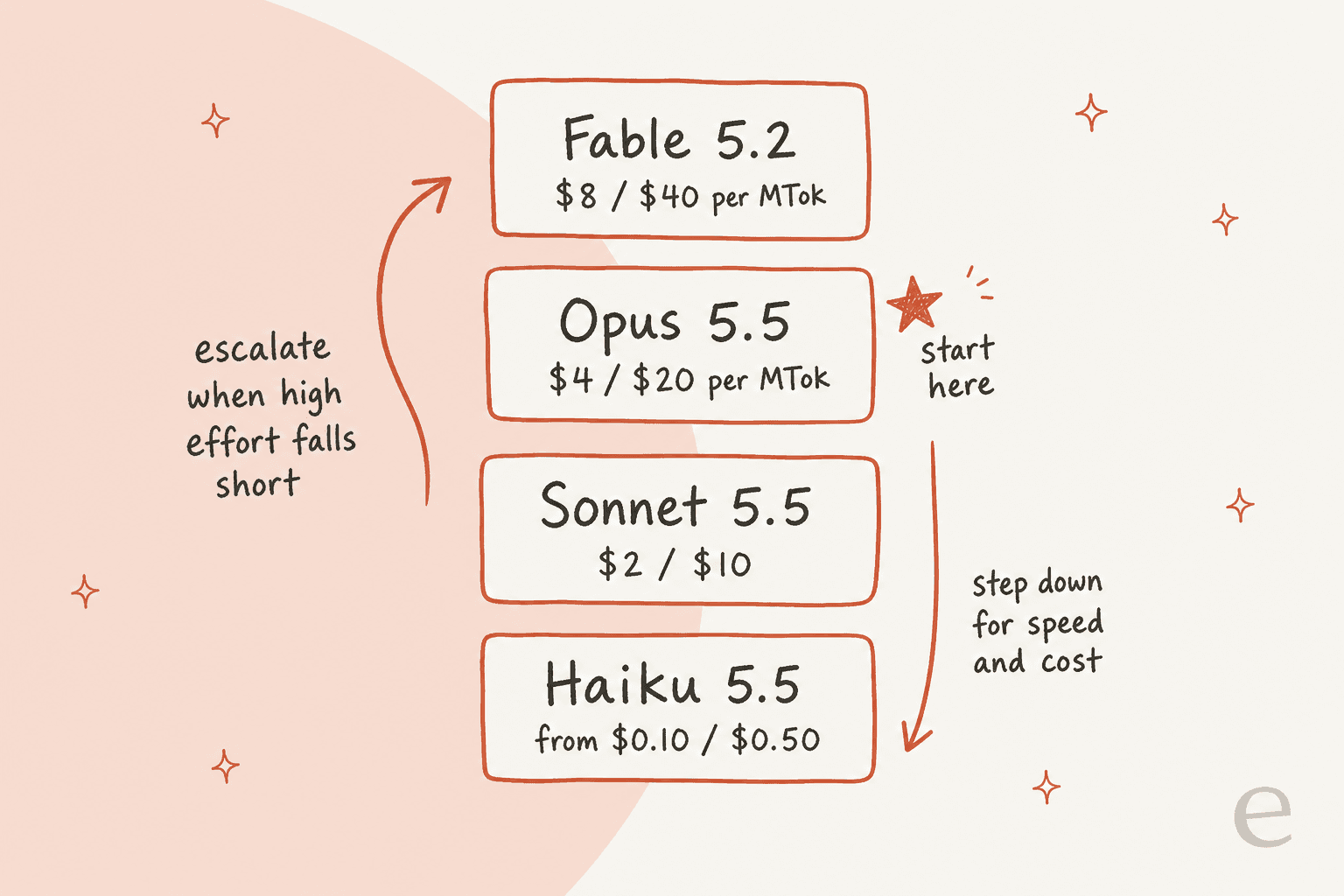
Here is how I would split it:
- You run Fable 5.1 today. Switch, after running the prefix-check test on your own request builder. You get a lower bill per token, faster output, and better scores for one model ID change.
- You run Opus 5.5 and it works. Stay. The price gap is 2x per token, and Opus 5.5 reviewed well on its own. See the Opus 5.5 pricing guide for how the effort dial moves its bill.
- Your Opus 5.5 evals at high effort still fall short. This is the case Fable 5.2 was built for: multi-hour agent runs, deep research, work carried to a finished document, spreadsheet or deck.
- You use Claude Code on a subscription. Try Fable 5.2 at medium effort and watch your usage. My Claude Code model selection notes cover the trade-offs.
- You are choosing between vendors. Compare against GPT-6 Sol and GPT-6 Astra on your own tasks, and read the earlier Opus 5 versus Fable 5 comparison for how the family has shifted.
- You want a support agent or content writer. You are shopping at the wrong layer, which is the next section.
I should say plainly what this review is: I read Anthropic's launch post, model page, pricing and migration documentation, plus the public Hacker News discussion. I did not run my own production workload on it, so where I give a recommendation it comes from those sources, not a personal benchmark.
Is a model the same as a teammate?
No, and this is the angle most Fable 5.2 coverage skips. The model is infrastructure. eesel is the employee. A frontier model has no idea what your product does, cannot see your help center or your last 10,000 tickets, and has no integration into your helpdesk. You do not hire a model, you hire a ready-to-work teammate for a specific job.
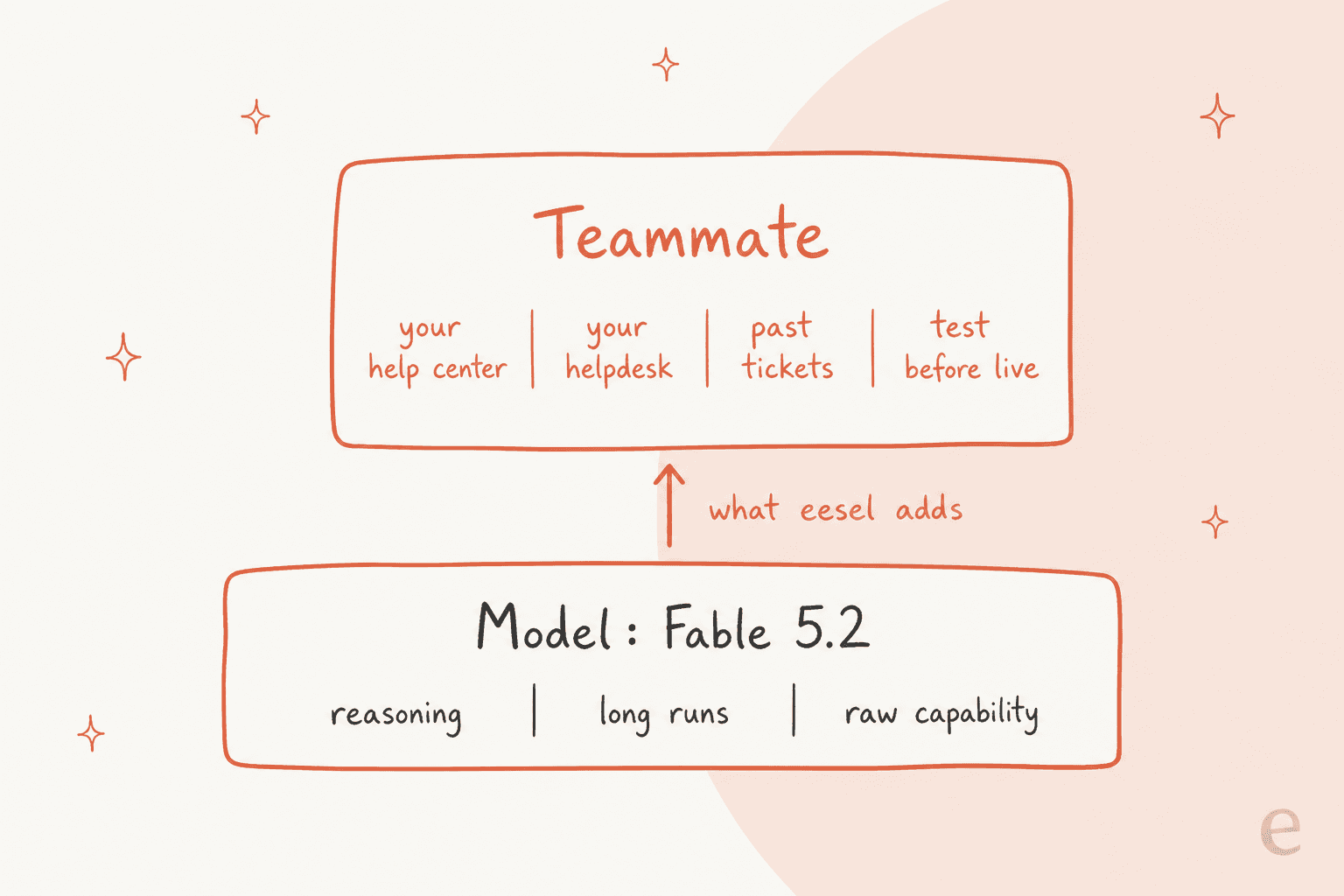
eesel's current roster is an AI helpdesk teammate that joins your existing support queue and an AI blog writer for content. Each arrives with the skills, integrations and company context its job needs. Readers following the wider AI teammates idea will recognize the split: the model changes every quarter, the job description does not.
The proof is in how real teams run it. SE Ranking runs three products on Zendesk with one eesel agent per product, and in one month (8 August to 8 September 2026) its agents handled 4,650 conversations: 2,554 Zendesk tickets and 2,102 live chats, answering from about 16,800 pages of knowledge. SamCart uses separate agents for Freshdesk tickets and website chat, each with its own tone. None of that depended on picking Fable over Opus. It depended on the agent searching the help center first, handing off refunds and hard cases to a person, and being measurable in the helpdesk. That is also what keeps AI resolution rate honest and prevents AI hallucinations in support.
The eesel CLI is where a frontier model like Fable 5.2 becomes useful to that teammate. A coding agent such as Claude Code can drive the same workspace from a terminal: upload exported help articles and macros, adjust the agent's instructions, and ask test questions to check the answers before they reach a customer. The helpdesk connection still needs someone with admin access to approve it, and uploaded knowledge is not "ready" until the test answers look right. If you want the wider picture, see Claude for customer support, the best AI customer support agents, and the cost view in AI customer service cost.
Try eesel
If the real question behind your Fable 5.2 research is "which model should run my support," the better question is which teammate to hire. eesel plugs an AI helpdesk teammate into your Zendesk, Freshdesk or Gorgias queue, learns from your help center and past tickets, and lets you simulate it on historical tickets before it replies to a real customer. Developers who want to drive that from code can use the eesel CLI, and the model underneath can change without you rebuilding anything. You can try eesel for free.
Frequently Asked Questions
Is Claude Fable 5.2 worth it?
How much does Claude Fable 5.2 cost?
What is the Claude Fable 5.2 model ID?
claude-fable-5-2 on the Claude API, Microsoft Foundry and Google Cloud, and anthropic.claude-fable-5-2 on Amazon Bedrock. Claude Mythos 5.2 is the same model with lighter safeguards, under the ID claude-mythos-5-2.