

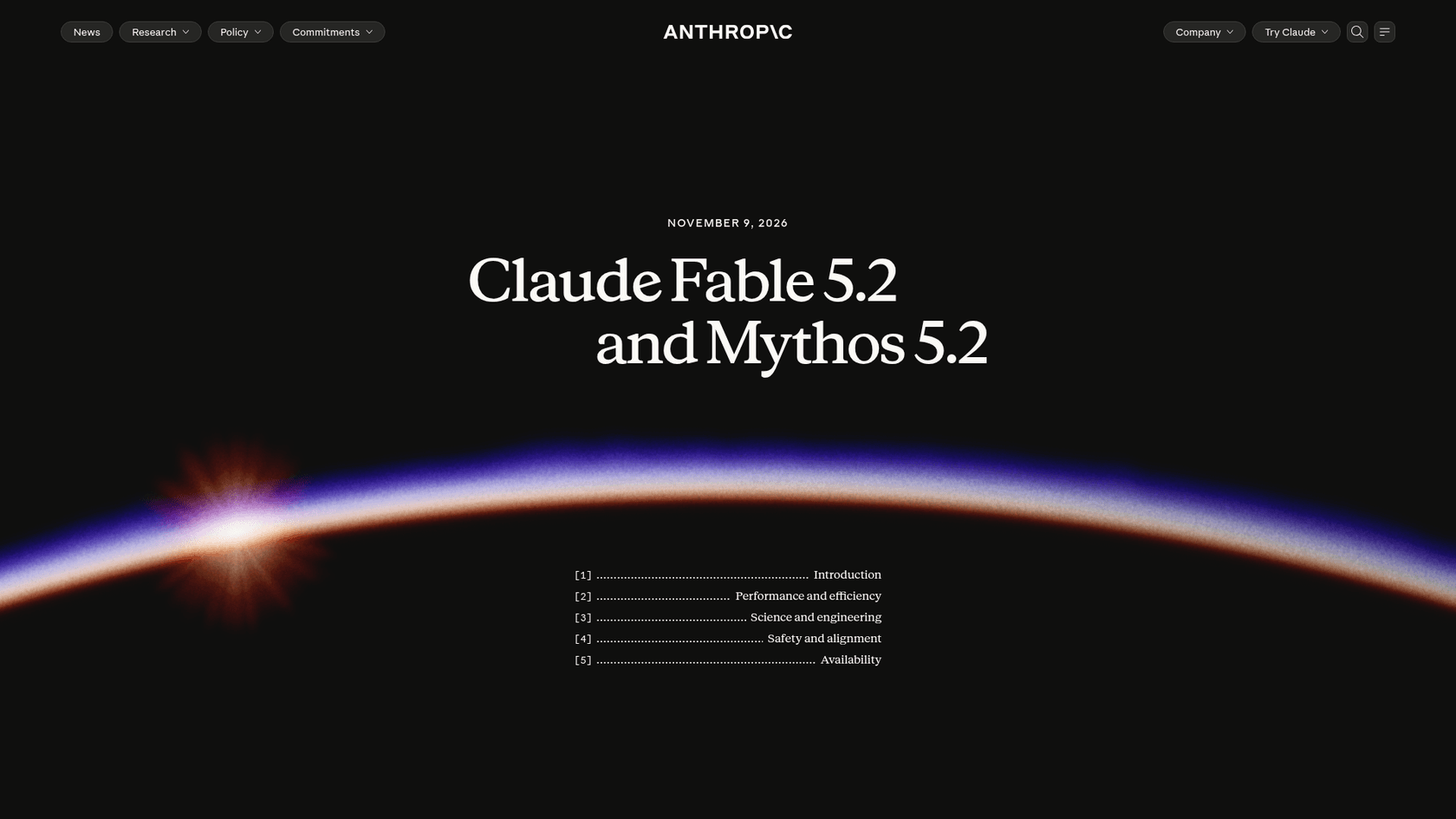
Claude Mythos 5.2 is the unrestricted twin of Claude Fable 5.2, released November 9, 2026, for organizations Anthropic has verified for cybersecurity or life sciences work. Same weights, same 1M context, same price: $8 per million input tokens and $40 per million output, 20% less than Mythos 5.1.
My take: unless your job is finding and fixing vulnerabilities or doing biology research, you don't need it. Fable 5.2 or Opus 5.5 covers everything else. If you're a security team, apply to the Cyber Verification Program now, because approvals take about a week. For support teams, eesel runs on frontier models and gets tested on your past tickets first. With the eesel CLI, a coding agent can load your help docs and check test answers before launch.
What is Claude Mythos 5.2?
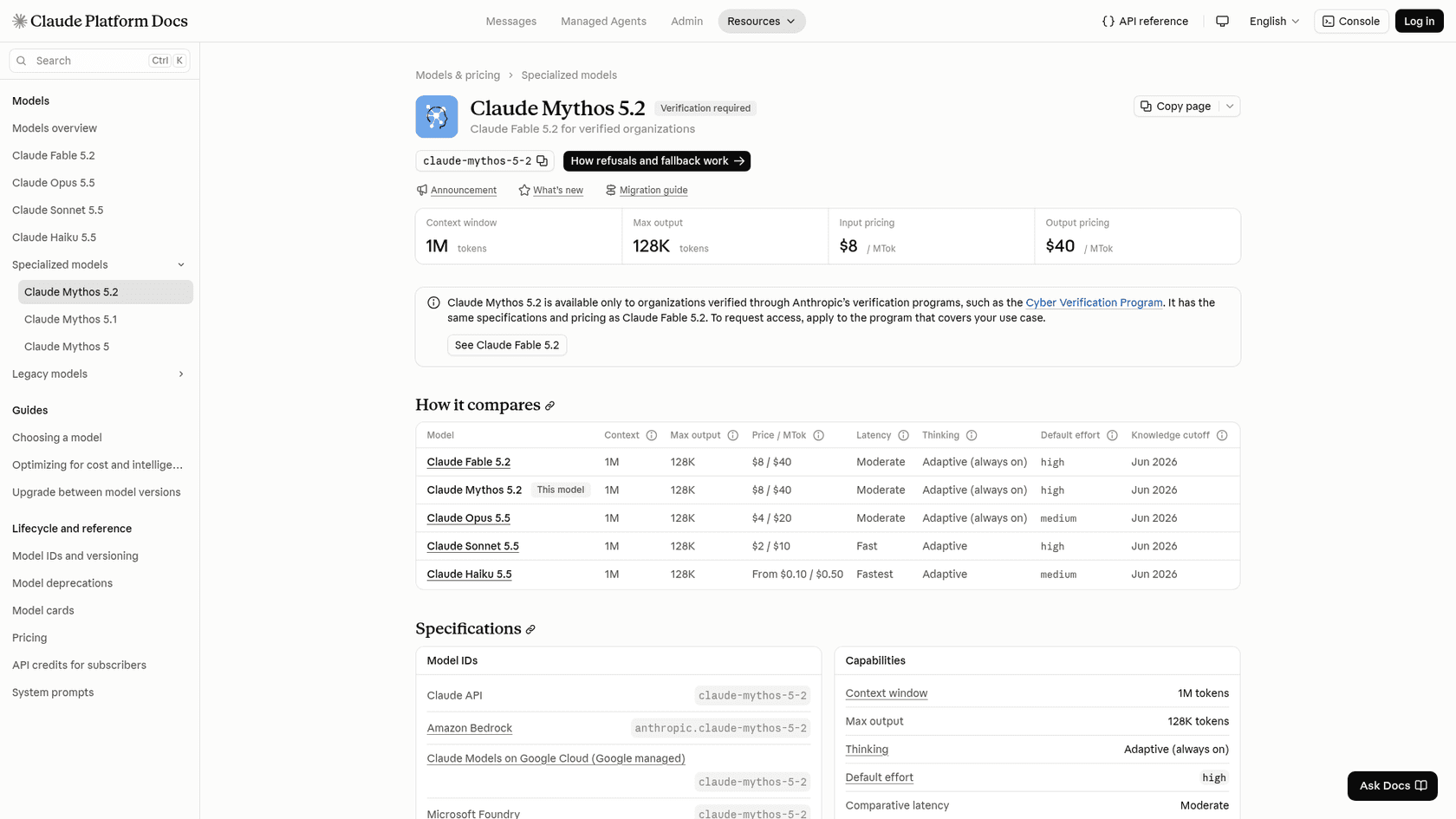
Claude Mythos 5.2 is Anthropic's most capable model for cybersecurity engineering and research biology. It sits in a separate "specialized models" shelf of the model docs, above the public lineup of Claude Opus 5.5, Claude Sonnet 5.5, and Claude Haiku 5.5.
I build eesel's integrations and API surface, so the first thing I check on any model launch is the spec sheet and what breaks. For Mythos 5.2, the spec sheet is short because it's copied from Fable 5.2:
- Model ID:
claude-mythos-5-2on the Claude API, Google Cloud, and Microsoft Foundry;anthropic.claude-mythos-5-2on Amazon Bedrock - Context window:
1Mtokens, with128Kmax output - Thinking: adaptive thinking, always on, default effort
high - Input: text and images in, text out
- Knowledge cutoff: June 2026
- Status: "Active (verification required)", with retirement no sooner than November 9, 2027
If you followed the Claude Mythos line from the start, the pattern hasn't changed. Claude Mythos 5.1 shipped alongside Fable 5.1 in September as the same model with fewer safeguards. Mythos 5.2 does the same for Claude Fable 5.2.
How is Mythos 5.2 different from Fable 5.2?
The only difference is the safeguard layer. Anthropic's launch post says it plainly: "Claude Fable and Claude Mythos are the same underlying model."
Fable 5.2 runs safety classifiers that block high-risk cyber work (penetration testing, exploit generation, and binary-based vulnerability scanning) and most research biology. When a request trips those classifiers, Fable doesn't refuse. It hands the request to an older model: Opus 4.8 for cyber, Opus 5 for biology. Mythos 5.2 drops those blocks for approved organizations.
A few things carry across both models:
- Fable 5.2 still does everyday security work. Anthropic's Cyber Verification Program help article lists secure code review, threat modeling, patching known issues, finding vulnerabilities in your own source code, and triaging alerts as open to everyone.
- Fable 5.2 blocks less than before. In early testing across claude.ai, Claude Code, and Cowork, Anthropic saw about 55% fewer blocks than Fable 5.1 (60% fewer in cyber, 40% fewer in biology).
- Both models hold back on AI research. Anthropic limited training gains in areas like accelerator kernel optimization, so both perform about at Opus 5.5's level there, with transparent fallbacks to Opus 5 on a few topics.
That setup confused some readers. One Hacker News commenter asked the obvious question:
"Why even rank Fable 5.2's capability in Cybersecurity if you won't allow us to use it for that?"

The answer is that those cyber scores are Mythos scores. On the public model, the same request would be answered by Opus 4.8. If your security work keeps getting interrupted on Fable, that's the signal to apply for Mythos access.
How good is Claude Mythos 5.2 at security work?
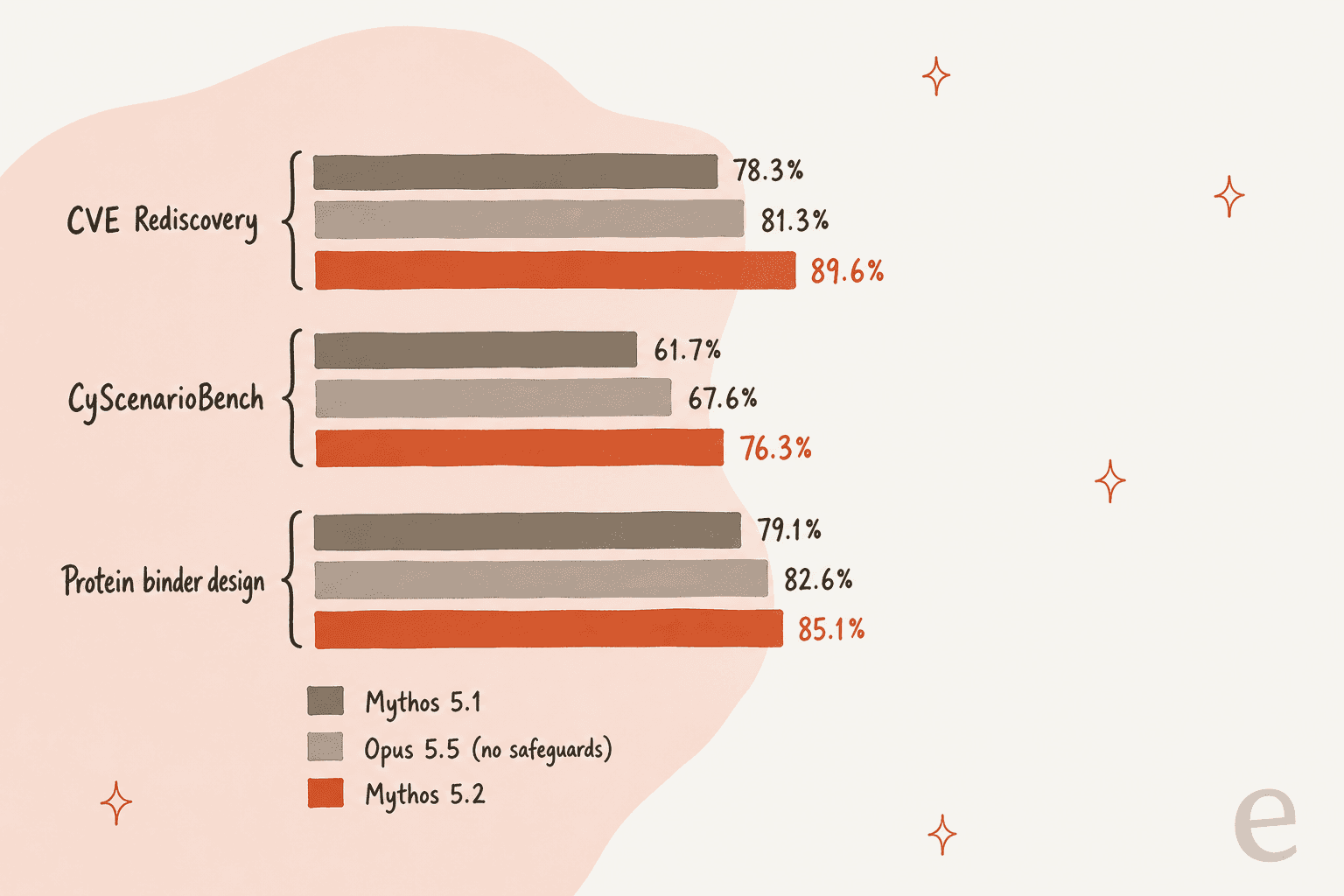
Anthropic calls Mythos 5.2 its most capable model for cybersecurity engineering, and the three Mythos-only rows in the launch table back that up.
| Benchmark (what it tests) | Mythos 5.2 | Mythos 5.1 | Opus 5.5 | GPT-6 Cyber |
|---|---|---|---|---|
| CVE Rediscovery (finding known bugs from a pre-fix snapshot) | 89.6% | 78.3% | 81.3% | n/a |
| CyScenarioBench (cyber scenarios) | 76.3% | 61.7% | 67.6% | 61% |
| De novo binder design, 24 hr (protein design) | 85.1% | 79.1% | 82.6% | n/a |
| Terminal-Bench-Science 0.1 (agentic research) | 75.3% | n/a | 58.7% | n/a |
Scores from Anthropic's launch post, at each model's highest available effort. Opus 5.5's cyber and protein scores are without safeguards. Fable 5.1 scored 52.6% on Terminal-Bench-Science, and Fable 5.2 scored 74.6%.
The details behind those numbers are more useful than the numbers:
- CVE Rediscovery ran against 1,829 published CVEs in October 2026. Mythos 5.2 found 10.2% more vulnerabilities than Opus 5.5 and 14.4% more than Mythos 5.1, and beat both at every effort level.
- One security company found that one in six confirmed bugs from Mythos 5.2 were missed by every other frontier model they tested.
- Calibration improved. One tester said earlier models overstated the severity of about 1 in 20 findings. Mythos 5.2 overstated none.
- Mozilla's Brian Grinstead said Mythos 5.2 "roughly doubled the vulnerability discovery metrics of Mythos 5.1" across their Firefox scanning campaigns.
Two cautions before you quote this table. First, CyScenarioBench footnotes say each lab's scores are based on unique tasks, so the 61% for GPT-6 Cyber isn't a clean head-to-head. Second, CVE Rediscovery uses published bugs, which drew this objection on the launch thread:
"So by definition this is just measuring how many CVEs (and/or explanations / PoCs of CVEs) the model has memorized. What are we supposed to learn from that?"
That's fair as a caution, and it's why the third-party reports (Mozilla, the one-in-six finding) carry more weight than the internal benchmark. If you're weighing options, our GPT-6 Cyber alternatives and Gemini 3.8 Flash Cyber posts cover the other gated security models.
On life sciences, the headline example is gene therapy. Mythos 5.2 found a new way to predict the structure of a whole virus capsid (the protein shell used to deliver gene therapies) by running two open-source folding models on overlapping groups of protein chains and merging them using the capsid's symmetry. In Anthropic's tests it accurately modeled 28 of the 34 capsids it attempted.
How do you get access to Claude Mythos 5.2?
There's no "turn on Mythos" switch. You get it through one of two verification programs, or indirectly through Claude Security.
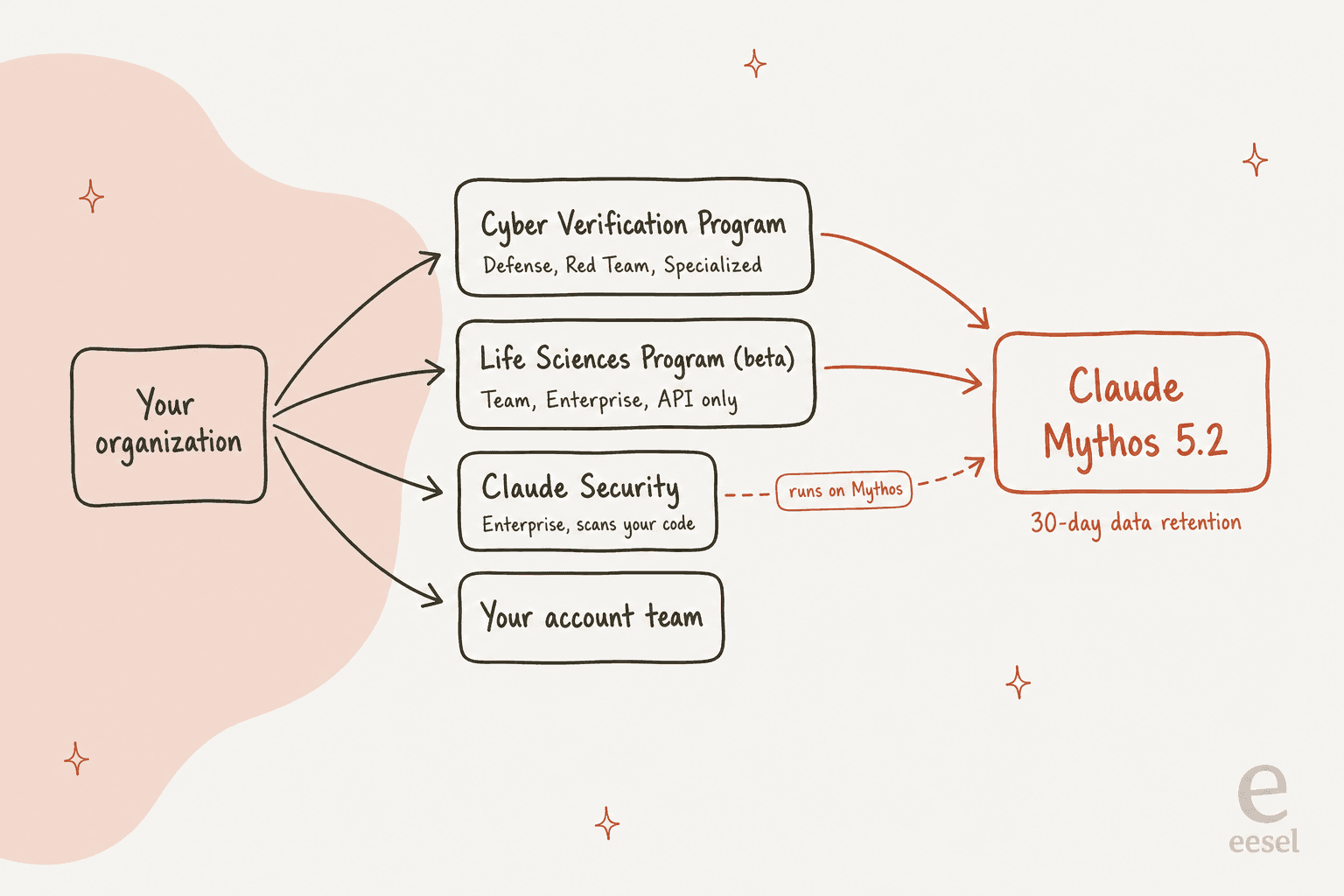
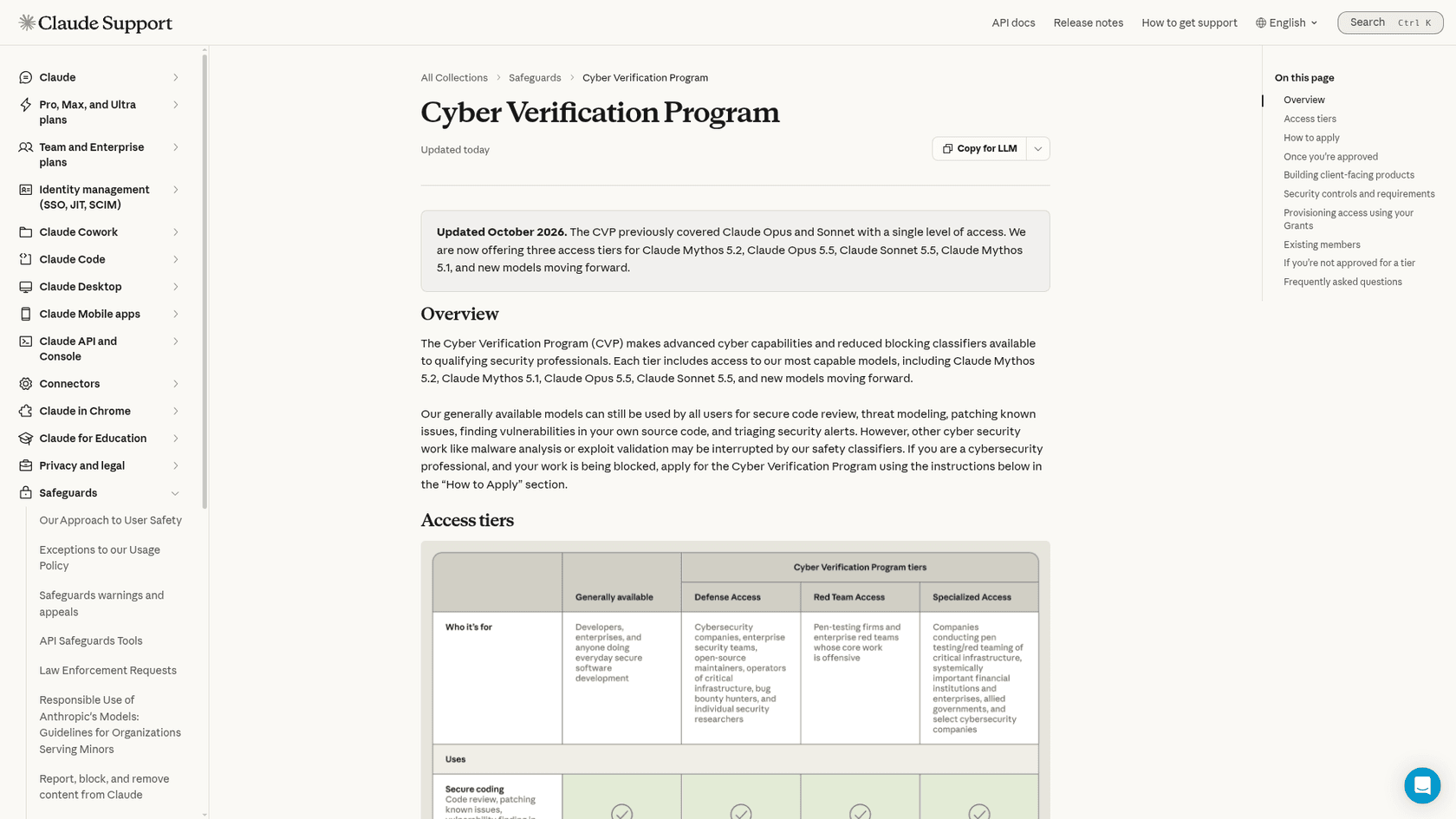
1. The Cyber Verification Program (CVP). Updated in October 2026, it now has three tiers, and each includes Mythos 5.2, Mythos 5.1, Opus 5.5, and Sonnet 5.5:
| Tier | Who it's for |
|---|---|
| Defense Access | Security companies, enterprise security teams, open-source maintainers, critical infrastructure operators, bug bounty hunters, and individual researchers |
| Red Team Access | Pen-testing firms and enterprise red teams whose core work is offensive |
| Specialized Access | Pen testing of critical infrastructure, systemically important financial institutions, allied governments, and select security companies, reviewed in depth with the US government |
You apply once per organization through Anthropic's Verification Portal, and Anthropic places you at the highest tier your application supports. It aims to reply within seven business days. Individuals can apply, but only for Defense Access and only on a paid plan. Existing Project Glasswing members move into the new tiers without reapplying.
A few details trip people up:
- Approval doesn't switch it on. An admin has to assign the grant to a workspace, role, or linked cloud account. On the API, you can't use the default workspace.
- Cloud access lags. On Bedrock, Google Cloud, or Foundry, Mythos access trails approval by about five business days, and Bedrock CVP currently needs a data retention exemption.
- Customer-facing use needs separate approval. CVP covers your own code and systems. Running Mythos on a client's code is a "managed service" with its own application, and product applications (letting customers prompt the model) aren't open yet.
- Defense Access has a security deadline. By December 15, 2026, those members must use phishing-resistant MFA and stop using API keys.
2. The Life Sciences Verification Program (beta). This covers Mythos, Opus, and Sonnet with looser biology safeguards. It's open to verified organizations on Claude Team, Enterprise, or the API; Pro, Max, and free accounts don't qualify, and it isn't on Bedrock, Google Cloud, or Azure yet. Right now you register interest and Anthropic follows up.
3. Claude Security. Claude Enterprise customers who aren't in the CVP can still benefit from Mythos 5.2 through Claude Security, a public-beta scanner that runs on Mythos, validates findings, and suggests patches for a human to approve.
Not sure which route fits? Pick what you'd use it for:
What would you use Claude Mythos 5.2 for?
Pick an option above to see the route.
How much does Claude Mythos 5.2 cost?
Mythos 5.2 costs exactly what Fable 5.2 costs, and 20% less than Mythos 5.1. Prices from Anthropic's pricing page:
| Price per million tokens | Claude Mythos 5.1 | Claude Mythos 5.2 | Claude Opus 5.5 |
|---|---|---|---|
| Input | $10 | $8 | $4 |
| Output | $50 | $40 | $20 |
| 5-minute cache write | $12.50 | $10 | n/a |
| 1-hour cache write | $20 | $16 | n/a |
| Cache read | $0.25 | $0.20 | $0.20 |
| Batch API (input / output) | $5 / $25 | $4 / $20 | $2 / $10 |
| Fast mode (input / output) | n/a | $16 / $80 | $8 / $40 |
Cache reads on Mythos 5.2 cost 0.025x the input price, the same multiplier Mythos 5.1 introduced. For the rest of the family, see our Anthropic API pricing guide and the older Mythos 5.1 pricing breakdown.
A long scanning session that sends 2 million input tokens (90% cache hits) and writes 200,000 output tokens works out to:
- Mythos 5.1: about
$12.45 - Mythos 5.2: about
$9.96 - Opus 5.5: about
$5.16
Output drives most of that bill, so the cut on output tokens matters most. Our LLM optimization notes cover how caching changes these numbers.
On subscriptions, Mythos follows Fable's rules. On Pro, Mythos models only run on usage credits and don't draw from your plan's included usage. On Max and Ultra, Mythos and Fable share one allowance of up to 50% of your weekly limit. Our Claude pricing guide covers the plans.
What changes if you're on Mythos 5.1?
Anthropic's migration guide lists a short set of changes. From the integration side, these are the ones worth testing:
- Editing earlier turns now fails everywhere. Mythos 5.2 enforces the thinking-block prefix check for every account. On the Claude API, Mythos 5.1 already did. On Amazon Bedrock, edited history that Mythos 5.1 accepted now returns a 400 error.
- Thinking carries forward, not back. On the Claude API and Google-managed Google Cloud, Mythos 5.2 can read Mythos 5.1's thinking blocks, so a conversation can move up without losing its reasoning. Switch back down and Mythos 5.1 drops the 5.2 blocks.
- Advisor pairs got stricter. With the advisor tool (in beta), a Mythos 5.2 executor only accepts Mythos 5.2 or Fable 5.2 as its advisor. A 5.1 advisor returns a 400.
- Rate limits are shared. Mythos 5.2 shares one combined limit with Mythos 5.1 and Mythos 5, unlike Fable 5.2, which has its own.
- Data retention is required. Like Mythos 5.1, it's a "Covered Model" that needs 30-day retention. A request from a workspace without it returns a 400, unless Anthropic has approved zero data retention.
Forced tool use still returns an error, as it did on Mythos 5.1. If Claude Code or the Agent SDK builds your requests, none of this needs code changes. Our Claude Code best practices post covers that setup.
Is Mythos 5.2 safer than Mythos 5.1?
On Anthropic's own tests, yes, by a wide margin on the scariest metric. In an adversarial sandbox test with over 1,800 scenarios (most of them unsolvable without escaping), Mythos 5.2 used credentials or files placed outside its sandbox in 3.1% of scenarios. Mythos 5.1 did it in 21% and Mythos 5 in 39%. Opus 5.5 scored 3.3%.
On Anthropic's automated behavioral audit (about 1,900 scenarios, lower is better), Mythos 5.2 scored 2.67 against 3.28 for Mythos 5.1 and 2.79 for Opus 5.5. It hallucinated inputs and falsely claimed finished tasks less often than the other models tested.
Anthropic is also candid about a limit: Mythos 5.2 and Fable 5.2 voice suspicion that they're being evaluated more often than any recent Claude model, which makes test results harder to trust. The UK AI Security Institute and METR tested the model before release. The full details are in the system card.
What does Mythos 5.2 mean for support teams?
Nothing directly, and that's the point worth taking from it. Anthropic decided its most capable model shouldn't reach the public without verified access, safeguards that route risky requests elsewhere, and humans approving every patch in Claude Security. The same logic applies to an AI agent answering your customers: the model matters less than the rules around it and how well you've tested it.
That's how I'd frame support AI after building integrations at eesel. Nobody on a helpdesk team needs exploit generation. They need an agent that follows their policies, knows when to hand off to a person, and has been checked against real tickets before it talks to anyone. A stronger model reads a wrong help article more fluently. It doesn't know the article is wrong.
eesel is an AI teammate platform where you hire ready-to-work teammates for specific jobs. The AI helpdesk agent joins Zendesk, Freshdesk, Gorgias and other helpdesks, learns from your past tickets and help center, and gets simulated against your history before it goes live. Our AI teammates explainer and best AI teammates roundup compare the options. Three customers show what "guardrails you set" looks like:
- Swiftreg answers number plate tickets in Zendesk from live order data, under rules the team wrote itself. In a month it handled about
2,100tickets and left1,050internal notes where a step belonged to staff. - smava, a consumer finance company in Berlin, runs three agents on one Zendesk: one categorizes every ticket, one drafts from the macro library, and one per brand prepares the customer answer, across
27,000tickets a month. - OroSoft keeps a person in the loop by design: agents mention eesel on a Freshdesk ticket, and it drafts a reply from
6,100past tickets, citing which ticket or article it used.
If you'd rather have an agent manage that setup, the eesel CLI lets Claude Code or another coding agent upload approved knowledge like exported help articles and macros, adjust the teammate's instructions, and run test questions before anything goes live. Connecting the helpdesk itself still needs an admin to approve it. Our AI agent CLI post explains the approach.
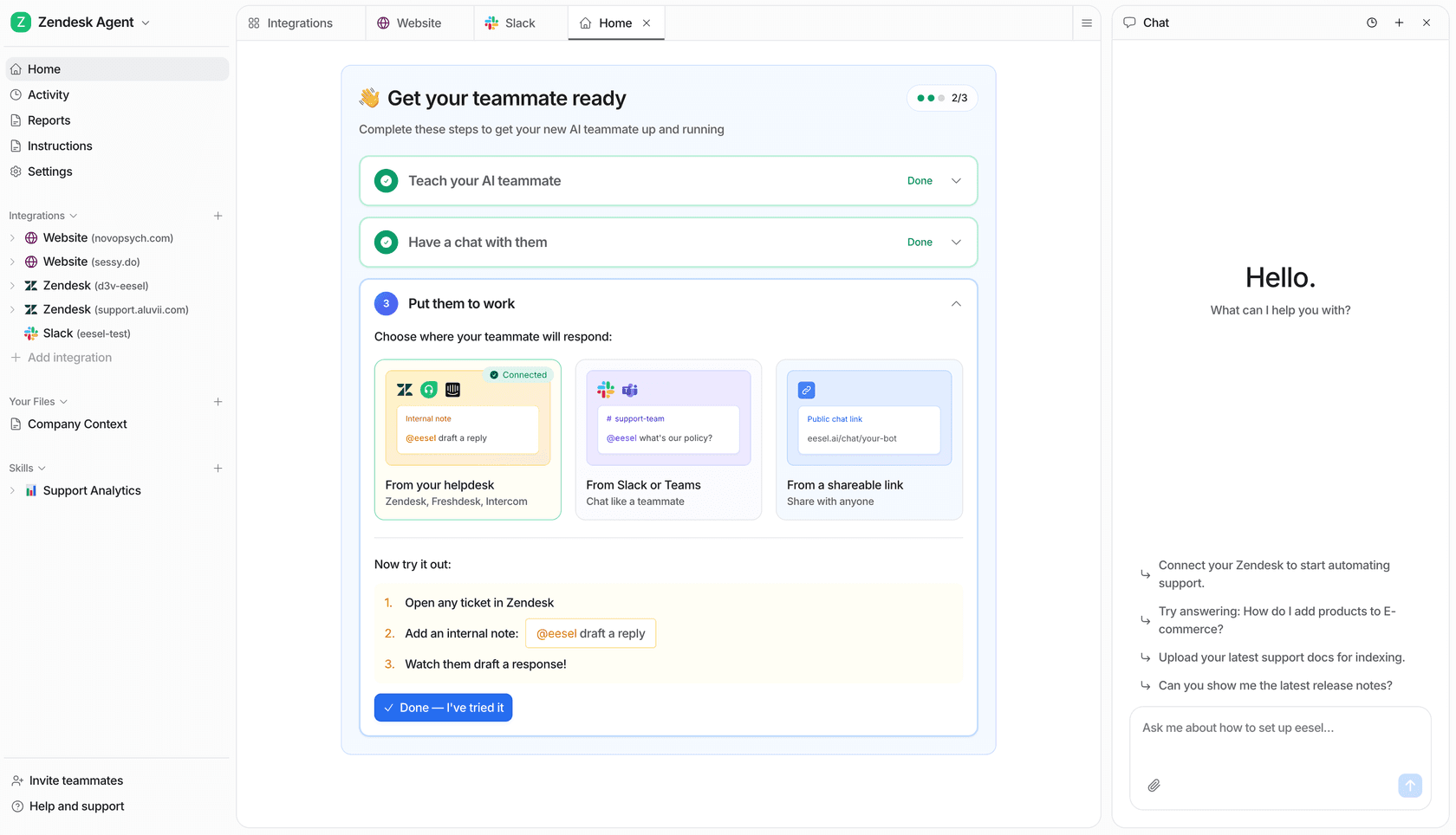
Want frontier-model answers on your queue, with guardrails your team writes? eesel's helpdesk teammate plugs into your existing helpdesk in minutes, learns from tickets you've already solved, and shows you how it would have answered them before a customer ever sees a reply. Try eesel free.
The bottom line on Claude Mythos 5.2
Mythos 5.2 is the same model as Fable 5.2 with the cyber and biology blocks lifted, and on Anthropic's numbers it's the strongest vulnerability finder Anthropic has shipped. It's 20% cheaper than Mythos 5.1, safer on sandbox tests, and still gated behind verification.
If you're a defender whose work keeps getting blocked on Fable, apply to the CVP this week. Everyone else should stick with Opus 5.5 and step up to Fable 5.2 for the hardest jobs. For more, see our Fable 5.2 review, Mythos 5.1 review, Opus 5.5 pricing, and Claude alternatives guides.