


What is Claude Fable 5.1?
I build the AI agents at eesel, so a new frontier model isn't an abstract benchmark race to me, it's the engine my teammates run on. When Anthropic shipped Fable 5.1 on September 1, 2026, the first thing I did was read what actually changed under the marketing, and there's a real story here beyond "our new model tops the charts."
Claude Fable 5.1 is Anthropic's most capable generally available model, pitched on its product page as the world's most advanced model for coding and knowledge work. It's the successor to Fable 5 and sits at the very top of the Claude 5 family, above Claude Opus 5. The API model ID is claude-fable-5-1.
A few specs worth pinning down before anything else:
- Context window: a 1M-token window, both the default and the max, with flat per-token pricing across the whole thing (no long-context surcharge tier).
- Max output: 128k tokens.
- Thinking: adaptive thinking is always on, and you dial its depth with an
effortparameter that defaults to high. - Availability: the API, Amazon Bedrock, Google Cloud Vertex AI, and Microsoft Foundry, plus Pro, Max, Team, and Enterprise plans. It is not on the free tier.
There's also Claude Mythos 5.1, the same underlying model with more permissive safeguards, available only to Project Glasswing participants (vetted cyberdefenders and life scientists). For almost everyone, Fable 5.1 is the one you'll actually call.
One honest note buried in Anthropic's own guidance: they tell you to start with Opus 5 for most workloads and only reach for Fable 5.1 when Opus 5 at higher effort still falls short, or for the most ambitious long-running projects. That's a refreshing bit of "don't overpay for our flagship," and it should shape how you think about this model. It's a specialist tool, not the default.
What actually changed from Fable 5
Here's the part I find genuinely clever, and it's not a benchmark number. Fable 5.1 keeps every base rate from Fable 5 identical, then quietly makes the one meter that dominates agentic bills 75% cheaper.
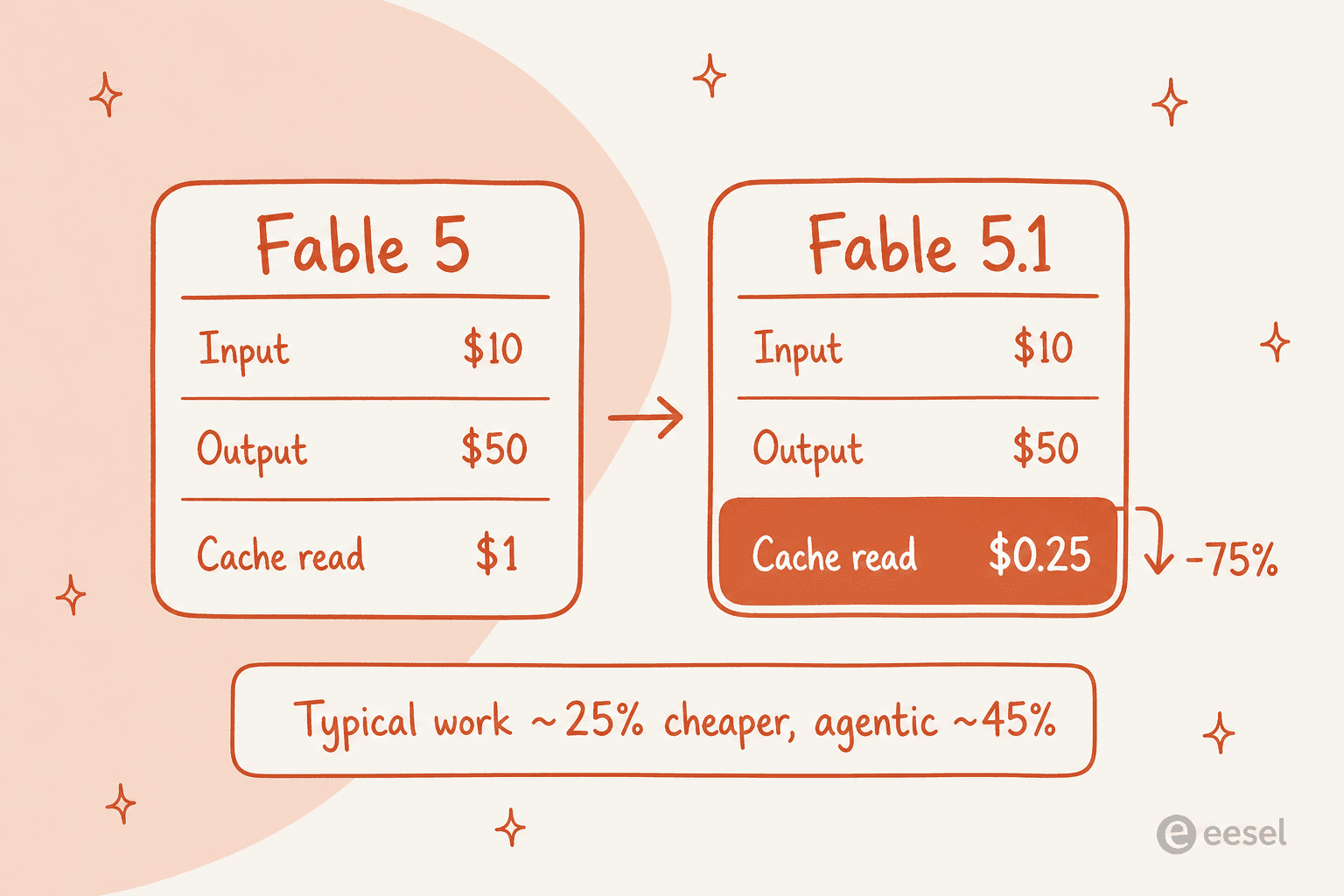
Cache reads dropped from $1 to $0.25 per million tokens. If you've never run an agent loop that matters, this sounds like a rounding error. It isn't. A long agentic session re-reads the same cached prefix (your system prompt, your codebase, your ticket history) on every single step, so cache reads pile up far faster than fresh input. Anthropic measured four weeks of real August 2026 usage and put the effective savings at about 25% on typical workloads and up to 45% on highly agentic ones.
The developer Lance Martin put the value angle sharply on launch day:
"Fable 5.1 at low effort is often competitive with Opus and Sonnet on $ / task while scoring higher. on CursorBench 3.2.0, Fable 5.1 at low effort is at parity w/ Fable 5 at high effort at a third of the cost."
Beyond price, the capability gains concentrate in six areas, per the docs: agentic coding over multi-hour sessions, knowledge work (documents, spreadsheets, decks), multistep research, vision on dense PDFs and charts, reasoning across the full 1M window, and computer use. Multilingual performance is on par with Fable 5, not a gain area, and it's good that Anthropic says so rather than implying everything got better.
Two more changes matter for anyone building on it:
- A text watermark (new). Every text output now carries Anthropic's statistical text watermark for EU AI Act compliance. It adds no tokens or hidden characters, but it does mean the output is identifiable as Claude-generated.
- Breaking API changes. Forced tool use is gone (a
tool_choiceofanyortoolnow returns a 400), thinking blocks are model-bound, and editing earlier turns invalidates thinking. If you're wiring up your own agentic coding CLI or tool loop, read the migration notes before you upgrade.
Claude Fable 5.1 pricing
Let's put the whole rate card in one place. All prices are per million tokens (MTok), in USD, from the platform pricing docs.
| Meter | Claude Fable 5.1 | Claude Fable 5 (prior) |
|---|---|---|
| Base input | $10 | $10 |
| Output | $50 | $50 |
| Cache reads | $0.25 | $1 |
| 5-min cache writes | $12.50 | $12.50 |
| 1-hour cache writes | $20 | $20 |
| Batch (input / output) | $5 / $25 | $5 / $25 |
The only line that moved is cache reads. Everything else is identical to Fable 5. There's also US-only inference at 1.1x for workloads that must stay in the US.
Where does that leave Fable 5.1 against the rest of the current lineup?
| Model | Input | Cache read | Output |
|---|---|---|---|
| Claude Fable 5.1 | $10 | $0.25 | $50 |
| Claude Opus 5 | $5 | $0.50 | $25 |
| Claude Sonnet 5 | $2 | $0.20 | $10 |
Fable 5.1 is still the priciest current Claude on base input and output, 2x Opus 5 and 5x Sonnet 5. But notice its $0.25 cache read is actually cheaper per token than Opus 5's $0.50. That's the whole point of the change: it makes a flagship model economical for the repetitive re-reads that define agent work.
A worked example. Say an agent re-reads a 150k-token cached context on each of 1,000 tool calls in one long session. That's 150M cache-read tokens. On Fable 5 that's $150; on Fable 5.1 the identical work costs $37.50. Multiply that across a fleet of agents running all day and the "same model, cheaper cache" trick stops looking like a rounding error.
One caveat from the community: even on the top consumer plans, people report hitting usage limits fast on Fable-class models, which is a separate concern from the token rate card. For exact Pro, Max, and Team subscription dollars, check claude.com/pricing directly, and our Claude Pro pricing breakdown for the consumer angle.
If you're comparing across vendors, our Gemini pricing, GPT-5.3 Codex pricing, and Gemini overview guides use the same lens.
What Claude Fable 5.1 can actually do
Anthropic reports Fable 5.1 leading every benchmark it lists. Here are the ones that tell you something, all produced with production safeguards enabled (more on that caveat below).
| Benchmark (what it measures) | Fable 5.1 | Fable 5 | Opus 5 | GPT-5.6 Sol |
|---|---|---|---|---|
| Terminal-Bench-Science 0.1 (agentic research) | 52.6% | 24.7% | 29.0% | 22.4% |
| Terminal-Bench 4.0 (agentic coding) | 55.8% | 42.0% | 52.3% | 37.3% |
| AutomationBench (business workflows) | 31.4% | 17.1% | 26.9% | 19.6% |
| OSWorld 2.0, partial (computer use) | 77.9% | 72.9% | 75.4% | - |
| Humanity's Last Exam, with tools | 65.0% | 63.8% | 63.6% | - |
| CursorBench 3.2.0 (agentic coding) | 73.4% | 70.5% | 70.0% | 67.2% |
The standout jumps are Terminal-Bench-Science (24.7% to 52.6%, more than double) and AutomationBench (17.1% to 31.4%). Both point the same direction: this model got a lot better at long, self-directed work.
Now the honest bit, because launch-day benchmark tables always deserve a pinch of salt. A Hacker News commenter said the quiet part out loud:
"There are hundreds of benchmarks. You just need to pick a favorable dozen on release day."

Fair. What moved me more than the table were the real, verifiable long-horizon runs in the announcement. Ramp let it run unattended for 38 hours on a machine-learning problem, where it diagnosed a prior result as a label artifact, corrected it, and kicked off six parallel overnight experiments. Millennium said it found the cause of a one-in-a-million-runs crash that no engineer or model had cracked in four to five years. And on Browserbase's hardest browser-agent benchmark it completed 82% of tasks versus 74% for Opus 5 and 57% for Fable 5, using fewer tokens. That's the kind of result a benchmark score can't quite convey.
Practitioners testing it echoed the coding story:
"I've tested Claude Fable 5.1 over the last week. Everyone should try this model... this model is delight to work with and has the depth of the Fable models. I really trust this model"
If you're evaluating it head to head with other coding models, our roundup of the best AI coding assistants, the top AI agents, and the GPT-5.3 Codex alternatives is a good place to calibrate expectations.
How the effort setting works
The single most useful thing to understand about Fable 5.1 in practice isn't a benchmark, it's the effort dial.
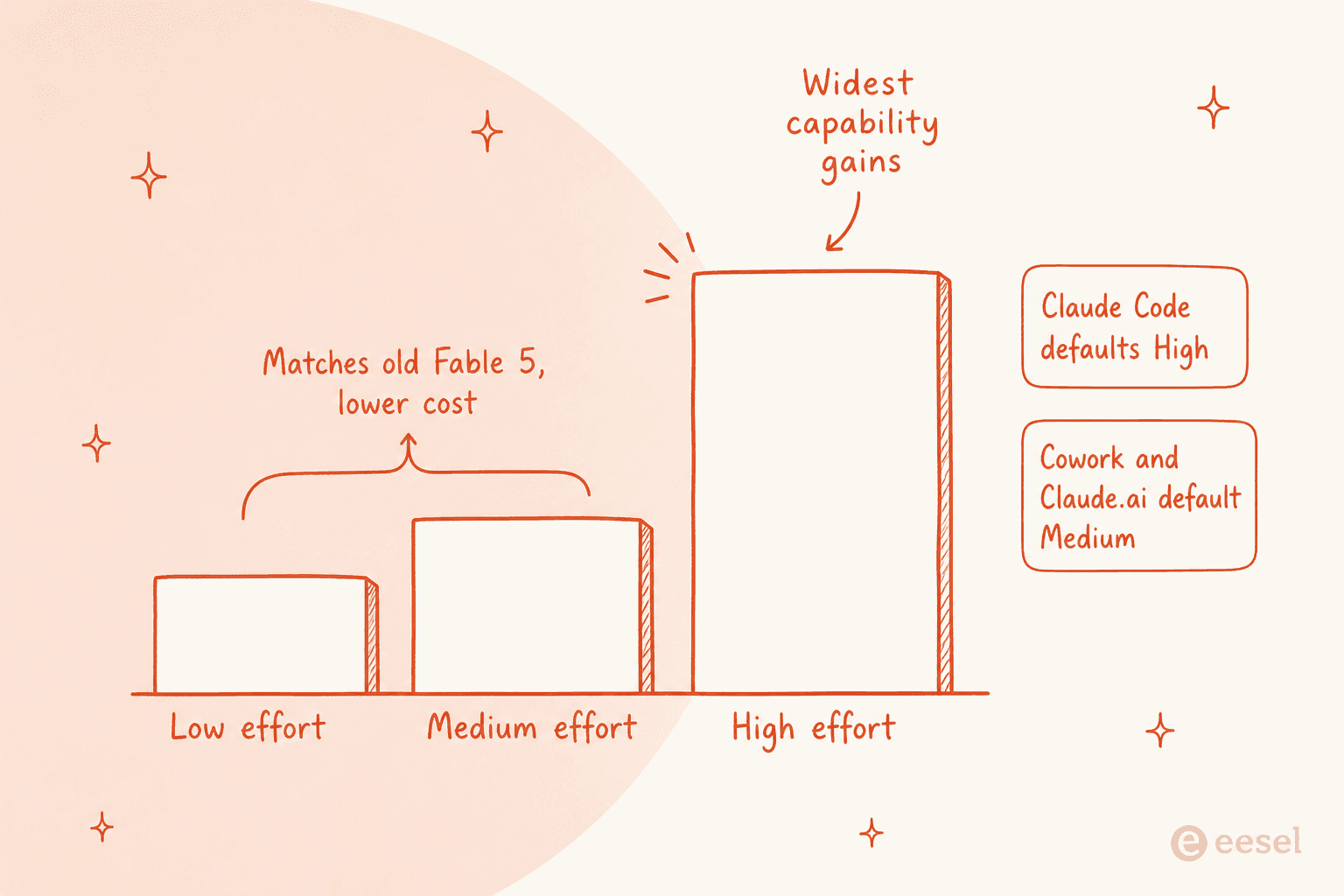
Adaptive thinking is always on, and effort controls how much of it you get. Anthropic's stated design goal is that at low or medium effort, Fable 5.1 matches or beats Fable 5 at much lower cost; the gap over Fable 5 is widest at high effort. Defaults differ by surface: high in Claude Code, medium in Claude Cowork and on Claude.ai. So the same model can be a budget workhorse or a maximum-depth specialist depending on one parameter, which is exactly what makes the cheaper cache reads land.
It's not a clean win for everyone, though. One developer who works in less-common languages pushed back:
"I write a lot of Rust and Lean, Fable 5 is in my experience better at both. Cost/performance is a different story."
That's a useful reminder: "leads every benchmark" is an average, and your workload might live in the tail where the previous model still wins on raw quality. Test on your own tasks before you migrate, the same way you'd approach any LLM optimization decision.
The catch: guardrails and trust
I try to be fair to every tool I write about, and that cuts both ways: Fable 5.1's biggest recurring complaint on launch day wasn't capability, it was refusals.
Anthropic did make safeguards more precise. Claude Code users can expect about 60% fewer cyber-safeguard interventions per session versus Fable 5, and biology safeguards now fire 85% less often on benign elementary questions. When a query does get flagged, it reroutes to an Opus model and you aren't charged Fable prices for it. Those are real, measurable improvements.
But developers still hit false positives, sometimes on their own code:
"Fable is useless. Me: 'Find my security problems in my own code. This is code I own. I'm doing this under authorization of the CEO/CTO of our company.' Fable: 'yeah, no.'"
"The main issue was that Fable was unpredictable and prone to false positives by the safeguards... it still seems completely unable to understand its own guardrails and will readily reason itself into triggering them."
Add the new watermark and the model-bound thinking blocks, and there's a real current of people who feel the model is getting less trusting of them as it gets more capable. Whether that trade is worth it depends entirely on your work; a defensive security team feels it far more than someone drafting docs. It's a fact worth weighing, not a dealbreaker for most.
Where Fable 5.1 fits if you run support or write content
Here's the reframe I'd push, and it's the thing three-plus years of putting AI on live support queues taught us at eesel: you don't hire a model, you hire a teammate that uses one.
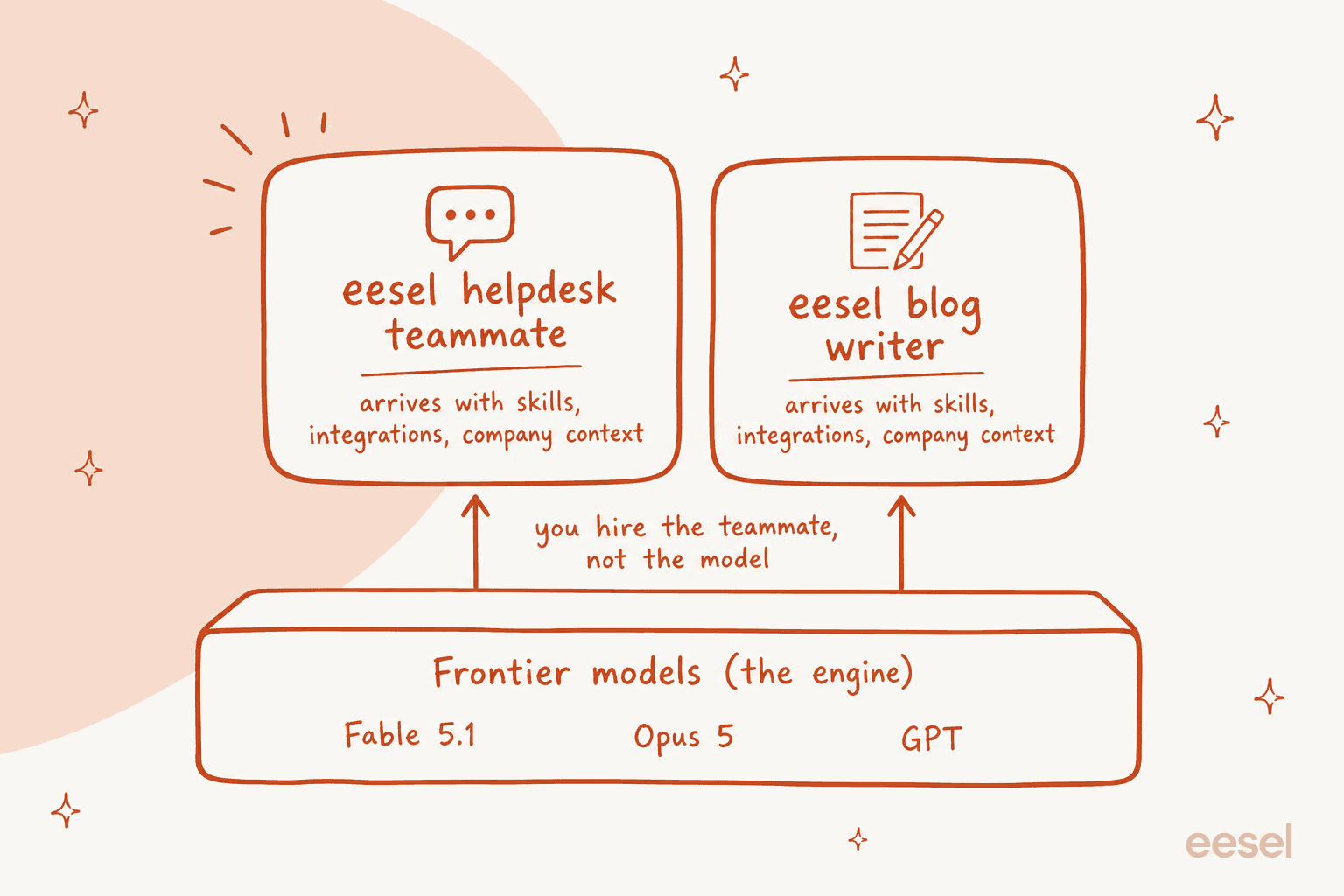
Fable 5.1 is infrastructure, the raw engine. A support manager doesn't want to write a tool loop, wire up retrieval over past tickets, handle refusals, and manage a token budget, they want tickets resolved. That gap between a frontier model and a working solution is exactly where a product like eesel lives. Our AI helpdesk agent runs on frontier models like this, but it arrives already trained on your help center and past tickets, plugged into the helpdesk you already run.

And because we've watched confident-sounding bots quietly give wrong answers, every eesel rollout gets simulated against your historical tickets before it touches a live customer, so you see how it'll actually perform. That's a very different proposition from calling claude-fable-5-1 yourself. If you're weighing options, our guides to the best customer service AI and AI for customer service automation walk through what to look for, and building a custom support GPT shows the DIY path if you'd rather go raw.
If you're mapping the category first, our guides to the best AI helpdesk software, AI customer service chatbots, and an AI copilot for support lay out the landscape.
The content side has the same shape. Fable 5.1's writing genuinely improved, Canva called "the standout is the writing" and Glean judges preferred its answers roughly 2-to-1 over Fable 5. But better prose from a raw model still doesn't do keyword research, place internal links, or pull real sources.
That scaffolding is the job, which is why an AI blog writer beats a bare chat window for publishing work, and why our AI blog writing tools roundup exists.
For the workflow itself, we've dug into AI blog automation, long-form AI writing, and the real AI blog writer cost.
Try eesel for support and content
eesel is an AI teammate platform: instead of a raw model, you hire ready-to-work teammates for specific jobs. The AI helpdesk teammate joins your support queue, and the AI blog writer researches and drafts SEO content, both running on frontier models like Fable 5.1 but arriving with the skills, integrations, and company context for the role.

The difference from wiring up a model yourself is that eesel goes live in minutes on the tools you already use, trains on your existing knowledge, and lets you simulate a teammate on real past data before go-live. You can try eesel free, no credit card and no sales call, and see it answer your own tickets or draft your own posts before you commit.
Fable 5.1 is a remarkable engine. Most teams just want the finished work it makes possible, and that's the part we build.