

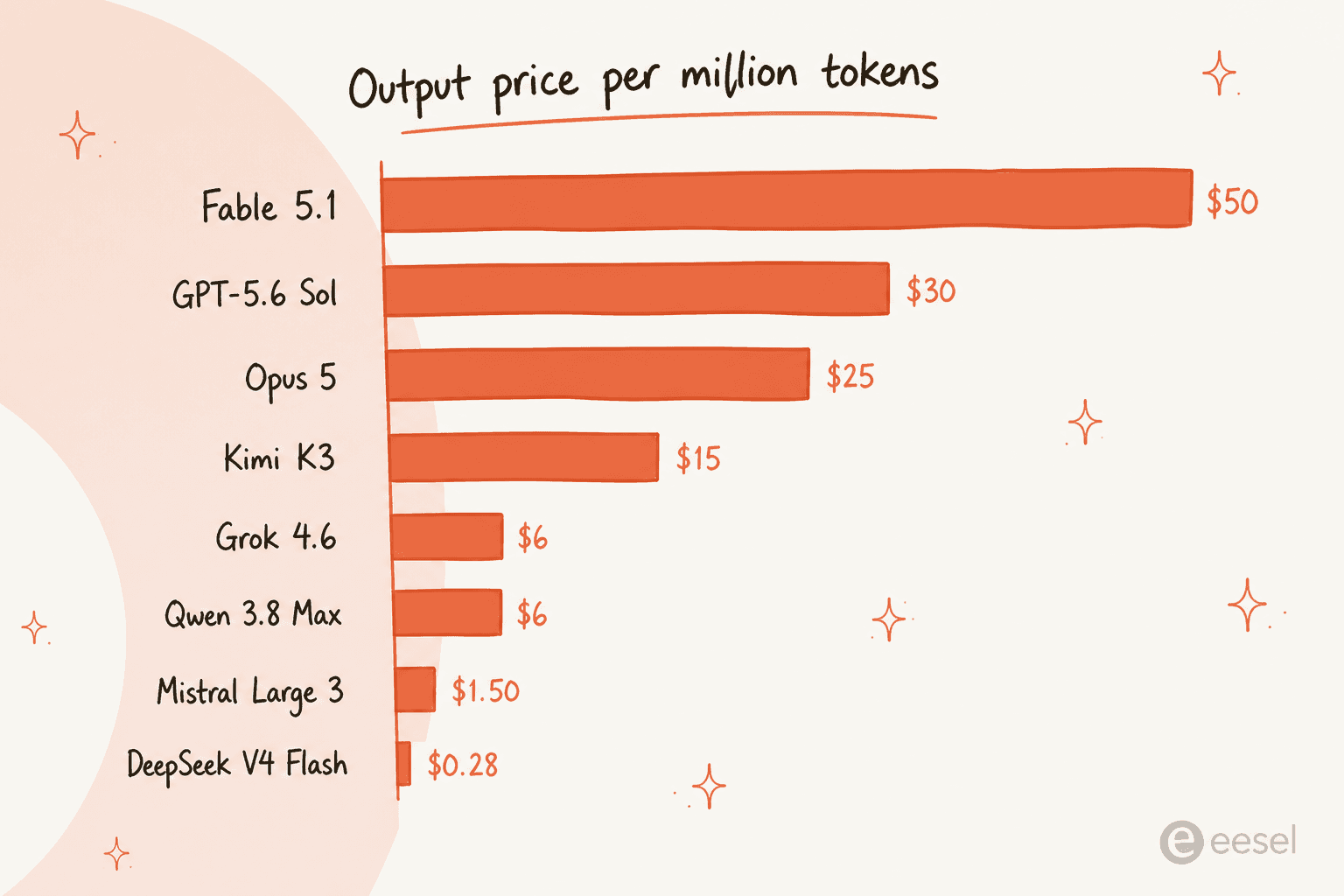
Claude Fable 5.1 is Anthropic's most capable model, and on its own benchmarks it leads. It is also the priciest sticker here at $10 in / $50 out per million tokens, and for a lot of jobs it is more model than you need. That is the whole reason to shop around.
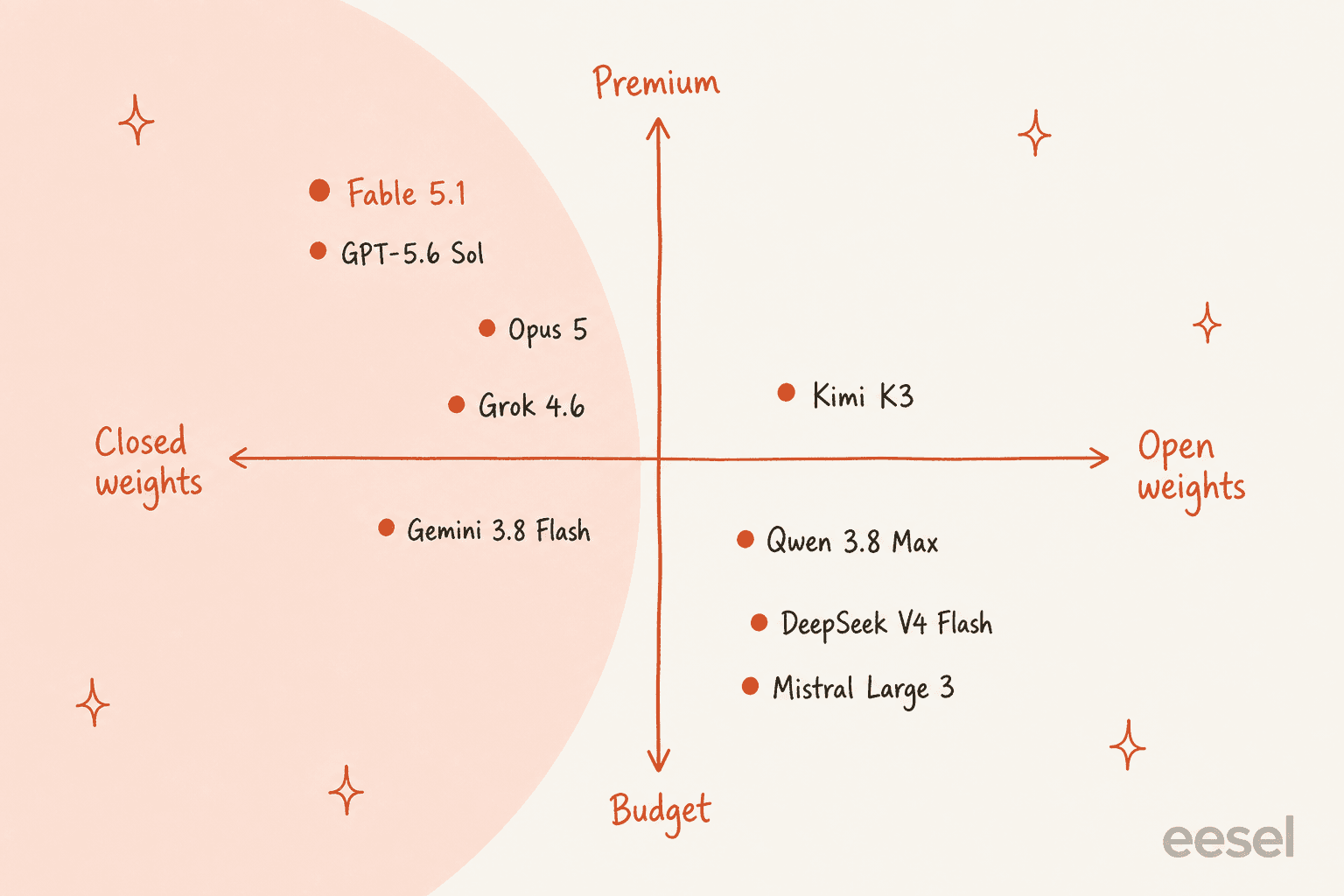
If you want the closest like-for-like swap, Anthropic's own Opus 5 is half the price ($5/$25) and is what Anthropic tells you to start with anyway. For OpenAI or Google stacks, GPT-5.6 Sol and Gemini 3.8 Flash are the peers. For open weights and lower bills, Kimi K3, Qwen 3.8 Max and DeepSeek V4 Flash span capable-and-cheap to rock-bottom budget. The full breakdown, with prices and picks, is below.
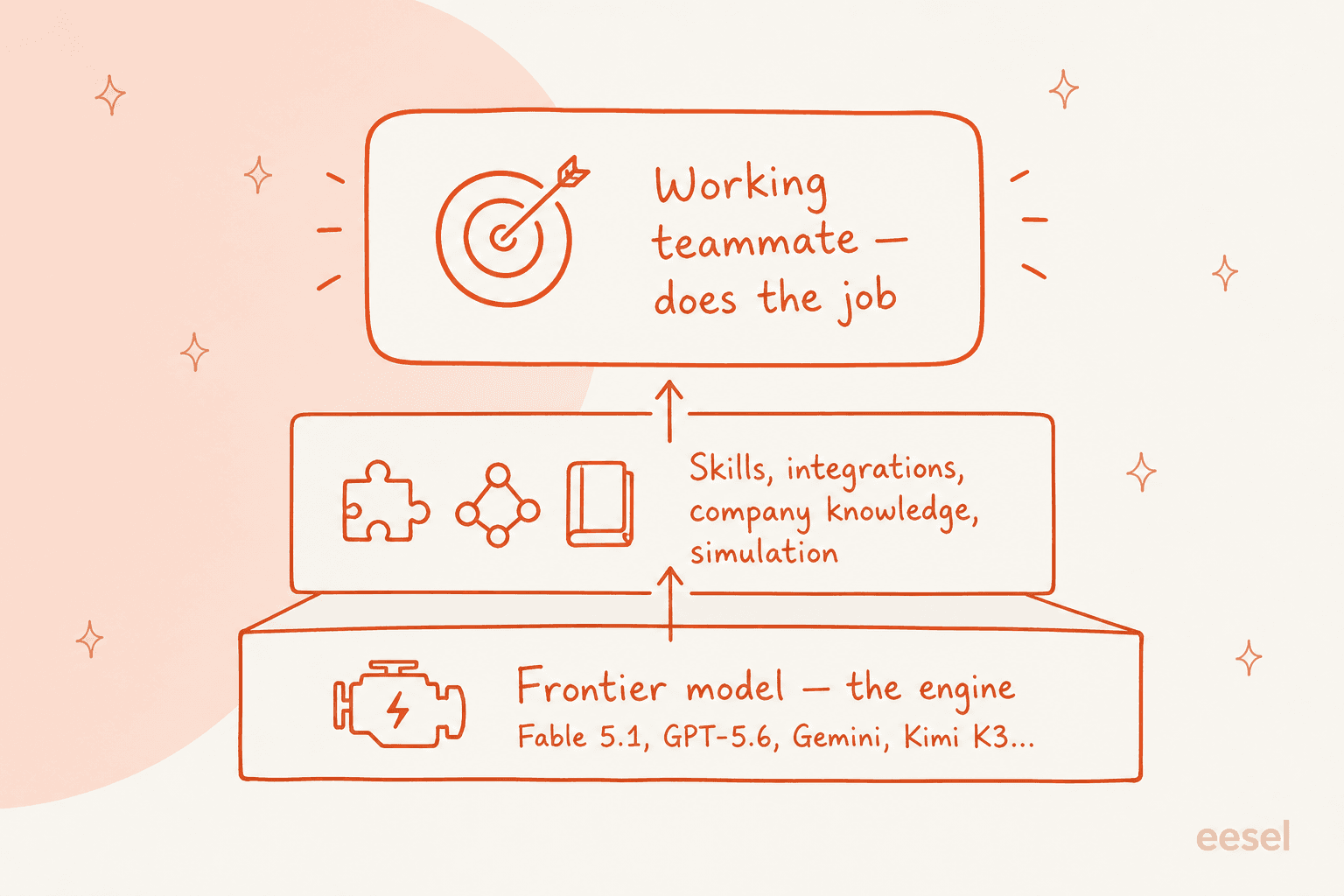
Here is the reframe worth walking in with: none of these are a finished worker. A frontier model is an engine. If what you actually want is a support agent or a writer that just does the job, the model is the wrong layer to buy at, that is what a teammate platform like eesel is for.
Why look past Fable 5.1 at all
Let me be fair to the incumbent first, because Fable 5.1 is a strong model. It launched on September 1, 2026, sits at the top of the Claude 5 family, and on Anthropic's own evals it leads every benchmark it publishes, with the biggest jumps on long-horizon agentic and scientific work. It ships a 1M-token context window at flat per-token pricing across the whole window, 128k max output, and adaptive thinking that is always on. The one price move in 2026 was a good one: cache reads dropped 75%, from $1 to $0.25 per million tokens, which cuts typical costs around 25% and heavily agentic ones up to 45%.
So why does anyone shop around? A few concrete reasons kept coming up.
- Price. The base rate is still $10/$50, the highest sticker in this roundup. If your workload is not the long, messy, multi-tool kind Fable is built for, you are paying a premium for headroom you will not use.
- Refusals. Several developers on Hacker News reported false-positive refusals, including on security review of their own code. Anthropic says Claude Code users should see about 60% fewer cyber-safeguard interventions than on Fable 5, but it is a real, current complaint.
- The watermark. Every Fable 5.1 output carries a statistical text watermark for EU AI Act compliance. That is fine for most people and a trust issue for some, and it drew the most heat on launch.
- You might not need a raw model. This is the big one, and I will come back to it. If the end goal is a support agent or a content writer, buying a frontier model means you still have to build the worker around it.
As an engineer who spends most days wiring models into an actual product at eesel, the thing I keep noticing is that the "which model" question is usually downstream of a "which layer" question people skipped. More on that after the list.
How I picked these alternatives
There is no single "best" model, so this list is organized by the job you are actually doing. I weighed four things for each option: the real published pricing (base rates, not the marketing "starts at"), independent scores where they exist (mostly the Artificial Analysis Intelligence Index, which is model-agnostic), whether the weights are open, and the honest trade-off that the leaderboard hides. Every model here is a real, generally-available option you can call today, not a preview.
A note on the numbers: pricing is per million tokens (MTok), input and output listed separately, because output is where the money goes on generative work. I have kept every figure to the vendor's own primary page.
The 8 best Claude Fable 5.1 alternatives in 2026
Here is the shortlist at a glance, then the detail on each.
| Model | Best for | Price (in / out, $/MTok) | Context | Open weights? | vs Fable 5.1 |
|---|---|---|---|---|---|
| Claude Opus 5 | The default swap | $5 / $25 | 1M | No | Half the price, Anthropic's recommended starting point |
| OpenAI GPT-5.6 Sol | OpenAI-native stacks | $5 / $30 (short ctx) | 400k | No | Cheaper base, but long-context tier repriced 2x past 200k |
| Google Gemini 3.8 Flash | Cheap high-throughput batch | $0.75 / $3.75 | 1M | No | Far cheaper, but 13.3s time-to-first-token and doubles Jan 2027 |
| Kimi K3 | Open-weight flagship | $3 / $15 | 1M | Yes | Near-top score, self-hostable, half Fable's output price |
| Qwen 3.8 Max | Multilingual + strong human preference | $2 / $6 | 1M | Base weights | Top-5 on LMArena Text, a fifth of the output cost |
| DeepSeek V4 Flash | The budget pick | $0.14 / $0.28 | 128k | Yes (MIT) | ~180x cheaper output, MIT-licensed |
| xAI Grok 4.6 | Real-time + X data | $2 / $6 (short ctx) | 500k | No | Cheaper base, but per-call tool meters and a 200k cliff |
| Mistral Large 3 | EU data residency, cheap | $0.50 / $1.50 | 256k | Yes | European vendor, lowest premium-tier output price here |
1. Claude Opus 5
Best for: anyone who wants a Fable-class Claude without the Fable-class bill.
The most honest alternative to Fable 5.1 is the model sitting right below it in Anthropic's own lineup. Opus 5 launched July 24, 2026, runs at $5/$25 per million tokens, and Anthropic's guidance is unusually direct: start with Opus 5 for most jobs, and only reach for Fable 5.1 when Opus 5 at higher effort still falls short. That is the vendor telling you the cheaper model is the default.
It shares Fable's best structural traits: a 1M-token window at flat pricing, no long-context surcharge, and cache reads at $0.50 (still cheap, if not Fable's $0.25). On the independent Artificial Analysis Intelligence Index it sits at the very top of the pack, a hair behind the newest releases.
The catch worth knowing: community testing found Opus 5 tends to spend roughly twice the output tokens of the prior Opus at matched effort, so the cost per task can rise even though the sticker is lower, and its hallucination rate on one independent set climbed noticeably versus older Claudes. It is brilliant and a little verbose. For teams already on Claude who want a real step down in cost without leaving the family, though, it is the obvious move.
Our take: the default pick. If you are on Fable 5.1 "just in case," try Opus 5 first, you will likely never notice the difference on everyday work.
2. OpenAI GPT-5.6 Sol
Best for: teams whose stack is already built on OpenAI.
GPT-5.6 Sol is OpenAI's high-reasoning flagship and the natural cross-vendor peer to Fable. The base rate is $5 in / $30 out for the short-context tier, which undercuts Fable on input and lands close on output. OpenAI also ships cheaper siblings in the same family: GPT-5.6 Terra at $2/$12 and Luna at $0.20/$1.20, so you can dial the cost down within one API.
Here is the trade-off Anthropic does not have: OpenAI charges a long-context tier. Cross 200k tokens and Sol reprices to $10/$45, and it applies to the whole request, not just the overflow. So a big-prompt agentic run can quietly cost twice the sticker. Fable and Opus bill their full window flat, which is a genuine edge for long-context work.
Our take: the right call if you are OpenAI-native and your prompts stay under 200k. If your work is long-context heavy, do the math on that cliff before switching.
3. Google Gemini 3.8 Flash
Best for: cheap, high-throughput batch jobs where nobody is waiting on the reply.
Gemini 3.8 Flash is the price story of this list. At $0.75 in / $3.75 out, it is more than an order of magnitude cheaper than Fable, ships a 1M-token window, and scores a respectable 59 on the Artificial Analysis Index. For overnight enrichment, classification, or bulk generation, that combination is hard to argue with.
Two honest caveats. First, responsiveness: Artificial Analysis measures a 13.3-second time to first token against a 2.99-second class median. Throughput is excellent (top-three for output speed) but the model is slow to start, which rules it out for anything a human waits on, like a live chat reply, and is a non-issue for a batch agent. Second, the price doubles: the $0.75/$3.75 rate holds through December 31, 2026, then rises to $1.50/$7.50 on January 1, 2027. Google itself even suggests staying on the older 3.7 Flash for efficiency-first workloads, since 3.8 "might use more tokens to maximize performance."
Our take: the value play for offline, high-volume work. Do not put it behind a chat widget, and diarize the January price change.
4. Kimi K3 (Moonshot AI)
Best for: teams that want a top-tier score with open weights they can actually download.
Kimi K3 is Moonshot AI's flagship, a 2.8-trillion-parameter mixture-of-experts model (104B active) with a 1M-token context window. It runs at $3 in / $15 out, so its output is under a third of Fable's, and it sits at #4 on the Artificial Analysis Intelligence Index, ahead of the prior Claude and GPT generations. The differentiator is that Moonshot published the open weights on time, so you can host it yourself.
One quirk to plan around: reasoning cannot be turned off. K3 ships with reasoning_effort levels (low, high, and the default max), but even the low setting still reasons, and all levels bill at the same rate, so the dial controls latency, not cost. That makes it pricier than its headline for simple, non-reasoning calls where a cheaper model would do.
Our take: the strongest open-weight flagship for teams that need to self-host for compliance or control. If you just want a hosted API and do not care about weights, Qwen and DeepSeek undercut it.
5. Qwen 3.8 Max (Alibaba)
Best for: multilingual work and anyone who trusts blind human preference over automated scores.
Qwen 3.8 Max went generally available on August 2, 2026. It is a 2.4-trillion-parameter MoE (95B active) with a 1M-token window, priced at $2 in / $6 out with an implicit cache read of $0.25. That is roughly a fifth of Fable's output cost for a model that ranks near the top of human-preference boards.
The interesting wrinkle is that automated and human rankings disagree for Qwen. On LMArena it is Text #5 and Vision #2, i.e. people like its answers; on the automated Intelligence Index it lands mid-pack around 58. Neither is wrong, they measure different things, so do not ship a single-number verdict. Alibaba also publishes a permissively-licensed smaller sibling, though the hosted Max adds vision, tools and a longer default context the open base does not.
Our take: a strong, cheap pick for multilingual and consumer-facing text, where its human-preference edge shows. For agentic tool-use, verify on your own tasks rather than the leaderboard.
6. DeepSeek V4 Flash
Best for: the budget line, when cost per token is the constraint.
If price is the whole decision, DeepSeek V4 Flash ends the conversation. At $0.14 in / $0.28 out, its output is roughly 180 times cheaper than Fable's, and it ships under an MIT license, the most permissive of any model here. It was re-post-trained on July 31, 2026, and that fresh build actually beats DeepSeek's own more expensive V4 Pro on every agentic benchmark the company publishes.
It will not match Fable on the hardest long-horizon reasoning or on deep recall over a huge context, and its window (128k) is smaller than the 1M-token models above. But on the Artificial Analysis Index it posts a real score at about $0.03 per task, which is the kind of number that makes a whole class of "too expensive to run" ideas viable again.
Our take: the default when you are running something at scale and the frontier tier is overkill. Prototype on it before you assume you need a $50-output model.
7. xAI Grok 4.6
Best for: products that live on real-time and X data.
Grok 4.6 runs at $2 in / $6 out for its 500k-token short-context tier, cheaper than Fable across the board on tokens, with strong tool-use and native access to real-time X data that no other model here has.
Read the meter before you commit, though. Like OpenAI, xAI charges a long-context tier: cross 200k tokens and every token in the request bills at $4/$12. And Grok adds per-call fees the token rate hides, web and X search run $5 per 1,000 calls, file search $10 per 1,000, so an agent that searches a lot costs more than the sticker suggests. One procurement gotcha: if you are cloud-mandated, Azure and Bedrock top out at Grok 4.3, so you cannot buy 4.6 through them at all.
Our take: worth it when real-time or X data is the actual feature. If it is not, the tool-call meters make a plain frontier model simpler to budget.
8. Mistral Large 3
Best for: European data residency and a low premium-tier bill.
Mistral Large 3 is the European entry, and it is the cheapest "flagship-class" model on this list at $0.50 in / $1.50 out. For teams that need an EU-headquartered vendor for data-residency or regulatory reasons, it is often the only frontier-ish option that clears procurement, and it ships open weights on top of that.
The trade-off is a straight one: it is not competing for the top of the intelligence boards the way Fable, Opus 5 or GPT-5.6 Sol are. For the hardest agentic and reasoning work it is a step behind, and its 256k context is smaller than the 1M-token models. But for a lot of practical generation and extraction, at that price and with EU hosting, it is a very reasonable floor. Mistral's consumer assistant, now branded Vibe, sits on the same models if you want a chat surface.
Our take: the pragmatic EU pick. Choose it for residency and cost, not to win a benchmark.
The reframe: a model is an engine, not an employee
Here is the thing every "best model" list buries. Picking between Fable 5.1 and these eight is the right question only if the model itself is what you are shipping. For most teams, it is not. You do not want tokens, you want tickets resolved or posts written.
A raw frontier model is infrastructure. It arrives knowing nothing about your product, connected to nothing, remembering nothing between calls. To turn it into a support agent you still have to build retrieval over your help center, wire it into your helpdesk, write the guardrails, add the escalation logic, and, if you are careful, find a way to test it before it talks to a real customer. That is months of work, and the model choice is a small part of it.
This is where I have earned some scars. I build the integrations and APIs at eesel, and we have spent the last three-plus years putting AI agents on live support queues across thousands of real tickets. The lesson that stuck: the model is rarely the thing that breaks. What breaks is a confident-sounding bot giving a wrong answer because nobody tested it against reality first, which is exactly why every rollout now gets simulated against a company's own historical tickets before it goes anywhere near a customer. No amount of "is Fable better than Opus" answers that.
So before you spend a week benchmarking models, ask which layer you are actually buying. If you are building a platform and the model is your product, this list is for you, pick by the job. If you want a worker, buy the worker.
Try eesel
If the job you are really trying to do is support or content, eesel is the layer that sits above all of these models. eesel is an AI teammate platform: instead of handing you a model and a blank canvas, you hire a ready-to-work teammate for a defined job. The current roster is an AI helpdesk teammate that joins your existing support queue, and an AI blog writer, each arriving with the skills, integrations and company context its role needs.
The part that matters for a model roundup: eesel is model-agnostic underneath, so you get the capability of a frontier model without having to pick, price, or wire one up, and without re-doing that work every time a new Fable or Opus lands. Before it answers a single real ticket, you can simulate the teammate on your past tickets to see exactly how it would have handled them, the test step that most raw-model builds skip and later regret.
And if you live in a terminal, the eesel CLI drives the same teammate and workspace programmatically. It is built to be agent-friendly: a person can run it by hand, scripts can automate it, and coding agents like Claude Code, Codex and Cursor can operate it directly, so you can manage instructions, kick off simulations, trigger the agent and read its activity without ever opening the dashboard. It is the same teammate, exposed as a surface an automation or an AI can drive. Trying it is free, and you can see it working on your own data before you commit.
Which alternative should you actually pick
To close the loop, the short version by job:
- Stay in the Claude family, spend less: Opus 5. It is Anthropic's own default.
- OpenAI or Google native: GPT-5.6 Sol (watch the 200k cliff) or Gemini 3.8 Flash (batch only, price doubles in January).
- Open weights: Kimi K3 for a self-hostable flagship, Qwen 3.8 Max for multilingual, DeepSeek V4 Flash for the budget floor.
- Real-time or EU: Grok 4.6 for X data, Mistral Large 3 for European residency.
- You wanted a worker, not a model: eesel.
The models will keep leapfrogging each other, and the sticker prices will keep drifting. What does not change is the layer question, decide whether you are buying an engine or an employee first, and the rest of the choice gets a lot smaller.