

Claude Fable 5.1 is Anthropic's most capable model, launched on September 1, 2026, and it sits at the top of the Claude 5 family, above Opus 5. The sticker price did not move: it is still $10 per million input tokens and $50 per million output tokens. The real change is cache reads, which dropped 75% from $1 to $0.25, cutting typical costs around 25% and heavily agentic ones up to 45%.
On Anthropic's own numbers it leads every benchmark it publishes, with the largest jumps on long-horizon coding, agents, and scientific research. In practice the launch reaction was less about scores and more about two things: the prose is noticeably more human, and the refusals are still frustrating (developers reported it declining to review their own code).
My take: Fable 5.1 is the best model to reach for when a job runs for hours and spans tools, and the cache-read cut finally makes a Fable-class model economical for that. For everyday work, Opus 5 is still the right default. And if what you actually want is a support agent or a writer that just works, a raw model is the wrong layer to buy at, that is what a teammate platform like eesel is for.
What Fable 5.1 actually is
Let me be precise about what launched, because the naming gets confusing fast. Claude Fable 5.1 is the successor to Fable 5 and the top of Anthropic's lineup. The API model ID is claude-fable-5-1. There is also a Mythos 5.1, which is the same underlying model with lighter safeguards, available only to vetted Project Glasswing participants (cyberdefenders and life scientists). When you see a benchmark number, it is Fable 5.1 unless Mythos is called out.
The specs are frontier-grade: a 1M-token context window at flat per-token pricing across the whole window, 128k max output, and adaptive thinking that is always on and tuned with an effort parameter (default high). Anthropic positions it for "demanding reasoning and long-horizon agentic work," and its own guidance is telling: start with Opus 5 for most jobs, and only reach for Fable 5.1 when Opus 5 at higher effort still is not enough. That is an unusually honest steer, and it is the frame I kept coming back to while testing.
As an engineer who spends most days wiring models into an actual product, the thing I care about is not the leaderboard, it is whether the model holds up over a long, messy, multi-tool run without me babysitting it. That is exactly where Fable 5.1 is aimed.
The one number that moved: pricing
Here is the pricing, because a review that says "starts at $10" is not doing its job.
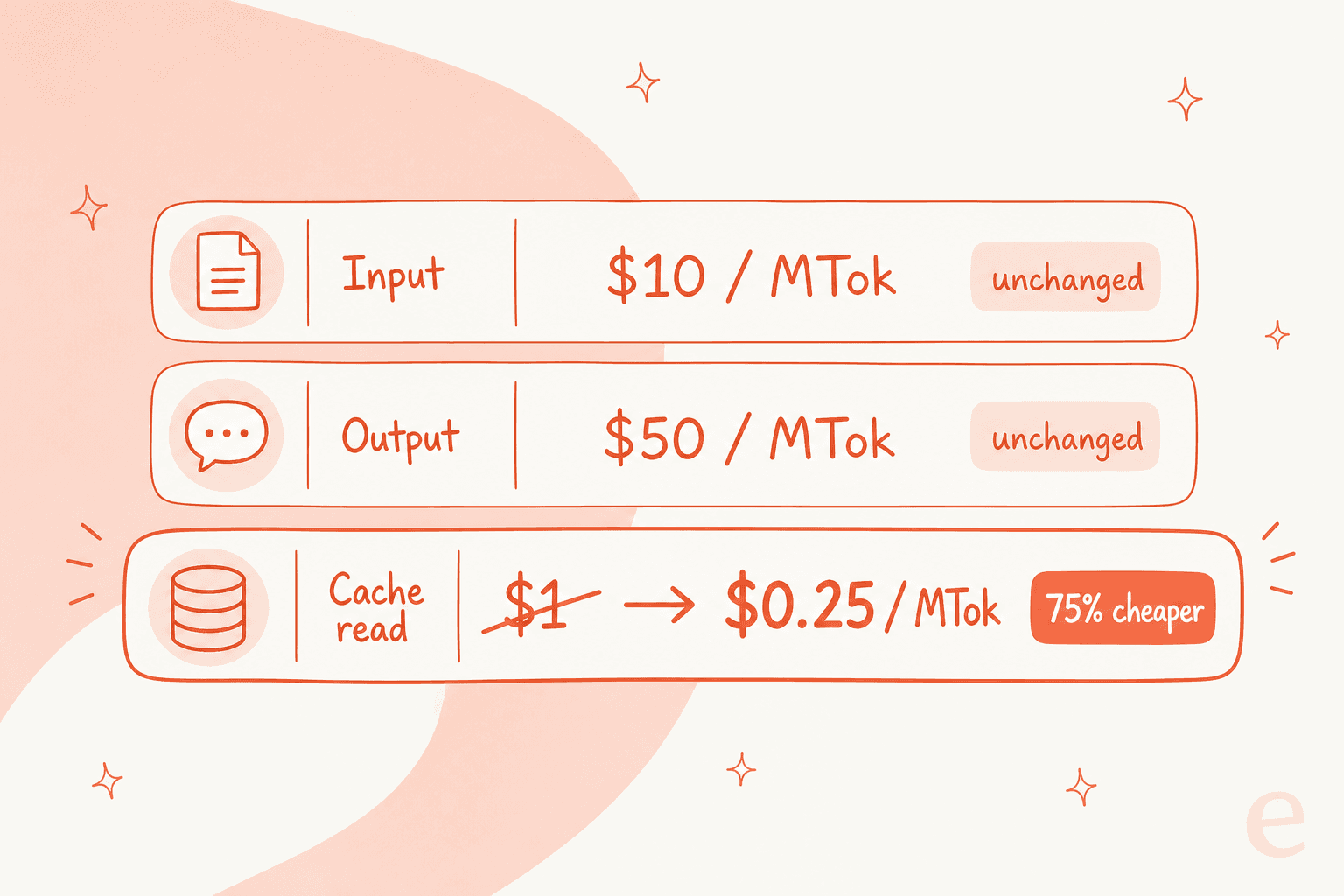
| Meter | Fable 5.1 | Fable 5 | Change |
|---|---|---|---|
| Input (per MTok) | $10 | $10 | unchanged |
| Output (per MTok) | $50 | $50 | unchanged |
| Cache read (per MTok) | $0.25 | $1.00 | 75% cheaper |
| Cache write, 5-min (per MTok) | $12.50 | $12.50 | unchanged |
| Cache write, 1-hr (per MTok) | $20 | $20 | unchanged |
| Batch input / output (per MTok) | $5 / $25 | $5 / $25 | unchanged |
The cache-read cut is the whole story on cost. Anthropic estimates it lowers a typical workload's cost around 25% and a highly agentic one up to 45%, because agentic runs re-read the same cached context on every turn. For context, Fable 5.1's $0.25 cache read is actually cheaper per token than Opus 5's $0.50, even though Opus 5's base input is half the price. If your workload is cache-heavy, the math shifts more toward Fable than the headline rates suggest.
Two caveats worth knowing before you budget. US-only inference carries a 1.1x multiplier, and Fable 5.1 is not on the free tier, you need Pro, Max, Team, or Enterprise. The launch also drew the obvious cross-model jab, with one X account pointing out that "Fable 5.1 charges 6x more than GPT-5.6 Sol." That is true on the sticker, and it is the wrong comparison if your job is a long agentic run where token efficiency and success rate decide the real bill.
The benchmarks, and how much to trust them
On paper, Fable 5.1 sweeps. Anthropic reports it leading every eval it published, and the two biggest leaps over Fable 5 are worth staring at.
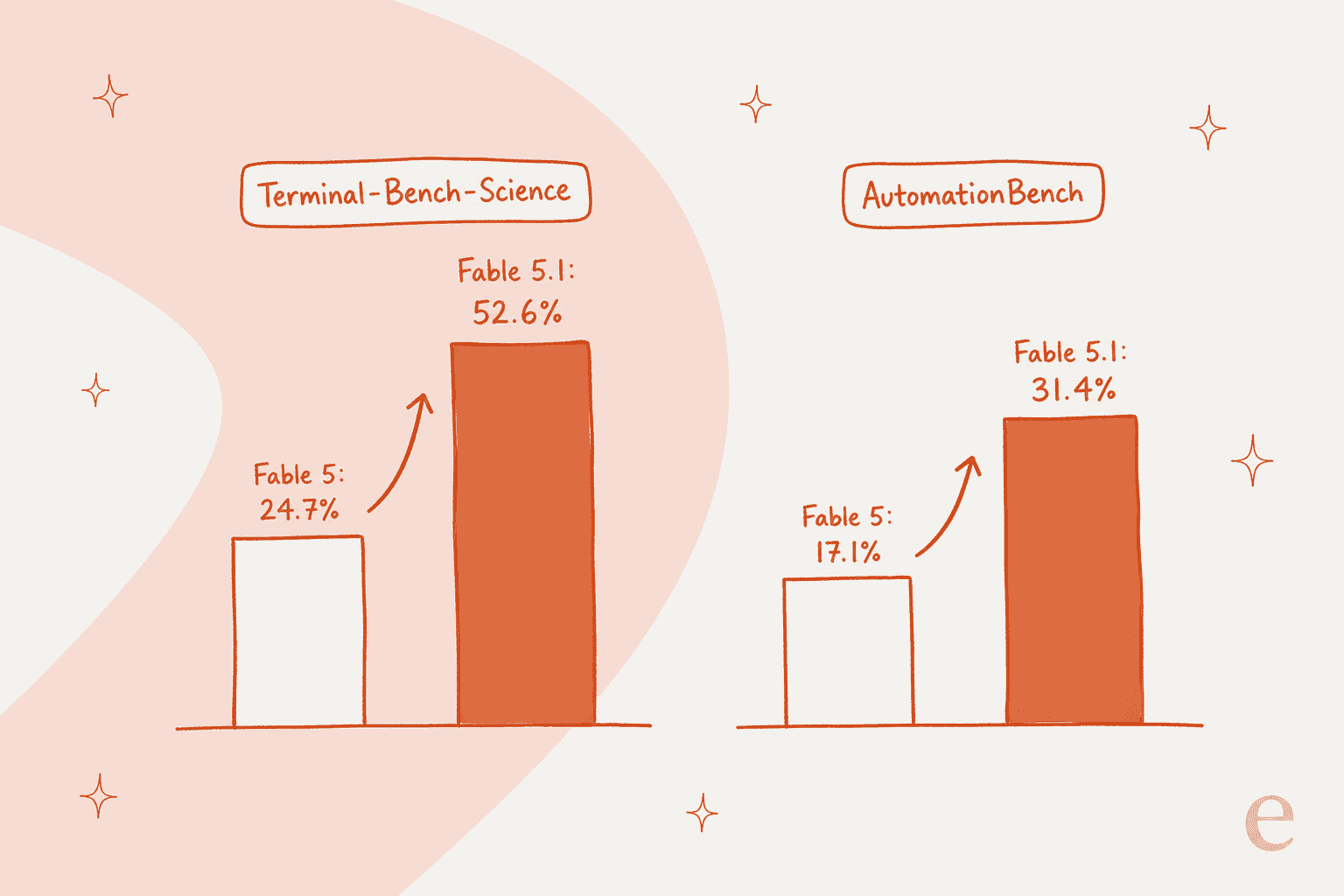
| Benchmark | Fable 5.1 | Fable 5 | Opus 5 | GPT-5.6 Sol |
|---|---|---|---|---|
| Terminal-Bench-Science (agentic science) | 52.6% | 24.7% | 29.0% | 22.4% |
| Terminal-Bench 4.0 (agentic coding) | 55.8% | 42.0% | 52.3% | 37.3% |
| GDPval-AA v2 (knowledge work, Elo) | 1853 | 1723 | 1824 | 1711 |
| AutomationBench (business workflows) | 31.4% | 17.1% | 26.9% | 19.6% |
| CursorBench 3.2.0 (agentic coding) | 73.4% | 70.5% | 70.0% | 67.2% |
| Humanity's Last Exam (with tools) | 65.0% | 63.8% | 63.6% | - |
| OSWorld 2.0 partial (computer use) | 77.9% | 72.9% | 75.4% | - |
The Terminal-Bench-Science jump from 24.7% to 52.6% is the eye-catcher: agentic scientific research more than doubled. AutomationBench nearly doubling matters more for the average buyer, since it is a proxy for messy business workflows.
Now the honesty part, which the marketing page mostly buries. All those Fable 5.1 numbers were produced with production safeguards on, and Anthropic notes that where safeguards intervened, Fable 5.1 scored zero on those tasks, so the real capability ceiling (approximated by safeguards-lighter Mythos 5.1, which hits 60.9% on Terminal-Bench 4.0) is higher. And there is standard error of roughly 3.5 to 4.5 points on the science benchmark. Benchmarks are a directional signal here, not a ruler.
The community's reflex is healthy skepticism, and I share it:
"How is it possible that all models from xAI, OpenAI, Anthropic, Qwen etc. win all benchmarks on each release? Tomorrow all of the above (except Anthropic of course) will bump version numbers and be at the top of HN winning all benchmarks."

So I put more weight on the customer runs Anthropic disclosed than the leaderboard. Ramp reported a single unattended 38-hour run that diagnosed a bad ML result as a label artifact and kicked off six overnight experiments. Millennium said it found the cause of a one-in-a-million crash no engineer or model had cracked in four to five years. Browserbase put it at 82% of tasks on their hardest browser-agent benchmark versus 74% for Opus 5 and 57% for Fable 5, using fewer tokens. Those are the kind of long-horizon results a benchmark row can't capture.
What it's genuinely good at
Three things stood out, and only one of them is on a leaderboard.
The writing is the surprise. For years the loudest complaint about Claude was that its prose read like a compliance memo. Fable 5.1 is the first version where that flips, and the reaction was immediate:
"As a fervent Claude Code user who made the switch to GPT 5.6 Sol over Opus 5 over hard-to-read prose this makes me happy. I love your product but the current models are very hard to work with if you need to do a lot of context switching. Brevity is key."
Glean said its judges preferred Fable 5.1's answers roughly 2-to-1 over Fable 5 on everyday knowledge and drafting, and Canva called the writing "the standout." If you write for a living, this is the upgrade that matters more than any coding score.
Coding holds up over long sessions. This is the pitch and it mostly lands. SpaceXAI (Cursor) called it the most capable model they have run on CursorBench 3.2, especially at verifying its own work, and Red Hat said it found the root cause of every broken build they tested. The one-shot demos flooded X on launch day, which are fun but prove less than the boring stuff (root-causing a build failure is the real test).
Agentic runs stay on the rails. Every summed up the efficiency angle as "Fable-level intelligence, Opus-level price, Sonnet-speed," clocking it around 2x faster than Opus 5 using about half the tokens. One builder captured the practical version:
"one prompt, 43 minutes, $2.96 – claude fable 5.1 wrote a 1,660-line world"
Where it bites
A fair review names the limits, and Fable 5.1 has two real ones.
Refusals are still the biggest pain point. This came up over and over on launch day, and it is not the usual "AI is too cautious" grumble, it is developers unable to do legitimate security work on their own code:
"Fable is useless. Me: "Find my security problems in my own code. This is code I own. I'm doing this under authorization of the CEO/CTO of our company." Fable: "yeah, no.""
Anthropic's own framing is that cyber safeguards are more precise now, with Claude Code users seeing about 60% fewer interventions per session than on Fable 5, and Fable 5.1 can now identify vulnerabilities defensively. But penetration testing, exploit generation, and binary scanning still reroute to Opus models, and the false positives around your own code are real. One tester put the trust problem plainly: it "still seems completely unable to understand its own guardrails and will readily reason itself into triggering them."
The watermark is a trust flashpoint. Fable 5.1 adds a statistical text watermark on every output, for EU AI Act compliance. It adds no tokens or hidden characters and does not encode who you are, but it means Anthropic can identify text the model produced, and some users are uneasy about it:
"Heads up: Claude fingerprinting (watermarking) is now live with Fable 5.1. This means Anthropic can identify text generated by the model."

If provenance requirements matter to your org, that is a feature. If you were counting on undetectable output, it is a dealbreaker. Either way, know it is there. There are also a few breaking API changes from Fable 5 worth a scan if you build on the API: forced tool use is gone (a tool_choice of any or tool now returns a 400), thinking blocks are model-bound, and parallel tool calling is more variable.
Who should actually reach for it
The honest verdict, by who you are:
- You run long, autonomous agent jobs. Yes. This is exactly the model's home turf, and the cache-read cut is what makes hour-long runs affordable. Reach for it.
- You write or do heavy knowledge work. Strong yes on quality. The prose leap is real and the deck/spreadsheet results are the best Anthropic has shipped.
- You do everyday coding and chat. Probably not, at least not by default. Opus 5 is cheaper and Anthropic itself says to start there. Escalate to Fable 5.1 when Opus 5 at high effort stalls.
- You do security research. Test the refusals against your real workflow first. The precision improved, but the false positives on your own code are a live complaint.
- You just want a support agent or a content writer that works. You are shopping at the wrong layer, more on that next.
A model isn't a teammate
Here is the reframe I want you to leave with, because it is where most "which model should I buy" questions go sideways. Fable 5.1 is a spectacular engine. It is not a worker. It has no idea what your product does, cannot see your help center or your last 10,000 tickets, has no integrations, and no way for you to test it against your own history before it touches a real customer. Buying raw model access to solve a support or content problem is like hiring the smartest person alive and then handing them zero context, zero tools, and zero onboarding.
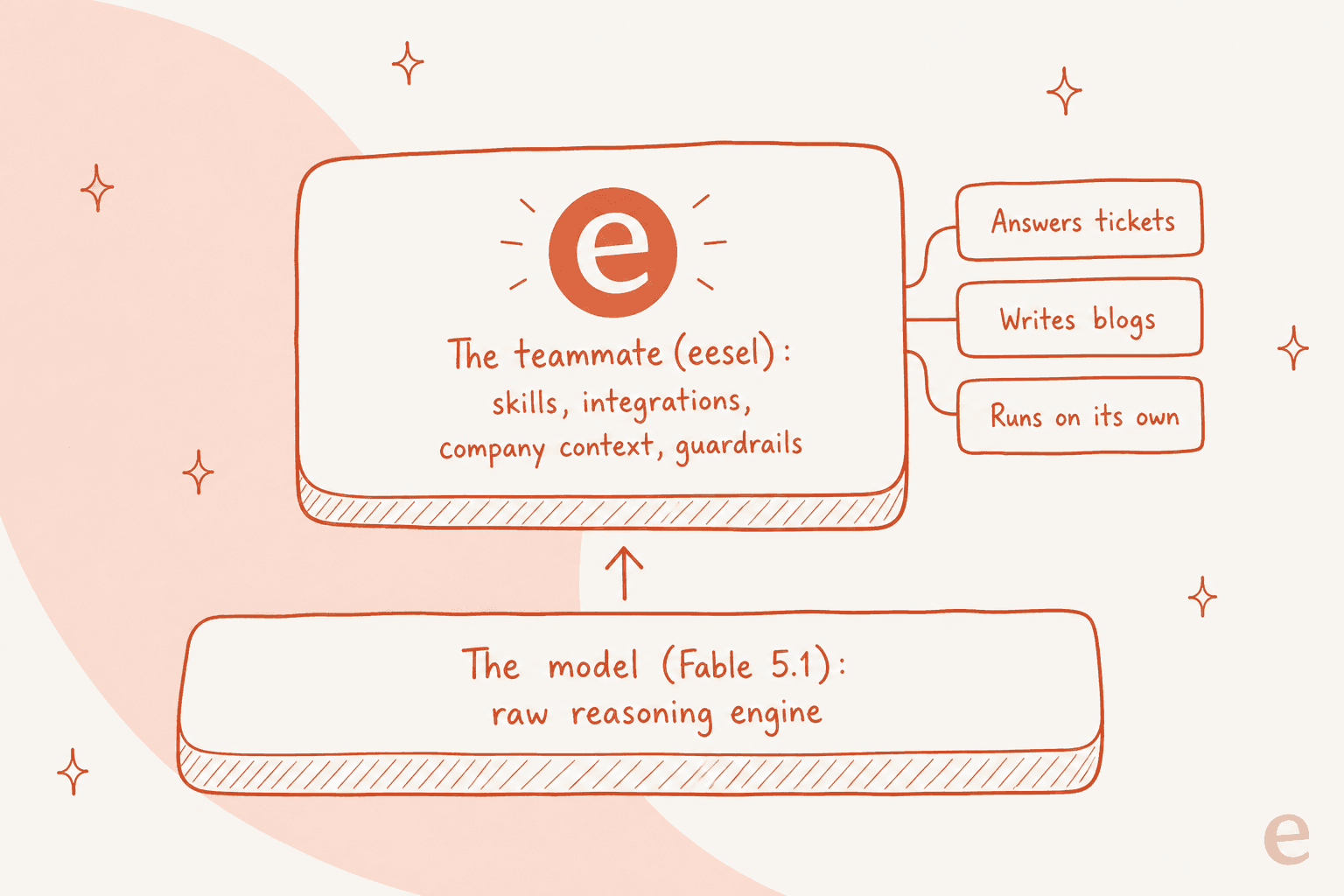
That gap between "raw model" and "finished teammate" is the whole reason eesel exists. The idea is simple: you do not hire a model, you hire a ready-to-work teammate for a specific job. The current roster is an AI helpdesk teammate that joins your existing support queue, and an AI blog writer, and each arrives already carrying the skills, integrations, and company context its role needs, running on a frontier model underneath.
And because it is agent-friendly all the way down, you are not stuck in a dashboard. The eesel CLI lets a person drive the same teammate from a terminal, lets scripts automate it, and lets coding agents like Claude Code or Cursor operate it programmatically, with MCP and webhooks alongside it. If you liked what Fable 5.1 does inside Claude Code, this is how you point that same energy at your support workspace instead of a fresh repo.
Try eesel
If you got here because you are trying to figure out which model to run your customer support on, the better question is which teammate to hire. eesel is an AI teammate platform: the AI helpdesk teammate plugs into tools like Zendesk, Freshdesk, or Gorgias in minutes, learns from your past tickets and help center, and, crucially, lets you simulate it on past tickets before it ever replies to a customer, so you see the resolution rate and the answers up front instead of flipping a switch and hoping.
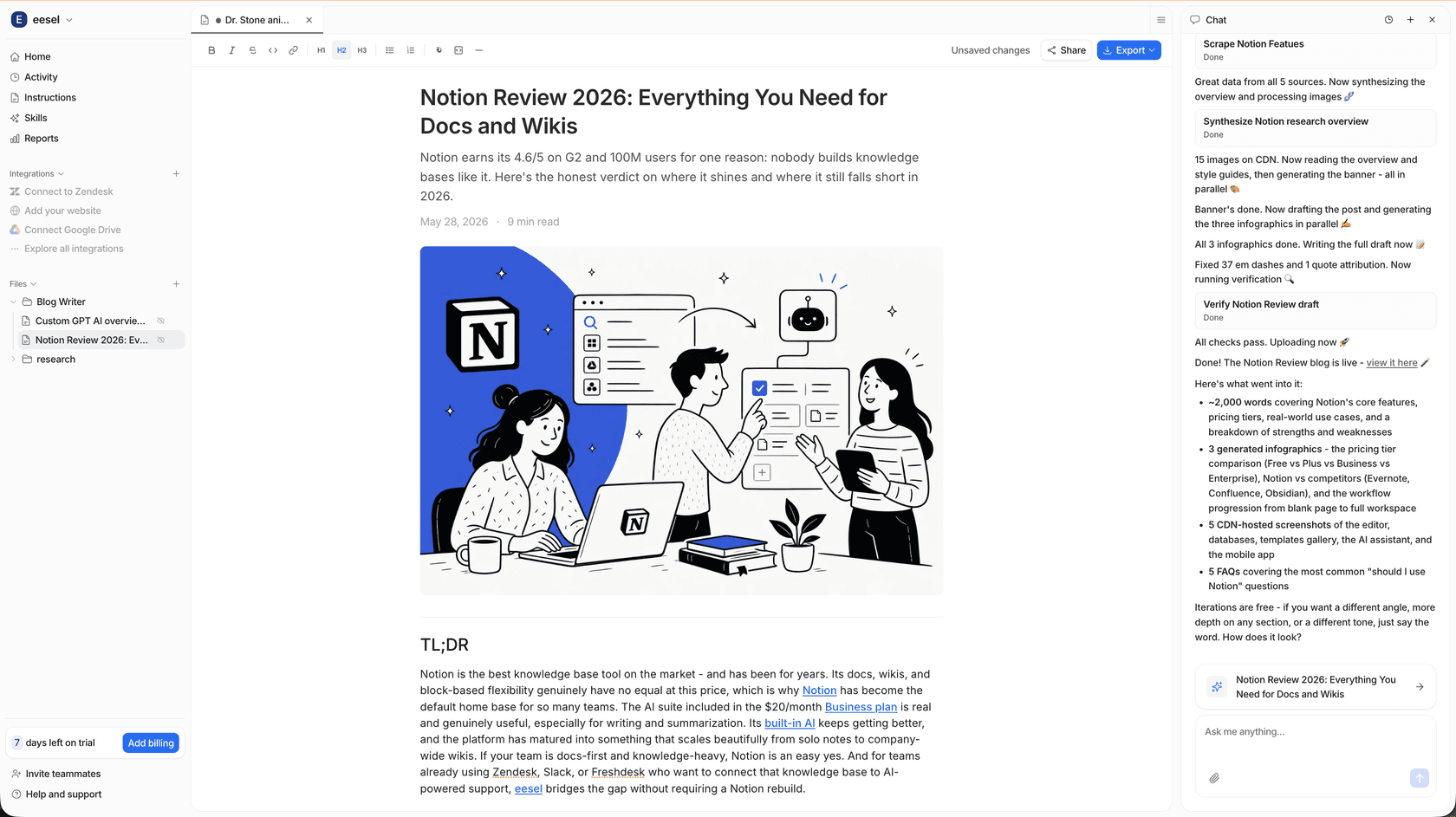
That simulate-before-you-ship step is the exact thing a raw model like Fable 5.1 can't give you, and it is why picking the model is the easy part and picking the teammate is the one that actually decides your outcome. You can try eesel for free.