

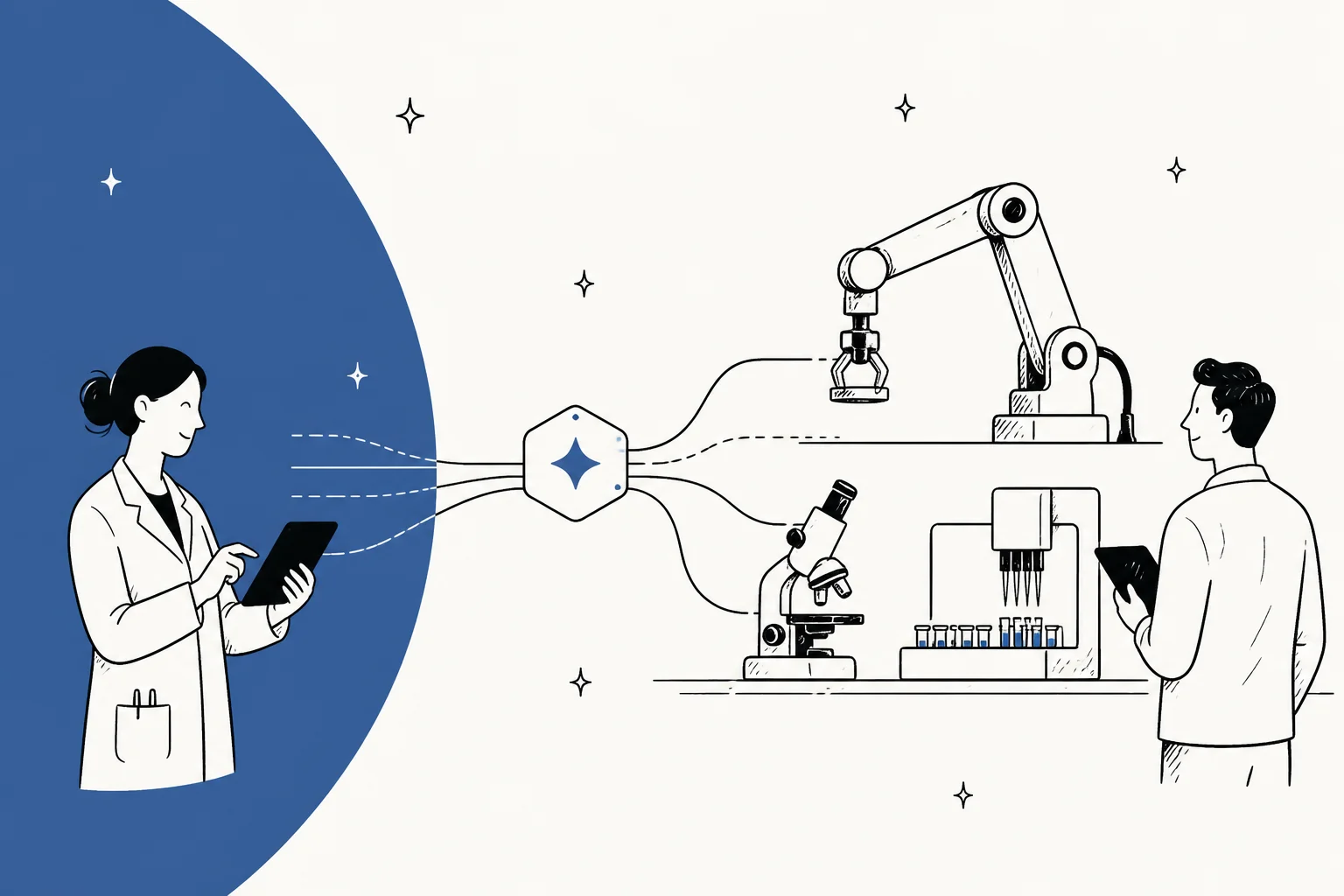
The Model Hardware Standard (MHS) is Anthropic's new shared specification for letting AI agents safely operate physical machines: robotic arms, microscopes, liquid handlers, quantum-computer lasers. It opened as a limited research preview on August 27, 2026. The easiest way to think about it: MHS is MCP for hardware. Where MCP gave agents one way to talk to software, MHS gives them one way to talk to lab and factory instruments, dropping integration time from weeks or months to hours or minutes.
Early pilots are real and specific. At QuEra, laser stabilization on a quantum computer went from a 58% success rate to 99.3%; at Carnegie Mellon, drug-discovery experiments ran about 3x faster. It's impressive research.
The catch worth knowing: it's called a "standard," but the spec isn't public yet. You apply for access, and Anthropic says it'll open source MHS "later." For most people that means MHS is a thing to watch, not build on today. And if what you actually want is an AI agent doing work now, that already exists in software, where you hire a ready-to-work teammate instead of wiring up a protocol.
What the Model Hardware Standard actually is
Strip away the announcement gloss and MHS is a driver. Anthropic describes it as "a shared specification for AI agents to safely operate physical devices," and the honest one-liner is that it standardizes the messy layer between a computer and a machine.
Right now, connecting an AI system to a piece of lab equipment is bespoke work. Every microscope, plate reader, and robotic arm ships with its own vendor interface, its own quirks, and a pile of physical characteristics (weight limits, safe operating ranges, adjustable parameters) that live in a paper manual or in one specialist's head. Wiring an agent into that is, in Anthropic's words, "a manual, time-consuming process that can take weeks or even months."
MHS collapses that. Each device gets a standardized driver so an agent can talk to any of them through one interface, and per Anthropic it works with "any device that has a programmable interface." The standard grew out of a collaboration between Anthropic and the HHMI Janelia Research Campus, where a postdoc kept hitting the same wall: running brain-imaging experiments meant babysitting a dozen incompatible vendor tools that refused to talk to each other.
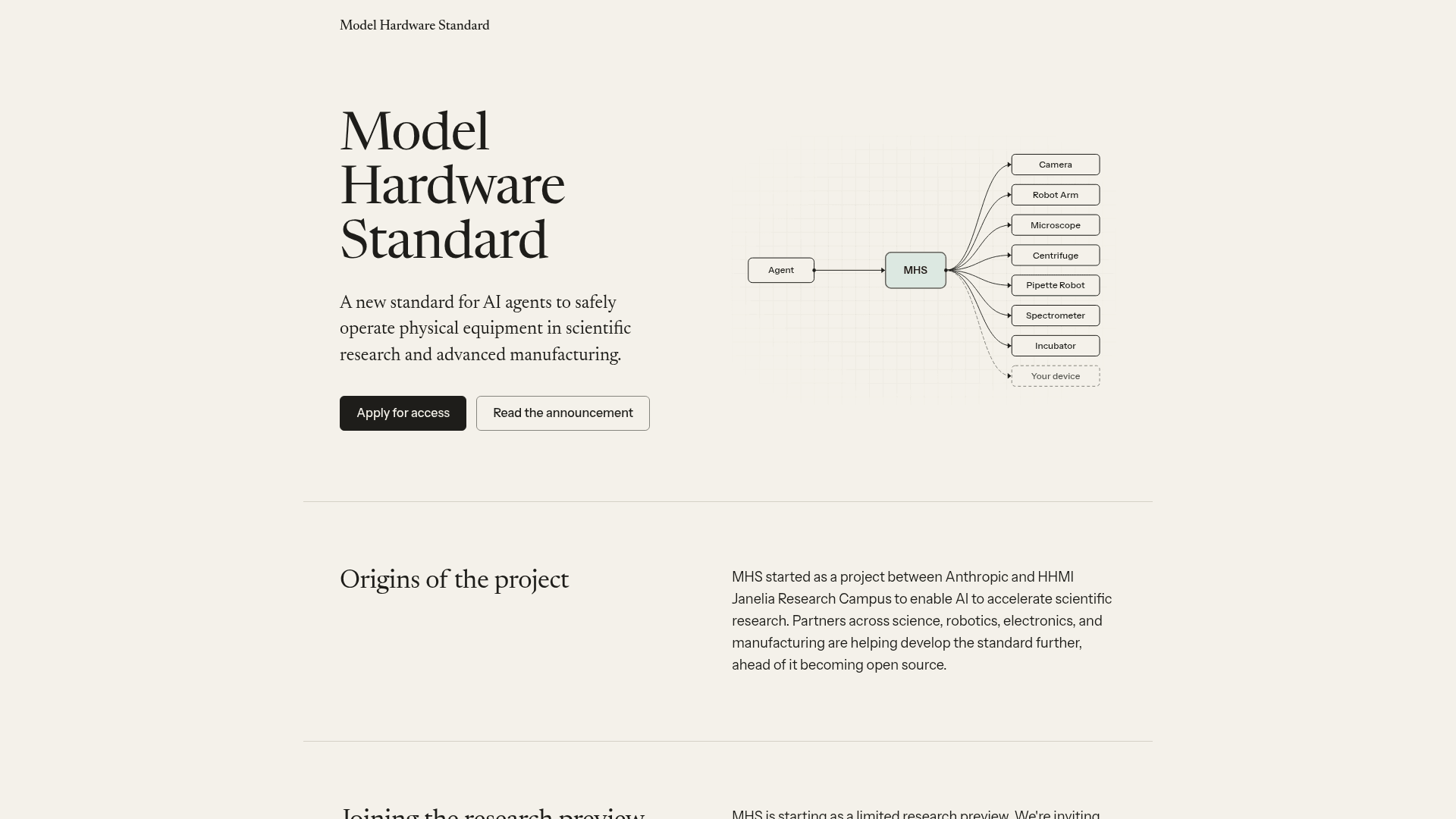
The instrument list Anthropic demoed is not a toy set. It spans liquid handlers, robotic arms, two-photon and laser-scanning microscopes, plate readers, incubators, centrifuges, qPCR machines, monitoring cameras, digital acquisition boards, and even the laser systems on a quantum computer. If it has a control surface, the pitch is that MHS can drive it.
How MHS works under the hood
Here's where the "it's just a driver" framing earns its keep. The whole thing is built on two primitives that anyone who's touched embedded code will recognize: read and write. read is "get temperature." write is "set temperature." That's the vocabulary an agent uses to operate a machine, and it's deliberately boring, because boring is what makes a standard spread.
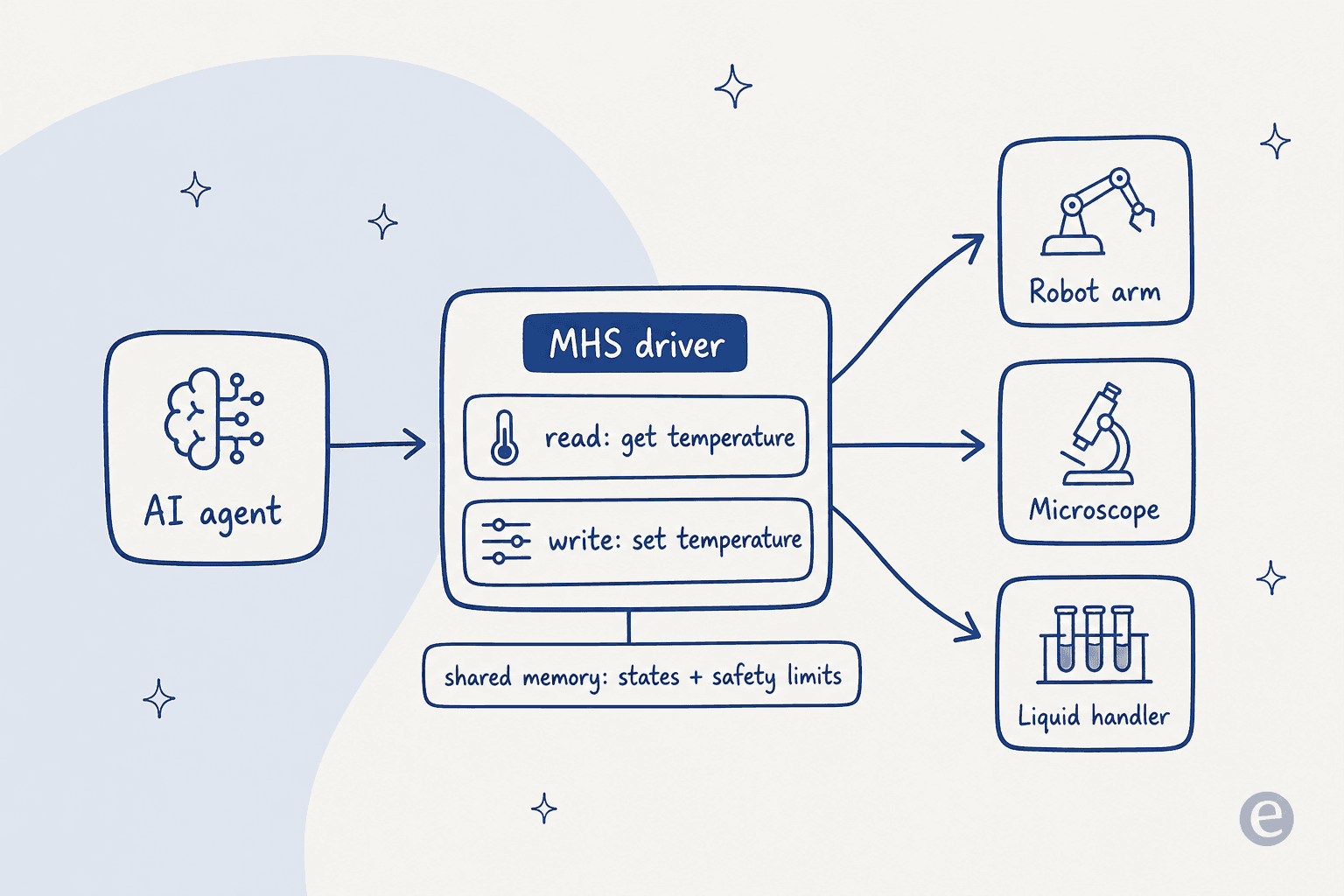
A few pieces do the heavy lifting:
- The standardized driver translates between an operating system and the hardware, so the agent never has to learn a vendor's proprietary interface.
- Natural-language tags let a human document a device's characteristics in plain text, right on the device, instead of leaving that knowledge in a manual.
- A shared memory dictionary stores device states and procedures in a standard format, so an agent (or the next agent) can see what's happening and what's safe.
- Three ways to drive it: MCP, a command line, or code APIs. Because MHS is model-agnostic, Anthropic says "any agent harness can access it using standard protocols, such as the Model Context Protocol."
Safety is baked into the driver layer, not bolted on afterward, which is the part that matters most when a mistake means a broken $200k instrument or a ruined experiment. MHS enforces device-level safety limits, runs pre-execution checks that block unsafe conditions, monitors in real time, and routes high-risk decisions to a human. In Anthropic's own testing, "Claude interacts with experiments and hardware in an exploratory manner, much as a scientist would," which is a nice framing and also a quiet admission: the model still doesn't reason perfectly about physical cause and effect, so a person stays in the loop.
MHS is MCP's playbook, pointed at the physical world
If this all sounds familiar, that's the point. Anthropic ran this exact play once already with the Model Context Protocol: ship a simple, model-agnostic interface, let the ecosystem adopt it, and become the de facto standard for how agents reach the outside world. MCP did that for software (databases, APIs, documents). MHS does it for atoms.
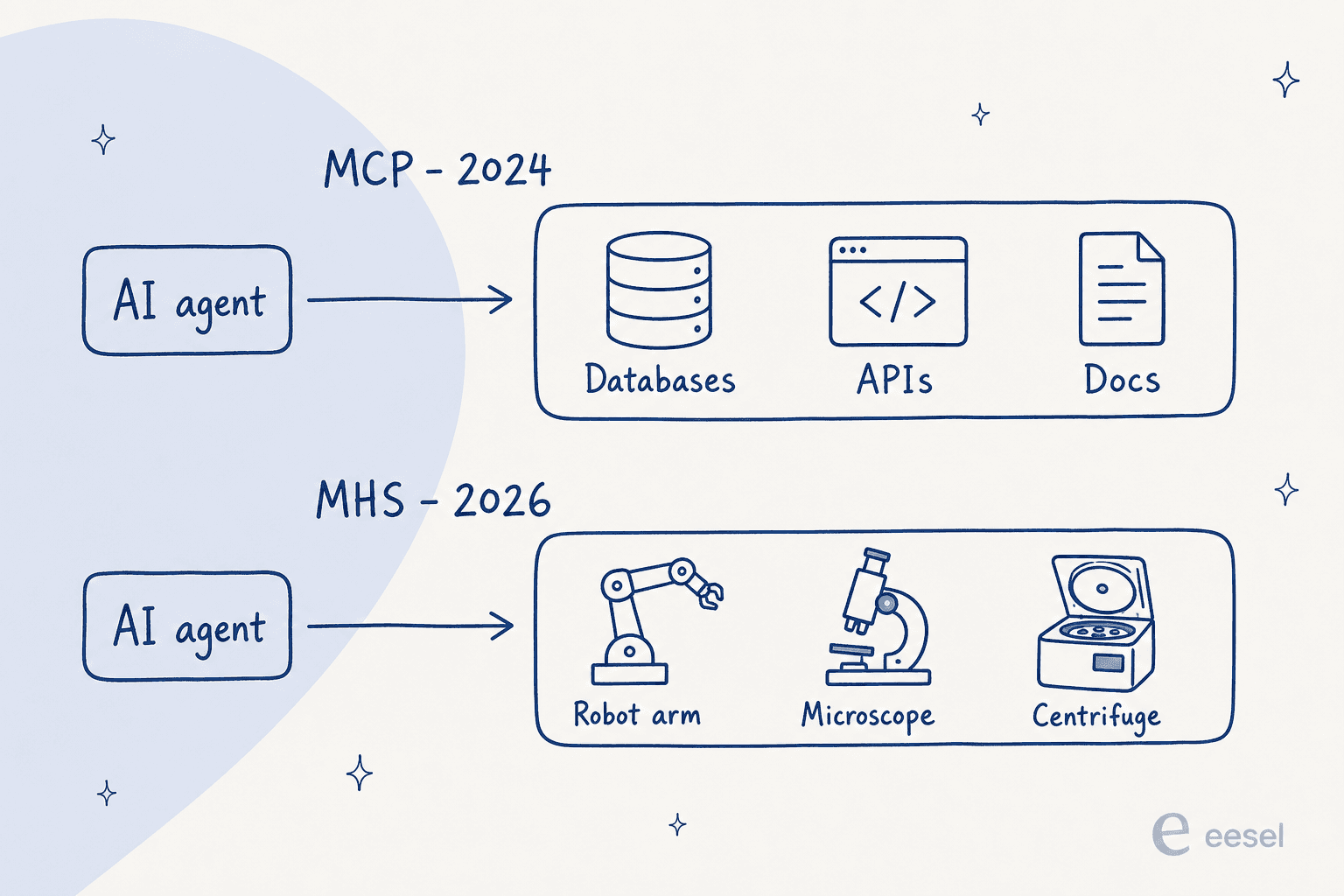
I build integrations for a living, so the "one interface instead of N custom ones" promise is the part I actually care about, and it's the part MHS gets right on paper. The N-by-M problem (every model times every device) is exactly what a good standard dissolves. The interesting tell is the industry list that showed up on day one: AWS, Universal Robots, Doosan Robotics, QIAGEN, Tecan, Danaher, plus Hugging Face's LeRobot and even Raspberry Pi. That's a lot of hardware makers signing on to a "read/write" spec before it's public, and it's the clearest signal that MHS is aiming to be the layer, not a demo.
The takeaway I'd hand a colleague: MHS isn't a robot and it isn't a model. It's plumbing. And whoever owns the plumbing tends to own a lot more than the plumbing.
The pilot numbers are the strongest part
Anthropic didn't just describe MHS, it shipped results with named partners and hard figures. This is the section I'd read first, because specifics are harder to fake than vision.
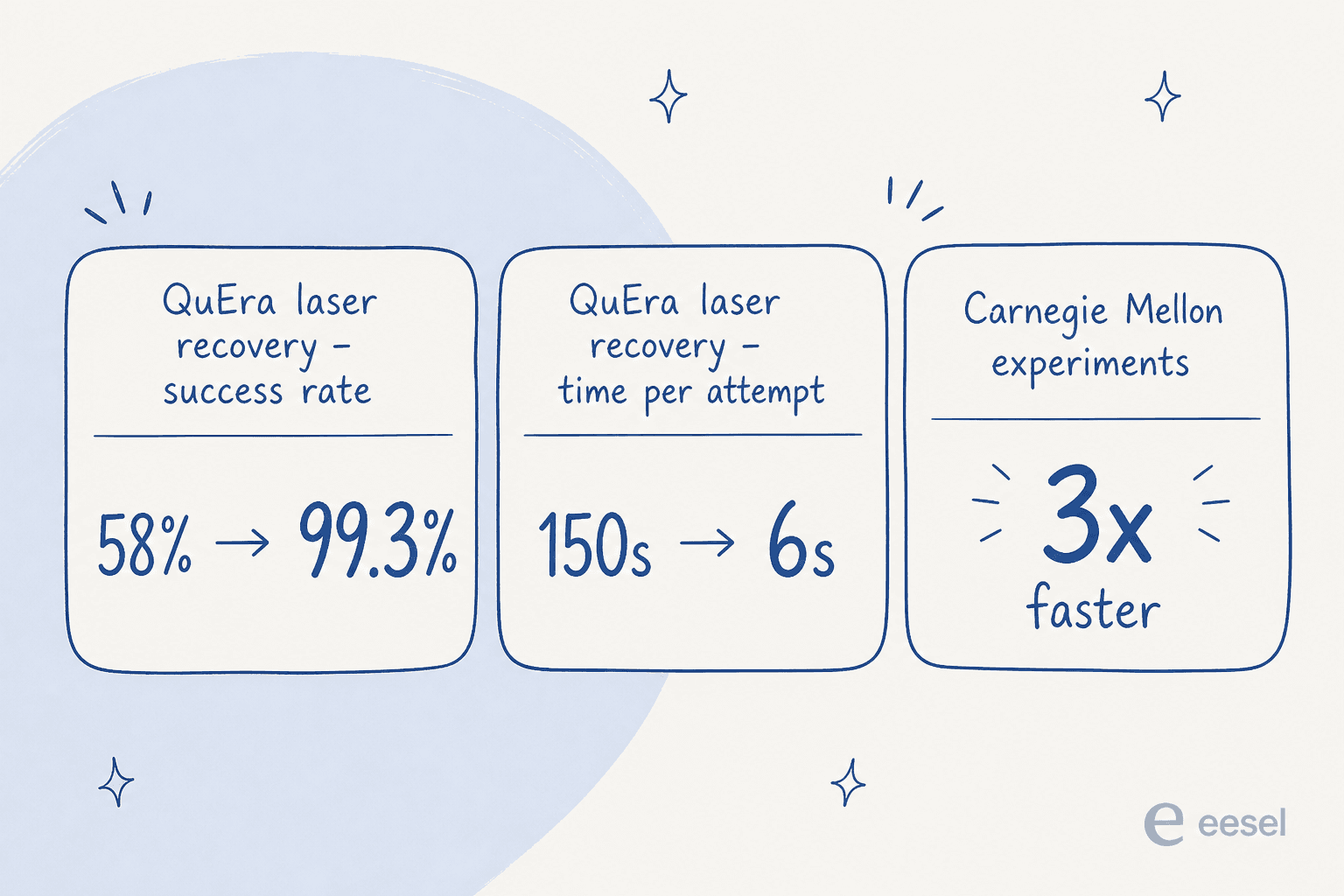
The QuEra laser-recovery result is the headline. Automating laser stabilization on QuEra's quantum computers took success rates from 58% to 99.3% while cutting time per attempt from 150 seconds to 6, across 363 experiments over 16 hours, with PID-tuning noise dropping roughly tenfold (15.7 mV to 1.55 mV). That's not a marketing chart; that's an operations metric a physicist would actually care about.
The rest hold up too:
- Carnegie Mellon ran dose-response drug-discovery experiments about 3x faster than before, integrated MHS in eight hours (versus the weeks a vendor-built setup usually takes), and when researchers tested six unsafe conditions, the system "correctly blocked all six."
- Genentech wired MHS into a BCA protein assay across a liquid handler, a robotic arm, and a plate reader in under a week.
- Tetsuwan Scientific ran 9,143 individual dispenses across 300 transfer types on a qPCR workflow, and the model predicted precision 12% more accurately than the manufacturer's own specs.
Take these as vendor-reported pilots rather than independent benchmarks, because that's what they are. But they're specific, named, and numeric, which is more than most "physical AI" announcements bring.
What the community actually thinks
The reaction split cleanly, and both sides are worth hearing. On X, the mood was mostly excitement about where this goes once it's open, with one widely-shared thread capturing the dream:
"It's gonna be freaking bizarre when they open source it. With the same ease that you play with Legos, you can order an open source robot arm, run this, and run your own robotics policies. You can vibe code hardware."
Hacker News was more skeptical, and asked the two questions that matter. First, the obvious one:
"How does this compare to ROS 2? Roughly the same goals."

It's a fair hit. ROS 2 has been the open robotics middleware for years, and MHS's real differentiator isn't the read/write model, it's being designed from the start for an LLM agent to drive, plus Anthropic's distribution weight behind it. Whether that's enough to displace an established open standard is the open question.
The catch: a "standard" you have to apply to read
This is the part I'd want a friend to know before they get too excited. MHS is being called a standard, but as of now the spec isn't public. You apply for access to see or implement it, and Anthropic says it'll open source the standard after the preview, with no date attached. The sharpest comment in the whole HN thread landed exactly here:
"But as far as I can tell, this technical 'standard' isn't actually public yet (you have to apply for access to even see or implement it.) Anthropic says they plan to open source it later. Quite a departure from the way foundational hardware standards like USB and CAN were developed. You shouldn't need permission to read a standard."
That's the honest asterisk on the whole launch. USB and CAN are the templates for how hardware standards win: public spec, free to implement, no gatekeeper. MHS today is half-open, announced as open, delivered as a waitlist. It may well open up exactly as promised, and MCP's own path from "messy internal tool" to real standard is a point in Anthropic's favor. But until the spec is public, "standard" is an aspiration, not a status. If you're not running a lab or a factory line, the practical move is to bookmark modelhardwarestandard.com, not to plan around it.
What MHS means if you don't run a lab
Here's the honest bridge: for the vast majority of teams, MHS changes nothing this year. It's infrastructure for scientific research and advanced manufacturing, and it's in a closed preview. You are not going to point it at your help desk.
But the shape of it is worth internalizing, because it's the same shape already playing out in software. The whole industry is converging on one idea: an AI agent is only as useful as the things it can safely touch. MHS is that idea for microscopes and robot arms. In customer support and back-office work, the "devices" are your helpdesk, your knowledge base, and your ticket history, and that version of the future isn't a preview. It's shipping.
That's also the trap in a launch like this. A standard is infrastructure, and infrastructure is not the same as an employee. MHS gives an agent a way to reach a machine; it doesn't give you a scientist. In the same way, an MCP server gives an AI agent a way to reach your helpdesk; it doesn't give you a support rep. The gap between "can technically connect" and "does the job on day one" is the entire product.
eesel: the teammate, not the protocol
At eesel, that gap is the whole point. Think of it this way: MHS is the infrastructure; eesel is the teammate you hire on top of infrastructure like it. eesel is an AI teammate platform, and instead of wiring up a protocol and hoping, you hire a ready-to-work teammate for a specific job. The current roster is an AI helpdesk teammate and an AI blog writer, and each arrives already knowing its role.
For support, that means the AI helpdesk teammate joins your existing queue in Zendesk, Freshdesk, Gorgias, or Front, learns from your past tickets and help center, and starts drafting and resolving, without you standing up a single connector by hand. And because putting a confident bot on live tickets is exactly the kind of "physical cause and effect" risk MHS designs around, eesel simulates every rollout against your historical tickets first, so you can see how it behaves before it ever touches a customer.

MHS is an exciting bet on AI in the physical world, and it's worth watching. But if what you need is an agent doing real work today, the teammate model is already here. You can try eesel free and have it running on your own tickets in minutes.