


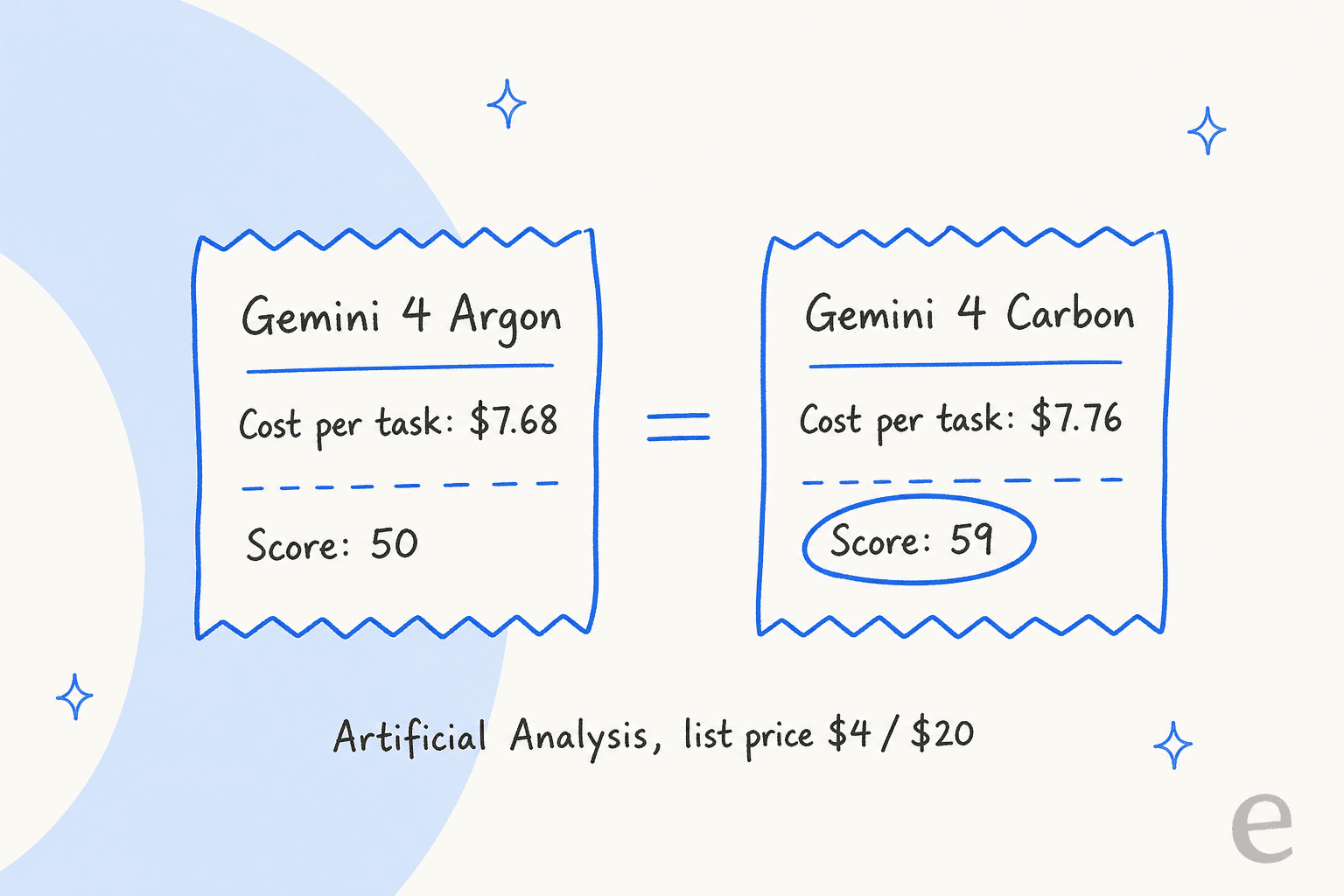
Gemini 4 Carbon is Google's new frontier model, and it's the strongest model on the Artificial Analysis Intelligence Index at 59, nine points above Gemini 4 Argon, which shipped only two weeks earlier. It beats Argon on all 17 benchmarks Google published, leads the field on cybersecurity tests like SEC-bench Pro (88.2%), and costs exactly the same: $2/$10 per million tokens at launch, $4/$20 later.
The catch is access. Today only a subset of cyber defenders can use Carbon, through Google's Fairwind Program. Developers, businesses, and consumers get it "as soon as possible", with no date. Argon went from announcement to API in about two weeks, so that's the best guess for Carbon too.
My read: Carbon isn't a bigger tier above Argon, it's Argon's replacement. If you already use Argon, plan to swap the model name when it lands. If you're looking at it for support tickets, the headline that matters is Google's claim that Carbon makes about half as many unsupported claims. That's the same problem eesel solves at the helpdesk agent level: drafts grounded in your help center and past tickets, and a handoff when there's nothing to ground them in.
What is Gemini 4 Carbon?
Gemini 4 Carbon is a large language model from Google DeepMind, announced on 28 October 2026 by Koray Kavukcuoglu, Google's Chief AI Architect. Google calls it "our strongest model with state-of-the-art cybersecurity and long horizon capabilities", and it is built "building on" Argon, not as a separate size class of its own.
The short version of what Google is claiming:
| What | Gemini 4 Carbon |
|---|---|
| Announced | 28 October 2026 |
| Built on | Gemini 4 Argon (launched two weeks earlier) |
| Artificial Analysis Intelligence Index v5.0 | 59.4, #1 at launch |
| Built for | Long-running agentic coding, cybersecurity defense |
| Context window | 1M tokens, per Artificial Analysis |
| Launch price | $2 in / $10 out per 1M tokens, cached input 95% off |
| Price after promo | $4 in / $20 out |
| Who can use it today | A subset of cyber defenders via the Fairwind Program |
Google says its own teams have watched Carbon "run for days to persist through dead ends" on engineering work like root-causing subtle bugs across large codebases. That is the job it's designed around, which is also why most of the launch post is talking about coding and security and not so much about chat.
How is Carbon different from Argon?
Carbon is a better Argon for the same price. Google doesn't say if it's a new training run or a later checkpoint, but everything about the launch (same price card, same rollout path, "building on Gemini 4 Argon") points to a successor and not a sibling. Here is how the two compares on the numbers that moved the most:
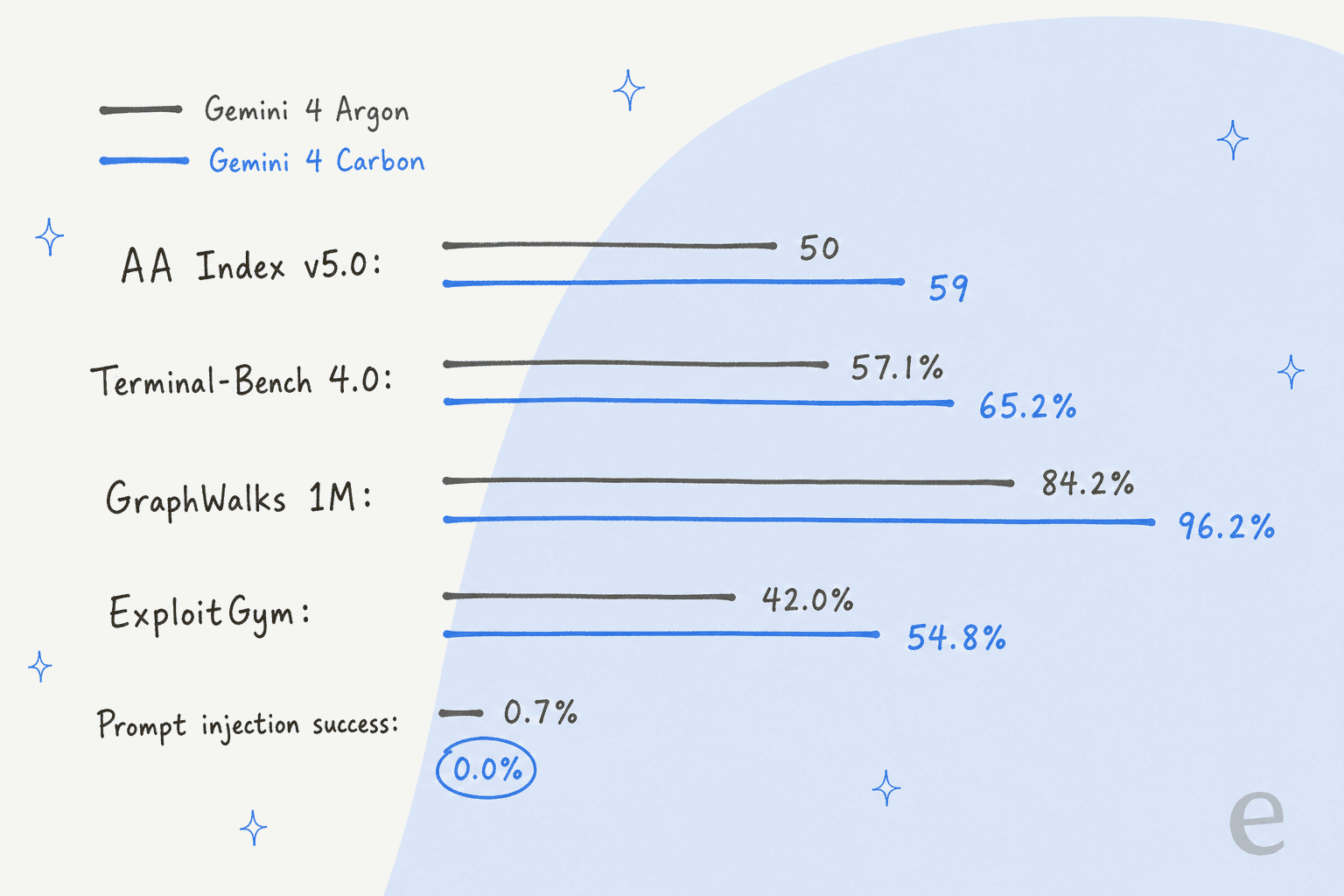
The biggest jumps are in the long context and in security. GraphWalks, which tests reasoning across 256K to 1M tokens, goes from 84.2% to 96.2%, and the exploitation benchmark ExploitGym goes up almost 13 points. General coding gains is smaller but still real, Terminal-Bench 4.0 gains eight points, and on WebDev Arena Carbon climbs 89 Elo to #4.
The naming, it confused almost everyone. Labs like OpenAI and Anthropic use names that tell you the size order (Astra, Sol, Terra; Opus, Sonnet, Haiku). Google's element names don't do that, and the Hacker News thread spent hundreds of comments only on this:
"Confusingly, Carbon is another model in the same size class as Argon. Every other lab would have just called it Gemini 4.1 Argon."

I think that's the right mental model. If you treat Carbon as "Argon, next version" then the rest of the launch makes sense too.
How does Gemini 4 Carbon score on benchmarks?
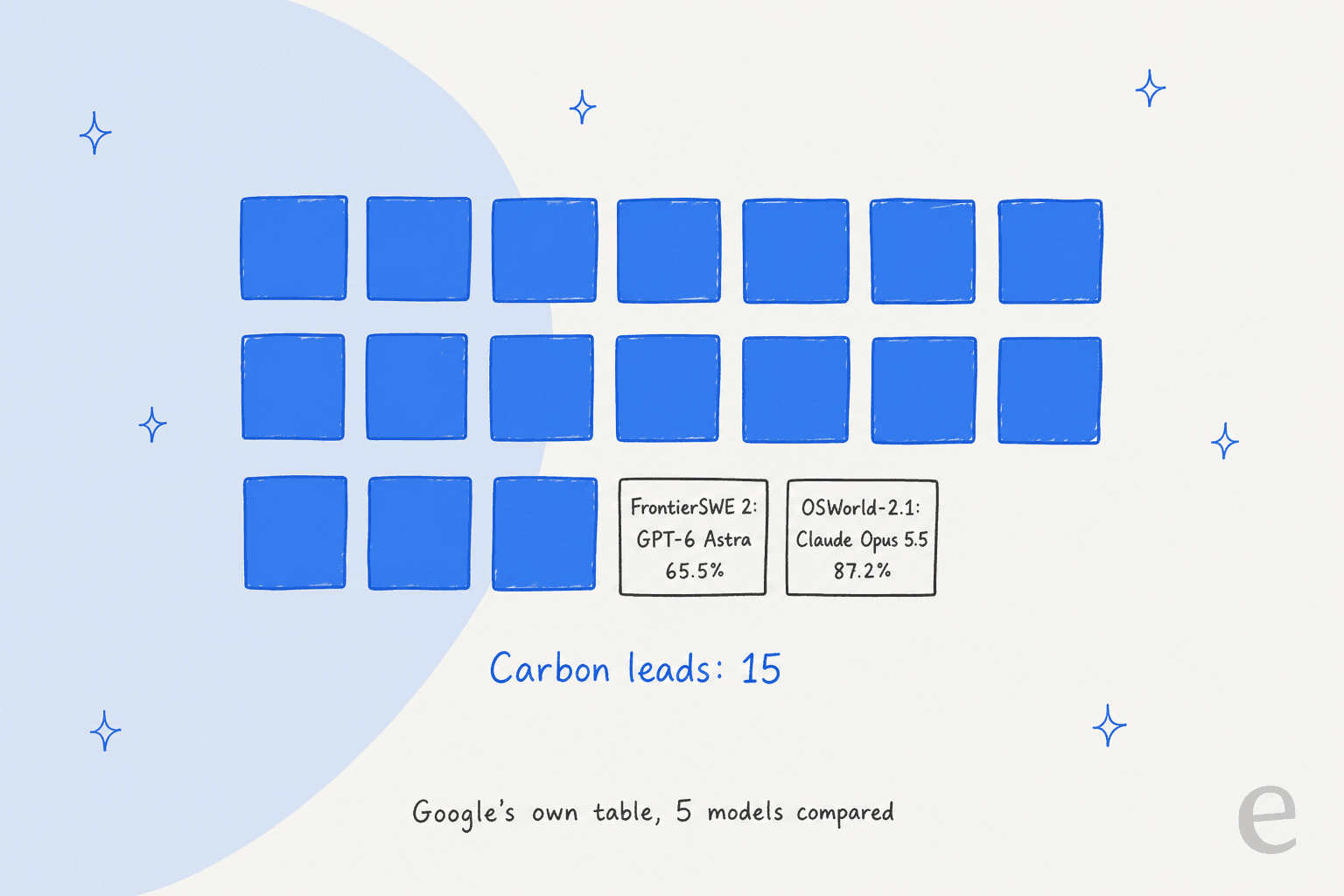
Carbon leads 15 of the 17 rows in Google's own table, against Argon, GPT-6 Astra, Claude Opus 5.5, and Claude Fable 5.1. Here's the full table as Google published it:
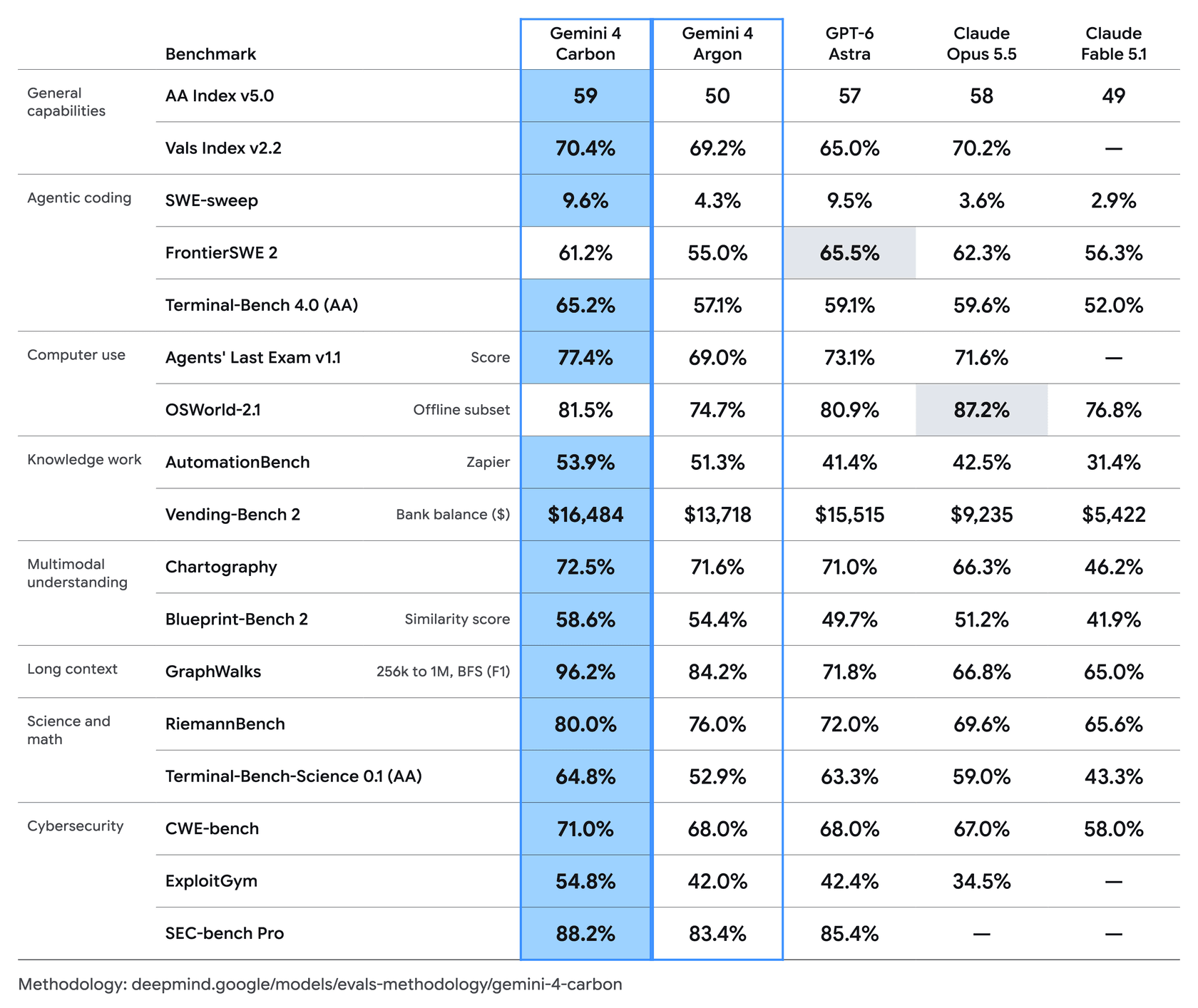
The two rows where Carbon doesn't win are worth to know, since they are the ones a coding or computer-use buyer would look at first:
Here are the rows I'd pay most attention to, pulled from the DeepMind model page:
| Benchmark | Gemini 4 Carbon | Gemini 4 Argon | GPT-6 Astra | Claude Opus 5.5 |
|---|---|---|---|---|
| AA Intelligence Index v5.0 | 59 | 50 | 57 | 58 |
| Terminal-Bench 4.0 (agentic coding) | 65.2% | 57.1% | 59.1% | 59.6% |
| FrontierSWE 2 (software engineering) | 61.2% | 55.0% | 65.5% | 62.3% |
| OSWorld-2.1 (computer use) | 81.5% | 74.7% | 80.9% | 87.2% |
| AutomationBench (Zapier tasks) | 53.9% | 51.3% | 41.4% | 42.5% |
| GraphWalks (256K to 1M tokens) | 96.2% | 84.2% | 71.8% | 66.8% |
| SEC-bench Pro (find vulnerabilities) | 88.2% | 83.4% | 85.4% | n/a |
There is two things that stand out for me. First, the lead on long context is big, it's not marginal: 96.2% on GraphWalks against 66.8% for Opus 5.5. If your work is reading whole codebases or long contracts, that is the row which matters. Second, the AutomationBench number (Zapier's test of real business workflows) puts Carbon more than 11 points clear of Astra and Opus, and for agent work this is a stronger signal than any single coding score is.
One fair caveat here: these are vendor numbers. The independent check so far is Artificial Analysis, which puts Carbon at 59.4, first overall, at $7.76 per task at list price. And Argon's track record is a reason to wait for real use before trusting the table. Argon also looked strong on paper, and a good part of the Hacker News thread on Carbon is developers saying it felt weaker in daily use, which my Gemini 4 Argon review gets into.
Why is Google calling Carbon a cybersecurity model?
Because that is where its lead is the clearest, and also where the risk is. Google reports state-of-the-art results across the steps a security team actually runs, from finding a flaw and proving it's exploitable, then patching it.
- Finding: 88.2% on SEC-bench Pro, autonomously uncovering flaws in real software.
- Validating: 54.8% on ExploitGym, the exploitation benchmark, up from Argon's 42.0%.
- Patching: 71.0% on CWE-bench, turning findings into working fixes.
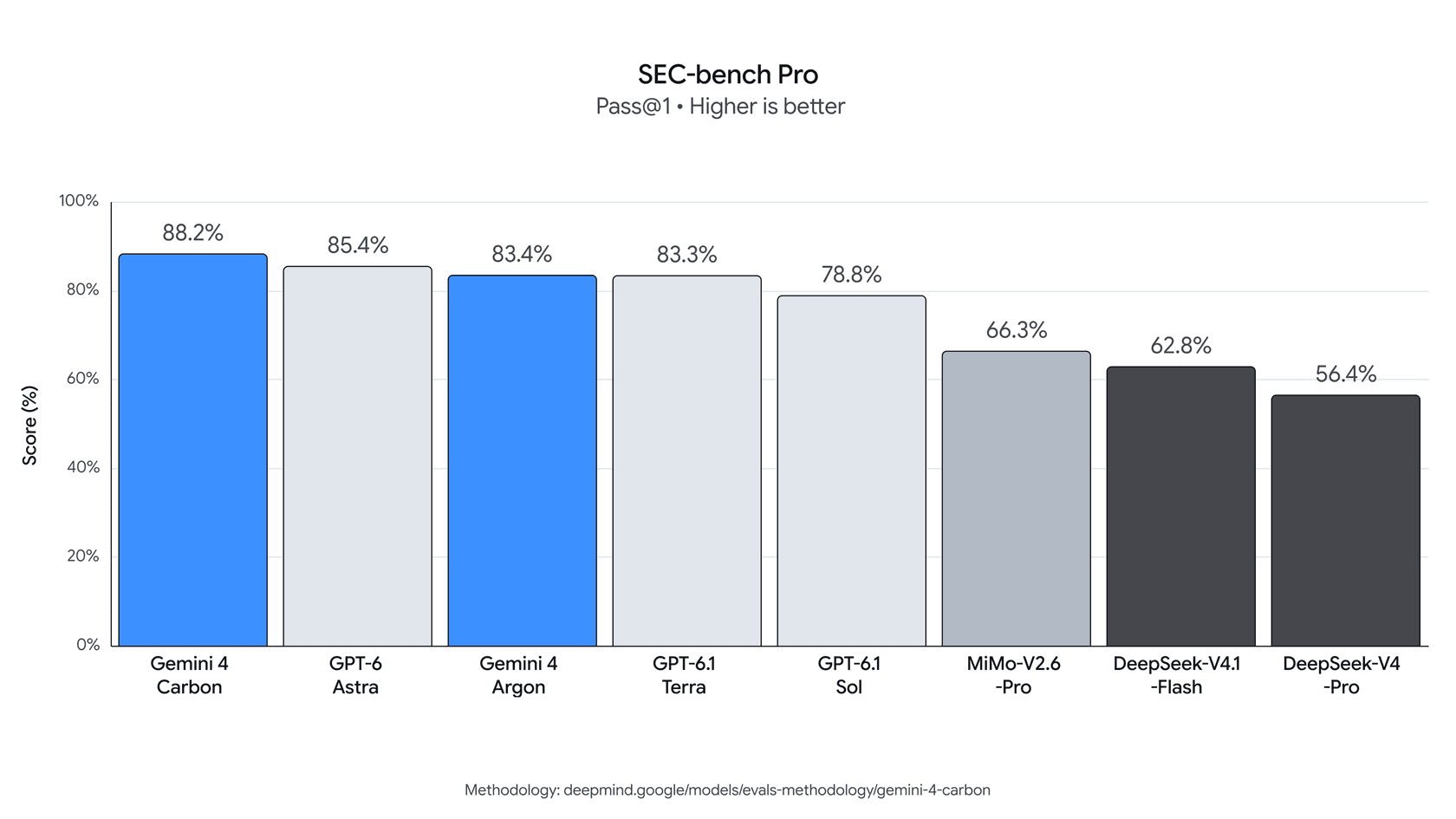
Google adds some claims from inside its own walls as well. On internal tests Carbon has "more than 2x uplift in success rate for generating secure code over Argon". The Chrome team says it did "more than 10X better than another lab's large frontier model" at writing high-quality patches. And Wiz sees it leading on web penetration testing. None of those can be checked independently yet, so I'd read them as a direction and not as numbers to plan around.
A model this good in finding and exploiting bugs is useful for attackers too, that's why the rollout starts with defenders. The Fairwind Program gives "high-priority defenders (like governments, healthcare providers, and telecommunications services)" early access, and Google says it works with over 650 partners. It's the same pattern as GPT-5.6-Cyber and Anthropic's Claude Mythos 5.1: the most capable cyber models are now shipping to vetted security teams first. Not everyone thinks it's fair for the smaller projects:
"Too bad you won't be able to use it to secure your open-source projects. If you try it'll throw up a prompt telling you to use some initiative you can't use or afford while the provider collects the findings."
If you need a cyber-tuned Google model which you can call today, Gemini 3.8 Flash Cyber is the available option.
What did Google change on safety and honesty?
This is the part of the launch I find the most useful outside security. Carbon runs on Argon's safety stack (training, real-time misuse defenses, prompt-injection resistance, chain-of-thought monitoring), and Google says they pushed further on how the model behave under pressure:
- Less cheating. Successful cheating on Terminal-Bench 4.0 dropped to 0.0%, with attempts at 0.4%. In live coding with Google's own teams, high-severity misalignment alerts fell by almost 80%.
- Fewer made-up claims. Carbon "cuts unsupported claims by approximately 2x over Argon". It puts caveats in the deliverable or lists what's still missing, "rather than fabricating or hedging around missing evidence".
- Asks before guessing. When a task is ambiguous, it retrieves sources and flags discrepancies to the user before acting.
- Stays in scope. Overreach down 26%, under-service down 29%.
- Prompt injection resistance. 0.0% attack success on Gray Swan's indirect prompt injection benchmark, down from Argon's 0.7%.
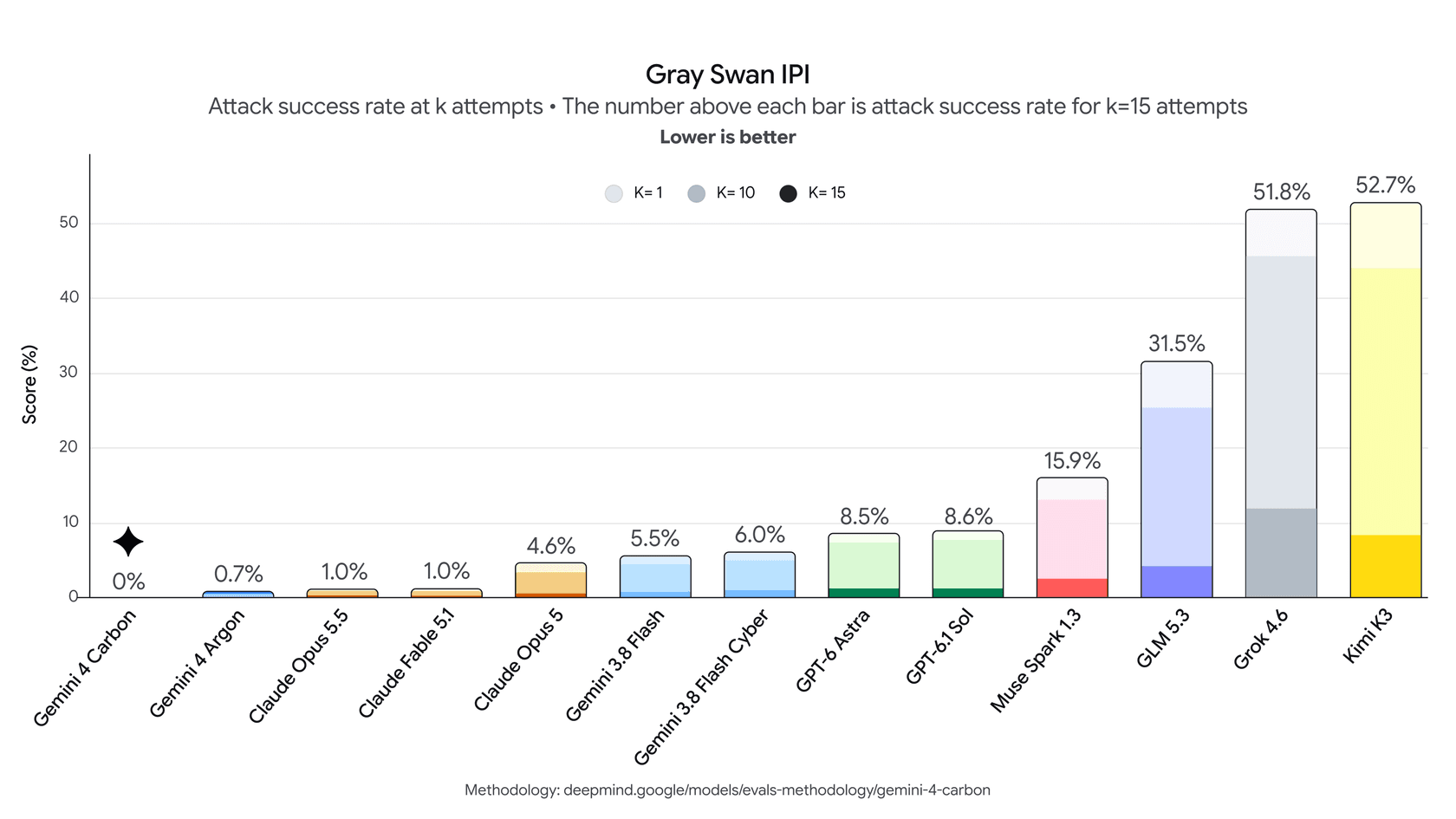
Prompt injection is the one I would underline for anyone who is building agents that read outside content. An agent reading emails, web pages or customer tickets is reading text that strangers wrote, and some of that text is going to try giving it orders. A 0% attack success rate over every attempt Gray Swan tried is a real step, even when "every evaluated attempt" isn't the same as every attempt.
Who can use Gemini 4 Carbon, and when?
Right now, almost nobody. Google's rollout runs in three steps and only the first one has started:
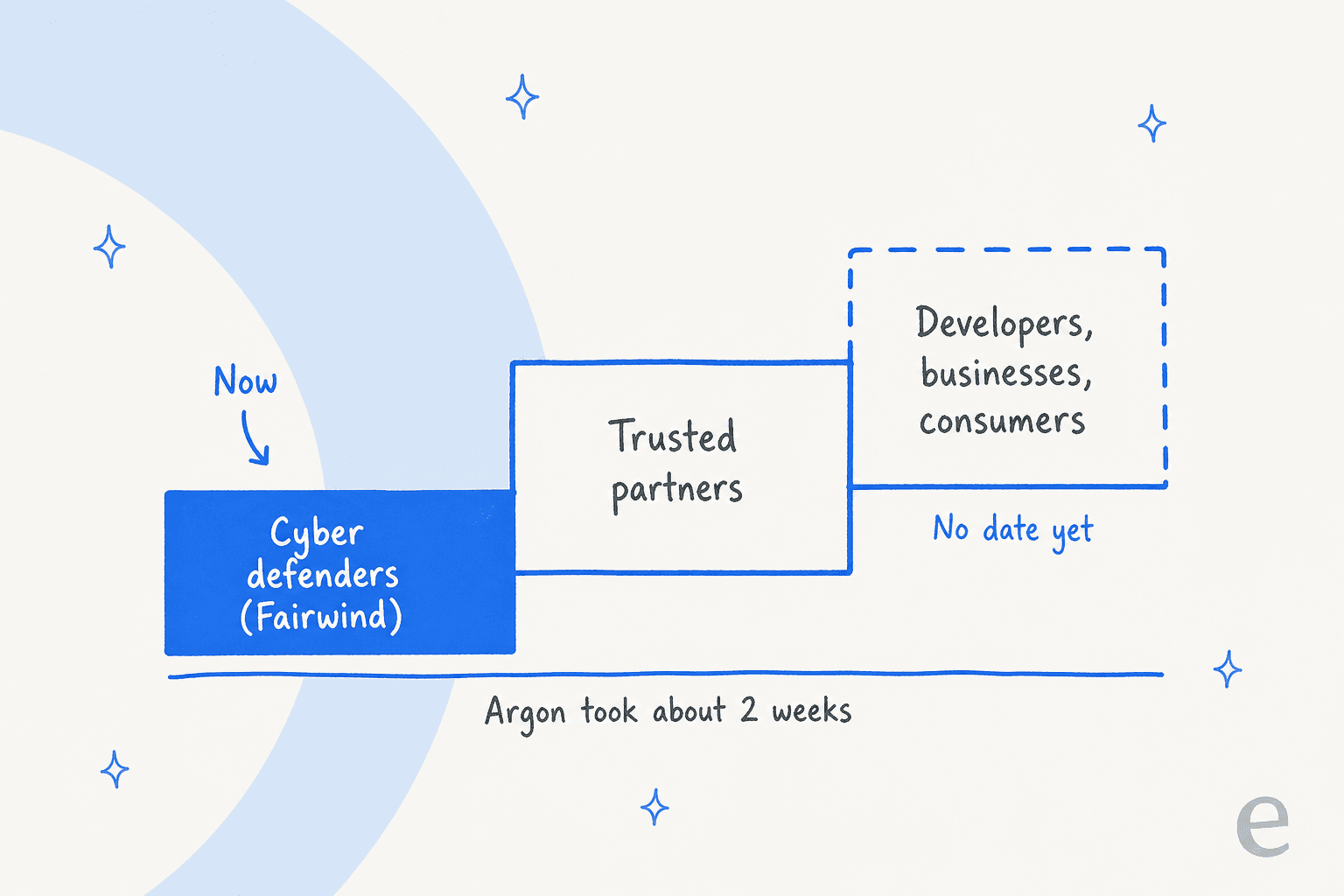
Google also says it is "actively engaged in the U.S. government's voluntary process for pre-release model testing", so part of the wait isn't in the hands of Google. The only promise on timing is "as soon as possible".
Argon is the best guide for how long that means in practice. One commenter laid the dates out:
"The previous model, Argon, was announced on 30 Sep and released on 13 Oct."
If Carbon is following the same path, it reaches the Gemini API and the Google AI Pro and Ultra plans in mid-November. I'd expect it lands in the same places where Argon did: the API, the Gemini app for paying subscribers, and Google's coding tools.
Until then, the practical options are:
- Use Argon now and switch when Carbon lands. Same API, same price card.
- Use Gemini 3.8 Flash for high-volume, everyday work. It's far cheaper, and for most everyday tasks it's enough.
- Use GPT-6.1 Sol or Claude Opus 5.5 if you need a frontier model this week and Argon hasn't worked for you.
How much does Gemini 4 Carbon cost?
Carbon launches at the same price as Argon: $2 per million input tokens and $10 per million output tokens, with cached input 95% off ($0.10). After an introductory period, Google's footnote says $4/$20 applies. There's no end date, and Carbon isn't on the Gemini API pricing page yet.
| Gemini 4 Carbon | Gemini 4 Argon | Claude Opus 5.5 | GPT-6 Astra | |
|---|---|---|---|---|
| Input / 1M (launch) | $2.00 | $2.00 until Nov 30 | $4.00 | $10.00 |
| Output / 1M (launch) | $10.00 | $10.00 until Nov 30 | $20.00 | $50.00 |
| Input / output after promo | $4 / $20 | $4 / $20 from Dec 1 | No promo | No promo |
| AA cost per task (list) | $7.76 | $7.68 | $10.03 (Max) | $6.24 (Max) |
The per-task figure from Artificial Analysis is the one that matters. Carbon writes a bit more tokens than Argon, so a task cost about the same for a score that is nine points better:
For promo maths, a cost calculator, and where the money in a task actually goes (spoiler: mostly cached input), see my full Gemini 4 Carbon pricing breakdown. The wider Gemini pricing guide covers the rest of Google's lineup.
Should you wait for Gemini 4 Carbon?
It depends on what you are doing with it, so here is how I'd decide on it.
Already on Argon? Yes, wait and then swap. Same price and same API, and better on every benchmark Google tested. Once Carbon is available for you there's no reason for staying on Argon.
Choosing a frontier model for long agentic coding or long-document work? Carbon is the one to test first when it lands. The long-context and Terminal-Bench leads are large, and at $2/$10 during the promo it undercuts Opus 5.5 by half per token. If you can't wait, my Gemini 4 Argon alternatives roundup prices every option for one buyer.
Doing computer use or pure software engineering? Opus 5.5 still leads OSWorld-2.1 and Astra still leads FrontierSWE 2. Carbon is close behind on both of them, but "close behind" is not a reason for switching.
Running high-volume, everyday tasks? Probably you don't need a frontier model at all. One commenter described a split which matches what I would do:
"I personally use 3.8 Flash most of the time and Argon/Carbon when I need to do deep analysis or research an ambiguous problem."
Open-weight options like Kimi K3.1 Pro and DeepSeek V4.1 Flash are also worth pricing for that kind of volume. For a wider look at Google's competition, see Gemini alternatives.
What does Gemini 4 Carbon mean for AI in customer support?
Less than what the benchmark table suggests, with one exception. Most support tickets don't need a model that can root-cause a kernel bug over three days. A ticket reply needs the right answer from your help center in your tone, then a handoff when it isn't sure. Smaller and cheaper models handle this well when the system around them is a good one.
The exception is honesty. Google's claim that Carbon halves unsupported claims and "surfaces discrepancies to the user before acting" is the behaviour every support team want, because a confident wrong answer to a customer is costing more than no answer at all. AI hallucinations in support are rarely about the model alone, though. They come from missing knowledge and unclear rules, and from an agent that is allowed to guess. A better model makes the problem smaller, it doesn't remove it.
I've built the parts of eesel that sit around the model, and the pattern I trust is the one Carbon is being trained toward: search first, answer from what you found, and say so when you found nothing. Qontro, a New Zealand ERP company, runs eesel that way on Freshdesk. Every new ticket gets a draft reply as an internal note, grounded in about 9,800 past tickets and help articles, with the help articles linked. Outages, data loss, and billing go straight to a person, and if a ticket doesn't have enough in it to answer confidently, eesel says so instead of guessing. The team compares each draft with what they actually sent and uses the gaps to fix the help center.
That last loop is the part which no model release gives you. It is also how you would measure if a new model helps, you run it on your own past tickets and compare. The AI customer service cost of a wrong answer is the number to watch, not the cost per token.
Try eesel
If Gemini 4 Carbon's "fewer made-up answers" pitch is what caught your eye, you can get that behaviour on your support queue now, without waiting for Google's rollout. Carbon is infrastructure; eesel is the employee. The eesel AI helpdesk teammate learns from your past tickets and help center, joins Freshdesk, Zendesk, and the other helpdesks you already use, and hands a ticket to a person when it can't ground the answer.
You can run a simulation on your real past tickets before it replies to anyone, so you see what it would have said. Plans are a fixed monthly credit plan, starting at $299 for 500 credits, and you can start free with 100 credits. Try eesel on a slice of your queue and check its drafts against your own replies.