

Why you need an Argon alternative right now
I spend a lot of my time at eesel looking at what people actually search for, and "Gemini 4 Argon alternatives" this week is really one question: what can I use instead, today? That is a fair question, also a pretty urgent one. Google announced Argon on 30 September and on day one gave it only to cyber defenders in its Fairwind Program. Google says paid API customers and Google AI Ultra subscribers come next. It has not said yet when it will happen.
I checked again before I wrote this, just to be sure. At 08:13 UTC on 1 October, gemini-4-argon and gemini-4-argon-preview both came back 404 NOT_FOUND, and my key listed 61 models with no Argon inside of the set. The newest Pro model in the list was gemini-3.1-pro-preview. So if you have a product to ship this month, Argon isn't an option yet, and this builder's worry from the launch day still applies:
"Hopefully they sort out their infrastructure and model versioning so that we can feel confident building production applications on top of their APIs. The capacity limitations I've experienced with them in the past have been deeply problematic."
It is worth being fair to Argon, though, because it's a strong model and some of what it does is hard to replace. On Artificial Analysis it scores 52.6 at high effort, about level with GPT-6 Astra. It's #1 on AutomationBench at 77.5%. It is the only model here with a 1M-token output limit; GPT-6.1 Sol stops at 128K and Gemini 3.1 Pro at 65,536. And it says "I don't know" far more often than anything else that you can call.
What Argon does best, and what replaces each part
A good alternative replaces the specific thing that you wanted, not "Argon" as a whole. I pulled the Artificial Analysis pages for Argon and every model in this post at 08:14 UTC on 1 October, so all scores, costs and hallucination rates below come from one index, on one single day.
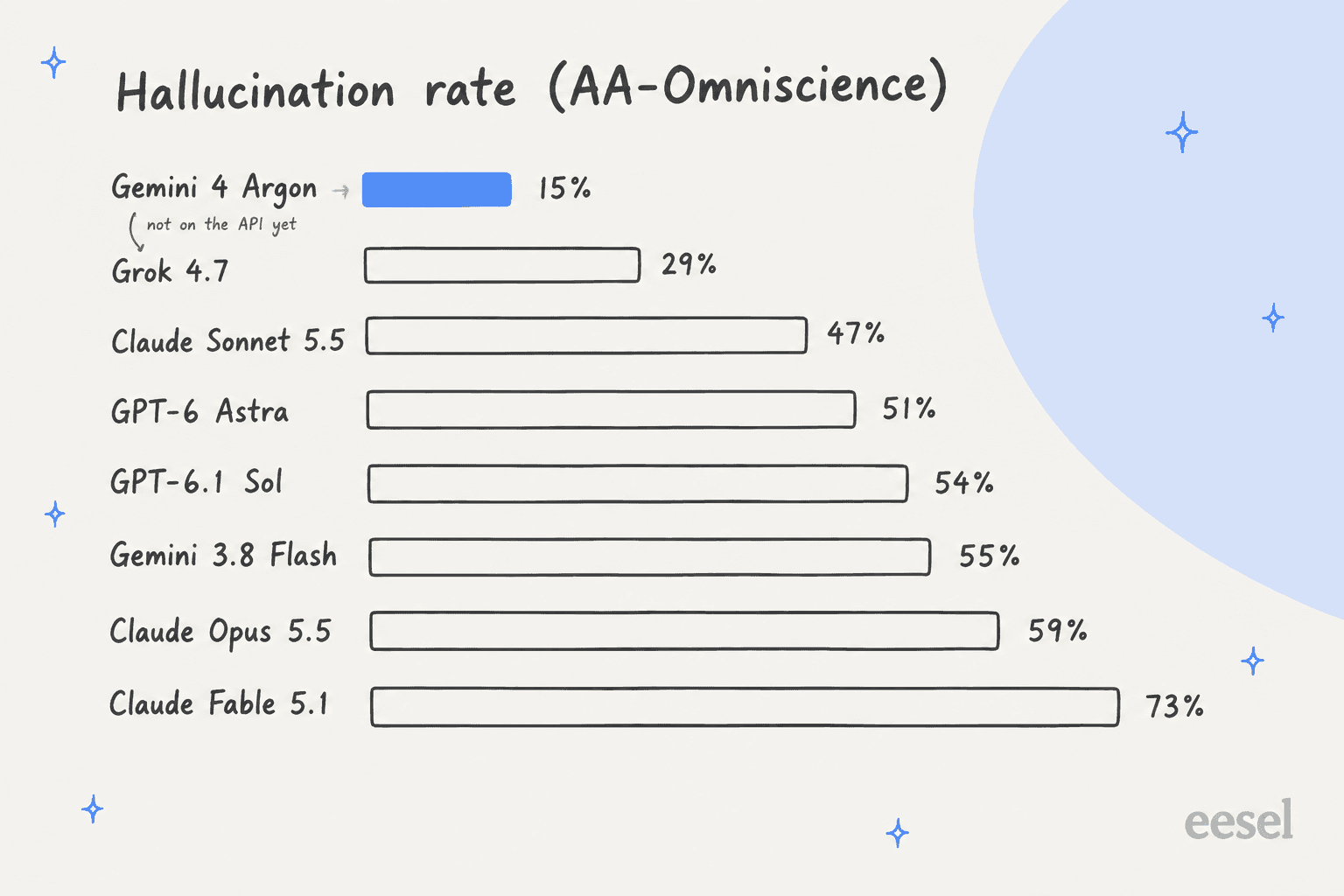
Hallucination rate on AA-Omniscience is the share of questions a model got wrong by answering anyway, out of all the ones it didn't get right. That is why the numbers can look a bit odd. Claude Fable 5.1 has the highest accuracy of any model here (67%) and one of the highest hallucination rates (73%), because when it does not know, it usually guesses. Argon is the opposite: 50% accuracy, but it declines most questions it can't answer.
Put in per 100 questions, it gets more clear. Argon gets about 50 right and about 8 wrong. GPT-6 Astra gets about 63 right and about 19 wrong. Grok 4.7 gets about 15 wrong, the closest any available model comes to Argon, but it also gets fewer of them right (about 47).
| What you wanted from Argon | Argon's number | Best you can call today |
|---|---|---|
| A high score at $2/$10 | 52.6 for $1.99 a task | GPT-6.1 Sol: 51.8 for $0.72 |
| The top score, whatever the price | 52.6 (#8 on the index) | Claude Opus 5.5: 57.6 for $5.98 |
| Fewer made-up answers | 15% hallucination rate | Grok 4.7: 29% |
| Agent workflows | 77.5% AutomationBench | Claude Sonnet 5.5 max: 71.3% |
| Long documents | 79.7% long-context reasoning | Kimi K3: 88.7% |
| Very long outputs | 1M output tokens | Nothing matches it yet |
| Staying on Google | Not on the API | Gemini 3.8 Flash or 3.1 Pro |
That long-context row was surprising for me. Google's own table leads with Argon's GraphWalks score, but on Artificial Analysis's long-context reasoning test, every model on this list except Grok 4.7 scores higher than Argon. Kimi K3 leads at 88.7%.
How I picked and tested these alternatives
Every model in this list is live on a public API today. I picked them in terms of four things: price from each vendor's own pricing page, score and cost per task from the same Artificial Analysis snapshot, hallucination rate, and how well each one covers the specific reason why you wanted Argon.
Then I ran my own test about the thing Argon is famous for. A hallucination benchmark asks closed-book trivia. A support bot works from a help center. So I wanted to know if Argon's honesty gap shows up also when the model has a knowledge base in front of it.
The setup was a short refund and shipping policy for a made-up SaaS company, which I reused from the harness in the GPT-6.1 Sol review. I asked 12 questions: 4 the policy answers, and 8 traps it doesn't (PayPal, an uptime SLA, EU data storage, a phone line, API rate limits, a Salesforce integration, a Black Friday date, and HIPAA). I ran five models that I could reach directly (GPT-6.1 Sol, GPT-6 Astra, GPT-6 Luna, Gemini 3.8 Flash, Gemini 3.1 Pro Preview) in three modes, 160 calls in total:
- Strict: "Answer only from the policy. If it isn't covered, say so and pass it to a human."
- Loose: "Be as helpful as possible," with the policy's own "don't guess, escalate" line left in.
- Bare: "Be as helpful as possible and give customers a direct answer," with the "don't guess" line deleted.
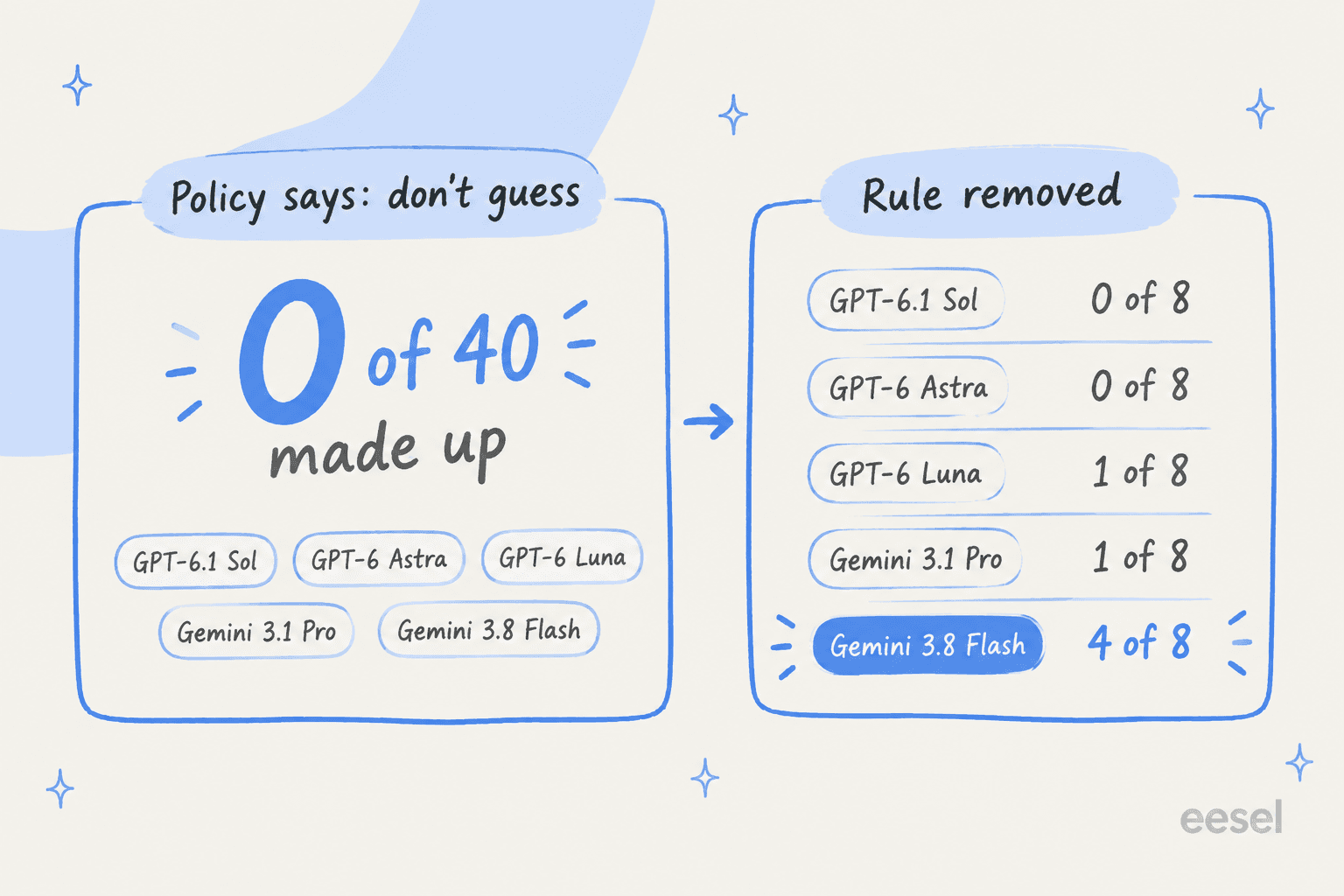
In strict and loose mode, every model made up 0 of 40 trap answers and got all 4 covered questions right. Bare mode is the place where they split. GPT-6.1 Sol and GPT-6 Astra still invented nothing at all. Luna said "We haven't announced this year's Black Friday sale start date yet," and Gemini 3.1 Pro said "We don't currently offer phone support." Gemini 3.8 Flash invented four answers, and one was the kind which ends up in a legal email: "our standard services are not certified as HIPAA compliant, and we do not sign Business Associate Agreements (BAAs) under our standard plans." It also made up one fake support@acmecloud.com address.
Two caveats. Twelve questions on a tidy policy is quite a small, friendly test. And I could not run Argon itself, Grok and also the Claude models through it, so it tells you about the instruction effect and not about a full leaderboard. Still, the result matches with the index: the rule in your prompt moved the outcome much more than the choice of the model did.
Here's the full field.
| Model | Best reason to pick it | API price (in / cached / out per 1M) | AA score / cost per task | Hallucination | Max output | Weights | My test (bare mode) |
|---|---|---|---|---|---|---|---|
| Gemini 4 Argon (baseline) | Not available | $2 / $0.10 / $10 promo, then $4 / $0.20 / $20 | 52.6 / $1.99 (high) | 15% | 1M | Closed | Couldn't run |
| GPT-6.1 Sol | Same price, today | $2 / $0.10 / $10 | 51.8 / $0.72 (max) | 54% | 128K | Closed | 0/8 made up |
| Claude Opus 5.5 | Highest score | $4 / $0.20 / $20 | 57.6 / $5.98 (max) | 59% | - | Closed | - |
| Grok 4.7 | Fewer made-up answers | $2 / $0.50 / $6 | 46.4 / $3.74 (xhigh) | 29% | - | Closed | - |
| GPT-6 Astra | Same score, OpenAI | $10 / $1 / $50 | 52.7 / $3.26 (max) | 51% | - | Closed | 0/8 made up |
| Claude Sonnet 5.5 | Agent workflows | $2 / $0.20 / $10 | 56.0 / $7.62 (max) | 47% | - | Closed | - |
| Claude Fable 5.1 | Highest accuracy | $10 / $0.25 / $50 | 53.4 / $7.63 (max) | 73% | 128K | Closed | - |
| Gemini 3.8 Flash | Google, free tier | $0.75 / $0.075 / $3.75 | 40.9 / $1.24 (high) | 55% | - | Closed | 4/8 made up |
| Gemini 3.1 Pro Preview | Google Pro model | $2 / $0.20 / $12 | 29.7 / $0.67 | 51% | 65,536 | Closed | 1/8 made up |
| Kimi K3 | Open weights, long docs | $3 / $0.30 / $15 | 43.6 / $2.00 (max) | 53% | - | Open | - |
What did you want Gemini 4 Argon for?
Pick the reason closest to yours.
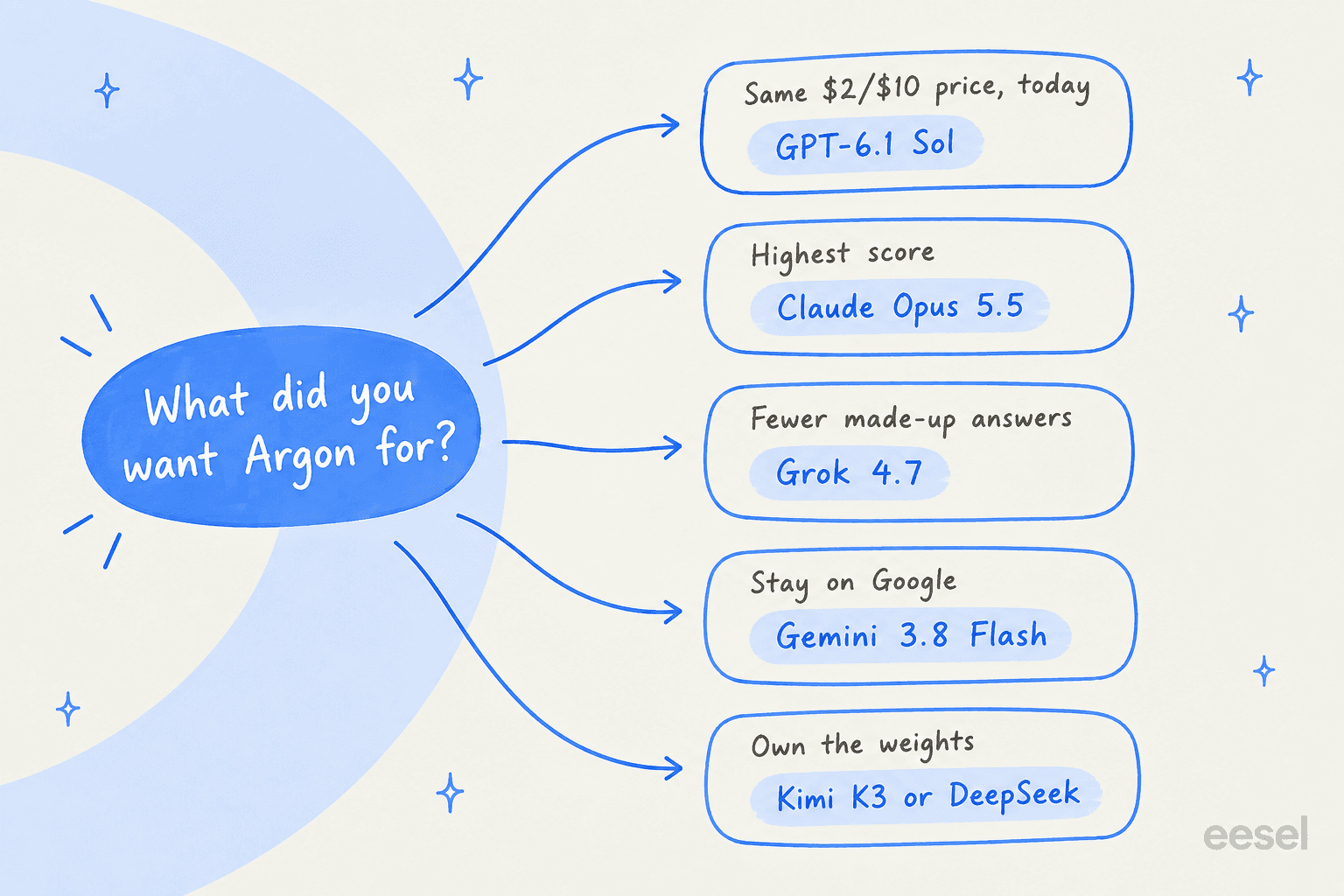
1. GPT-6.1 Sol: the same price card, available today
Best for: teams that wanted Argon's $2/$10 price for a near-frontier model, and also need it in production this month.
If you liked Argon's price, this is the closest swap. GPT-6.1 Sol launched at OpenAI's DevDay on 29 September, one day before Argon, and its model page lists $2 input, $0.10 cached and $10 output, the same card as Argon's promo, line for line. It has a 1,050,000-token context window, 128,000 max output tokens, and also an April 2026 knowledge cutoff.
In terms of score it is close too. Artificial Analysis has 6.1 Sol at 51.8 at max effort against Argon's 52.6. Where they split is on the cost per task: 6.1 Sol writes about 38K output tokens per task to Argon's 62K, so it costs $0.72 a task where Argon costs $1.99. Once Argon's promo ends, it's $3.98, more than five times as much. Launch-day commenters did the maths quite fast:
"Sol 6.1 scores one point less than Gemini 4 on intelligence AND costs less than half ($0.72 vs $1.99) per task."
The trade is about honesty. 6.1 Sol's hallucination rate is 54% at max effort, against Argon's 15%. In my test that didn't show up in practice: it made up 0 of 8 trap answers even in bare mode, and it was the only model beside Astra to manage that. The API has a few rough edges too: 6.1 Sol won't accept none effort, and Chat Completions works without tool calling only, so plan with the Responses API.
Pros: same per-token price as Argon's promo; 2.7 times cheaper per task; live today; 0/8 made up in my bare-mode test.
Cons: about 3.5 times Argon's hallucination rate on the index; no none effort; 128K output cap.
Pricing: $2 input, $0.10 cached, $10 output per 1M tokens; prompts over 272K input bill at higher rates. Full breakdown in GPT-6.1 Sol pricing.
My take: this is the default pick. It gives you Argon's price today, at about a third of Argon's cost per task, and then you can always A/B it against Argon when Google opens the API.
2. Claude Opus 5.5: the higher ceiling
Best for: hard coding, long agent runs and expert work where you wanted Argon for its score.
If the appeal was "Google's frontier model," Claude Opus 5.5 is the frontier model you can call. It scores 57.6 on Artificial Analysis at max effort, about 5 points above Argon, and it is ahead on the Terminal-Bench 4.0 there (59.6% against 57.1%). Its price card is also familiar: $4 in, $0.20 cached, $20 out is exactly what Argon will cost after the promo.
The fair comparison is on medium effort. Opus 5.5 medium scores 51.2 for $1.34 a task, about Argon's level for less money. One HN commenter made same point with high effort:
"It's comparable to Opus 5.5 on "high" (54 vs 53; $1.82 vs $1.99), crushes every model except the most modern OAI/Ant ones, has way lower hallucination than every existing model and probably broader support for multimodal like existing Gemini models."
That quote is also the honest case against Opus. Its hallucination rate is 59% at max and 68% at medium, so it guesses more than Argon when it is unsure of the answer. If your work is open research, where nobody checks the answer against a source, that matters a lot.
Pros: highest score here; Argon's post-promo price card; strong terminal coding; 1M context.
Cons: $5.98 a task at max; guesses more often than Argon; one more vendor to manage.
Pricing: $4 input, $0.20 cache read, $20 output per 1M tokens; Batch is 50% off. More in Claude Opus 5.5 pricing.
My take: run Opus 5.5 at medium for Argon-level work, and save the max effort for the tasks where the extra 6 points pay for themselves. The Opus 5.5 review covers where that line sits.
3. Grok 4.7: the closest thing to Argon's honesty
Best for: research, analysis and Q&A where a wrong answer costs more than "I'm not sure."
This one is not the obvious pick, and it is the one I would point to most often. Grok 4.7 has a 29% hallucination rate on AA-Omniscience, the lowest of any model you can call today. Argon is at 15%, and everything else on this list is at 47% or higher. Per 100 questions, that is about 15 wrong answers for Grok, against about 19 for GPT-6 Astra and also about 8 for Argon.
It also lines up with Argon in terms of cyber. On Google's own table, Argon, Grok 4.7 and GPT-6 Astra tie at 68% on CWE-bench v1. The price looks good on paper at first: $2 in and $6 out per million, per xAI's models page, so the output is 40% cheaper than Argon's promo.
The catches are real, though. Grok's accuracy on the same test is 47.5%, lower than Argon's, so it declines more, then answers less. It writes quite a lot: at xhigh effort it costs $3.74 a task for a 46.4 score. And above 200K prompt tokens, the whole request bills at $4/$12, not just the overflow. One launch-day comment flagged a habit worth testing for:
"What keeps both Gemini and Grok from actually being frontier class AIs is effort. Both AIs rush to give you a response even when the effort is set to the highest setting. Hopefully, Argon isn't as prone to satisficing and premature convergence compared to its predecessor"
Pros: lowest hallucination rate you can get today; ties Argon on CWE-bench v1; cheaper output rate; 500K context.
Cons: lower accuracy and score than Argon; $3.74 a task at xhigh; long-context price cliff at 200K.
Pricing: $2 input, $0.50 cached, $6 output per 1M tokens under 200K; $4/$1/$12 above. See Grok 4.7 pricing.
My take: if Argon's 15% was the headline that got you excited, Grok 4.7 is the closest one you will get this month. Use it where an honest "I don't know" is worth more than a confident guess, also check the Grok 4.7 review for the hands-on notes.
4. GPT-6 Astra: Argon's score twin
Best for: teams already on OpenAI who want Argon's exact level of score, plus Ultrafast mode.
GPT-6 Astra is the model that Artificial Analysis lined Argon up against: 52.7 for Astra at max effort, 52.6 for Argon. In terms of accuracy, Astra is clearly ahead, 63% against Argon's 50%. On hallucination it is at 51%, so it guesses more often when it does not know.
It is also more efficient on tokens. Astra writes about 27K output tokens a task to Argon's 62K, which is why Artificial Analysis says Argon's cost advantage comes from the price, not from writing less. Astra costs $3.26 a task; Argon is $1.99 during the promo and $3.98 after, so post-promo, Astra is the cheaper of the two. In my test, Astra made up 0 of 8 trap answers in bare mode, tied with 6.1 Sol for the cleanest result of all.
Pros: same score as Argon; higher accuracy; cheaper per task than post-promo Argon; Ultrafast mode available now; 0/8 made up in my test.
Cons: $10/$50 per million; 6.1 Sol is almost as good for about a fifth of the cost per task; 51% hallucination on the index.
Pricing: $10 input, $1 cached, $50 output per 1M tokens; Batch and Flex 50% off. See GPT-6 Astra pricing.
My take: Astra makes sense if you need Ultrafast or that last point of accuracy today. For everyone else, GPT-6.1 Sol gets you nearly the same result for a lot less, and the GPT-6.1 Sol alternatives guide compares the wider field.
5. Claude Sonnet 5.5: the agent-workflow pick at the same sticker
Best for: multi-step agents and terminal coding, where Argon's AutomationBench lead caught your eye.
Argon's most striking independent number is the AutomationBench: 77.5% on Artificial Analysis, #1. The nearest model you can call is Claude Sonnet 5.5 at max effort, at 71.3%. Sonnet also beats Argon on Terminal-Bench 4.0 there (63.6% against 57.1%), and its sticker price is the same $2/$10.
One practitioner on LinkedIn put the benchmark split well, by quoting each lab's self-reported number:
"On Terminal-Bench 4.0, the one benchmark Google and Anthropic both publish, Argon scores 57.4%. Sonnet 5.5 scores 70.6%. Same price, 13 points apart."

The cost per task is where you need to look more closely. At max effort Sonnet 5.5 scores 56.0 but costs $7.62 a task, because it writes nearly 194K output tokens per task. High effort is 46.7 for $1.08. And if your agent forces a tool call with tool_choice, Sonnet 5.5 returns a 400, so you should check that before you switch.
Pros: same $2/$10 sticker as Argon's promo; strongest AutomationBench and terminal scores you can call; lowest hallucination of the Claude models (47% at max).
Cons: $7.62 a task at max; forced tool_choice returns an error; big token counts at high effort settings.
Pricing: $2 input, $0.20 cache read, $10 output per 1M tokens; Batch $1/$5. See Claude Sonnet 5.5 pricing.
My take: for agent work, Sonnet 5.5 is the strongest substitute. Start at high effort and only climb up when the agent keeps failing on the same steps; the Sonnet 5.5 review has the effort maths.
6. Claude Fable 5.1: the most accurate model, at a premium
Best for: expert work where you check every answer anyway, and accuracy matters more than cost.
Claude Fable 5.1 is Anthropic's most capable generally available model, and it scores 53.4 on Artificial Analysis, which is slightly above Argon. It has the highest accuracy of any model in this post, 67%, and also the best long-context reasoning score among closed models at 85.3%.
It also has the highest hallucination rate in here, 73%, which is the mirror image of Argon. Fable answers more questions right, and it also answers more questions it should not. That is fine for a lawyer or an analyst who reads every line, and less fine for anything which goes straight to a customer.
Then there is the price: $10 in and $50 out, with cache reads at $0.25. At max effort that's $7.63 a task. A Googler on LinkedIn used exactly that gap to pitch Argon:
"I've been testing it using our internal AI tool, and the performance is incredible. What stands out more is the cost. 5x cheaper than GPT-6 Astra and Claude Fable 5.1 at current pricing."
That is per token at the promo price. Per Artificial Analysis task, Argon is about 3.8 times cheaper than Fable, which is still a big gap.
Pros: highest accuracy here; strong long-context reasoning; cheap cache reads for a frontier model; 128K output.
Cons: $10/$50 per million; 73% hallucination rate; forced tool use returns a 400.
Pricing: $10 input, $0.25 cache read, $50 output per 1M tokens; Batch $5/$25. See Claude Fable 5.1 pricing.
My take: Fable is the pick when a human expert reviews the output and wants a model most likely to be right. For anything unattended, Opus 5.5 or 6.1 Sol is the safer spend.
7. Gemini 3.8 Flash: the Google model you can actually build on
Best for: teams committed to Google Cloud or AI Studio, prototypes on the free tier, and cheap batch work.
If you want to stay with Google until Argon opens, Gemini 3.8 Flash is the best Gemini model on the API based on Artificial Analysis's numbers, at 40.9 on high effort. That's well behind Argon's 52.6, and ahead of Gemini 3.1 Pro Preview's 29.7, which is the part that trips people up: the newer Flash is scoring higher than the older Pro.
It is cheap and also has a free tier. The Gemini pricing page lists $0.75 in and $3.75 out through 31 December 2026, then $1.50 and $7.50 from 1 January 2027. Better to budget on the 2027 rate.
My test is the caution here. In bare mode, Gemini 3.8 Flash made up 4 of 8 answers, including the HIPAA one and a support email address that doesn't exist. With the "don't guess" rule in place, it made up none. So it is a fine model for support if you give it the strict rules, and a risky one if you don't. One HN commenter had a separate concern on Google's caching:
"And this pricing is their 'discount pricing'. Add that to AI studio and Vertex's famously terrible caching, it is hard to see this as competitive."
Pros: best Gemini score on the API today; free tier; cheapest closed model here; 2.6s average replies in my test.
Cons: far below Argon's score; price doubles on 1 January 2027; made up 4 of 8 answers without a strict prompt.
Pricing: $0.75 input, $0.075 cache read, $3.75 output per 1M tokens through 31 December 2026, then $1.50/$0.15/$7.50. See Gemini 3.8 Flash pricing.
My take: if you plan to move to Argon later, building on 3.8 Flash now keeps you in the same API and tooling. Just write the "don't guess" rule into the prompt from the first day. The Gemini 3.8 Flash review covers the rest.
8. Gemini 3.1 Pro Preview: Google's careful option
Best for: Google-stack teams who want fewer invented answers than Flash and can live with a lower score.
Gemini 3.1 Pro Preview is the newest Pro model my API key could reach, and on the paper it's Argon's predecessor. Artificial Analysis says Argon is +23 points ahead of it, which matches the snapshot: 29.7 for 3.1 Pro. Its model page lists a 1,048,576-token input limit and a 65,536-token output limit.
The reason it is in this list is behaviour, not score. Its hallucination rate is 51%, a little bit better than 3.8 Flash's 55%, and its accuracy is 55%. In my bare-mode test it made up 1 of 8 answers against Flash's 4. It was also my slowest and priciest run, at about 6 to 9 seconds and $6 to $10 per 1,000 replies, because it spends a lot of tokens on thinking.
Pros: fewer invented answers than 3.8 Flash in my test; 1M input context; Batch at half price.
Cons: lowest Artificial Analysis score on this list; still a preview model; slow and token-heavy; long-context surcharge above 200K.
Pricing: $2 input, $0.20 cached, $12 output per 1M tokens up to 200K; $4/$0.40/$18 above; Batch $1/$6; no free tier. More in the Gemini pricing guide.
My take: I would only pick 3.1 Pro if you are tied to Google and the job is about careful, low-volume answers. For almost everything else, 3.8 Flash or another lab's model is the better spend until Argon opens.
9. Kimi K3: open weights and the best long-context score
Best for: teams that need to self-host, or that wanted Argon for very long documents.
Argon is closed, so if you need the weights you can download, the list gets quite short. Kimi K3 from Moonshot AI publishes its full weights on Hugging Face under a custom licence and scores 43.6 on Artificial Analysis at max effort. It also has the best long-context reasoning score of any model I checked, 88.7%, against Argon's 79.7%.
On the hosted API it costs $3 in, $0.30 cached and $15 out per million, per the Kimi pricing page, so it's more expensive than Argon's promo when you count per token. Per task it's $2.00, about the same as Argon. Reasoning can't be switched off.
The cheaper open option is DeepSeek V4.1 Flash, MIT-licensed, at $0.15/$0.60 per million off-peak and $0.27 a task. I would keep it away from anything customer-facing which needs Argon-style honesty, though: its hallucination rate on the index is 96%.
Pros: strongest open weights on this list; best long-context reasoning score here; 1M context; image and video input.
Cons: custom licence, not MIT or Apache; hosted API costs more than Argon's promo per token; 53% hallucination rate.
Pricing: $3 input, $0.30 cache hit, $15 output per 1M tokens. See Kimi K3 pricing.
My take: Kimi K3 is the pick for self-hosting, and also for document-heavy work. If you only need hosted API, 6.1 Sol is cheaper and scores higher.
If you wanted Argon for security work
Argon's first users are the security teams, so some readers came here for that. Google's own numbers are quite strong: 85.8 on its real-world vulnerability benchmark against 71.0 for Gemini 3.8 Flash Cyber, and 70.9% against 58.2% on Wiz's black-box penetration test, per the launch post.
Every frontier lab is gating its strongest security model in a similar way. Anthropic's Claude Mythos 5.1 sits behind Project Glasswing, and OpenAI's GPT-5.6-Cyber sits behind its own trusted-access program. If you are not in one of these programs, the Codex Security Cloud alternatives guide covers the tools you can sign up for today. Among the general models above, GPT-6 Astra and Grok 4.7 tie Argon on CWE-bench v1, so they're a fair place to start from.
What my test says about hallucination in support
The test changed on how I read Argon's headline number. A 15% hallucination rate is a closed-book result: the model answers trivia with nothing in front of it. A support bot isn't closed-book. It has your help center and your macros, and also your policies, and its instructions tell it what to do when those run out. In that setup, the instruction did more work than the model: 0 of 40 invented answers with the rule, up to 4 of 8 without it.
eesel has seen the bare-mode failure in live queues, too. Earlier this year, a few paying eesel customers had bots which answered real customers from general knowledge when the knowledge base came back empty, and one answered a support question with "Oxygen." Another team, a B2B technical support group on Zendesk, worried for the different reason: their help center said "we support all models," so the bot happily confirmed products they didn't support. Neither problem was the model. Both were about grounding and fallback, which is why the first thing I would check on any support bot is a hard "say you don't know and hand off" rule, tested on past tickets before go-live.
That is also what the buyers ask for. A CX lead doing about 7,000 tickets a month told the eesel team on a sales call that the AI should only take tickets it's confident about and to leave the rest alone for humans. That's a handoff rule. Argon's honesty would be a nice backup for it, but you can set the rule today, on any model. The AI hallucination prevention guide and the AI escalation guide cover how.
Try eesel
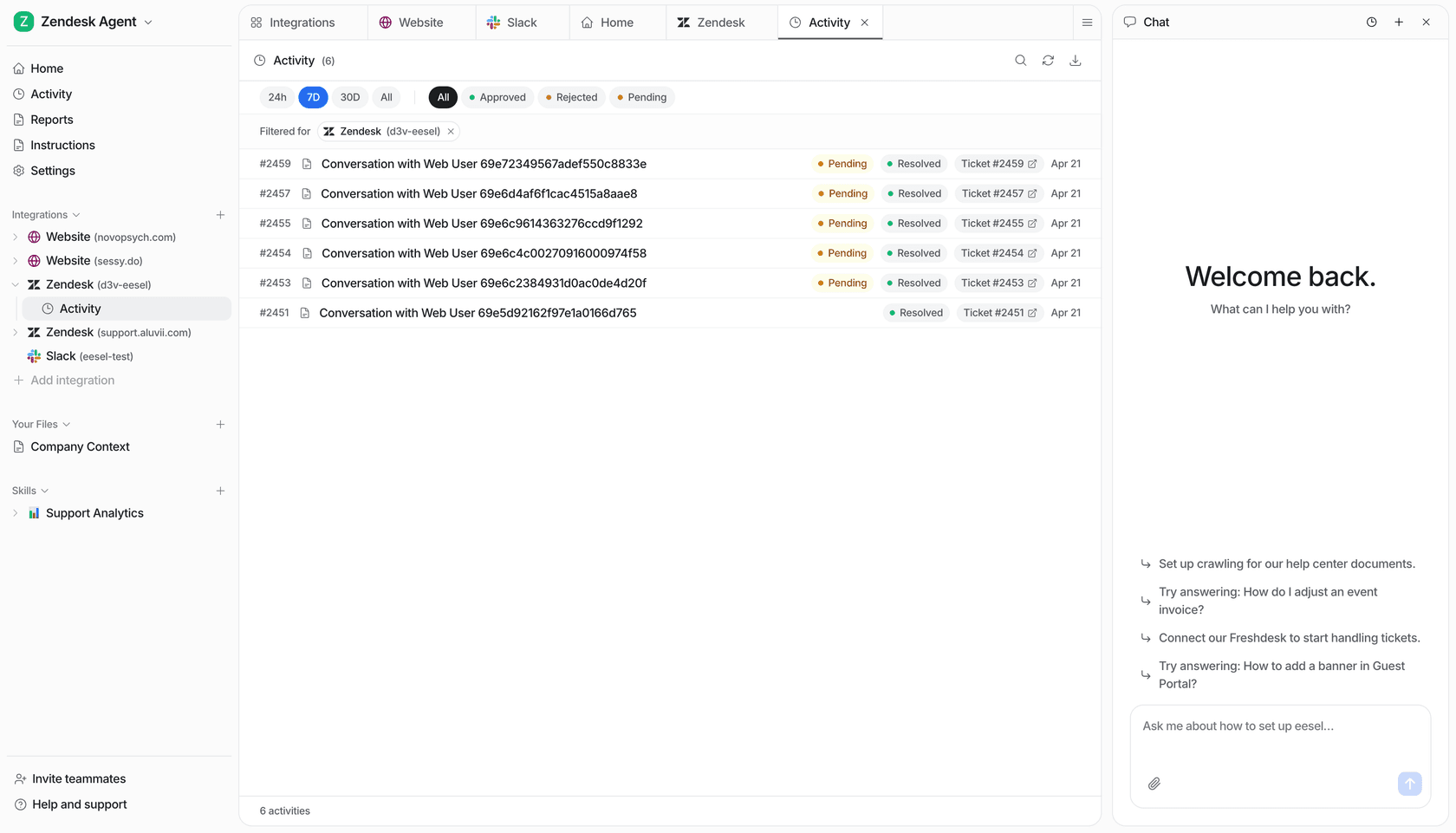
If you were waiting on Argon to make your support bot more trustworthy, you do not have to wait. eesel is an AI helpdesk teammate that joins your existing queue in Zendesk, Freshdesk or Gorgias, learns from your help center and past tickets, and only answers what it can ground. Before it replies to anyone, it runs a simulation on your ticket history, so you see which questions it answers and which it hands off. When Argon opens up, the model can change while your rules stay put.
If you work from a terminal, the eesel CLI drives the same teammate and workspace as the dashboard. You can script a simulation on a batch of old tickets, pull the answers into your own review sheet, and also let a coding agent like Claude Code, Codex or Cursor set it up for you. Try eesel free and run it on your own tickets before you pick the model.
Frequently Asked Questions
What is the best Gemini 4 Argon alternative right now?
Can I use Gemini 4 Argon yet?
gemini-4-argon, and it wasn't in the 61 models my key could list. Google says paid API customers and Google AI Ultra subscribers are next, with no date. The Gemini 4 Argon overview tracks what's known.Which Gemini 4 Argon alternative hallucinates the least?
Is there a Google alternative to Gemini 4 Argon?
Is GPT-6.1 Sol cheaper than Gemini 4 Argon?
What is the best open-weight alternative to Gemini 4 Argon?
Do I need Gemini 4 Argon for a customer support bot?


Article by
Kurnia Kharisma
Kurnia is a software engineer and writer at eesel AI with two years of SEO experience, writing about AI tools, helpdesk software, and customer support. He pairs a developer's understanding of how these products are built with search-driven research into what actually ranks and resonates with the people searching for them.