


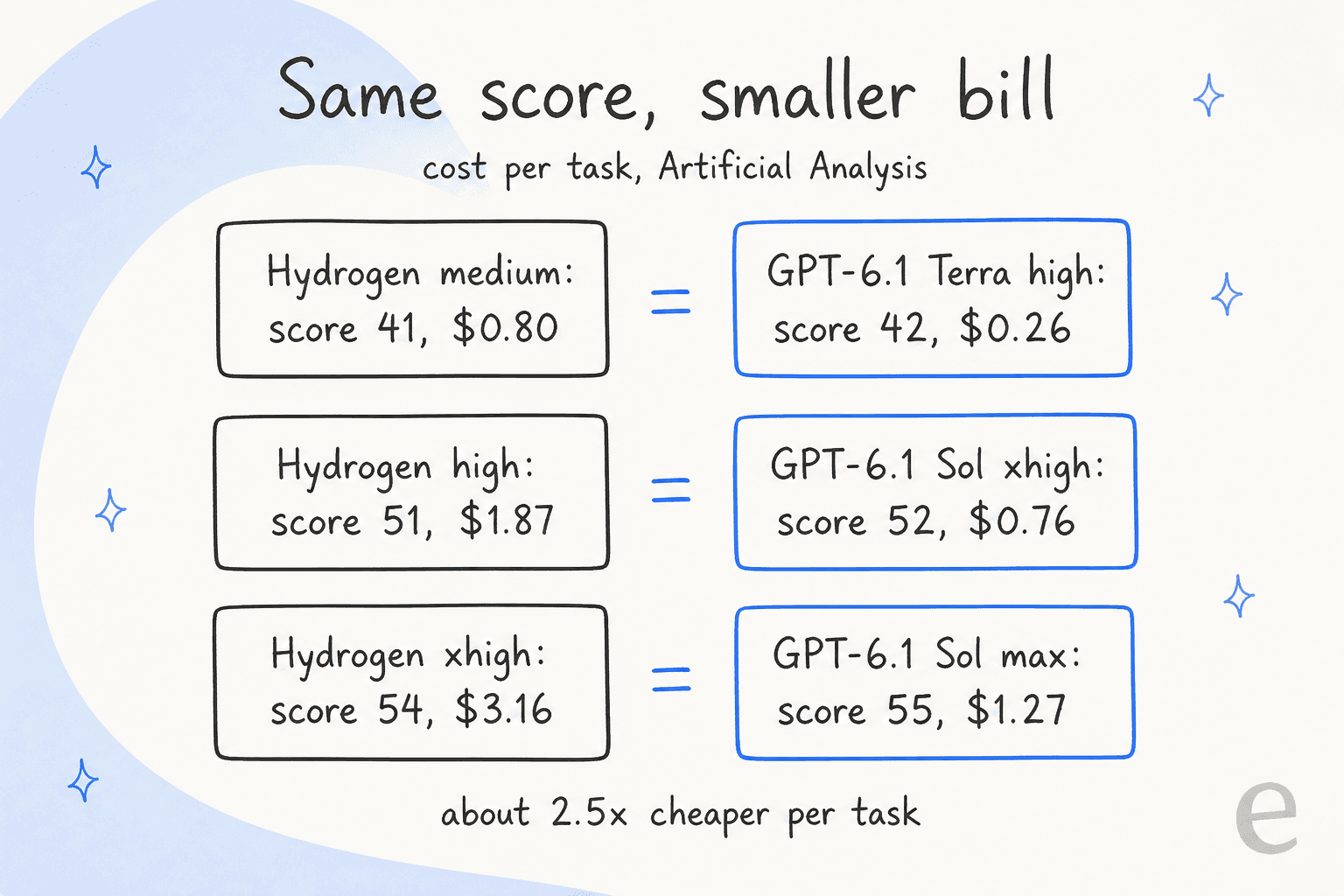
The best Gemini 4 Hydrogen alternative for most builders is GPT-6.1 Sol at xhigh effort. It costs more per token than Hydrogen, but Artificial Analysis scores it 52 for $0.76 a task, while Hydrogen at its default high level scores 51 for $1.87. Hydrogen thinks a lot before it answers, and you pay for every one of those tokens.
Pick Claude Sonnet 5.5 for coding and computer-use agents, DeepSeek V4.1 Flash for the smallest bill, and Gemini 4 Carbon only for the hardest problems. If you're building a support agent, eesel is a ready-made helpdesk teammate that sits on top of models like these, and its CLI lets a coding agent load your help articles and test its answers before launch.
Why look past Gemini 4 Hydrogen at all?
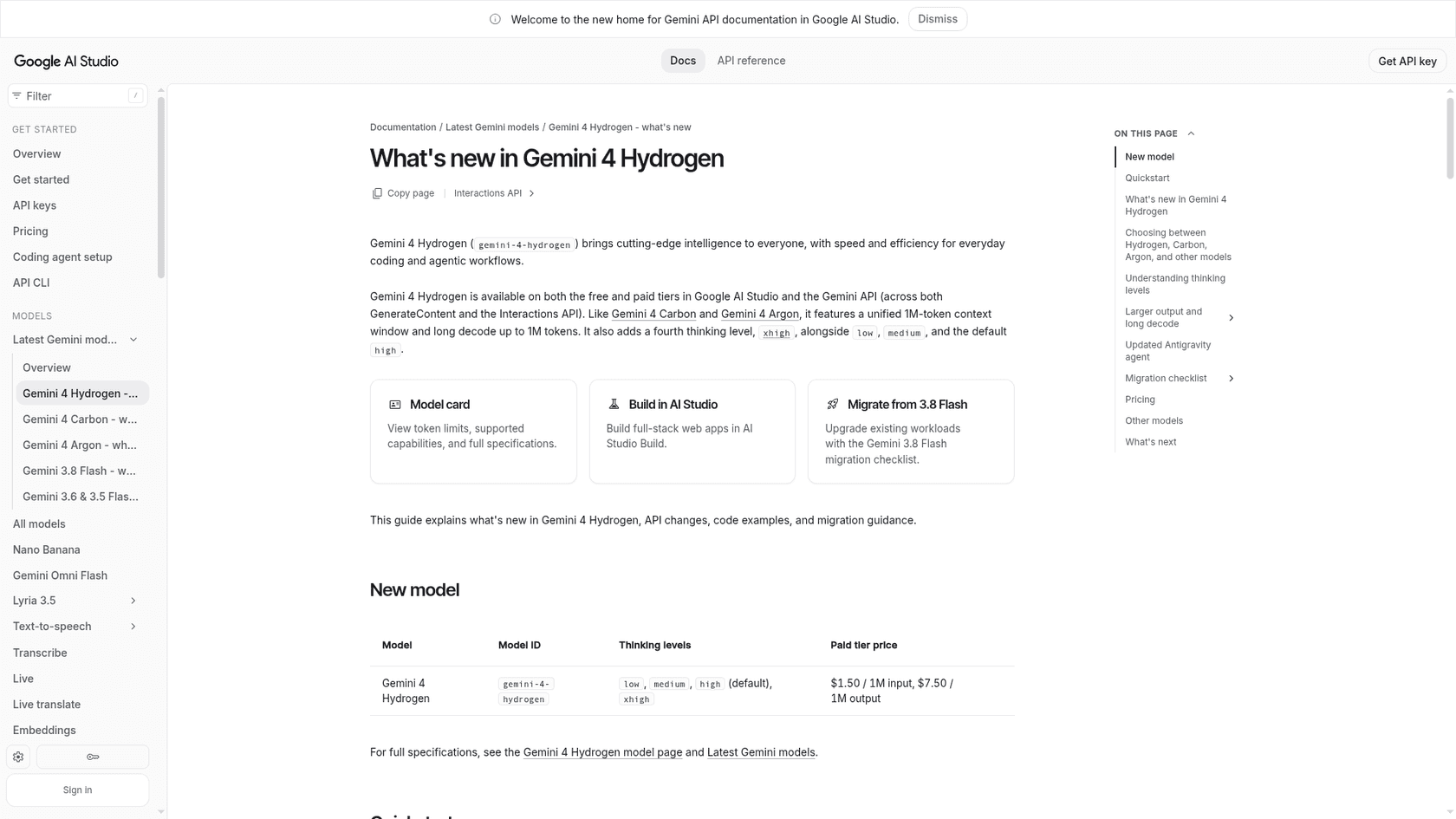
I'll start with the good part, because there's a lot of it. Gemini 4 Hydrogen launched on 12 November 2026 at $1.50 per million input tokens and $7.50 per million output, priced flat across its full 1 million-token window. It has a rate-limited free tier, it takes text, images, audio, video and PDFs, and at low and medium thinking it's quick: 1.3 and 3.7 minutes per Intelligence Index task on Artificial Analysis. Google also reports it as 2.5 times faster than Gemini 3.8 Flash at its default setting, per the launch post.
Builders still go shopping, and in my experience it's for one of four reasons:
- The bill climbs fast at high thinking. The token price never changes, but cost per task does. Artificial Analysis puts Hydrogen at
$0.29per task on low,$0.80on medium,$1.87on high (the default) and$3.16on xhigh. That's an 11x spread on the same model, because AA describes it as "very verbose" at the top end. - Coding and computer use trail Claude. Google's own model card has Sonnet 5.5 ahead on Terminal-Bench 4.1 (
63.9%vs57.0%) and OSWorld-2.1 (83.9%vs77.6%). - Migration breaks things. Per Google's migration notes, Hydrogen ignores
temperature,top_pandtop_k, rejects theminimalthinking level, drops explicit context caching, and can returnMALFORMED_FUNCTION_CALLif you prompt it to write raw JSON tool calls without declaring tools. - Google's prices keep moving. More on that below, because it changes the maths for anyone on Gemini 3.8 Flash.
The Hacker News launch thread captured the tradeoff well:
"My TL;DR is: seems like a better choice than Sonnet in areas outside of coding, and at high reasoning it's smarter than Terra but somewhat more expensive."

What happens to Gemini prices next?
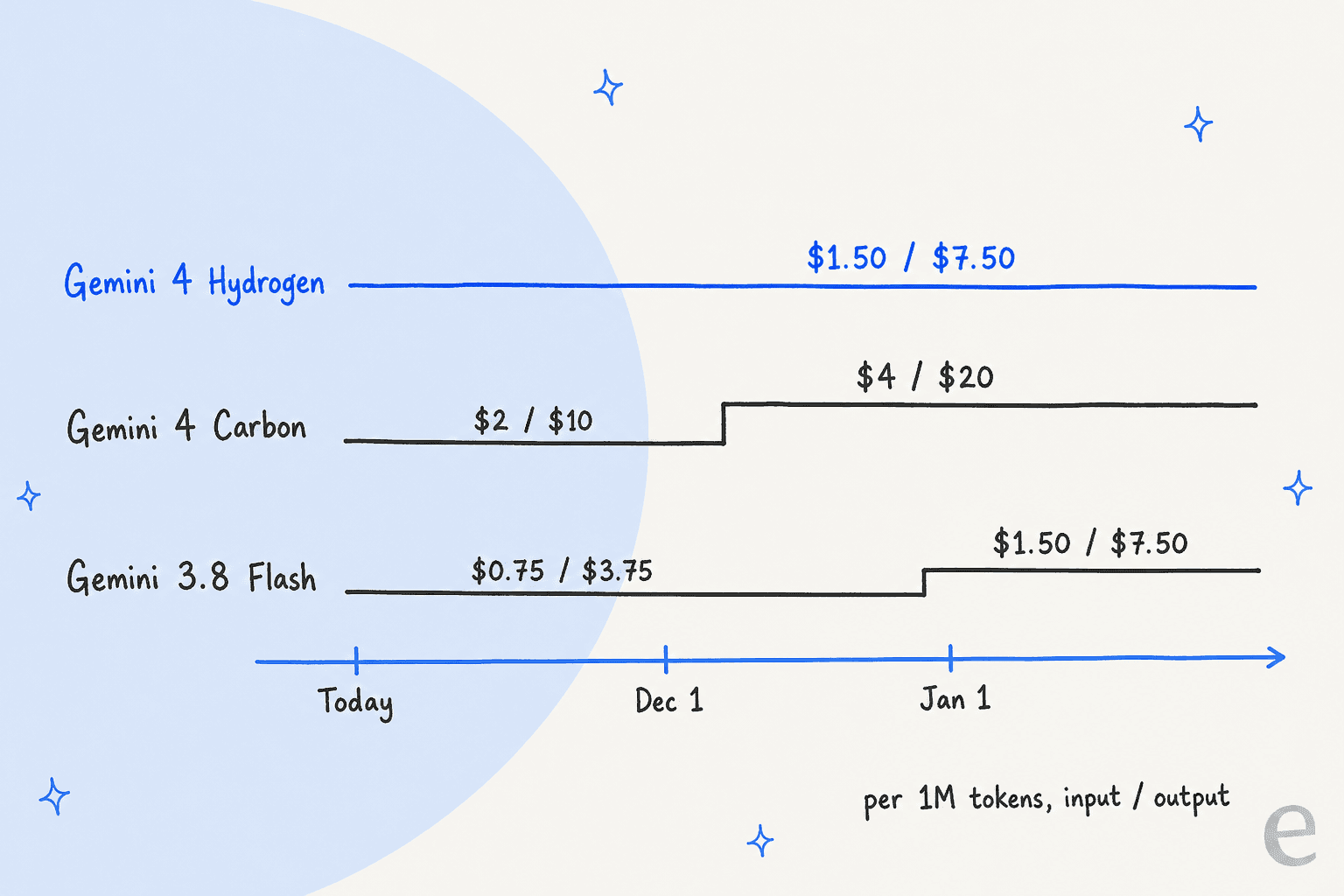
Two Google price changes land in the next seven weeks. Gemini 4 Carbon goes from $2/$10 to $4/$20 on 1 December 2026, and Gemini 3.8 Flash goes from $0.75/$3.75 to $1.50/$7.50 on 1 January 2027, both per the Gemini API pricing page. From January, Flash and Hydrogen have the same list price, which is why Google calls Hydrogen the recommended upgrade.
One Flash user in the launch thread had already done that sum:
"If this is Google's strategy we'll have to migrate to Luna, because costs are already high for our workload on 3.8 Flash"
I hear the same worry from support teams. One B2B hardware team I spoke with had been burned when a previous AI vendor's prices "more than doubled", and asked for a yearly contract just to lock the rate in. Price risk is a real reason to keep a second model ready.
How I picked and priced these
I build the integrations and APIs that connect eesel's AI agents to helpdesks, so I spend a lot of time swapping models underneath a running agent. Here's the lesson that keeps repeating: a cheap token can make an expensive task. That's why every pick below is judged on:
- List price per 1M tokens, read on 13 November 2026 from each vendor's own pricing page.
- Cost per task, score and time per task from Artificial Analysis, which runs the same Intelligence Index suite on every model and records what each one actually spent, thinking tokens included. I note the effort level in brackets, because one model can land anywhere on the chart depending on that setting.
- A monthly bill for one buyer: an agent sending 1 million requests a month, each with 2,000 input tokens and 300 output tokens. That's 2 billion input and 300 million output tokens, before caching or thinking tokens. It's a floor, not a forecast.
I also ran a fresh ChatGPT search with the question a builder would type. Its shortlist was Claude Sonnet 5.5, GPT-6.1 Terra, GPT-6.1 Sol, Claude Opus 5.5 and DeepSeek, and it said the number to watch is "cost per successful task". I kept all five, then added Gemini 4 Carbon, Kimi K3.1 Pro and GPT-6 Luna to cover the same-vendor, open-weight and budget routes.
Gemini 4 Hydrogen alternatives compared
| Model | Input / output per 1M | Cached input | Context | Open weights | AA score (level) | AA cost per task | AA time per task | Monthly bill (example buyer) |
|---|---|---|---|---|---|---|---|---|
| Gemini 4 Hydrogen (baseline) | $1.50 / $7.50 | $0.075 | 1M | No | 51 (high) | $1.87 | 8.3 min | $5,250 |
| GPT-6.1 Sol | $2 / $10 | $0.10 | 1.05M | No | 52 (xhigh) | $0.76 | 9.8 min | $7,000 |
| GPT-6.1 Terra | $1 / $5 | $0.05 | 1.05M | No | 42 (high) | $0.26 | 4.2 min | $3,500 |
| Claude Sonnet 5.5 | $2 / $10 | $0.10 | 1M | No | 55 (max) | $10.02 | 33.0 min | $7,000 |
| Claude Opus 5.5 | $4 / $20 | $0.20 | 1M | No | 48 (medium) | $2.45 | 7.2 min | $14,000 |
| Gemini 4 Carbon | $2 / $10, then $4 / $20 from Dec 1 | $0.10 | 1M | No | 58 (medium) | $4.68 | 23.8 min | $7,000, then $14,000 |
| DeepSeek V4.1 Flash | $0.15 / $0.60 off-peak | $0.003 | 1M | Yes (MIT) | 33 (max) | $0.60 | 15.1 min | $480 |
| Kimi K3.1 Pro | $2 / $10 | $0.20 | 1M | Yes | 46 | $3.68 | 38.3 min | $7,000 |
| GPT-6 Luna | $0.10 / $0.50 | $0.01 | 1.05M | No | 28 (max) | $0.15 | 11.6 min | $350 |
Read the last three columns before the first one. On list price, Hydrogen looks cheaper than Sol. Per task, Sol does slightly better work for about 40% of the cost, and in a similar amount of time. The scores, costs and times come from each model's Artificial Analysis page on 13 November 2026.
What would each one cost you per month?
Plug in how many agent tasks you run a month, and pick a size. The calculator multiplies by each model's Artificial Analysis cost per task, so it includes thinking tokens, which the list-price bill above leaves out. AA's tasks are long agentic jobs, so treat the totals as a way to compare models against each other, not as your exact invoice.
1. GPT-6.1 Sol
Best for: builders who want Hydrogen-level work for less per task, and can live with OpenAI's API shape.
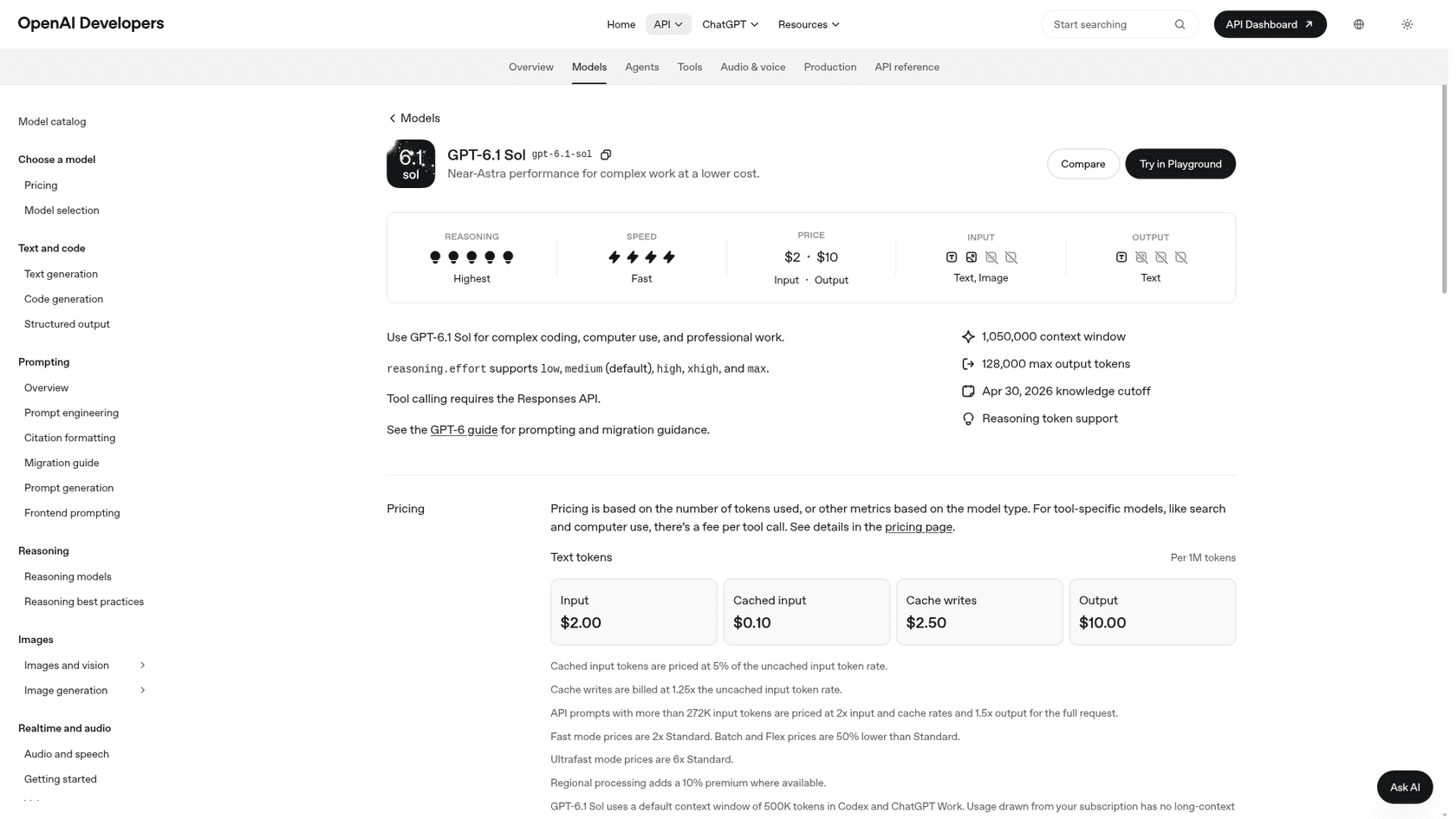
GPT-6.1 Sol is OpenAI's second rung, under GPT-6 Astra. OpenAI describes it as "Near-Astra performance for complex work at a lower cost", and per task it's the closest thing to a straight upgrade from Hydrogen on this list.
Pros
- At xhigh it scores
52for$0.76a task in9.8minutes. Hydrogen at high scores51for$1.87in8.3minutes. - At max it scores
55for$1.27, cheaper than Hydrogen at xhigh (54,$3.16). - Five effort levels, from
lowtomax, so you can tune it the same way you'd tune Hydrogen's thinking level.
Cons
- Tool calling requires the Responses API, so a Gemini-shaped integration needs real rework.
- No free tier, and prompts over 272K input tokens cost 2x input and 1.5x output on the whole request.
- Its knowledge cutoff is 30 April 2026.
Pricing: $2 input, $0.10 cached, $10 output per 1M tokens on the OpenAI pricing page. Batch and Flex are half that.
Verdict: if you were about to set Hydrogen to xhigh, try Sol at xhigh first. Per task it's the cheaper road to the same score. The GPT-6.1 Sol review has a hands-on support ticket test.
2. GPT-6.1 Terra
Best for: fast, cheap work where Hydrogen at low or medium is already good enough.
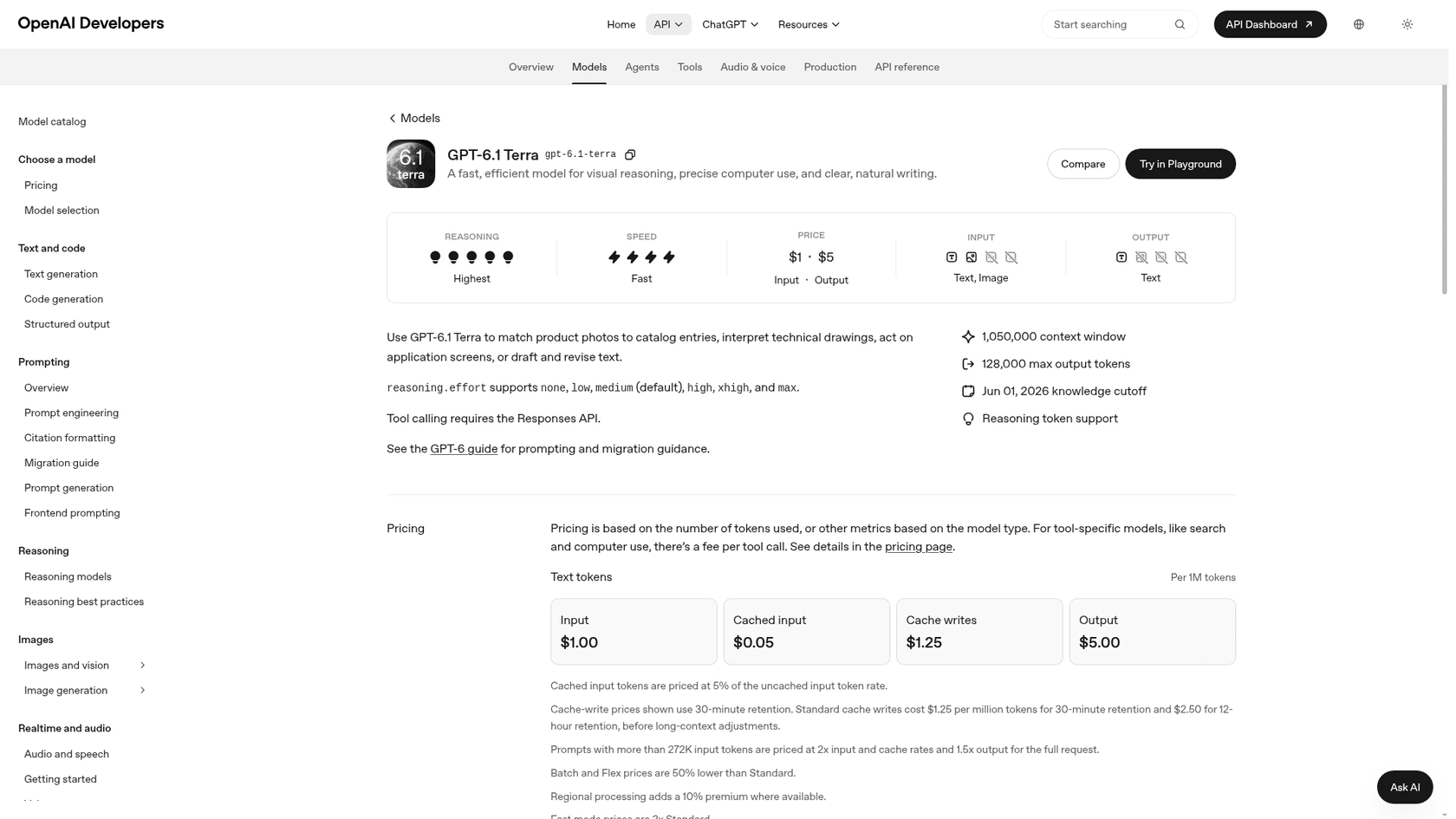
GPT-6.1 Terra is one rung down from Sol, and it's Hydrogen's most direct rival. Google even put it in its own comparison table, where Hydrogen beats it on 8 of 9 shared rows.
Pros
- At high it scores
42for$0.26a task in4.2minutes. Hydrogen at medium scores41for$0.80in3.7minutes. That's about a third of the cost for the same score. - It has a
noneeffort level for a no-thinking fast path, which Hydrogen doesn't offer. - List price is a third lower than Hydrogen's on both input and output.
Cons
- Google's table has Hydrogen ahead on SWE-sweep (
13.5%vs5.8%) and AutomationBench (76.1%vs60.2%). - Pushing it to max (
51,$0.96,14.2minutes) is slower than Hydrogen at high. - Same Responses API requirement for tool calls as Sol.
Pricing: $1 input, $0.05 cached, $5 output per 1M tokens, per the OpenAI pricing page.
Verdict: the swap for high-volume, mid-difficulty traffic. For hard tasks, step up to Sol instead of maxing Terra. The GPT-6.1 Terra review shows how it handled real tickets.
3. Claude Sonnet 5.5
Best for: coding agents, terminal work and computer use.
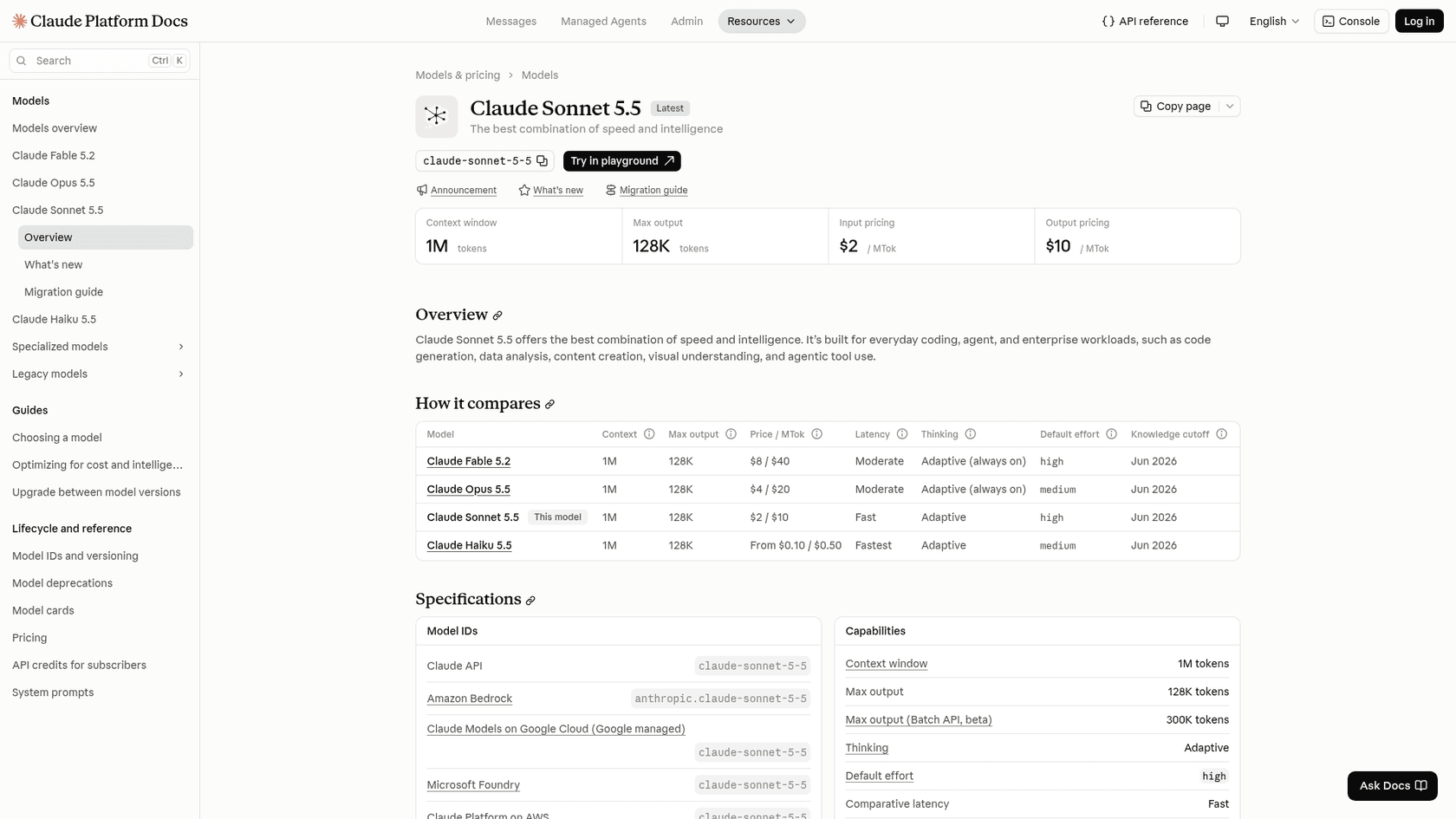
Claude Sonnet 5.5 is Anthropic's middle model, which Anthropic calls "the best combination of speed and intelligence". ChatGPT ranked it the top Hydrogen alternative, and Google's own numbers explain why it's in the conversation.
Pros
- It beats Hydrogen on the two agent rows that matter most for coding tools: Terminal-Bench 4.1 (
63.9%vs57.0%) and OSWorld-2.1 (83.9%vs77.6%), per Google's model card. - At max it scores
55, above Hydrogen's best (54at xhigh). - Flat pricing across the full 1M window, and cache reads at
$0.10.
Cons
- At max it costs
$10.02a task and takes33minutes on Artificial Analysis. At medium it drops to$0.78, but the score drops to31. - Hydrogen wins Google's SWE-sweep (
13.5%vs3.1%) and HLE-Diamond (58.8%vs53.3%) rows. - Strict API: a non-default
temperatureand forcedtool_choiceboth return errors, covered in the Sonnet 5.5 review.
Pricing: $2 input, $0.10 cache read, $10 output per 1M tokens on Anthropic's pricing page. Batch halves it.
Verdict: pick it when the agent writes code or drives a computer. For general knowledge work, Hydrogen is the better buy, which matches what the HN thread concluded.
4. Claude Opus 5.5
Best for: long-running agents where getting it right matters more than the bill.
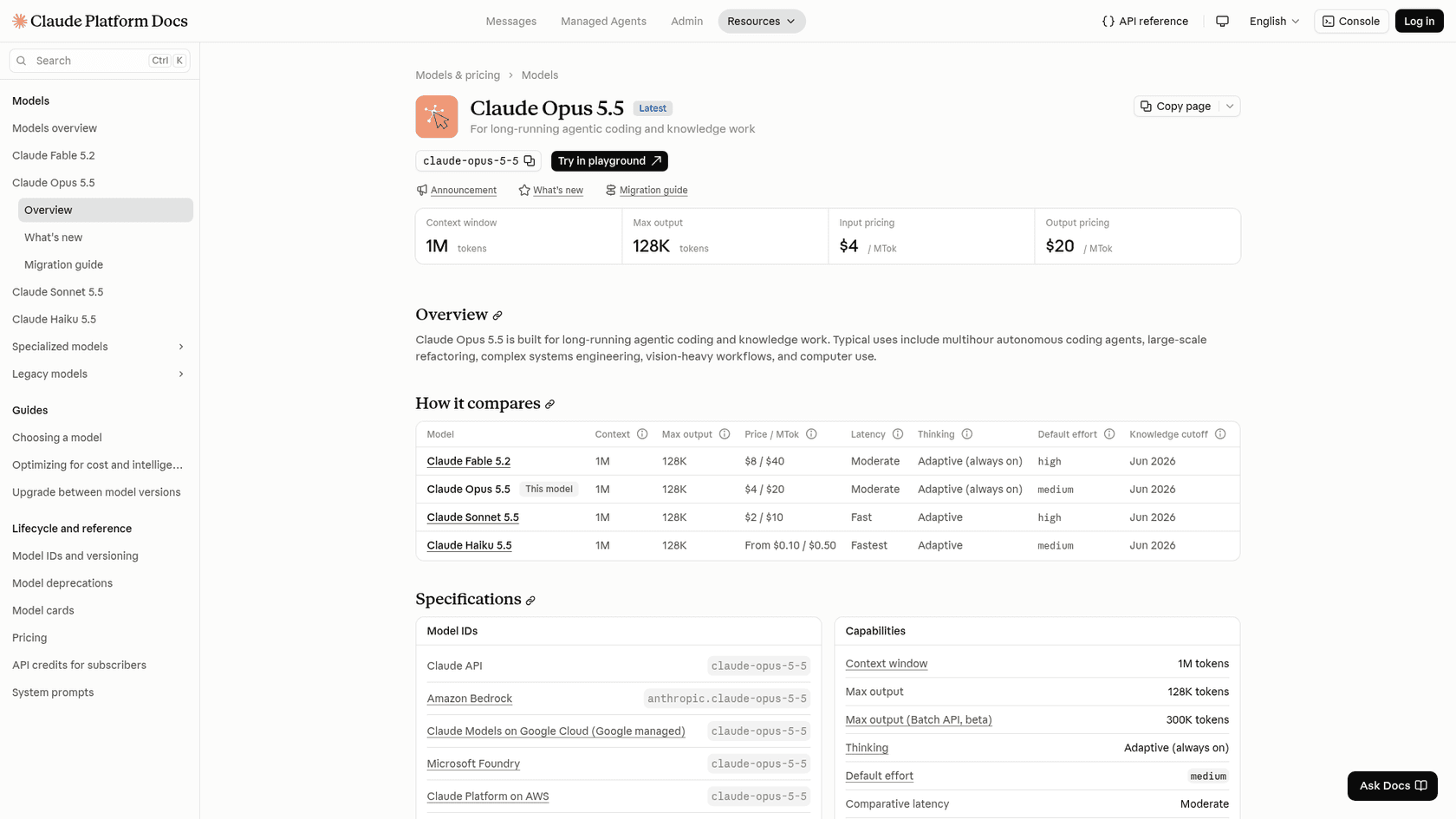
Claude Opus 5.5 is Anthropic's larger model, built "for long-running agentic coding and knowledge work". It's the most expensive pick here per token, so it belongs on this list as the escalation target, not the default.
Pros
- At max it scores
59on Artificial Analysis, the second-highest score in this roundup after Carbon at high. - At medium, its default, it scores
48for$2.45in7.2minutes. - Cache reads cost
$0.20, just 5% of the input price, which helps agents that resend a long system prompt.
Cons
$4/$20list price, so the example bill is$14,000, almost 3x Hydrogen's.- At max,
$10.04per task and25.2minutes. - Thinking is always on, which Anthropic lists as "Adaptive (always on)", and it's billed as output.
Pricing: $4 input, $0.20 cache read, $20 output per 1M tokens on Anthropic's pricing page. Fast mode is $8/$40.
Verdict: a planner, not a worker. Have Opus plan or review, and let something cheaper do the steps. The Opus 5.5 review has the effort-by-effort numbers.
5. Gemini 4 Carbon
Best for: teams staying on Google who need more reasoning than Hydrogen gives.
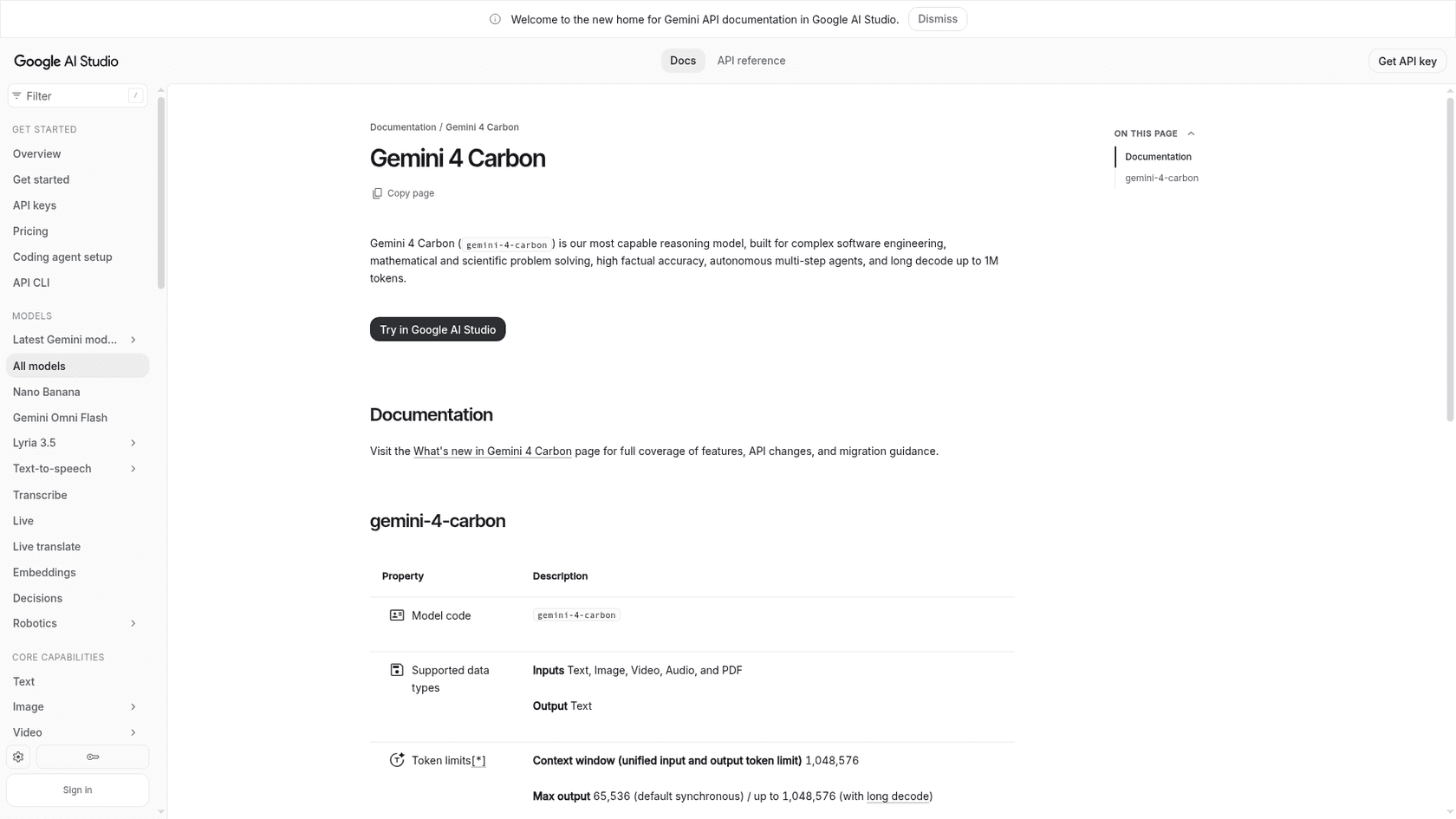
Gemini 4 Carbon is Hydrogen's bigger sibling and reached general availability on 10 November 2026. Same API and same inputs, so this is the least work of any switch on the list.
Pros
- At medium it scores
58on Artificial Analysis, and60at high, the top score in this roundup. - You keep the Gemini SDK, the Search grounding and the multimodal inputs you already built around.
- Google's Orchestrator in Antigravity pairs Carbon for planning with Hydrogen for execution, which shows the intended split.
Cons
$4.68per task at medium,$5.48at high, and23.8to27.4minutes per task.- Price doubles to
$4/$20on 1 December 2026, and there's no free tier. - It defaults to medium and caps at high, so there's no xhigh.
Pricing: $2 input, $0.10 cached, $10 output per 1M tokens until 30 November 2026, then $4/$0.20/$20, per the Gemini API pricing page. More in the Gemini 4 Carbon review.
Verdict: route your hardest 10% here and keep Hydrogen for the rest. Sending everything to Carbon after December 1 is a big bill for a few points of score.
6. DeepSeek V4.1 Flash
Best for: the lowest bill, and teams that want open weights.
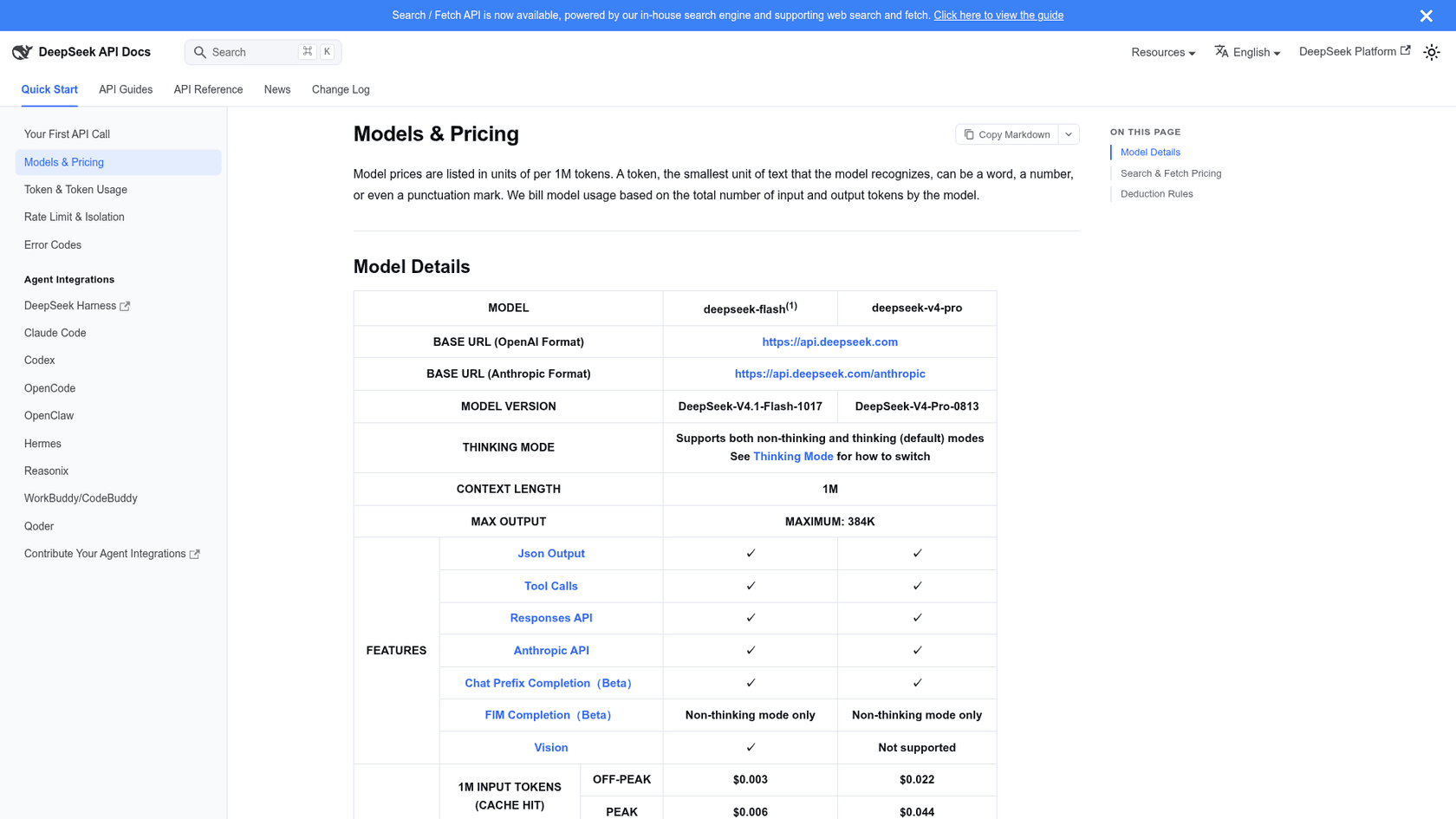
DeepSeek V4.1 Flash is called as deepseek-flash on DeepSeek's API, and the old deepseek-v4-flash name now routes to it too. It's the only model here that costs less than a tenth of Hydrogen's list price.
Pros
$0.15/$0.60per 1M tokens off-peak, so the example bill is$480against Hydrogen's$5,250.- MIT-licensed weights, so you or a hosting provider can run it outside China.
- Vision input, tool calls, JSON output, and both OpenAI-format and Anthropic-format endpoints.
Cons
- It scores
33at max on Artificial Analysis, well under Hydrogen at medium (41). - Peak hours (
01:00to04:00and06:00to10:00UTC, weekdays) double the price. - On DeepSeek's own platform, your data goes to a company based in China, so check that against your data rules first.
Pricing: $0.15 input, $0.003 cache hit, $0.60 output per 1M tokens off-peak; $0.30/$0.006/$1.20 at peak, per DeepSeek's pricing page.
Benchmarks don't tell the whole story here. One builder running head-to-head agent tests posted this:
"Right now DeepSeek Flash 4.1 Flash has a 64% win rate against GPT 6.1 Sol. Small data still, but it has 33 wins vs. 18 losses"
Verdict: worth a bake-off for any high-volume job before you pay Hydrogen rates. The DeepSeek V4.1 Flash pricing guide covers the peak-hour maths.
7. Kimi K3.1 Pro
Best for: teams that need a large open-weight model and can wait for answers.
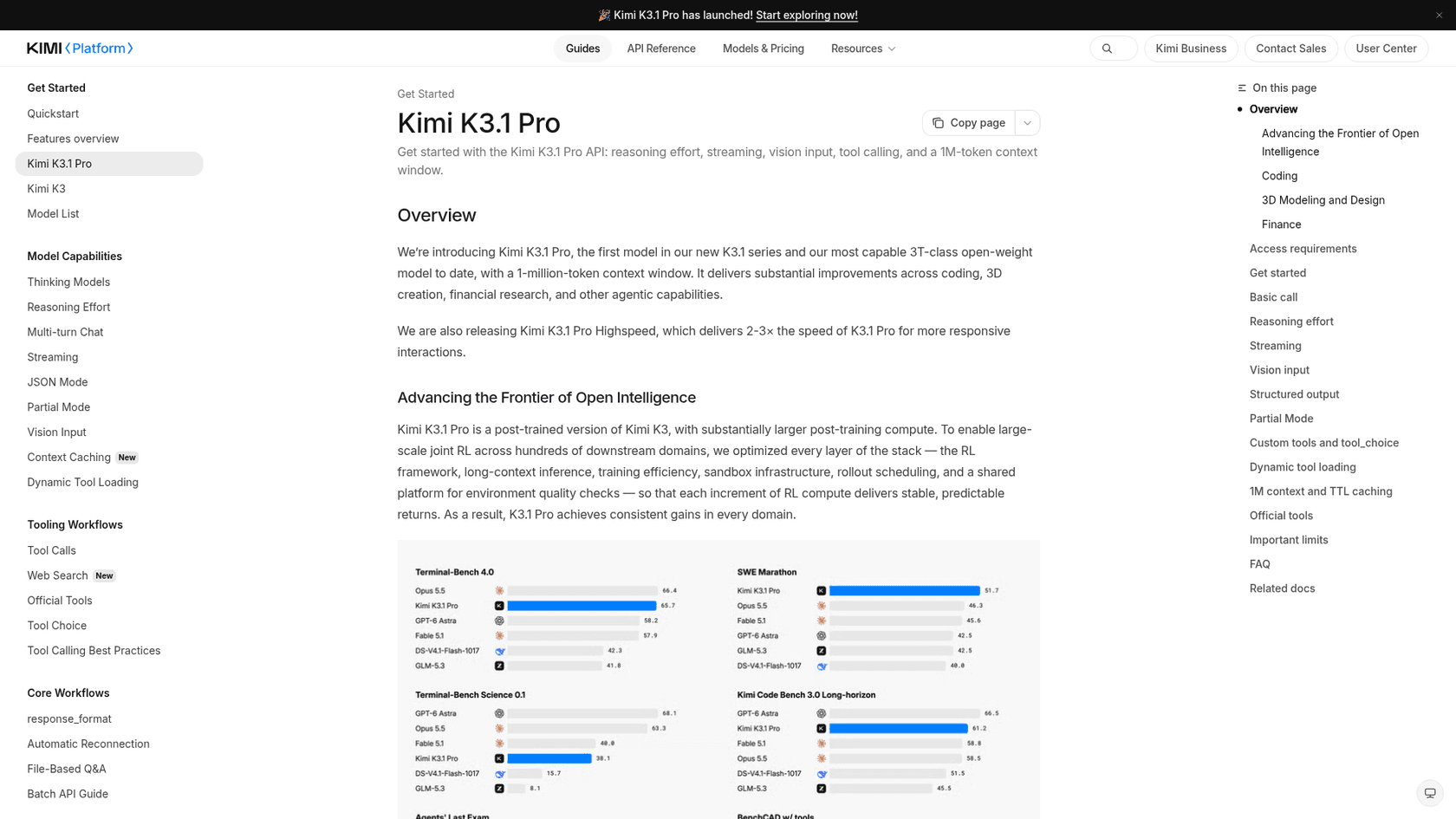
Kimi K3.1 Pro is Moonshot AI's flagship, described in its docs as "our most capable 3T-class open-weight model to date". Its weights are now on Hugging Face.
Pros
- Artificial Analysis ranks it first of 28 open-weight models in its size class, at
46. - 1,048,576-token context, image input, and batch inference at 60% of the standard price.
- A Highspeed version (
$4/$20) runs 2 to 3 times faster, per Moonshot.
Cons
$3.68per task and38.3minutes on Artificial Analysis, which flags it as slow and expensive for an open-weight model.- AA measured a
172-second time to first answer token at about31tokens a second. - Same
$2/$10list price as Sol, with a lower score.
Pricing: $2 input, $0.20 cache hit, $10 output per 1M tokens on Moonshot's pricing page.
Verdict: a fit when open weights are the requirement, not a saving on Hydrogen. If you only need cheap, DeepSeek wins. The Kimi K3.1 Pro review goes deeper.
8. GPT-6 Luna
Best for: triage, tagging and routing at the lowest possible price.
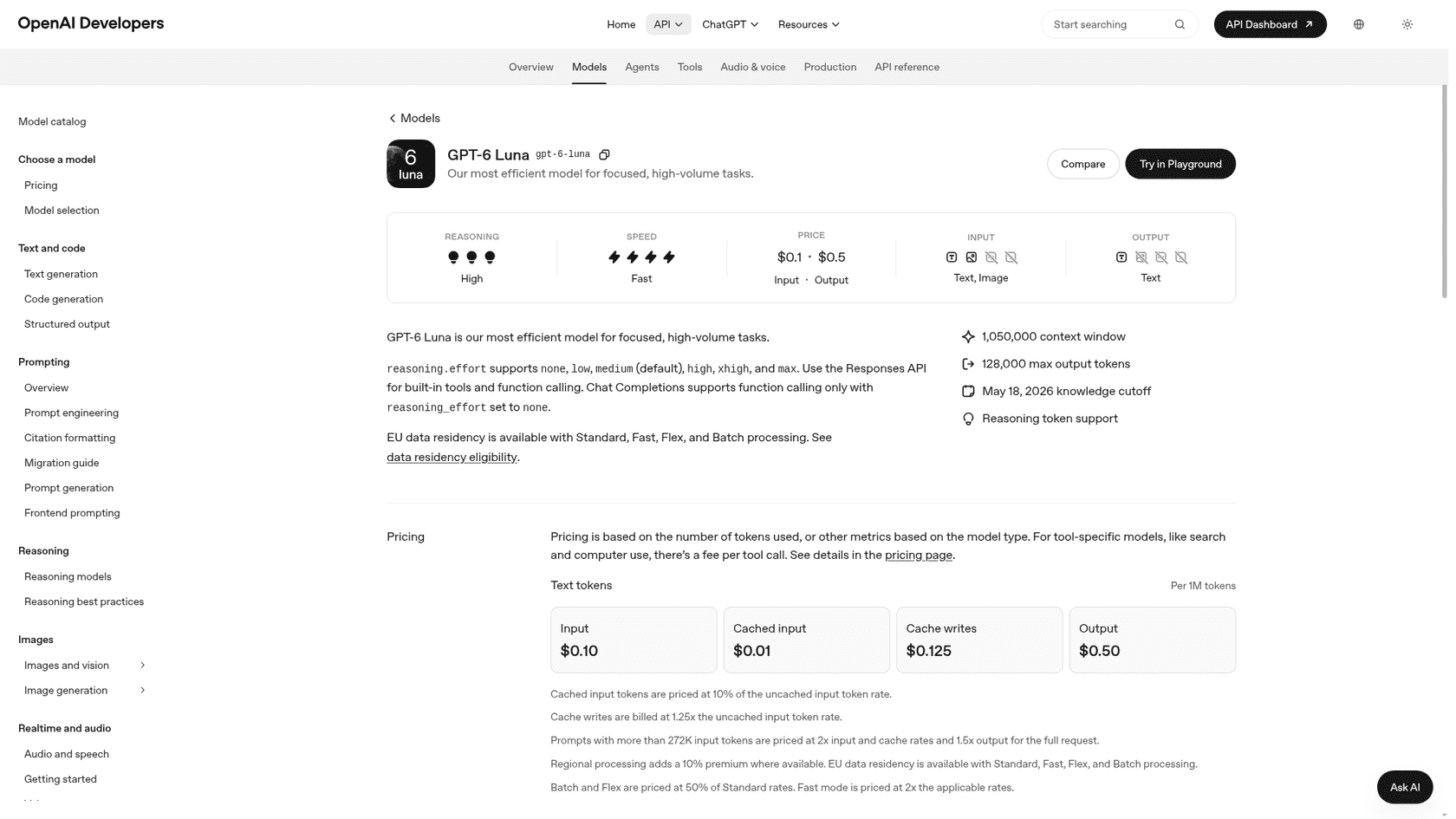
GPT-6 Luna is OpenAI's smallest model, "our most efficient model for focused, high-volume tasks". It's where Gemini 3.8 Flash users looked first when Hydrogen landed at twice Flash's current price.
Pros
$0.10/$0.50per 1M tokens, so the example bill is$350.$0.15per task at max effort on Artificial Analysis, the cheapest on this list.- Supports Chat Completions function calling when effort is set to
none, which makes porting simple routing code easier.
Cons
- It scores
28at max, far below Hydrogen even at medium. - Same long-prompt surcharge as the other OpenAI models over 272K input tokens.
- Not a model for multi-step agent work on its own.
Pricing: $0.10 input, $0.01 cached, $0.50 output per 1M tokens on the OpenAI pricing page.
Verdict: the front door of a routed setup, not a full Hydrogen replacement. Let it sort requests and hand the hard ones up.
Which Gemini 4 Hydrogen alternative should you pick?
Start from why you're leaving, not from the leaderboard. Each reason points to a different model:
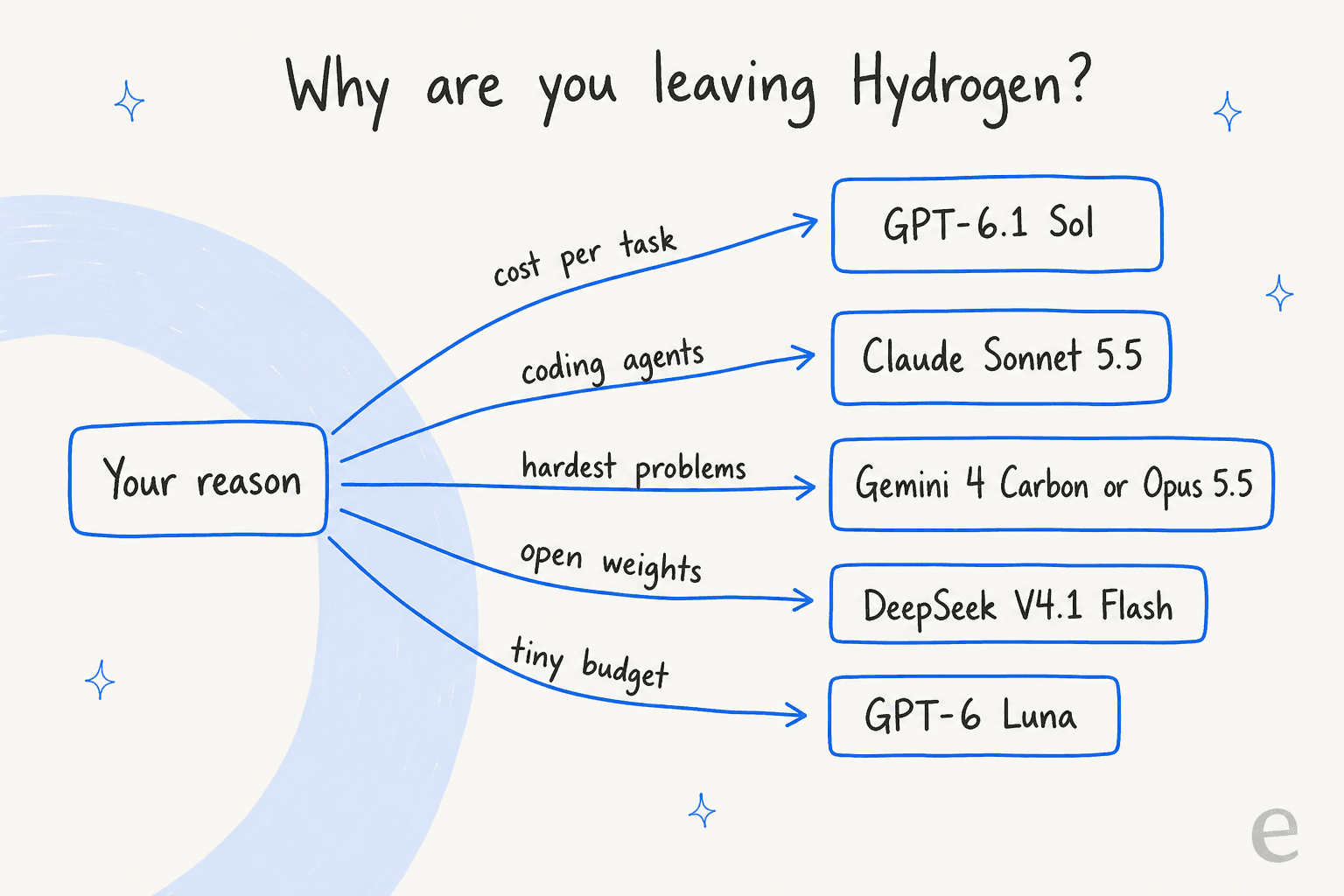
| If your reason is... | Pick | Why |
|---|---|---|
| The bill at high or xhigh | GPT-6.1 Sol | 52 for $0.76 vs Hydrogen's 51 for $1.87 |
| Fast, cheap mid-level work | GPT-6.1 Terra | 42 for $0.26 vs Hydrogen medium's 41 for $0.80 |
| Coding or computer-use agents | Claude Sonnet 5.5 | Wins Terminal-Bench 4.1 and OSWorld-2.1 on Google's own table |
| Hardest problems, staying on Google | Gemini 4 Carbon | 58 at medium, same API |
| Hardest problems, any vendor | Claude Opus 5.5 | 59 at max, low cache-read price |
| Lowest bill | DeepSeek V4.1 Flash | $480 vs $5,250 on the example bill |
| Open weights at the top end | Kimi K3.1 Pro | Top open-weight model in its class on AA |
| Triage and routing | GPT-6 Luna | $0.15 per task |
You also don't have to pick one. A commenter in the launch thread described the setup I'd recommend for most agents:
"I have found it a good subagent workhorse for code implementation, with some higher level model doing the spec and review."
That's Hydrogen as the worker and something like Carbon or Opus as the planner, the same split Google built into Orchestrator. If the bill is the problem, swap the worker for Sol or Terra and keep the structure.
How do you test an alternative before switching?
Benchmarks rank models on someone else's tasks. Before moving production traffic, run your own:
- Pull 50 to 100 real requests from your logs, including the awkward ones.
- Run each candidate at two effort levels, because the level moves cost more than the model does.
- Measure cost per successful task, counting retries, not cost per million tokens.
- Check the migration traps: Hydrogen ignores sampling settings, Claude rejects non-default
temperature, and OpenAI wants the Responses API for tool calls. A prompt tuned for one won't transfer unchanged. - Keep a fallback model wired up, so the next price change or outage is a config switch, not a rewrite.
Google's own advice for Hydrogen says the same: run your evaluations "at all four levels" before settling on one.
If the model is for a support queue
A lot of people comparing Hydrogen alternatives are really building a support bot. I've spent years wiring AI agents into live helpdesks, and the model is rarely what breaks first; the rules around it are. The failures I see are a bot promising something it can't do, or not handing over when it should. A bigger model doesn't fix that. Clear escalation rules and answers grounded in your own help center and past tickets do, which is also how you keep AI hallucinations down whichever model writes the words.
SE Ranking is a good example of that layer. It runs three products on Zendesk with one eesel agent per product, answering from about 16,800 pages of knowledge, and handled 4,650 conversations in one month. Refunds, trial extensions and requests for a person go to the team with the details already collected. Swiftreg, a private number plate seller, answers about 2,100 Zendesk tickets a month from live order data, under rules its own team wrote. Neither setup depends on which model is fastest this week.
If you'd rather work from a terminal, the eesel CLI controls the same teammate as the dashboard. A coding agent like Claude Code can upload approved knowledge, such as exported help articles and saved replies, adjust the agent's instructions, and ask test questions to check the answers before anything goes live. Connecting the helpdesk itself still needs someone with admin access to approve it, and uploaded knowledge isn't the same as tested, so the test step stays.
Try eesel
Hydrogen, Sol and Sonnet are engines. If what you're building is support automation, eesel is the AI helpdesk teammate that does the job on top of models like these. It joins the helpdesk you already use, whether that's Zendesk, Freshdesk or another, learns from your past tickets, macros and help center, and follows the handover rules you set. Before it replies to anyone, you can run it against your real past tickets and compare its answers with what your team sent.
Pricing is a fixed monthly credit plan: one ticket or chat is one credit, starting at $299 a month for 500 credits. There's no per-token charge, so your bill doesn't move when Google or OpenAI changes theirs. You can try eesel free with 100 credits for 7 days on a slice of your queue.