


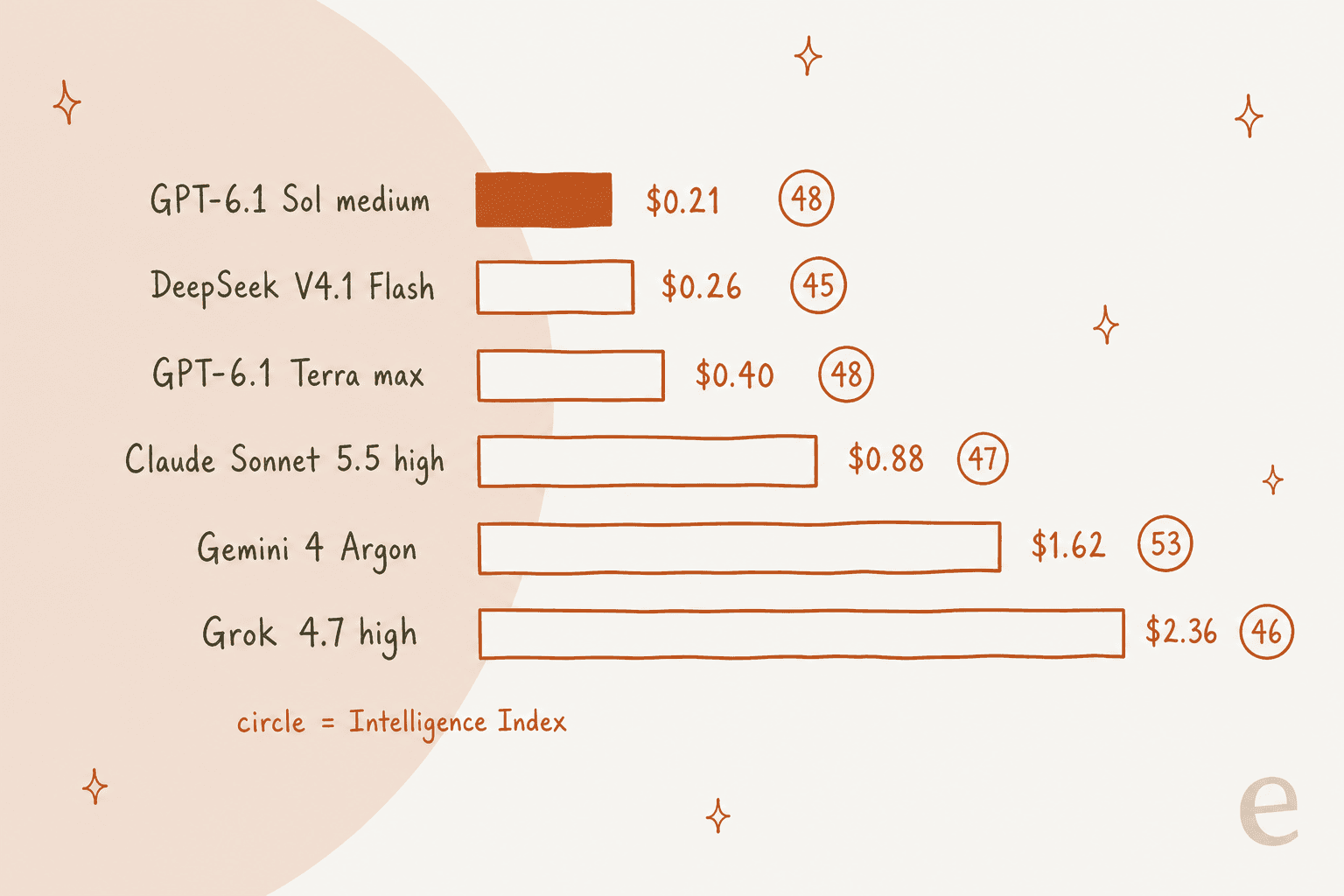
The best GPT-6.1 Terra alternative for most teams is GPT-6.1 Sol at medium effort, which feels backwards because Sol costs twice as much per token. Per task, it flips: Artificial Analysis scores Sol medium 47.8 for $0.21 a task, while Terra at max scores 48.1 for $0.40. If you were about to push Terra to max effort, switch models instead.
If you want off OpenAI: Claude Sonnet 5.5 for coding and agents ($2/$10), DeepSeek V4.1 Flash for the lowest bill ($0.15/$0.60 off-peak, open weights), and Gemini 4 Argon for the hardest reasoning, at a promo price that doubles on December 1. On a 1-million-request month, the list-price bill ranges from $480 on DeepSeek to $7,000 on Sol or Sonnet, against $3,500 on Terra.
If the model is for a support queue, the model matters less than you think. In my GPT-6.1 Terra review, Terra got 15 of 16 tickets right against Sol's 16, and the one miss was an escalation rule, not intelligence. That rule lives in the layer eesel handles, the way Koffer.ch runs it on Freshdesk with every reply as a draft.
Why look past GPT-6.1 Terra at all?
Let me say it first: Terra is a good model. GPT-6.1 Terra shipped on 26 October 2026 at $1 per million input tokens and $5 per million output. It has a 1,050,000-token context window, plus a none reasoning effort that Sol and Astra don't have. On my own support tickets it was the quickest model I tried, at 2.5s to 3.1s each.
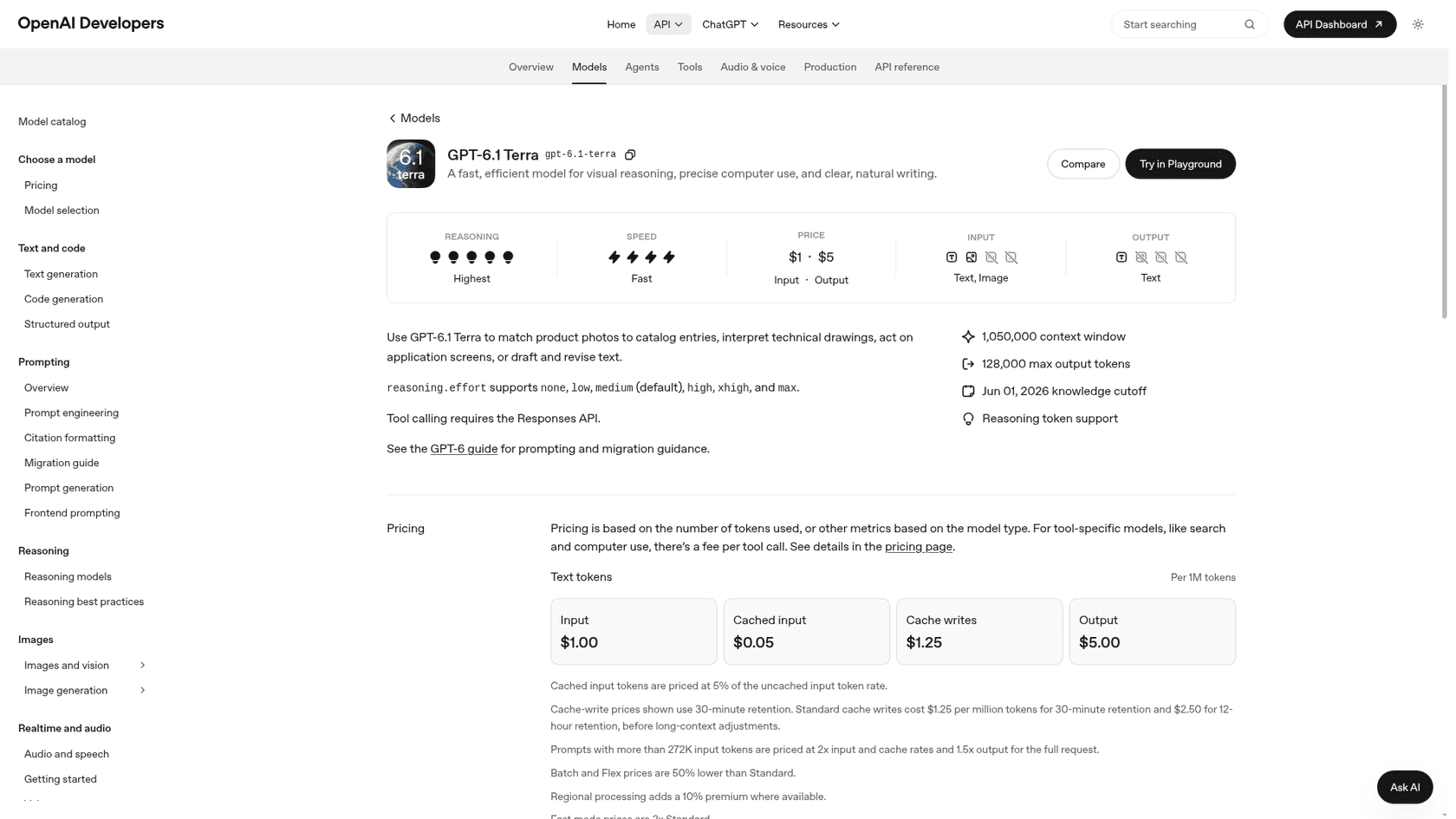
Still, people go looking for something else, and it usually comes down to these:
- It gets expensive when you turn it up. Terra's Intelligence Index rises from
36.2at low effort to48.1at max. Cost per task, though, goes from$0.05to$0.40, and time per task from29sto384s, per Artificial Analysis. Push it to the top and you're paying Sol money for something that isn't Sol. - Coding and terminal work trail the bigger models. Terminal-Bench 4.0 came up again and again in the Hacker News launch thread. One commenter put Terra at max at 50%, with Claude Opus 5.5 at 70%.
- Single-vendor risk. When your whole product sits on one OpenAI model, their price change or outage becomes yours as well.
One skeptical comment captures point 1 pretty well:
"Terra XHigh more expensive than Sol Low and still does worse."

And here's the one to keep in mind while reading every table below:
"Per token, yes. But per task it's not even necessarily the case depending on how much thinking is needed."
How I picked and priced these
I build the AI agents that sit on eesel customers' helpdesks, and I'm the one who ran the 80-ticket Terra eval for my review. Years of live queues taught me that token price is the wrong thing to measure. Half the price with twice the retries doesn't save you anything in production. So I judged every pick below on these:
- List price per 1M tokens, pulled on 28 October 2026 from each vendor's own pricing page.
- Cost per task and Intelligence Index from Artificial Analysis. It runs one test suite across every model and logs what each of them really spent.
- A monthly bill for one buyer: picture a product sending 1 million requests a month, each with 2,000 input tokens and 300 output tokens. That adds up to 2 billion input and 300 million output tokens, not counting caching or thinking tokens.
I also asked ChatGPT this question the way a buyer would. Its shortlist was Sonnet 5.5, Gemini 3.6 Flash, DeepSeek V4.1 Flash, Gemini 4 Argon and Grok 4.7. Most of those stayed. I traded Gemini 3.6 Flash for 3.8 Flash (same price, newer model) and added Sol and Haiku 5.5, which ChatGPT skipped.
GPT-6.1 Terra alternatives compared
| Model | Input / output per 1M | Cached input | Context | AA Intelligence Index | AA cost per task | Time to first token | Open weights | Monthly bill (example buyer) |
|---|---|---|---|---|---|---|---|---|
| GPT-6.1 Terra (baseline) | $1 / $5 | $0.05 | 1.05M | 48.1 (max) | $0.40 | 1.3s (low) | No | $3,500 |
| GPT-6.1 Sol | $2 / $10 | $0.10 | 1.05M | 47.8 (medium) | $0.21 | 4.4s | No | $7,000 |
| Claude Sonnet 5.5 | $2 / $10 | $0.10 | 1M | 46.8 (high) | $0.88 | 3.1s (medium) | No | $7,000 |
| DeepSeek V4.1 Flash | $0.15 / $0.60 off-peak | $0.003 | 1M | 45.1 (max) | $0.26 | 1.2s | Yes | $480 (off-peak) |
| Gemini 3.8 Flash | $0.75 / $3.75 to Dec 31 | $0.075 | 1M | 40.9 (high) | $3.49 | 28.3s (high) | No | $2,625 |
| Gemini 4 Argon | $2 / $10 to Nov 30 | $0.10 | 1M | 52.6 (high) | $1.62 | 48.2s | No | $7,000 |
| Grok 4.7 | $2 / $6 | n/a | 500K | 46.3 (high) | $2.36 | 5.4s (low) | No | $5,800 |
| Claude Haiku 5.5 | $0.10 / $0.50 up to 100K prompt | $0.01 | 1M | 37.8 (high) | $0.08 | 26.7s (high) | No | $350 |
Two things stand out here. DeepSeek V4.1 Flash costs about 7x less than Terra per bill and lands within 3 points on the index. Then there's Gemini 3.8 Flash: cheap per token, yet one of the priciest per task, since it does a lot of thinking before it answers. The index, cost per task and first-token times all come from Artificial Analysis model pages, at the effort shown in brackets.
1. GPT-6.1 Sol
Best for: teams already on the OpenAI API who need better judgment without changing a line of integration code.
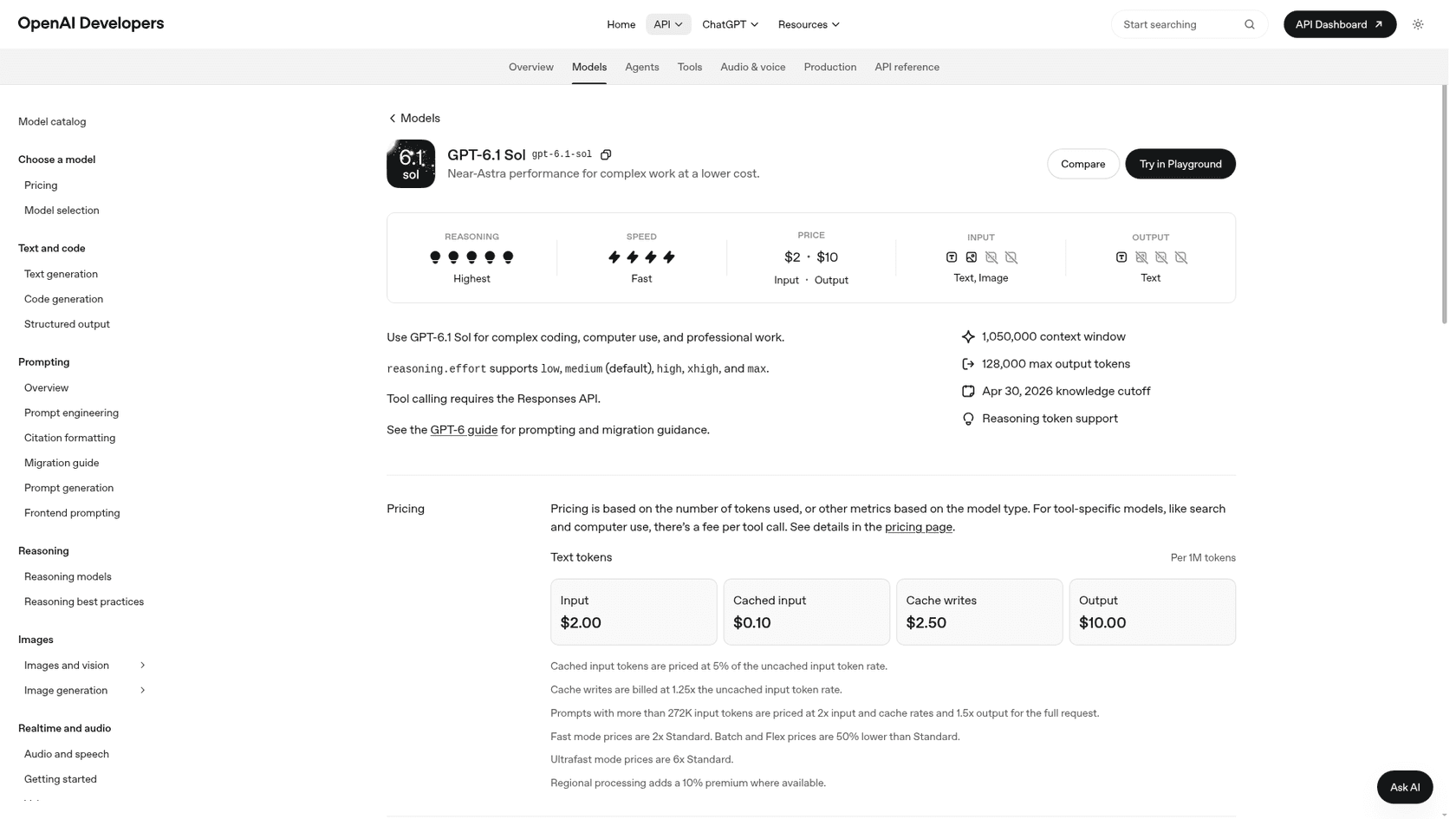
Think of Sol as Terra's bigger sibling. It sits one rung up OpenAI's ladder, between Terra and GPT-6 Astra. The API, the tools and the gpt-6.1 generation are all the same, so switching just means changing the model name.
Pros
- Sol at medium effort matches Terra at max on the Artificial Analysis index, for roughly half the cost per task (
$0.21vs$0.40). - In my support test its judgment was the best: 16 of 16. It was also the only setup that escalated a Spanish address change it couldn't make.
- AA puts its hallucination rate at high effort at
49%, against38%for Terra at max. So it isn't the more careful model on facts. Where it wins is edge-case decisions.
Cons
- It's slower. AA clocks about
54output tokens a second at medium versus Terra's91, and a4.4sfirst token versus1.3sfor Terra at low. - Short, easy requests cost more on Sol. My test came out at
$1.62per 1,000 tickets, compared with$0.75for Terra at low. - There's no
noneeffort, which means no zero-thinking fast path.
Pricing: $2 input, $0.10 cached, $10 output per 1M tokens on the OpenAI pricing page. Batch halves it to $1/$5.
My take: Leave the easy 80% on Terra at low, and route anything that would need high effort to Sol at medium. The upgrade path from Terra isn't Terra at max, it's Sol. You'll find the full numbers in the GPT-6.1 Sol review.
2. Claude Sonnet 5.5
Best for: coding tools, terminal agents and multi-step tool use.
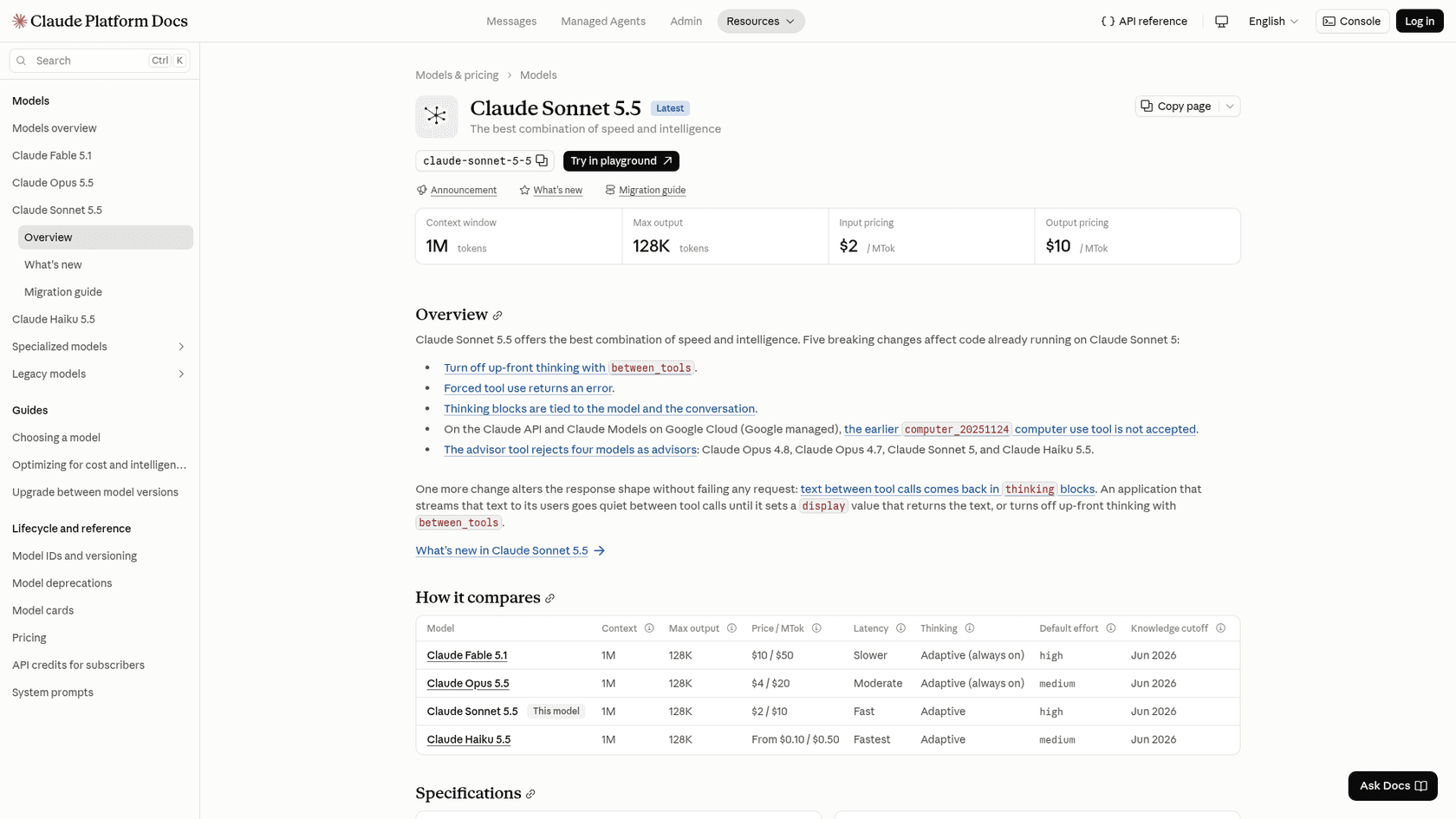
This is Anthropic's mid-tier model, out since 28 September 2026. ChatGPT called it the "best first alternative to test", and for agent work I'd say that's right.
Pros
- The best coding numbers in its price band. Anthropic reports
70.6%on Terminal-Bench 4.0, ahead of Opus 5.5's66.4%, and80.1%on OSWorld 2.1 for computer use. - It's priced like Sol at
$2/$10, and comes with a 1M context window and 128K output. - Quick first token at medium effort (
3.1son AA), and roughly107output tokens a second.
Cons
- At high effort it costs
$0.88a task on AA. That's over 4x Sol medium, and for a lower index score. - On AA its hallucination rate at high effort is
65%, the highest among the closed models here. - Migrating isn't painless:
thinking: disabledand forcedtool_choiceboth return a 400 error on Sonnet 5.5, so code built for older Claude models will need changes.
Pricing: $2 input, $10 output, $0.10 cache hits, per the Claude pricing page. Batch is $1/$5.
My take: If your product writes or runs code, or drives a browser for long stretches, go with Sonnet 5.5. Short text jobs like drafting and extraction get more per dollar on Terra or Sol. The Claude Sonnet 5.5 review and the Sol vs Opus 5.5 comparison go deeper.
3. DeepSeek V4.1 Flash
Best for: high-volume chat, extraction and RAG where the token bill is the main constraint, or where you want weights you can host.
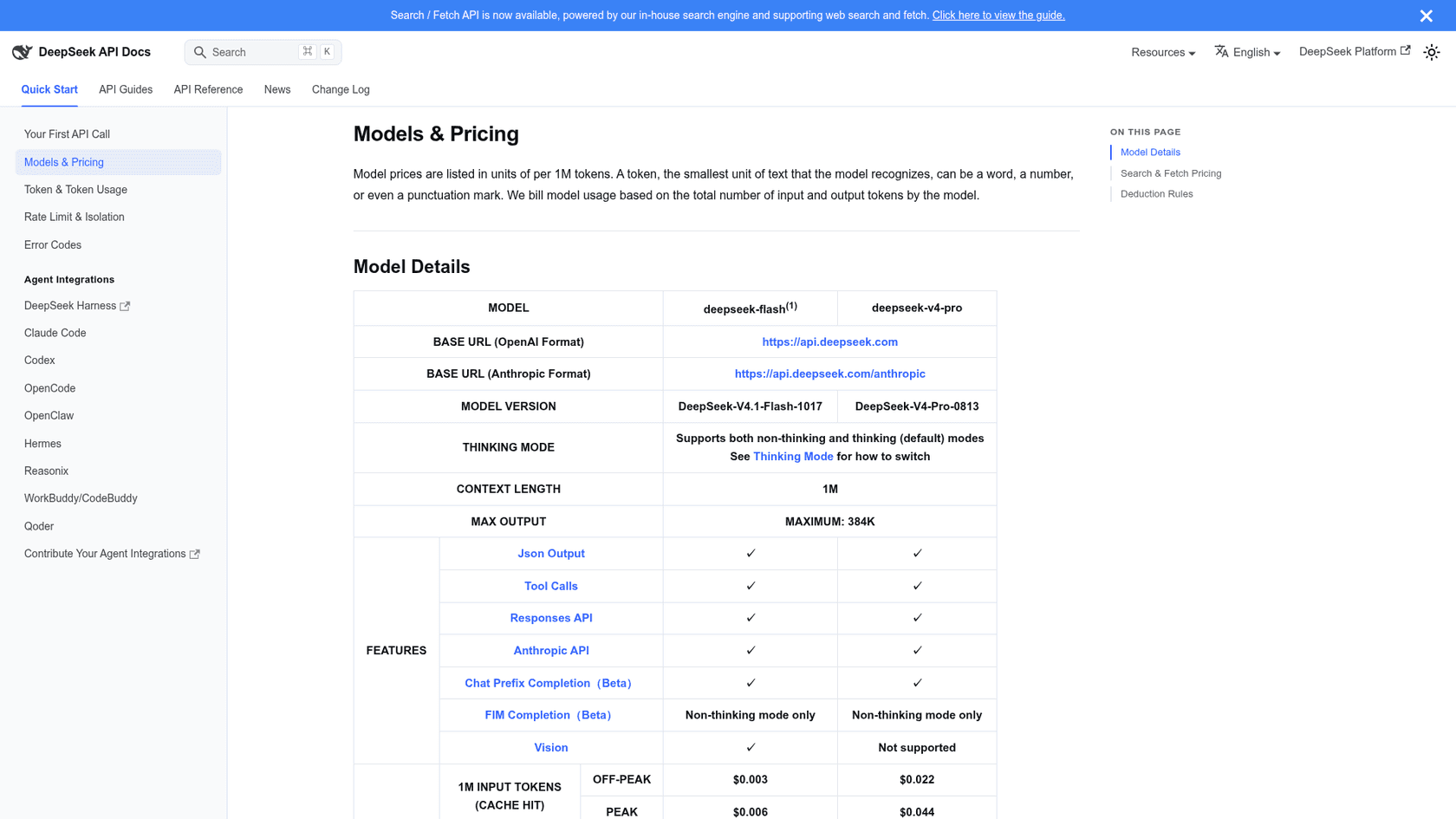
On the API, the name is now simply deepseek-flash, and the DeepSeek-V4.1-Flash-1017 checkpoint serves it. Older deepseek-v4-flash names keep working and bill at the Flash price, per the DeepSeek pricing docs.
Pros
- Of the models here scoring above 45, this one has the lowest bill. The example buyer pays
$480a month off-peak, compared with$3,500on Terra. - Cache hits cost
$0.003per 1M tokens off-peak, so repeated system prompts cost almost nothing. - The weights are open, so you can self-host when data residency matters. It reads images and supports tool calls too, and it speaks both the OpenAI and Anthropic API formats.
- It has the fastest first token here,
1.2son Artificial Analysis.
Cons
- Peak pricing doubles everything to
$0.30/$1.20. Peak hours run 01:00 to 04:00 and 06:00 to 10:00 UTC on weekdays, which lands right on the European working morning. - AA's hallucination rate for the 1017 checkpoint at max is
67%, so keep it grounded in your own documents. - Server-side Search and Fetch calls start billing at
$0.75per 1,000 requests on 1 November 2026.
Pricing: $0.15 input (cache miss), $0.003 cache hit, $0.60 output off-peak; $0.30, $0.006 and $1.20 at peak.
My take: For mostly simple traffic, and if a different vendor is fine with you, DeepSeek is the cheapest swap worth taking seriously. One HN commenter summed up the split plainly:
"If all I want is coding at a cheaper price, then deepseek is a good model for that."
The DeepSeek V4.1 Flash 1017 review and the DeepSeek API guide walk through setup.
4. Gemini 3.8 Flash
Best for: multimodal batch jobs (PDFs, video, audio) where nobody is waiting on the reply.
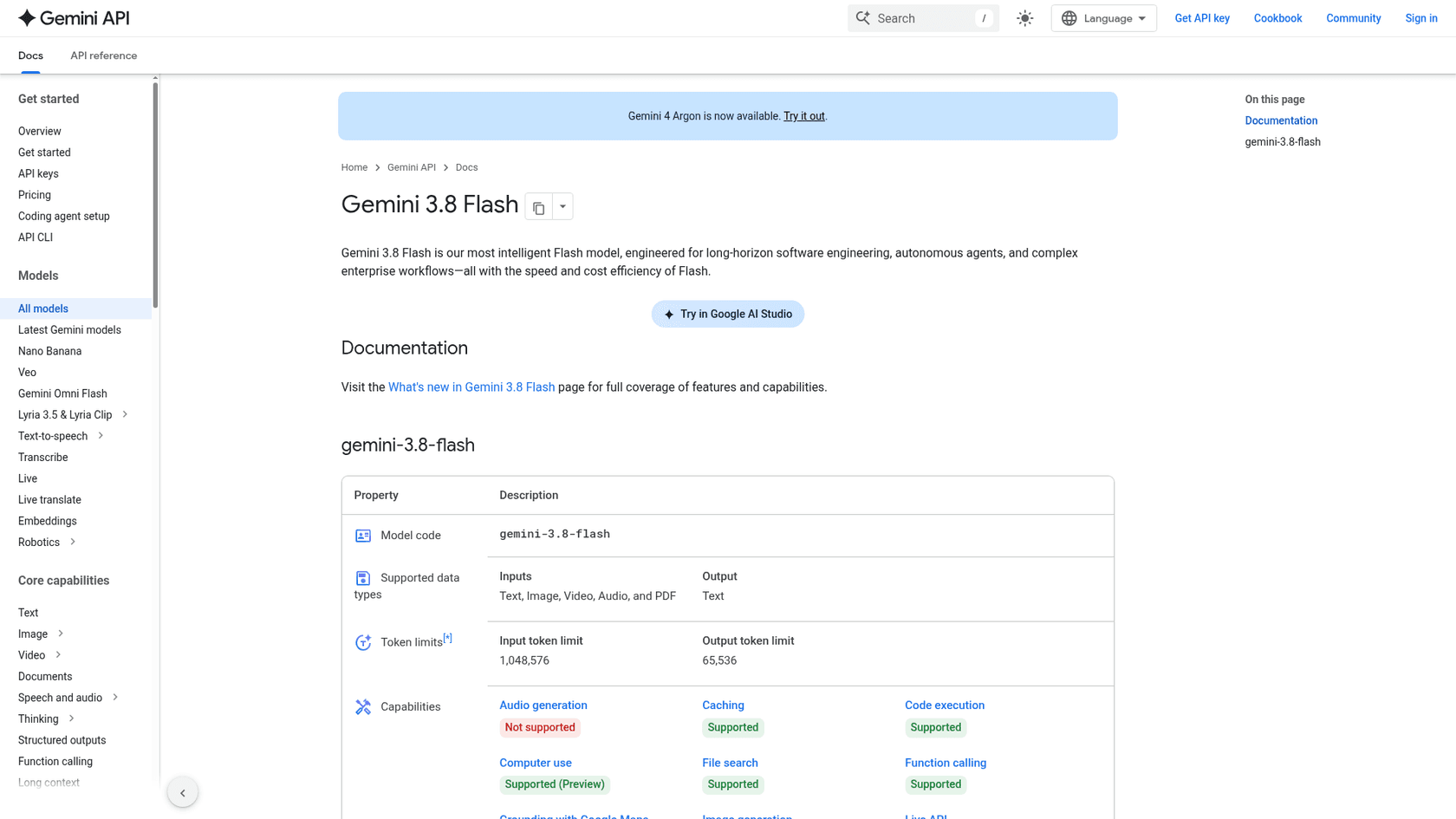
ChatGPT's pick in this slot was Gemini 3.6 Flash. But on the Gemini pricing page, 3.6 Flash and 3.8 Flash cost exactly the same, and Google now calls 3.6 its "previous generation Flash model". If you're testing Google's Flash tier, then, test 3.8.
Pros
- Cheaper per token than Terra until the end of 2026:
$0.75input and$3.75output, which puts the example buyer at$2,625. - It accepts text, image, video, audio and PDF input, which is wider than any other model here.
- There's a free tier for testing, something Terra doesn't offer.
Cons
- On 1 January 2027 the price doubles to
$1.50/$7.50, putting it above Terra per token. - It thinks a lot. AA has it at
$3.49per task and a28.3sfirst token at high effort, which makes it a poor fit for a chat window someone is staring at. - Google's own launch notes say 3.8 Flash can use more tokens to maximize performance. The Gemini 3.8 Flash review has the detail.
Pricing: $0.75/$3.75 through 31 December 2026, then $1.50/$7.50. Batch and Flex are half that.
My take: It works well for overnight document processing priced on tokens. For anything interactive, or anything still running in January, work out the cost per task first.
5. Gemini 4 Argon
Best for: the hardest reasoning, research and long autonomous agents, where getting the answer right is worth paying for.
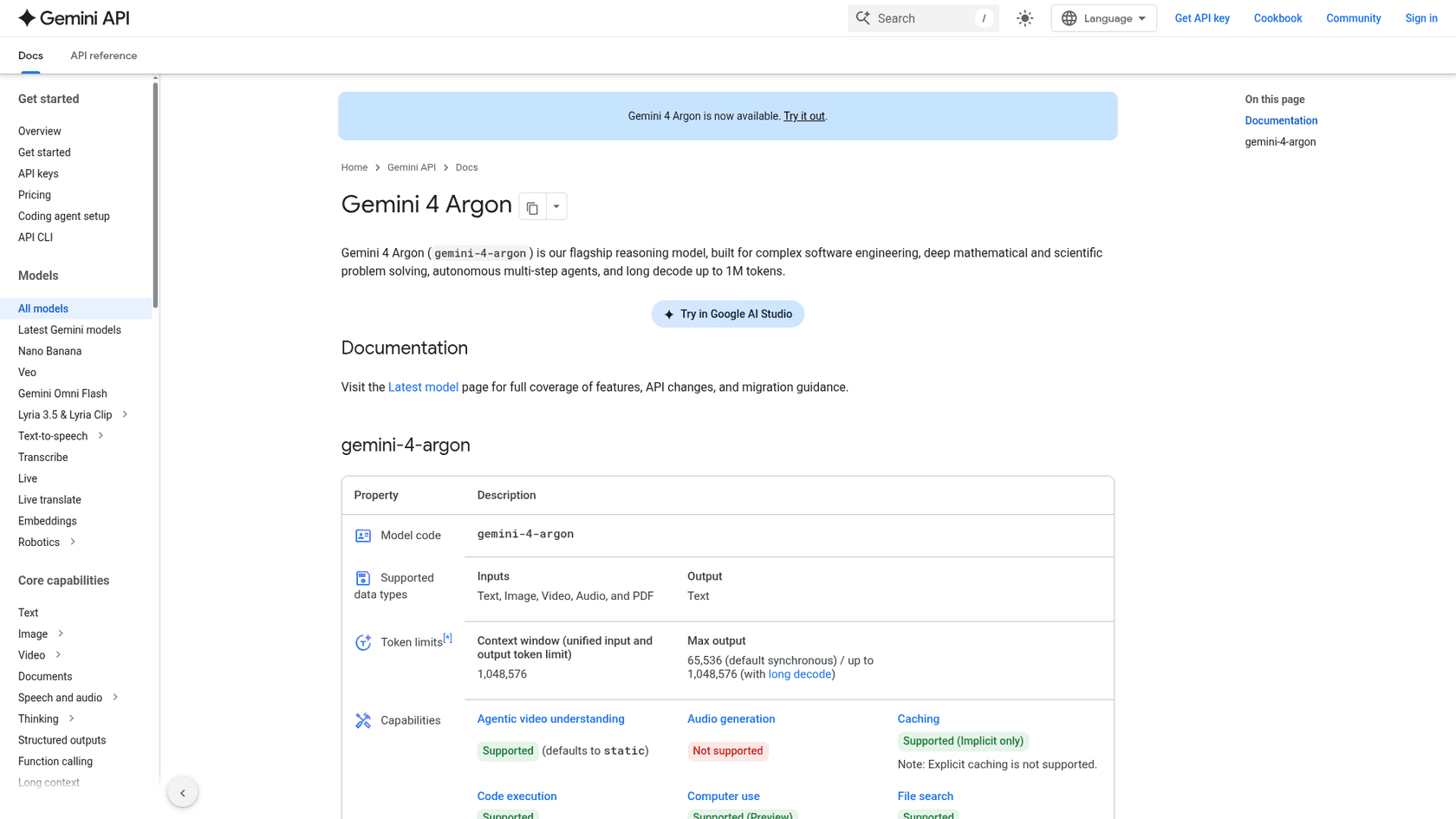
This is Google's flagship, released 30 September 2026, and nothing on this list scores higher.
Pros
- Top Intelligence Index here at
52.6, more than 4 points clear of Terra at max, on Artificial Analysis. - Its AA hallucination rate,
15%, is the lowest on this list, against38%for Terra at max. If wrong facts are your biggest risk, Argon is the safest model here. - 1M context and long outputs.
Cons
- That
$2/$10price is only an introductory rate, ending 30 November. From 1 December it moves to$4/$20, which doubles the example buyer's bill from$7,000to$14,000. - It's slow, with a
48.2sfirst token and about80tokens a second on AA. - There's no free tier, and caching is implicit only.
Pricing: $2/$10 through 30 November 2026, then $4/$20, per the Gemini pricing page. The Gemini 4 Argon pricing guide breaks down the promo.
My take: Treat Argon as the pricey specialist your router escalates to, not a Terra replacement for everyday traffic. And budget at the December price rather than the promo. The Gemini 4 Argon review has more.
6. Grok 4.7
Best for: adding a fourth independent vendor to your bake-off, especially for long, output-heavy answers.
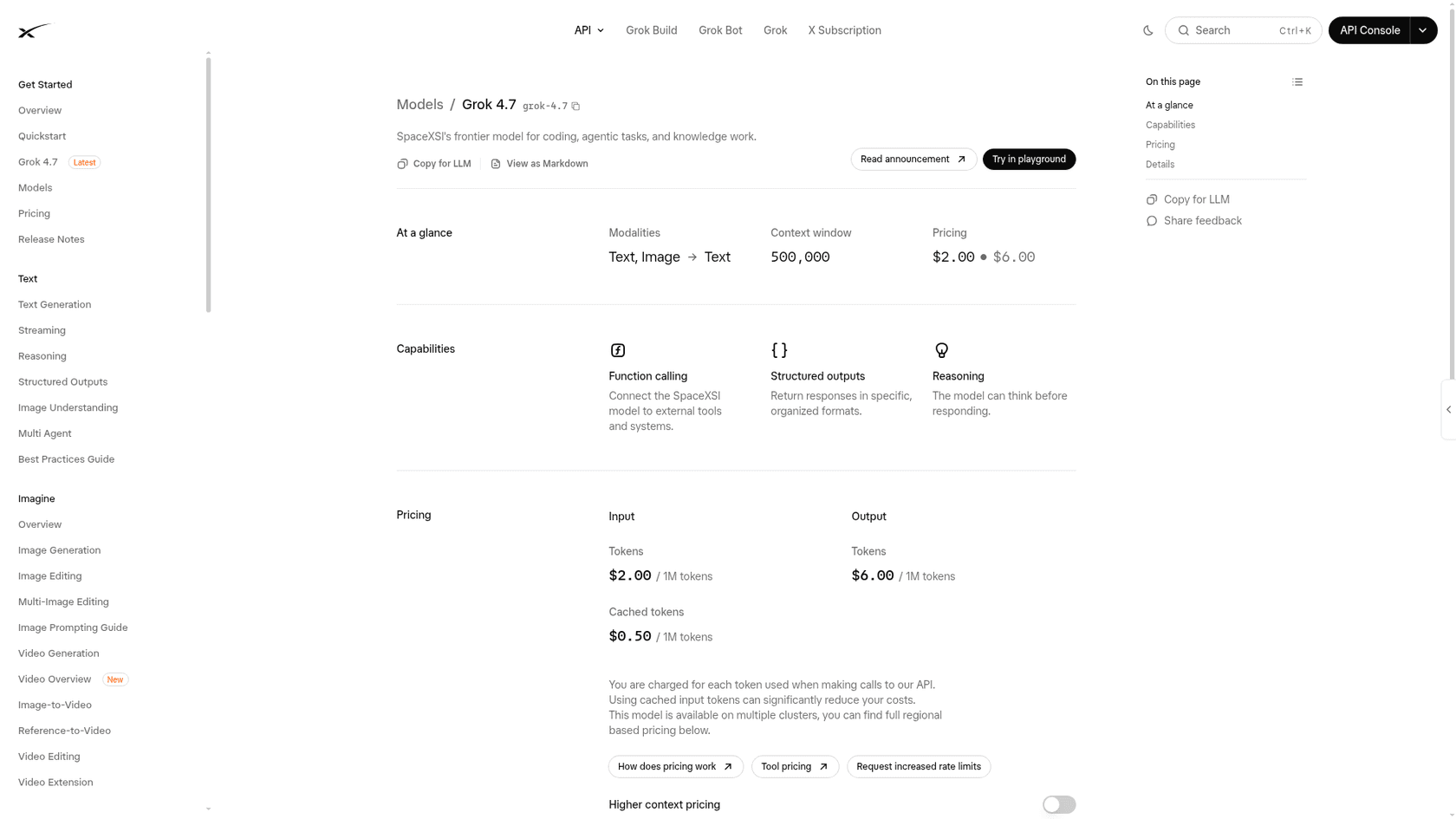
This is xAI's flagship, described on its models page as "our flagship model for code and everything else".
Pros
- Output is cheap for a frontier model:
$6per 1M against$10for Sol and Sonnet, which brings the example buyer to$5,800. - AA's hallucination rate at high effort is
32%, which is lower than Terra at max. - Reasoning is configurable, and there are server-side web and X search tools.
Cons
- At 500K tokens, it has half the context of everything else here.
- It's expensive per task. AA has it at
$2.36at high effort for a46.3index, the worst ratio on this list. - The first token takes
45.7sat high effort, though low effort cuts that to5.4s.
Pricing: $2 input, $6 output per 1M on the xAI docs.
My take: It earns one slot in a bake-off so you aren't relying only on the big three. On these numbers, though, I wouldn't pick it over Sol or Sonnet. The Grok 4.7 review goes into the rest.
7. Claude Haiku 5.5
Best for: tagging, routing and classification at huge volume, where nothing goes straight to a customer.
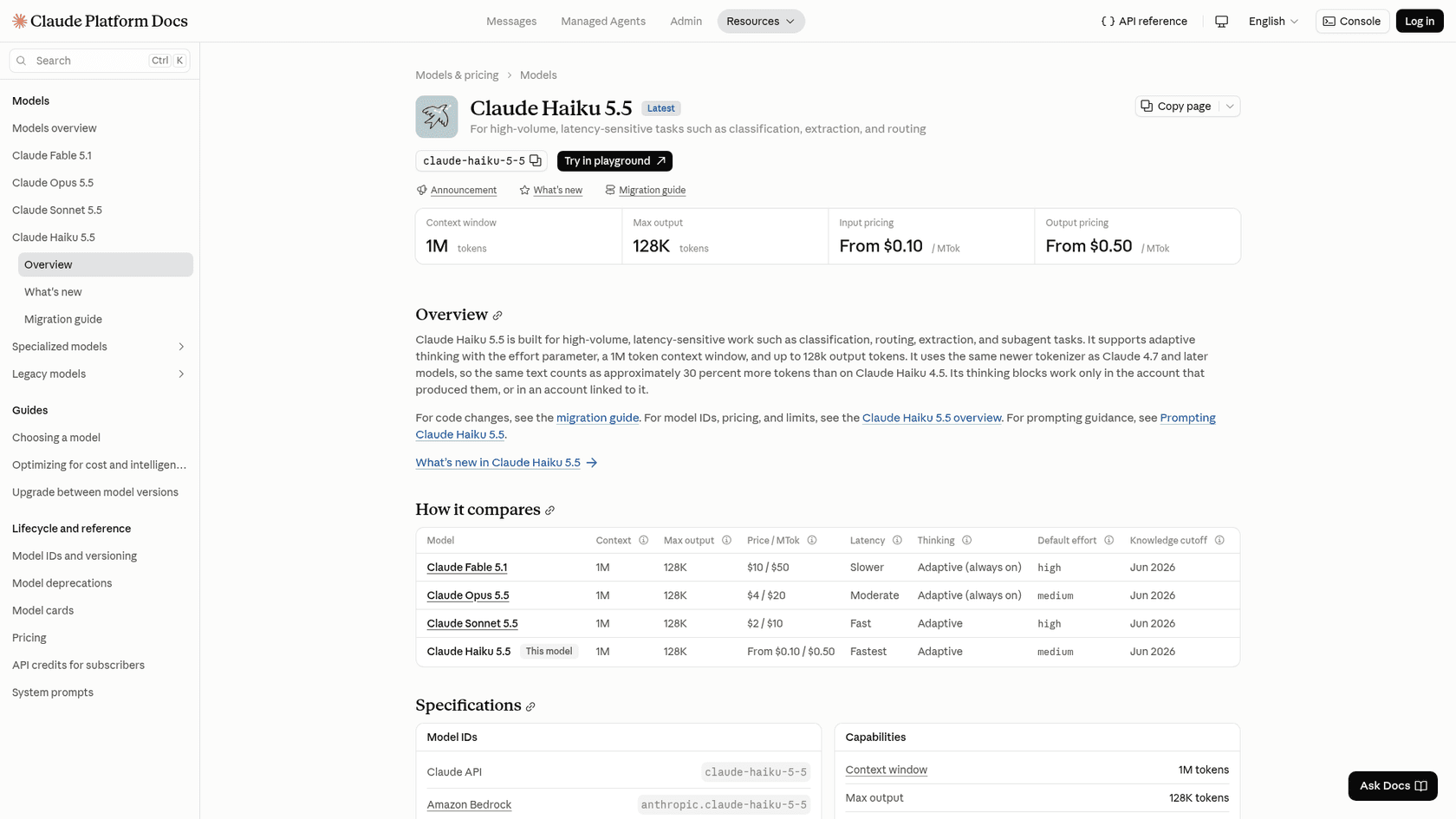
When Terra is more model than the job needs, step down a tier instead of sideways. Claude Haiku 5.5 is Anthropic's small model, out since 7 October 2026, and it sits at the same $0.10/$0.50 price point as GPT-6 Luna.
Pros
- The example buyer pays
$350a month, a tenth of the Terra bill. - AA scores it
37.8at high effort for$0.08a task, ahead of Luna's32.9. - It runs at about
185output tokens a second on AA.
Cons
- Once a prompt goes over 100,000 tokens, you pay 5x:
$0.50input and$2.50output. An HN user called it a model "destroyed by Anthropics crazy decision to price it x5 after 100k context" (rockdoe). - It sits
10points below Terra on the index, so treat it as a tier down rather than a swap.
Pricing: $0.10/$0.50 up to 100K-token prompts, $0.50/$2.50 above, per the Claude pricing page.
My take: Haiku 5.5 or Luna make a good cheap first pass in a router. Just keep prompts under 100K. The Claude Haiku 5.5 review has its benchmarks.
Which GPT-6.1 Terra alternative fits your product?
Start from the job, not the leaderboard. A model can read a screenshot well and still click the wrong button. Another can be brilliant at math and still feel slow in a chat window.
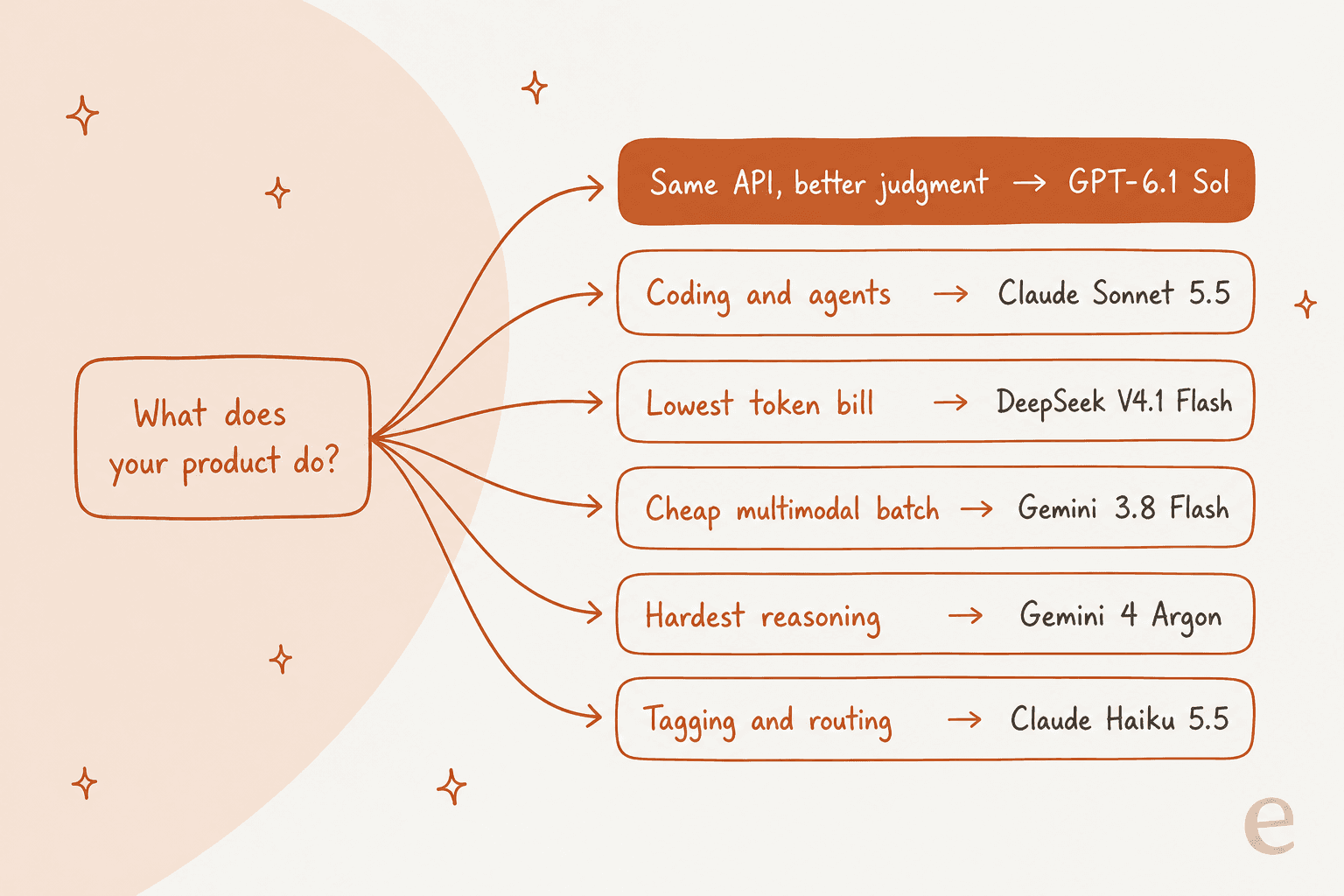
| If your product mostly does... | Test first | Why |
|---|---|---|
| Customer-facing drafts and chat | Terra at low, Sol at medium | Fast first token, good writing, and Sol for edge cases |
| Coding or terminal agents | Claude Sonnet 5.5 | 70.6% on Terminal-Bench 4.0 per Anthropic |
| High-volume extraction or RAG | DeepSeek V4.1 Flash | $0.15/$0.60 off-peak and open weights |
| PDF, video or audio processing overnight | Gemini 3.8 Flash | Widest input types, cheap until 2027 |
| Research and the hardest reasoning | Gemini 4 Argon | Top AA index, lowest hallucination rate |
| Tagging and routing | Claude Haiku 5.5 or GPT-6 Luna | $0.10/$0.50 |
| Self-hosted or data-residency bound | DeepSeek V4.1 Flash, or Qwen 3.8 | Weights you can run yourself |
If nothing here fits, two more are worth knowing. Kimi K3.1 Pro scored 55.1 on AA but runs slowly, at about 46 tokens a second. Mistral Large 4 is still in preview.
How to run a model bake-off before you switch
A leaderboard shows how a model does on someone else's test. What you need is how it does on yours. This is the process I'd follow, and it has the same shape as the eval in my Terra review:
- Pull 100 to 500 real requests. Anonymize them and keep the ugly ones in: typos, two questions in one, tool timeouts, a prompt injection.
- Pick three challengers. Use Terra as the baseline, and add the two or three rows from the table above that match your job.
- Measure what users feel. Task success rate, invented facts,
p50andp95latency, tool-call accuracy, retries, and cost per successful task. - Grade by hand at first. On the first run, read every output yourself. Once you trust the rubric, automate it; the OpenAI agent evals tooling helps with that.
- Test a router, not just single models. Send everything to a cheap default, then escalate the cases that are hard or uncertain.
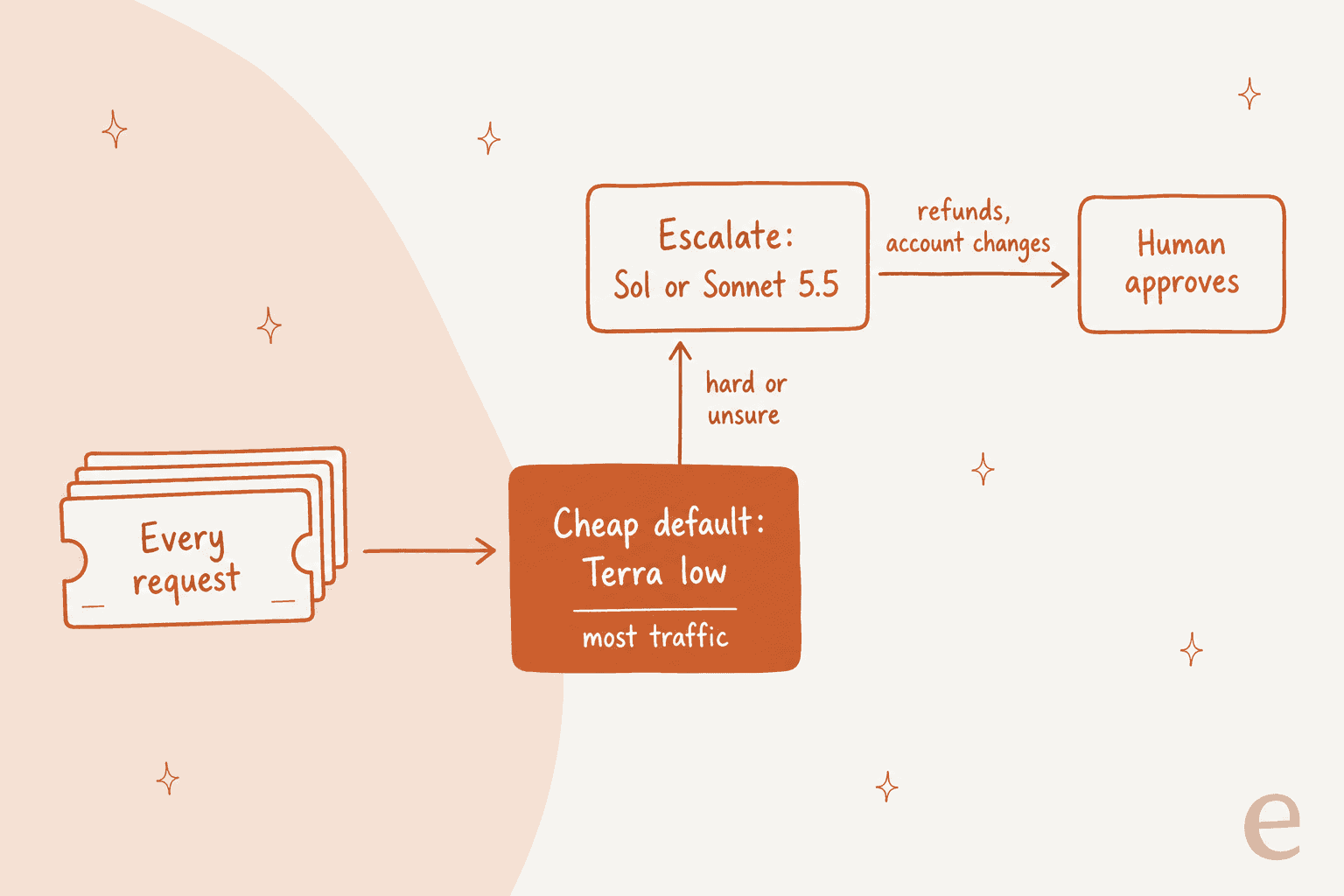
Most of the savings come from routing. OpenAI built Terra's none and low efforts for this exact fast path, and HN users kept circling back to one question about it:
"Is a high effort terra above a low effort Sol? Are larger models mostly always better regardless of effort?"
Going by the AA data, the answer is often no, and measuring is the only way to know for your own workload. Caching also helps with every option. Terra's cached input is $0.05, a 95% discount, and the OpenAI API pricing guide covers Batch and rate limits before you scale.
If the model is for a support queue
Plenty of the teams comparing Terra alternatives are really building a support bot. I've spent years putting AI agents on live helpdesk queues, and I keep seeing the same thing: the model is rarely the weak point; the rules around it are. In my 80-run Terra test, no model got fewer than 15 of 16 tickets right. The only real failure was Terra at none telling a Spanish-speaking customer "we've noted the new address" when it had no way to change it.
That's an escalation problem. You fix it in the layer that decides when to hand over, not by paying for a bigger model. What prevents AI hallucinations is grounding answers in your help center and past tickets, no matter which model writes the words. And next to a wrong promise made to a paying customer, the token bill is a small slice of AI customer service cost.
SamCart shows what that layer looks like in practice. One eesel agent works its Freshdesk tickets and another its website chat, both answering from about 280 help center articles, on a plan sized at 8,000 interactions a month. Koffer.ch, a Swiss luggage shop, keeps every reply as a draft in German, French, English or Italian on Freshdesk. That's exactly the kind of setup where a cheaper model does the job fine.
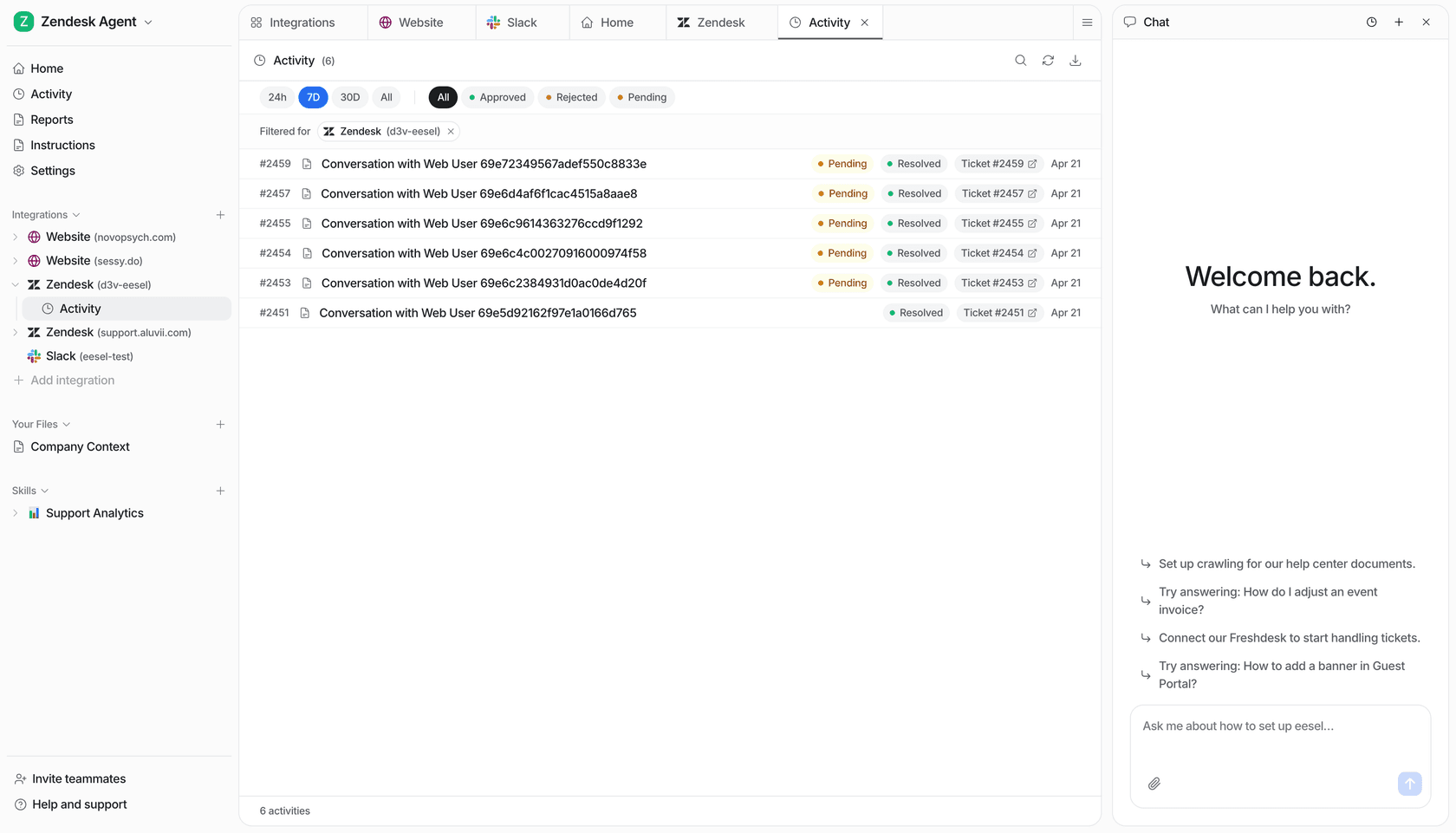
Prefer to drive it from code? The eesel CLI runs the same teammate you'd set up in the dashboard. Test a reply with eesel chat and see what the agent did with eesel activity; any change can be previewed with --dry-run. Every command returns JSON. Each workspace is also an MCP server, so a coding agent running on Terra or Sonnet can call your support teammate as a tool.
Try eesel
Terra, Sol and Sonnet are engines. When the thing you're building is support automation, eesel is the AI helpdesk teammate that already does that job on top of them. It joins the helpdesk you already run, whether that's Zendesk, Freshdesk, Gorgias or another. It learns from your past tickets and macros as well as your help center, and it follows the escalation rules you set. Before answering anyone live, it runs a simulation on your real past tickets, so you can compare its replies with what your team actually sent.
Pricing is a fixed monthly credit plan, where one ticket or chat counts as one credit. It starts at $299 a month for 500 credits, with every feature and unlimited seats included. Because there's no per-token charge, your bill stays put when a cheaper model like Terra ships. Start on the free plan and try eesel on a slice of your queue.