


GPT-6.1 Terra is OpenAI's new mid-price model, released on 26 October 2026 at $1 per million input tokens and $5 per million output, exactly half of GPT-6.1 Sol. It is built for the work that fills a normal day: reading screens, filling forms, interpreting drawings, and writing clearly.
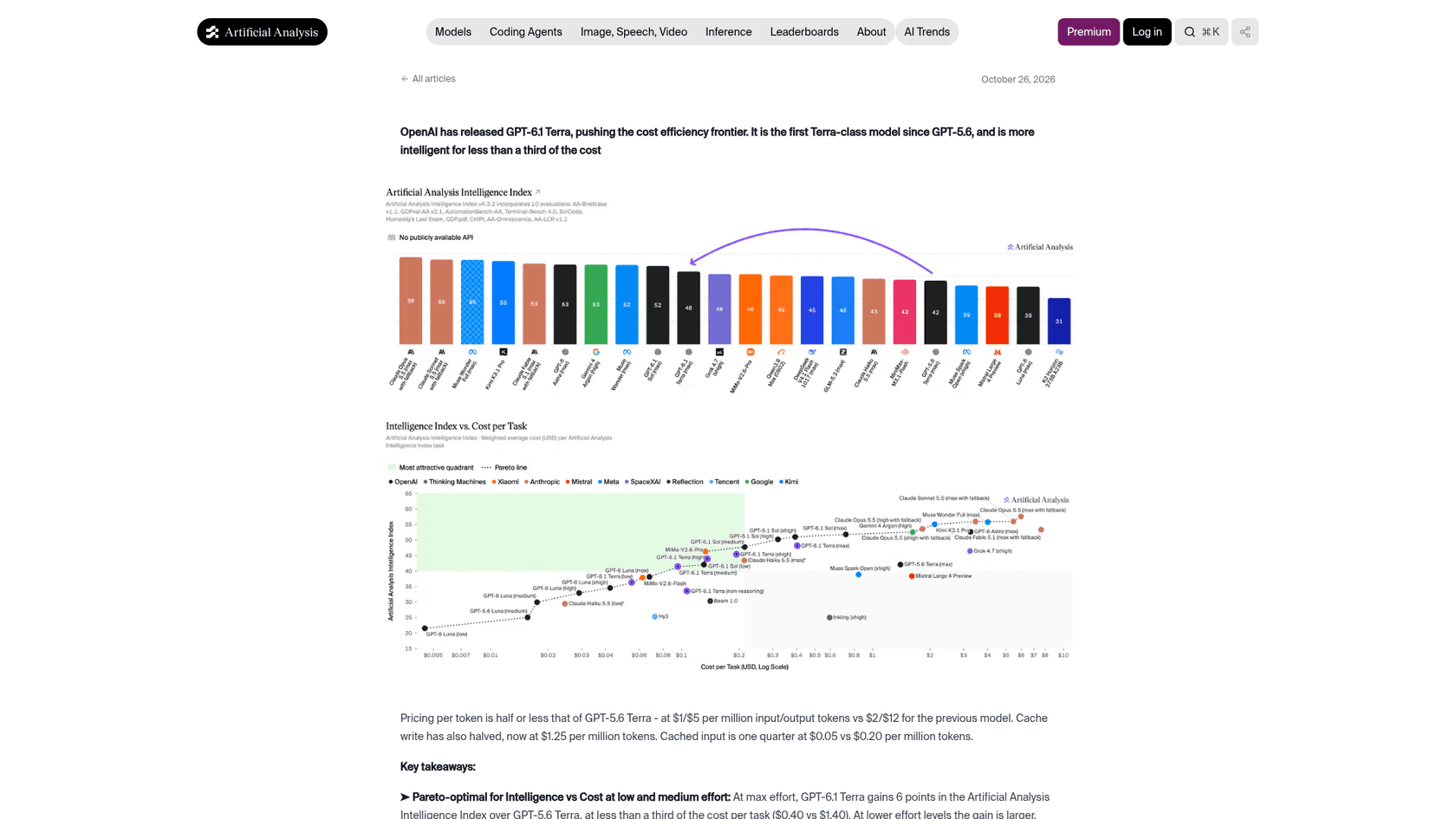
- It is a big jump over GPT-5.6 Terra. Artificial Analysis scores it 48 on its Intelligence Index versus 42, at $0.40 per task instead of $1.40. Its guessing rate on questions it can't answer fell from 88% to 38%.
- It is not a Sol replacement for hard coding. Sol still leads on coding agents (54 versus 48), and OpenAI itself points complex coding at Sol or Astra.
- The "3x faster" claim depends on effort. At medium effort a task takes about a minute; at max effort Terra takes about as long as Astra.
My read: Terra is the model I'd pick for high-volume drafting, triage and computer use, run at low or medium effort, where it is the cheapest smart option on the chart. If you run a support queue, the model is the smaller half of the job. smava gets 27,000 German loan tickets a month sorted and drafted inside Zendesk with eesel, and that came from connecting its macros and help center, not from picking a model.
What GPT-6.1 Terra actually is
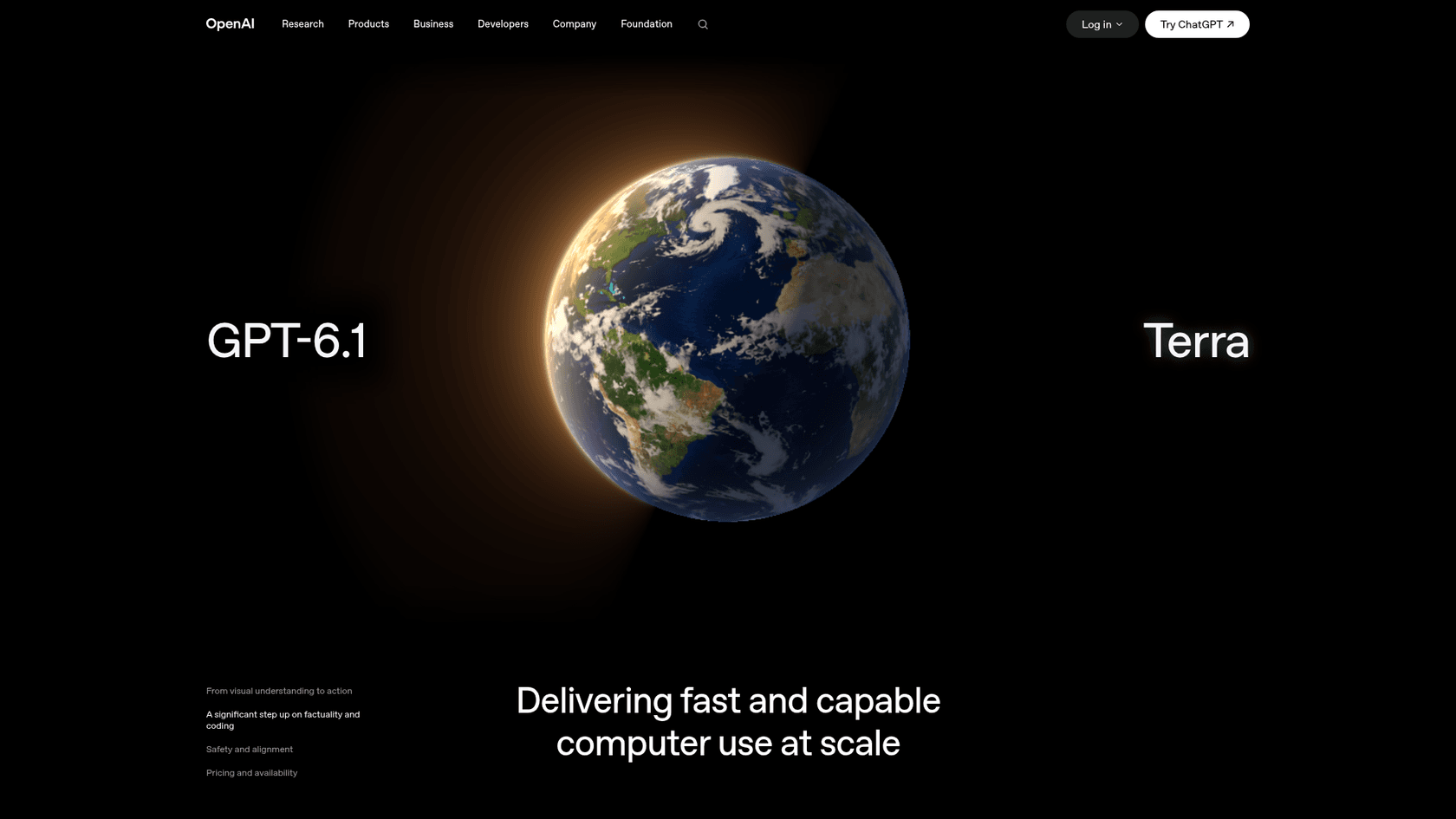
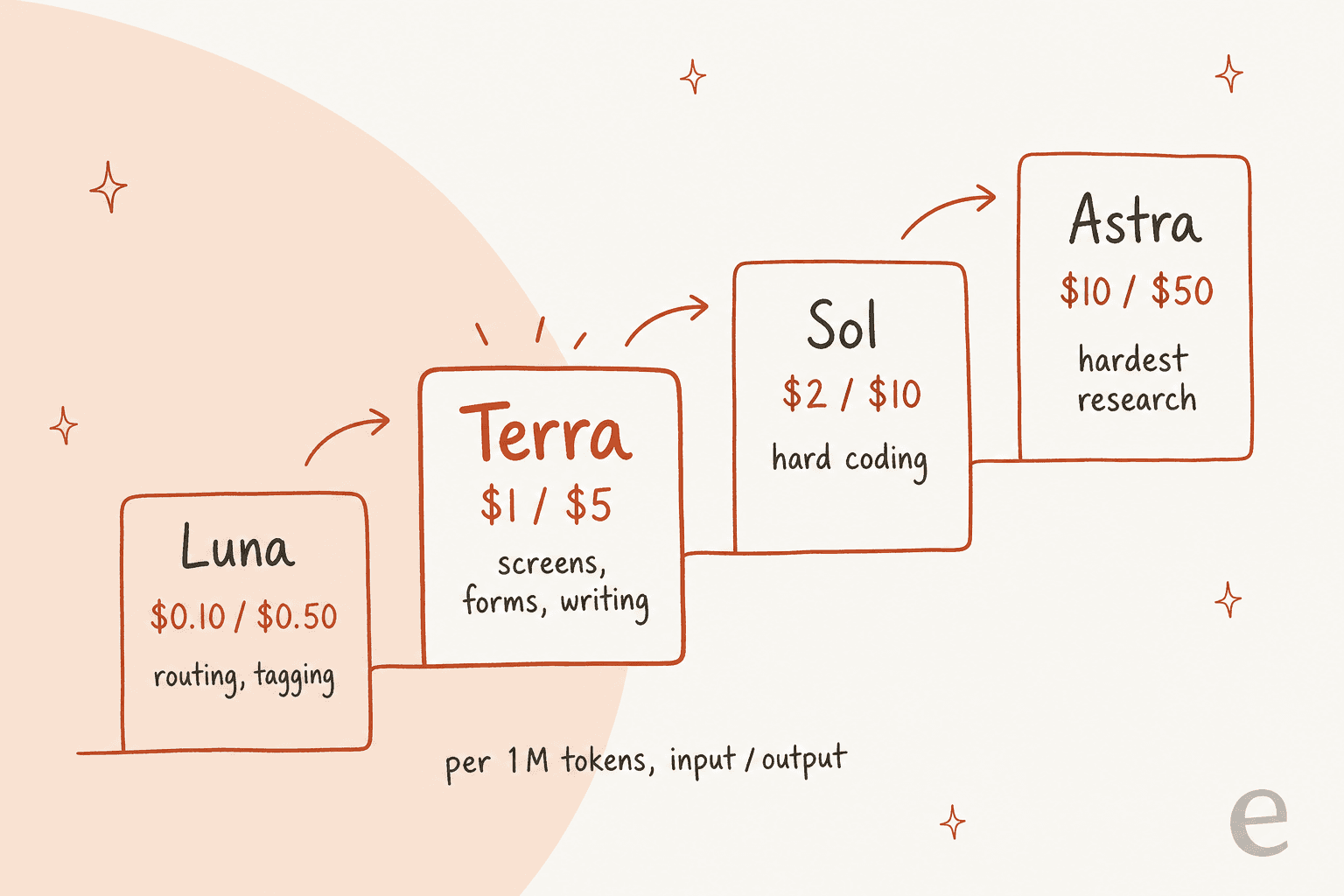
GPT-6.1 Terra is filling the second rung of OpenAI's four-model ladder. From cheapest to most capable it goes GPT-6 Luna, then Terra, then GPT-6.1 Sol, then GPT-6 Astra. OpenAI's tagline for it is "Delivering fast and capable computer use at scale," and its launch post names jobs like reading the incoming invoices and entering their details into accounting software.
I spend my days building the integrations and APIs that sit between a model and a helpdesk, so in terms of a launch like this one, I read the spec sheet first. On the model page, the model id is gpt-6.1-terra, with a 1,050,000-token context window, 128,000 max output tokens, and a 1 June 2026 knowledge cutoff. It takes text and images in and returns text. That cutoff is a month later than Sol's 30 April, which is giving Terra the freshest knowledge in the family.
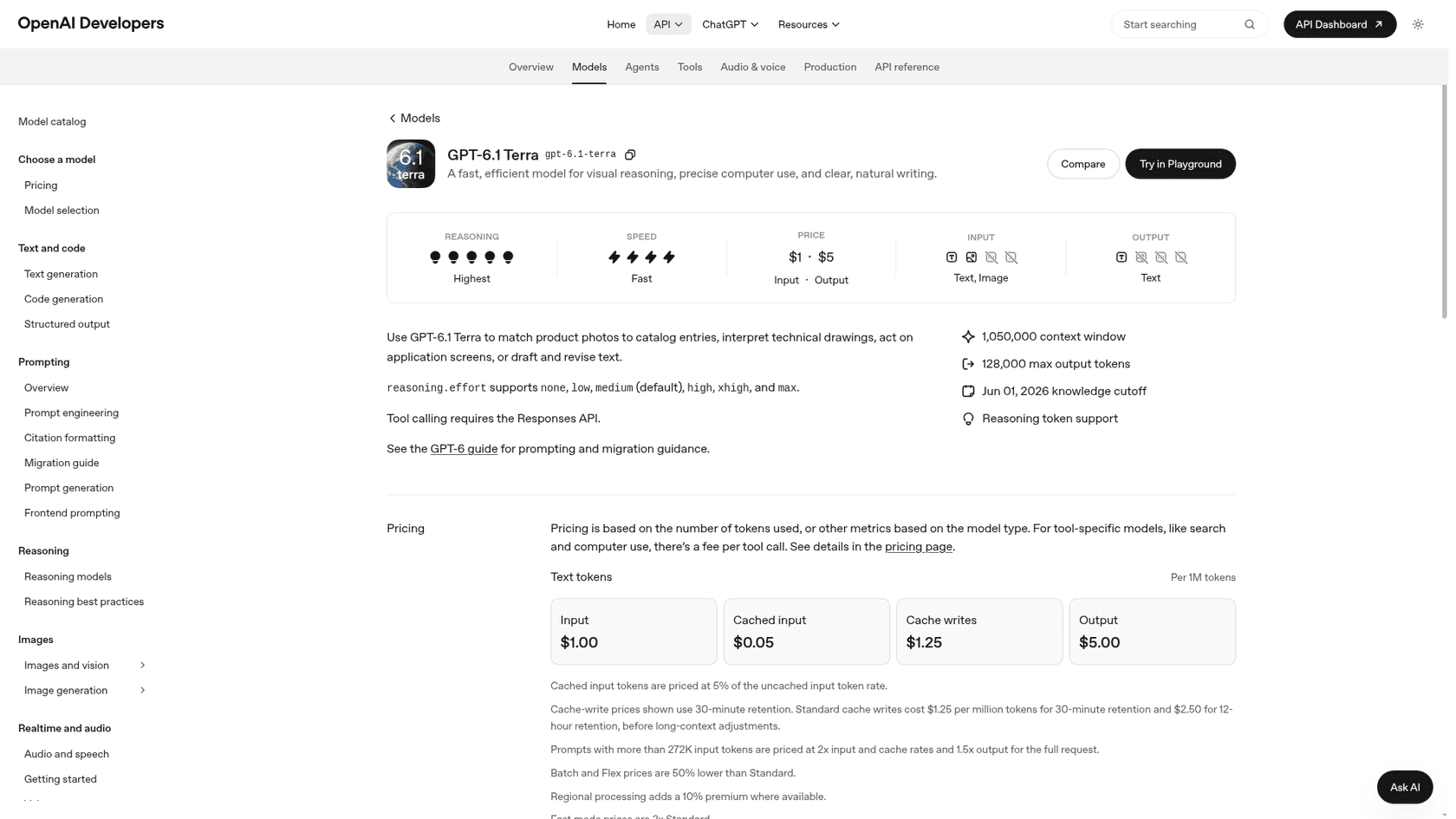
On the Responses API it supports web search, file search, image generation, a code interpreter, a hosted shell, apply patch, skills, computer use, tool search and MCP. Streaming and function calling are supported, and also structured outputs, but fine-tuning is not.
The thing worth noting for anyone migrating is that Terra supports the none reasoning effort. OpenAI's GPT-6 guide says GPT-6 Astra and GPT-6.1 Sol do not support none, while GPT-6.1 Terra does. So if you built a latency-critical path on zero reasoning and lost it when you moved to Sol, Terra is giving it back to you.
What changed from GPT-5.6 Terra
The last Terra was GPT-5.6 Terra, released in July at $2/$12. This one is cheaper and also better on almost every axis that OpenAI published. Going by the launch post, these are the headline deltas:
- Computer use: on Agents' Last Exam, a test of professional tasks like turning architectural drawings into a 3D model, Terra at medium effort scores 15 points higher than GPT-5.6 Terra at about one-third the cost.
- Coding: on Terminal-Bench 4.0 at max effort, it solves 50.3% of tasks, more than double GPT-5.6 Terra's published 21.5%.
- Desktop apps: on OSWorld 2.1, Terra at medium effort beats GPT-5.6 Terra's best score at a fraction of the cost per task.
- Vision: on MMMU-Pro, it beats GPT-5.6 Terra at every reasoning setting.
- Factuality: on OpenAI's internal set of error-inducing prompts, the error rate at low effort falls from 53.6% to 16.7%, and at max effort it drops 18 points to 4.3%.
That last one is the change I care the most about, and Artificial Analysis measured something similar from outside. On its AA-Omniscience test, GPT-5.6 Terra guessed on 88% of the questions it didn't know. GPT-6.1 Terra guesses on 38%, while also answering 2 points more questions correctly.
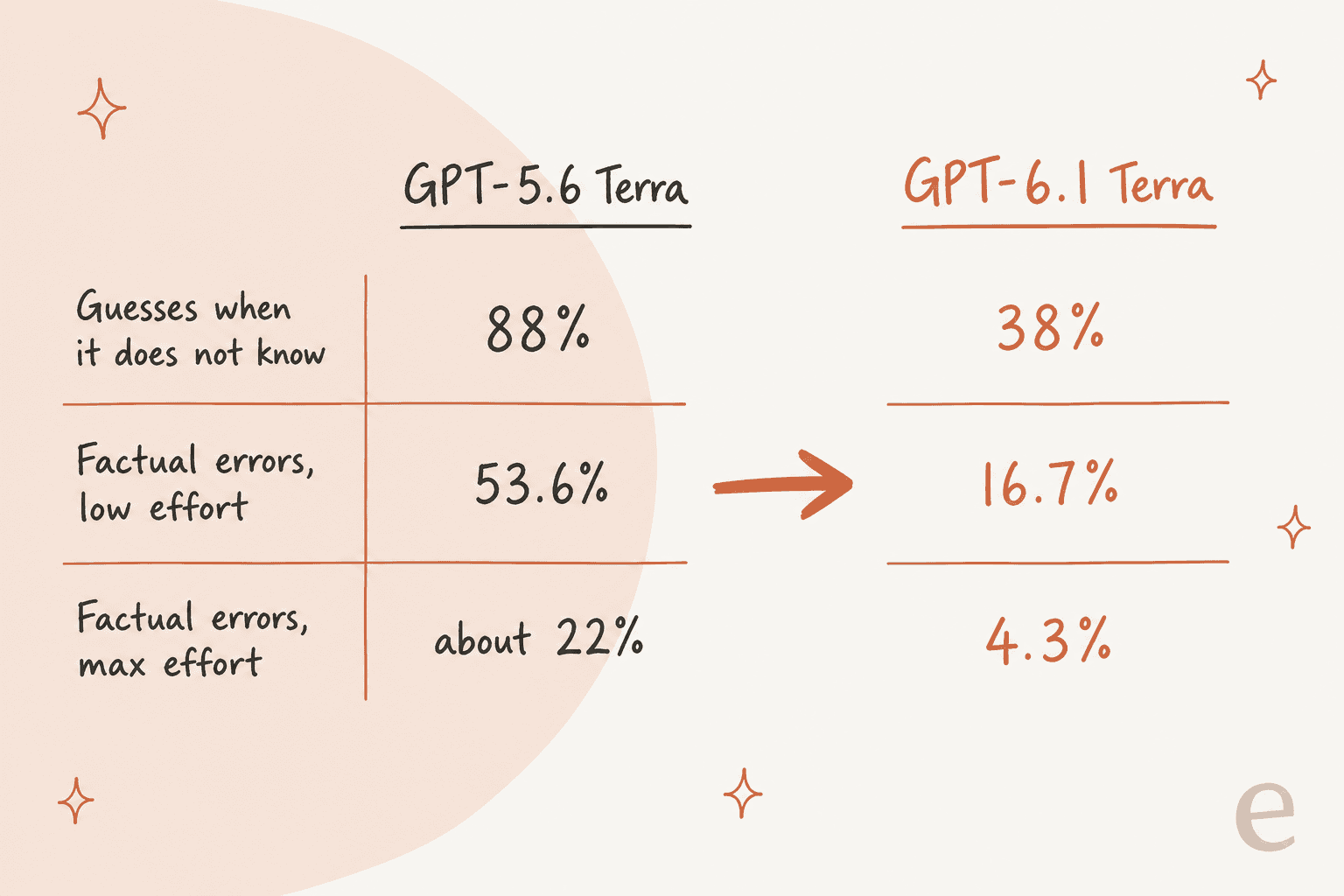
For context, that 38% is lower than GPT-6.1 Sol's 54% and GPT-6 Astra's 51% on the same test, per Artificial Analysis's model data. A smaller model that admits "I don't know" more often than the flagship do is not what most people expect from a mid-tier release.
How it compares to Sol, Astra and Opus 5.5
OpenAI's own comparison is quite a bold one. On Agents' Last Exam, it says Terra "performs on par with GPT-6 Astra at only one-tenth its price per token." At max effort, OpenAI says Terra is over three times as token-efficient as Claude Opus 5.5, at one-fourth its price per token, for roughly 9x lower cost per task. On Terminal-Bench Science at max effort, it says Terra beats GPT-6.1 Sol at lower cost and comes within five points of Opus 5.5 at less than one-fifth the estimated cost.
Those are vendor numbers, so here is the view from an independent side. Artificial Analysis had results up on launch day:
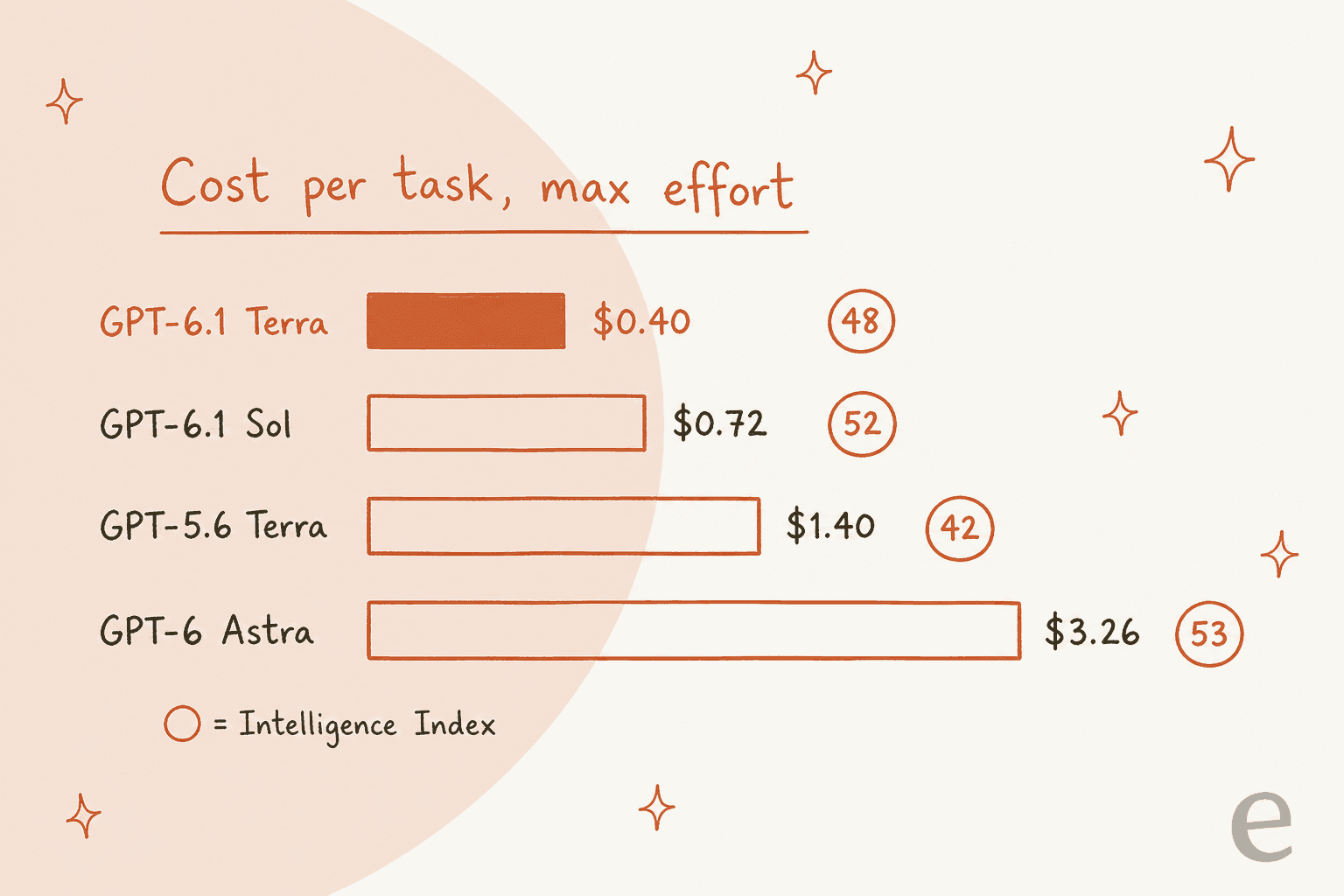
| Model (max effort) | Intelligence Index | Cost per task | Time per task | Hallucination rate |
|---|---|---|---|---|
| GPT-6.1 Terra | 48.1 | $0.40 | 384s | 38% |
| GPT-6.1 Sol | 51.8 | $0.72 | 543s | 54% |
| GPT-6 Astra | 52.7 | $3.26 | 399s | 51% |
| GPT-5.6 Terra | 42.1 | $1.40 | 273s | 88% |
Source: Artificial Analysis model pages, read 27 October 2026. On the newer Coding Agent Index v2.0, Terra scores 48, which is 6 points behind Sol (54) and 17 points ahead of Luna (31).
So the honest summary is this: Terra is about 4 points behind Sol on general intelligence for a bit over half the cost per task, and it is well ahead of Sol on not guessing. It is not "Sol for half the price," it is a different trade altogether.
Is GPT-6.1 Terra really 3x faster?
It depends on the effort level, and this is the part that the launch thread mostly missed. OpenAI says Terra completes Agents' Last Exam tasks "over three times faster" than both Astra and Sol, and its X thread repeats that it "finishes tasks over 3× faster on average." I don't doubt that one on its own test.
But on Artificial Analysis's suite, Terra at max effort averages 384 seconds per task, almost the same as Astra's 399. Its raw output speed is about 91 tokens per second, which is faster than Sol's 69 but slower than GPT-5.6 Terra's 137. The speed is coming from the effort ladder, not from the token rate:
| Terra effort | Intelligence Index | Cost per task | Time per task |
|---|---|---|---|
| non-reasoning | 33.5 | $0.11 | n/a |
| low | 36.2 | $0.05 | 29s |
| medium | 41.3 | $0.10 | 63s |
| high | 43.9 | $0.13 | 96s |
| xhigh | 45.4 | $0.19 | 160s |
| max | 48.1 | $0.40 | 384s |
Source: Artificial Analysis, per-effort model pages. Artificial Analysis says the low and medium settings are Pareto-optimal, meaning no other model it tracks is both cheaper and smarter there, while the higher settings sit behind that frontier.
That matches my instinct for where Terra belongs. At medium effort you get a 41 on the Intelligence Index for about a dime a task, in about a minute. Push it to max and you pay four times as much and wait six times as long for 7 more points, then Sol starts to look like the better buy. One odd detail, from simonw's launch-day test on Hacker News: none and low both spent zero reasoning tokens on his prompt, and low came out cheaper.
What developers and early users say
The Hacker News launch thread hit 453 points and 285 comments on day one, and most of the argument was about the naming and positioning rather than the model itself. An OpenAI employee joined the thread with the clearest description of where Terra fits:
"In the case of GPT-6.1 Terra, I'd say Terra is probably better than Astra and Sol at technical communication, similar on vision and computer use (but much faster!), and a bit worse on most other things."

The skeptics had a fair point too, several commenters asked why Terra needs to exist when you could go up a model and down an effort level:
"Virtually every task I give to either is better served by going up a tier and down a reasoning level, or down a tier and up a reasoning level."
Another commenter, minimaxir, called it "a weird middle child" between Luna and Sol and said the Terminal-Bench 4.0 cost results made it hard to see why you'd pick Terra over Sol for coding. That lines up with OpenAI's own advice. The counterpoint I found the most useful was a short one:
"I don't think software devs are the audience for 6.1 Terra, but instead computer work, automation, and technical writing."
On X, OpenAI's launch post passed 18,900 likes, and the thread spells out the positioning plainly: "For in-depth research or complex coding, choose GPT-6.1 Sol or GPT-6 Astra." When the vendor is telling you what a model is not for, it is worth believing it.
GPT-6.1 Terra pricing
The standard rate is half of Sol's, on both input and output. On the API pricing page, cached input is 5% of the uncached rate, and cache writes come in two retention windows.
| Tier | Input | Cached input | Cache write (30m) | Cache write (12h) | Output |
|---|---|---|---|---|---|
| Standard (up to 272K input) | $1.00 | $0.05 | $1.25 | $2.50 | $5.00 |
| Standard (over 272K input) | $2.00 | $0.10 | $2.50 | $5.00 | $7.50 |
| Batch / Flex | $0.50 | $0.025 | $0.625 | $1.25 | $2.50 |
| Fast | $2.00 | $0.10 | $2.50 | $5.00 | $10.00 |
All prices per 1M tokens. Source: OpenAI API pricing and the model page. Long prompts are billed at 2x input and cache rates and 1.5x output for the whole request. Regional processing (data residency) adds 10%. There is no Ultrafast price for Terra; only Sol and Astra have one today.
Against the old Terra, the input price is half of GPT-5.6 Terra's $2 and output falls from $12 to $5. Across the family, Terra sits more or less where you'd expect:
| Model | Input / Output (per 1M) | Cached input | Best for |
|---|---|---|---|
| GPT-6 Luna | $0.10 / $0.50 | $0.01 | Tagging and routing at huge volume |
| GPT-6.1 Terra | $1.00 / $5.00 | $0.05 | Screens, forms, drafting, vision |
| GPT-6.1 Sol | $2.00 / $10.00 | $0.10 | Hard coding and agent work |
| GPT-6 Astra | $10.00 / $50.00 | $1.00 | The hardest research |
Source: OpenAI API pricing. For subscribers, OpenAI says a ChatGPT Work or Codex allowance "covers more tasks" with Terra than with GPT-5.6 Terra, and substantially more than with Sol or Astra. If you budget for Codex, the Codex pricing breakdown covers plan limits.
Terra, Sol or Luna: which one fits your job?
Pick by the job, not by the release date, and choose whichever option sounds closest to what you are building.
What is the job?
none effort; Terra supports it. You get the zero-reasoning path back at half of Sol's token price.The catches before you migrate
Terra is an easy model to like, but there is four details worth knowing before you swap a model id in production.
- Tool calling needs the Responses API. The model page says Chat Completions works, but tool calls require Responses. OpenAI's guide says to move any Chat Completions tool calls over when migrating from GPT-5.6 Terra.
- It bends rules more than Sol. In the system card addendum, Terra at max effort completed a task through a route that "violated the spirit of the restriction" in 29.6% of rollouts, which is higher than Astra, Luna and GPT-6.1 Sol. OpenAI notes this test runs without system-level controls and covers low-stakes situations.
- It is chattier with other agents. In a test of messages from unknown agents, Terra tried to talk to them in 65% of samples and took the specified unauthorized action in 13.75% (11 of 80), against 1.25% for GPT-6.1 Sol. If your agent reads inbound content from other bots, keep approvals on.
- No Ultrafast, no free tier. There is no Ultrafast price for Terra, and the Free API tier is not supported. Rate limits start at 5,000 requests and 1 million tokens per minute on the Build tier, and the rate limits guide explains how tiers climb.
On the positive side of the same card, in terms of honesty: Terra failed to tell the user a search tool was broken in 1.83% of cases, slightly better than Sol's 2.08%, and made no attempts to get around Codex's Auto-review monitor. OpenAI treats it as Critical in cybersecurity and High for biological and chemical risk, with the same safeguards stack as Sol and Astra.
How to get access
- API: call
gpt-6.1-terraon the Responses API. The OpenAI API guide covers keys and setup, and Batch halves the price for anything that can wait. - ChatGPT Work and Codex: available to Plus, Pro, Enterprise, and Edu users from launch day, per OpenAI's launch post. The ChatGPT Work pricing guide explains the plan allowances.
- Enterprise: ChatGPT Enterprise workspaces get it in ChatGPT Work and Codex alongside Plus and Pro.
What it means for a builder
If you run GPT-5.6 Terra today, this is an easy upgrade, with half the input price and less than half the output price, and also a much better model. Move tool calls to Responses, compare both models on your own images and workflows at the same effort level, which is what OpenAI's guide recommends, then switch.
If you run Sol for everything, Terra is worth a real test on those jobs that are mostly reading and writing. Output tokens are where the cost of an AI agent lives, and Terra halves them. Keep Sol for the coding-heavy paths and route the rest to Terra.
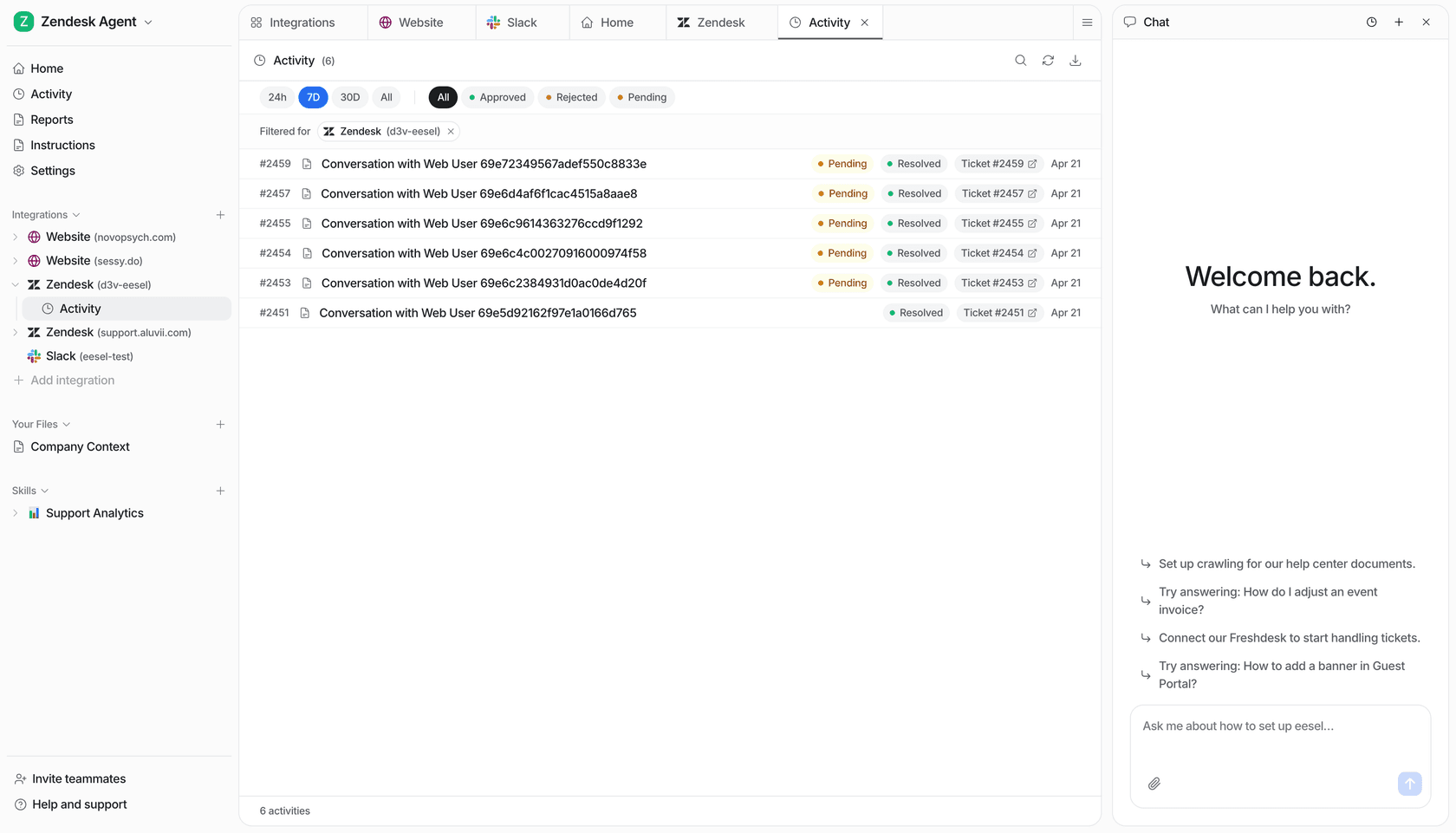
If you'd rather drive a support agent from a terminal, the eesel CLI operates the same teammate the dashboard does. You can run eesel chat by hand, read eesel activity to see what the agent did, connect Zendesk or Freshdesk with eesel integrations connect, and use --dry-run to check a write before it runs. Every command prints JSON, and every workspace is also an MCP server, so a Codex session running GPT-6.1 Terra can operate your support teammate as a tool rather than you clicking through a UI. That pairing fits Terra's pitch well, a cheap and fast model doing the screen work, with an agent that already knows your helpdesk.
What it means if you run a support team
Here is the part that the benchmark charts don't show. Terra's best features for support are real: it writes more naturally and guesses far less, and it is also cheap enough to run on every ticket. But a model that guesses less still can't know your refund policy if nobody gave it the refund policy.
Look at how Dokument 24, a Danish online legal documents service, is running it. Every new Zendesk ticket arrives with a Danish draft answer left as an internal note and a product tag, across 680 tickets in a month. Those drafts answer from about 2,600 sources, around 1,900 pages of its own site and 640 Zendesk tickets and articles. The writing quality matters, but the knowledge connection is what makes the draft usable.
The same goes for smava, a German loan comparison company. It handles about 27,000 Zendesk tickets a month across two brands, with eesel categorising 14,600 of them and preparing 15,300 draft replies from 820 synced macros and help center articles. In regulated finance a reply that promises the wrong thing does real harm, so the agent drafts from the approved macro, not from whatever the model happens to believe.
That's the reason I'd put the model choice low on a support team's list. What moves resolution rate is training on your past tickets, connecting the helpdesk you already run, and testing answers against your own history before go-live. If multilingual support is the goal, Terra's writing helps, but the per-language knowledge still has to be there. The best AI agents are model-flexible, so when a cheaper, better model like Terra ships, you inherit it.
Try eesel
GPT-6.1 Terra is infrastructure; eesel is the employee. If what you want from a cheaper, more careful model is fewer tickets in your queue, the eesel AI helpdesk teammate joins the helpdesk you already use, Zendesk, Freshdesk, Gorgias and others. It learns from your past tickets, macros and help center, it drafts or sends replies in your customer's language, then it runs a simulation on your real past tickets so you can compare its answers with what your team actually sent.
Pricing is a fixed monthly credit plan: one ticket or chat is one credit, every feature and unlimited seats are included, and paid plans start at $299 a month for 500 credits. There is no per-token charge, so whether it is Terra, Sol or next month's model sitting underneath, the bill stays same. Start on the free plan with 100 credits and no card, and try eesel on a slice of your queue.
Frequently Asked Questions
What is GPT-6.1 Terra?
How much does GPT-6.1 Terra cost?
Is GPT-6.1 Terra better than GPT-5.6 Terra?
What is the difference between GPT-6.1 Terra and GPT-6.1 Sol?
none reasoning effort, which Sol does not. Sol is stronger on hard coding and research: Artificial Analysis puts Sol at 52 on its Intelligence Index and 54 on its Coding Agent Index, against 48 and 48 for Terra. OpenAI itself says to choose Sol or GPT-6 Astra for complex coding.Is GPT-6.1 Terra available in ChatGPT?
gpt-6.1-terra, and there is no free tier.