
What GPT-6.1 Sol actually is
GPT-6.1 Sol is an upgrade to the mid-tier model in OpenAI's GPT-6 family. So the family now goes like this: Astra sits on top, 6.1 Sol is in the middle, with GPT-6 Luna down at the bottom. The tagline OpenAI picked for it is "Near-Astra intelligence for a fifth of the price," and they printed that phrase right on the launch price cards as well.
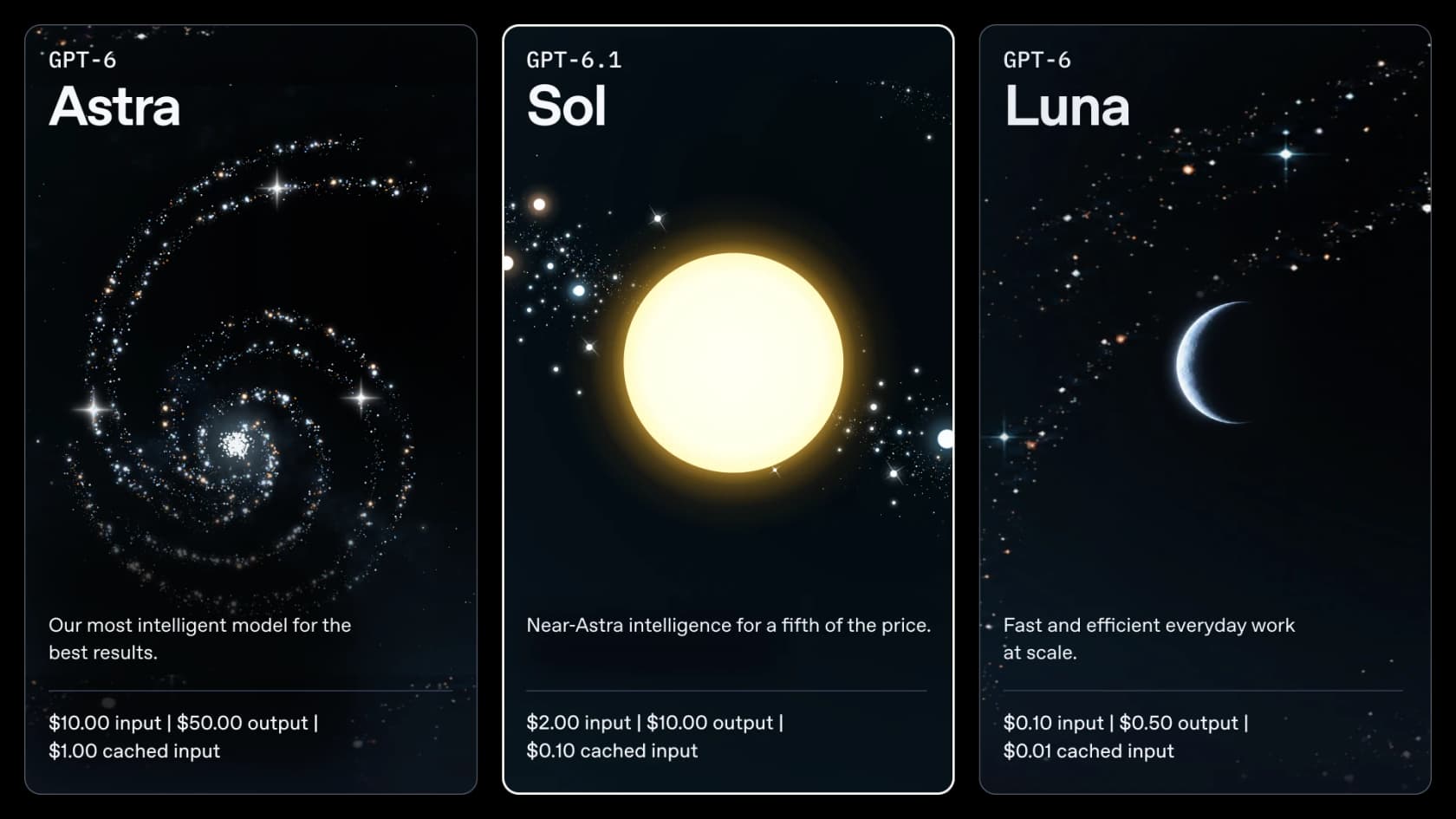
Most of my writing on AI models comes from the search side, and the search intent here is easy to read. Someone who searches "GPT-6.1 Sol" one day after launch is not asking what a language model is, they are asking one thing only: do I still need to pay for Astra? So that is the question I built this post around.
On the model page, the spec sheet looks almost the same as the one for its predecessor. The model id is gpt-6.1-sol, with a 1,050,000-token context window, 128,000 max output tokens, and a 30 April 2026 knowledge cutoff (ten days later than GPT-6 Sol's 20 April). Input can be text or images, and what comes back is text. On the Responses API it supports web search, file search, a code interpreter, a hosted shell, apply patch, skills, computer use, tool search, and MCP. There is also US and EU data residency, although if you pick EU residency then Fast mode is not available.
What changed from GPT-6 Sol, one week later
When GPT-6 Sol shipped on 22 September, the honest summary was "same intelligence as GPT-5.6 Sol at half the price." Artificial Analysis had it only about a point above GPT-5.6 Sol on its Intelligence Index, and not much more. GPT-6.1 Sol is the release where the capability actually starts moving.
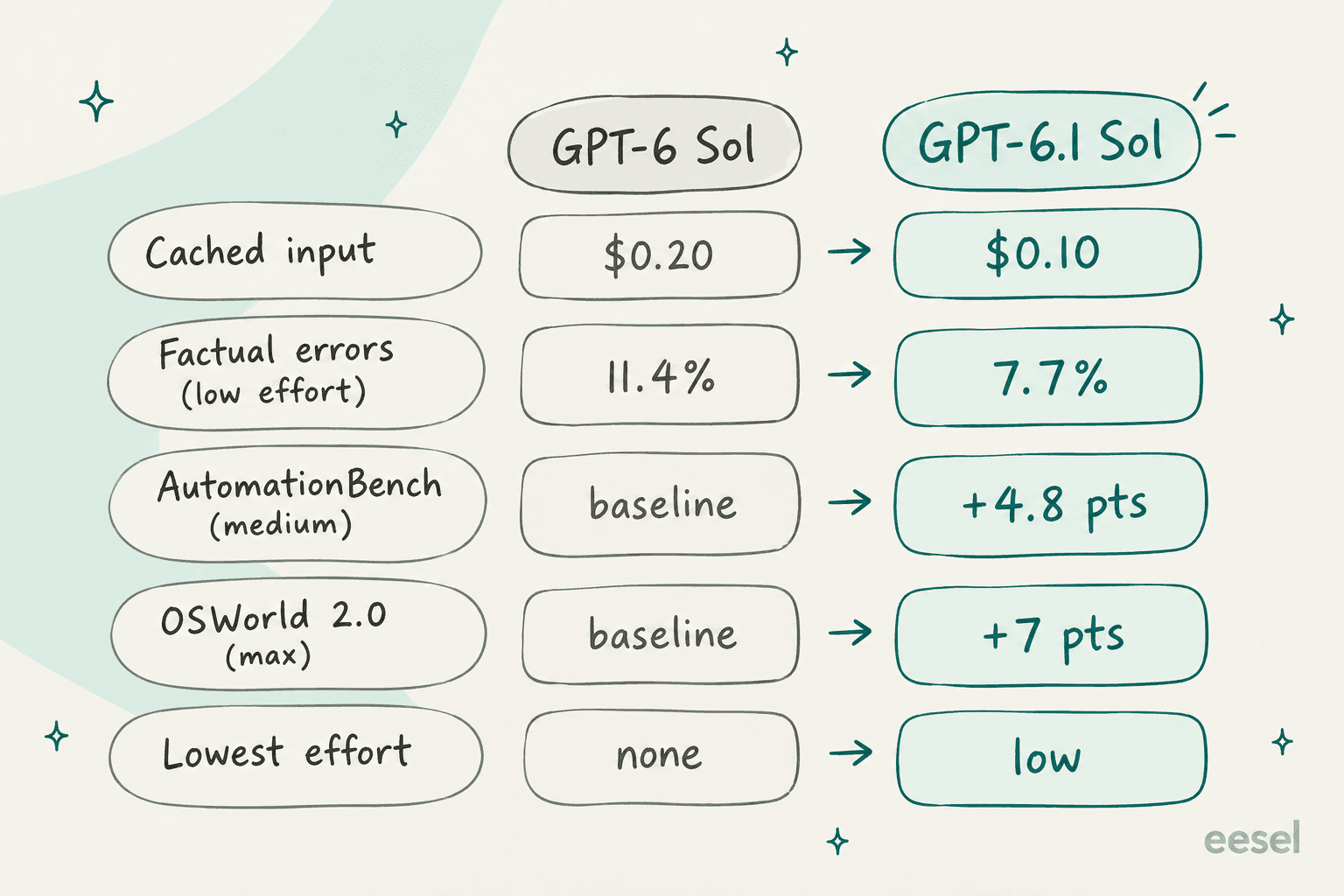
Going by OpenAI's launch post, these are the deltas against GPT-6 Sol:
- Coding: on DeepSWE v1.1, it beats GPT-6 Sol's best score by 6.4 percentage points, at a lower reasoning effort and cost.
- Business workflows: on AutomationBench, it is up 4.8 points from GPT-6 Sol at medium effort.
- Computer use: on OSWorld 2.0's offline set, it beats GPT-6 Sol by 7 points at max effort, at less than half the cost.
- Science: on Terminal-Bench Science 0.1, it more than doubles GPT-6 Sol's score at max effort.
- Factuality: at low effort, the share of responses with a factual error drops from 11.4% to 7.7%, about a 32% reduction.
Something moved on the safety side too. The system card addendum reports that when a search tool is broken, GPT-6.1 Sol fails to tell the user in 2.08% of cases, compared with 4.92% for GPT-6 Sol. If the thing you build is customer-facing, a model that "admits when it can't look something up" is worth more to you than a couple of benchmark points.
One small thing did go backwards, and I'll come back to it in the catches section: the lowest reasoning setting is now low, not none.
How close does it get to Astra?
This part is the one that decides if you keep paying for the flagship or not. OpenAI frames it as "nearly matches," and for the most part the numbers do back that up.
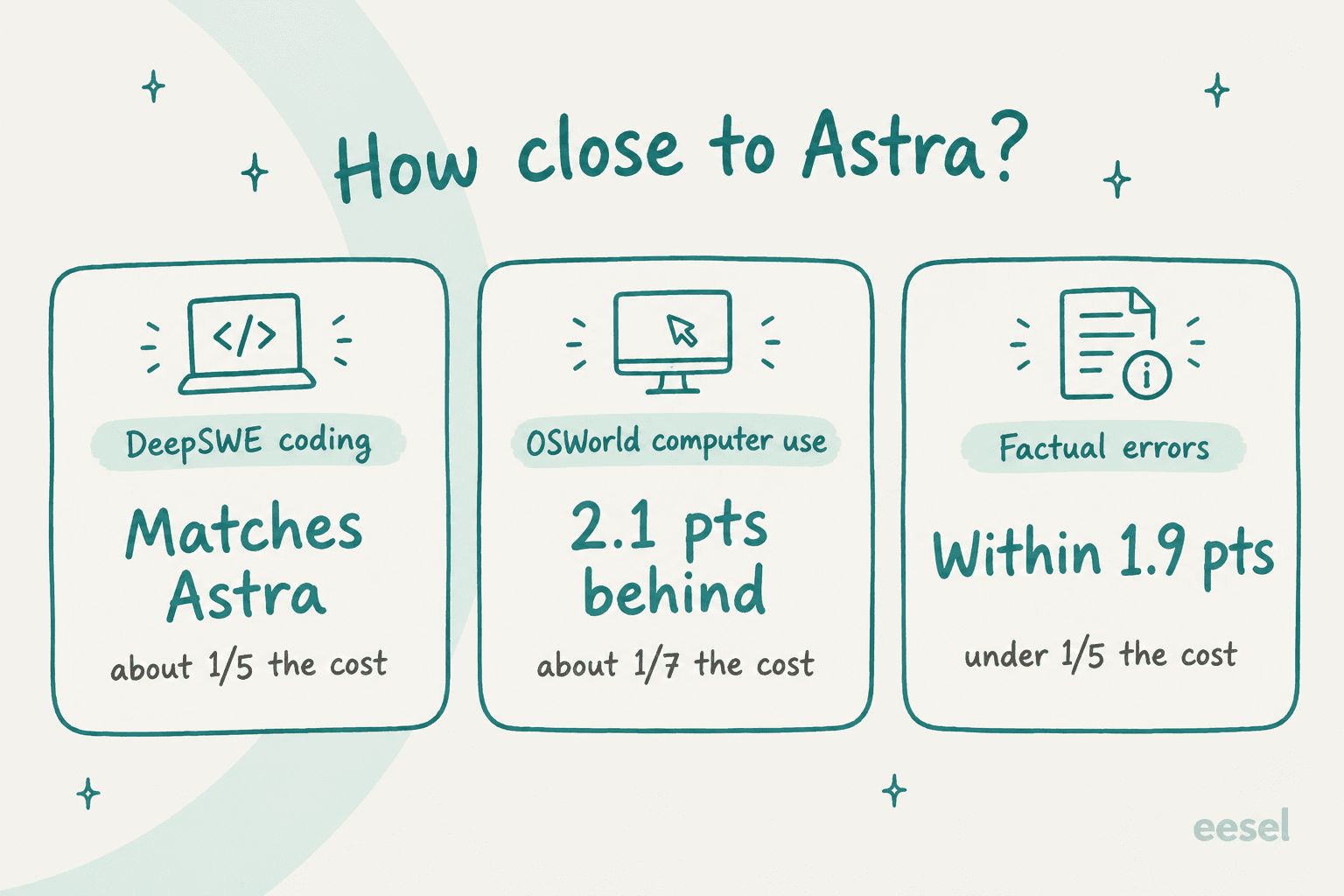
On DeepSWE v1.1, OpenAI says 6.1 Sol matches GPT-6 Astra at roughly one-fifth of the cost. On OSWorld 2.0, it comes within 2.1 points of Astra at max effort for about one-seventh the cost per task. And across all the reasoning settings they tested, the factual error rate stays within 1.9 points of Astra's, at less than one-fifth the cost per task.
Against Anthropic it lines up well too. On GDP.pdf, a test of answering professional questions from complex PDFs, OpenAI reports 6.1 Sol scores higher than Claude Opus 5.5 with fallbacks at less than half the cost per task. Then on AutomationBench it sits 2.2 points above Opus 5.5 at medium effort, for roughly a third of the cost.
Where the cost gap gets widest is the science work. At max effort on Terminal-Bench Science, OpenAI puts 6.1 Sol at $5.47 per task on average, against $23.21 for Opus 5.5 and $23.80 for Astra.
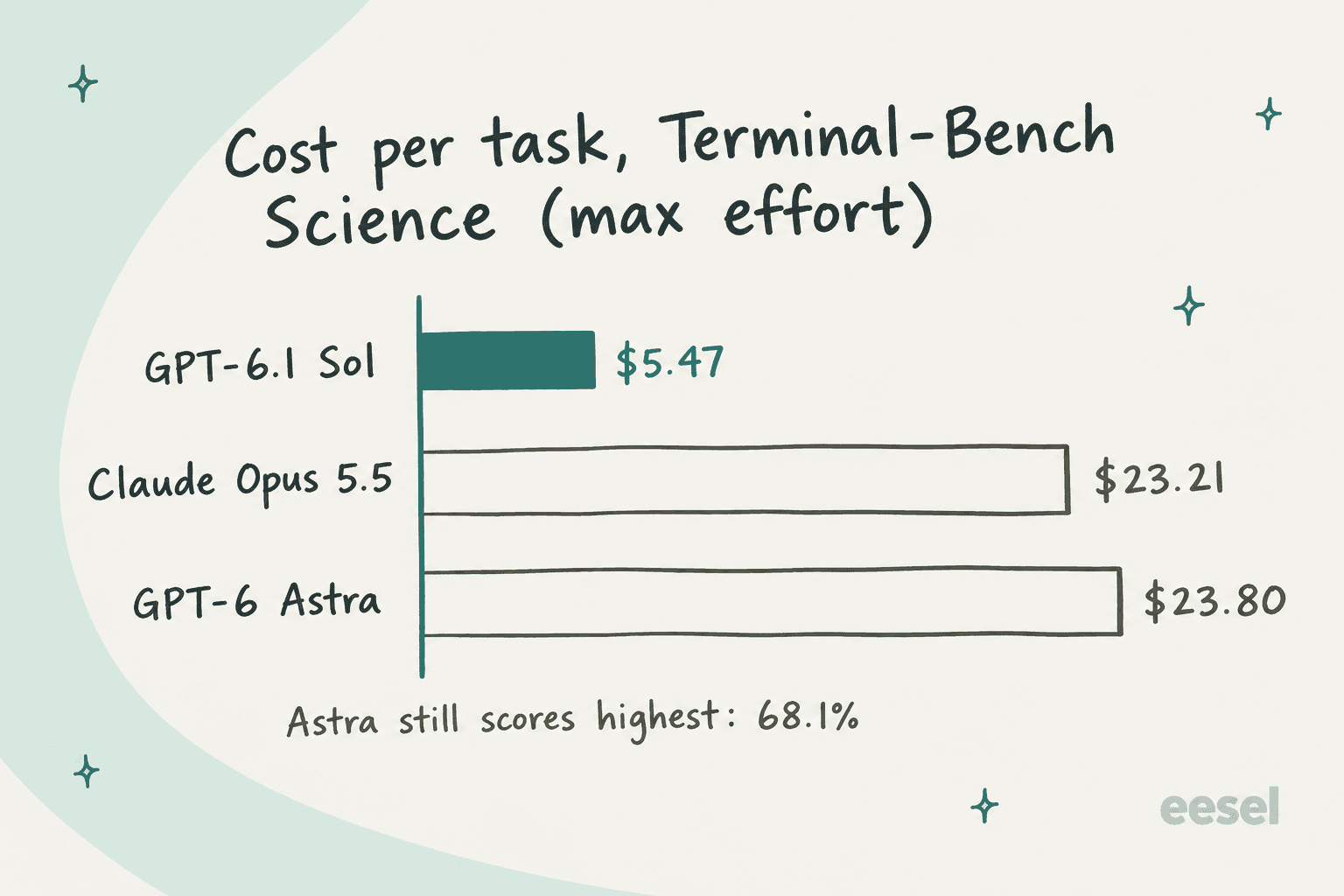
There is one fair caveat to put on all of this. Every number above is OpenAI's own evaluation, and the competitor figures come from "publicly available reports," per the launch post's footnote. OpenAI also says Astra still posts the highest science score, 68.1%, and "should be used for the most difficult scientific research tasks." So the gap is small, but it isn't zero. The good news here is that the independent numbers below tell more or less the same story.
What independent testing and early users say
Artificial Analysis had numbers up on launch day, and honestly they back OpenAI's headline more than I was expecting. At max effort, GPT-6.1 Sol scores 51.8 on the Intelligence Index, against 47.5 for GPT-6 Sol and 52.7 for GPT-6 Astra. It gets there at $0.72 per task versus $3.26 for Astra, which works out to roughly 22% of the flagship's cost for about one point less.
"GPT-6.1 Sol replaces GPT-6 Sol after just 7 days. It scores 1 point below GPT-6 Astra in the Intelligence Index at less than one quarter of the Cost per Task"
For me the most useful thing in their data is the per-effort table, because the curve flattens hard once you get to the top:
| Effort | Intelligence Index | Cost per task | Time per task |
|---|---|---|---|
| low | 42.1 | $0.13 | 56s |
| medium | 47.8 | $0.21 | 131s |
| high | 50.2 | $0.32 | 205s |
| xhigh | 51.0 | $0.39 | 271s |
| max | 51.8 | $0.72 | 569s |
Source: Artificial Analysis. With xhigh you get within a point of max for about half the cost, and half the wait as well. Artificial Analysis also found xhigh beat max by 3 points on its Coding Agent Index, landing 1 point above Astra "for less than 15% of the Cost per Task." So if coding agents are what you run, xhigh looks like the sweet spot.
The same data also has two honest caveats in it. First, it is slower than GPT-6 Sol: 67 versus 76 tokens per second, and 569 versus 408 seconds per task at max, because it writes more output tokens. Second, its hallucination rate improved from 60% to 54%, which is better, though still not at the flagship's 51%.
In the Hacker News launch thread people were mostly positive about the cost and more mixed on the polish, with the cache price getting the loudest reaction:
"This is the actual big announcement. 50% cheaper cache than GPT-6 Sol will get you far more mileage on Codex."

One developer ran the same image-to-HTML job on 6.1 Sol and on Claude Opus 5.5, then came back with a fair, split verdict:
"Overall, opus executes a bit better than 6.1 sol, which surprises me. [...] It's not bad by any means, but I think where Opus really wins is the motion animation of the svgs / final polish [...] Still, it executed quick and was quite cheap to run."
Over on X, the take I kept seeing most often was a blunter one:
"OpenAI just launched GPT-6.1 Sol, and for coding it can replace Astra outright at 1/5 the price."
The one sour note was more about subscriptions than about the model itself. One commenter on Hacker News said ChatGPT plan allowances were cut at the same time, so "even in the best case scenario it's about 2.5 times cheaper for Codex users." That is a claim from a user and not an OpenAI number, but if you are on Sol through a plan instead of the API, it pays to check your own usage meter before you assume a 5x saving.
GPT-6.1 Sol pricing
The headline here is simple: nothing went up. On the API pricing page, GPT-6.1 Sol replaces GPT-6 Sol in the main table at the same $2/$10 standard rate. Only one line changed, cached input, and it drops from $0.20 to $0.10 per million, which is 5% of the uncached rate.
| Tier | Input | Cached input | Cache writes | Output |
|---|---|---|---|---|
| Standard (up to 272K input) | $2.00 | $0.10 | $2.50 | $10.00 |
| Standard (over 272K input) | $4.00 | $0.20 | $5.00 | $15.00 |
| Batch / Flex | $1.00 | $0.05 | $1.25 | $5.00 |
| Fast | $4.00 | $0.20 | $5.00 | $20.00 |
| Ultrafast | Coming soon |
All prices per 1M tokens. Source: OpenAI API pricing. Regional processing (data residency) adds a 10% premium.
That cached-input cut matters more than it looks at first. An agent reuses the same long system prompt and tool definitions on every call, plus the conversation history on top, so the cached share of the input tends to be large. OpenAI calls this out directly in the post: the cut gives developers "more room to build and run capable agents that reuse context across requests."
Looking across the family, output steps up 20x from Luna to Sol and 5x from Sol to Astra:
| Model | Input / Output (per 1M) | Cached input | Best for |
|---|---|---|---|
| GPT-6 Luna | $0.10 / $0.50 | $0.01 | High-volume, low-stakes jobs |
| GPT-6.1 Sol | $2.00 / $10.00 | $0.10 | The new default for real work |
| GPT-6 Astra | $10.00 / $50.00 | $1.00 | The hardest research and long-horizon tasks |
Source: OpenAI API pricing. For the full catalog, including image and audio models, the OpenAI API pricing guide has everything.
Sol or Astra: which one should you use?
When you are picking between the two for a real project, the answer comes down to how hard the job is and how long it runs, not to which model is the newest one. Pick whichever option is the closest match.
What is the job?
The catches nobody puts in the headline
The launch is a strong one, but there are four details in it that will trip up anybody who migrates an existing integration.
- No
nonereasoning effort. The model page says effort supportslow,medium(the default),high,xhigh, andmax, and thatnoneandminimalare not supported. GPT-6 Sol did supportnone. So if you built a latency-critical path on top of zero reasoning, test it first before you switch. - Chat Completions has no tool calling. OpenAI says to use the Responses API for tool calling; Chat Completions is supported without it. Any older agent code that lives on Chat Completions is going to need moving.
- Not in regular ChatGPT Chat yet. It is in ChatGPT Work and Codex for Plus, Pro, Business, Enterprise, and Edu, but OpenAI says it is "not yet available in Chat." Free and Go users don't get it.
- Ultrafast is a promise, not a product. The DevDay recap says Ultrafast runs up to 8x faster (300 tokens per second) in Codex and up to 6x in the API, and that "GPT-6.1 Sol Ultrafast is coming soon." Today, only Astra has an Ultrafast price.
None of these is a dealbreaker on its own. They are the kind of small change that turns a "just swap the model id" migration into a half-day of debugging, if nobody told you about them beforehand.
How to get access
- API: use the model id
gpt-6.1-solon the Responses API. There is no free tier, so Tier 1 is the floor, at 500 requests and 500,000 tokens per minute, scaling to 15,000 requests and 40 million tokens per minute at Tier 5. The rate limits guide explains how tiers climb. - ChatGPT Work and Codex: available to Plus, Pro, Business, Enterprise, and Edu users from launch day. If you live in Codex for agentic coding, this is the model to switch to, and the Codex pricing breakdown covers plan allowances.
- Business and Enterprise: ChatGPT Enterprise and Business workspaces get it in ChatGPT Work and Codex from day one, the same as Plus and Pro.
What it means for a builder
If you already run GPT-6 Sol, this is the easiest upgrade of the year: the price stays the same and you get more capability, plus cheaper cached context on top. Check the four catches above first, and then point your integration at gpt-6.1-sol.
The bigger decision is the one about Astra. A week ago, reaching for Astra on coding agents was still easy to defend. Today, with Sol matching it on DeepSWE, most teams paying 5x for Astra should run their own test set on both and see where Sol actually falls short. On long tasks, the cost of an AI agent is mostly output tokens, and output is exactly where the 5x gap lives.
If you would rather drive that kind of workflow from a terminal, the eesel CLI is worth knowing about. It operates the same eesel teammate and workspace the dashboard does: you can run eesel chat by hand, script eesel activity to read back what the agent did on each run, use --dry-run to see exactly what a write would send before it sends it, and let coding agents such as Claude Code, Codex, and Cursor call it directly. On top of that, every workspace exposes an MCP server, which means a Codex session running GPT-6.1 Sol can operate your support teammate as a tool, instead of you clicking through a UI for it.
What it means if you run a support team
Now here is the counterintuitive bit. A model being near-Astra on coding benchmarks changes less for a support queue than what the launch suggests.
Better factuality is real, and it's welcome, since fewer confident wrong answers is exactly what support needs. But in support, most wrong answers don't come from the model making things up, they come from the knowledge the model was given in the first place. One B2B vehicle-telematics support team setting up eesel on Zendesk hit this early: their bot answered yes to "do you support my car model" for brands that weren't in their database, because the help center said "we support all models." The model read the source faithfully, it was the source that was wrong. No model upgrade fixes that, and the team described the early setup as trial and error.
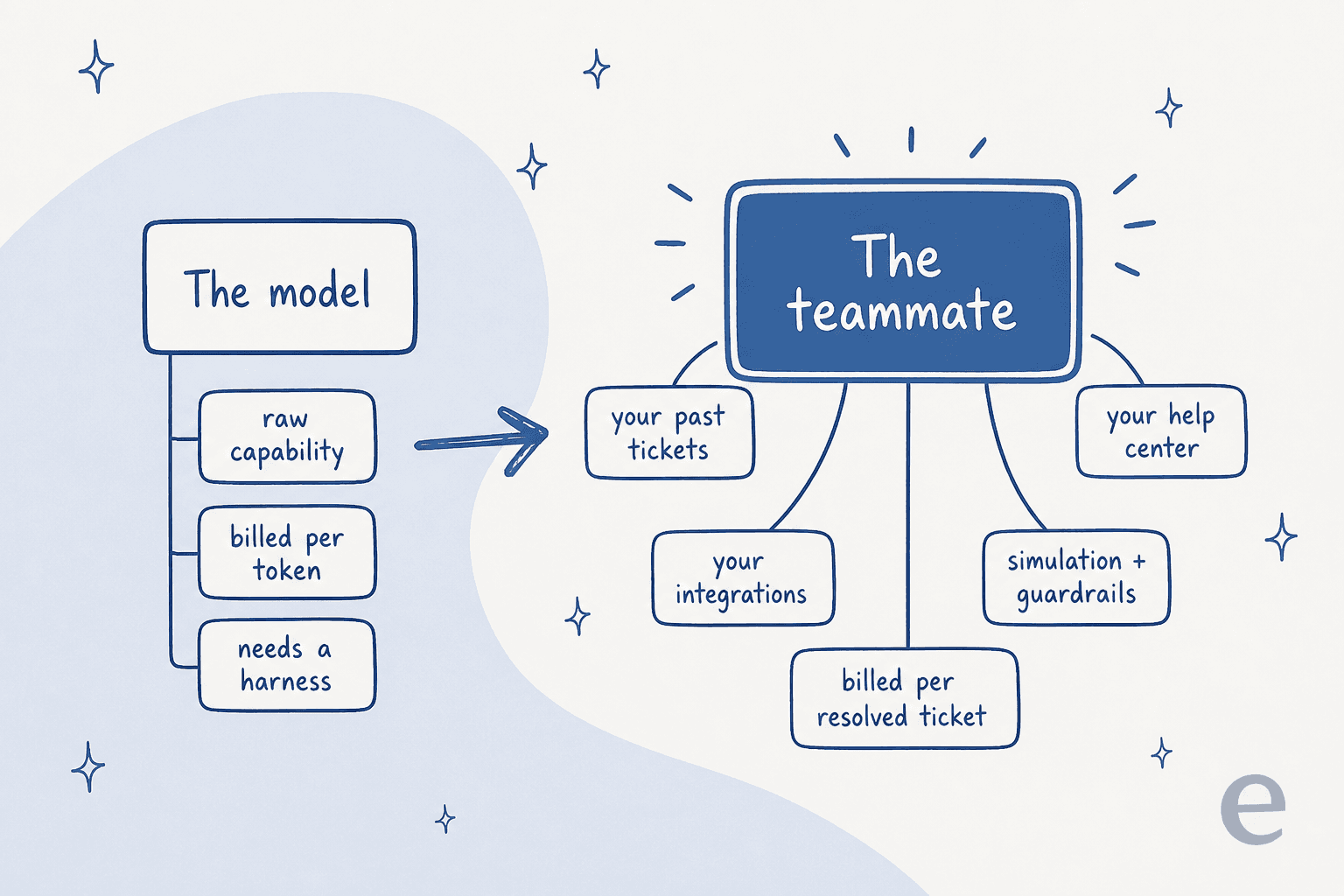
That's why I'd put a new model at the bottom of a support team's priority list. What moves resolution rate is the layer around the model, meaning training on your past tickets and connecting the helpdesk you already run, and then also testing answers against your own history before go-live. If hallucinations are the worry, the fix is mostly in that layer too. The best AI agents are model-flexible, so when a better model like GPT-6.1 Sol ships, you inherit it rather than re-platforming.
Try eesel
If what you actually want from GPT-6.1 Sol is fewer tickets in the queue, there's no need for you to build the harness yourself. GPT-6.1 Sol is infrastructure; eesel is the employee. The eesel AI helpdesk teammate learns from your past tickets and help center, plugs into Zendesk, Freshdesk, Gorgias and the other helpdesks you already use, and runs a simulation on your real past tickets so you can compare its answers with what your team actually sent before it replies to a single customer.

Pricing is a fixed monthly credit plan where one ticket or chat is one credit, with every feature and unlimited seats included, and a free plan with 100 credits and no card. There is no per-token charge, so whether the model underneath is GPT-6.1 Sol or whatever the next release is, the bill stays predictable. Try eesel on a slice of your queue and see the answers on your own tickets.
Frequently Asked Questions
What is GPT-6.1 Sol?
How much does GPT-6.1 Sol cost?
What is the difference between GPT-6 Sol and GPT-6.1 Sol?
none reasoning effort is gone, so low is now the floor. The original GPT-6 Sol writeup covers the earlier model.Is GPT-6.1 Sol as good as GPT-6 Astra?
Is GPT-6.1 Sol available in ChatGPT?
gpt-6.1-sol, with no free-tier access.Does GPT-6.1 Sol have an Ultrafast mode?
What are the GPT-6.1 Sol rate limits?
Should I use GPT-6.1 Sol for customer support automation?


Article by
Kurnia Kharisma
Kurnia is a software engineer and writer at eesel AI with two years of SEO experience, writing about AI tools, helpdesk software, and customer support. He pairs a developer's understanding of how these products are built with search-driven research into what actually ranks and resonates with the people searching for them.