


Why people look for a GPT-6 Luna alternative
Let me start by being fair to Luna, because it earns it. When OpenAI launched Sol and Luna on 23 September 2026, the headline was a flat 50% price cut versus the GPT-5.6 generation. Simon Willison summed up the mood on the launch thread:
"GPT-6 Luna being half the price of GPT-5.6 Luna is a really big deal."

At $0.10/$0.50 per 1M tokens, a 1.05M-token context window, and image inputs, Luna is a lot of model for the money. It is also the default cheap model for millions of people, since it is the only GPT-6 model on ChatGPT Free and Go. Another commenter put the value plainly:
"6-luna is at the pareto for most of the tasks! I dont know how they make money here but its insane value from a closed source model."
So why shop around? Three real reasons come up again and again:
- Price at volume. If you are running millions of tokens a day through a classifier, a summariser, or a batch pipeline, even Luna's tiny output rate adds up, and a couple of models list lower.
- Open weights. Luna is closed and API-only. If you need to self-host for privacy, sovereignty, or cost control, you have to leave OpenAI entirely.
- A specific strength. Richer multimodal inputs (audio, video, PDF), faster response times for a live chat widget, or a data policy that keeps everything on Western infrastructure. Luna is a strong generalist, not the leader on any single one of these.
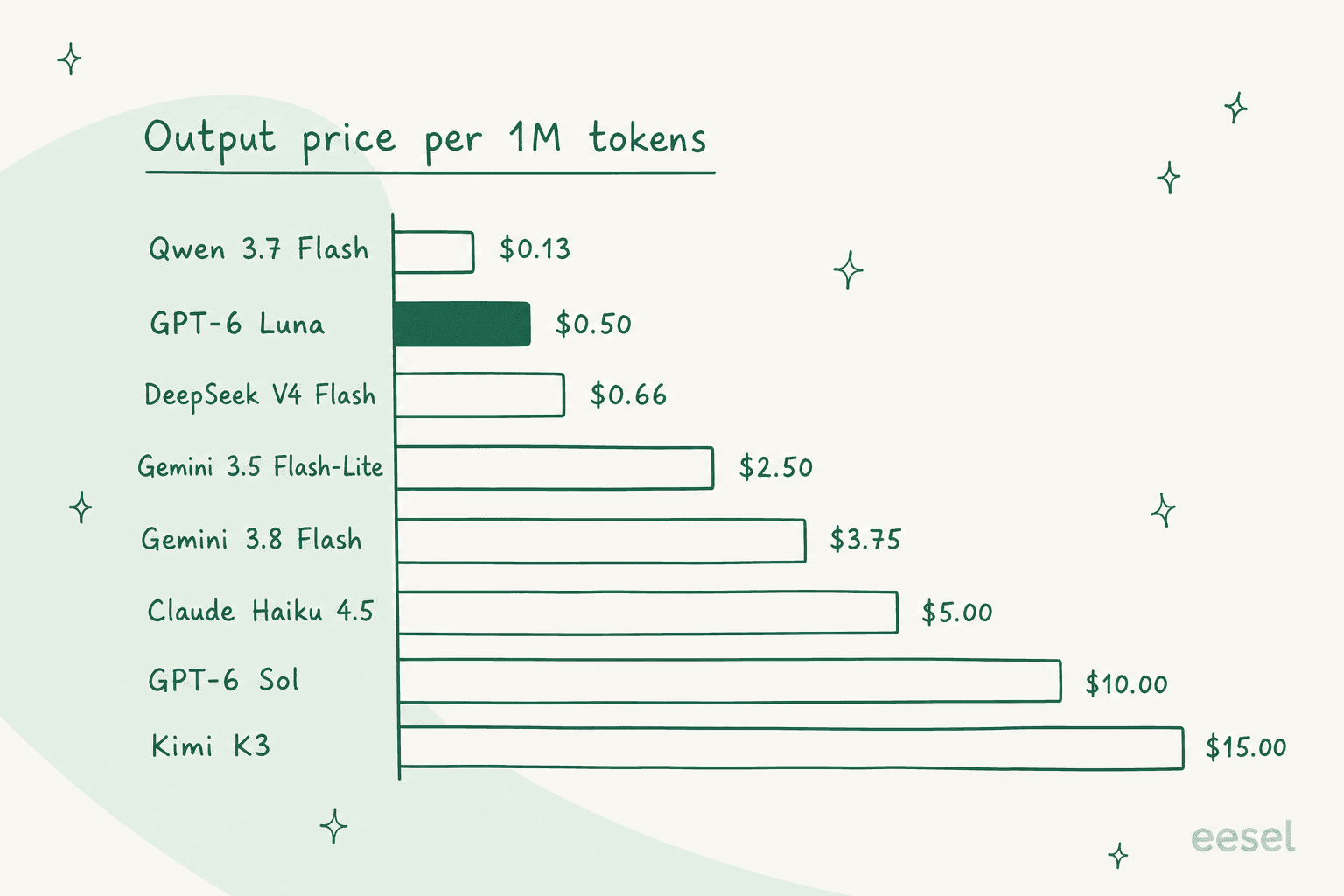
Here is where the eight alternatives actually sit on the one number most people start with, the output price per 1M tokens.
How I picked these alternatives
I kept the list to models that are genuinely in Luna's weight class: cheap, fast, and built for high-volume or lightweight work, not the frontier flagships on the OpenAI models list you would reach for to write code all day. I did not include GPT-6 Astra or Claude Opus here, because a model at 20 to 100 times Luna's output price is not an "alternative," it is a different budget. (If a frontier engine is what you actually want, my GPT-6 Astra alternatives roundup is the better read.)
For each model I looked at the real per-token price from the vendor's own rate card, the context window, whether the weights are open, what it can take as input, and where it genuinely shines or falls down. Everything below is priced from primary sources, and where a model's pricing is unusual (brackets, peak/off-peak surcharges, a scheduled increase) I have called it out, because those quirks are exactly what turns a "cheaper" model into a surprise invoice.
Here is the whole field at a glance.
| Model | Best for | Input $/1M | Output $/1M | Context | Open weights | Image input |
|---|---|---|---|---|---|---|
| GPT-6 Luna (incumbent) | The balanced default | $0.10 | $0.50 | 1.05M | No | Yes |
| Gemini 3.8 Flash | Multimodal batch work | $0.75 | $3.75 | 1M | No | Yes |
| Gemini 3.5 Flash-Lite | Cheapest multimodal | $0.30 | $2.50 | 1M | No | Yes |
| Claude Haiku 4.5 | Reliability per dollar | $1.00 | $5.00 | 200K | No | Yes |
| DeepSeek V4 Flash | Cheapest open weights | $0.22 (off-peak) | $0.66 (off-peak) | 1M | Yes (MIT) | No |
| Qwen 3.7 Flash | Lowest small-prompt rate | $0.03-$0.20 | $0.13-$0.80 | 1M | No | Yes |
| Kimi K3 | Open-weight heavyweight | $3.00 | $15.00 | 1M | Yes | Yes |
| GPT-6 Sol | Staying in OpenAI, more headroom | $2.00 | $10.00 | 1.05M | No | Yes |
| Grok 4.7 | Agent loops and real-time | $2.00 | $6.00 | 500K | No | Yes |
Now, the models themselves.
1. Gemini 3.8 Flash
Best for: teams that want multimodal inputs and huge throughput for overnight, non-interactive work.
Gemini 3.8 Flash is Google's newest Flash model, and the honest framing is one Google itself gives you: it is built directly on Gemini 3.7 Flash, not a new base model. The model card says so, in so many words, in four separate sections. What you get for the same price as 3.7 is a model that "works harder," running extra reasoning steps and calling tools more, which is great for hard tasks and wasteful for easy ones.
Where it clearly beats Luna is inputs: text, image, audio, video and PDF all go in, against Luna's text-and-image. It also posts a strong Artificial Analysis Intelligence Index of 59, well above the class median.
Pros:
- Full multimodal inputs (audio, video, PDF), which Luna does not take.
- Genuinely fast raw throughput: 302 tokens/sec, ranked near the top of Artificial Analysis's speed table.
- A free tier and a 1M-token context window.
Cons:
- The under-reported number is time to first token: Artificial Analysis measured
13.3sversus a roughly3sclass median. That is disqualifying for anything a human is waiting on, like a chat reply, and irrelevant for an overnight batch job. - The price doubles on 1 January 2027, to
$1.50/$7.50. Google itself tells efficiency-focused developers to stay on 3.7 Flash.
Pricing: $0.75 in / $3.75 out per 1M through 31 December 2026, then exactly 2x from January 2027. Batch and Flex are 50% off. See the full Gemini pricing breakdown for the tiers.
My take: pick Gemini 3.8 Flash over Luna when you need to feed it audio or video and the work is not interactive. For a live chat widget, that time-to-first-token figure rules it out, and I would look at Flash-Lite or Luna instead.
2. Gemini 3.5 Flash-Lite
Best for: the cheapest way to get Google's multimodal inputs at high volume.
If Gemini 3.8 Flash is the "works harder" model, Flash-Lite is the "just be cheap and fast" one. It is the budget, high-throughput member of the Gemini 3.5 line, and it is the most direct Google answer to Luna. It takes the same rich set of inputs (text, image, video, audio, PDF) and returns text, with a roughly 1M-token context window. The wider Gemini alternatives field is worth a look if you want more Google options.
The standout spec is speed: Artificial Analysis clocks it near the top of the field for output speed, around 490 tokens/sec, which is a different world from the 3.8 Flash latency problem. The trade is intelligence: its Intelligence Index sits at 36, so this is a workhorse for classification, extraction and routing, not for reasoning-heavy tasks.
Pros:
- Multimodal inputs at a genuinely low price.
- Very fast output, which makes it viable for interactive use where 3.8 Flash is not.
- Cheaper than Claude Haiku 4.5 on both meters, per Google's own comparison.
Cons:
- One real functional gap worth knowing: the model page lists computer use as not supported, so it is not the one to build a browser-driving agent on.
- Lower raw intelligence than Luna, so it is a narrower tool.
Pricing: $0.30 in / $2.50 out per 1M (Standard). Batch and Flex halve that to $0.15/$1.25. The free tier trains on your content, so it is not for sensitive data.
My take: this is the Gemini I would actually put head-to-head with Luna for cheap, high-volume text-and-image work. Its output price is higher than Luna's, but for anything with an image in it, the multimodal support and the speed can be worth the difference.
3. Claude Haiku 4.5
Best for: teams that want Claude-family reliability and instruction-following at a fast-tier price.
Claude Haiku 4.5 is Anthropic's small, fast model, and it is the priciest of the true "cheap" tier here at $1.00/$5.00. What you pay for is Anthropic's reputation for careful instruction-following and a lower tendency to go off the rails, which matters a lot when the model output feeds something automated.
It is a smaller context window than the rest (200K rather than 1M), which is fine for most tasks and a real constraint for anyone stuffing an entire codebase or knowledge base into a single prompt.
Pros:
- Strong, predictable instruction-following in the Claude style.
- Fast responses, so it works for interactive uses.
- The Claude ecosystem, tooling and docs are excellent.
Cons:
- Ten times Luna's output rate, so at pure volume it is the expensive choice in this group.
- 200K context is the smallest here.
- Not open weights, and no giant-context option like the 1M-token models.
Pricing: $1.00 input / $5.00 output per 1M tokens. Prompt caching and batch discounts apply and bring the effective rate down for repetitive workloads.
My take: if reliability is the thing that keeps you up at night, and your prompts fit in 200K, Haiku is worth the premium over Luna. If you are chasing the lowest bill, it is not the one, and one of the Chinese open models below will do the same routine work for a fraction of the cost.
4. DeepSeek V4 Flash
Best for: the cheapest option with open weights you can actually download and self-host.
DeepSeek V4 Flash is the budget-champion pick, and the one where the pricing footnotes matter most. It is a 284B-total / 13B-active mixture-of-experts model, released under an MIT license with downloadable weights, so you can run it on your own hardware.
Two things to know before you get excited about the sticker price. First, it is text-only, so no image input is documented. Second, the first-party API uses peak and off-peak pricing: $0.22/$0.66 per 1M off-peak, rising to $0.44/$1.32 at peak. Peak hours are 01:00 to 10:00 UTC (Chinese business hours), so a US or European queue mostly bills at the cheaper off-peak rate, which is a nice quirk and a fragile one.
There is also a subtler cost trap that came up directly in the Luna launch thread. A commenter compared their own DeepSeek and Luna bills, and someone pushed back:
"This isn't right. You're comparing cost per token, but DeepSeek V4 Flash uses more tokens. Artificial Analysis found GPT 6 Luna to be significantly cheaper than DeepSeek."
That is the whole category in one exchange: DeepSeek is verbose, and a chatty model spends more tokens finishing the same job, so the lower per-token rate does not always mean a lower invoice.
Pros:
- MIT open weights, so you can self-host and keep data in-house.
- The lowest published per-token rate of any capable model here (off-peak).
- Huge 1M-token context and reasoning built in.
Cons:
- Text only, no documented image input.
- Verbose output can erase the per-token savings on real tasks.
- The paid-API terms are silent, not explicitly permissive, on training use, and data sits under PRC law, so it is not a drop-in for customer data.
Pricing: off-peak $0.22 in / $0.66 out, peak $0.44/$1.32, all per 1M. Reasoning tokens bill at the output rate, and thinking is on by default, so budget for it.
My take: if you want open weights and the absolute floor on cost, DeepSeek V4 Flash is the one to test, but test it on your real prompts and measure the token count, not just the rate. For customer data, treat the "silent" training policy as a reason to self-host rather than use the first-party API.
5. Qwen 3.7 Flash
Best for: the lowest headline rate on small prompts, if you can live with thin documentation.
Alibaba's Qwen 3.7 Flash has the lowest number on the whole chart, $0.03/$0.13 per 1M, but there is an asterisk you cannot skip: the price is bracketed by prompt size. That cheap rate only holds under 32K tokens. It steps up to $0.10/$0.40 from 32K to 256K, and $0.20/$0.80 from 256K to 1M. So the "cheapest vision model" rate and the "1M context" cannot both be true in the same call.
The other honest note is that almost nothing about this model is independently verified. Alibaba published no benchmarks, no architecture, no parameter count, and the weights are closed. The one third-party eval, Roboflow's vision test, ranks it #22 of 23 overall but #1 of 23 on cost. And "Flash" here means cheap, not fast: it runs about 59 tokens/sec, far slower than Gemini's Flash-Lite.
Pros:
- The lowest per-token input rate here, on small prompts.
- Accepts image input, unlike DeepSeek.
- 1M-token context available (at the top pricing bracket).
Cons:
- Bracketed pricing means the cheap rate evaporates on large prompts (6.7x more on input at the top bracket).
- Slow output and thin, unverified documentation.
- Closed weights, single provider, so no self-hosting and no fallback routing.
Pricing: three brackets by prompt size, from $0.03/$0.13 under 32K up to $0.20/$0.80 at 256K-1M. Compare with the full Qwen pricing picture before committing.
My take: Qwen 3.7 Flash is a great fit for high-volume, short-prompt vision tasks where cost is everything and you can validate quality yourself. For anything that needs a big context or documented benchmarks, I would pass. My Qwen alternatives piece has the wider Qwen family if you want more headroom.
6. Kimi K3
Best for: teams that want a genuinely open-weight heavyweight and will pay for it.
Kimi K3 is the outlier on this list, and I have included it deliberately. At $3/$15 per 1M it is not cheap; it is in the same band as Claude Sonnet, and roughly 30 times Luna's output rate. So why is it here? Because it is the open-weight model people reach for when they want to own a capable model outright, and its weights genuinely shipped on Hugging Face on time.
It is a 2.8T-total / 104B-active mixture-of-experts model with native vision, a 1M-token context, and an Artificial Analysis Intelligence Index of 57, which puts it near the top of the whole field, not just the cheap end.
Pros:
- Open weights that shipped as promised, verifiable on Hugging Face.
- High intelligence, well above the rest of this list.
- Native vision and a 1M-token context.
Cons:
- Not a budget model. It is a Luna alternative only in the "open and capable" sense, not the "cheap" sense.
- Reasoning cannot be turned off, and it defaults to maximum effort, so latency and token spend run high.
Pricing: $3 input / $0.30 cache-hit / $15 output per 1M. Consumer app tiers run from a free plan up to $199/mo. My Kimi K2.5 alternatives roundup covers the wider open-model field.
My take: if what you actually wanted from "a Luna alternative" was an open, capable model to self-host, Kimi K3 is the pick, and DeepSeek V4 Flash is the cheaper cousin. If you wanted the lowest bill, Kimi is the wrong tree entirely.
7. GPT-6 Sol
Best for: staying inside OpenAI when Luna runs out of headroom.
Sometimes the best alternative to Luna is the model one rung up in the same family. GPT-6 Sol is OpenAI's mid-tier GPT-6 model at $2/$10, and it exists for exactly the moment Luna's answers stop being good enough but you do not want to change providers, SDKs, or data agreements.
OpenAI's own framing is "build with Sol, scale with Luna," and the benchmark story is honest: Sol's Intelligence and Coding indexes are roughly level with GPT-5.6, so this is a price cut more than a capability jump, with one real win in factuality (OpenAI reports about half the mistakes of the previous Sol).
Pros:
- Same API, tooling, and data terms as Luna, so switching is a one-line change.
- Full Responses API tool set: web search, code interpreter, hosted shell, computer use, MCP.
- Meaningfully more capable than Luna on hard tasks, with a big factuality gain.
Cons:
- 20 times Luna's output price, so it is a step up in cost, not a saving.
- Not on the Free or Go plans; you need Plus, Pro, Business or the API.
Pricing: $2 in / $10 out per 1M standard, with Batch and Flex at 50% off. The full GPT-6 Sol pricing page has the long-context and Fast-mode rates.
My take: Sol is not an alternative for anyone shopping on price, it is the natural upgrade path when Luna's quality is the bottleneck. Reach for it when the failure you are trying to fix is accuracy, not cost.
8. Grok 4.7
Best for: running agent loops at volume and tasks that want real-time or X data.
Grok 4.7 from xAI is the priciest of the mid-tier options at $2/$6, but it is built for a specific job: long, multi-hour agentic tasks. It runs on a new, larger base model than 4.6 with a longer reinforcement-learning run weighted toward multi-step work, and it natively understands xAI's own agent harness.
The pitch is "frontier-adjacent at a volume-friendly price." On xAI's own tables it posts strong agentic and terminal scores, though the top coding and terminal crowns still belong to models like Fable 5.1. It is fair to note it loses on some benchmarks too, like HealthBench, where both GPT-6 Sol and Fable beat it.
Pros:
- Strong on long-horizon agentic tasks, with a Context Compaction API for very long runs.
- Real-time and X data access through xAI's tools.
- A capable model at Grok 4.6's pricing.
Cons:
- The most expensive mid-tier option here, and the long-context rate (
$4/$12above 200K prompt tokens) applies to every token in the request, not just the overflow. - 500K context, smaller than the 1M-token models.
- The non-token meters (search, code exec) add up in agent loops.
Pricing: $2 in / $6 out below 200K prompt tokens, $4/$12 above, all per 1M. Tool calls are billed separately, e.g. web and X search at $5/1,000 calls.
My take: Grok 4.7 is not really a Luna competitor for cheap text tasks. It is the pick when the job is a long agentic run, especially one that needs live data. For plain high-volume summarising or classifying, it is overkill and overpriced next to Luna.
The two questions that actually decide it
Strip away the model names and this whole comparison comes down to two questions.
The first is open or closed. Most of these are closed, API-only models. If self-hosting is a hard requirement, your shortlist collapses fast.
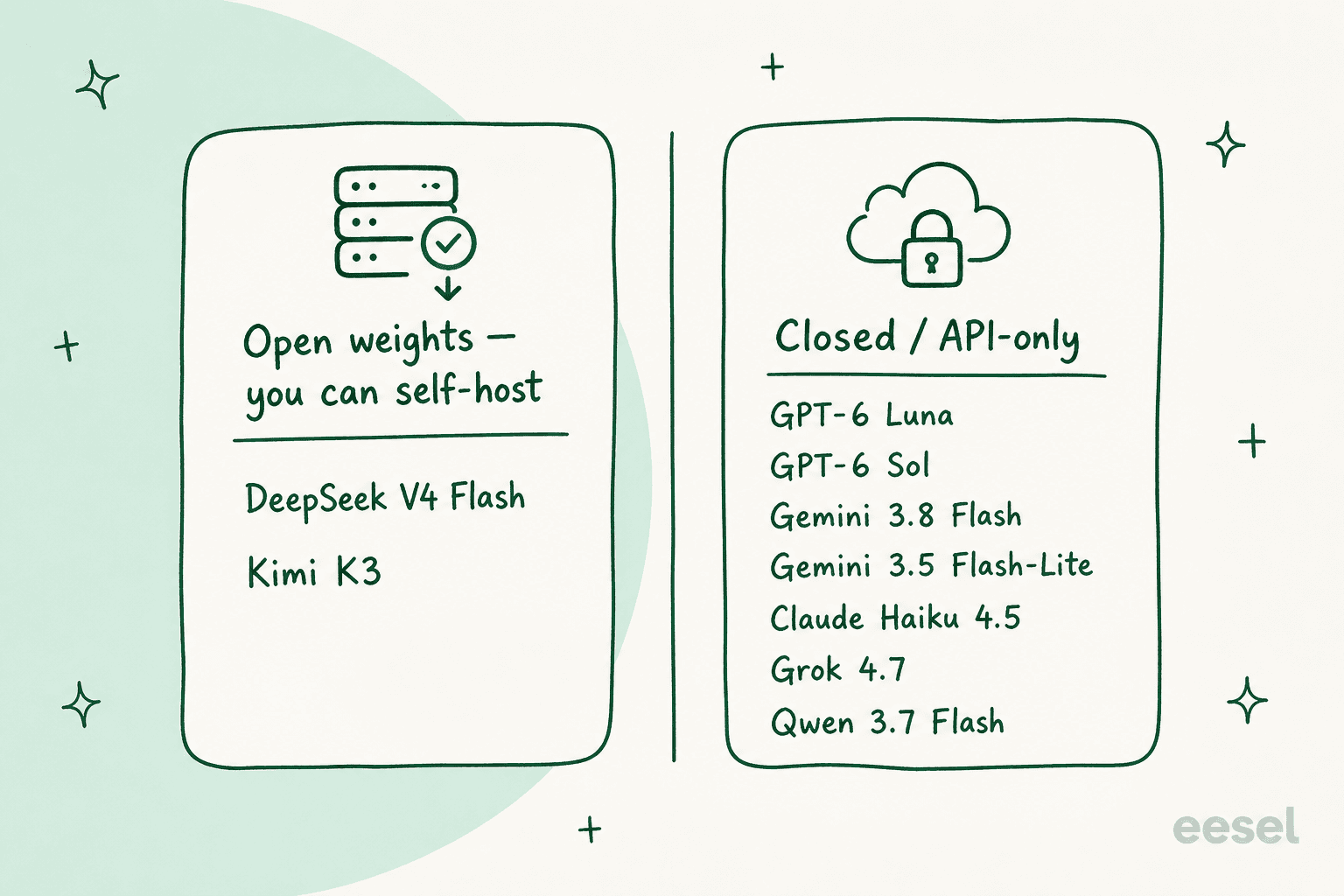
This same trade-off shows up whenever you compare the best AI agents: the license decides your architecture before the benchmarks do. The second question is the one that trips up every spreadsheet: cheapest per token is not cheapest per task. A model that lists at a third of Luna's price but writes twice as many tokens to finish the same job is not saving you anything. The only way to know is to run your real prompts through two or three candidates and compare the actual bill, not the rate card. That is also why the ChatGPT subscription can quietly beat all of these API rates for individual use, since a flat monthly fee sidesteps per-token pricing entirely.
The part the model does not solve
Here is the thing I would want to hear if I were the one reading this. If you are choosing a cheap model to power a real, recurring job, and for most teams reading a post like this that job is customer support, then picking the model is the easy 10% of the work.
I have spent the last few years watching teams put AI on live support queues, and the pattern is always the same. The raw model is tokens in, text out. Before it can safely answer a customer, someone still has to build the retrieval so it knows your help center, the guardrails so it does not confidently invent a refund policy, the integrations so it can look up an order, the testing so you find out how it behaves before a customer does, and the escalation path for when it should hand off to a human. An AI copilot for customer service has to solve every one of those. That is the 90%.
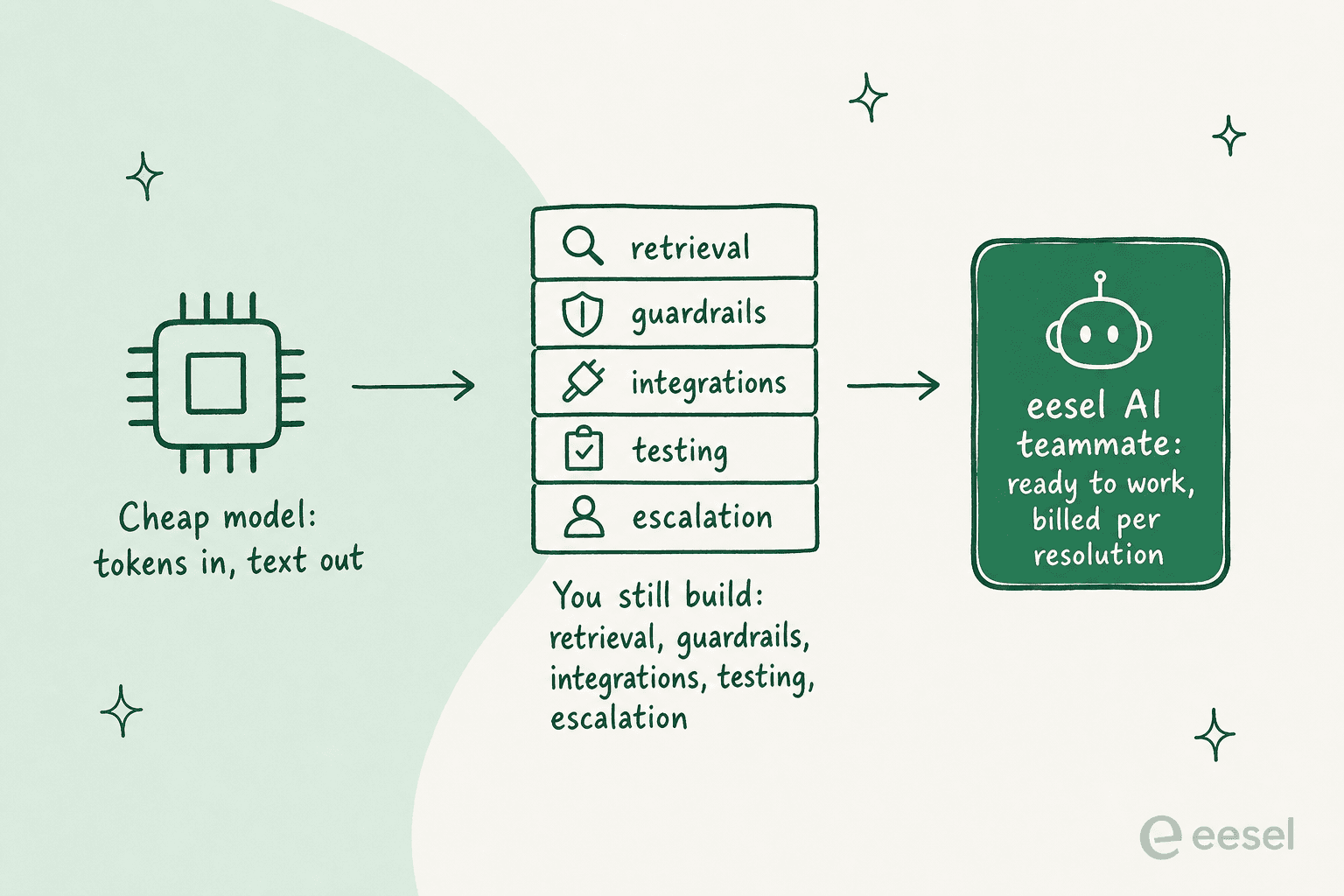
The most expensive mistake I see is a team that ships a cheap model straight onto the queue, watches it give a confident wrong answer to a real customer, and only then goes looking for the missing 90%. It is why every rollout I would trust gets simulated against historical tickets first, so you see the wrong answers before they ever reach a person.
Try eesel AI
This is where I get to be direct about what I build. The models above are infrastructure. eesel AI is the employee that runs on top of them. Rather than sell you a model and a stack of parts, we ship ready-to-work AI teammates for specific jobs, and the one most people reading this want is the AI helpdesk teammate.
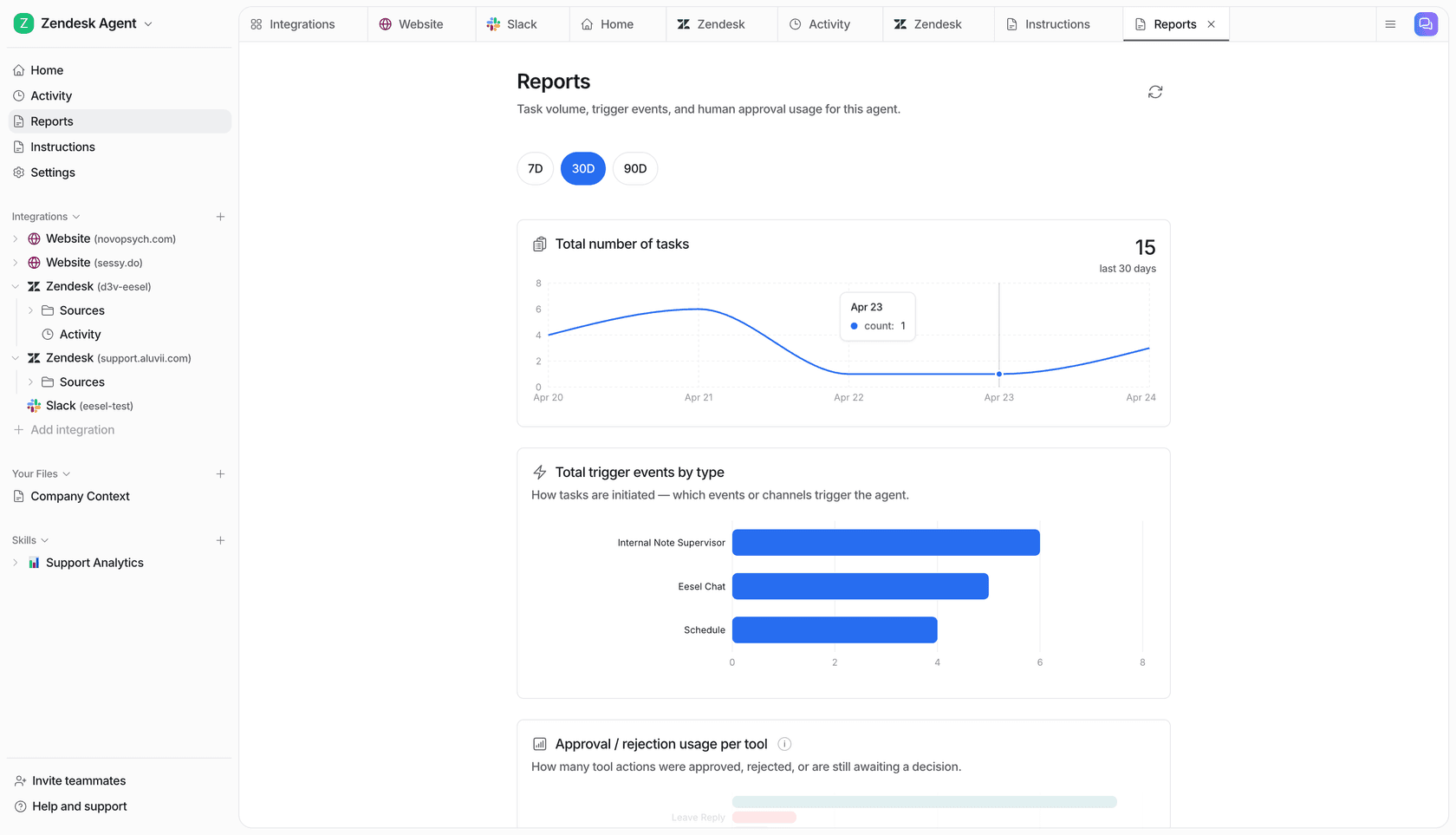
It joins your existing queue, learns from your past tickets and help center, and it is billed per resolution, so you are paying for jobs done rather than tokens burned. And because you can simulate it against your own historical tickets before it touches a live one, you get to see exactly how it would have handled real customers first.
If you would rather drive all of this from a terminal or a script, there is also the eesel CLI. It is an agent-friendly way to operate the same teammate and workspace: a person can run it by hand, scripts can automate it, and coding agents like Claude Code, Codex and Cursor can drive it directly. You can connect a source, push instructions, kick off a simulation, trigger a run, and read back activity, all without opening the dashboard. If the reason you are comparing raw model APIs is that you want programmatic, headless control, that is the surface built for it, sitting on top of a teammate that already handles the 90% the model does not.
You can try eesel AI free, and if support is the job, that is a far shorter path than wiring a cheap model up yourself.
Frequently Asked Questions
What are the best GPT-6 Luna alternatives in 2026?
Is there a cheaper alternative to GPT-6 Luna?
What is the cheapest GPT-6 model?
Which GPT-6 Luna alternative is best for customer support?
Do GPT-6 Luna alternatives have open weights?


Article by
Kurnia Kharisma Agung Samiadjie
Kurnia is a software engineer and writer at eesel AI with two years of SEO experience, writing about AI tools, helpdesk software, and customer support. He pairs a developer's understanding of how these products are built with search-driven research into what actually ranks and resonates with the people searching for them.