
Grok 4.7 pricing at a glance
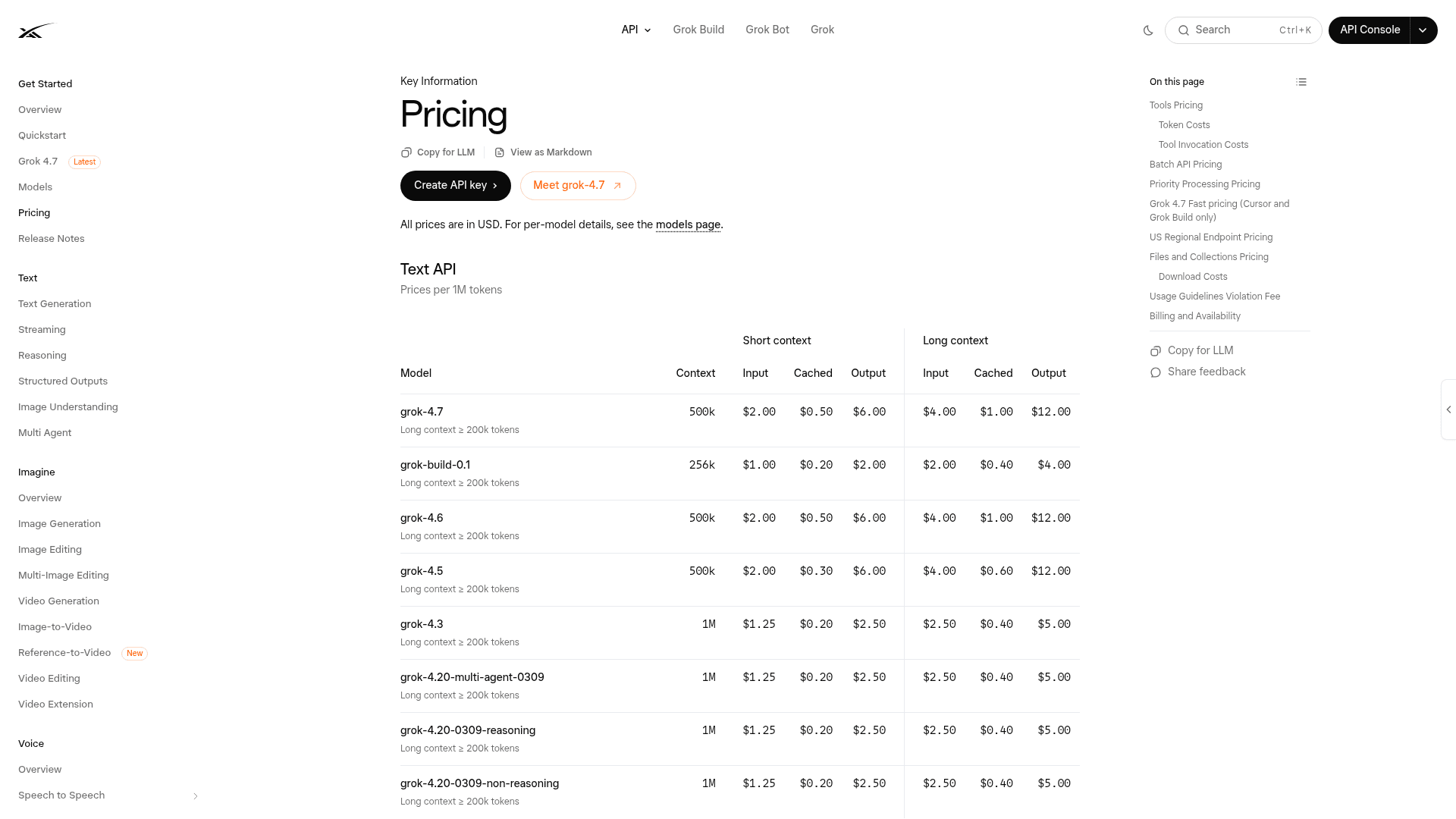
Here is the rate card, straight from the source rather than a "starts at" number.
| Tier | Input / 1M | Cached input / 1M | Output / 1M |
|---|---|---|---|
grok-4.7, prompt under 200k | $2.00 | $0.50 | $6.00 |
grok-4.7, prompt 200k and over | $4.00 | $1.00 | $12.00 |
| Grok 4.7 Fast (Cursor and Grok Build only) | 2x the rates above | 2x | 2x |
The 500k context window and the token rates are both unchanged from Grok 4.6, which is the headline of this release for a buyer: you get a stronger model on the same meter. The gains landed on long-horizon agentic work, and the price did not move to pay for them.
One nice detail for the API: reasoning effort is configurable across low, medium, high, and xhigh, so you can dial how hard the model thinks per request. Since output tokens cost 3x input, and reasoning burns output tokens, effort is a real cost lever, not just a quality one. Turning effort down on easy calls is the cheapest optimization you are not making.
The 200k long-context cliff
This is the single most expensive thing to miss in Grok 4.7 pricing. Once a request's prompt crosses 200k tokens, the long-context rates apply to every token in the request, not just the overflow past 200k.
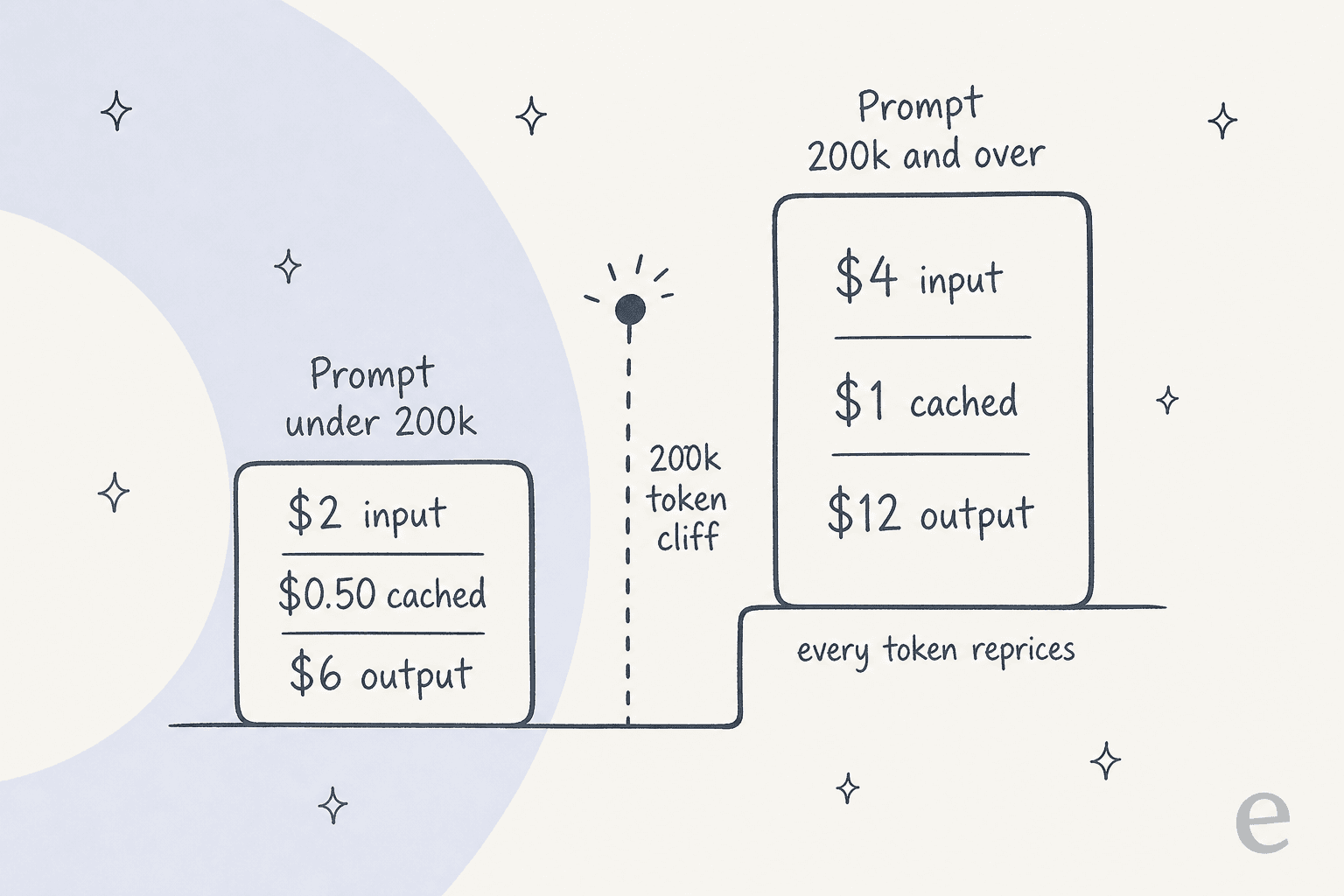
So a 210k-token prompt is billed entirely at $4 / $12, not mostly at $2 / $6. That is a doubling triggered by the last 10k tokens. For a long agent loop that slowly accumulates context, message by message, the cliff is a real trap: the run gets quietly twice as expensive the moment it tips over, and nothing in the response headers waves a flag before it happens.
xAI clearly knows this, because it shipped a Context Compaction API specifically to shrink conversations before they cross the line. If you are running anything long, budget engineering time to keep prompts on the cheap side of 200k, or accept that some of your requests will silently bill at double. This is the kind of detail that makes token pricing feel predictable in a spreadsheet and unpredictable on the invoice.
The meters most cost models miss
Token rates are the headline, but they are not the whole bill. On the API, xAI's pricing page lists a set of per-call meters that stack on top of tokens, and they matter a lot for agents that do more than chat:
- Web search, X search, and code execution: $5 per 1,000 calls each.
- File-attachment search: $10 per 1,000 calls.
- Collections search (the RAG-style retrieval one): $2.50 per 1,000 calls.
- Priority Processing: doubles all token rates, and is only billed when the response confirms it ran in the priority tier.
- Usage-guidelines violation fee: $0.05 for a request blocked pre-generation.
None of these break the bank on their own. But an agent that searches the web, retrieves from a knowledge base, and runs code on every ticket is firing three or four billable calls per turn, and that is a line item your token math will not show. If you are modelling an AI agent's cost, the meters are where the surprise usually hides.
There is also a batch note worth knowing: the 20% batch discount xAI offers does not apply to Grok 4.7. It covers only the older grok-4.3 and grok-4.20 variants, so if you have a bulk, latency-tolerant job, running it on Grok 4.3 in batch can be cheaper per token than Grok 4.7 at standard rates. That is a real fork in the road for offline workloads.
Grok 4.7 Fast, and the 2x tax
Grok 4.7 Fast is the same model, served at roughly twice the output speed for twice the token price. It is only available inside Cursor and Grok Build, not on the public API.
The trade is pure latency for money. You are paying $4 / $12 (or $8 / $24 past the cliff) to shave seconds off the response. That is worth it in an interactive coding session where you are watching code stream back and every second of wait breaks flow. It is a waste on batch jobs, overnight runs, or any background task where a human is not staring at the cursor. My rule of thumb: Fast for the foreground, standard for everything else.
Where you can (and can't) buy Grok 4.7
The buying path changes the effective price more than most people expect, so it is worth mapping before you commit.
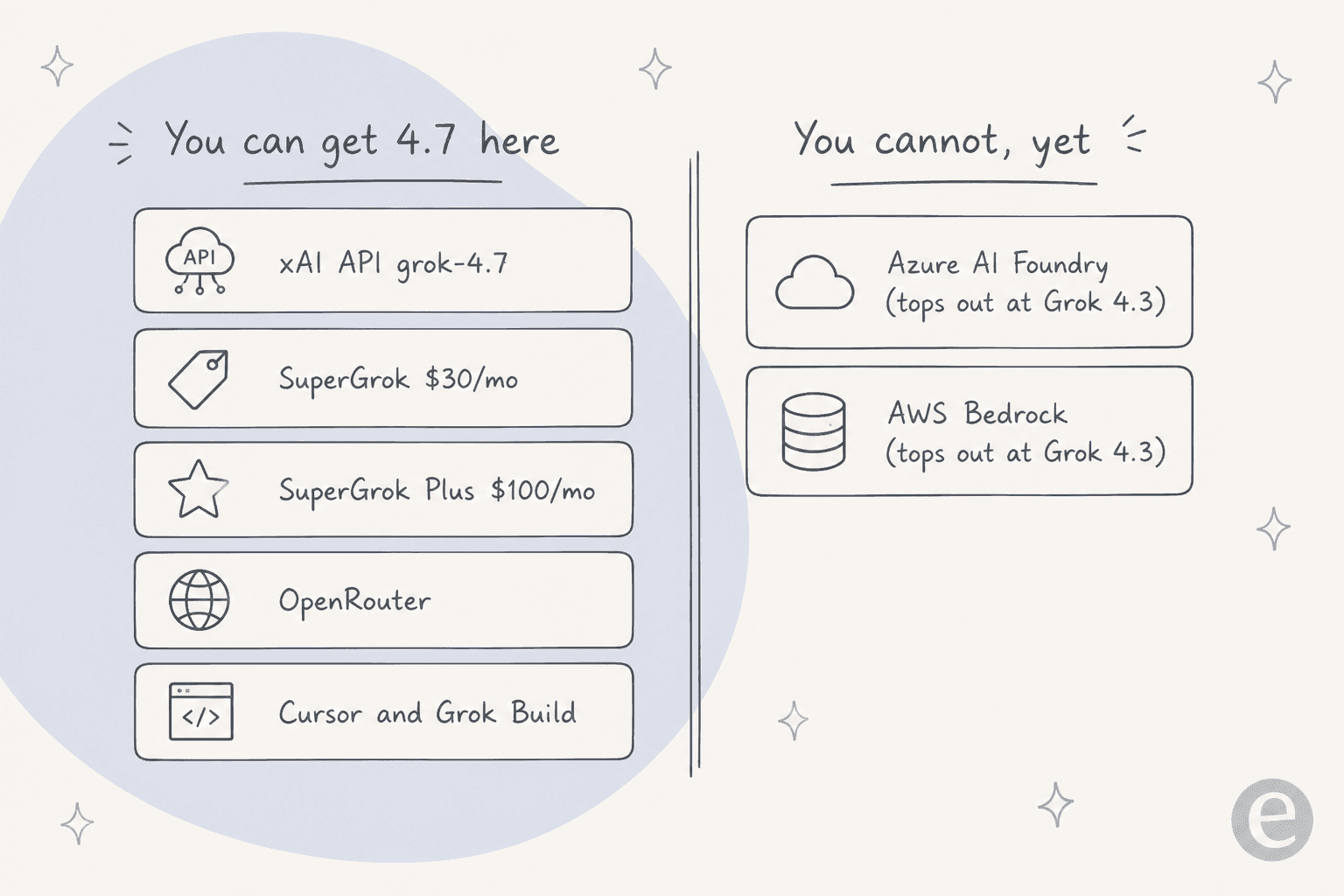
- xAI API (
grok-4.7): the reference price, $2 / $6, and where you should model your bill. - SuperGrok and SuperGrok Plus: the consumer subscriptions, $30/month and $100/month. Good for a person using Grok in the app, not for programmatic volume.
- OpenRouter: passes provider pricing through with no inference markup, but charges 5.5% on credit purchases ($0.80 minimum), and credits expire after a year. Its value is measured, real-world effective pricing: on Grok 4.6, heavy caching pulled the weighted-average input well below list, which is a preview of how 4.7 will bill for cache-friendly traffic.
- Cursor and Grok Build: where the Fast variant lives, and a good place to try the model before wiring up the API.
The gap worth flagging: Azure AI Foundry and AWS Bedrock both top out at Grok 4.3, priced around $1.25 / $2.50. If your company mandates procurement through a cloud marketplace, you cannot buy Grok 4.7 there at all, at least not yet. That is a genuine limit, not a knock, and it is the sort of thing that decides model choice for enterprise buyers regardless of the rate card.
Grok 4.7 vs GPT-6 Sol and Fable 5.1 on price
Here is the current-state comparison, using each vendor's own published rates. Note that xAI's own launch materials benchmarked against the older GPT-5.6 Sol at $4 / $20, but OpenAI has since shipped GPT-6 Sol at half that, so this is the live picture a buyer faces today.
| Model | Input / 1M | Cached / 1M | Output / 1M |
|---|---|---|---|
| Grok 4.7 | $2.00 | $0.50 | $6.00 |
| GPT-6 Sol | $2.00 | $0.20 | $10.00 |
| Fable 5.1 | $10.00 | n/a | $50.00 |
The pattern is clean. Grok 4.7 ties GPT-6 Sol on input and undercuts it by 40% on output, which is where a chatty agent spends most of its money. Against Fable 5.1, Grok is roughly a fifth of the price per token. Fable still leads on peak coding and long-horizon terminal work, so the real question is never "which is smarter" (often Fable), it is "how much am I willing to pay per marginal point."
Put it in per-task terms. A single agent turn of 50k input plus 10k output costs about $0.16 on Grok 4.7, $0.40 on GPT-6 Sol, and $1.00 on Fable 5.1. Run that ten thousand times a day and the difference is the whole reason volume workloads default to the cheap-output model. One caveat I have learned the hard way: cheaper per token is not always cheaper per task, because a model that emits more reasoning tokens to finish the same job can erase its rate advantage. Model it on your own traffic with the calculator above before you switch. If you are weighing this against a premium model, our Claude Opus 5.5 pricing breakdown makes the same per-task point in more detail.
Is Grok 4.7 worth the price?
For anyone writing code, building AI agents, or shipping on the API where token cost compounds, yes, comfortably. The combination of frontier-adjacent scores and Grok 4.6 pricing is the whole pitch, and the long-horizon gains mean it holds up on jobs that run for a while, not just one-shot prompts. If you want the deeper capability read, our Grok 4.7 overview covers the benchmarks.
Heavy users echo the "run it constantly" angle. One long-time Grok subscriber described wiring it into everyday jobs and still never hitting limits:
"I have a Grok bot monitor my email every 15 minutes and file things away for me. I have another bot that monitors for blood test results... and I never even get close to using my quota."

That is the shape of a model priced for volume: it invites you to leave it running. Where I would set expectations is the meters and the cliff. The sticker price is low, but an agent that searches, retrieves, and runs code on every turn, over prompts that creep past 200k tokens, will bill well above the "$2 / $6" you budgeted. Grok 4.7 is cheap to start and easy to under-forecast, which is the same trap every token-metered model sets.
Token pricing is a meter, not a bill you can predict
Here is the reframe, because it is the thing a pure price comparison misses. Every number in this post is a meter reading, not a bill. Grok 4.7 is infrastructure: a brilliant engine you rent by the token, that arrives knowing nothing about your company, your tickets, your tone, or your tools. To turn it into something that does a real job, someone has to build the harness, connect the knowledge, wire the integrations, write the guardrails, handle escalation, and then keep watching a meter that reprices itself at 200k tokens and adds $5 every thousand searches.
That gap is the whole idea behind eesel. Instead of a model and a blank harness, eesel is an AI teammate platform where you hire ready-to-work teammates for a specific job. The current roster is an AI helpdesk teammate that joins your support queue and an AI blog writer that researches and drafts long-form posts. Each shows up already carrying the skills, integrations, and company context its role needs, running on frontier models like this one underneath, so you get the capability without owning the plumbing, or the meter.

The pricing difference is the point: eesel bills per resolved ticket, not per token, so the cost maps to work done rather than to how verbose the model was that day. You are not forecasting output tokens or dodging a long-context cliff, you are paying for outcomes.
And if you liked Grok 4.7 because you live in a terminal, eesel meets you there. The eesel CLI operates the same teammate and workspace as the dashboard, but from the command line: a person can run it, scripts can automate it, and coding agents like Claude Code, Codex, and Cursor can drive it. You can inspect a teammate's instructions, send a test message, read back the JSON result and activity, and propose a bounded change for an owner to approve, all without leaving your shell. It is the same "operate the agent programmatically" appeal that makes a raw model API attractive, pointed at an employee that already knows the job. You can try eesel free.
Frequently Asked Questions
How much does Grok 4.7 cost?
Grok 4.7 pricing is $2 per million input tokens, $0.50 per million cached input, and $6 per million output tokens for any request whose prompt is under 200k tokens, per the xAI pricing page. Cross 200k prompt tokens and the rates double to $4 / $1 / $12 on every token in that request. That is the exact same rate card as Grok 4.6.
What is the Grok 4.7 API price per million tokens?
On the xAI API, grok-4.7 is $2 input and $6 output per million tokens at the standard short-context tier. That is the number to model your bill on. The Grok 4.7 pricing page also lists tool-call meters (web and X search, code execution at $5 per 1,000 calls) that stack on top of tokens for agentic workloads.
What is the Grok 4.7 long-context pricing cliff?
Once a request's prompt hits 200k tokens or more, xAI bills the whole request at the long-context rate of $4 / $1 / $12 per million, not just the tokens past 200k. A 210k-token prompt is billed entirely at the higher rate. xAI ships a Context Compaction API to shrink conversations before they tip over the cliff.
What is Grok 4.7 Fast and how much more does it cost?
Grok 4.7 Fast is the same model served at roughly twice the output speed for twice the token price. It is available only inside Cursor and Grok Build, not the public API. It is worth the premium when latency matters, like watching code stream back, and a waste on batch or background jobs.
How much does Grok 4.7 cost for consumers?
On x.ai/pricing, the cheapest paid tier that names the latest Grok is SuperGrok at $30/month, with SuperGrok Plus at $100/month. There is a free tier with limits. If you want to call Grok 4.7 programmatically instead, that is the $2 / $6 API price, not the subscription.
Can I use Grok 4.7 on Azure or AWS Bedrock?
Not yet. Azure AI Foundry and AWS Bedrock both top out at Grok 4.3 at the time of writing, so a cloud-mandated buyer cannot procure Grok 4.7 through them. You can reach it on the xAI API, through OpenRouter, or inside Cursor and Grok Build.
Is Grok 4.7 pricing worth it versus paying per outcome?
Token pricing rewards you for optimizing prompts and punishes you for long context, so your bill is only as predictable as your traffic. If you would rather pay per resolved ticket than per token, an AI teammate like eesel runs on frontier models underneath but bills per outcome, so the cost maps to work done.


Article by
Kurnia Kharisma Agung Samiadjie
Kurnia is a software engineer and writer at eesel AI with two years of SEO experience, writing about AI tools, helpdesk software, and customer support. He pairs a developer's understanding of how these products are built with search-driven research into what actually ranks and resonates with the people searching for them.