


GPT-6.1 Terra costs $1 per million input tokens and $5 per million output, with cached input at $0.05, on OpenAI's pricing page. That is half of GPT-6.1 Sol per token and less than half of the old GPT-5.6 Terra.
The sticker is not what decides your bill, though. Three things do: the effort level ($0.05 a task at low, $0.40 at max, per Artificial Analysis), the 272K long-context rule that doubles the price of the whole request, and caching, which cuts input 95% but charges 1.25x to write the cache in the first place.
My take: run Terra at low or medium, keep prompts under 272K, and use Batch for anything that can wait. In the GPT-6.1 Terra review I ran 80 support-ticket tests, and the model cost under a cent per ticket. For a support team, the tokens are the cheap part. smava gets about 27,000 German tickets a month sorted and drafted in Zendesk with eesel, and what made that work was 820 macros and articles, not the model's price.
How much does GPT-6.1 Terra cost?
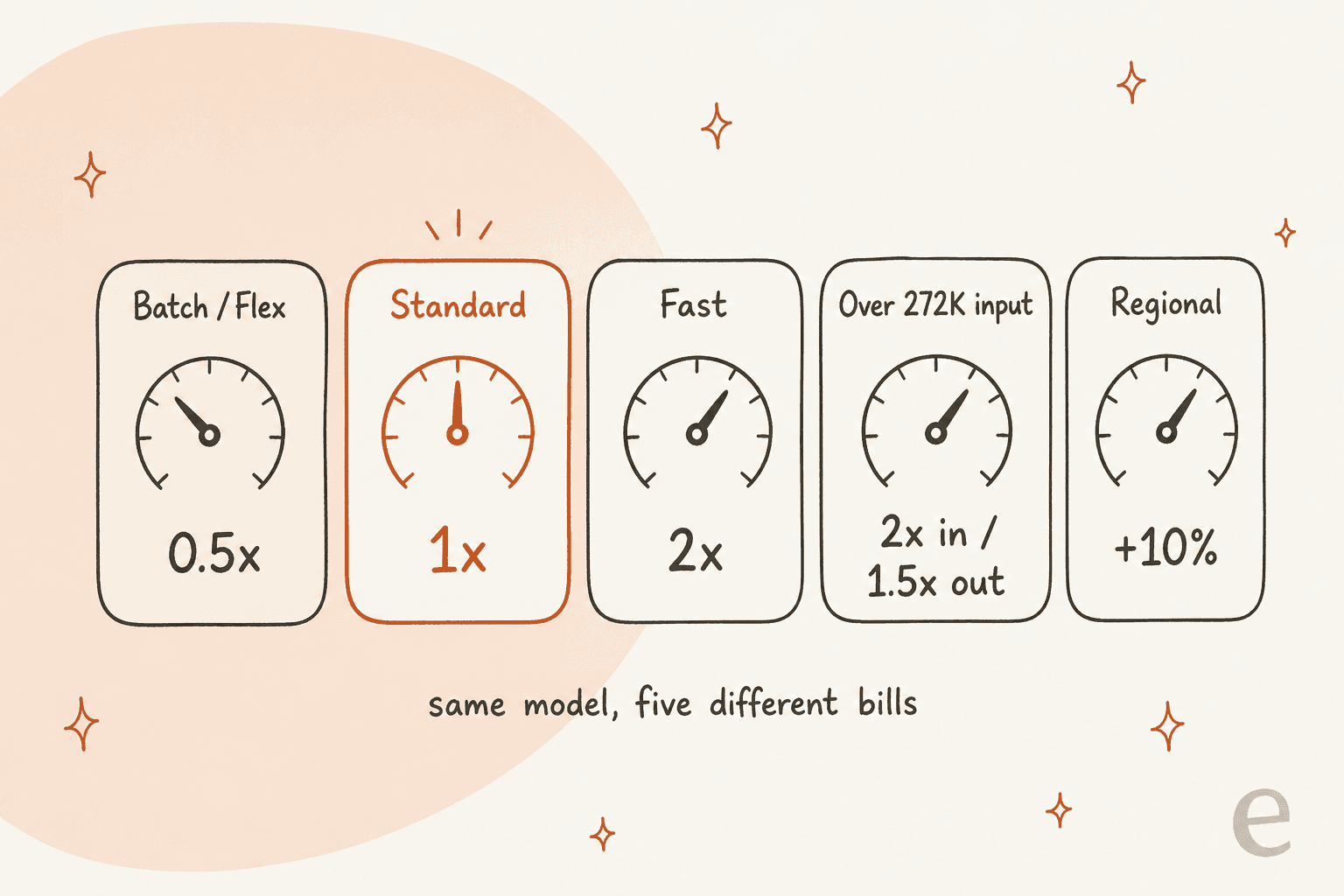
GPT-6.1 Terra costs $1.00 per million input tokens, $0.05 per million cached input tokens and $5.00 per million output tokens at Standard speed. I build the API side of eesel's integrations, so I read price pages the way I read API docs: looking for the multipliers hiding under the headline number. Terra has five of them.
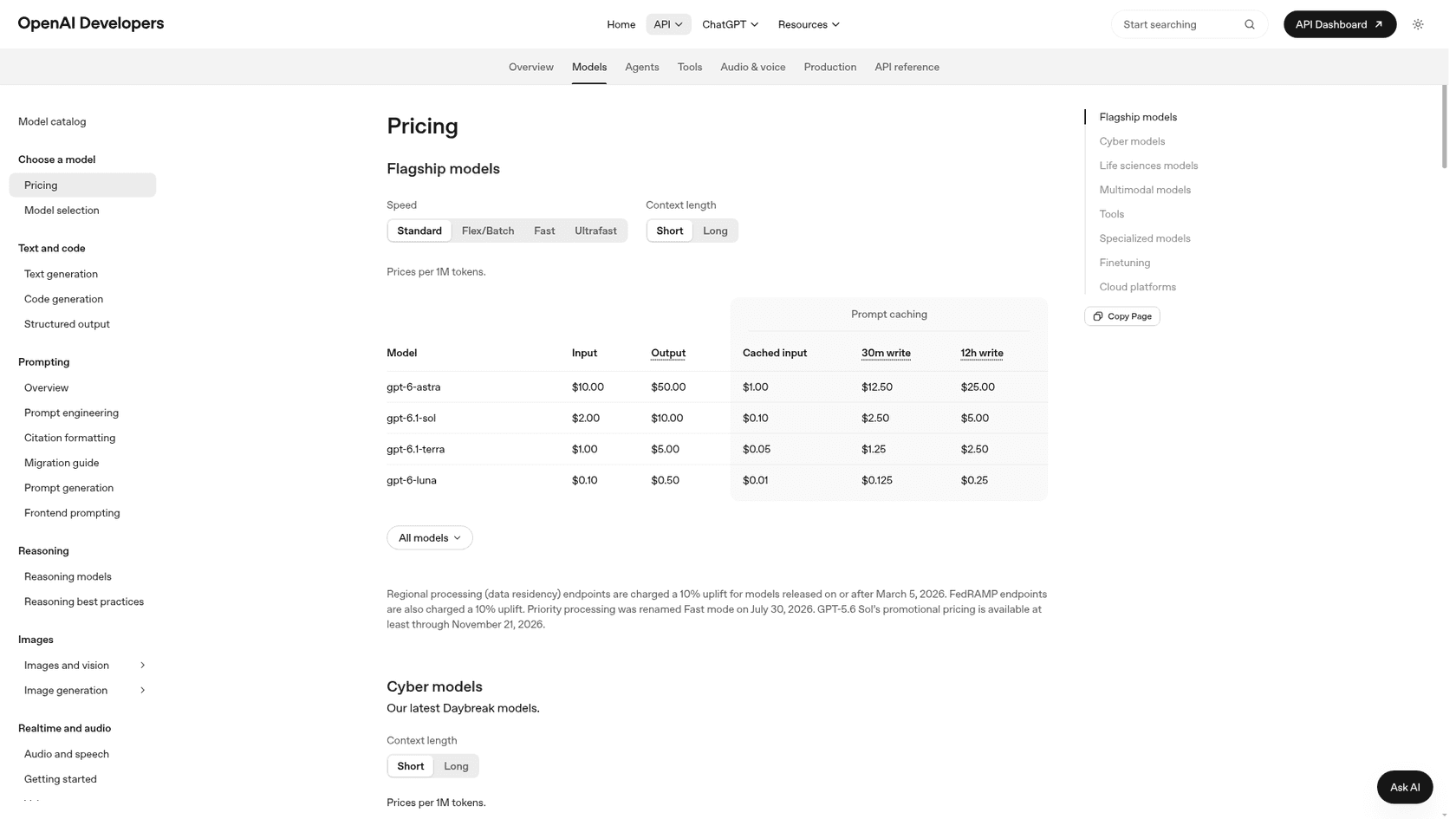
Here is the full rate card, per million tokens:
| Tier | Input | Cached input | Cache write (30m) | Cache write (12h) | Output |
|---|---|---|---|---|---|
| Standard (up to 272K input) | $1.00 | $0.05 | $1.25 | $2.50 | $5.00 |
| Standard (over 272K input) | $2.00 | $0.10 | $2.50 | $5.00 | $7.50 |
| Batch / Flex | $0.50 | $0.025 | $0.625 | $1.25 | $2.50 |
| Fast | $2.00 | $0.10 | $2.50 | $5.00 | $10.00 |
| Ultrafast | Not offered |
Source: OpenAI API pricing and the GPT-6.1 Terra model page. Regional processing (data residency) and FedRAMP endpoints add 10%. Ultrafast exists only for Sol and Astra today.
A few things in that table are worth reading slowly:
- Reasoning tokens bill as output. Every effort level above
noneproduces thinking tokens you never see, and each one costs$5per million. That is why effort moves the bill more than anything else. - Cache reads are 5% of input, cache writes are 125%. The model page says cached input is priced at 5% of the uncached rate, and that writes cost
$1.25for 30-minute retention and$2.50for 12-hour retention. - The long-context price covers the whole request. OpenAI's wording is "2x input and cache rates and 1.5x output for the full request." One token past 272K and every token in that call costs more.
If you need the whole OpenAI catalog side by side, the OpenAI API pricing guide has every model, and the OpenAI models list explains where each one fits.
What does a GPT-6.1 Terra task actually cost?
A task costs anywhere from $0.05 to $0.40 on Artificial Analysis's benchmark suite, and the effort setting is the whole difference. Same model, same token price, 8x spread:
| Terra effort | Intelligence Index | Cost per task | Time per task |
|---|---|---|---|
none (non-reasoning) | 33.5 | $0.11 | n/a |
low | 36.2 | $0.05 | 29s |
medium | 41.3 | $0.10 | 63s |
high | 43.9 | $0.13 | 96s |
xhigh | 45.4 | $0.19 | 160s |
max | 48.1 | $0.40 | 384s |
Source: Artificial Analysis per-effort model pages. Artificial Analysis calls low and medium the Pareto-optimal settings, meaning no model it tracks is both cheaper and smarter at those points.
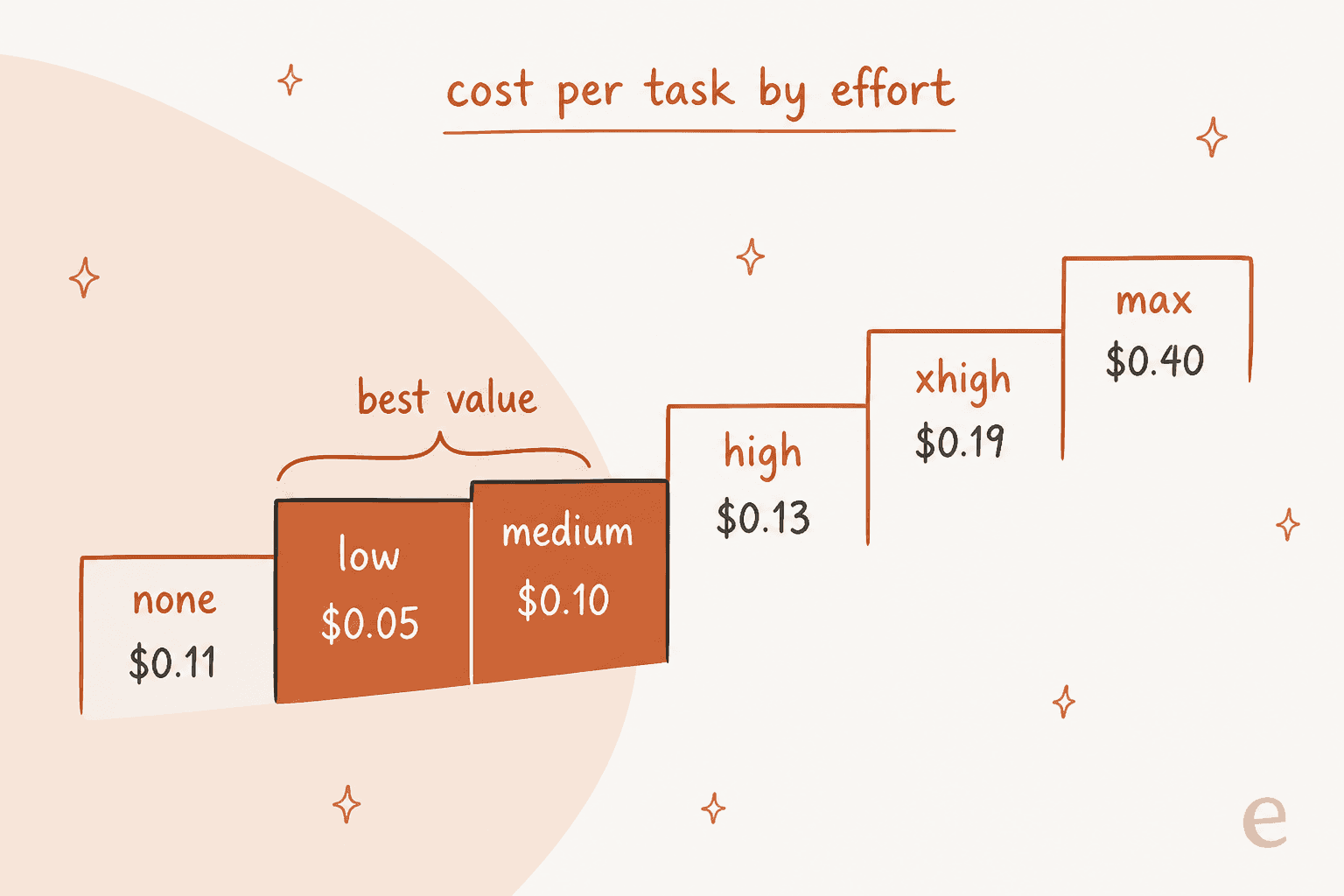
Two details surprised me. First, none costs more per task than low on that suite, which is the opposite of what the names suggest. simonw saw something similar in a launch-day test on Hacker News: both settings spent zero reasoning tokens on his prompt, and low still came out cheaper. Don't assume none is the budget setting; measure it.
Second, max effort is where Terra stops being the cheap option. Going from medium to max costs 4x more and takes 6x longer for 7 more index points. At that point, GPT-6.1 Sol at medium ($0.21 a task, index 47.8) gets you about the same score for roughly half the money. Hacker News readers worked this out within hours:
"Per token, yes. But per task it's not even necessarily the case depending on how much thinking is needed."

And from someone running it in production:
"I have some business automation process for some customers that I maintain, where Terra with low reasoning ended up with the best price/performance & latency."
That matches what I measured in my own Terra review. On 16 support tickets run through the Responses API, Terra at low scored the same as medium and cost $0.75 per 1,000 tickets instead of $0.92:
| Setup | Correct (of 16) | Cost per 1,000 tickets | Mean time |
|---|---|---|---|
Terra, none | 15 (1 fail) | $0.65 | 2.5s |
Terra, low | 15 | $0.75 | 2.7s |
Terra, medium | 15 | $0.92 | 3.1s |
GPT-6.1 Sol, medium | 16 | $1.62 | 3.9s |
GPT-6 Luna, medium | 15 | $0.14 | 4.1s |
The none setting was cheapest, but it told one Spanish-speaking customer their address change was "noted" when it had no tool to change anything. That is a 10 cent saving per 1,000 tickets, paid for with one promise your team can't keep. I'd start at low.
Why does a long prompt cost twice as much?
Because the long-context rate applies to the entire request, not just the tokens past the line. Below 272K input tokens you pay $1/$5. Above it, the whole call is billed at $2/$7.50.
The jump is steep. A request with 270K input and 2K output costs $0.28. Add 10K more input and it costs $0.58, more than double, for 4% more text.
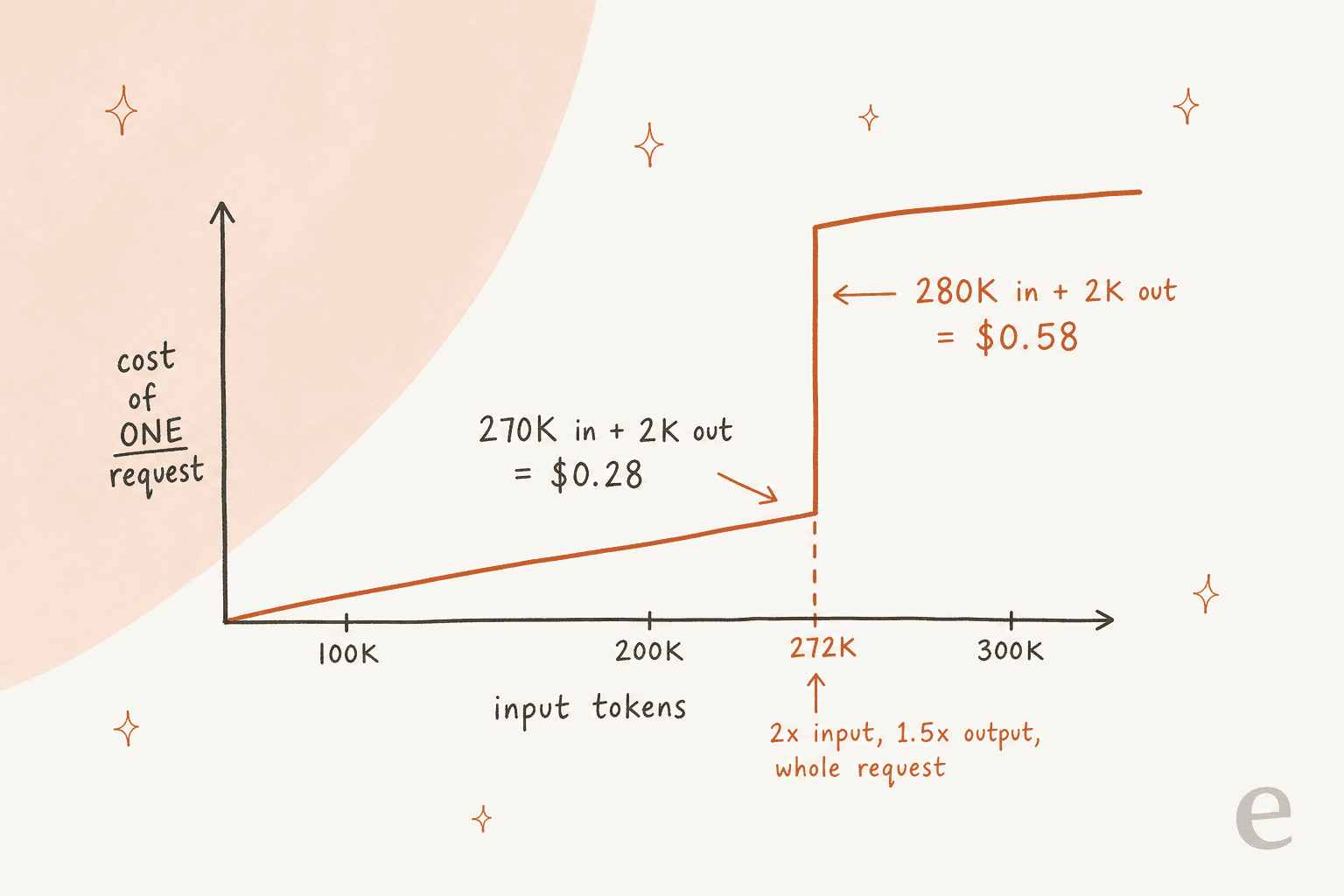
Terra's context window is 1,050,000 tokens, so it will happily take a 400K-token contract or log dump. Here is what that costs, and what splitting it costs:
| Approach | Math | Cost |
|---|---|---|
| One 400K-token request, 4K output | 400K x $2 + 4K x $7.50 | $0.83 |
| Two 200K-token requests, 4K output each | 2 x (200K x $1 + 4K x $5) | $0.44 |
Splitting saves 47%, as long as the task survives being split. Summaries, extraction and per-section review usually do. A question that needs the whole document at once doesn't, and then you pay the long rate.
The quiet way to cross the line is an agent loop. Each turn resends the conversation, so a session that starts at 50K can drift past 272K by turn 20 without anyone noticing. If you run Terra as an agent, log input tokens per call and trim or summarize history before it gets there. The OpenAI function calling guide covers how tool results add to that history.
Does prompt caching save money on Terra?
Yes, when traffic is steady. Cached input costs $0.05 per million, 95% off. The catch is the write: storing a prefix in the cache costs $1.25 per million for 30 minutes, or $2.50 for 12 hours, which is more than just sending it uncached.
Take a support reply with a 4,000-token system prompt and policy block that never changes, 2,000 tokens of ticket and help center context that does, and 400 tokens of output:
| Scenario | Per ticket | Per 1,000 tickets |
|---|---|---|
| No caching | $0.0080 | $8.00 |
| Prefix cached and read (busy queue) | $0.0042 | $4.20 |
| Prefix written every time (one ticket per 30 min) | $0.0090 | $9.00 |
On a busy queue the prefix is written once per window and read thousands of times, so caching nearly halves the bill. On a quiet one, where each request lands after the cache has expired, you pay the write premium every time and end up about 12% worse off than not caching at all.
OpenAI's model guide says to track cached_tokens and cache_write_tokens to understand net cost, and that is the right habit. The 12-hour retention only pays when a prefix is reused across hours but less than every 30 minutes, such as a nightly job.
How much does Terra cost per month?
Here is one workload priced across every tier: 1 million requests a month, each with 2,000 input tokens and 300 output tokens.
| Tier | Input cost | Output cost | Monthly total |
|---|---|---|---|
| Standard | $2,000 | $1,500 | $3,500 |
| Batch / Flex | $1,000 | $750 | $1,750 |
| Fast | $4,000 | $3,000 | $7,000 |
| Standard + regional | $2,200 | $1,650 | $3,850 |
Batch is the easiest saving. If results can arrive within the batch window (classification, overnight summaries, backfills), you pay half. The OpenAI Batch API guide covers the setup. Fast mode only makes sense for user-facing calls where latency loses you a customer.
To price your own workload, plug your numbers in here:
The defaults are a 100,000-ticket month with a 6,000-token prompt, which comes to about $800. Put in your real prompt size, not the one from your prototype. Retrieved help center chunks and conversation history are usually what make a prompt 5x to 10x bigger than you expected.
How does Terra pricing compare with other models?
Terra is the second rung of OpenAI's four-model ladder. Here is the same 1-million-request workload (2,000 in, 300 out) across OpenAI's family and the closest rivals:
| Model | Input / output per 1M | Cached input | AA cost per task | Monthly bill (example) |
|---|---|---|---|---|
| GPT-6 Luna | $0.10 / $0.50 | $0.01 | n/a | $350 |
| GPT-6.1 Terra | $1.00 / $5.00 | $0.05 | $0.40 (max) | $3,500 |
| GPT-6.1 Sol | $2.00 / $10.00 | $0.10 | $0.21 (medium) | $7,000 |
| GPT-6 Astra | $10.00 / $50.00 | $1.00 | $3.26 (max) | $35,000 |
| GPT-5.6 Terra (previous) | $2.00 / $12.00 | n/a | $1.40 (max) | $7,600 |
| Claude Sonnet 5.5 | $2.00 / $10.00 | $0.10 | $0.88 (high) | $7,000 |
| Claude Haiku 5.5 | $0.10 / $0.50 | $0.01 | $0.08 (high) | $350 |
| DeepSeek V4.1 Flash | $0.15 / $0.60 off-peak | $0.003 | $0.26 (max) | $480 |
| Gemini 3.8 Flash | $0.75 / $3.75 to Dec 31 | $0.075 | $3.49 (high) | $2,625 |
Sources: OpenAI API pricing, each vendor's own pricing page as of 28 October 2026, and Artificial Analysis for cost per task. Haiku's price applies up to a 100K prompt.
Against its own predecessor, the drop is real. OpenAI's launch thread put it simply:
"It's a significant step up over GPT‑5.6 Terra, with 50% lower standard API prices."
At the per-token level, Terra is mid-pack: 10x Luna and Haiku, half of Sol and Sonnet. Per task, it is among the cheapest models with an Intelligence Index above 45. If your work is narrow tagging and routing, Luna at a tenth of the price is the better buy. If it is hard coding, OpenAI itself points you to Sol or GPT-6 Astra. The GPT-6.1 Terra alternatives post goes through each option in depth.
What does Terra cost in ChatGPT and Codex?
There is no separate Terra price in ChatGPT. It comes with Plus, Pro, Enterprise and Edu plans in ChatGPT Work and Codex, per OpenAI's launch post. OpenAI says your usage allowance goes further with Terra than with GPT-5.6 Terra, and much further than with Sol or Astra.
So in a subscription, picking Terra doesn't lower the bill, it stretches the allowance. If you hit limits on Sol for routine work, switching those tasks to Terra is the cheap fix. The ChatGPT Work pricing and Codex pricing guides cover what each plan includes, and ChatGPT Enterprise explains the workspace tier.
What are the hidden costs and limits?
Most of these are small on their own and add up together. Here is the list I'd check before committing:
- No free API tier. The model page lists Free as "Not supported." You need a paid account from the first call.
- Rate limits start low. Build tier gives
5,000requests and1,000,000tokens per minute. At 2,300 tokens a request, that is about 430 requests a minute. Launch goes to4,000,000TPM and Grow to40,000,000. The OpenAI rate limits guide explains how you move up. - Tool calls cost extra. Web search and file search are billed per call or per GB on top of tokens, and tokens used by built-in tools are billed at Terra's rates, per the pricing page.
- Regional processing is +10%. Data residency and FedRAMP endpoints carry the uplift for models released on or after 5 March 2026, which includes Terra.
- Retries and evals. A failed tool call or a reply you regenerate is billed in full. Budget a margin, and run OpenAI agent evals on a fixed set before changing effort levels, so you're comparing cost at the same quality.
| Rate limit tier | Requests per minute | Tokens per minute | Batch queue limit |
|---|---|---|---|
| Free | Not supported | ||
| Build | 5,000 | 1,000,000 | 3,000,000 |
| Launch | 10,000 | 4,000,000 | 200,000,000 |
| Grow | 15,000 | 40,000,000 | 15,000,000,000 |
Source: GPT-6.1 Terra model page.
Is GPT-6.1 Terra worth it for customer support?
For drafting and triage, yes, and the token bill is the smallest line in the budget. A realistic support ticket, with a 6,000-token prompt, costs about $0.008 at Standard. A 10,000-ticket month is $80 in model costs, or about $42 with a cached prefix.
What actually costs a support team money is the wrong reply. In my test, the cheapest setting told a customer an address change was done when it wasn't, and that one ticket would cost more in a follow-up and a refund than a year of token savings. eesel has spent years putting AI agents on live support queues, and building the integrations for them, I keep relearning the same lesson: the model is the smaller half of the job. The bigger half is what it reads, what it is allowed to do, and when it hands off to a person. The AI customer service cost breakdown covers the full picture, and AI hallucinations in support covers the failure mode above.
The smava story shows what that half looks like. Its eesel agent works inside AI for Zendesk, handles about 27,000 tickets a month across two lending brands, prepared 15,300 draft replies in a month, and drafts from the 820 macros and help center articles the team already maintains in Zendesk. In regulated finance, a reply that promises something the team won't do is real harm, which is why the wording comes from the macros, not from the model's imagination. Dokument 24 runs the same pattern in Danish: 670 draft replies a month left as internal notes for the team to check and send, a good fit for multilingual customer support.
Try eesel
If you're pricing Terra because you want AI drafting or answering tickets, you may not need to build the pipeline at all. eesel is an AI teammate platform, and its AI helpdesk agent joins your existing Zendesk, Freshdesk or Gorgias queue, learns from your past tickets and help center, and drafts or answers with the escalation rules you set. You can test it on your own historical tickets before it touches a live customer.
Pricing is per ticket, not per token: eesel's plans start at $299 a month for 500 credits, where one ticket is one credit however long the thread runs, with 100 free credits to try it. That puts the model choice, prompt size and the 272K rule on eesel's side of the table instead of yours. SamCart runs one agent on Freshdesk tickets and another on its website chat, both answering from 280 help center articles.
If you'd rather drive it from code, the eesel CLI operates the same teammate from a terminal, and every workspace is also an MCP server, so a Codex session running GPT-6.1 Terra can call your support agent as a tool. Try eesel and see the drafts on your own tickets.
Frequently Asked Questions
How much does GPT-6.1 Terra cost?
How much does GPT-6.1 Terra cost per task?
Is GPT-6.1 Terra cheaper than GPT-6.1 Sol?
What is the GPT-6.1 Terra long-context price?
Does GPT-6.1 Terra have a free tier?
gpt-6.1-terra, and rate limits start at 5,000 requests and 1 million tokens per minute on the Build tier. The OpenAI rate limits guide explains how tiers climb. In ChatGPT, Terra comes with Plus, Pro, Enterprise and Edu plans.