

What does Elorian Glimpse cost?
I'm Alicia, and I build features and AI agents at eesel. A lot of my week goes into the gap between what a model costs per token and what it costs per finished job, because that gap is where AI budgets go sideways. So before doing any maths on Glimpse, I read Elorian's launch post, the platform terms, and the provider pages line by line. Vision is also a live question in my day job: in eesel's sales calls this year, support teams for technical products kept asking for AI that can read the diagrams in their PDFs and the photos customers attach to tickets. So I wanted the real cost of a model built for exactly that kind of looking.
Glimpse launched on October 16, 2026, as the first model from Elorian, a startup founded by Andrew Dai, who previously co-led data work on Gemini at Google DeepMind. Elorian calls it a "visual thinking" model: it takes images and video, zooms into regions, rewatches short stretches at a higher frame rate, and only then answers in text. It is a research preview, post-trained on an open-weights base model.
Here is everything you can buy today and what it costs:
| How you access it | Input (per 1M tokens) | Cached input (per 1M) | Output (per 1M tokens) | Notes |
|---|---|---|---|---|
| Elorian API | $0.60 | Not published | $3.00 | Sign up on the Elorian platform |
| OpenRouter | $0.60 | $0.06 | $3.00 | Every request goes to Together AI |
| Together AI dedicated | Contact sales | Contact sales | Contact sales | Single-tenant GPUs, priced per hour |
| Elorian chat interface | Free | Free | Free | Web chat, not an API |
On specs, OpenRouter lists a 262,144 token context window and up to 256,000 output tokens. Inputs are text, images, and video. Output is text only.
Two things are missing from Elorian's own materials, and they matter. There is no published cache price on the Elorian API itself, and there is no batch discount anywhere. If you want caching on the record today, OpenRouter's listing is the only public source for it.
How does Glimpse pricing compare with Astra, Sol, Opus 5.5, and Gemini?
Elorian's launch post compares Glimpse against four frontier models, and the price rows are the first thing in its results table. Here is that table, straight from the launch page:
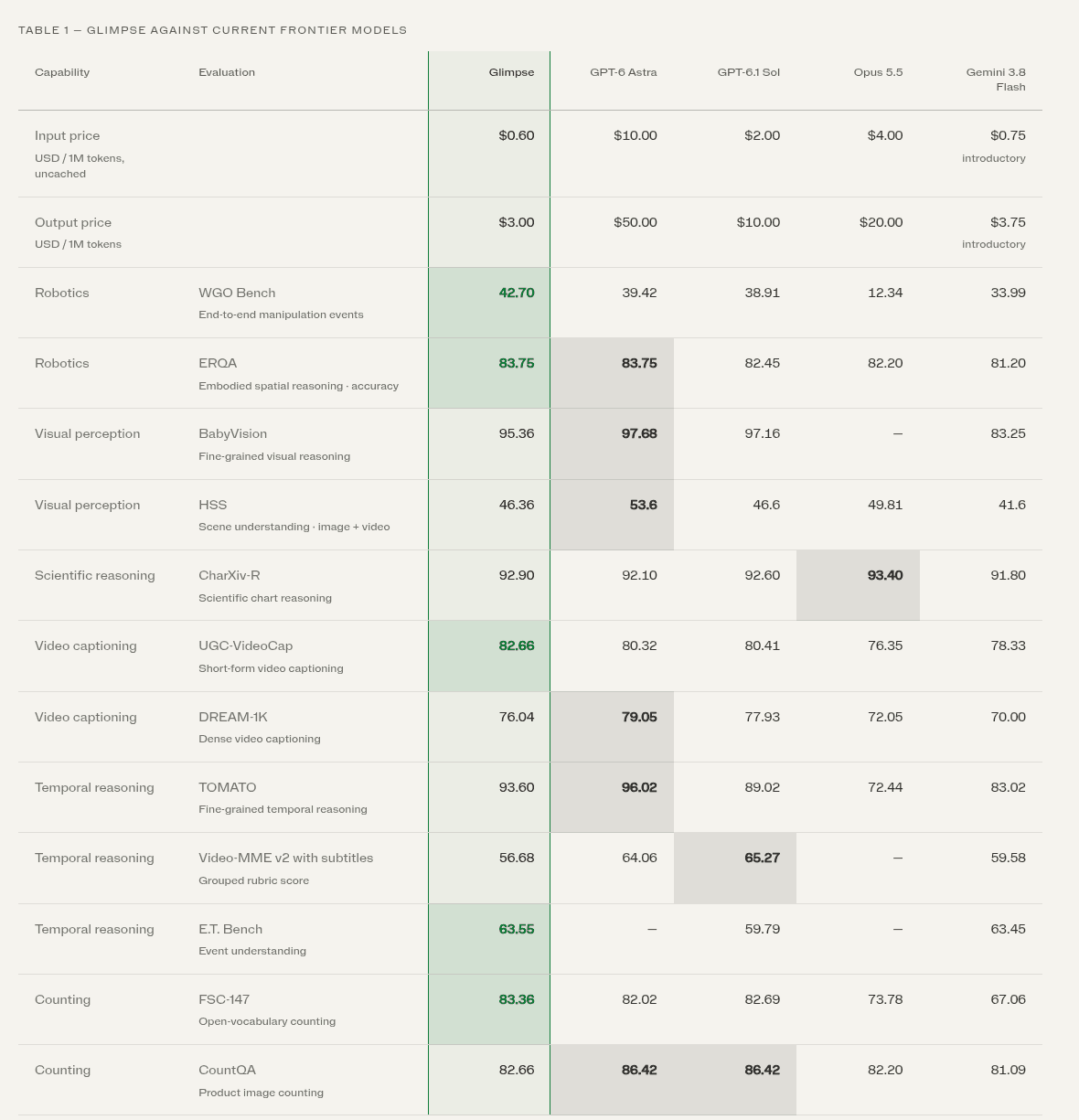
I checked each competitor's price against its own vendor page and added the cache rates, since caching changes the picture for image-heavy work where the same reference frames get sent again and again:
| Model | Input (per 1M) | Cached input (per 1M) | Output (per 1M) | Glimpse saving on output |
|---|---|---|---|---|
| Elorian Glimpse | $0.60 | $0.06 (OpenRouter) | $3.00 | - |
| Gemini 3.8 Flash (to Dec 31, 2026) | $0.75 | $0.075 | $3.75 | 20% |
| Gemini 3.8 Flash (from Jan 1, 2027) | $1.50 | $0.15 | $7.50 | 60% |
| GPT-6.1 Sol | $2.00 | $0.10 | $10.00 | 70% |
| Claude Opus 5.5 | $4.00 | $0.20 | $20.00 | 85% |
| GPT-6 Astra | $10.00 | $1.00 | $50.00 | 94% |
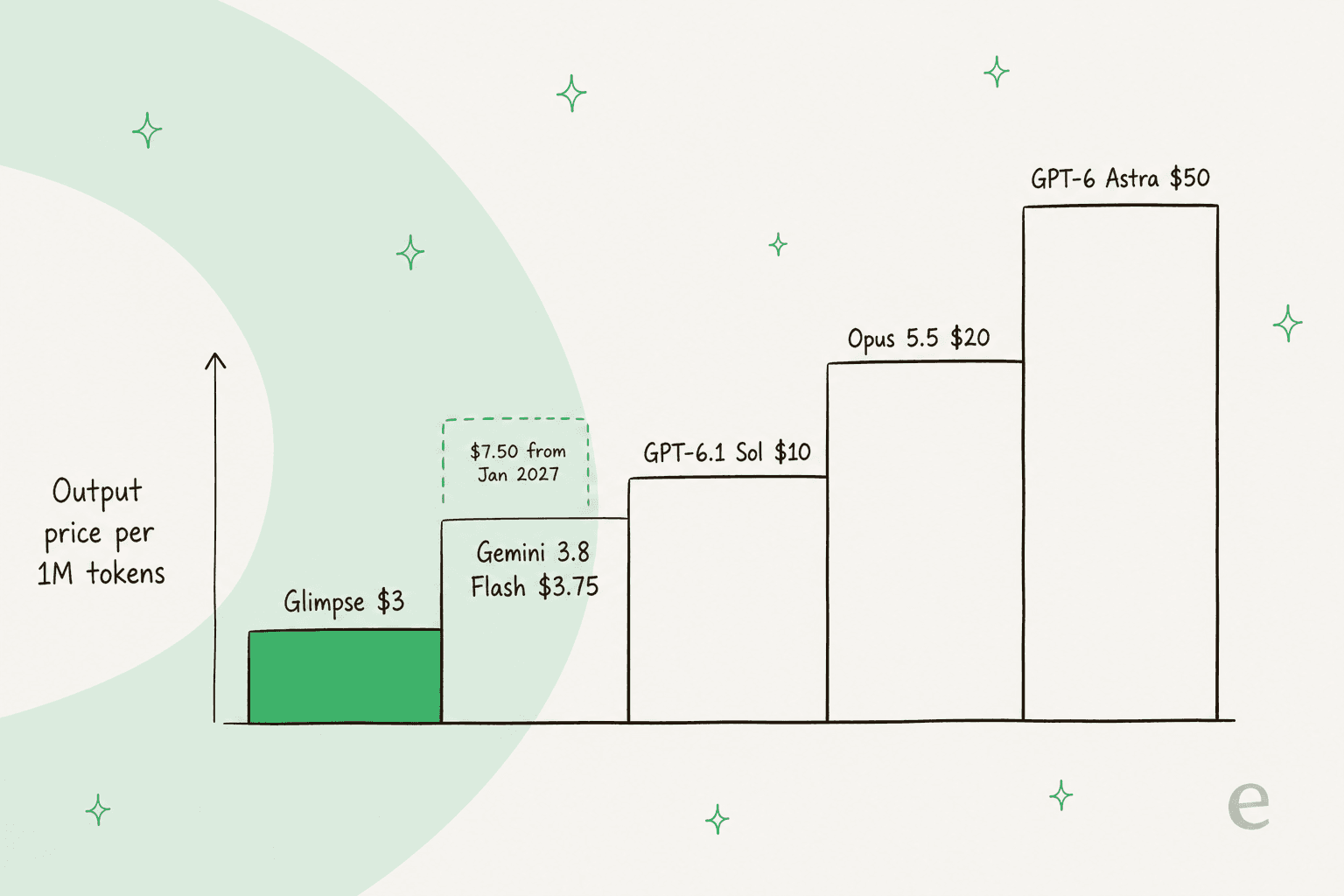
The row that deserves the most attention is Gemini. Elorian is careful to say "introductory" next to the Flash price, and that word is doing real work: Gemini 3.8 Flash goes from $0.75 and $3.75 to $1.50 and $7.50 on January 1, 2027. Today Glimpse undercuts Flash by 20%. In ten weeks it undercuts it by 60%. If you are choosing between these two for a project that runs into 2027, price the 2027 column, not the October one.
At the other end, the Astra comparison is the headline Elorian leads with, and it holds up on the rate card. GPT-6.1 Sol sits in the middle at $2 and $10, and Opus 5.5 at $4 and $20.
For open and budget alternatives with vision, the DeepSeek V4 Flash Vision preview and Nemotron 3.5 Super VL are both cheaper again per token, though neither is built around rewatching video the way Glimpse is.
For the full first-party rate cards, see the guides to OpenAI API pricing, Gemini pricing, and Anthropic API pricing.
Why is the real saving smaller than 94%?
Because Glimpse is designed to look twice, and looking costs tokens. Elorian says so itself in the launch post: "Looking that closely takes time, and tokens. Token efficiency is our next highest focus."
The cleanest evidence is Elorian's own robot demo. Both Glimpse and GPT-6 Astra acted as the planner for the same robot policy (π0.5 from Physical Intelligence) on the same task: put the cream cheese in the bowl, then put the bowl on the cabinet. Both finished. Per the launch post, Glimpse's planning cost $0.035 for the episode and Astra's cost $0.249.
That is a 7.1x gap. The rate card gap is 16.7x. The difference has to come from token counts, and on this task it implies Glimpse used roughly 2.3 times as many tokens as Astra to reach the same result. That is my calculation from Elorian's two numbers, not a figure Elorian published, and it comes from a single demo. But it is the right shape of warning for anyone budgeting off the 94% headline.
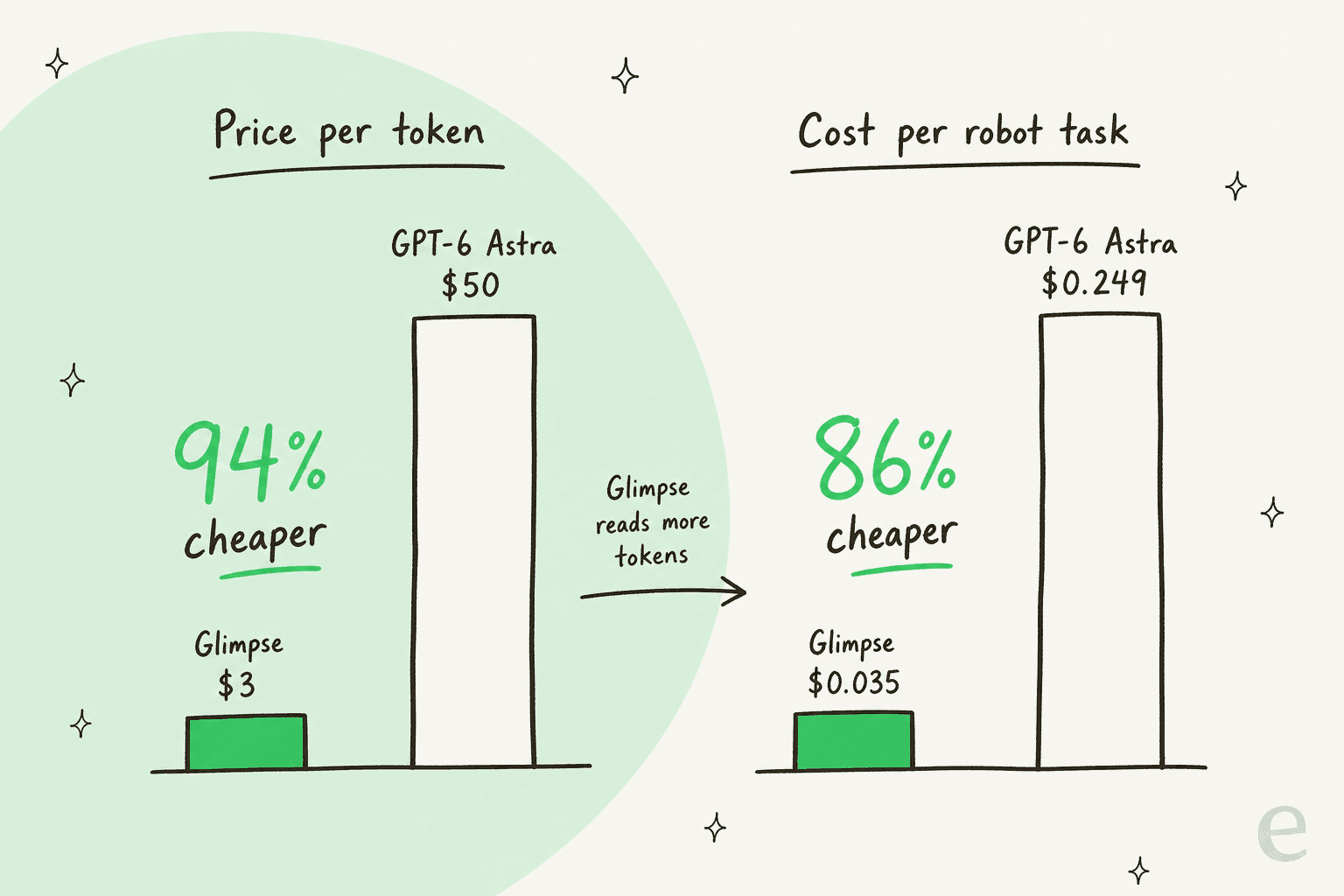
An 86% saving is still a very good deal, and for robotics it changes what is affordable. Brian Zhan, an investor in Elorian, did the per-hour maths on exactly this demo:
"A check every 2s is 1,800 calls per robot-hour. Glimpse is 7x cheaper than GPT-6 Astra and ~1s faster per call. The same budget on Astra buys one check every 14s."
Note the "7x", not "16x". Even Elorian's own backers quote the per-task number when they do real maths. The extra looking is also visible in how early testers describe the model:
"Glimpse broke the image into four sections, zoomed in to examine the details, and analyzed the visual clues before reaching its final answer: 5 horses."
Four crops and a zoom is a better answer. It is also four crops and a zoom worth of tokens.
Where does a Glimpse bill actually go?
OpenRouter publishes live traffic for every model it hosts, which gives a rare look at how real workloads spend money on Glimpse. Over its first three days, the OpenRouter page showed 557M prompt tokens, 57.2M reasoning tokens, and 13.2M completion tokens.
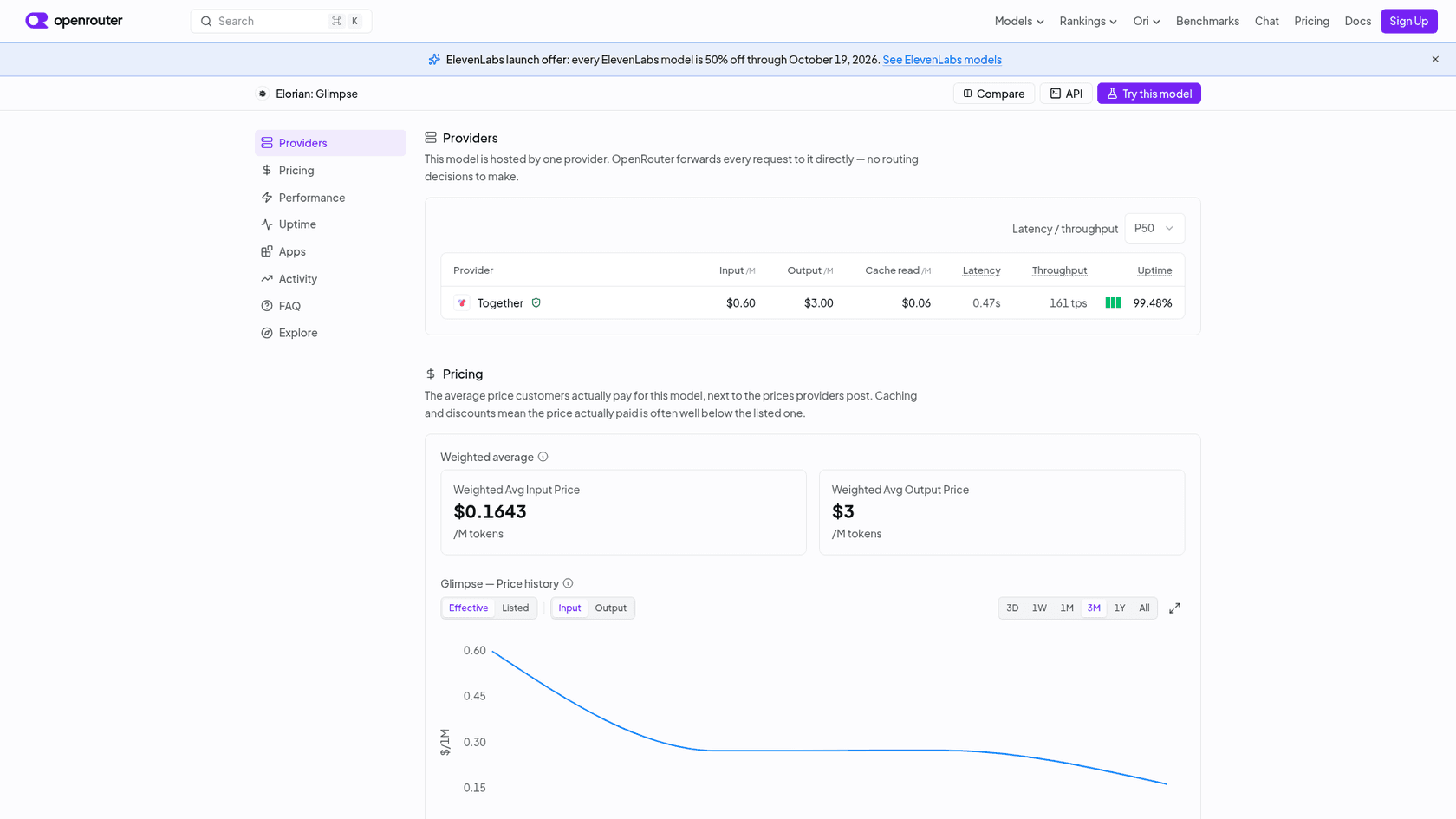
Two numbers on that page explain most of the bill:
- Cache hit rate of 80.7%. Most of the input was served from cache at
$0.06, which drags the average input price paid down to$0.1643per million, about 73% below the$0.60list price. - Reasoning is 81% of output. Of the
70.4Moutput tokens,57.2Mwere thinking and only13.2Mwere the visible answer. On OpenRouter, reasoning tokens bill as output at the full$3rate.
Put those together and the money flips. Input is 89% of the tokens but only about $91 of the roughly $303 spent. Output is about $211, or 70%, and the thinking alone costs more than all the input combined.
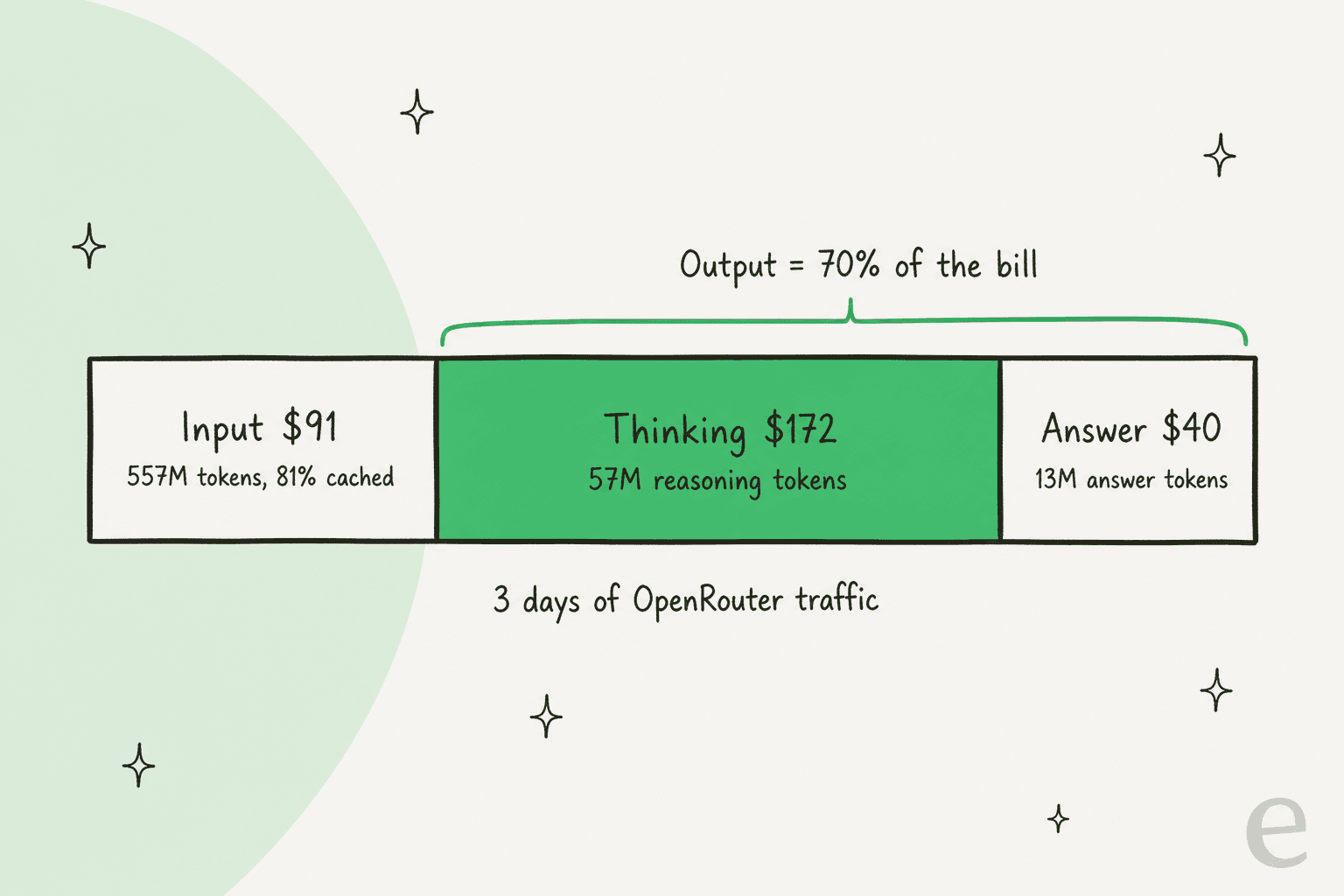
This is a traffic mix, not your mix. The top apps sending Glimpse traffic in those first days were coding agents and Hermes Agent, which resend long, stable prompts and cache well. A pipeline that sends a fresh video clip every call will cache far less, and input will take a bigger share. But the lesson carries over: on Glimpse, the lever is reasoning, not the image. OpenRouter's reasoning parameter lets you set effort or a maximum reasoning budget, and that is the first knob I'd turn on a cost review.
Estimate your own Glimpse bill
Plug in your own request volume and token sizes. The "Glimpse token multiplier" is there because of the robot example above: set it to 1.0 if you assume Glimpse uses the same tokens as the other models, or around 2.3 to match what Elorian's own demo implies.
With the defaults (10,000 requests, 20,000 input tokens and 3,000 output tokens each, no caching), Glimpse comes out at $210 a month against $262.50 for Gemini 3.8 Flash, $700 for Sol, $1,400 for Opus 5.5, and $3,500 for Astra. Now slide the multiplier to 2.3 and Glimpse jumps to $483, more than Gemini 3.8 Flash costs today. Switch on the 2027 prices and Flash rises to $525, so Glimpse wins again. That swing is the whole buying decision in one slider.
Is the Glimpse chat interface free?
Yes. Founder Andrew Dai said so in the launch thread:
"Free on the chat interface at https://platform.elorian.ai with an API available too."
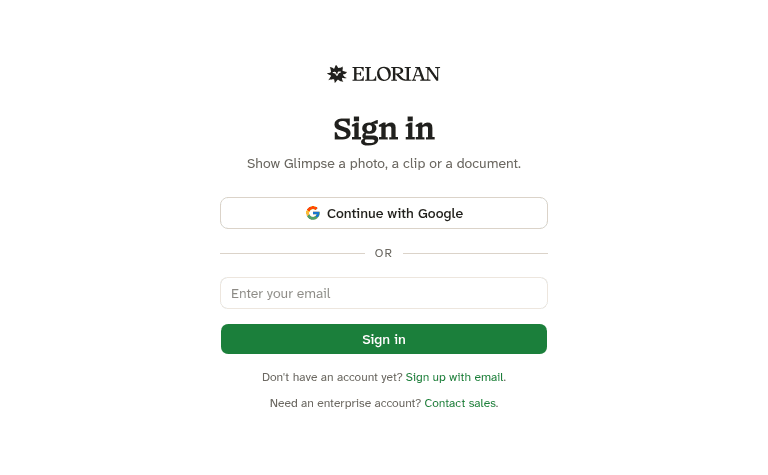
Elorian's launch post repeats it with a "Try Glimpse free on the Elorian platform" button. Sign-up is by Google or email, and there is a separate contact for enterprise accounts.
I could not find published usage caps for the free chat. The platform terms, last updated October 12, 2026, describe how paid use works once you go past it:
- Fees are in US dollars and are non-refundable except where the law requires, with refund requests reviewed case by case.
- Billing can run on prepaid credits or a continuous subscription.
- If you turn on automatic payment, Elorian charges your card periodically for usage, and you cancel it by contacting Elorian before the next billing date.
- Free trials and beta offerings carry no guarantee and can end.
The free chat is the right place to start. It even shows the model's "visual scratch space" as it zooms and rewatches, which is the fastest way to get a feel for how many steps your kind of image takes, and therefore how many tokens the API will bill you for.
What are the hidden costs and gotchas?
The rate card is short, so the real surprises are in how the model behaves. These come from OpenRouter's live metrics and Elorian's own notes:
| Gotcha | What the numbers say | Why it costs you |
|---|---|---|
| Tool call errors | 9.20% error rate on OpenRouter | Failed calls usually get retried, and retries bill again |
| Structured output errors | 10.38% error rate | Schema-strict pipelines will retry about 1 in 10 calls |
| Long tail latency | P50 end-to-end 12.48s, P90 76.17s | Fine for batch labeling, slow for anything a person waits on |
| One provider | Together is the only host, 99.48% uptime | No fallback provider if Together has a bad hour |
| Research preview | Elorian's own label | Prices and behavior can change, and no batch tier yet |
The error rates are the ones I'd watch most closely. At a 10% retry rate, your effective price is about 10% higher than the calculator says, and for reasoning-heavy calls a retry repeats the expensive part. If you are extracting structured data from images, validate early and keep retries capped.
On the "open weights" point: Glimpse is post-trained on an open-weights base model, but the Glimpse weights themselves are not public. Elorian's Hugging Face page lists no models. Self-hosting is not an option today. The closest thing is a dedicated deployment on Together, where the pricing page lists dedicated H100s at $5.49 per GPU per hour on demand. That only pays off at steady, high volume, and you would arrange it through Together's sales team.
What does Glimpse cost for real workloads?
Here are three worked examples using Elorian's rates. Where I had to assume token sizes, I say so.
1. Robot planning, using Elorian's own episode cost. At $0.035 per episode, 1,000 planning episodes cost $35 on Glimpse against $249 on GPT-6 Astra. This is the only example with token counts measured by Elorian rather than assumed, so it is the most trustworthy one. It is also the use case Elorian and its investors talk about most, alongside Gemini Robotics 2 and Gemini 4 Argon.
2. Video labeling at 10,000 clips a month. Assume 20,000 input tokens per clip and 3,000 output tokens, with no caching because each clip is new. That is $210 a month on Glimpse and $262.50 on Gemini 3.8 Flash at today's prices. If Glimpse needs 2.3 times the tokens to rewatch tricky stretches, it becomes $483, and Flash is cheaper until January.
3. A screenshot reader for support tickets. Assume 5,000 tickets a month with one screenshot each, about 3,000 input tokens and 800 output tokens per ticket. On Glimpse that is roughly $21 a month. On Claude Opus 5.5 it is $140. At this size the model bill is a rounding error next to the engineering time to wire it into your helpdesk, which is the real cost I explore in the AI customer service cost guide.
The pattern across all three: Glimpse is cheapest when the job needs its careful looking, and the saving shrinks when the job is simple enough that a cheaper reader would have got there in fewer steps.
Who should pay for Glimpse?
Glimpse is good value when the visual reasoning is the product. Labeling robot footage, counting objects across a moving camera, checking whether a step in a video actually happened: these are the tasks where Elorian's own table shows it matching or beating models that cost 6x to 16x more. One tester put the open question well:
"Asking why something changed means tracking the same object across frames and tying it to a cause, and that is where a lot of vision models start guessing."
If that is your problem, the price is easy to justify, and the free chat lets you check it on your own footage before spending anything.
I'd skip it, or at least benchmark hard first, in three cases. First, simple image reading like OCR or "what product is in this photo," where Gemini 3.8 Flash or a budget DeepSeek model will answer in fewer tokens. Second, anything a customer waits on in real time, given the long-tail latency. Third, schema-strict pipelines, until that 10% structured output error rate comes down.
For everything in between, treat the $0.60 and $3 as a ceiling on price per token, not a forecast of your bill, and set a reasoning budget from day one. The guide to LLM optimization covers the other knobs worth turning.
Where eesel fits
Glimpse is infrastructure: a very capable pair of eyes you call from your own code. If you are evaluating vision models, or a raw customer service API, because customers keep sending screenshots and photos to your support queue, the model is the smallest part of what you need. You still need the helpdesk connection, the knowledge, the guardrails, and a way to know it answers correctly before it talks to a customer.
That is the part eesel handles. eesel's AI helpdesk teammate joins your existing helpdesk, such as Zendesk or Freshdesk, learns from your past tickets and help center, and is simulated against your historical tickets before it goes live, so you see its answers before your customers do. If you are comparing models for support work specifically, the roundup of the best support ticket models is a good next read.
Try eesel free and see what it would answer on your own tickets.
Frequently Asked Questions
How much does Elorian Glimpse cost?
$0.60 per million input tokens and $3.00 per million output tokens on the API. On OpenRouter, cached input reads cost $0.06 per million, which is why the average input price paid there is about $0.16. Compare that with Gemini 3.8 Flash pricing at $0.75 and $3.75.Is Elorian Glimpse free to use?
Is Glimpse really 94% cheaper than GPT-6 Astra?
$0.60 and $3 against Astra's $10 and $50. Per task, the gap is smaller. In Elorian's own robot planning example, Glimpse cost $0.035 against $0.249 for Astra, which is 86% cheaper, because Glimpse reads more before it answers. The GPT-6 Astra pricing breakdown has the full Astra rate card.Does Glimpse charge for reasoning tokens?
$3 per million. In OpenRouter's public traffic for Glimpse, reasoning made up about 81% of all output tokens, so capping reasoning is the biggest lever on your bill. The same rule applies to most thinking models, including Claude Opus 5.5.Where can I buy Glimpse API access?
$0.60 and $3 on the first two. A dedicated deployment is priced by GPU hour instead, like other options in this API comparison.