Hermes AI agent review: an honest 2026 take

Kira

Katelin Teen
Last edited July 19, 2026

What is the Hermes agent?
I spend my days building AI agents at eesel, so when Nous Research shipped an open-source agent that "grows with you," I wanted to see how the mechanism actually holds up rather than take the launch thread at face value.
Hermes is a self-hosted, autonomous agent built in Python and released under the MIT License. The pitch that separates it from a rule-based chatbot or a coding copilot: it has a built-in learning loop. It creates skills from experience, improves them during use, and builds a model of you across sessions. It is designed to live on infrastructure you own, not be tethered to your laptop.
The traction is real for such a young project. Nous claims 10k+ GitHub stars and 2.3M+ launch views on the landing page, it ranked #1 on OpenRouter shortly after launch, and reporting has Nous Research in talks at a $1.5B valuation. Those are vendor and press numbers, but they line up with how much noise the launch made.
There are two ways to run it. The self-hosted framework is the free, MIT-licensed open-source version. FlyHermes is the managed cloud that removes the server work. Almost everything below applies to the open-source version, because that is the one people are actually talking about. If you are just here to compare options, my roundup of the best AI agents puts tools like this side by side.
How the Hermes learning loop actually works
This is the part I care about most, because "the agent learns" is the easiest claim to fake and the hardest to build. Here is what is really going on under the hood.
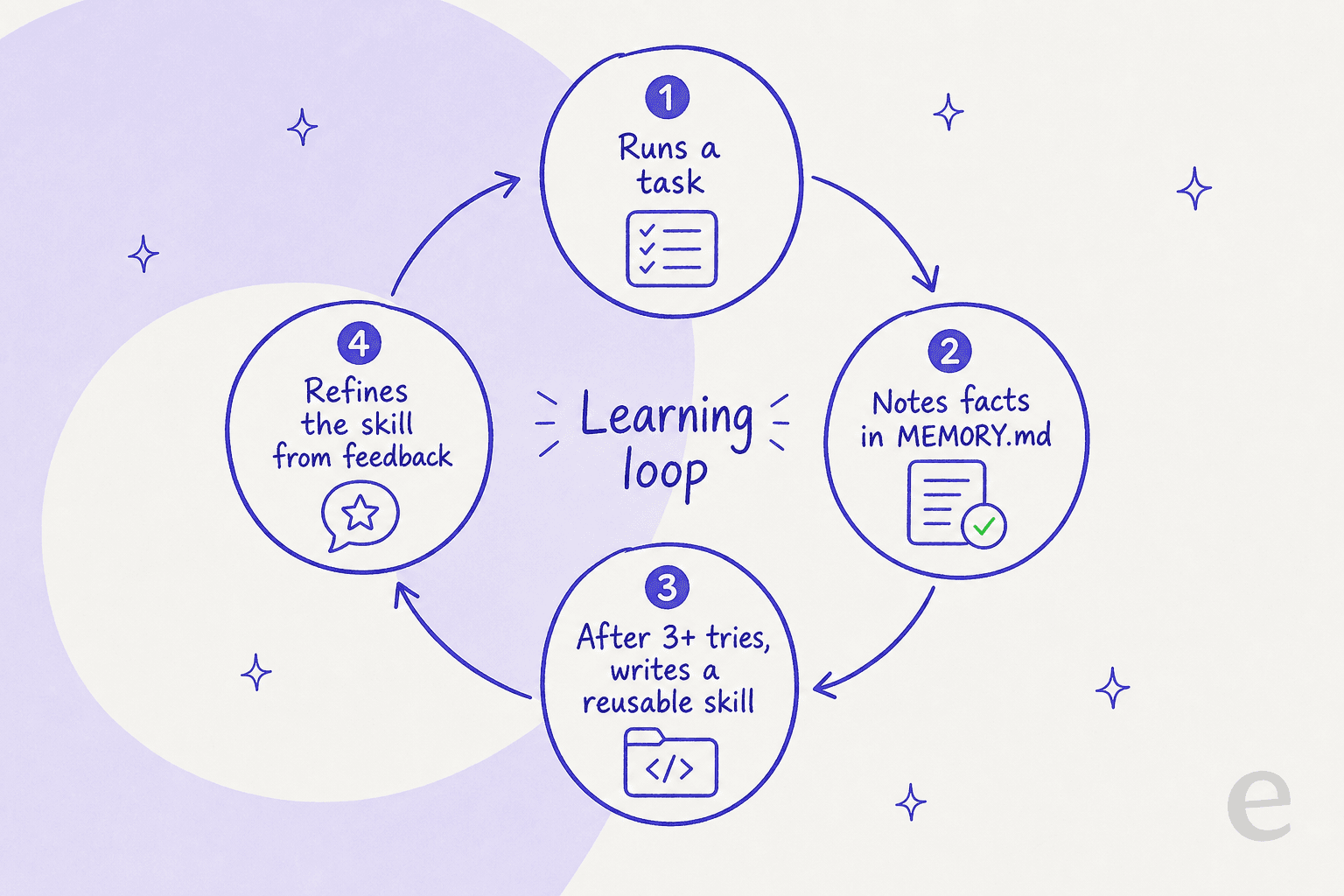
Memory is two plain files. MEMORY.md holds the agent's own notes (environment facts, conventions, lessons) and USER.md holds your profile (preferences, communication style). The agent writes to them itself, with no "read" action needed because both are injected into the system prompt at session start. There is a real design choice here worth flagging: memory is hard-bounded and does not auto-compact. MEMORY.md caps at 2,200 characters and USER.md at 1,375. When a write would blow the limit, the tool returns an error instead of silently dropping older notes, and the agent has to consolidate in the same turn. That is a more honest design than a memory that quietly forgets, but it also means the "multi-level memory system" is smaller than it sounds. One Hacker News commenter put it bluntly: the memory feature is essentially MEMORY.md files. That is roughly accurate.
Skills are where it gets more interesting. Hermes follows the agentskills.io open standard, so skills are portable documents the agent loads on demand using progressive disclosure (a cheap list first, full content only when needed). The /learn command turns a doc directory, a URL, or a workflow you just walked through into a reusable SKILL.md. The learning loop is the honest version of "self-improving": after you do a multi-step task a few times, it drafts a skill, then refines it from your feedback. It is not magic, but it is a real feedback mechanism rather than a marketing word.
Tools and delegation round it out. Hermes ships 70+ tools across 28 toolsets, full MCP support, and a delegate_task tool that spawns child agents with isolated context (three concurrent by default). The one gotcha the docs are refreshingly clear about: subagents know nothing, so the parent has to pass the full goal and context in every call.
What Hermes gets right
Set expectations aside for a second, because there is a lot to like here.
The multi-platform gateway is the standout. One background process connects Hermes to 20+ platforms (Telegram, Discord, Slack, WhatsApp, Signal, Matrix, Email, SMS and more), and the same memory and skills follow you across all of them. You can kick off a task from your terminal and check on it from Telegram.
The cron scheduling is thoughtfully built. A single cronjob tool handles one-shot and recurring jobs, and it has two safety mechanics I wish more agents copied: an unpinned job fails closed if the default model changes (so an unattended job cannot silently switch to a pricier model and run up a bill), and cron sessions cannot create more cron jobs (no runaway scheduling loops).
And it runs where you want it to. The terminal tool has six backends (local, Docker, SSH, Singularity, Modal, Daytona), so you can keep the agent isolated from its own code or push it onto a serverless box that hibernates when idle. For the homelab crowd, that flexibility is the whole point. The community sentiment backs this up:
"I use Hermes at home. Swapped out Openclaw for this... it's a sysadmin for my homelab... It's magical."

"it's been really good... having a competent agent with constant state has been good for memorializing and organizing important info. It's definitely both faster and a better documenter than I am... I've been pretty pleased. Surprised even, if I'm being honest."
That is the profile of a happy Hermes user: a technical person automating their own world. If that is you, it sits alongside the other AI agent examples worth a weekend. Which is exactly why the support question below has the answer it does.
Where Hermes falls short
A fair review names the rough edges, and Hermes has a few.
The experience can feel janky. More than one tester flagged a slow, busy startup and a CLI that gets in the way:
"Hermes: Sluggish, very slow to start, a lot is going on in the background, didn't like it."
"I was deeply unimpressed with their janky, flickery CLI that force-enables a bulky obnoxious header on every launch."
The same reviewer found the models hard to keep concise, noting it was tough to stop them being "so damnably verbose."
There is a reputational cloud too. Multiple Hacker News threads reference plagiarism allegations against Hermes Agent, and a separate thread titled "Nous Research edits GitHub issue to remove plagiarism claims". I am not in a position to adjudicate any of that, and it is context rather than a usage verdict, but if provenance matters to your org it is worth reading the threads yourself before you deploy.
And like any autonomous agent, it needs a leash. The community's own advice, from a thread about a privilege-escalation issue, is the sensible default:
"The same applies to all agents, don't give it free reign over all your stuff. Run it within a sandbox."
That is good hygiene for a personal agent. It becomes a much bigger deal the moment you point an autonomous agent at real customer conversations, which is the theme of the support section.
Hermes pricing: is it really free?
Yes and no, and the honest answer is the interesting one.
The self-hosted software really is free. MIT license, no subscription, no usage cap imposed by Hermes. What is not free is everything around it. In the pricing page's own words, "the software is free. Your time is not." You pay for your own provider API keys, a server, uptime, updates, gateway restarts and debugging.
To its credit, Nous is transparent about this. The pricing page does not hide behind "free" - it shows a calculator estimating what self-hosting actually costs.
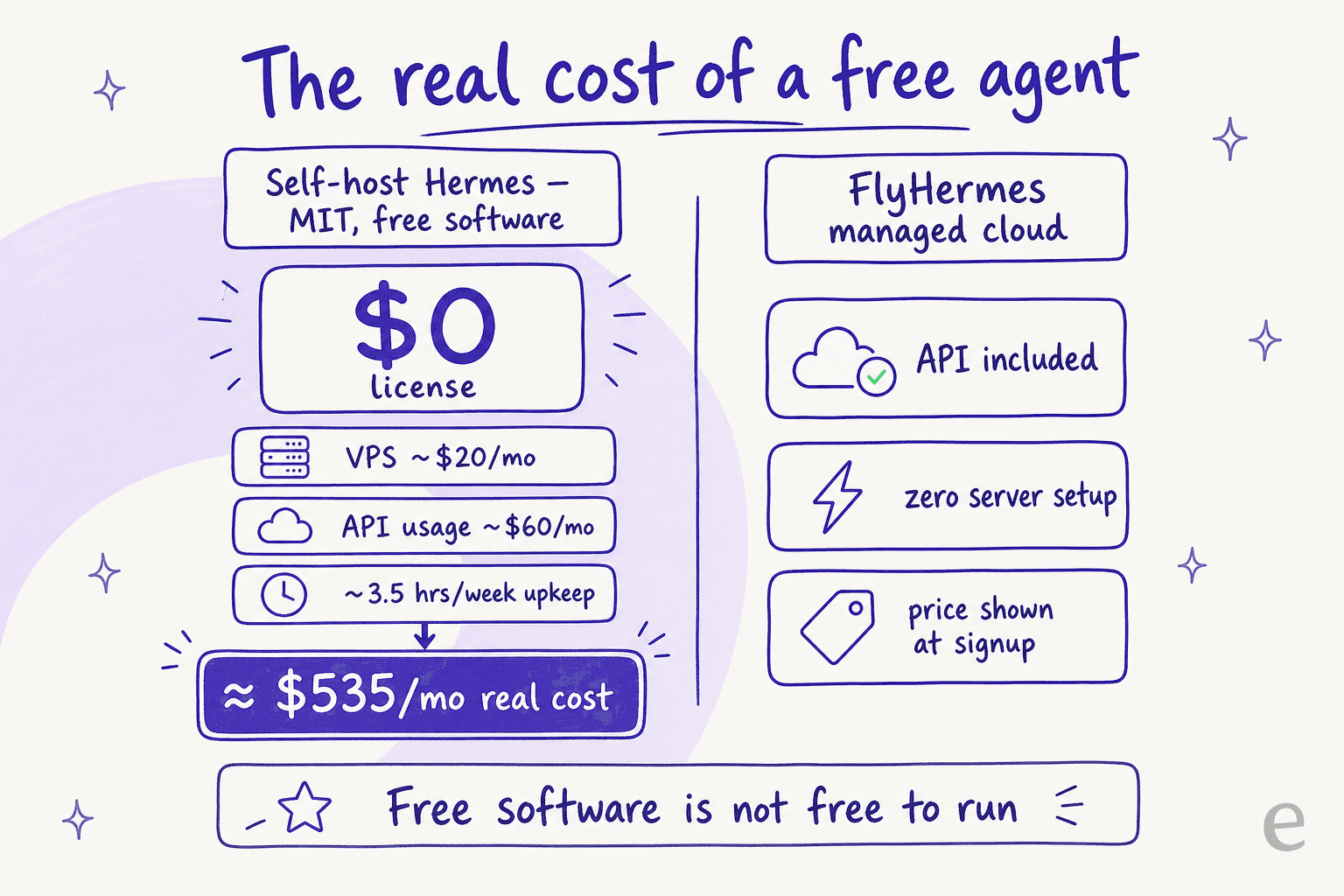
| Cost path | What you pay | Price (as the page states) |
|---|---|---|
| Self-host software | MIT license | $0 |
| Self-host, VPS scenario | VPS + API + upkeep | ~$535/mo (est.) |
| Self-host, own hardware | Hardware + power + API + upkeep | ~$563/mo (est.) |
| FlyHermes managed cloud | API included, zero setup | Shown only at signup |
Those self-hosting figures are the page's own assumptions ($20/mo VPS, $60/mo API usage, ~3.5 hours a week of maintenance costed at an hourly rate), not a bill from Hermes. But that is the point: the big line item is your time, not the license. The one frustration is that FlyHermes does not publish a number at all. There are no named tiers and no free tier stated. The page says the current offer is "shown during signup" to avoid leaking price tests, which is a fair reason but still means you cannot compare it on a table without handing over an email.
If you are weighing this against paid alternatives, the page's own comparison lists ChatGPT Pro and Claude Pro at $20/mo and Devin at $500/mo. For a personal agent, self-hosting can absolutely come out ahead, especially if you enjoy the upkeep. For a business function, the build vs buy math usually tips the other way once you price in your team's hours, which is the same reason the AI agent vs human agent cost comparison rarely favors a DIY stack.
Hermes for customer support: the honest answer
This is where I have to be straight with you, because the slug that brought some of you here is a support one.
Hermes is not a customer support product. It is a general-purpose personal and developer agent. Its homepage does mention a support use case for solopreneurs ("handle first-line customer support 24/7, train Hermes on your docs, pricing and policies"), and technically it can read your docs and answer a question. But across every real community usage story I could find, not one person was running Hermes on a support queue, deflecting tickets, or handling end-customer conversations. Every real account is personal automation: homelab sysadmin, note-taking, research, server monitoring.
That matters, because a support queue is a different animal from a homelab. Here is the gap, concretely.
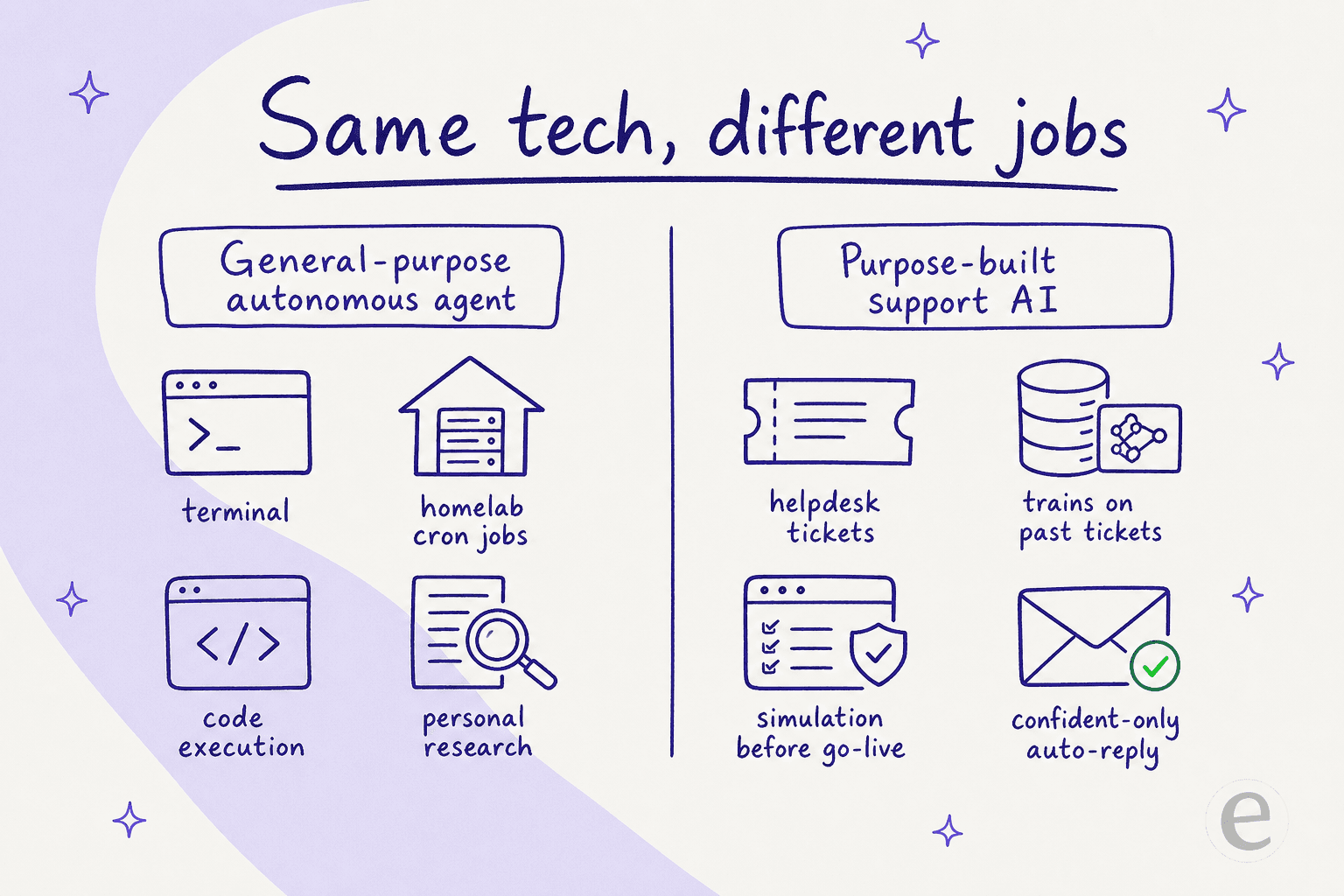
A purpose-built support AI has to do things Hermes simply does not:
- Live inside the helpdesk. Replies belong on the ticket in your AI helpdesk (Zendesk, Freshdesk or Gorgias), with the customer, tags and history attached, not in a Telegram chat with you.
- Train on your past tickets. The single most-requested capability from real support teams is training the AI on tickets you have already resolved, so it sounds like your team from day one.
- Route by confidence. You cannot let an autonomous agent auto-reply to everything. It has to handle only what it is confident about, classify each ticket, and cleanly escalate the rest.
- Be tested before it goes live. You need to simulate the AI against historical tickets and see the deflection rate before a single customer sees an answer.
That last point is the one I feel most strongly about, because I have watched confident-sounding agents give wrong answers. A homelab agent that gets it wrong annoys you. A support agent that gets it wrong annoys your customer, on your brand. One anonymized supplements CX lead put the guardrail I hear most often like this:
"The AI will never be able to answer 100% of the questions... I need an AI who is only handling the tickets that it's confident to handle and all the other ones, leave them alone."
Hermes gives you the raw autonomy. It does not give you the guardrails, the helpdesk integration, or the pre-launch simulation that make autonomy safe on a customer-facing queue. So which do you actually need?
I want to automate my own tasks and I run my own servers
Go with Hermes (self-hosted). The learning loop, cron scheduling and multi-platform gateway are built for exactly this, and you will enjoy owning the stack.
I want an agent working, but I do not want to maintain a server
Look at a managed cloud (FlyHermes, or a hosted assistant). You trade some control for zero upkeep and no 3am alerts.
I need to deflect and answer real customer tickets safely
You want a purpose-built support AI like eesel. It lives in your helpdesk, trains on past tickets, routes by confidence, and lets you simulate on historical tickets before go-live.
Try eesel for support instead of a self-hosted agent
If your goal is a personal or homelab agent, Hermes is a great pick and I would happily run it myself. If your goal is to put AI on a real support queue, especially as a small team, that is what I build eesel for, and it is a very different tool.
eesel is a managed AI for customer service that plugs straight into Zendesk, Freshdesk, Gorgias, Help Scout and more, trains on your past tickets and help center, and lets you simulate it on your real ticket history before it ever replies to a customer. It is the kind of AI customer service software that handles customer service automation without a VPS, a cron file, or 3am pages. It goes live in minutes, not a weekend of setup.

The build-vs-buy call is the same one plenty of technical teams land on. One eesel customer, Karel at GENERAL BYTES, framed it the way I hear most often:
"We could try to write our own LLM application but we didn't want to invest our time into that. We wanted something that we would not have to maintain."
And when the fit is right, the numbers show up fast. Gridwise saw eesel resolve 73% of tier-1 requests in the first month, the kind of outcome a dedicated support agent is built for and hard to reach when your agent is also your weekend infrastructure project. You can try eesel free and point it at your own tickets to see the number for yourself.