The 8 best Hermes agent alternatives in 2026

Rama Adi

Katelin Teen
Last edited July 21, 2026
Why people look for a Hermes alternative
Hermes is popular for good reasons. It is MIT licensed, it runs on a $5 VPS, it has a real learning loop, and it plugs into Telegram, Slack, and Discord from one gateway. Nous claims 10k+ GitHub stars and reporting has the company in talks at a $1.5B valuation. It earned the hype.
So why go looking for an alternative at all? From the research and the community threads, it comes down to a few recurring reasons.
The first is the one nobody puts on the landing page: self-hosting a "free" agent is not free. Hermes's own pricing page is refreshingly honest about this. It shows a calculator that puts the real cost of running the self-hosted version at roughly $535 a month once you add a VPS, API usage, and about 3.5 hours a week of upkeep. The license is $0. Your time is the line item.
The second is fit. Hermes is a general-purpose personal and developer agent. Its homepage mentions a support use case, but across every real usage story I could find, people run it as a homelab sysadmin, a note-taker, or a research assistant, not on a support queue. One Hacker News user summed up the archetypal Hermes setup:
"I use Hermes at home. Swapped out Openclaw for this... it's a sysadmin for my homelab... It's magical."

The third is the day-to-day experience. Testers have flagged a slow, busy startup and a janky CLI, plus a memory system that is simpler than the marketing implies. None of that is a dealbreaker for a hobbyist, but it adds friction if you are trying to run something business-critical.
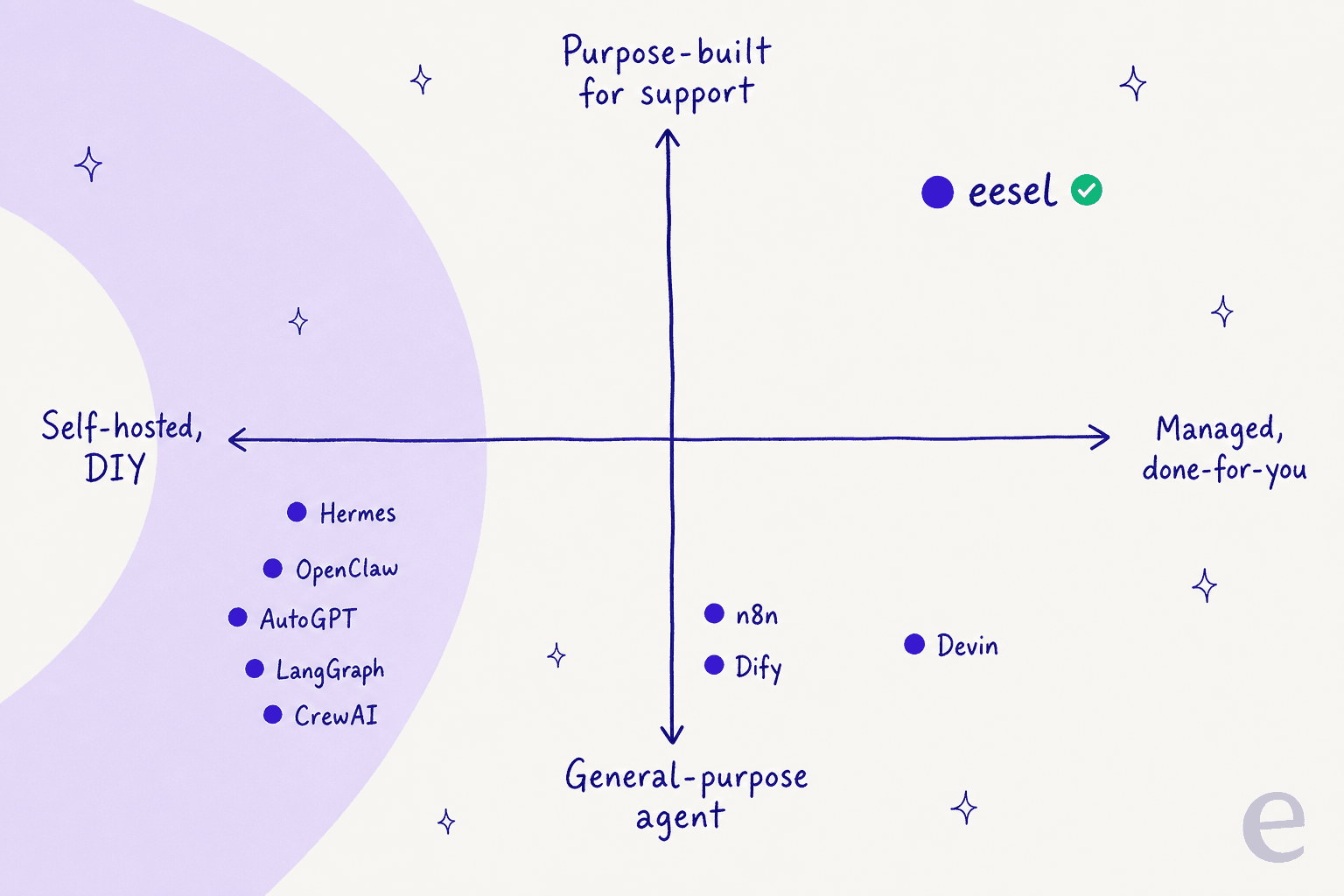
Once you separate those reasons, the shortlist basically sorts itself into the map above: DIY self-hosted agents on the left, general-purpose ones along the bottom, and the one purpose-built-for-support option up in the top-right corner.
The 8 best Hermes agent alternatives at a glance
Here is the whole field in one table before we go tool by tool. I have put the billing unit and the license front and centre, because those two columns are where most of the real decision lives.
| Tool | Best for | License | Self-host | Starting price | Purpose-built for support? |
|---|---|---|---|---|---|
| eesel | AI on a real support queue | Proprietary (managed) | No | From $299/mo for 500 credits | ✅ Yes |
| OpenClaw | Closest self-hosted swap | MIT | Yes | Free (BYO model) | ❌ No |
| AutoGPT | No-code agent builder | Split: Polyform Shield + MIT | Yes | Free self-host / $42.50/mo cloud | ❌ No |
| n8n | Self-hosted workflow automation | Fair-code / source-available | Yes | Free self-host / $20/mo cloud | ❌ No |
| Dify | Building your own LLM app | Dify OSS license | Yes | Free self-host / $59/mo cloud | ❌ No |
| CrewAI | Multi-agent orchestration in code | MIT | Yes | Free framework / Enterprise custom | ❌ No |
| LangGraph | Max control, built from scratch | MIT | Yes | Free framework / $39/seat/mo | ❌ No |
| Devin | Autonomous software engineering | Proprietary | No | $20/mo | ❌ No |
Two things jump out. Almost everything here is a general-purpose or developer tool, and almost everything is priced in a way that hides the real cost (free-but-you-run-it, or per-seat, or usage that scales with model calls). The one row that is built for support and priced as one fixed monthly plan is eesel, which is exactly why I am starting there.
1. eesel: best for putting AI on a real support queue
Best for: support and ops teams that want an autonomous agent answering tickets without building or hosting one.

If your reason for leaving Hermes is "I want an agent, but I want it on my support queue," this is the honest answer, and it is a different category of tool than everything else on the list. Where Hermes gives you a general agent you have to point at a problem, eesel is an AI helpdesk agent that already knows the problem is support.
It plugs straight into Zendesk, Freshdesk, Gorgias, Help Scout, and more, then trains on your past tickets and help center so it sounds like your team from day one. The part I care about most, having watched confident agents give confidently wrong answers, is the simulation mode: you run the AI against your real ticket history and see the deflection rate by theme before a single customer sees a reply.
Strengths: Lives inside the helpdesk, so replies land on the ticket with tags and history, not in a chat with you. Trains on solved tickets, not just help articles. Confidence-based routing so it only auto-replies when it is sure and cleanly escalates the rest. 100+ integrations and 80+ languages out of the box.
Watch-outs: It is not open source and you cannot self-host it, so if owning the stack is your hard requirement, this is not your tool (OpenClaw or Hermes itself is). It is focused on support, IT, and ops, so it is not a general "do anything" agent for personal automation.
Pricing: One fixed monthly plan, from $299/month for 500 credits (1 credit per ticket or chat), with no per-seat fees and no platform fee, plus a free plan with 100 credits and no card. SSO and MFA are add-ons from $199/month. Compared with a $535/month self-hosting bill for a homelab-grade agent, the cost math tends to favour the managed route once you price in your own hours.
The build-vs-buy call is one a lot of technical teams land on. As one eesel customer, Karel at GENERAL BYTES, put it:
"We could try to write our own LLM application but we didn't want to invest our time into that. We wanted something that we would not have to maintain."
Verdict: If you want an agent for a support queue, pick eesel and be done. If you want an agent for your homelab or your codebase, keep reading, because the next seven are built for that instead.
2. OpenClaw: best for the closest self-hosted swap
Best for: developers and homelabbers who want a self-hosted, MIT-licensed personal assistant that lives in their chat apps, exactly like Hermes.

If Hermes and OpenClaw feel like siblings, that is because they occupy nearly identical ground. OpenClaw is an open-source, self-hosted personal AI assistant created by Peter Steinberger that launched in November 2025. You run a single "Gateway" process on your own hardware, and it bridges your messaging apps to an AI assistant, with the same "runs on your hardware, your rules" philosophy Hermes users like. It is the tool the Hacker News crowd literally swaps in and out with Hermes.
Strengths: Enormous channel support (WhatsApp, Telegram, Slack, Discord, Signal, iMessage, Teams, Matrix, and many more) from one gateway. A ClawHub skills marketplace for community plugins. Bring-your-own-model, including signing in with an existing ChatGPT subscription. MIT licensed and genuinely community-driven.
Watch-outs: It is explicitly a single-user, personal assistant, not a team or customer-facing product. Like Hermes, it is bring-your-own-model and self-hosted, so you carry the API bills and the upkeep. And like any autonomous agent with system access, the community's own advice is to sandbox it rather than hand it the keys.
Pricing: Free and open source, no paid tier from the project. Your real cost is model API usage plus the machine you run it on.
Verdict: If you liked Hermes but want to try the other leading self-hosted personal agent, OpenClaw is the most direct swap on this list. It is not a support tool and does not pretend to be, so treat it the same way you would treat Hermes: great for your own automation, wrong for your ticket queue.
3. AutoGPT: best for a no-code autonomous agent builder
Best for: people who want to build autonomous agents from plain-English briefs or visual blocks, without writing framework code.
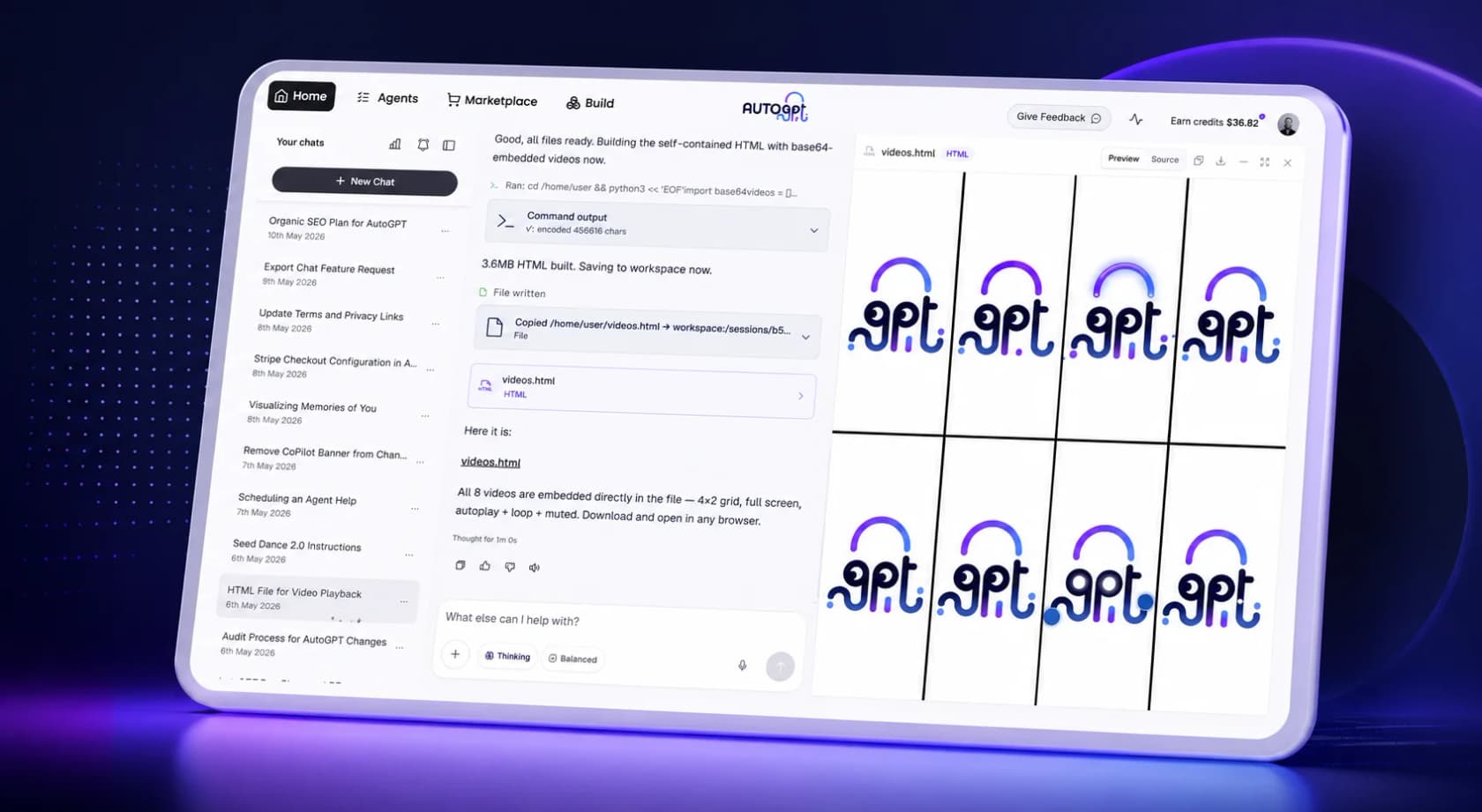
AutoGPT was one of the original viral autonomous agents back in 2023, and it has since been rebuilt into a full platform. Today it has two faces: AutoPilot, a chat interface that turns a brief into a working agent, and a visual block-based builder for wiring agents by hand. With 186k GitHub stars, it is one of the most-starred AI projects anywhere.
Strengths: The most beginner-friendly way to build an autonomous agent on this list, thanks to AutoPilot and the drag-and-drop canvas. A marketplace of ready-made community agents. 45+ integrations and hundreds of models. A hosted cloud option now that it is out of closed beta.
Watch-outs: The license is split, and this matters: the modern Platform code is Polyform Shield (free for personal and internal business use, but you cannot resell it as a competing hosted service), while classic AutoGPT is MIT. It is a general automation builder, so customer support is listed as one example use case, not a product with ticketing or deflection built in.
Pricing: Self-hosting is free. The hosted Platform is usage-metered: Pro at $42.50/month and Max at $272/month billed annually, with a Team tier "coming soon."
Verdict: If you want to experiment with autonomous agents and would rather describe them than code them, AutoGPT is the friendliest entry point. For a support desk you would still be building the whole support layer yourself.
4. n8n: best for self-hosted workflow automation with AI
Best for: technical teams that want AI steps inside broader automations, with the option to drop into real code anywhere.
n8n is a self-hostable workflow automation platform for technical teams, and its pitch is "code when you need it, UI when you don't." You get a visual node canvas plus the ability to write JavaScript or Python inline in any step. It sits around 196.6k GitHub stars, holds 4.7/5 on G2, and is used by Microsoft, NVIDIA, and Mercedes-Benz, among others.
Where Hermes is one agent that lives in your chat apps, n8n is the plumbing that connects hundreds of systems, with AI agent nodes as one type of building block. That makes it a strong Hermes alternative when your real goal is "automate a multi-step process that happens to use an LLM," not "run a single conversational agent." A team like Vodafone reports saving £2.2 million with it on security workflows.
Strengths: 500+ integrations, both visual and full-code control, self-hostable via Docker, and serious enterprise controls (SSO, RBAC, audit logs). Billing is per full execution, not per step or per user, so seats are unlimited.
Watch-outs: It is an automation platform, not a conversational agent, so a chat-first Hermes user will feel the shift. Building a support agent on it means assembling the knowledge, routing, and helpdesk connection yourself.
Pricing: Community Edition is free and self-hosted. Cloud runs Starter $20/month, Pro $50/month, and Business $800/month, with Enterprise custom.
Verdict: If your Hermes use case was really "automate my workflows," n8n is a more capable and more maintainable home for that than a general agent. For a customer-facing support bot, it is a construction kit, not a finished product.
5. Dify: best for building your own LLM app or support bot
Best for: teams that want a visual platform to build, host, and run their own LLM apps and agents, including a bespoke support chatbot.
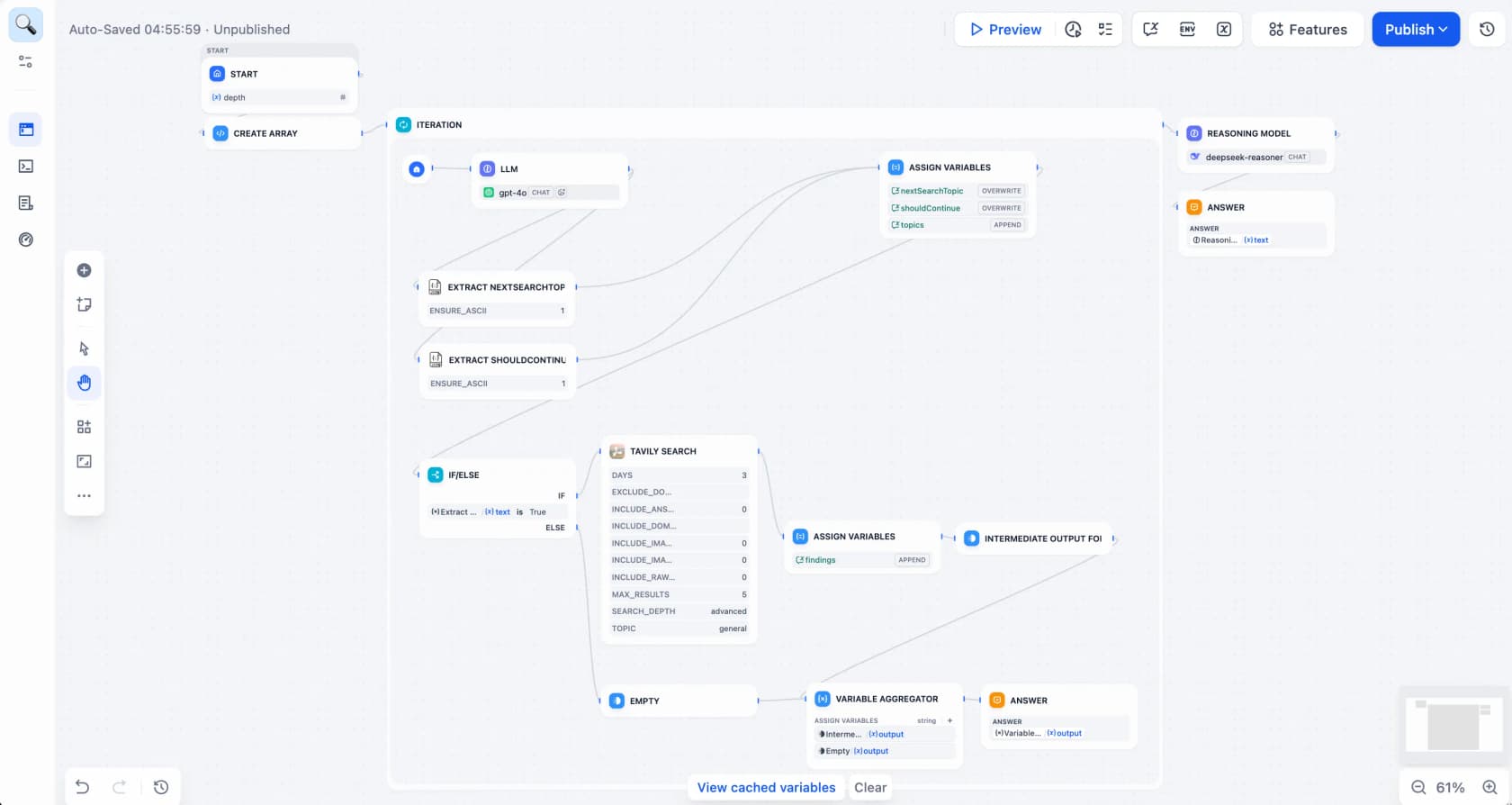
Dify is an open-source LLM app development platform with a visual workflow studio, a built-in RAG knowledge pipeline, agent nodes, and support for hundreds of models. At roughly 149,500 GitHub stars, it is one of the most popular ways to build an LLM app without starting from a blank Python file. Its own docs name "customer support chatbots" as a top use case for the RAG pipeline.
Strengths: A genuinely nice visual builder, strong out-of-the-box RAG (PDF and doc ingestion, hybrid search, reranking), model-agnostic, and self-hostable via Docker. If you want to construct and own a bespoke support bot, this is one of the better foundations.
Watch-outs: The license is not plain open source. The Dify Open Source License is Apache 2.0 plus a multi-tenant restriction and a "don't remove our logo" clause, which matters if you plan to resell it. More importantly for support, there is no native helpdesk integration, no ticketing, no confidence-based escalation, and no historical-ticket simulation. You build all of that.
Pricing: Community Edition is free to self-host. Dify Cloud runs a free Sandbox (200 credits), Professional at $59/month (5,000 message credits), and Team at $159/month.
Verdict: Dify is the pick if you want a GUI to build your own agent and you are happy owning the support-specific layer yourself. If you would rather that layer already exist, that is the gap a dedicated support AI fills.
6. CrewAI: best for multi-agent orchestration in code
Best for: engineers building production multi-agent systems where several role-playing agents collaborate on a task.
CrewAI is an open-source Python framework for building "crews" of role-based agents that delegate tasks to each other, plus "flows" for event-driven control. It is code-first, so you interact with it like this rather than through a dashboard:
from crewai import Agent, Crew, Task

researcher = Agent(role="Researcher", goal="Find the answer", backstory="...")
task = Task(description="Answer the customer's question", agent=researcher)
crew = Crew(agents=[researcher], tasks=[task])
crew.kickoff()
With ~55.8k GitHub stars and 100,000+ developers through its courses, it is one of the best-known agent frameworks going.
Strengths: Clean primitives for multi-agent collaboration, a lightweight core, and a commercial AMP control plane that adds observability, governance, and human-in-the-loop gates when you productionise. Genuinely powerful if multiple cooperating agents is the actual shape of your problem.
Watch-outs: It is a developer framework, not a product. There is no inbox, no helpdesk connection, no ticket UI, you assemble everything in Python. And the pricing ladder is unusual: the framework is free, but the managed platform jumps straight from a capped free tier to a sales-gated Enterprise plan.
Pricing: The framework is free and MIT-licensed. The platform offers a free Basic tier capped at 50 workflow executions per month, then Enterprise at a custom, quote-only price.
Verdict: Reach for CrewAI when your problem genuinely needs several agents working together and you have the engineering time to build it. For a support queue, you would be reinventing a lot of what a purpose-built tool already ships.
7. LangGraph: best for maximum control, built from scratch
Best for: developers who want low-level, graph-based control over a stateful agent and are comfortable writing the whole thing.
LangGraph, from the LangChain team, is a low-level orchestration framework that models an agent as a graph of nodes, edges, and shared state. Its tagline is "balance agent control with agency," and that is the trade: you give up turnkey convenience for fine-grained control. It carries ~37.7k GitHub stars and names Klarna, Replit, and Uber among its users.
Strengths: Durable execution that resumes after failures, first-class human-in-the-loop checkpoints, and proper short- and long-term memory via checkpointers and stores. If you need exact control over how an agent behaves, few frameworks give you more.
Watch-outs: This is the most build-it-yourself option on the list. There is no out-of-the-box agent, no UI, no support features, you write Python or JavaScript to define graphs and state. It sits at the opposite end of the spectrum from a plug-in support AI, which is great for a platform team and rough for anyone who just wants an agent running this week.
Pricing: The framework is free and MIT-licensed. The hosted platform (LangSmith) has a free Developer tier (1 seat), then Plus at $39/seat/month plus usage, and custom Enterprise.
Verdict: LangGraph is the right call when control is the whole point and you have engineers who want to own the agent's internals. It is the furthest thing from a ready-made support agent, which is exactly its appeal for the right team.
8. Devin: best for autonomous software engineering
Best for: engineering teams that want an autonomous agent for writing, testing, and shipping code, which is the developer half of Hermes taken to its logical extreme.

Hermes lists developer use cases like debugging and PR review. If that is the part you cared about, Devin from Cognition is the specialist managed version. It is billed as "the first autonomous software engineer" and it plans, writes, tests, and ships code inside your codebase. Cognition raised over $1B at a $26B valuation, so it is the best-funded name here by a wide margin.
Strengths: Deep, autonomous coding across cloud, desktop, and CLI, with real enterprise proof (Cognition says Mercedes-Benz cut an 8-month modernization to 8 days). Its recent Devin Fusion harness claims frontier-level coding at 35% lower cost. Fully managed, so no self-hosting.
Watch-outs: It is a coding agent, full stop. There is nothing support-oriented about it, and it is proprietary and cloud-only, so it is the opposite of Hermes's self-hosted ethos. Hermes's own pricing page even lists Devin at $500/month as a pricier managed comparison, though the self-serve tiers are now cheaper.
Pricing: Free tier, Pro at $20/month, Max at $200/month, and Teams at $80/month base plus $40 per seat. Enterprise is billed in Agent Compute Units at a quote-only price.
Verdict: If the "agent" you actually want is one that writes code for you, Devin is the managed heavyweight. If you want one that answers customers, it is the wrong list entirely, which brings us neatly back to the point.
The bucket most of these tools quietly miss
Notice what almost every option above has in common: they are general-purpose. That is a feature if you want to point an agent at anything. It is a bug the moment the "anything" is a live customer queue, because a support queue needs things a general agent simply does not have.
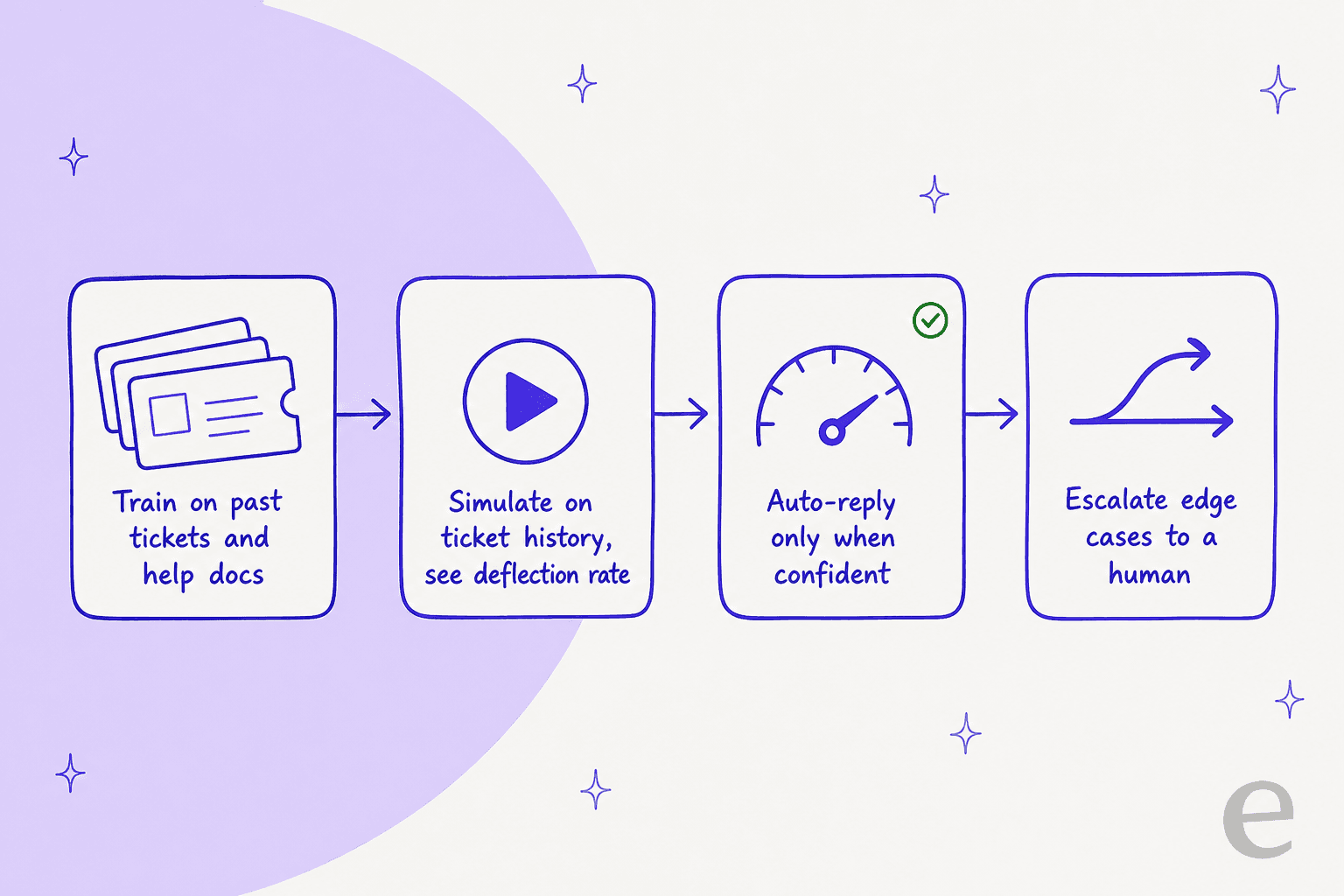
A purpose-built support AI has to:
- Live inside the helpdesk. Replies belong on the ticket in Zendesk, Freshdesk, or Gorgias, with the customer, tags, and history attached, not in a Telegram thread with you.
- Train on your past tickets, so it answers in your team's voice from day one, not just from a help-center article.
- Route by confidence. You cannot let an autonomous agent auto-reply to everything. It has to classify each ticket, answer only what it is sure about, and escalate the rest.
- Be tested before it goes live, by simulating against historical tickets so you see the deflection rate before a customer ever does.
That last one is the difference between a homelab experiment and a customer-facing system. A homelab agent that gets it wrong annoys you. A support agent that gets it wrong annoys your customer, on your brand. One anonymized CX lead I spoke with framed the guardrail everyone eventually wants:
"The AI will never be able to answer 100% of the questions... I need an AI who is only handling the tickets that it's confident to handle and all the other ones, leave them alone."
General agents like Hermes give you the autonomy. They do not give you the confidence gate, the helpdesk integration, or the pre-launch simulation that make autonomy safe on a queue. So the real question is not "which Hermes alternative," it is "which job am I hiring for."
Which Hermes alternative should you actually pick?
If you skimmed this far, here is the decision in one place. Answer the one question that matches you.
I want the closest self-hosted, open-source swap for my own automation
Go with OpenClaw (personal assistant in your chat apps) or AutoGPT (if you want a visual builder). Both are MIT-ish, self-hosted, and general-purpose, just like Hermes.
I'm a developer building an agent or workflow in code
Use CrewAI or LangGraph for code-first agents, or n8n / Dify if you want a visual builder with code escape hatches.
I want an autonomous agent for writing code
Look at Devin for a fully managed autonomous software engineer, or self-host Hermes for the DIY version.
I need to deflect and answer real customer tickets safely
You want a purpose-built support AI like eesel. It lives in your helpdesk, trains on past tickets, routes by confidence, and simulates on your history before go-live.
For most of the buckets, the right pick is a general agent and you should enjoy owning it. For the support bucket, the right pick is a tool built for the job, and that is the one thing none of the other seven are.
Try eesel if the job is support
If your goal is a personal or homelab agent, honestly, run Hermes or OpenClaw and have fun with it. If your goal is to put AI on a real support queue, especially as a small team, that is what I build eesel for, and it is a genuinely different tool.
eesel is a managed AI for customer service that plugs into your helpdesk, trains on your past tickets and help center, and lets you simulate on your real ticket history before it ever replies to a customer. It handles customer service automation without a VPS, a cron file, or a 3am page, and it goes live in minutes instead of a weekend of setup. When the fit is right, the numbers show up fast: Gridwise saw eesel resolve 73% of tier-1 requests in the first month.
You can try eesel free, point it at your own tickets, and watch it run against your history before it answers anyone. That is the one thing a self-hosted general agent was never built to do.