


The actual TypeSafe Jev pricing
Here is every published number in one place. TypeSafe does not have a dedicated pricing page, and every URL variant I tried (typesafe.ai/pricing, docs.typesafe.ai/pricing, typesafe.ai/docs/pricing) returns a 404. The figures below come straight from the homepage and the launch post.
| Line item | Jev | Notes |
|---|---|---|
| Input tokens | $0.042 / MTok | $42 per billion input tokens |
| Output tokens | Free | TypeSafe calls it "too cheap to meter" |
| Comparison claim | 238x lower input | Versus Claude Fable 5.1 input pricing |
| Plan tiers | None published | No named plans or tiered table |
| Free tier | Not stated | Access via early-access waitlist |
| Rate limits | Not published | A launch demo ran ~10 queries/sec at ~$7/hour |
| Context window | 32,000 tokens | Model version jev-1.13.0 |
| Cloudflare | Billed in dashboard | Model id typesafe/jev |
The illustrative side-by-side on the homepage puts a single Jev call at $0.000081, versus $0.013880 for an LLM doing the same shaped work. That is the number TypeSafe wants you to screenshot, and for a pure decision call it is a fair one.
Why the output-free part matters
In most LLM pricing models, output is the expensive half, often around 5x the input rate. That is because a chatbot's value is the paragraph it writes, and paragraphs are a lot of tokens. Jev flips this. A System One model does not generate prose, it returns a typed decision plus a confidence score, so the output payload is a handful of bytes. Pricing it at zero costs TypeSafe almost nothing and removes the scariest line from your bill.
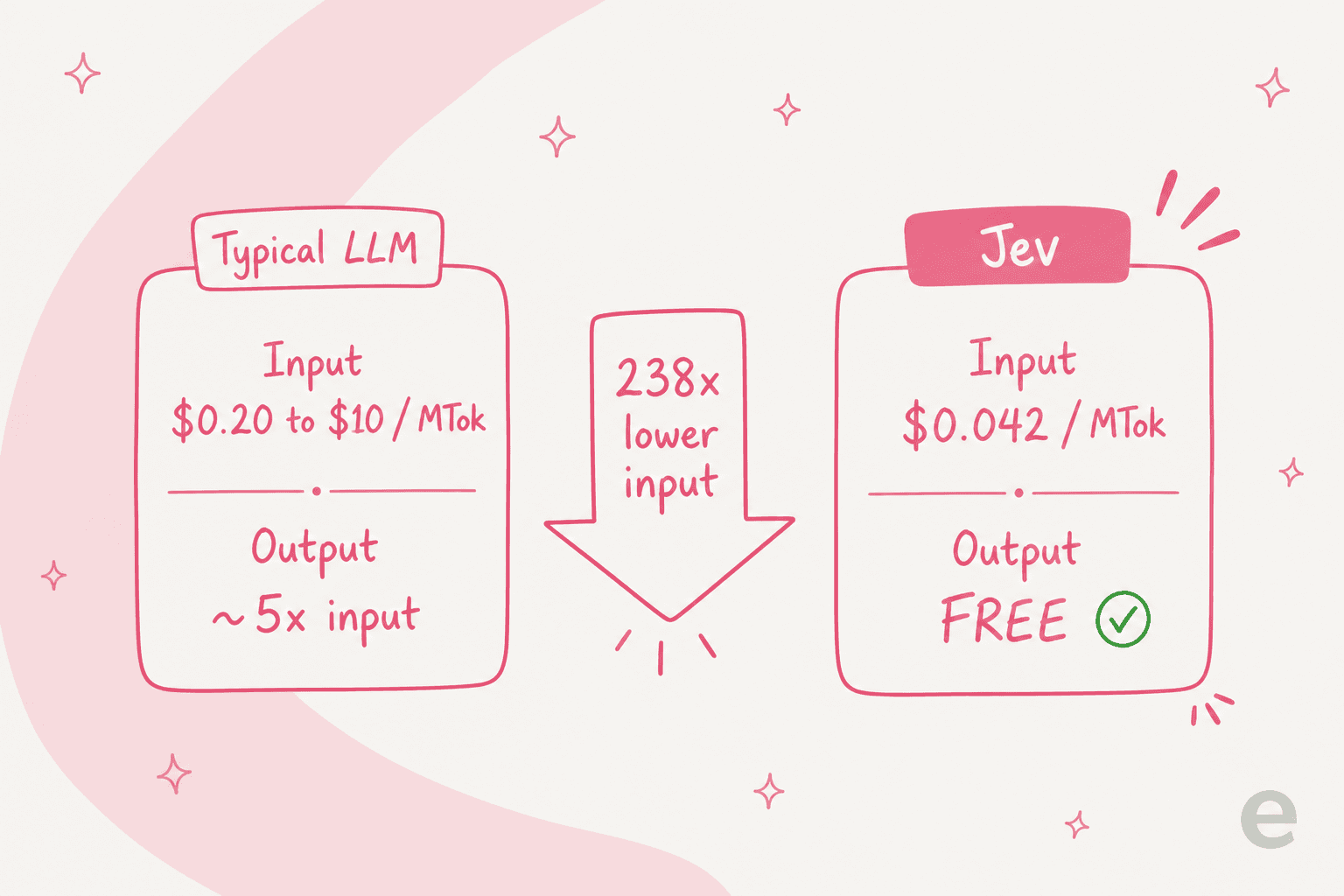
The practical read: if your workload really is a stream of small typed questions, "is_urgent", "which department", "how frustrated is this customer", then Jev's meter runs almost entirely on the input state you send, and that state is usually small. This is the same shape as the ticket triage work Cloudflare uses as its own Jev example, which is not a coincidence.
Model your own bill
Numbers on a homepage are one thing, your actual monthly volume is another. Plug in how many decisions you run per month and the average input size, and this compares Jev against a typical LLM at TypeSafe's own quoted range. The LLM rates are editable, because "typical" depends on which model you use.
A word of caution on reading that multiplier: it is a token-cost comparison for the decision step alone. It is not a total-cost-of-ownership number, because a real support flow does more than decide.
What the price does not include
This is where a pricing post earns its keep. The $0.042 rate is real and it is low, but it buys you a narrow thing. Here is what sits outside the meter:
- Generation. Jev cannot write the reply. It returns a decision, not a sentence. If your support workflow needs a drafted answer, you are still paying an LLM for that half.
- Orchestration. You have to build the loop that sends state in, reads the decision out, and acts on it. The token cost is trivial, the engineering is not.
- Actions. Deciding "escalate this" is free-ish. Actually escalating, tagging, refunding or routing the ticket is your integration work.
- A predictable seat or resolution price. There is no plan, no SLA tier, no committed-use discount published. For a team that needs to forecast a budget against human cost, "one input rate and a waitlist" is thin.
None of that makes Jev bad value. It makes it a component. The right mental model is that Jev prices the decision primitive, and the rest of your customer service automation budget lives elsewhere.
Is it subsidized? TypeSafe says: maybe
Cheap AI pricing always raises the "are they burning VC money" question, and TypeSafe answers it head-on. From the launch post:
"We make our pricing transparent. We can't prove it isn't subsidized; we'll need the long-term to prove the sustainability of our pricing (which we expect to go down, not up)."
That is more honest than most launch copy. The counter-evidence is technical: on Hacker News, one commenter reverse-engineered the price into a size estimate.
"At 0.042-per-million price they have, Astra estimates the model to be 3bn parameters."

A ~3-billion-parameter model is cheap to serve, so a low sustainable price is plausible rather than fantasy. The top comment on the thread still pushed back on the framing though, arguing the speed and cost comparisons flatter Jev because it skips generation entirely:
"Seems like a more accurate title would be 'Jev: Trading general purpose generation for fast typed inference'... the speed comparison seems misleading?"
The pricing enthusiasm on X was real too, and from a named operator. Vercel's CEO reported it beating GPT Luna on a production reviewer:
"Jev is up to 18x faster (p95) and more accurate. It's coming to @vercel AI Gateway and likely new default."
Read those together and the pricing verdict is: the rate is real and low, the "238x" is a best-case single-call comparison, and the honest use is decisions, not everything.
Where this leaves a support team
If you run a helpdesk, the interesting question is not "how cheap are the tokens", it is "what does the finished automation cost and do". A tier-1 deflection flow that triages, drafts, and resolves needs generation and actions on top of the decision. Jev can be the fast, cheap triage brain inside that, but it is not the AI agent itself.
This is the split I keep coming back to: Jev is infrastructure, a decision primitive you build with. eesel is the employee. Our AI helpdesk teammate joins your existing queue, makes the triage-route-escalate call and writes the reply and takes the action, then simulates the whole thing against your historical tickets before it goes live. We price per resolution, not per token, so the number on the invoice maps to work actually done, not to how many yes/no calls happened under the hood. It is one of a small roster of ready-to-work AI teammates, not a raw model you assemble yourself.
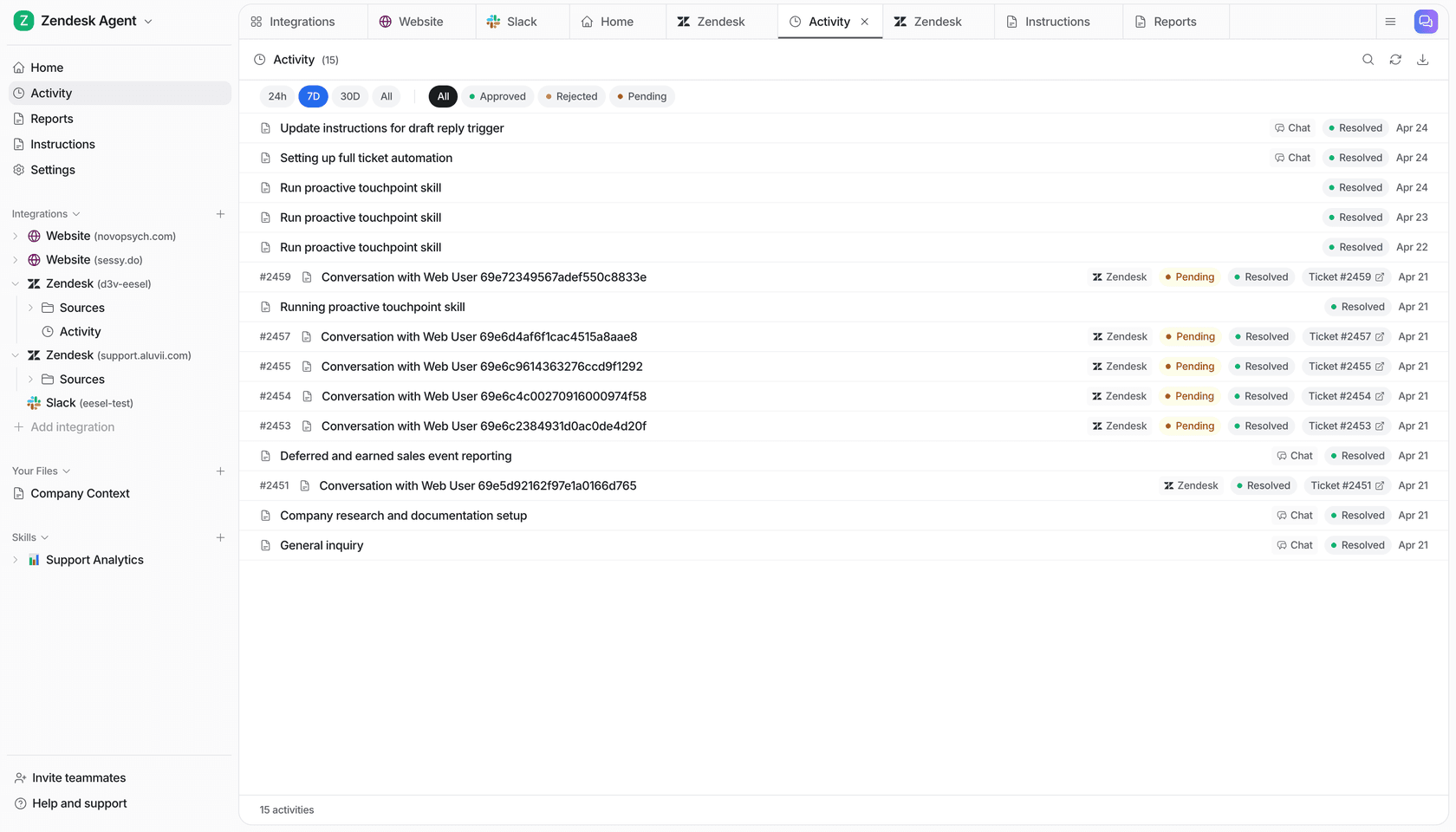
And if you live in a terminal, the same teammate is drivable from the eesel CLI. It is not a second product bolted on, it is the same eesel workspace and agent exposed for scripting: a person can run it by hand, a cron job can automate it, and a coding agent like Claude Code or Cursor can drive it through the CLI and eesel's MCP server. So if the reason you were pricing Jev was to wire a decision model into an agentic pipeline from the command line, you can point that same pipeline at a teammate that already knows your help center and can act on the ticket, not just score it.
Want to see the finished cost, not the token cost? eesel runs on your own tickets in a free trial, so you can watch what a resolution actually costs before you commit.
The bottom line on TypeSafe Jev pricing
Jev is $0.042 per million input tokens with output free, and for a pure decision workload that is a very low number. It is bounded by a real caveat: no plan tiers, no public free tier, a waitlist for access, and a price the company admits it cannot yet prove is sustainable. Model it as a cheap decision primitive, not as a drop-in replacement for the LLM writing your answers, and the TypeSafe Jev pricing story is easy to reason about. Whether you should build your whole support stack on it is a different question, and one worth answering with the full review open next to this.
Frequently Asked Questions
How much does TypeSafe Jev cost?
TypeSafe prices Jev at $0.042 per million input tokens with output free, which the company frames as 238x lower input price than Claude Fable 5.1. There is no published plan-tier table yet, so that single input rate is effectively the whole of TypeSafe Jev pricing today.
Is there a TypeSafe Jev free tier?
Not a self-serve free tier. Access is through an early-access waitlist rather than a public sign-up with free credits. Output tokens are free once you are in, but the input rate still applies, and TypeSafe has not published a monthly free allowance. If you want to test AI on your own ticket classification today, eesel has a real free trial.
Why is Jev output free?
A System One model does not generate long text. Its output is a typed decision, a probability and a confidence score, so the output payload is tiny compared to a chatbot's answer. TypeSafe calls the output rate "too cheap to meter" and prices only the input state you send in. It is a real gap in most LLM pricing models, where output is usually the expensive half.
How does Jev pricing compare to LLM pricing?
By TypeSafe's own framing, frontier LLMs run $0.20 to $10 per million input tokens with output roughly 5x the input rate. Jev charges $0.042 input and nothing for output. For a classify-or-route task, that is a large gap, but it only holds when the job is a typed decision, not text generation. For a fuller frontier example, see Google Gemini 3 pricing.
Is TypeSafe Jev pricing subsidized?
TypeSafe is unusually direct about this. In the launch post it says it cannot prove the price is not subsidized and expects the long term to prove sustainability, adding that it expects pricing to go down, not up. Community estimates on Hacker News put the model at roughly 3 billion parameters, which makes a low serving cost plausible.
Where can I buy or access Jev?
Two routes. Directly through the TypeSafe console off the waitlist, or via Cloudflare Workers AI as the model id typesafe/jev, where billing is handled in the Cloudflare dashboard.
Does cheap Jev pricing mean I can replace my support LLM with it?
Only for the decision steps. Jev can triage, score and route a ticket cheaply, but it cannot write the reply. A production support flow still needs generation, actions and escalation. That is what a teammate like eesel handles on top of the raw model, and eesel prices per resolution rather than per token.


Article by
Kurnia Kharisma Agung Samiadjie
Kurnia is a software engineer and writer at eesel AI with two years of SEO experience, writing about AI tools, helpdesk software, and customer support. He pairs a developer's understanding of how these products are built with search-driven research into what actually ranks and resonates with the people searching for them.