


Why I looked closely at this launch
I spend most of my week reading what people search for and what they actually mean by it. "Mercury 3" is a speed search: people want to know whether the 1,000 tokens-per-second number survives contact with a real API. So that's how I read the launch, with Inception's own pages open next to OpenRouter's live numbers and the Hacker News launch thread.
There's a second reason. eesel has spent years putting AI models on live support queues, and the lesson that keeps repeating is that a model's lab numbers never decide whether it works on your tickets. That's why eesel simulates every rollout against a customer's historical tickets before the AI answers anyone. I applied the same habit here: check the claim against an outside measurement before you plan around it.
What is Inception Mercury 3?
Mercury 3 is the flagship model from Inception, a lab that builds what it calls diffusion LLMs (dLLMs). Inception's launch post calls it "the most capable diffusion-based LLM released to date", and says it's more than 40 times larger than Mercury 1 while running at the same speed. It replaces Mercury 2.5, which shipped only last month.
Here's what you get, straight from Inception's model docs:
| Spec | Mercury 3 |
|---|---|
| Launch date | 19 October 2026 |
| Type | Diffusion LLM, closed weights |
| Output speed (Inception's figure) | 1,068 tokens per second on NVIDIA GPUs |
| Context window | 1M tokens (up from 260K on Mercury 2.5) |
| Max output | 131,072 tokens |
| Reasoning effort | instant, low, medium, high |
| Features | Tool calling, structured outputs |
| Input and output | Text only |
| API | OpenAI compatible, model ID mercury-3 |
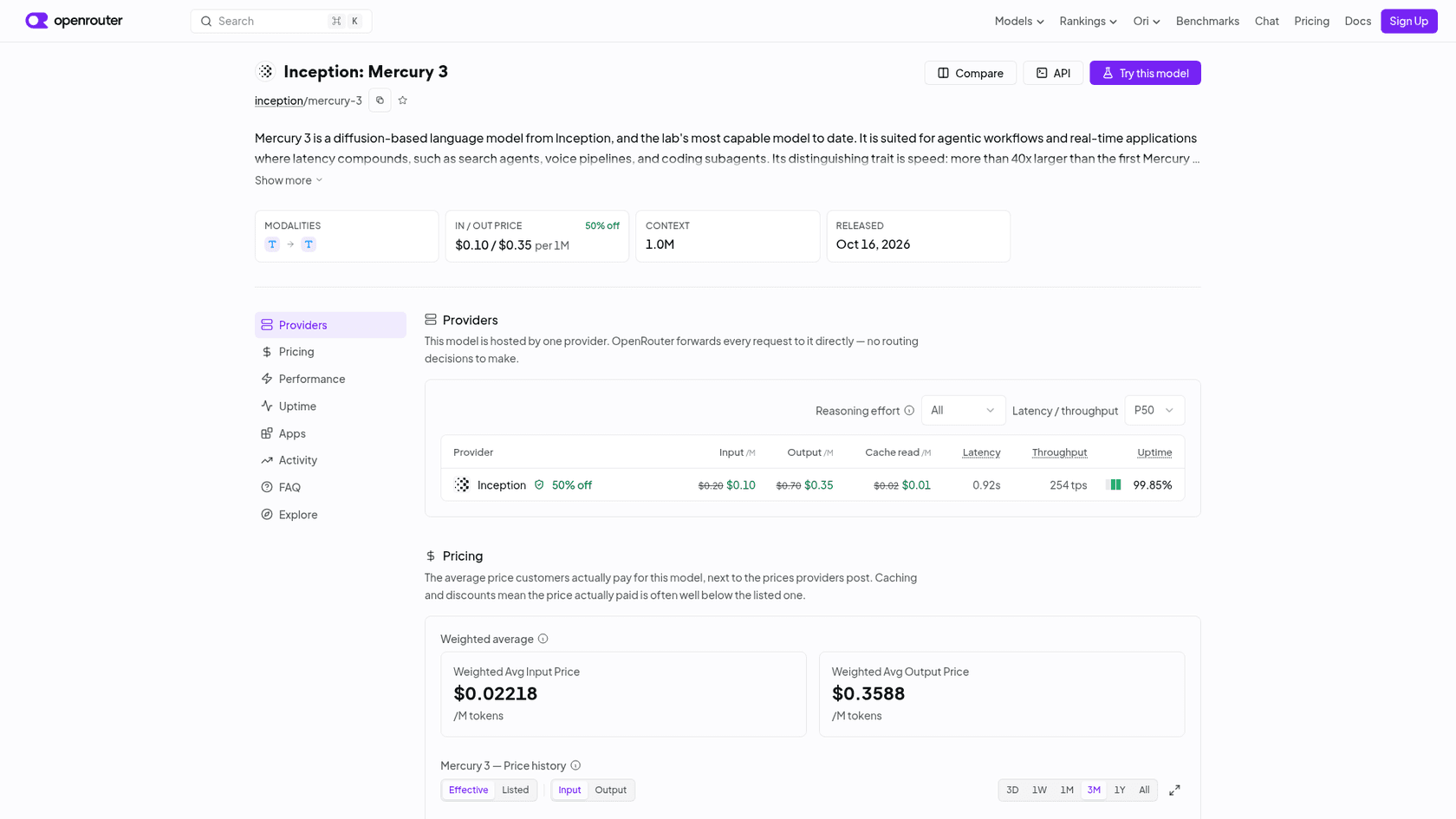
| Price (list) | $0.20 input / $0.70 output per 1M tokens |
| Price (launch, 50% off) | $0.10 input / $0.35 output per 1M tokens |
| Free allowance | 100 million tokens on new API keys |
Two things the table doesn't say. Inception hasn't published the parameter count; its co-founder wrote on Hacker News that they're "not publicly announcing the model size right now." And there are no weights to download. If those matter to you, Google's DiffusionGemma is the open diffusion model to compare against.
How is a diffusion LLM different?
Almost every model you use today, from GPT-6.1 Sol to DeepSeek V4.1 Flash, is autoregressive. It predicts the next token, appends it, and repeats, left to right. That's why long answers take long: a 2,000-token reply is 2,000 steps in a row, no matter how fast each step is.
A diffusion model works the other way round. It starts from a rough, noisy draft of the whole answer and refines all of it in parallel over a small number of passes. Inception's Mercury 2 launch post put it well: "Less typewriter, more editor revising a full draft at once." If you've seen image generators sharpen a picture out of static, it's the same idea applied to text. My explainer on diffusion-based AI models goes deeper on the image side.
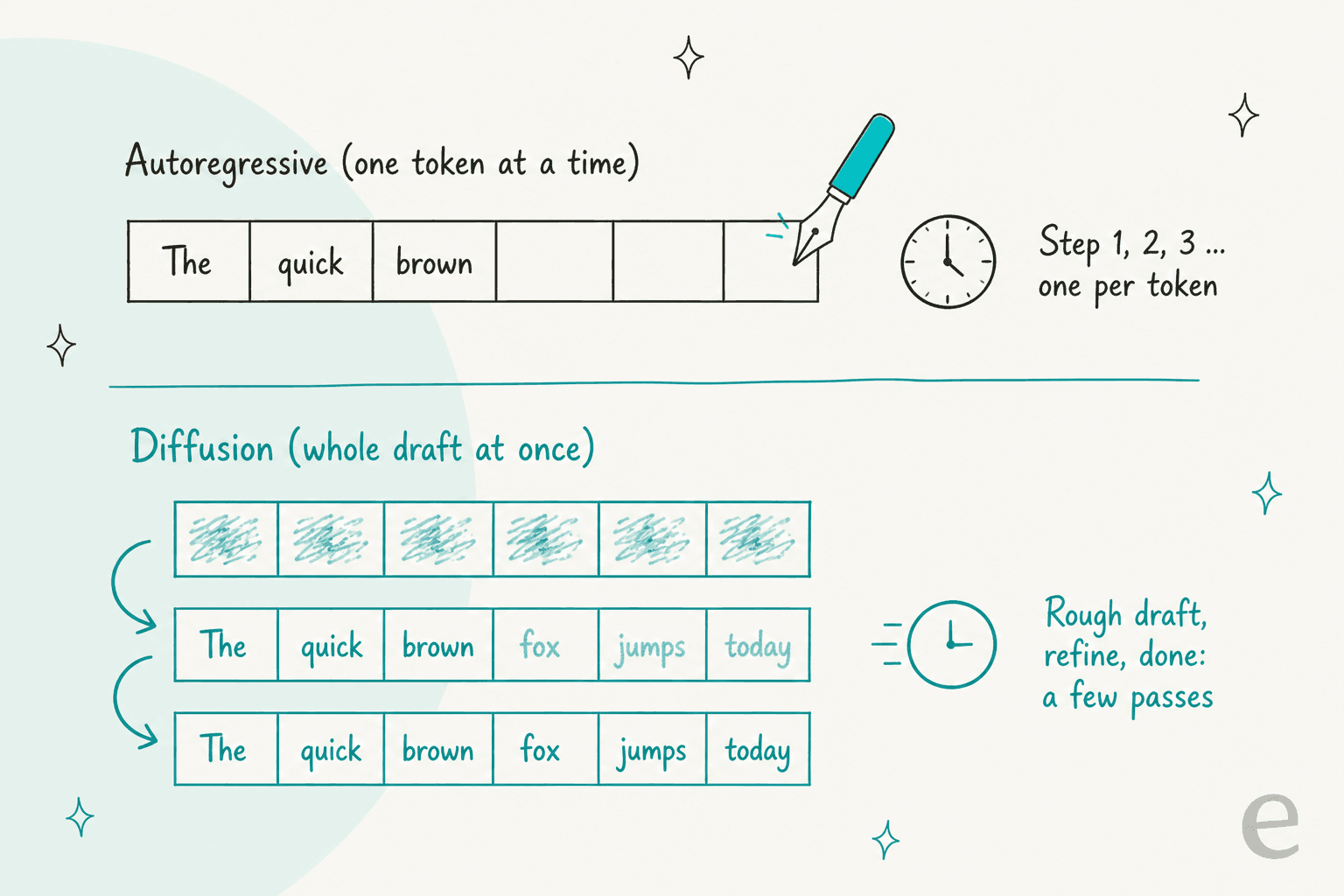
Why that matters more now: reasoning models think before they answer, and thinking is output tokens. Inception's co-founder and chief scientist Volodymyr Kuleshov made the point in the launch thread, that because diffusion writes tokens in parallel, the speed gap grows as models think longer.
"Diffusion generates tokens in parallel through iterative denoising rather than one at a time, so as reasoning models think longer per answer, the speed advantage over autoregressive models of the same size grows."

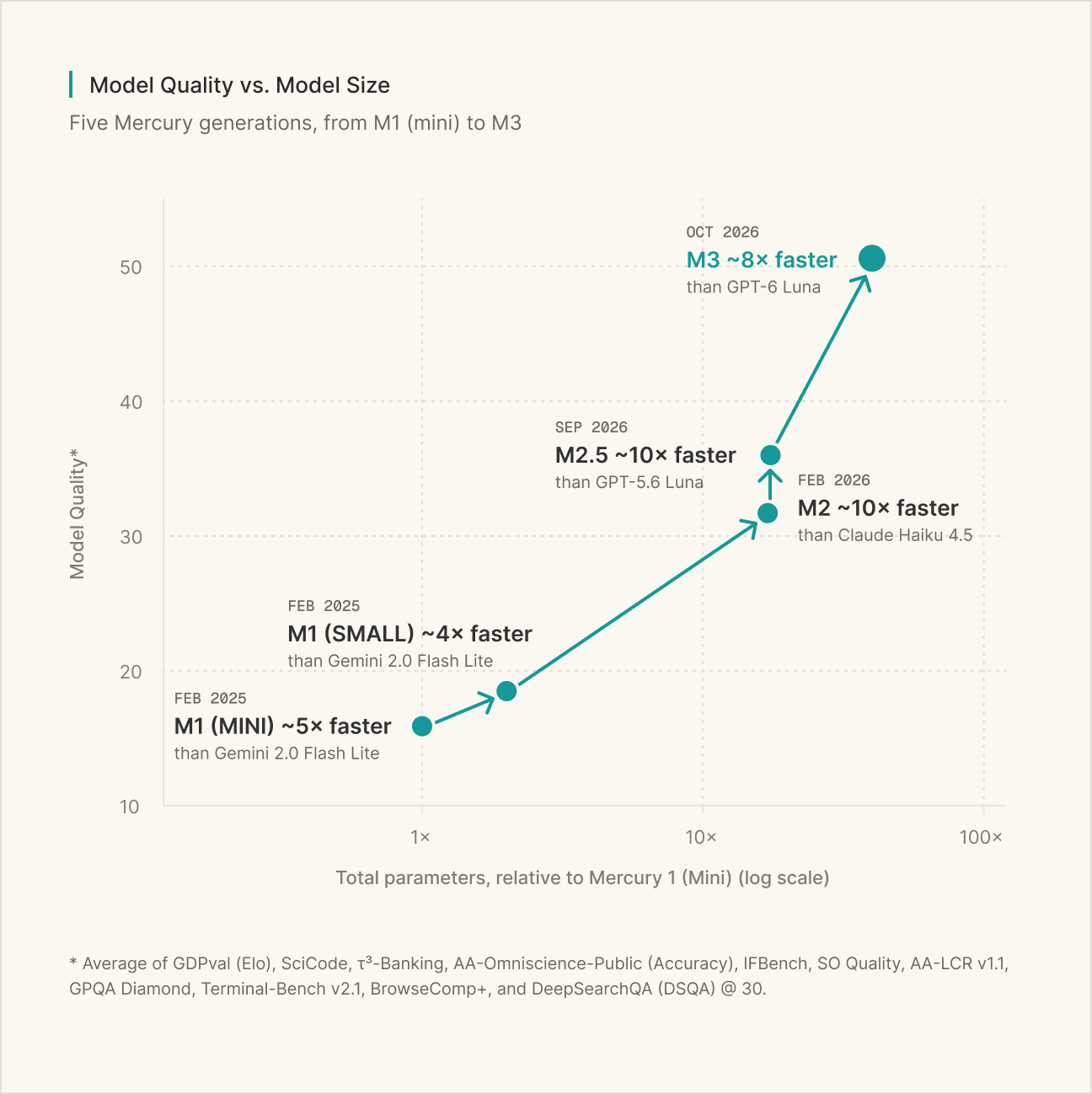
The open question for years was whether diffusion LLMs could get smart, not just fast. Inception's answer is a scaling chart: five Mercury generations from early 2025 to now, with quality climbing as the model grows.
Mercury 3 benchmarks: what Inception's table shows
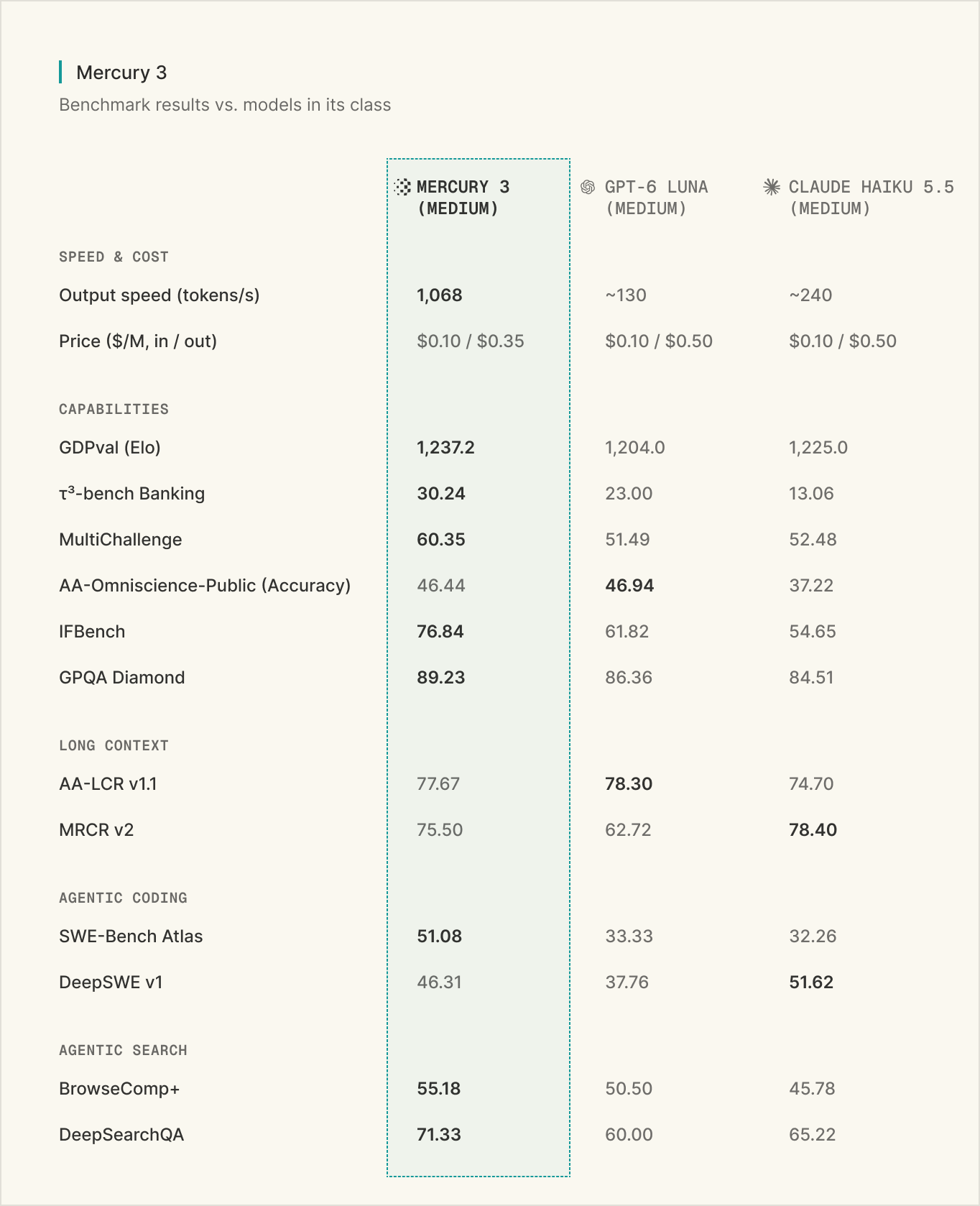
Inception compares Mercury 3 against the two models it's priced to replace: OpenAI's GPT-6 Luna and Anthropic's Claude Haiku 5.5, both at medium effort. Here's the full table from the launch post:
| Benchmark | What it tests | Mercury 3 | GPT-6 Luna | Claude Haiku 5.5 |
|---|---|---|---|---|
| GDPval (Elo) | Real work tasks | 1,237.2 | 1,204.0 | 1,225.0 |
| τ³-bench Banking | Agent customer service | 30.24 | 23.00 | 13.06 |
| MultiChallenge | Multi-turn chat | 60.35 | 51.49 | 52.48 |
| AA-Omniscience (Accuracy) | Factual recall | 46.44 | 46.94 | 37.22 |
| IFBench | Instruction following | 76.84 | 61.82 | 54.65 |
| GPQA Diamond | Graduate-level science | 89.23 | 86.36 | 84.51 |
| AA-LCR v1.1 | Long-context reasoning | 77.67 | 78.30 | 74.70 |
| MRCR v2 | Long-context recall | 75.50 | 62.72 | 78.40 |
| SWE-Bench Atlas | Agentic coding | 51.08 | 33.33 | 32.26 |
| DeepSWE v1 | Agentic coding | 46.31 | 37.76 | 51.62 |
| BrowseComp+ | Agentic search | 55.18 | 50.50 | 45.78 |
| DeepSearchQA | Agentic search | 71.33 | 60.00 | 65.22 |
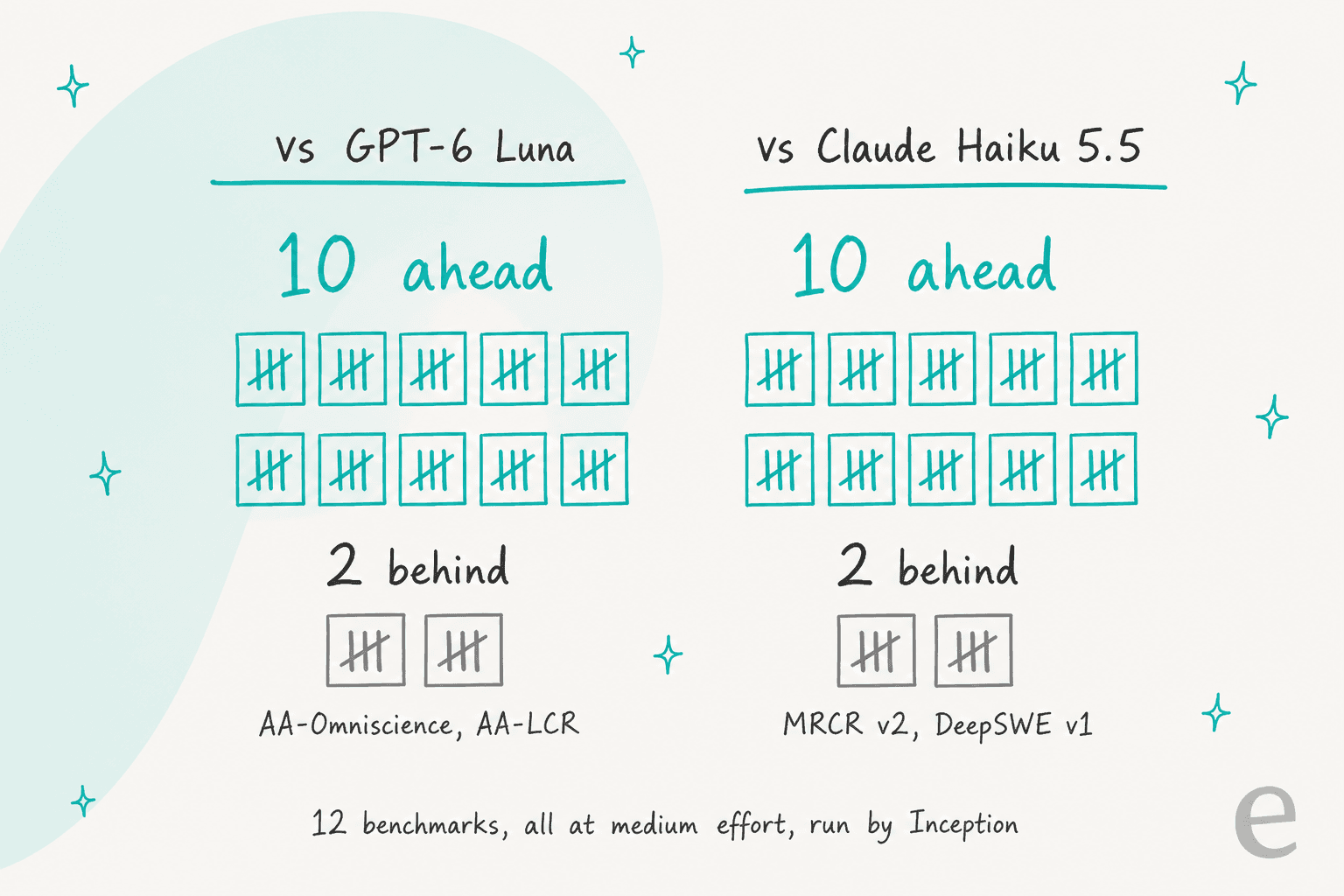
Read across it and Mercury 3 has the top score on 8 of 12 rows. Head to head, it beats each rival on 10 of 12.
Three things I'd keep in mind before quoting that:
- Every number is Inception's run. There's no Artificial Analysis page for Mercury 3 yet, and Kuleshov said on Hacker News that third-party benchmarking is still under way.
- Everything is at medium effort. One commenter asked why, since many people run cheap models at high or max. There's no low-to-high curve, so you can't tell how far Luna or Haiku close the gap with more thinking.
- The biggest wins are on agent tests. SWE-Bench Atlas (51 vs 33) and τ³-bench Banking (30 vs 23 and 13) are wide gaps. The losses are on long-context recall and one coding test, where Haiku 5.5 is ahead.
The honest summary comes from Inception itself. Asked why Haiku won DeepSWE, Kuleshov didn't oversell it:
"overall we have found the model to be Haiku- or Luna-level in our own daily usage. That means that it won't yet replace Opus or Fable as the primary driver of a harness, but we have used it successfully for subagents"
That's the frame I'd use: Luna-class smarts, much faster output. Partner results in the launch post point the same way. TinyFish says Mercury 3 completed half of 50 live Mind2Web web-navigation tasks, "significantly more than GPT-6.1-Sol," and Octen measured a median generation time of 0.9 seconds in its smart-glasses search tests.
How fast is Mercury 3 in practice?
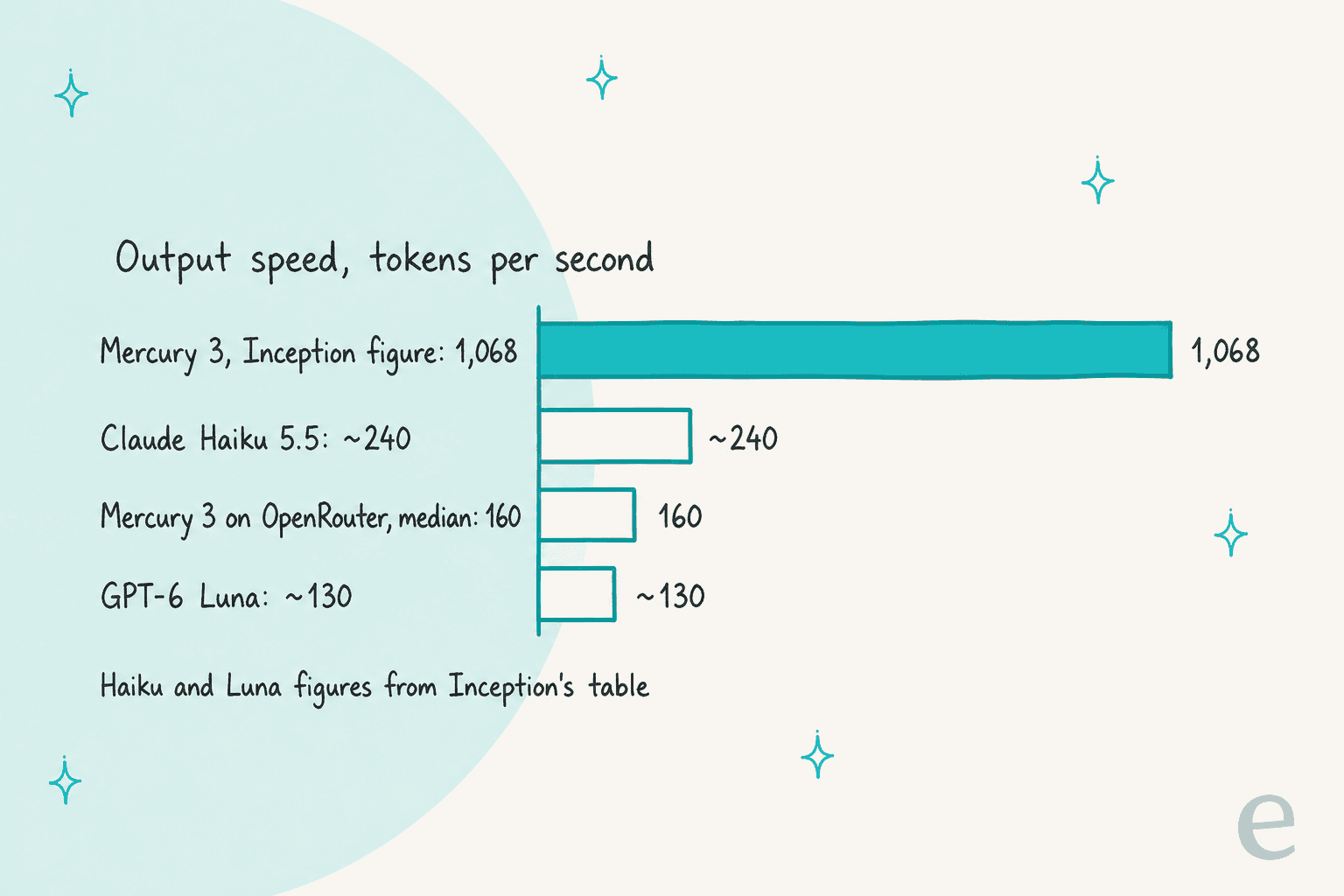
This is the part most launch coverage skips. The 1,068 figure is Inception's measurement on its own NVIDIA hardware. The one independent number I could find comes from OpenRouter, which has a single provider for Mercury 3 (Inception itself) and publishes live throughput.
When I checked on 20 October 2026, OpenRouter showed a median of 160 tokens per second, and a second capture later the same day showed 254. Its one-week average for the median is 203, with median latency around one second. That is still quicker than the ~130 Inception lists for Luna, but it's roughly a fifth of the headline.
Why the gap? OpenRouter's throughput is measured across real traffic, at whatever reasoning effort callers pick, under whatever load the servers carry. Diffusion's speed edge is strongest at low concurrency, which is the trade-off one commenter described for Google's experimental diffusion model:
"It doesn't benefit from batching to reduce memory bandwidth in the same way that a "standard" autoregressive model does, which ends up meaning that it's great at reducing latency for individual/low-concurrency users and delivers better outcomes on certain tasks but much more expensive per token at scale."
Kuleshov says Mercury has scaled well with batch size, and Inception's prices suggest it can serve at volume. But Simon Willison, who ran his usual pelican test, found the speed "a bit disappointing," and calling Inception's API directly instead of OpenRouter "didn't seem to speed it up."
Does the real-world speed still matter? It depends on how many model calls sit in a row. A chatbot that makes one call per message barely notices 1,068 versus 160. An agent that makes 12 calls in sequence feels every one of them. Plug your own task into the calculator below to see where the speed gap stops mattering.
Change the number of steps and tokens per step to see how much model wait Mercury 3 saves per task, at Inception's speed and at OpenRouter's measured median.
With the defaults (12 calls of 600 tokens), Mercury 3 finishes generating in 6.7 seconds at Inception's speed and 45 seconds at OpenRouter's median, against 55 seconds for Luna. Even the slower number saves time on long chains. Drop to one call and the whole difference shrinks below a second, which is why Mercury 3 is a pick for loops, not for single replies.
Mercury 3 pricing at a glance
Inception publishes one rate card, the same on its own API and on OpenRouter. The models page lists the whole family:
| Model | Input (list → launch) | Cached input | Output (list → launch) | Context | Best for |
|---|---|---|---|---|---|
| Mercury 3 | $0.20 → $0.10 | $0.02 → $0.01 | $0.70 → $0.35 | 1M | General reasoning, agents |
| Mercury Voice | $0.40 → $0.20 | $0.04 → $0.02 | $1.50 → $0.75 | 128K | Voice agents, TTFT under 170ms |
| Mercury Decide | $0.04 → $0.02 | $0 | $0 (not billed) | n/a | Classification, scoring |
| Mercury Edit 2 | $0.25 | $0.025 | $0.75 | 32K | Code autocomplete, next edit |
All prices are per million tokens. Access comes in three plans: Free (100 million tokens, all models), Developer (usage-based) and Enterprise (custom rate limits, SLA, volume pricing). Inception hasn't said when the launch discount ends.
How that compares with the models it's chasing, using each vendor's own rate card:
| Model | Input per 1M | Output per 1M | Note |
|---|---|---|---|
| Mercury 3 (launch) | $0.10 | $0.35 | 50% off for now |
| Mercury 3 (list) | $0.20 | $0.70 | After the discount |
| GPT-6 Luna | $0.10 | $0.50 | OpenAI standard API |
| Claude Haiku 5.5 | $0.10 | $0.50 | Prompts up to 100K tokens; 5x above that |
| DeepSeek V4.1 Flash | $0.15 | $0.60 | Off-peak, cache miss; peak hours double |
So at launch, Mercury 3 is the cheapest output token in this group. At list price it's the most expensive on output. A Hacker News commenter put the worry plainly: "I'm wondering if it'll still be useful once the discount is lifted?" My read: if you're buying it for speed, $0.70 is still cheap. If you're buying it because it's cheap, budget at list. My GPT-6 Luna pricing guide covers OpenAI's side in full, and DeepSeek's peak-hour rules are broken down in my V4.1 Flash pricing post.
One more pricing detail worth knowing: Mercury 2 and Mercury 2.5 are closed to new users. Existing customers keep access until 15 November 2026, so if you run either, plan the switch now.
How to access Mercury 3
You have four ways in, per the launch post:
- Inception API Platform. Sign up at platform.inceptionlabs.ai, create a key, get 100 million free tokens.
- OpenRouter. Same price, routed to Inception, useful if you already bill through OpenRouter.
- Baseten. Listed in Baseten's model library, but you contact Baseten for access. My Baseten review covers the platform.
- Vercel. Inception lists Vercel as a launch partner too.
The API is OpenAI compatible, so switching is mostly a base URL and a model name. Here's the call from Inception's docs:
curl https://api.inceptionlabs.ai/v1/chat/completions \
  -H "Content-Type: application/json" \
  -H "Authorization: Bearer $INCEPTION_API_KEY" \
  -d '{
    "model": "mercury-3",
    "messages": [{"role": "user", "content": "What is a diffusion model?"}],
    "reasoning_effort": "medium",
    "max_completion_tokens": 8192
  }'
Inception's integration docs cover coding tools (Cursor, Kilo Code, OpenCode), frameworks like LangChain, and voice platforms like ElevenLabs and Vapi.
For coding, Kuleshov's own advice is to use it as a helper, not the lead. A fast model fits Claude Code subagents and side tasks while a bigger model drives the main work.
What early users are saying
The Hacker News launch thread drew 85 comments in its first day. The mood was impressed but skeptical about the speed claim.
The positive takes came from people who tried it on real work:
"If their benchmarks are to be believed they've made some real progress. [...] EDIT: just trying this out on a repo and it's actually pretty good so far. Pleasantly surprised."
The most common complaint was the wait before the first token, which a tokens-per-second number doesn't capture:
"Hmm at least in Openrouter, deepseek v4.1 flash via together/baseten/fireworks still beat mercury 3 on latency and intelligence Ttft is quite slow with mercury"
Another tester saw the same thing but still liked the price: "the issue with speed seems to be that ttft is still high," they wrote, adding that it "was as cheap as deepseek for a few tasks I tried." And one commenter pushed on the economics: "Pricing can always be set at a loss, however, particularly for a private company." That's a fair question with no public answer yet.
Where Mercury 3 falls short
- No independent benchmarks yet. Every score is Inception's, at medium effort only.
- Real-world speed is lower than the headline. OpenRouter's median was 160 to 254 tokens per second on launch week, and testers report a slow first token.
- Text only. No image or audio input. Inception says it has internal multimodal prototypes, open to early testers by email.
- Closed weights, undisclosed size. You can't self-host it or inspect it.
- Behind Haiku 5.5 on two tests. Long-context recall (MRCR v2) and DeepSWE coding, so test it on long documents before you trust it there.
- The price is a promo. List output is $0.70, twice the launch rate, with no end date announced.
- Structured output isn't flawless. OpenRouter shows a 2.78% structured output error rate on its traffic, so keep a schema check in your pipeline.
Is Mercury 3 good for customer support?
Support is one of the four production uses Inception names at launch, and the strongest benchmark gap for support work is τ³-bench Banking, which simulates an agent handling bank customers: 30.24 for Mercury 3 against 23.00 for Luna and 13.06 for Haiku 5.5. Lorikeet, a support AI vendor, told Inception that in early testing "Mercury 3 beat other models on latency while also performing higher on evals and in production." If you're comparing support vendors, my Lorikeet alternatives post covers that market.
Speed matters most in live channels. On website chat and voice agents, a customer is watching the dots or listening to silence. On email tickets, a few seconds don't change anything. That's where Mercury Voice, with time to first token under 170 milliseconds, is aimed, and it's worth a look next to the tools in my best AI voice agents roundup.
But a fast wrong answer is still a wrong answer. The thing eesel learned running AI on real queues is that you can't trust any model on a live queue until you've watched it handle your own past tickets. A banking benchmark score of 30 also means it failed most of those tasks, so the model needs guardrails, escalation and testing around it. My guide to AI hallucination prevention covers those guardrails, and AI ticket classification is a low-risk first job for a cheap, fast model like this one.
Who should use Mercury 3?
Here's how I'd decide:
- Agent builders with long call chains. Browser agents, search agents, coding subagents. This is where speed compounds and where Inception's partner results are strongest. Try it first.
- Voice and real-time chat teams. Look at Mercury Voice for the first-token latency, and test Mercury 3 for the reasoning steps behind it. Compare with Retell AI if you want a full voice stack.
- Teams paying for Luna or Haiku on high-volume, low-stakes calls. At launch pricing it's cheaper on output and faster. Re-run the math at list price before you commit.
- Anyone who needs vision, weights or long-document recall. Wait, or pick a different model. Gemini 3.8 Flash handles images, and DeepSeek V4.1 Flash has open weights.
- Teams whose bottleneck isn't the model. If a single reply takes a second either way, speed won't move your numbers. Look at your AI agent API setup or retrieval first.
If you're still mapping the field, my roundup of the best AI agents and the guide to the best support ticket model are good next reads.
Try eesel
Mercury 3 is infrastructure: a fast model, an API and a per-token bill. To put it on your support queue you'd still build the helpdesk connection, retrieval over your help center, escalation rules and the testing harness. eesel is the employee. Its AI helpdesk teammate joins the queue you already run, learns from your past tickets and docs, and you can replay it against your historical conversations before it answers a single customer.
SamCart is a good example of where speed and channels meet. It runs one eesel agent on Freshdesk tickets and a separate one in the chat bubble on its website, each with its own greeting and tone, both answering from about 280 help center articles. The ticket agent replies only until a teammate picks the ticket up, and a seller asking for a person ends its part.
If you're the kind of reader who tests new models from a terminal, the eesel CLI drives the same teammate. eesel init chat-bubble --site https://your-site.com sets up a website chat agent that reads your pages, eesel instructions edits its standing rules, and eesel approvals lists actions waiting on a human. Every command prints JSON, so a coding agent like Claude Code can run the setup for you. More on that in my AI agent CLI guide.
Plans start at $299 a month for 500 credits, where a ticket or a chat is one credit, and the free trial gives you 100 credits with no card. Try eesel on last month's tickets, or check the pricing page first. If you write content instead of answering tickets, the roster also has an AI blog writer.