


What TypeSafe Jev actually is
TypeSafe AI is a San Francisco lab that spent two years in stealth before shipping Jev on September 15, 2026. The framing on the homepage is deliberately provocative: LLMs "produce words for people," while "Jev produces typed decisions and is more like code." The launch post has a cleaner one-liner, calling Jev "a frontier-intelligence function call: unstructured state in, typed probabilistic decisions out."
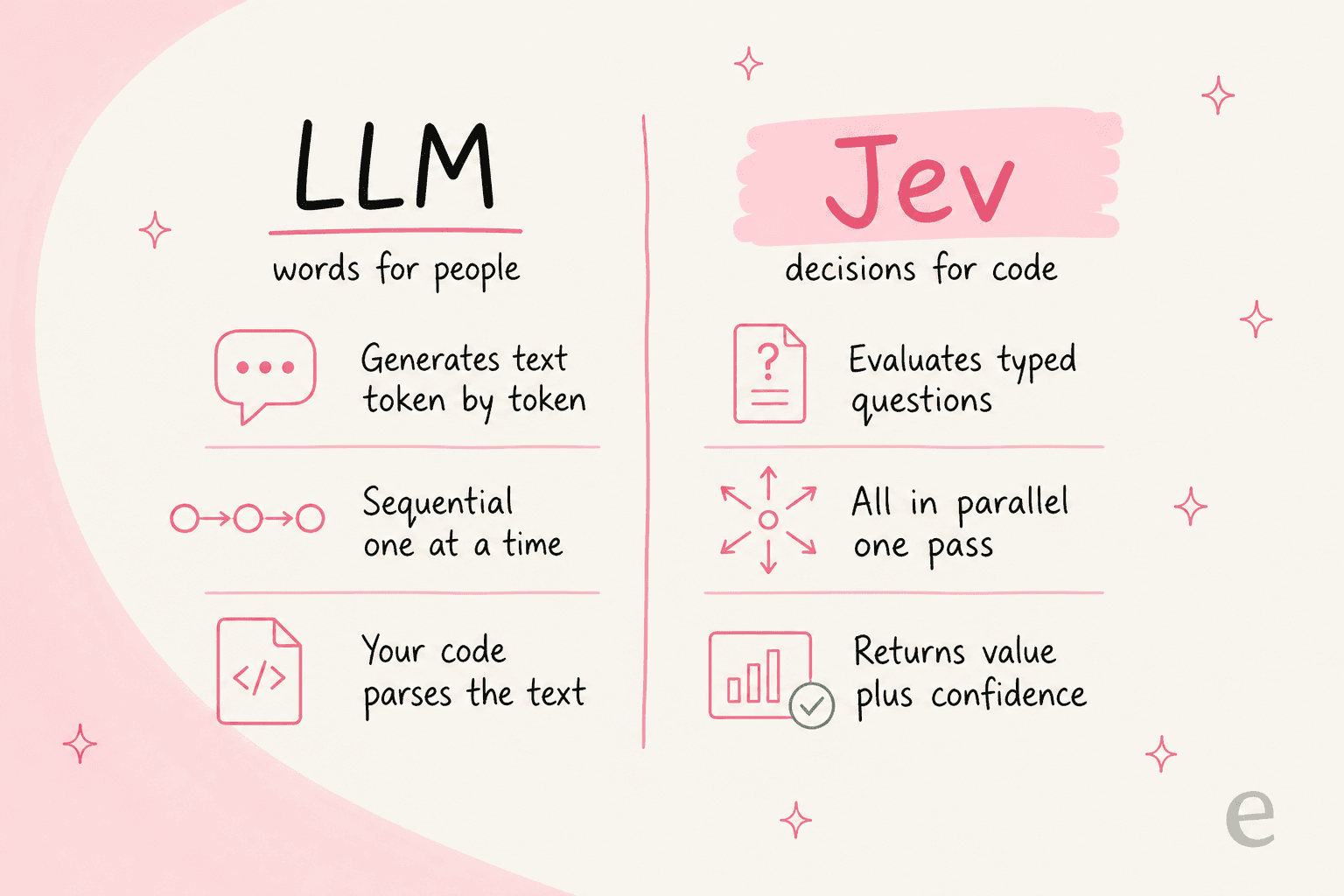
The name is a tell about the whole philosophy. "System One" nods to Daniel Kahneman's fast, intuitive System 1 thinking, and "Jev" is after economist William Stanley Jevons, whose paradox says every drop in the cost of a resource unlocks far more use of it. TypeSafe is betting that cheap, fast, typed decisions get used everywhere a slow generative call is too expensive today.
The company also says it took "the opposite research direction" from chat. Rather than more RLHF, it trained on a new objective it calls Reinforcement Learning for Calibrated Decisions (RLCD), with a new architecture and sampler. The pitch is three words: decisions not strings, calibrated confidence, more like code. Their tagline, "Build Prod, Not God," tells you who they're talking to.
How it works: state plus questions, evaluated in parallel
This is the part that clicked for me, and it is worth understanding before any of the claims. The docs describe the mismatch Jev is built to kill:
"you are coercing a text-generation system into outputting structured decisions, then parsing the results back into something your code can depend on."
Anyone who has shipped an LLM feature has felt that exact pain. Jev's model is different: you send a state (a string, or a structured object) plus a set of typed questions, and it evaluates each question against that state, in parallel, in a single pass. Your code then branches, sorts and routes on the typed answers that come back.
There are only three primitives, and they map to the shapes you actually need:
| Question type | What it asks | What it returns |
|---|---|---|
| Noul | Is this statement true? | a single probability, 0 to 1 |
| Choice | Pick one option from a list | the choice, per-option probabilities, and a confidence |
| Score | Rate the state on a rubric | a numeric score, per-level probabilities, and a confidence |
The design decision I like most: because each question is evaluated independently against the same state, adding more questions barely moves the latency and never creates context-rot. TypeSafe's composition guidance is to keep every question atomic, "the kind of judgment a knowledgeable person could make in a few seconds," and to compose the hard stuff in code rather than one giant prompt. Instead of "rate this startup pitch," you ask about market size, feasibility and differentiation separately, then combine the scores with your own formula.
The Cloudflare model page makes this concrete with a support example that, honestly, reads like our own product spec. Send the state "Help! My payouts have been failing for 3 days." with three questions, and you get back:
is_urgent(Noul):0.95department(Choice):"billing", confidence0.8, probabilities {billing 0.87, technical 0.13}frustration(Score):1.04on a Calm/Frustrated/Very angry scale, confidence0.94
That is ticket triage in one call. It is also the clearest picture of what Jev is: a very fast classifier with calibrated probabilities, not a thing that talks.
The claims, checked one by one
TypeSafe's marketing is bold, so let me take the headline claims in order and separate what holds from what stretches.
Speed: fast, on the tasks it is shaped for
TypeSafe claims 70-500ms end-to-end versus 3-329 seconds for frontier LLMs, framed as 40x to 200x faster. The single parallel pass is a real architectural reason to be quick, and the outside evidence is encouraging. Vercel's CEO reported it in production:
"Jev is up to 18x faster (p95) and more accurate. It's coming to @vercel AI Gateway and likely new default."
The fair caveat, raised repeatedly on Hacker News, is that the comparison isn't apples-to-apples. A generative model producing all the type names, schema and prose is doing more work than a model that only emits a constrained decision. The speed is real; the multiplier depends on what you're comparing against.
Price: cheap, with an honest asterisk
At $0.042 per million input tokens with free output, Jev is priced like infrastructure, not like a frontier model. TypeSafe claims that is 238x lower input price than Claude Fable 5.1. Credit where due: they address the subsidy question head-on instead of dodging it.
"We can't prove it isn't subsidized; we'll need the long-term to prove the sustainability of our pricing (which we expect to go down, not up)."
Worth knowing before you plan around it: there is no pricing page (every /pricing URL 404s today), no published plan tiers or rate limits, and access is gated behind a waitlist. This is a launch price on an early-access product, so treat it as directional. If you're modelling costs, our guide to Qwen pricing shows how fast launch numbers move. The same lesson runs through our Gemini 3 pricing breakdown, and if the waitlist is a blocker, our Qwen alternatives list has open options today.
"Can't hallucinate": half true, and oversold
This is the line that got the most pushback, and I think fairly. Jev can't make a type error because the output is mathematically constrained to your schema. That part is real and useful. But the marketing slides from "no type errors" to "can't hallucinate," and the top of the Hacker News thread wasn't having it:
"if it puts a high confidence value on a wrong answer, thats still hallucinating, no?"

The defenders had a reasonable answer: a calibrated confidence score means you can see a 0.1 and disregard it, which is different from a model that is confidently wrong. Another commenter set the bar the claim should be measured against:
"What we would want to see is a confidence value that is in line with the actual correctness. If the value is 0.9 for 1000 different answers, then approximately 900 of those answers should be correct."
That is the right test, and it is exactly what RLCD is supposed to optimize. My read: calibrated confidence is a genuine safety feature I wish more models exposed. "Can't hallucinate" is a stronger promise than the model actually keeps, and TypeSafe would be on firmer ground saying "type-safe with calibrated confidence."
The benchmark: a chart worth reading closely
TypeSafe's own workflow evals headline a striking "193.6x Faster, 444.6x Cheaper," which the blog admits are "on the higher end of real world gains." The chart underneath is more honest than the headline, and it is the single most useful thing they published.
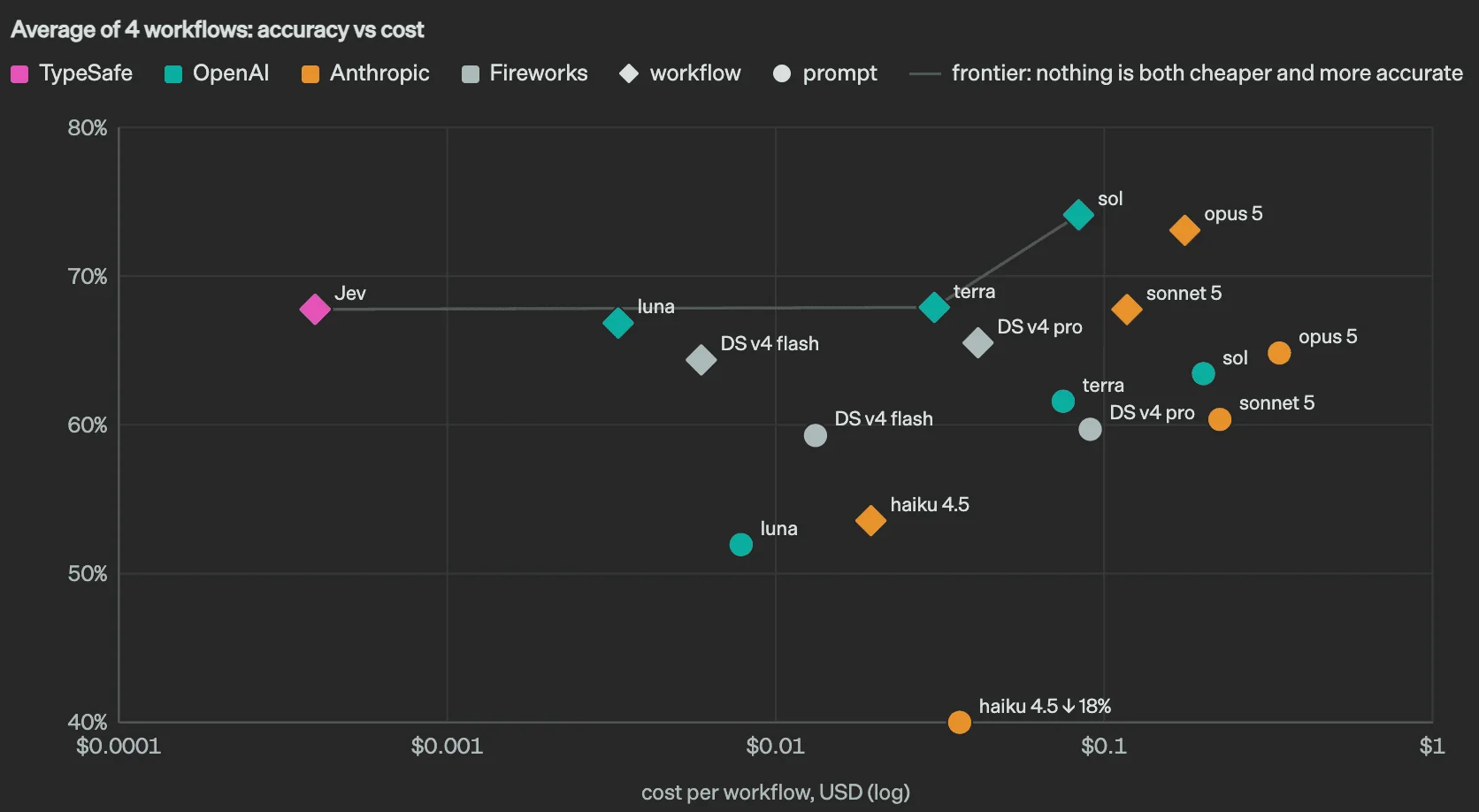
Read it and the real claim comes into focus: Jev sits on the frontier at roughly the accuracy of a mid-tier reasoning model, at a fraction of the cost per workflow. It is not the most accurate point on the chart. It is the cheapest point that is still competitive, which for high-volume decision work is often what matters. The measured take from a top commenter captures it well:
"Seems like a more accurate title would be "Jev: Trading general purpose generation for fast typed inference"."
What builders are actually doing with it
The X reaction was where I got most convinced there's a there there, because it was demos, not takes. The two biggest posts were both about squeezing agent context. One developer used Jev for instant compaction:
"in 2026, why is compaction still a summarization prompt? Jev can make it instant by scoring every tool call and dropping what's irrelevant"
Another wired it into Claude as a tool-call reviewer and reported taking a session "from nearly 1M to 86K tokens" in about a second. Those are exactly the shape of job Jev is good at: a fast, cheap, high-volume judgment that a big model was massively overqualified to make. It is the same instinct behind good agent-assist tools, small checks that don't need a frontier brain.
It is not universal love, and the pushback is worth hearing. Developer Theo Browne's blunt "Please don't do this" reply captured a real worry: that people will reach for a System One classifier in places where a general model's reasoning actually mattered. Both things are true at once. Jev is excellent for the narrow decision, whether that's bug-report triage or an escalation call, and wrong for the open-ended one. The discipline is knowing which is which.
Where a typed-decision model fits, and where it doesn't
Here is the honest boundary, because a review that says "use it for everything" is useless.
Jev fits when the job is a decision your code consumes: routing and triage, urgency and sentiment scoring, spam and abuse flags, ticket tagging, or a review of a tool call before it runs. Anywhere you'd otherwise force an LLM into JSON, a typed-decision model is a cleaner primitive, and the calibrated confidence gives you a real lever for when to auto-act versus escalate.
It does not fit when the output is the point. Jev doesn't write the reply, explain its reasoning, hold a conversation, or handle the long tail of a truly novel question. It also carries a 32,000-token context window and, as a launch-week product, an early-access waitlist rather than open availability. For the reply itself you still want a general model, the kind we compare in our best AI chatbot builder roundup, and if you're a smaller team, our small-business AI agents guide.
The most useful mental model I landed on: Jev is the fast reflex, not the deliberation. TypeSafe's own security-workflow diagram shows the pattern well, a pipeline of small Bool, Score and Choice questions with your code choosing the action between them.
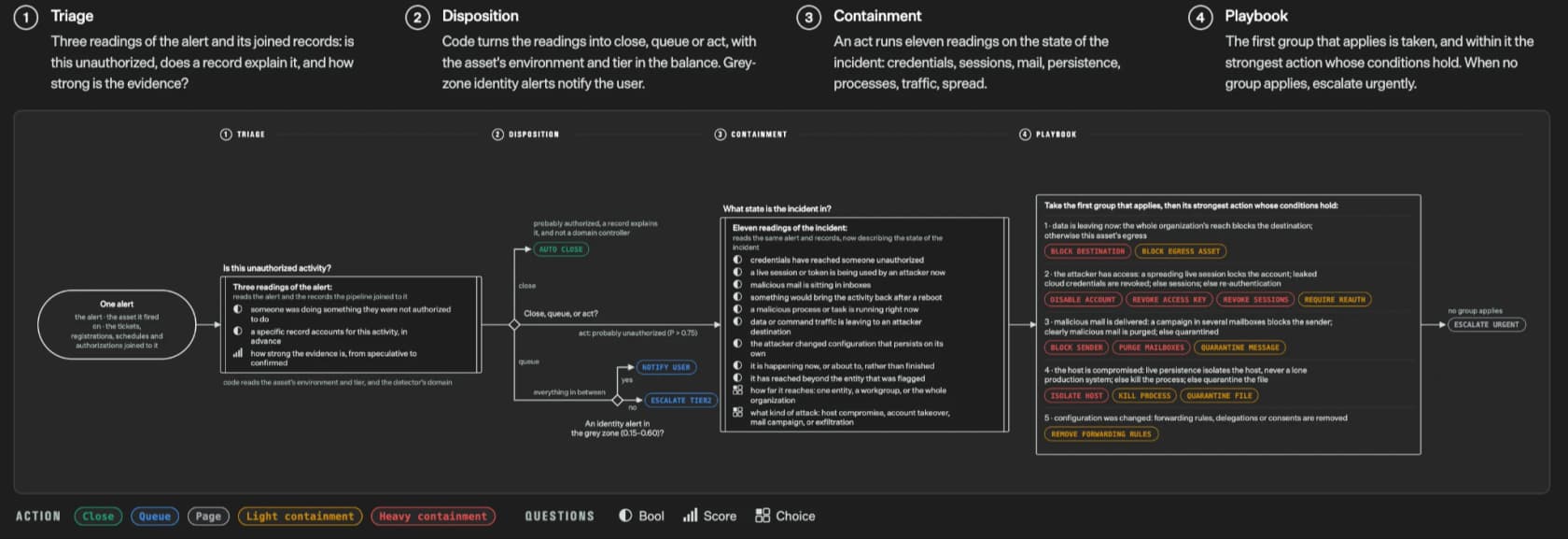
To make the call quicker, here's the decision I'd actually walk through:
Jev at a glance
| Model | Jev (jev-1.13.0), the first public System One model |
| What it returns | typed decisions (Noul / Choice / Score) with calibrated confidence |
| Latency | 70-500ms end-to-end, one parallel pass |
| Price | $0.042 / MTok input, output free (launch price, no tiers) |
| Context window | 32,000 tokens |
| Access | early-access waitlist, plus typesafe/jev on Cloudflare Workers AI |
| Best for | high-volume structured decisions, tool-call review, compaction |
| Not for | writing replies, reasoning in prose, open-ended conversation |
What this means if you run a support team
Jev's own flagship demo is a support ticket, which is not a coincidence, triage is the textbook System One task. I've spent enough time on live queues to know the trap, though: a great triage decision is only the first inch of customer service automation. This is a builder's distinction I keep coming back to. The classification is where AI is already reliable; the generated reply, and the human-agent cost math, is where it still slips.
We saw exactly that split in a trial I helped run for a consumer-goods brand, across 284 chats and a 100-ticket cross-validation. The typed decisions were excellent, 93% triage accuracy and 100% spam detection with zero false positives. The drafted replies still carried a 7% factual-error rate, and only 12% were clean enough to send as-is.
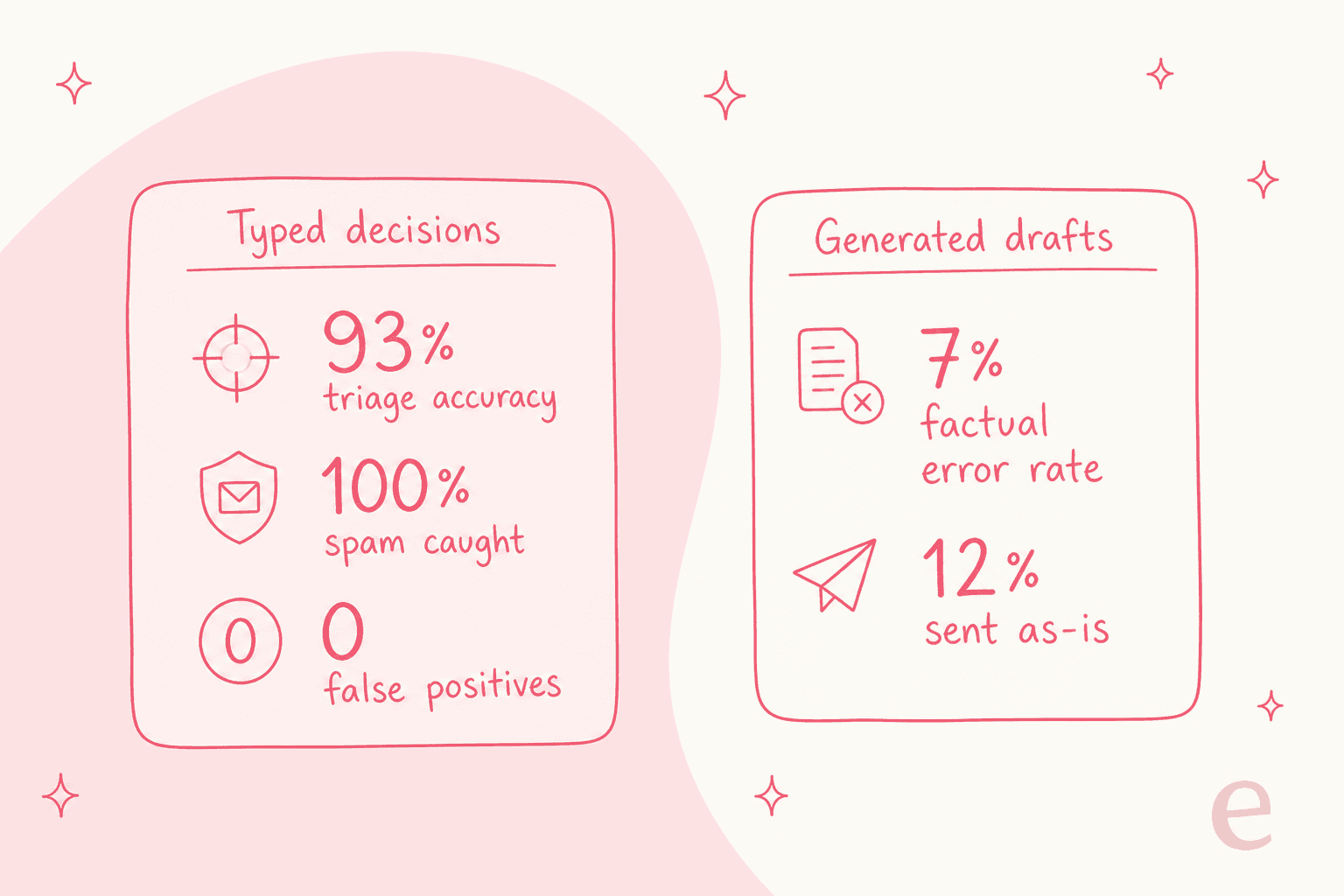
That is the whole reason a model like Jev is exciting and also the reason it isn't the finish line. A typed-decision model is infrastructure. The support job on top of it, connecting to the helpdesk, reading your knowledge, drafting the reply, taking the action, knowing when to escalate, and proving it works before it goes live, is an employee's job.
That's the line eesel sits on. Where Jev is a fast building block, eesel's AI helpdesk teammate is the ready-to-work hire: it plugs into the major helpdesk integrations (Zendesk, Freshdesk, Gorgias, Front, Help Scout, HubSpot), then triages and drafts and resolves on your live queue.
Crucially, it simulates against past tickets before it answers a single customer, so you see the accuracy on your data instead of on a launch chart. It bills per ticket handled, not per seat, so the economics track the work.
And for the developers this post is really for, eesel isn't dashboard-only. The same teammate is driveable from the eesel CLI (npx @eesel/cli): a person can run it from a terminal, scripts can automate it in CI with an API token, and coding agents like Claude Code, Codex and Cursor can operate it directly. You can connect an integration, edit the standing instructions, list and approve human-in-the-loop actions, and read the run-by-run activity log, all as JSON, with --dry-run to preview a write before it fires. Every workspace is also an MCP server, so the same agent you'd point at Jev can point at your support teammate. The roster doesn't stop at support either; there's an AI blog writer teammate for content. If you like Jev because it treats intelligence like code, that's the same reason to like operating a teammate from the terminal.
My verdict
Jev is one of the more interesting model launches of the year precisely because it isn't chasing a better chatbot. It is a real, useful primitive: fast, cheap, type-safe decisions with calibrated confidence, and a clean mental model for composing them in code. The speed and price hold up for what it's for, the "can't hallucinate" claim is oversold, and the benchmark headline is louder than the (still good) reality underneath.
If you're a developer wiring up agentic systems, get on the waitlist and use it exactly where it's strong: the high-volume decisions you were forcing a big model to make. For the bigger picture of what these systems look like in production, our roundups of AI agent examples and the best AI teammates are a good next read.
Just don't mistake the reflex for the whole nervous system. The decision is the easy inch; the end-to-end job is still the mile.
Frequently Asked Questions
What is TypeSafe Jev?
Jev is TypeSafe AI's first System One model, launched September 15, 2026. Instead of generating text like a chatbot, it evaluates typed questions against a state and returns structured decisions with confidence scores. It is closer to a fast classifier than to a general LLM, which is the whole point of this TypeSafe Jev review.
Is Jev an LLM?
No, and TypeSafe is careful to say so. Jev does not reason in prose or write explanations. It returns a typed value plus a probability, and anything heavier gets split into separate questions and recombined in your own code. If you need conversational answers, a general model or a support AI agent is the right tool.
Can Jev really not hallucinate?
It cannot make a type error, because the output is constrained to your schema. It can still be confidently wrong on a judgment, which is the point Hacker News commenters pressed hardest. The honest read: a calibrated confidence score is a real safety feature, but "can't hallucinate" is stronger than what the model actually guarantees.
How much does Jev cost?
TypeSafe prices input at $0.042 per million tokens and lists output tokens as free. There is no standalone pricing page and no plan tiers yet, and access runs through an early-access waitlist. On Cloudflare Workers AI, billing is deferred to the Cloudflare dashboard.
What can you build with a System One model?
Structured decisions your code consumes directly: ticket classification, routing, urgency and sentiment scoring, tool-call review, and context compaction. It is a good fit anywhere you were coercing an LLM into JSON and parsing it back out. For the end-to-end support job on top of those decisions, see the best AI agents for customer service.
Is Jev better than GPT or Claude for support?
Different jobs. Jev is faster and cheaper for the narrow decision (is this urgent? which queue?), while a model like the best LLM for support use cases still writes the reply. Most production systems will use both, or hand the whole workflow to a teammate that already wires the pieces together.
How do I access TypeSafe Jev?
Sign up for early access at console.typesafe.ai, use it via the Cloudflare Workers AI model id typesafe/jev, or wrap an existing LLM with TypeSafe's open-source System One adapter. Full details are in the docs.


Article by
Rama Adi Nugraha
Rama is a software engineer at eesel AI with two years of experience writing about B2B SaaS, AI tools, and customer support technology. Based in Bali, Indonesia, he brings a developer's perspective to product comparisons — cutting through marketing copy to what the integrations and APIs actually do.