

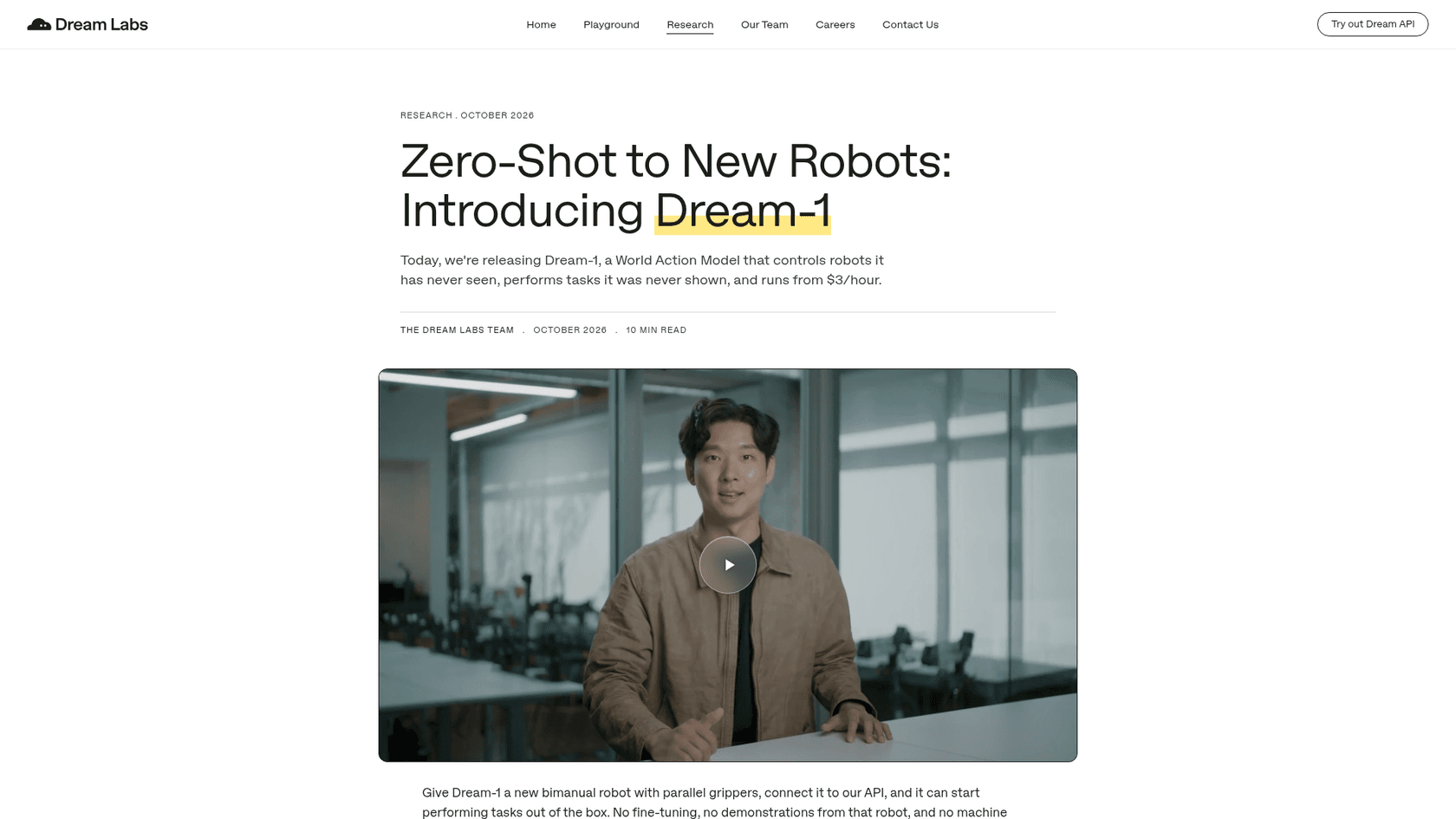
Dream-1 pricing is $3 an hour of robot time, or $2 an hour for Dream-1-flash. Dream Labs bills per model call: each call returns 1.6 seconds of arm movement, so an hour is 2,250 calls. Fine-tuning on your own robot is $200 per job. One 8-hour shift on Dream-1 costs $24.
The hourly rate is the wrong number to budget on. Run one robot a full working year and the model costs $6,336, more than three times a $1,998 arm kit. And because a fumbled grip is still a billed call, the price that matters is per finished task: by my estimate about $0.18 for pick and place, but $1.17 for tool use, where Dream-1 succeeds 6% of the time.
If what you need done is software work, not arm work, you can skip the hourly meter entirely. eesel sells ready-to-work AI teammates on a fixed monthly price, from $299 for 500 tickets or chats, and IC Intracom, a networking hardware maker, runs one per brand on its 2,100-product catalogue.
How much does Dream-1 cost?
Dream-1 costs $3 per hour of robot run time, and Dream-1-flash costs $2 per hour. That's it, the whole public rate card. Dream Labs prints it right on the launch page under the line "Everything above the hourly cost is yours to keep."
I ship eesel's APIs and integrations, and whenever an API is billed on usage, the first thing I want to know is what one billed unit actually is. Dream Labs is clear on this. Each model call returns 1.6 seconds of actions, which means an hour of continuous control works out to 2,250 calls. The developer console shows billing as a price per action for each model, and each call is priced by the model it runs.
| Item | Dream-1 | Dream-1-flash |
|---|---|---|
| Price per hour of robot time | $3 | $2 |
| Seconds of motion per call | 1.6 | 1.6 |
| Calls per hour | 2,250 | 2,250 |
| Price per call | ~$0.0013 | ~$0.0009 |
| One 8-hour shift | $24 | $16 |
| 8 hours a day, 22 days | $528 | $352 |
| A working year (2,112 hours) | $6,336 | $4,224 |
| Fine-tuning on your robot | $200 per job | $200 per job |
| Running a fine-tuned model | Same as base | Same as base |
Dream Labs supplies the per-call, hour and price rows. The shift, month and year rows are my own arithmetic at 8 hours a day and 22 days a month, so if your robot runs two shifts, just double them.
Nothing Dream Labs has published mentions a seat fee or a platform fee, and there's no monthly minimum either. That makes it look a lot more like OpenAI API pricing or Anthropic's API than a robotics software licence. Which is the point, really: Dream Labs wants hobbyists and small teams, and it says so.
What does Dream-1 actually bill you for?
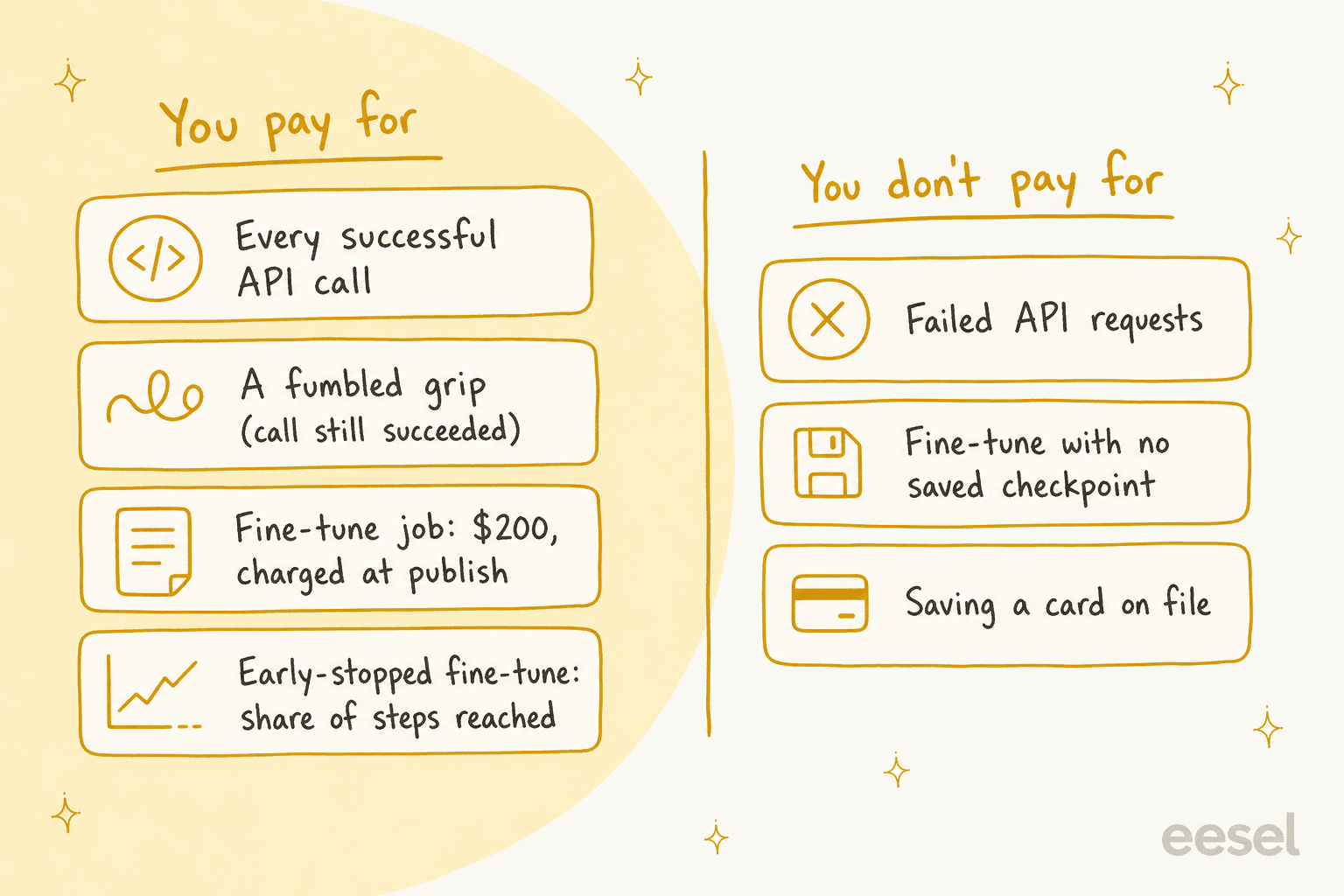
Dream-1 bills every successful API request. The console's billing copy says "only successful requests are billed", and that phrasing carries more weight than it first seems. A request counts as successful when the model returns actions. If the robot then drops the cup, that's not the API's problem.
Here is how the rest of the billing works, from the platform console:
- Prepaid credit only. You top up between
$5and$10,000through Stripe, with quick picks at$25,$50and$100, plus applicable taxes. Auto-reload below a threshold is optional. - A monthly spending limit. You pick the number, and requests pause shortly after your spend goes past it. Once you raise it, they come back within about a minute.
- Free credit to start. Adding a card unlocks free credit "to try Dream-1 on your robot or in simulation", and saving the card charges nothing. The amount isn't published.
- No refunds. Unused credit is not refunded, and closing the account forfeits the balance.
- A rate limit. Three calls in a row per session, then one call every 0.7 seconds.
The rate limit is worth a second look. Since one call every 0.7 seconds is faster than the 1.6 seconds each call covers, a single robot won't feel it at all; all it does is stop you from hammering the API.
The terms also call the service an "experimental beta research preview", and fees can change on 30 days' notice. That matters more than it sounds, and I've seen why on eesel's own sales calls this year. A budget-conscious buyer said a previous vendor's price had more than doubled on them, and the very first thing they asked for was a contractual price lock. Dream-1 doesn't offer one. If you build a product on top of it, model your margin at a higher rate than $3, and let any surprise be a pleasant one.
How much does fine-tuning Dream-1 cost?
Fine-tuning costs $200 per job "at the time of writing", per the console's own docs. Dream Labs calls it Fine-tuning-as-a-Service, or FaaS. You upload demonstrations from your robot in the LeRobot v2.1 dataset format and get a custom model ID back.
The billing rules turned out friendlier than I expected:
| Fine-tuning rule | What it means for your bill |
|---|---|
| Price is held from credit when the job is queued | You need $200 of prepaid credit before you start |
| Charged when the model is published | You don't pay for a job that never finishes |
| Run ends early | Charged for the last saved checkpoint, in proportion to steps reached |
| No checkpoint saved | Costs nothing |
| Queued job | Can't be cancelled |
| Running the tuned model | Same hourly price as the base model |
For a robot with two or three cameras, a job takes about 4 to 5.5 hours. The amount of data you need depends on how far your robot sits from what Dream-1 already knows. Dream Labs' launch post shows 5 minutes of data moving the needle on the reBot B601-DM and Maker Arm, while a Dexmate robot with dexterous hands needed 77 minutes and a YAM with swapped grippers needed 98.
Fine-tuning isn't a sure win either. Out of 12 partner robots, it raised the instruction-following score on 10, with the big jumps on AI Worker, from 44% to 84%, and ROBO-T1, from 28% to 68%. Two got slightly worse: Bracket Bot (32% to 31%) and Unitree R1 (42% to 31%). So budget $200 for the first try, and assume a second job will probably follow.
One cost never shows up on the invoice. Fine-tuned models are hosted on demand, and an idle one can take up to an hour to restart (25 to 50 minutes in Dream Labs' own tests). So if your robot works a morning shift, warm the model up before people get in.
What does Dream-1 cost per finished task?
This is the number I'd actually budget on, and Dream Labs publishes enough to estimate it. On its home robot, the YAM, Dream-1's full success rate ranges from 40% on pick and place down to 6% on tool use, per the launch post. Each failed attempt still burns through billed calls.
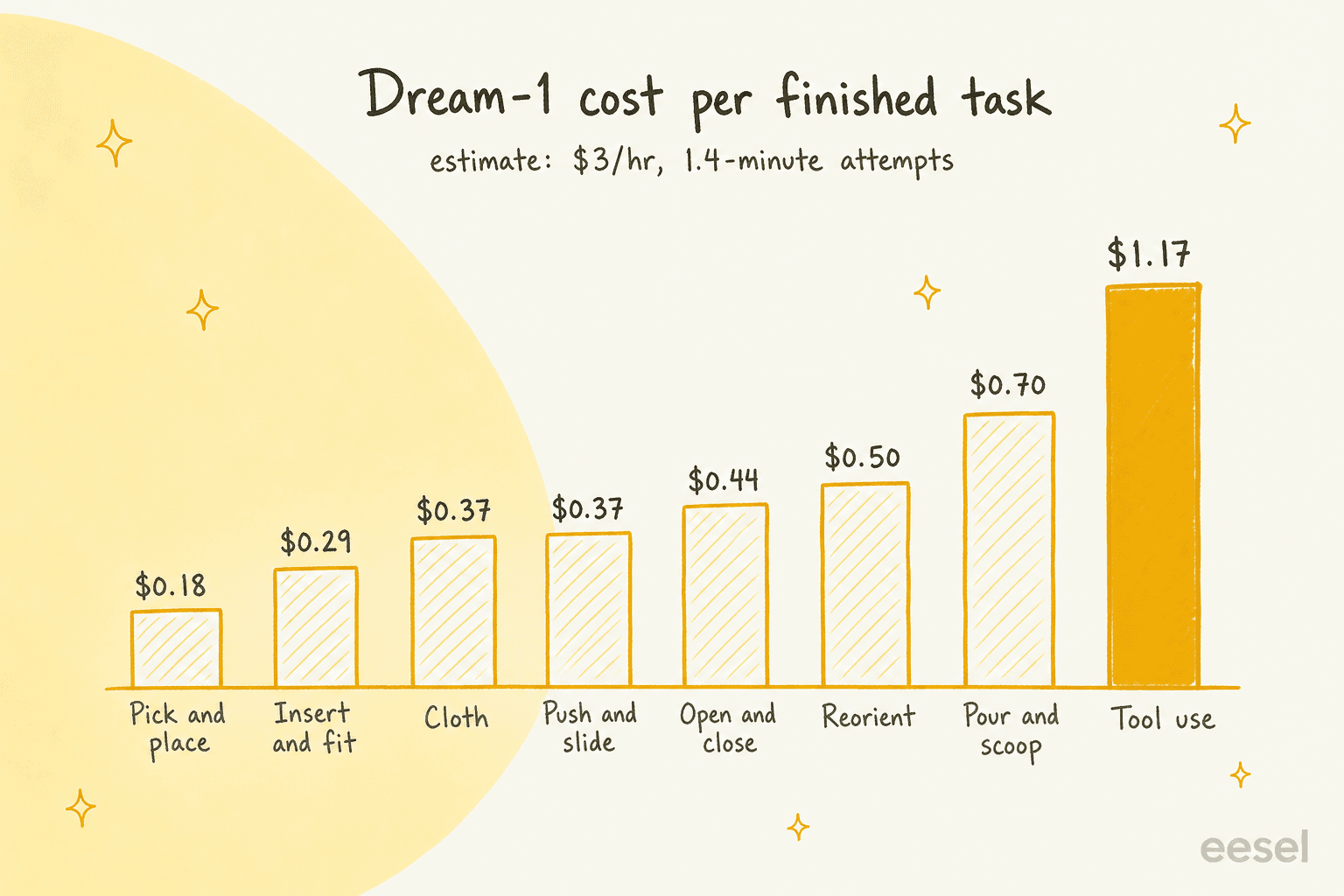
Here's how I got there. Robocurve's benchmark put Dream-1 at 1.4 minutes per task attempt, and at $3 an hour, 1.4 minutes of run time is $0.07. Divide that by the success rate and you get the cost of one finished task:
| Task type (Dream-1 on YAM) | Full success rate | Est. cost per finished task |
|---|---|---|
| Pick and place | 40% | $0.18 |
| Insert and fit | 24% | $0.29 |
| Cloth | 19% | $0.37 |
| Push and slide | 19% | $0.37 |
| Open and close | 16% | $0.44 |
| Reorient | 14% | $0.50 |
| Pour and scoop | 10% | $0.70 |
| Tool use | 6% | $1.17 |
Treat these as a floor rather than a quote. Robocurve's own chart puts Dream-1 at about $0.15 per attempt, roughly double my $0.07, so it's probably counting more than raw model time. If you use Robocurve's figure instead, every number in the right column doubles. And real tasks tend to run longer than benchmark ones.
The useful part is the pattern. With a 6.5x spread between the easiest and hardest task category, "Dream-1 costs $3 an hour" tells you almost nothing about what your own use case will cost; the success rate is what tells you. "Progress scores", which give partial credit, run higher, at 42% to 69%, so a fumble usually gets the arm somewhere. Somewhere still isn't done, though.
I see buyers fall into this exact trap with support AI, where cost per ticket hides the real story. A tool that charges per conversation handled and one that charges per resolution can carry the same sticker price and end up with very different bills. Dream-1 is a "handled" pricing model. That isn't a criticism, since almost every API works this way, but it is the lens to price it through.
What does a year of Dream-1 cost with the robot included?
For a small team, more than the robot does, which surprised me when I ran it. Dream Labs' own price ladder of enabled robots starts at Hugging Face's $399 Microduck and runs to a $40,000 AI Worker from ROBOTIS, with the Maker Arm kit at $1,998, OpenYAM at $3,800 and the YAM itself at $5,998.
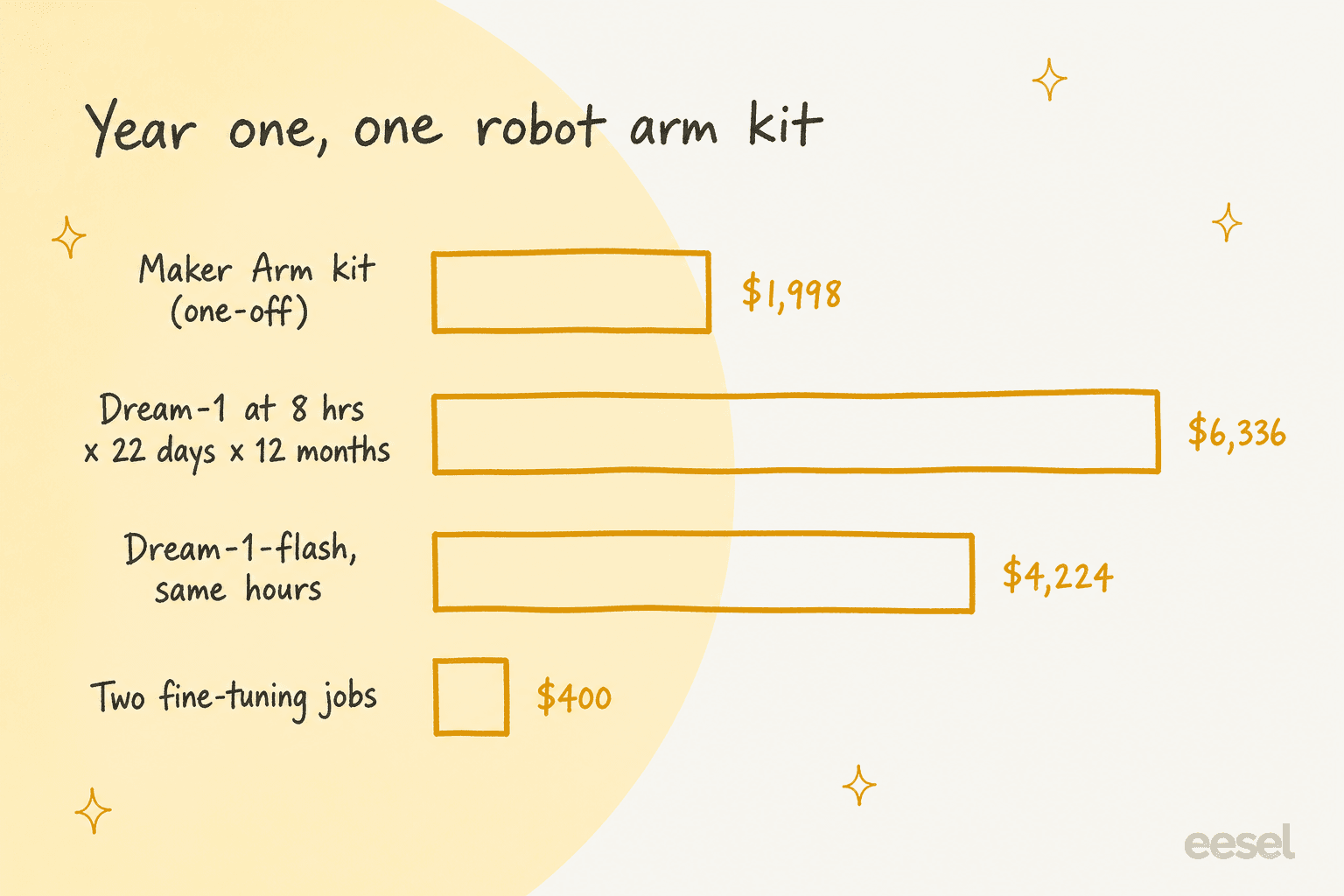
At one shift a day, a year of Dream-1 costs $6,336. On a $1,998 Maker Arm that's 3.2x the hardware, and even on a $5,998 YAM the model costs more than the arm in year one. Only at the top of the ladder, with a $40,000 AI Worker, does the model shrink to a small slice of the bill.
| Robot (Dream Labs price ladder) | Hardware | Year of Dream-1, one shift | Year of flash, one shift |
|---|---|---|---|
| Microduck (Hugging Face) | $399 | $6,336 | $4,224 |
| Maker Arm (MakerMods) | $1,998 | $6,336 | $4,224 |
| OpenYAM (Anvil Robotics) | $3,800 | $6,336 | $4,224 |
| YAM (I²RT Robotics) | $5,998 | $6,336 | $4,224 |
| AI Worker (ROBOTIS) | $40,000 | $6,336 | $4,224 |
None of this makes Dream-1 expensive, and the AI versus human cost math still favors the robot for dull, repeatable work. What it does mean is that the "cheap robot plus cheap brain" story flips once the robot runs every day. The brain turns into the recurring cost, and the arm is the one-off. Most hobby use won't get there, since nobody runs a desk robot for 2,112 hours, but a business that resells robot labor will.
Calculate your Dream-1 cost
Plug in your own robot, hours and task type. The success rates are Dream Labs' published Dream-1 figures, and the hardware prices come from its enabled-robot ladder.
The calculator makes two things obvious. Switching to flash saves exactly a third on run time, but only if flash finishes your task as often as Dream-1 does, and Dream Labs hasn't published success rates for flash. The other thing is that the task-type dropdown moves the per-task cost far more than the model dropdown does.
How does Dream-1 pricing compare with other robot models?
Dream-1 is one of very few robot action models you can pay for by the hour at all. Most of its rivals are either open weights you host on your own GPUs, or closed systems without a public price.
| Model | Maker | How you pay | Public price |
|---|---|---|---|
| Dream-1 | Dream Labs | Prepaid API credit | $3/hr, flash $2/hr, fine-tune $200 |
| Gemini Robotics 2 action model | Google DeepMind | Private preview waitlist | Not public |
| Gemini Robotics ER 2 (planner only) | Google DeepMind | Gemini API tokens | $1 / $5 per 1M tokens in / out until Dec 31, 2026 |
| pi0 / pi0.5 | Physical Intelligence | Open weights, self-host | Your GPUs |
| GR00T N1.7 | NVIDIA | Open, Apache 2.0, self-host | Your GPUs or Jetson |
| SmolVLA | Hugging Face | Open weights, self-host | Your laptop or GPU |
| Helix | Figure AI | Only on Figure's humanoid | Not sold separately |
| S1 | Skild AI | Commercial partners | Not public |
"Free" open weights still come with a real bill. The pi0 repo says fine-tuning needs over 22.5 GB of GPU memory for LoRA on an RTX 4090, and over 70 GB, an A100 or H100, for a full fine-tune. GR00T runs at about 28 Hz on a Jetson AGX Thor. Self-hosting wins on cost at scale if you already own that hardware and have the engineers for it. If what you own is a $2,000 arm kit and a laptop, Dream-1's hourly meter is the cheapest way to get moving.
Gemini Robotics ER 2 is the odd one out, and it's the same family as Gemini 4 Argon for robotics. It's priced like a text model because that's what it is. It plans steps and points at objects, and something else has to turn those plans into motor commands. That's also why the big LLMs lost on cost in Robocurve's test, where Claude Opus 5.5 scored 48 to Dream-1's 59. Dream-1 cost about $0.15 per task attempt, and Dream Labs says that's 16x lower than Gemini 4 Argon, the model whose token pricing I've covered separately.
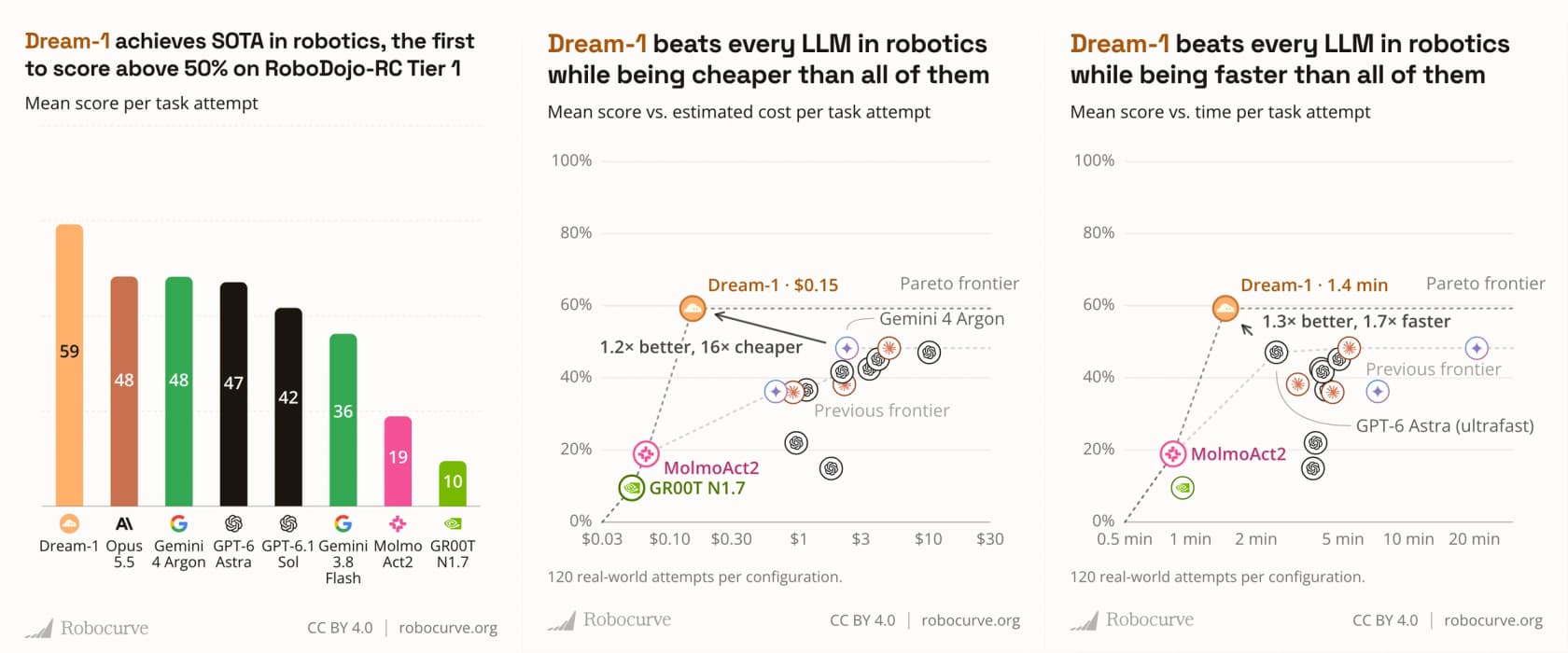
To see what that gap means: a frontier LLM priced like Opus 5.5 or GPT-6 Astra bills for every token it spends reasoning about a grip, while Dream-1 bills for 1.6 seconds of movement no matter how hard it "thinks". For fast, repetitive physical control, the per-hour meter is just the better fit.
Is Dream-1 worth the price?
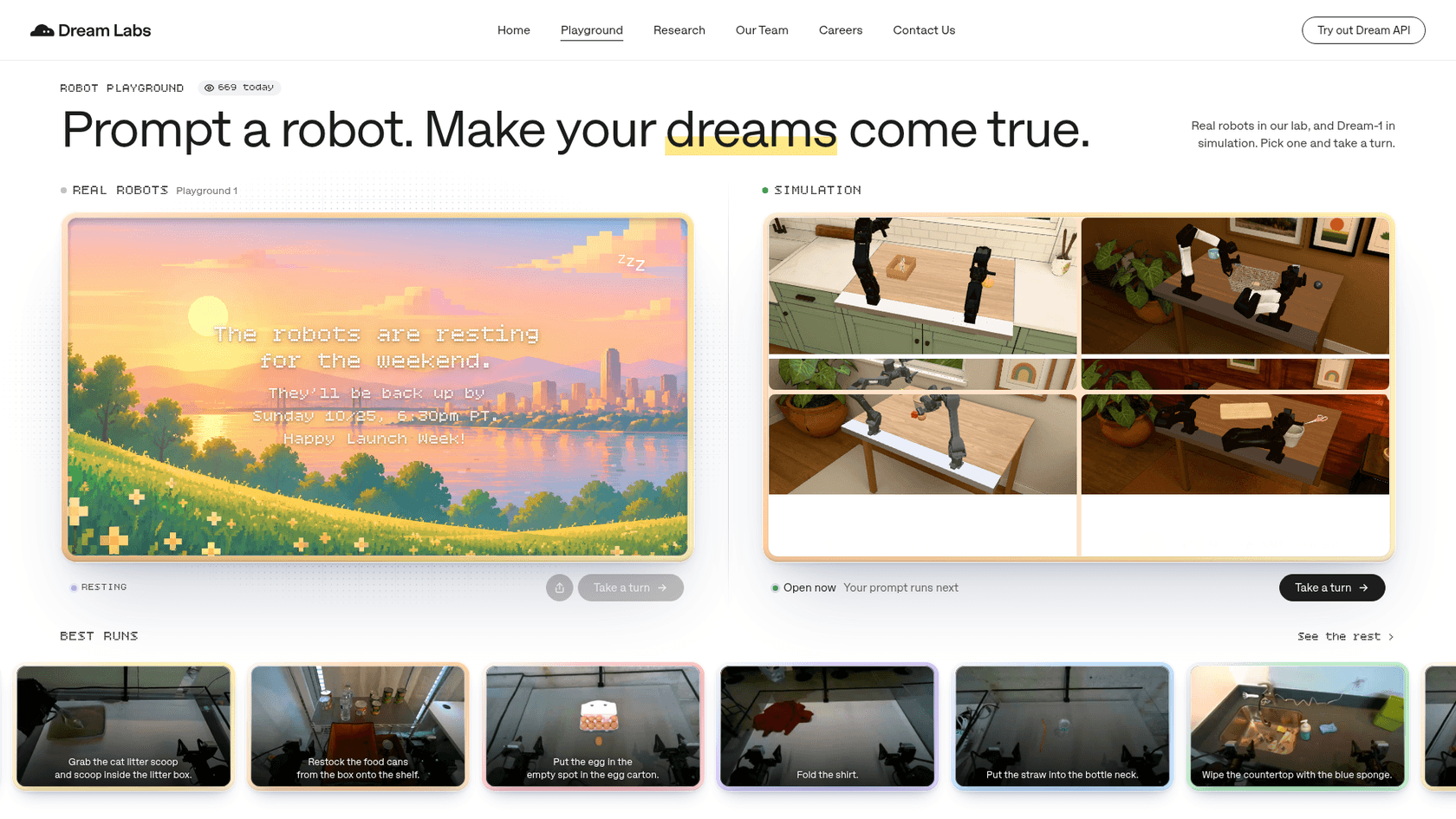
For builders and small teams, yes, as long as you price it per finished task. A $24 shift is a cheap way to learn whether your robot can do a job at all, and with the playground you can check before you spend anything. One Hacker News commenter made the labor-cost argument bluntly:
"You rent a couple of robots who will build it for you for $3/hr."

The skeptics on that thread weren't arguing about price. Their question was whether the robot finishes the job, the same point this whole post keeps coming back to, and Dream Labs' CEO is upfront about it:
"Dream-1 is still a research beta, and it will make mistakes."
Here's how I'd spend money on it:
- Start in the playground and the sandbox. Both are free to try, and the sandbox needs no robot, a similar try-first idea to Google's Project Genie.
- Top up
$25, not$500. Credit doesn't refund, and an hour of testing is$3. - Measure your own success rate on the one task you care about, over 50 or so attempts, then plug it into the calculator above.
- Fine-tune once zero-shot stalls. A
$200job is about 67 hours of Dream-1 run time, which makes it worth it for a task you'll run for weeks, not for one afternoon. - Model your margin at a higher rate than today's. It's a beta, and fees can change on 30 days' notice.
For warehouse or production work, it's too early to put Dream-1's price into a business plan. With a 40% best-case success rate the per-task cost swings too much, and there are no independent results outside the YAM family yet. If you want the full picture of what the model does beyond the bill, my Dream-1 overview covers the benchmarks and the robots it supports.
What if the work you need done isn't physical?
Dream-1 is infrastructure. You still have to build the body and wire it up, then point it at a job. Dream Labs says it plainly, "We're the brain, not the body." For software jobs, you don't need to assemble the parts yourself. eesel is the employee rather than the engine: you hire a ready-to-work teammate for a defined job, today either the AI helpdesk teammate or the AI blog writer. I compare that model with build-your-own agents in the AI employee explainer.
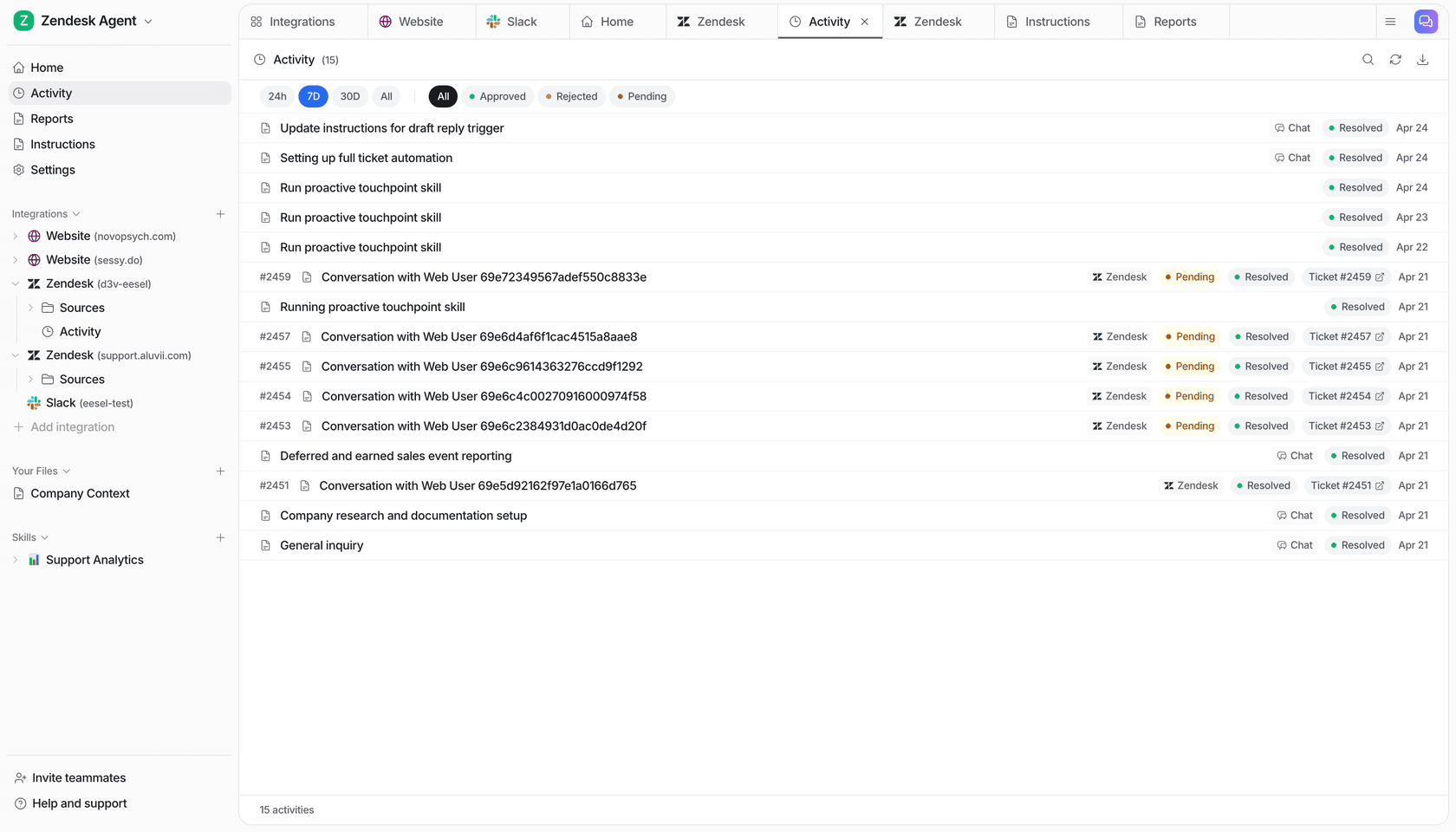
The pricing shape is different on purpose. eesel's pricing is one fixed monthly batch, from $299 for 500 credits, where a ticket or a chat is 1 credit. There's a free trial with 100 credits and no card needed. There are no seat fees, and overage stays off unless you switch it on, at $0.80 a credit with a cap you set. Like Dream-1, a credit counts work handled, not work resolved, so the same per-finished-job thinking applies. I'd rather say that plainly than pretend otherwise. If you want the wider spread of options, my notes on AI support agent costs go deeper.
Hardware companies tend to be a good fit, because their support questions are technical and very specific. IC Intracom, which makes networking gear under two brands, runs one eesel agent per brand on its website chats, answering from 2,100 Shopify product records with specs, stock and part numbers. An industrial automation company goes further: every new support ticket arrives with a drafted answer, sourced only from its technical documents, before an engineer opens it. That's AI documentation search doing a real job.
And if you liked Dream-1's "API call returns actions" design, eesel works that way for software too. The eesel CLI runs the same teammate from a terminal: eesel activity shows recent runs, eesel approvals approves or denies pending actions, and every command prints JSON, so coding agents like Claude Code can drive it, including through eesel's MCP server.
It's the same "planner calls a doer" pattern Dream Labs is betting on, minus the arms. For more on how software agents get real work done today, these AI agent examples are a good start, and my roundup of the best AI teammates shows how eesel stacks up.
Try eesel
Dream-1 rents you a robot brain by the hour and leaves the job to you. eesel gives you a teammate that already knows the job. It plugs into your helpdesk in minutes and learns from your past tickets and docs, then handles tickets for a fixed monthly price you can see before you start. Try eesel free with 100 credits, and see what it does with last week's tickets.
Frequently Asked Questions
How much does Dream-1 cost?
Dream Labs prices Dream-1 at $3 per hour of robot run time and Dream-1-flash at $2 per hour. Each call returns 1.6 seconds of actions, so an hour is 2,250 calls, about $0.0013 per call on Dream-1. Fine-tuning on your own robot is a separate $200 per job. For what the model actually does, see my Dream-1 explainer.
Is there a free tier for Dream Labs Dream-1?
There is no free plan, but adding a card on the Billing page unlocks free credit to try Dream-1 on a robot or in the browser sandbox, and saving the card charges nothing. Dream Labs doesn't publish the credit amount. The public Robot Playground lets you prompt a lab robot without an account. Compare that with Hugging Face pricing, where open robot models like SmolVLA cost nothing but your own compute.
What is the difference between Dream-1 and Dream-1-flash pricing?
Dream-1 costs $3 per hour and Dream-1-flash costs $2 per hour, about $0.0009 per call. Dream Labs calls flash the faster, lighter model. Its published success rates are all for Dream-1, so check flash on your own tasks before you switch to save a third of the bill.
How much does fine-tuning Dream-1 cost?
A fine-tuning job costs $200 at the time of writing, takes about 4 to 5.5 hours, and is charged from prepaid credit when the model is published. A run that stops early is charged in proportion to the steps it reached, and a run with no saved checkpoint is free. Your fine-tuned model then runs at the base model's hourly price, the same pattern as OpenAI API pricing for tuned text models.
Is Dream-1 cheaper than using an LLM like Gemini or Claude to control a robot?
Yes, by Robocurve's numbers. Dream-1 cost about $0.15 per task attempt on the RoboDojo-RC Tier 1 benchmark, and Dream Labs says that is 16x lower than Gemini 4 Argon. Token-priced models like Claude Opus 5.5 also scored lower, 48 against Dream-1's 59.
Does Dream-1 charge for failed robot tasks?
Dream-1 bills every successful API request, and a fumbled grip is still a successful request. Only failed requests, the kind that return an error, are free. So the real number to track is cost per finished task, which on Dream Labs' own success rates ranges from about $0.18 for pick and place to $1.17 for tool use. This is the same handled-versus-resolved question covered in cost per resolution for support AI.
Can I get a refund on unused Dream-1 credits?
No. Dream Labs' console says unused prepaid credit is not refunded, and closing your account forfeits the balance. Top-ups run from $5 to $10,000, so start small. Software teammates such as eesel's AI teammates take the opposite approach with a fixed monthly batch you can resize any time.