It feels like every week a new AI model pops up that can do something straight out of science fiction. We’ve gone from AI that can write a decent email to AI that creates photorealistic images. The next step is AI that generates entire interactive worlds. And that's exactly where Google is heading with Project Genie.
First announced in early 2024 and now running on the more advanced Genie 3 model, this experiment is a huge leap. As of January 2026, a small group of users can now turn simple prompts into playable worlds. It’s the kind of tech that feels like it was pulled from a movie script.
So, what's the real story here? Let's break down what Project Genie actually is, how it works, where it might be used, and what its limits are as an early-access prototype.
What is Google's Project Genie?
At its core, Project Genie is a foundational "world model" created by the team at Google DeepMind. The version you can try out in Google Labs runs on the Genie 3 model.
But what's a "world model"? It's a term for an AI that doesn't just spot patterns in data but actually learns the underlying rules of how an environment works. Think of it as an AI that develops an intuition for a little universe, allowing it to simulate that universe, guess what might happen next, and understand how your actions will affect things.
The key thing to get about Project Genie is that it’s not just making videos or static pictures. It generates interactive, 2D platformer-style spaces you can actually move around in. You can control a character, jump, and explore a world it just created for you, all in real time. It’s less like watching a movie and more like stepping into a dream you just described.
One quick but important note: if you search for "Project Genie," you might also find the AACR Project GENIE®. This is a completely separate and unrelated public cancer research registry. It’s a fantastic project, but it has nothing to do with Google’s AI world model. Just to be clear, we’re talking about the AI that makes playable worlds, not the one helping with oncology research.
How does Project Genie work?
So, how does Google’s AI pull this off? It’s a mix of clever engineering that builds on everything we’ve learned about generative AI so far.
How Project Genie creates worlds from prompts
Genie is multi-modal, meaning it understands different kinds of input. You can give it a simple text prompt like "a spooky forest with glowing mushrooms," but you can also feed it images, photos, or even your own sketches to get things started.
It even has a feature called "World Sketching" that works with the Nano Banana Pro, letting you fine-tune an image before generating the world. This gives you more creative control, so you can tweak the visual style before Genie brings it to life. Google has shown off some neat examples, like making a world with "a shiba inu centered in the frame" or letting you fly "a high-speed paper airplane" through a landscape.
Real-time generation and dynamic events in Project Genie
A key aspect is its real-time generation. Genie doesn't pre-render the entire world at once. Instead, it generates the world on the fly at up to 24 frames per second at 720p resolution, which is smooth enough for a decent game-like experience.
As you move your character with a keyboard and mouse, the model is constantly creating the next piece of the world just out of sight. This is called autoregressive generation, a process where it builds the future based on the immediate past, one frame at a time.
On top of that, Genie includes "promptable world events." This means you can be exploring a world and then type in a new prompt to change things up. For instance, you could be walking through a sunny field and type "make it rain" to dynamically alter the environment you're in.
Maintaining consistency with long-horizon memory
One of the toughest parts of generative models is keeping things consistent. If you walk out of a room and then come back, you expect it to look the same. Genie tackles this by being "auto-regressive" and having a form of memory.
The model can recall details of places you’ve already been, so if you backtrack, the environment stays stable. According to Google, Genie can maintain a consistent world for several minutes of interaction, with its visual memory stretching back for about a minute. It’s not perfect, but it’s a big step toward creating believable, persistent AI-generated spaces.
| Capability | Description |
|---|---|
| Real-time Generation | Operates at up to 24 FPS at 720p, allowing for fluid, game-like exploration. |
| Multi-modal Input | Creates worlds from text descriptions, images, photos, or sketches. |
| Promptable Events | Allows users to dynamically change the world (e.g., weather) using text prompts during exploration. |
| Environmental Consistency | Recalls details of revisited locations for several minutes to maintain a stable world. |
| Controllable Characters | Users can navigate the world with a character that responds to keyboard and mouse inputs. |
What are the potential use cases for Project Genie?
While it’s still an experiment, the tech behind Project Genie could change a lot of industries. It’s not just about making quirky little games from text prompts; the implications are much bigger.
The future of gaming and creative prototyping
The most direct application is in gaming. Imagine creating a unique game world just by describing it. This could completely change user-generated content, letting players build and share their own interactive experiences without knowing a single line of code.
For game developers, this could be a significant tool for rapid prototyping. Instead of spending weeks building a test level, a designer could generate a playable version in minutes. Artists could turn a piece of concept art into an interactive environment instantly, speeding up the creative process and allowing for much faster iteration.
Looks cool. I have a feeling this type of thing will have a niche, but I don't think it will replace many types of games. It will probably be cool to check out a few times and then you kinda get bored because you realize even though you could create anything, it ends up being all kinda the same.

Advanced training for AI agents and robotics
Another significant use for Project Genie is as a training ground for other AIs. Creating realistic simulations to train AI agents is incredibly expensive and time-consuming. Genie offers a way to generate a nearly infinite variety of training environments on demand.
Google is already using it for this. They’ve shown how their SIMA agent can learn to perform tasks, like finding and opening a specific door, inside a world generated by Genie. This lets the agent learn skills in a safe, controlled environment before being deployed in the real world. You can easily see this extending to robotics, where a robot could practice a complex task a million times in simulation, or to training self-driving cars by putting them through countless scenarios without any real-world risk.
Immersive simulation for education and research
Beyond gaming and AI training, there is significant potential in other fields. History students could walk through an interactive reconstruction of the palace of Knossos on Crete just by uploading a photo of the ruins. Scientists could model complex systems, like the spread of a a forest fire or the flow of crowds in a city, to better understand their behavior. It’s a tool for creating sandboxes for almost any field you can think of.
From experimental worlds to reliable business AI
Project Genie is undeniably cool, and it offers a glimpse into a very exciting future. But it's important to remember that, for now, it's a research prototype. The gap between a fascinating experiment and a reliable business tool is a big one.
The current limitations of Project Genie
Google has been upfront about Genie's current shortcomings. As a research prototype, it has a few key limitations:
- Interaction Duration: Generated experiences are currently limited to 60 seconds, and the world's consistency starts to fray after a few minutes of play.
- Limited Action Space: The characters in these worlds can't perform complex, multi-step actions yet. They can move and jump, but that’s about it.
- Inaccurate Simulation: Genie can't create perfect "digital twins" of real-world environments just yet. It doesn't always follow the laws of physics.
- Control Latency: The character controls can sometimes feel a bit laggy, which can mess with the playability.
How AI can learn your business's world today
These limitations show the difference between a futuristic prototype and a dependable tool you can use for your business right now. The core idea behind a "world model," an AI that learns a specific environment, is already a reality in the business world, just in a different way.
Just as Project Genie learns a model of a playable world from internet videos, an AI teammate like eesel AI learns the "world" of your business. It connects to your existing tools and instantly learns from your past support tickets, help center articles, and internal docs. It builds a deep understanding of your company's policies, tone, and common customer problems.
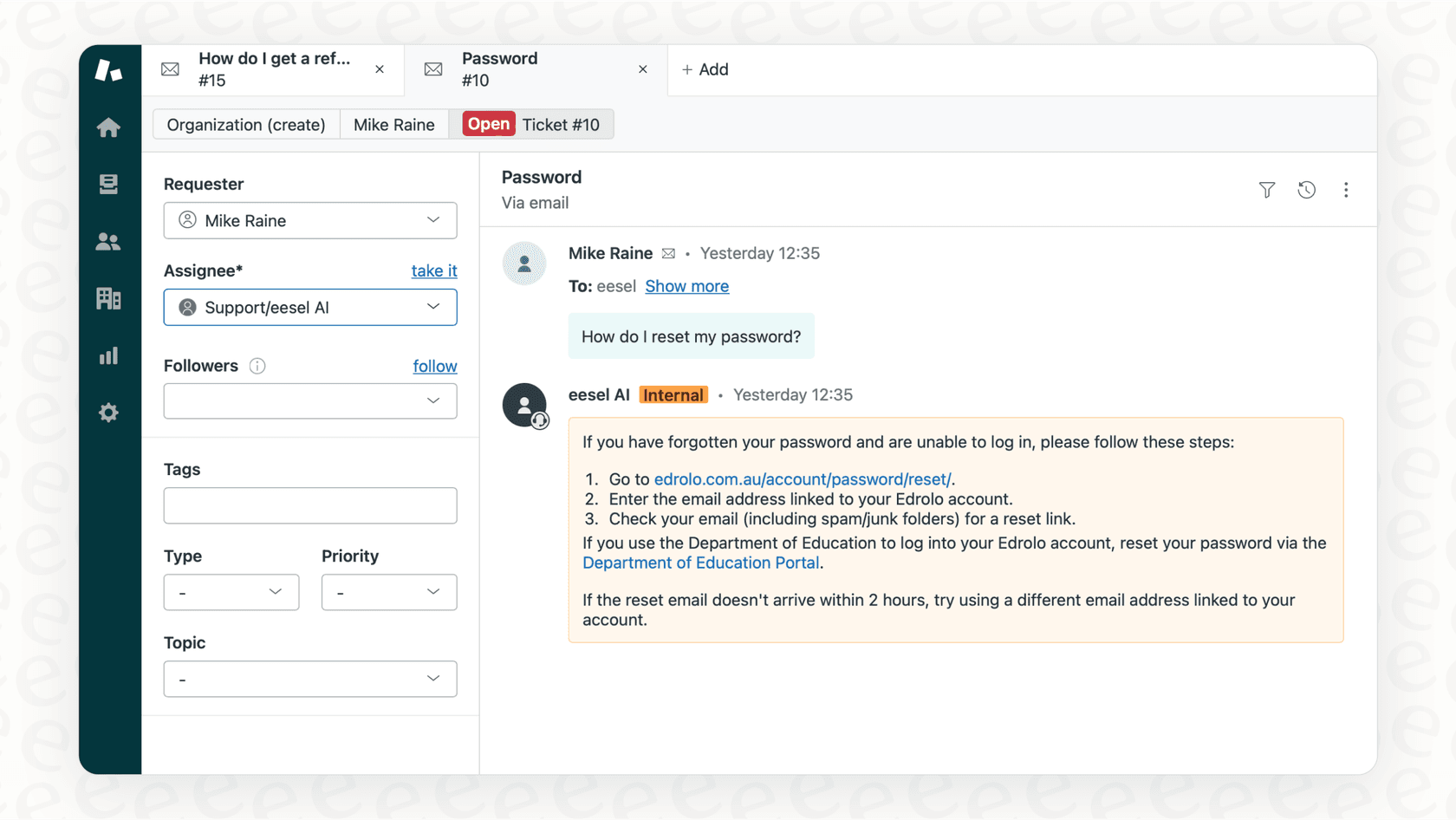
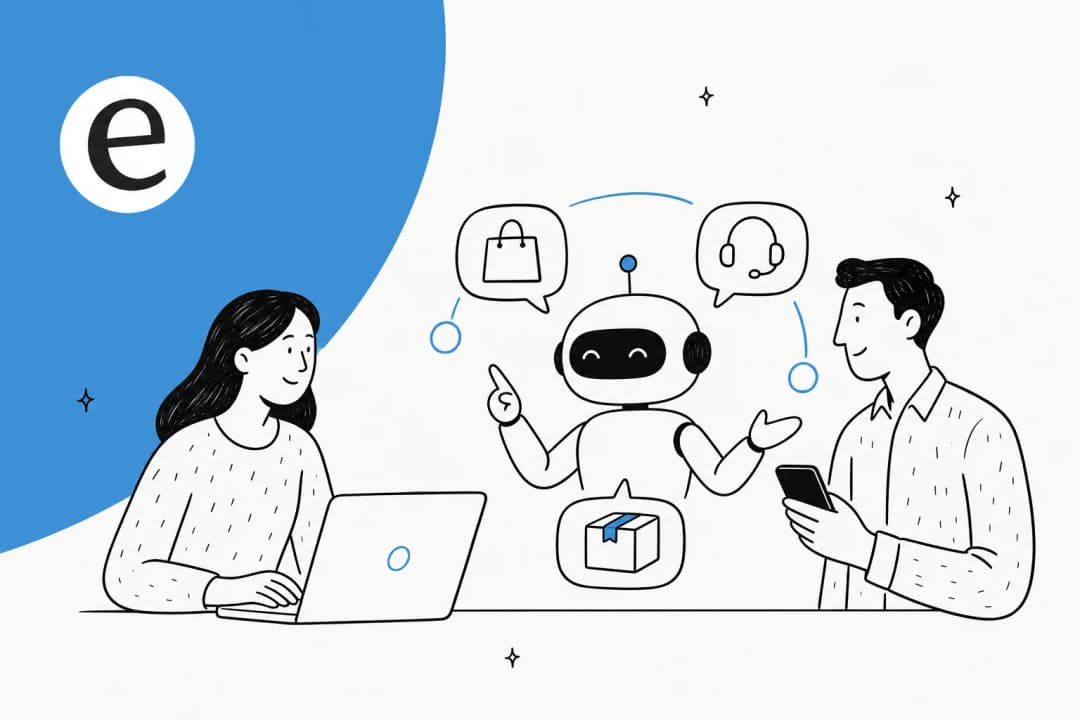
While Project Genie is a fascinating experiment, you can invite an AI agent for customer service from eesel AI that’s ready to go today. It can be trained to understand your business context and autonomously resolve real customer issues.
Furthermore, its performance can be verified before deployment. eesel AI includes a simulation feature. You can run simulations on past tickets to see exactly how your AI teammate would have handled them. You get clear metrics on its performance, letting you fine-tune its behavior and build confidence before it ever interacts with a live customer. It's the "world model" concept, but applied to the real world of your business.
How to get access to Project Genie
If you want to try it for yourself, access is currently limited. As of January 2026, Project Genie is an experimental research prototype in Google Labs.
Here are the current requirements:
- You must be a Google AI Ultra subscriber.
- You must be 18 years or older.
- You must be located in the US.
I think it needs to be said that Genie is not really intended to be fun or useful to humans right now. However, it's a stepping stone towards simulated environments for general agents to inhabit and interact with. This is a long game DeepMind is playing to expand their multimodal models in the (not so far) future. And robots.
Access is tied directly to that subscription tier. Google has said it plans to expand access to more users and regions in the future, but for now, it's an exclusive club.
The dawn of interactive AI worlds with Project Genie
Project Genie, powered by the Genie 3 model, is a significant development in AI technology. It’s a powerful proof-of-concept showing we are on the verge of generating real-time, interactive worlds from simple prompts. Its potential to reshape industries like gaming, AI training, and education is significant.
At the same time, it’s important to see it for what it is today: an early-access experiment with clear limitations. It’s a fantastic glimpse of the future, but it isn’t a polished product.
The core principles that make Project Genie so exciting, like deep contextual understanding and learning the rules of a specific environment, are already here and solving real business problems. While AI-generated playable worlds are still on the horizon, you can leverage an AI that understands your world today.
To see how an AI teammate can learn your company's world and start autonomously handling customer inquiries in minutes, feel free to give eesel AI a try.