

What Skild's S1 actually is
Skild AI is a Pittsburgh robotics lab building what it calls an "omni-bodied" robot brain: one model meant to run any robot for any task. Its tagline is literally "Any robot. Any task. One brain." S1 is the first big model release under that banner, announced in late August 2026.
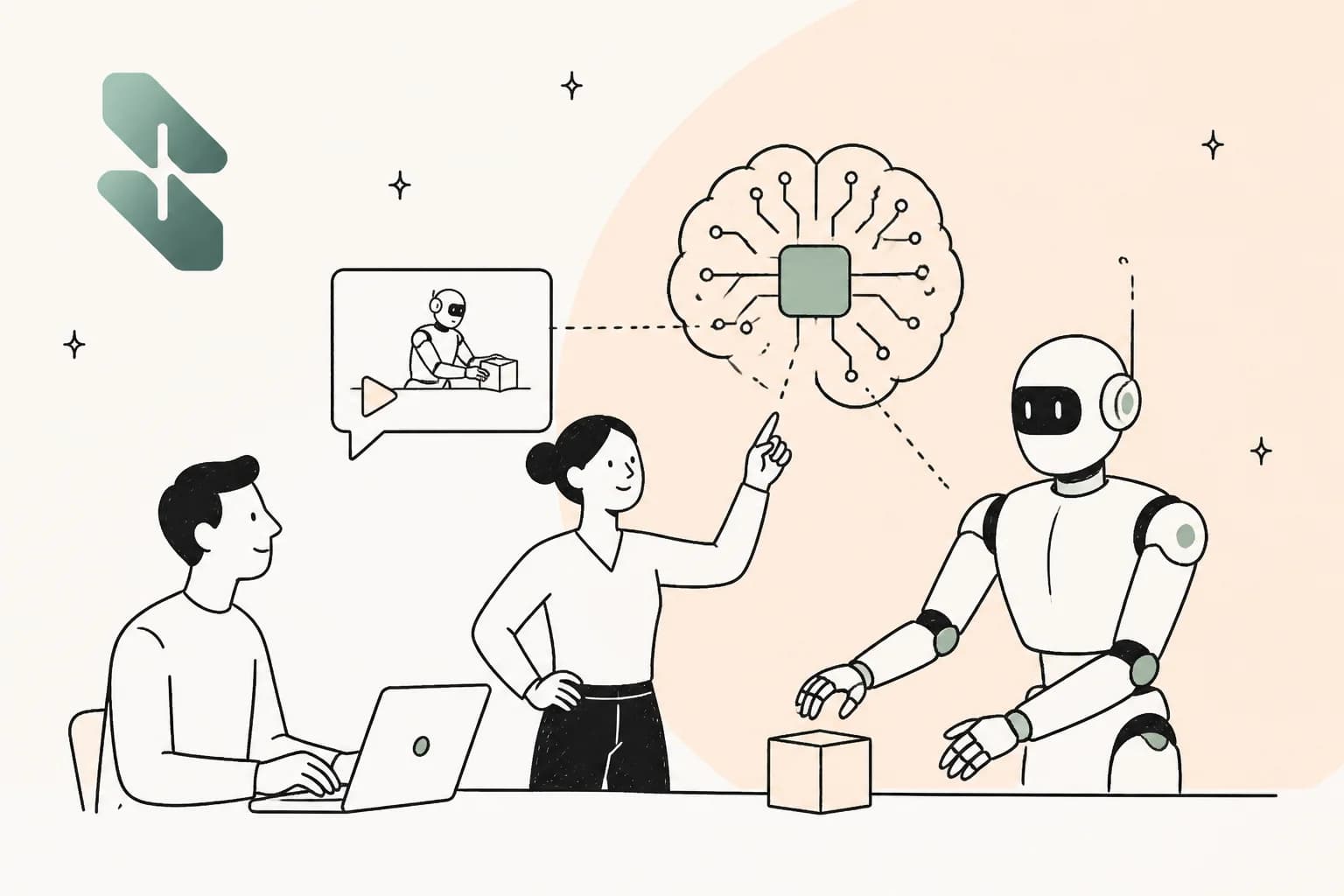
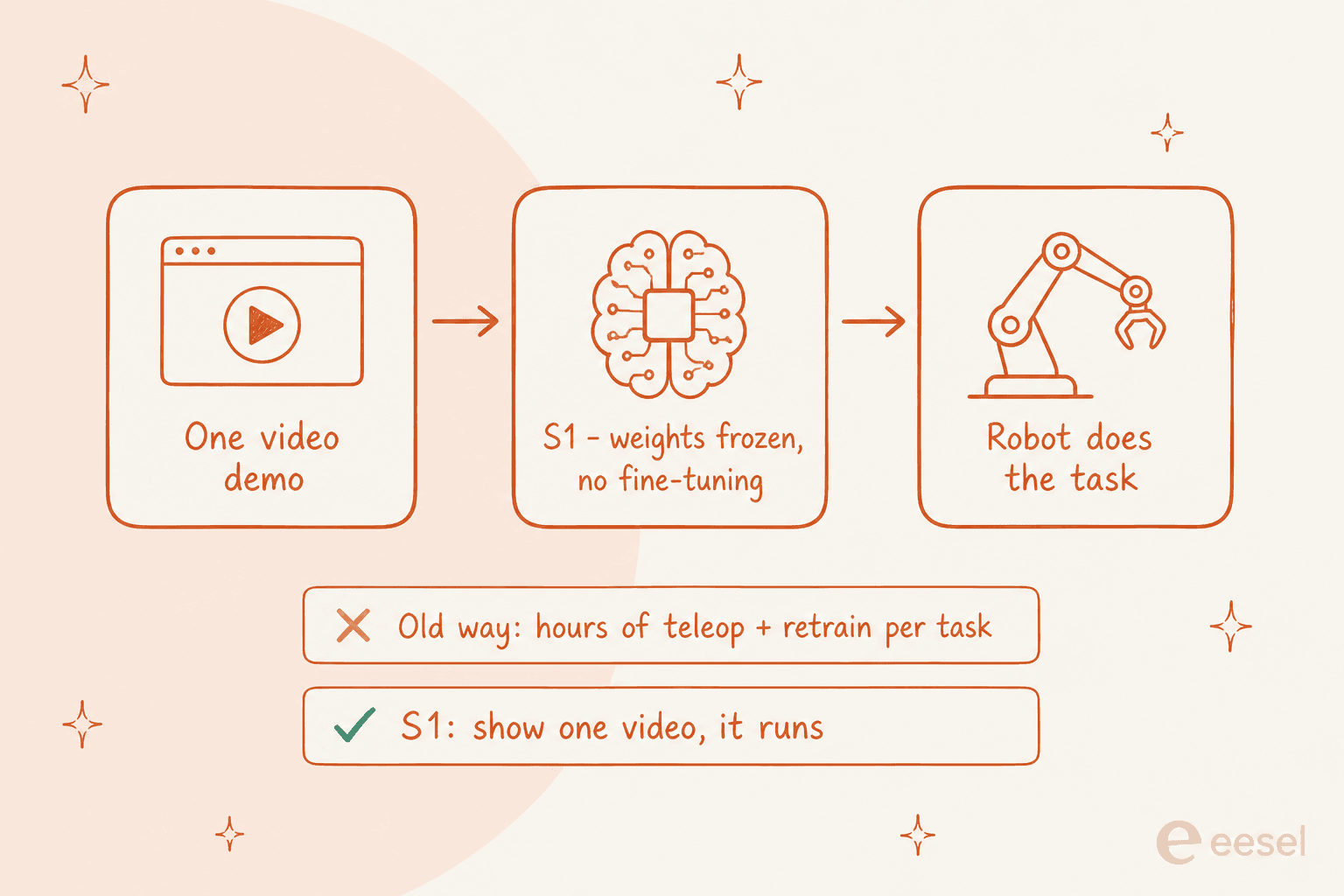
Here is the part that matters. Most robot policies today are specialists. To get a robot doing a new job, teams collect hours of task-specific data and then fine-tune a model on it. S1 skips that. You give it a single video of the task, that video goes into the model's context, and the robot performs the task with the exact same weights that shipped. In Skild's words, "no fine-tuning, no post-training. The same model weights produced every example shown in this blog."
If that sounds familiar, it is the same trick large language models pulled off. A modern chatbot doesn't get retrained every time you ask it something new; you describe the task in the prompt and it figures it out. Skild argues robotics has been "stuck in the BERT era," where every new skill still needs its own training run, and that S1 is the jump to prompting. I build AI agents for a living, and the shift from "retrain per task" to "show it once" is the single most important idea in the whole announcement, so it's worth slowing down on how it works.
The one number everyone is quoting: 66% vs 9%
Skild ran a controlled study to make its case. It trained two models on identical data, architecture, and compute, differing only in how the task was specified: one an in-context learner prompted with a video, the other a language-conditioned policy prompted with text. Then it scaled the training data from 1,000 to 100,000 hours and measured success on long-horizon tasks (4 to 8 minutes each).
On tasks the models had seen in training, both did well at scale: S1 reached 96% versus 89% for the language-prompted version. The dramatic gap shows up on unseen tasks.
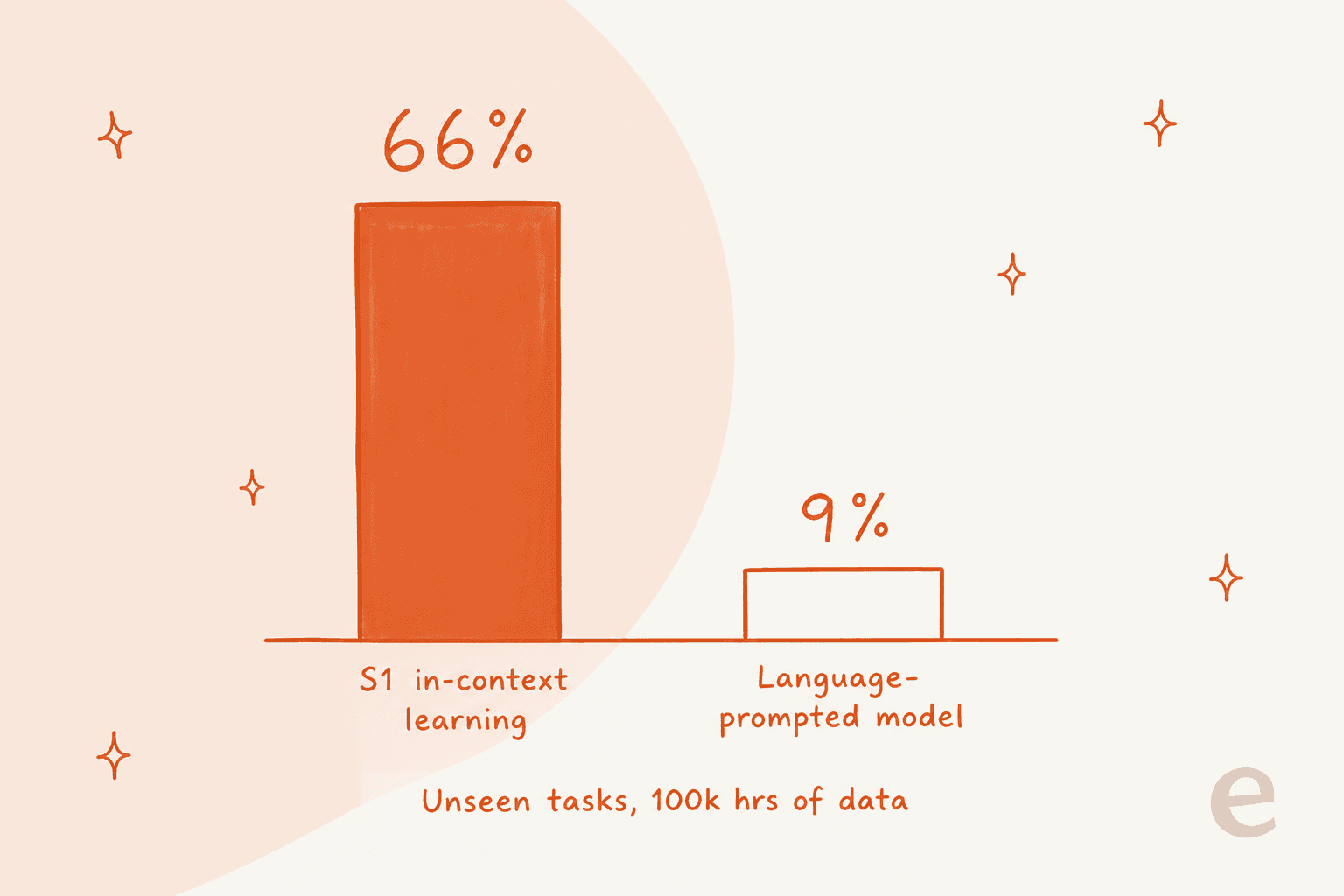
At 100,000 hours of data, the language-prompted model managed just 9% on tasks it had never seen, per Skild's own study. S1's in-context learning hit 66%, roughly seven times better, and the gap widened as the data grew. Skild's explanation is intuitive once you sit with it: language is a coarse way to describe a genuinely new physical skill. "Flip the pancake" doesn't tell a robot what the motion feels like, but a video shows it directly. For novel tasks, a demonstration carries information a sentence can't.
There is a second stat doing a lot of work here. Skild also asked how many hand-collected demonstrations a fine-tuned model would need to match what S1 gets from one video. The answer: a single in-context demo is worth about 380 teleoperation demonstrations, which took 50 to 100 hours of teleoperation to collect. That is the efficiency argument in one line.
How you actually "teach" S1
The demonstration doesn't have to come from the robot itself. It can be an egocentric human video, someone just doing the task while wearing a camera. S1 has to translate that human demo to its own body and the scene in front of it, which means implicitly working out the person's intent, which objects matter, and how far along the task is.
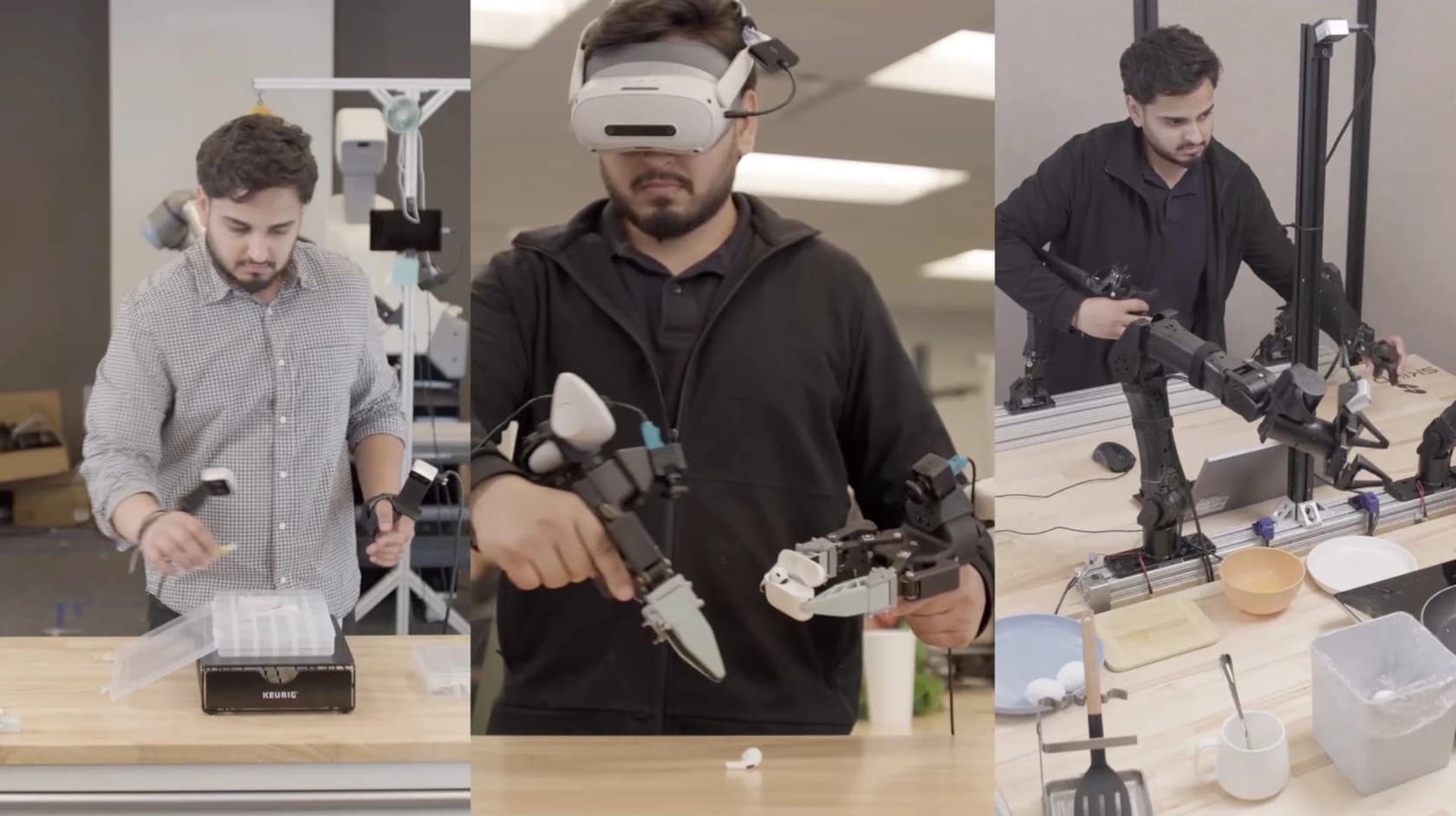
Under the hood, this is meta-learning. Pre-training is the "outer loop" that teaches the model how to learn from a demonstration; at run time, the video drives an "inner loop" that adapts behaviour without touching a single weight. The mechanism is what turns a one-off demo into a working policy.
The behaviour that emerged from this training is the genuinely interesting bit, because Skild says it never collected data specifically for it. S1 recovers from its own mistakes and retries rather than plowing ahead. It shows a rough common sense: if the demo waters a plant with a watering can but only a cup is on the table, S1 uses the cup. And it corrects flawed demos, treating the video as "a specification of the goal, not a trajectory to reproduce." A robot that improves on a sloppy human example is doing something more than mimicry.
What it looks like in practice
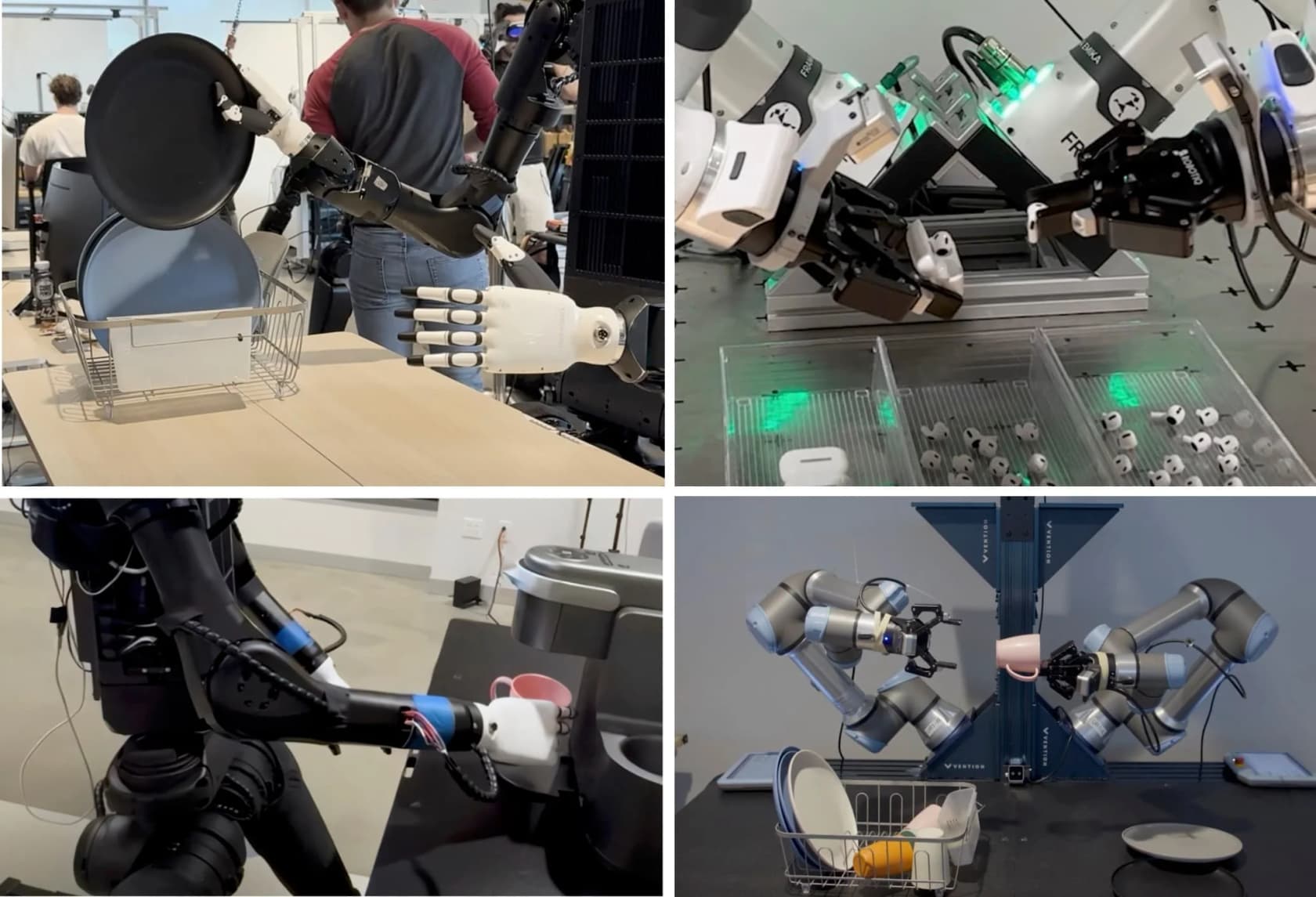
The headline demos are four tasks S1 was never trained on: plant potting, pancake cooking, pour-over coffee, and kit assembly. Each runs up to ten minutes, spans dozens of steps, and is driven by one video.
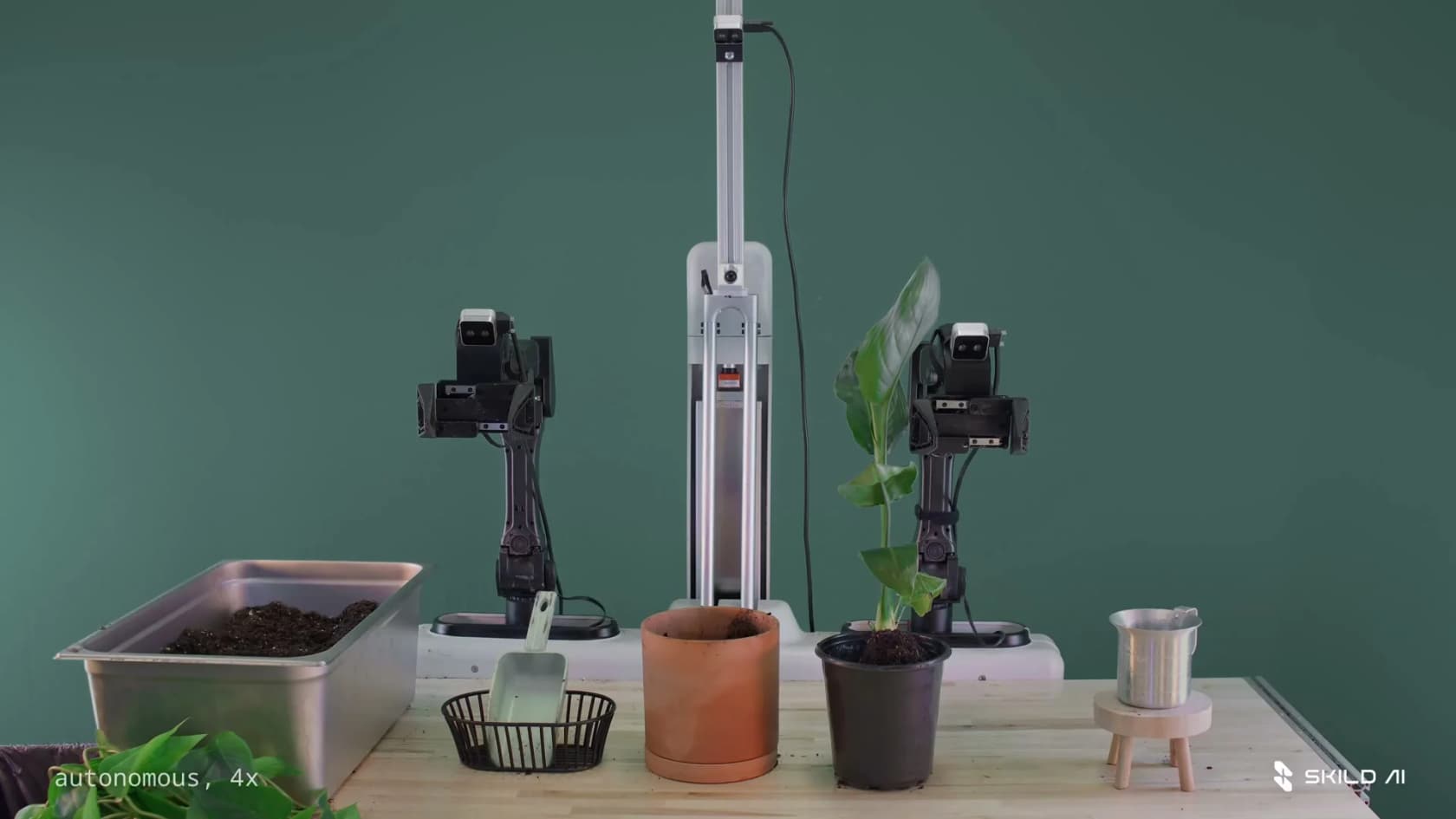
The plant-potting run is the one that stuck with me, because Skild published the timeline. The supplies arrived at the office at 8:54 PM. By 9:22 PM someone had recorded a single human video of the task. At 9:27 PM the robot was potting the plant autonomously. That is 11 minutes from demonstration to a working robot, on a task nobody had built a dataset for. The old workflow starts with hours of teleoperation and a fine-tuning run before the robot does anything.
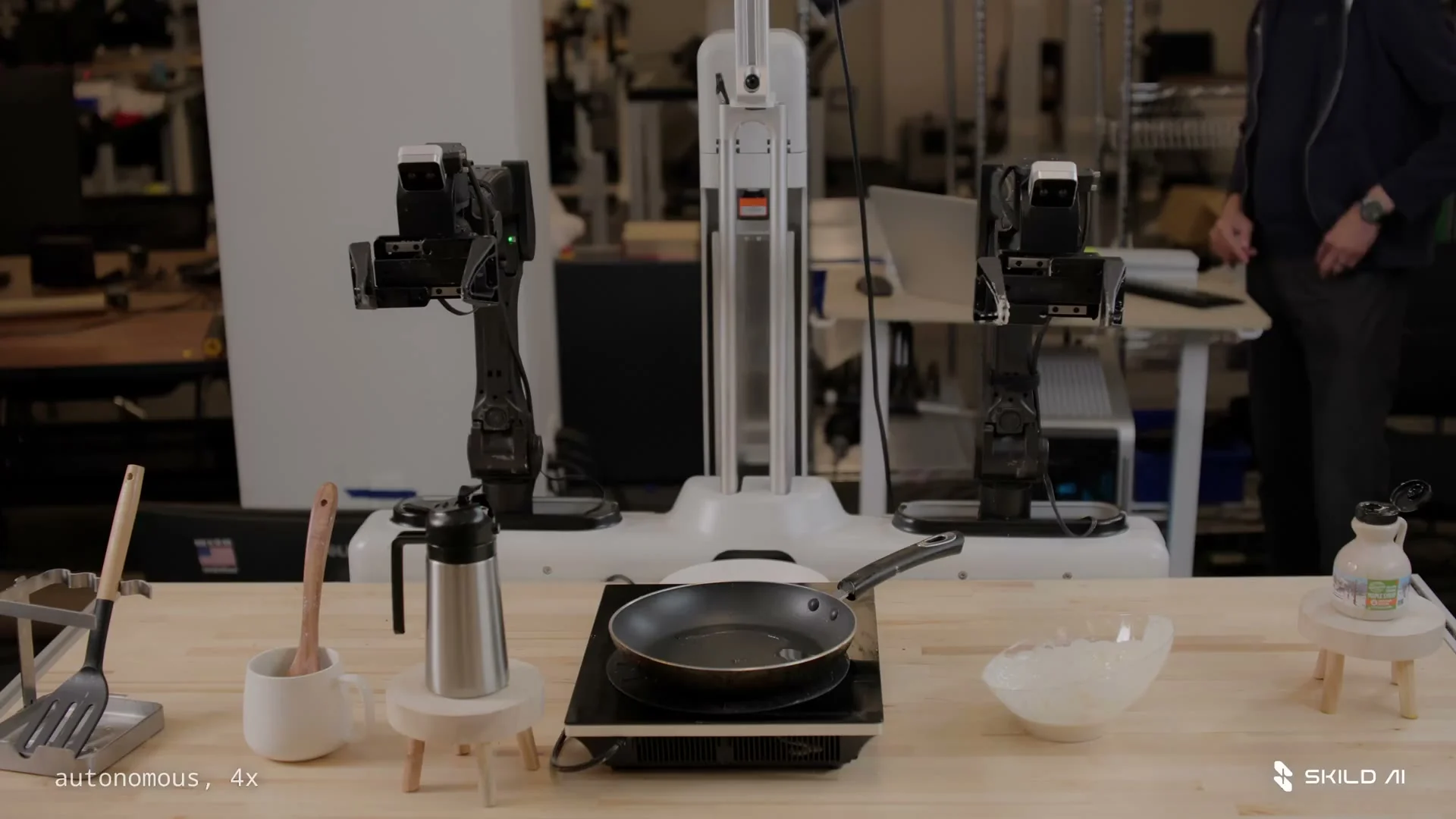
Skild also stress-tested how far a scene can drift from the demo before S1 breaks. It holds up well when objects are shifted by 30 cm and 45 degrees, or even swapped for different objects with the same use, and only degrades sharply when the new layout forces a genuinely different plan (like doing the work with the opposite arm). The language-prompted baseline, by contrast, fell apart up to three times as fast once a novel motion was required.
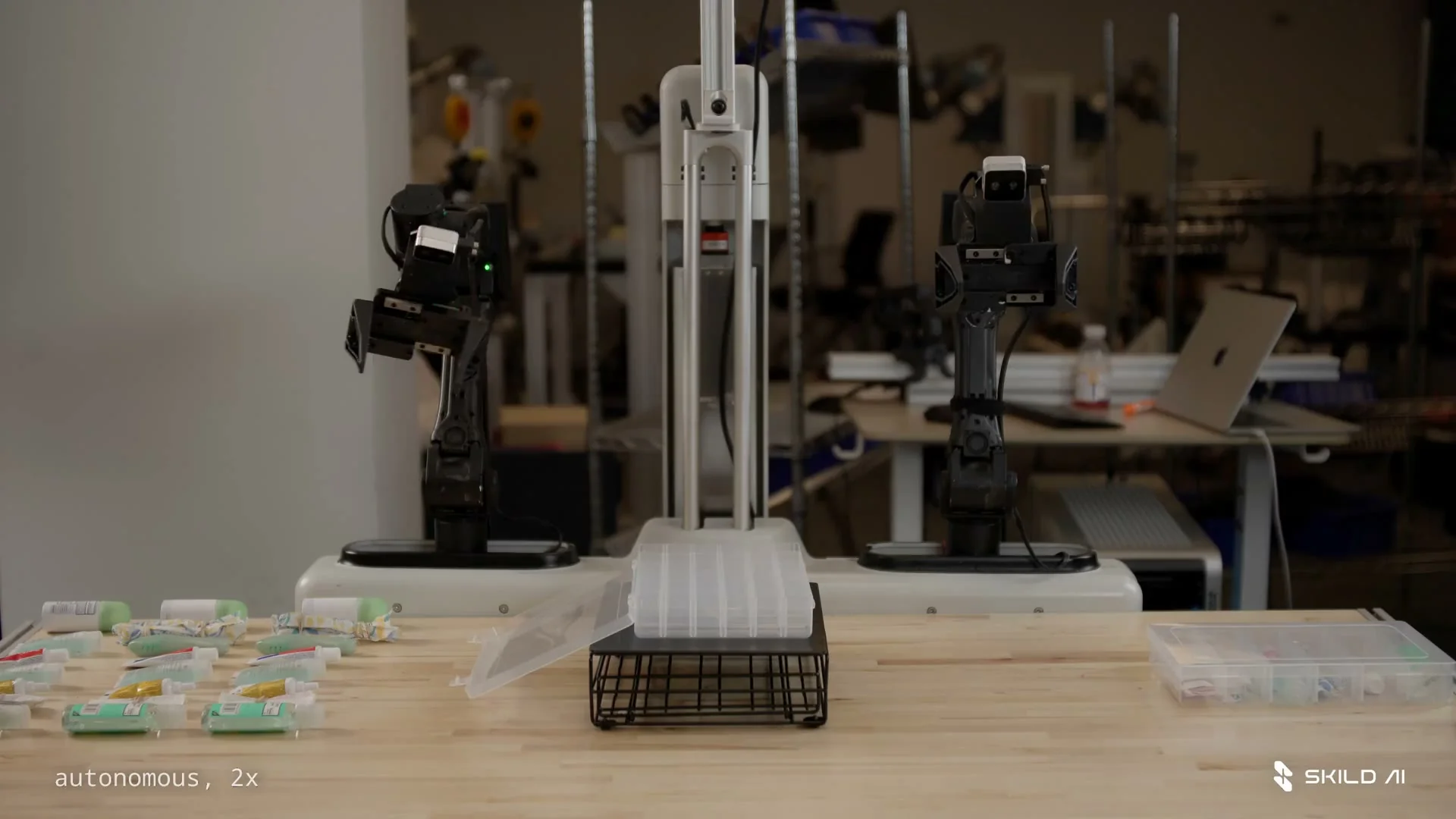
One brain, many bodies
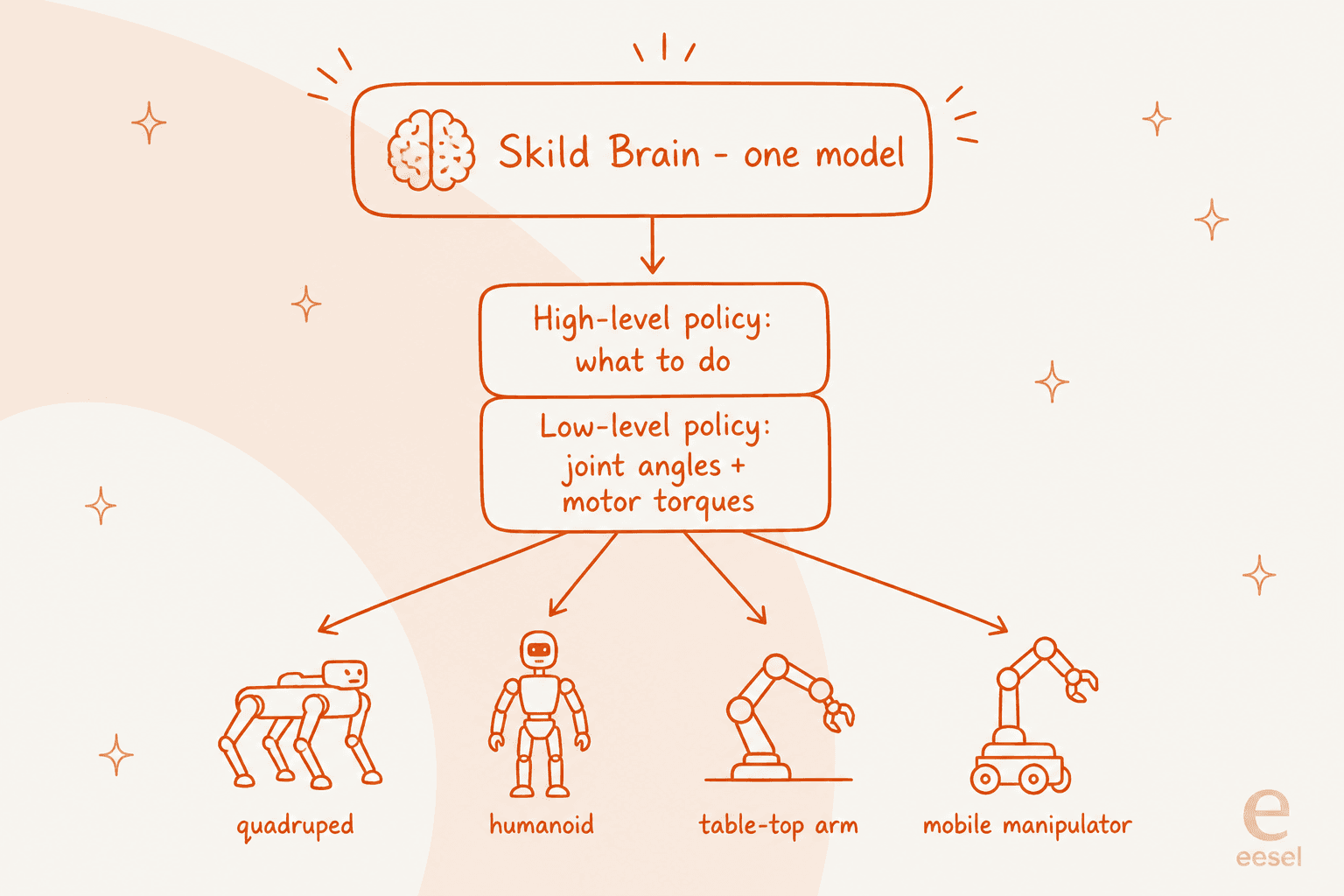
The task demos above all use a two-armed manipulation rig, but the bigger Skild bet is that a single model should drive many kinds of robot. Skild calls it "omni-bodied," and it even folds human video into the mix on the argument that "humans are also a form of robot."
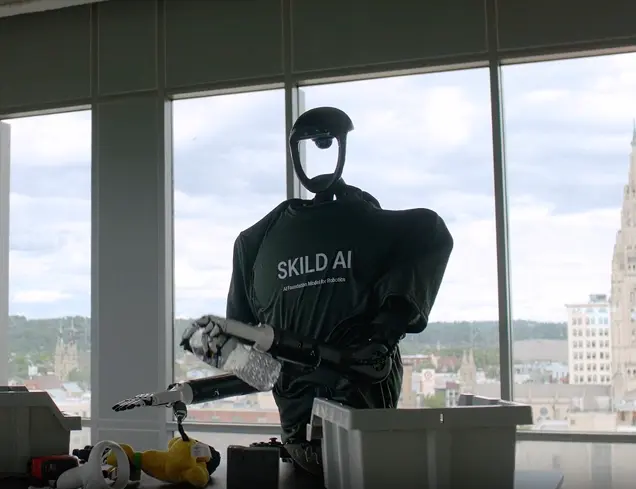
The architecture is a two-policy stack. A slower, high-level policy decides what to do (pick up that cup, move here). A fast, low-level policy turns those decisions into the actual joint angles and motor torques that move the body. Train that stack across many morphologies and, Skild argues, you get two things: more data to learn from, and graceful degradation when hardware changes or fails.
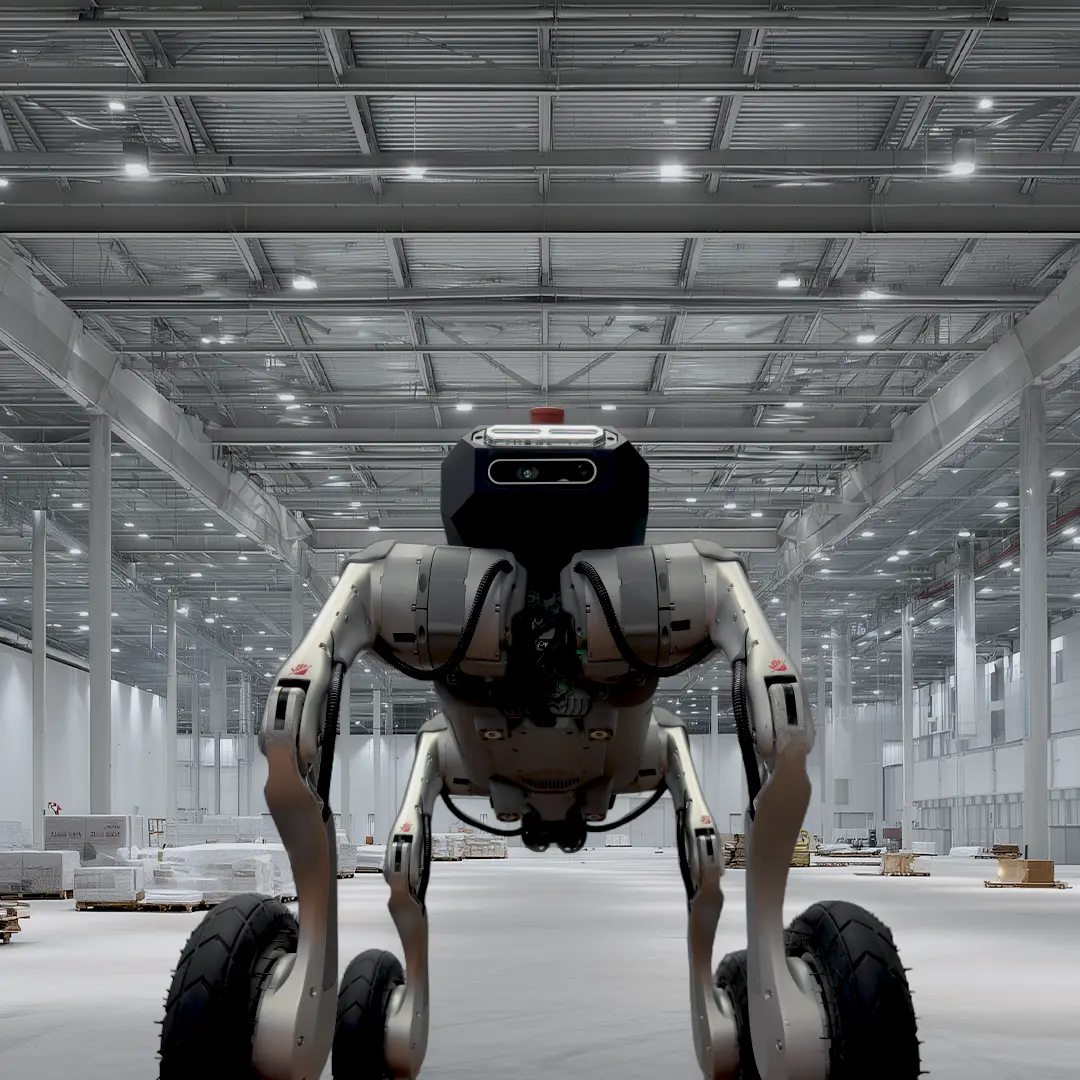
That robustness claim is not just theory in Skild's telling. In its NVIDIA case study, the brain recovers from a jammed wheel in 2 to 3 seconds, handles payloads up to 1.5x its body weight, and even keeps going after losing a limb. The commercial hook there is cost: Skild says the same model runs on $4,000 to $15,000 hardware where conventionally customised systems cost $250,000 and up, which it frames as a 10x cut in total cost of ownership.
The data problem underneath all of it
Every robotics lab hits the same wall: real-world robot data is slow and expensive to collect, and there is nowhere near enough of it. Skild's stance is blunt. It argues you don't need millions or billions of examples but trillions, and that "even if the whole population of earth collects data it will take years to reach 100 trillion trajectories." Real teleoperation alone will never get there.
So Skild leans on sources that scale. No single one wins on everything, so it combines them:
| Data source | Looks like the robot | Task variety | Cheap to scale |
|---|---|---|---|
| Robot teleoperation | High | Low | Low |
| UMI handheld grippers | Moderate | Moderate | Moderate |
| Egocentric human video | Low | High | High |
| Simulation | Moderate | Low | High |
The recipe: pre-train the brain on large-scale simulation plus internet human video (both effectively infinite), then post-train on targeted real-world data. Skild runs this on NVIDIA's stack, using Isaac Lab for reinforcement-learning scenarios, Omniverse for physics, and Cosmos to generate synthetic variety, which it says compresses "a millennium of experience within days." It also spends heavily on cleaning that data: "for every dollar we spend on collecting data, we spend three on quality control."
This is also where Skild throws its sharpest elbow. It dismisses rivals who "start with an existing [vision-language model] and sprinkle in less than 1% of real-world robot data" and call the result a robotics foundation model. Those, Skild says, are a "Potemkin village": they have semantic knowledge but "lack the true substance of grounded actionable information." Whether that critique is fair is exactly what the coming year of real deployments will settle.
Who is behind it, and the money
Skild was founded in 2023 by Deepak Pathak, its CEO, and Abhinav Gupta, both professors at Carnegie Mellon's Robotics Institute who, per Sequoia, "discussed starting a company for a decade" first. Their research lineage (scaling robot data, curiosity-driven learning, large-scale sim-to-real) is the actual foundation the product sits on, which is a nice change from a lab that appeared out of nowhere.
The funding tells you how seriously the market takes the bet. In its latest funding round, Skild just raised $1.4 billion, tripling its valuation to more than $14 billion, in a deal led by SoftBank with participation from NVIDIA's venture arm, Bezos Expeditions, Samsung, LG, and Salesforce Ventures, among others. That brings total funding to about $1.83 billion. Skild also told Crunchbase it went from roughly zero to $30 million in revenue "in just a few months" in 2025. For comparison in the same space, humanoid maker Figure AI has been raising at its own eye-watering numbers, so S1 lands in a robotics funding environment that hit $13.8 billion in 2025.
What the robotics world is saying
Reaction split fast, and both sides are worth hearing. On the bullish end, respected AI voices called it a milestone. Immunologist and prolific AI commentator Derya Unutmaz put it plainly:
"This is super exciting advance in robotics AI! I believe S1 is the most impressive robot foundation model I had seen! ... In Skild's internal benchmarks, S1 achieved a 66% step-success rate on unseen tasks versus 9% for a language-prompted model, while one video demonstration provided roughly the benefit of 380 post-training examples!"
The skeptics aren't dismissing the work, they're pointing at where robot demos historically break. A reply on that same thread caught the mood well:
"'66% on internal benchmarks' is doing a suspicious amount of lifting. robotics demos always look like the future until lighting, grippers, clutter, and failure recovery show up. in-context prompting is cool; the physical world still charges interest."
Both are right at the same time. The in-context result is real and the method is sound. The numbers are also all Skild's own, on Skild's own benchmarks, and a controlled lab is a forgiving place. To Skild's credit, it says S1 is "already at work with our commercial partners," so real-world evidence should follow. Until then, the honest read is: promising, unusually well-grounded for a launch, and unproven outside the lab.
Where eesel fits in an AI-teammate world
S1 is exciting because it points at a future where physical work gets automated the way software work already is. But notice the tense: that future is still being demoed. If your problem is a queue of support tickets or a content backlog rather than a plant that needs potting, you don't have to wait for a robot brain. The "learn from your own context, then do the work" idea that makes S1 interesting is already shipping in software.
That is the shape of eesel: you hire ready-to-work AI teammates for specific jobs, and each one arrives already knowing your company. The AI helpdesk teammate joins your existing Zendesk, Freshdesk, or Gorgias queue, learns from your past tickets and help center, and drafts or sends replies. It even simulates against your historical tickets before it goes live, which is our version of "test it before you trust it."
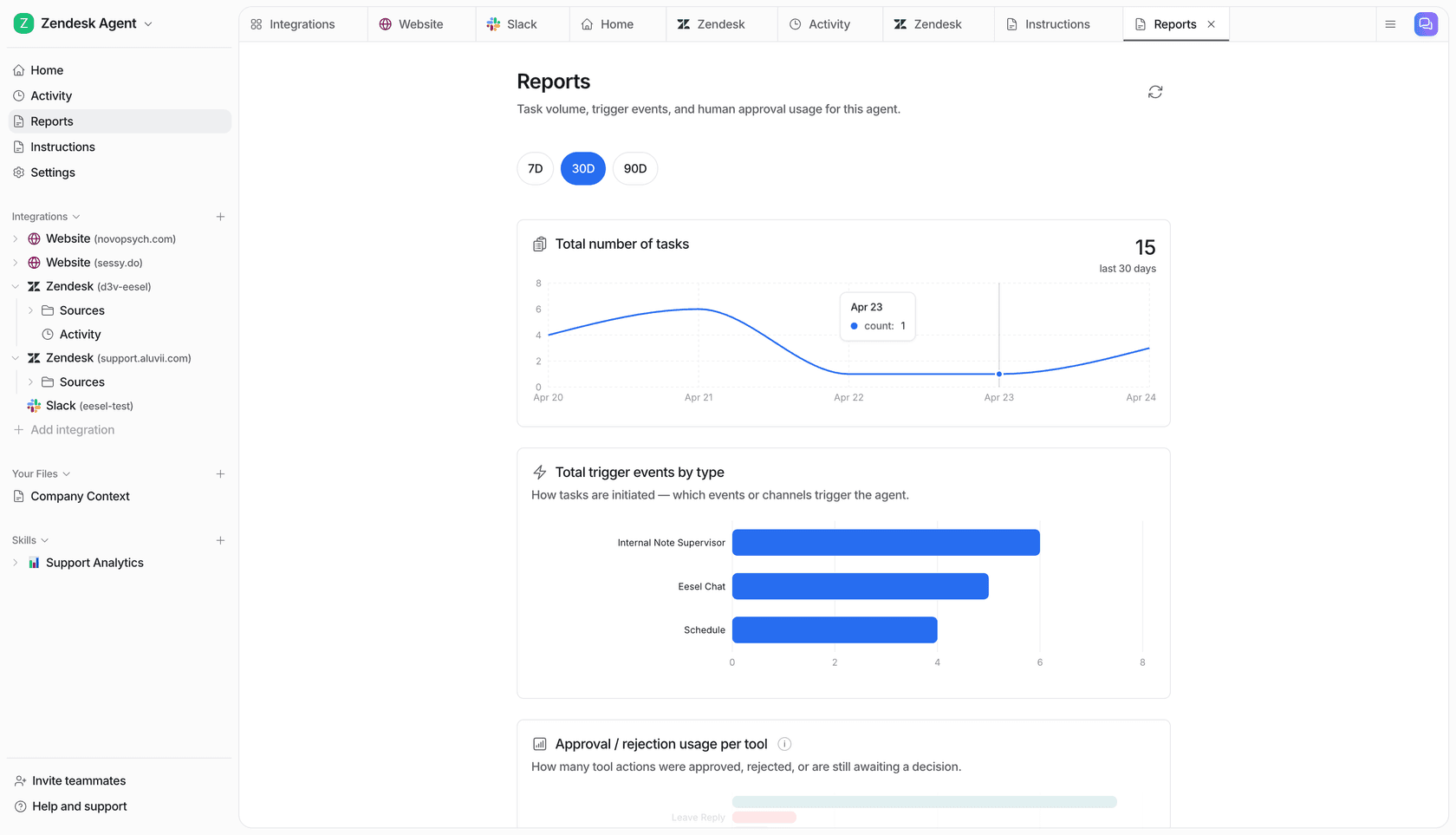
The other teammate on the roster is the AI blog writer, which researches and drafts long-form posts (this kind of post, in fact). Where S1 needs a video demonstration, an eesel teammate needs your knowledge base, and where S1 is a lab result, these are live in minutes with a free trial and no sales call. If you want the physical-robot future, watch Skild and its emerging rivals. If you want AI doing real work in your business this afternoon, you can try eesel free, no sales call needed.
Frequently Asked Questions
What is Skild AI's S1?
Skild AI's S1 is a robotics foundation model announced in August 2026. Instead of retraining a robot for every new job, you show S1 a single video of the task and it performs it, using the same frozen model weights. It is the flagship release of Skild's general-purpose robot brain.
How does Skild S1 learn a new task?
S1 uses in-context learning: the task is specified by a video demonstration (even an everyday human video), which goes into the model's context window with no fine-tuning. On unseen long-horizon tasks Skild reports a 66% step-success rate versus 9% for a language-prompted baseline. There is more detail in the Skild AI review.
Can I buy or use Skild AI S1 today?
Not directly. S1 is a research and capability announcement, not a purchasable product with public pricing or an API, and Skild says it is already running with commercial partners. If you want AI that does real work now, see these AI agent examples.
How much funding does Skild AI have?
In its latest round, Skild AI raised $1.4 billion, tripling its valuation to about $14 billion, in a SoftBank-led deal, bringing its total raised to roughly $1.83 billion. It was founded in 2023 by two Carnegie Mellon robotics professors.
Is Skild S1 the same kind of AI as a customer service chatbot?
No. S1 is embodied AI, a brain for physical robots. A support agent like an AI agent vs chatbot works in software, resolving tickets and chats. Both learn from examples, but one moves a robot arm and the other drafts a reply inside your helpdesk.