

What Microduck actually is
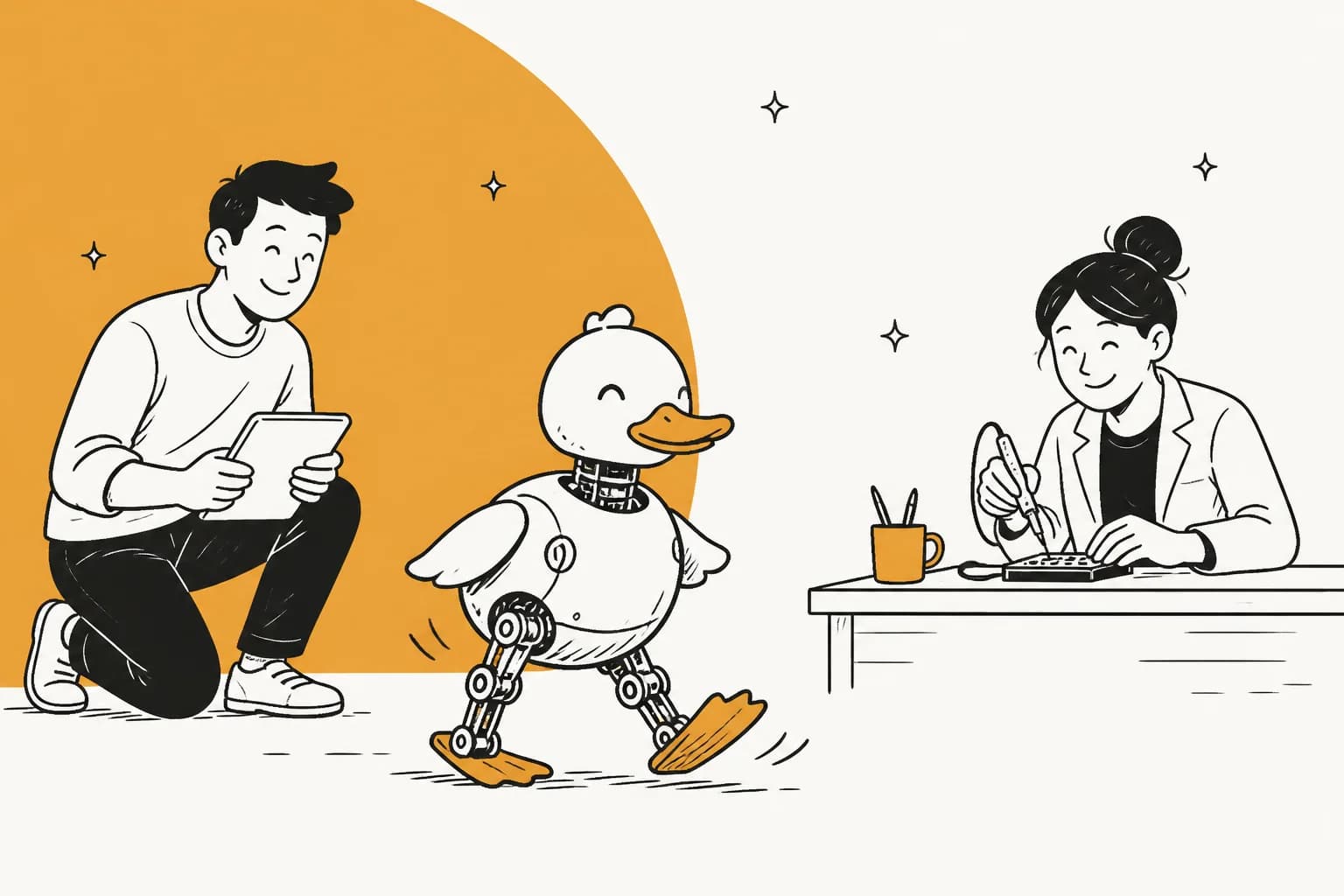
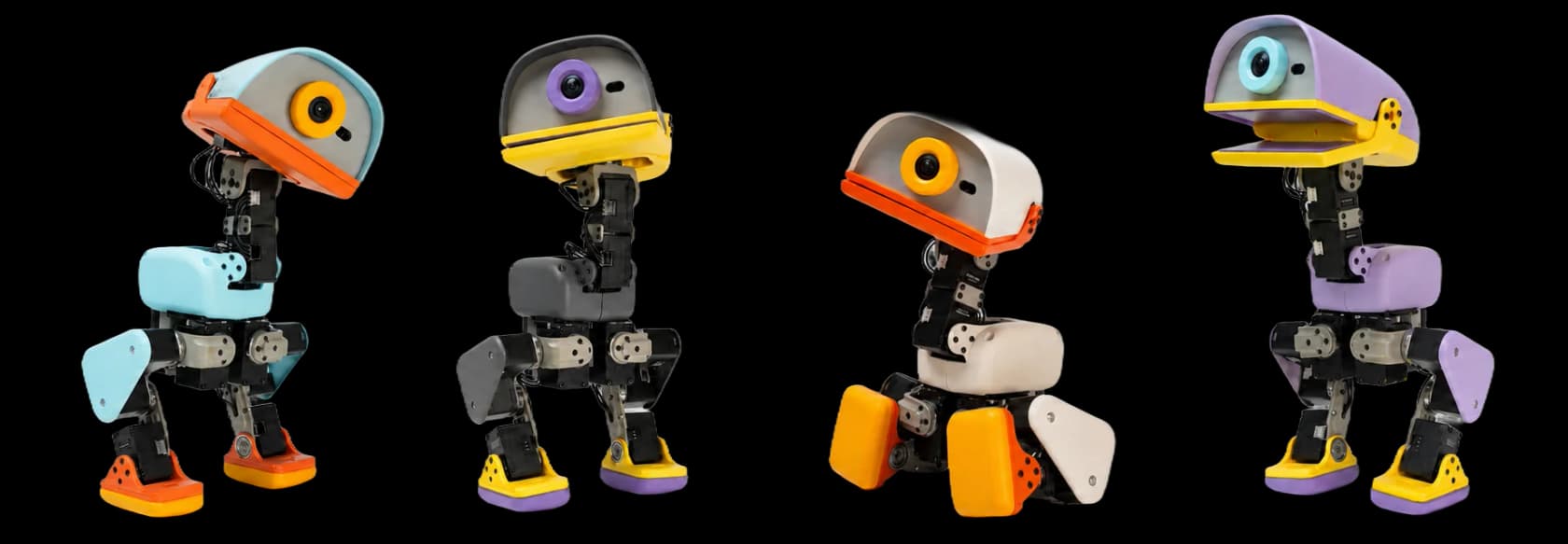
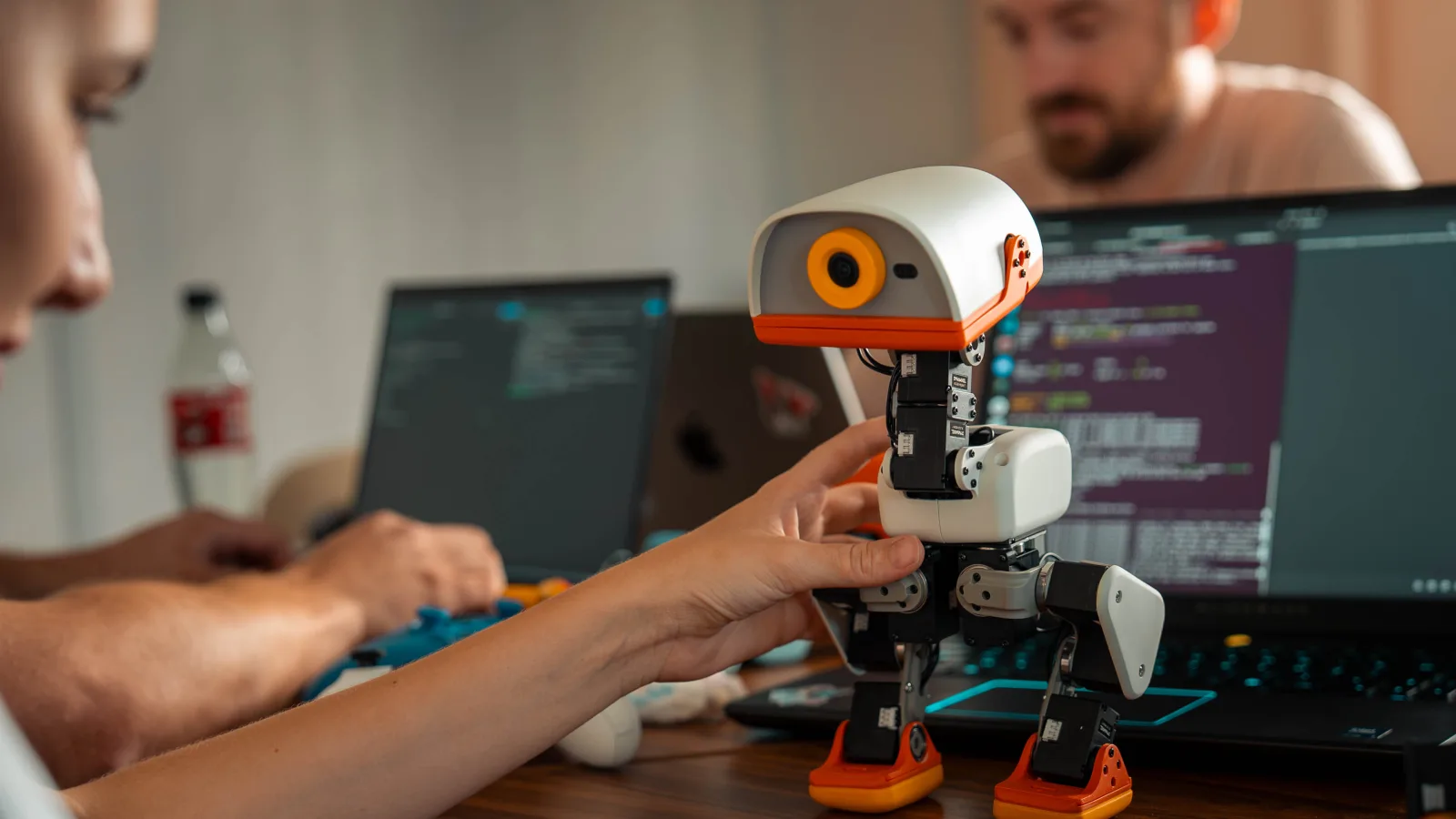
Microduck is a 25 cm tall biped that weighs under 800 g and fits in one hand. It has 15 motors, a front camera, a small depth sensor, two motion sensors, and an articulated beak it uses to pick things up. It's the second consumer robot from Pollen Robotics, the Bordeaux team founded in 2016 by former Inria researchers that joined Hugging Face in April 2025.
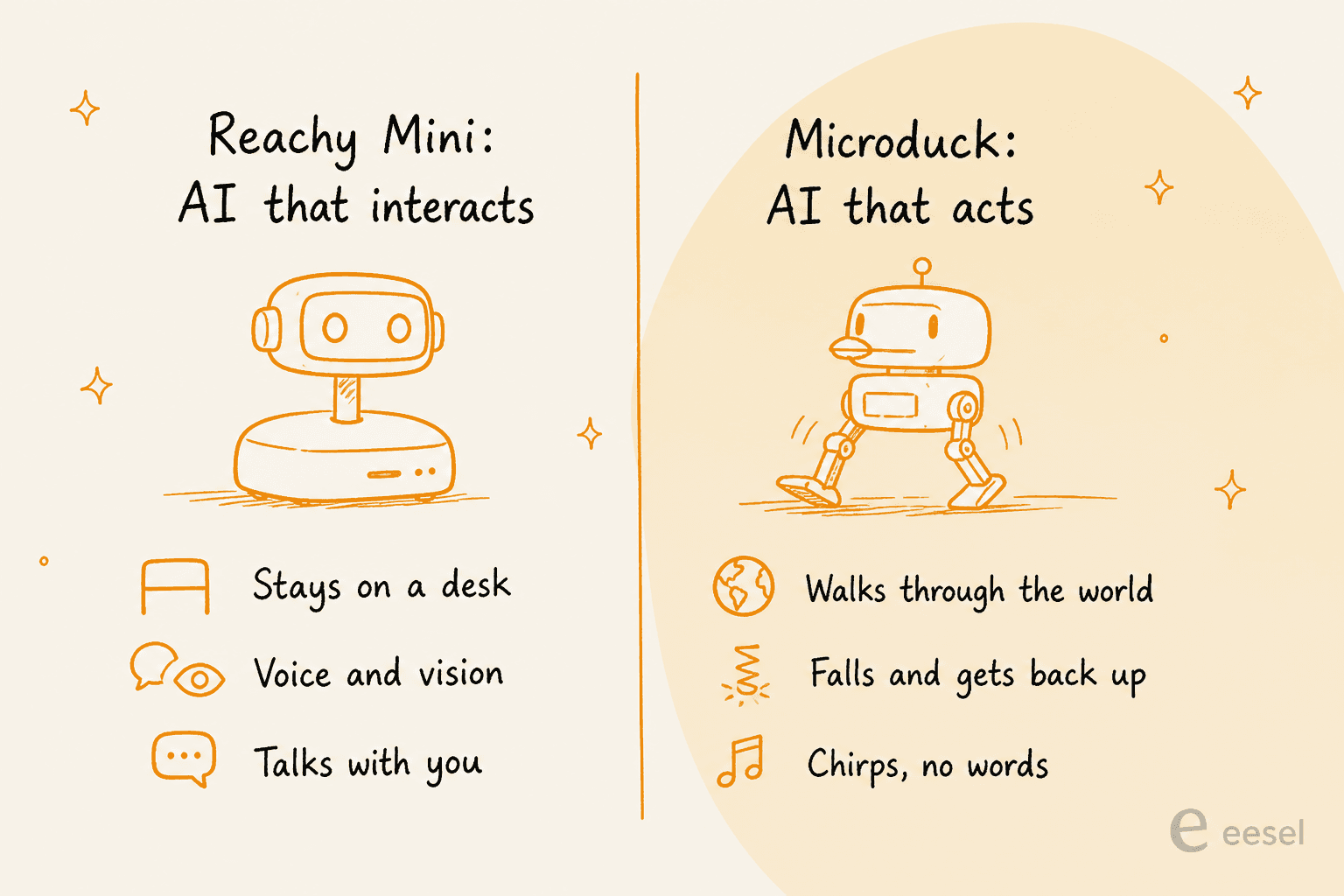
The framing from the launch team, laid out in the launch post, is the part worth holding onto. Their last robot, Reachy Mini, is a desktop companion that stays put and talks to you, and it has sold more than 10,000 units. Microduck asks a different question: what does a small robot look like if its job is to move through the world instead of sit on a desk? So it doesn't speak with words. It communicates through weird little sounds, and each unit generates its own voice the first time it wakes up and keeps it for life.
The specs, without the marketing
For something this small, the sensor list is dense. The brain is a Rockchip RK3566 with an AI accelerator, paired with 1 GB of RAM and 32 GB of storage, running the behavior policy at 50 Hz. Here's the full sheet, all from Pollen's press kit and product page.
| Component | Spec |
|---|---|
| Motors | 15 degrees of freedom across legs, head, and neck |
| Size and weight | 25 cm tall, 14 cm wide, under 800 g |
| Compute | Rockchip RK3566 with AI accelerator |
| Memory | 1 GB RAM, 32 GB storage |
| Vision | Front camera with a REC-light-style indicator |
| Depth | 8x8 time-of-flight LiDAR matrix |
| Motion sensing | Two IMUs, one in the body and one in the head |
| Manipulation | Articulated grasping beak |
| Audio | Microphones and speaker, per-robot generated voice |
| Wireless | Wi-Fi and Bluetooth, plus two NFC antennas |
| Battery | Removable NP-F550, 2600 mAh, around 1 hour |
| Trained moves in the box | 7 |
Two honest caveats. The battery is a standard NP-F550 camera cell good for about an hour, so plan on swapping if you're doing a long training session (the Charger pack exists for exactly this). And Pollen flags several numbers, including camera resolution, LiDAR range, and radio versions, as not final yet, so treat the sheet as provisional until the first units ship.
Interaction versus action: why a duck, and why now
The cleanest way to understand Microduck is against its own sibling. Reachy Mini is a platform for AI that interacts. Microduck starts, as the team puts it, from the other side of physical AI: action.
Why make it small? Because learning to move is messy. As Pollen puts it, a robot has to try things, fail, and try again. On a full-size humanoid, every bad attempt is expensive, hard to reset, or unsafe. Make the robot small and light and a failed behavior usually ends with a little robot on the floor, not a major incident. It even stands itself back up, so you're not resetting it by hand after every fall. That single design choice, keeping the stakes of failure low, is what makes the whole learning loop accessible outside a research lab.
This is Microduck riding the 2026 wave everyone's calling physical AI: teach a motor skill in simulation, then transfer the learned policy to real hardware. NVIDIA has built its robotics pitch around exactly this, and Hugging Face itself frames simulation as the training ground for physical AI. Microduck is a $399 consumer on-ramp to that pipeline. It's the same shift from scripted rules to learned behavior that reshaped software agents, the one I dug into in AI agents versus rule-based chatbots, now happening in hardware you can hold.
How you actually teach it something
Here's the mechanism, because it's the whole point. Every one of the seven shipping behaviors is a policy you can retrain, and the loop is four steps.
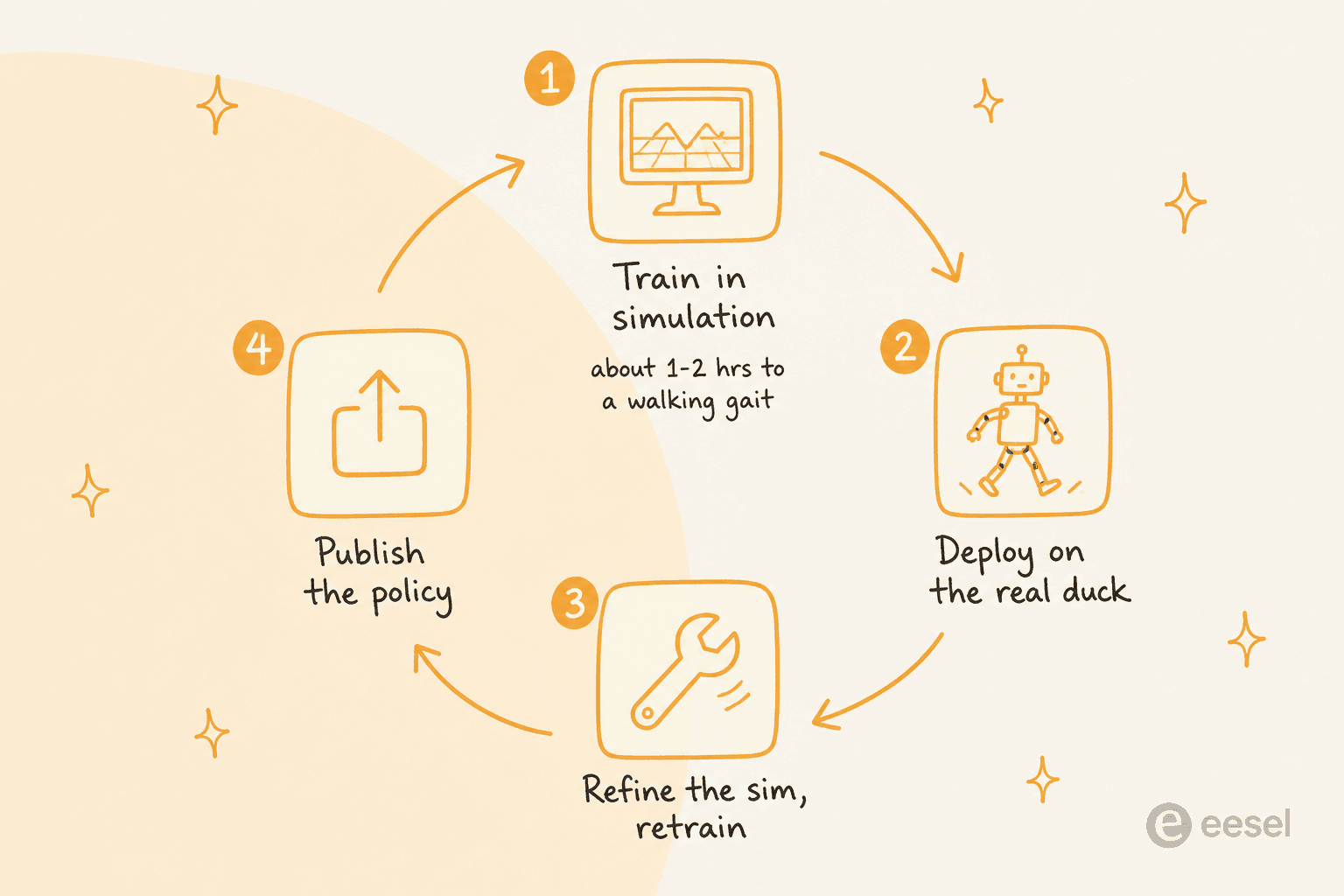
You train the behavior in a physics simulator, deploy it to the robot, refine the sim against what went wrong on real hardware, and publish the finished policy for others to reuse. Training runs in MuJoCo, the same physics engine most robotics RL research runs on, using PPO. The headline number from the training repo: a usable walking gait trains in about 1 to 2 hours at 4,096 parallel environments on a single GPU.
No GPU? Add one flag and the training job runs on Hugging Face Jobs instead of your machine, which is the tell that this is a Hugging Face product and not just a robot with a repo attached. The learned policy is exported to ONNX and loaded by the on-robot runtime, which is written in Rust and runs as a handful of daemons on that little RK3566. At runtime, walk, recover, and trick policies hot-swap behind a shared observation contract, so any behavior can take over the robot at any moment.
The whole stack is open source and lives in two repos: pollen-robotics/microduck for the robot software and microduck_rl for the training tools. There's even a simulated twin you can drive in your browser before your hardware arrives. One caveat worth stating plainly, since early coverage blurred it: the open-source claim covers the software only. The mechanical and electronic design files are not open, so this is open-source software, not open-source hardware.
What $399 gets you
The base robot is everything you need on day one. The packs are spares and extras, not paywalled features.
| Item | Price | What's inside |
|---|---|---|
| Microduck | $399 | Robot, battery, USB-C cable, game controller |
| Charger pack | $39 | Dual charger, 2 spare batteries |
| Accessory pack | $39 | Laser pointer, rollers, ball, 10 NFC tags |
| Dev pack | $119 | 3 spare motors, cables, 2 batteries, charger, NFC tags, Hugging Face credit, tools |
A realistic first order for someone who actually wants to train new behaviors is the robot plus the Dev pack, which lands around $518 before tax and shipping, and gets you spare motors (you will strip a gear eventually) and cloud training credit. The $399 sticker is an introductory price, and it comes in four colorways: Cream, Graphite, Lavender, and Sky, all the same robot underneath.
One thing to budget for that isn't money: time. Pre-orders opened August 27, 2026 with deliveries targeted before Christmas, but demand was heavy enough that the store now quotes a 4 to 6 month lead and stops short of promising the holiday date. If you order today, plan for spring.
Where Microduck sits against everything else
Put price on one axis and mobility on the other, and Microduck lands in a corner nothing else occupies.
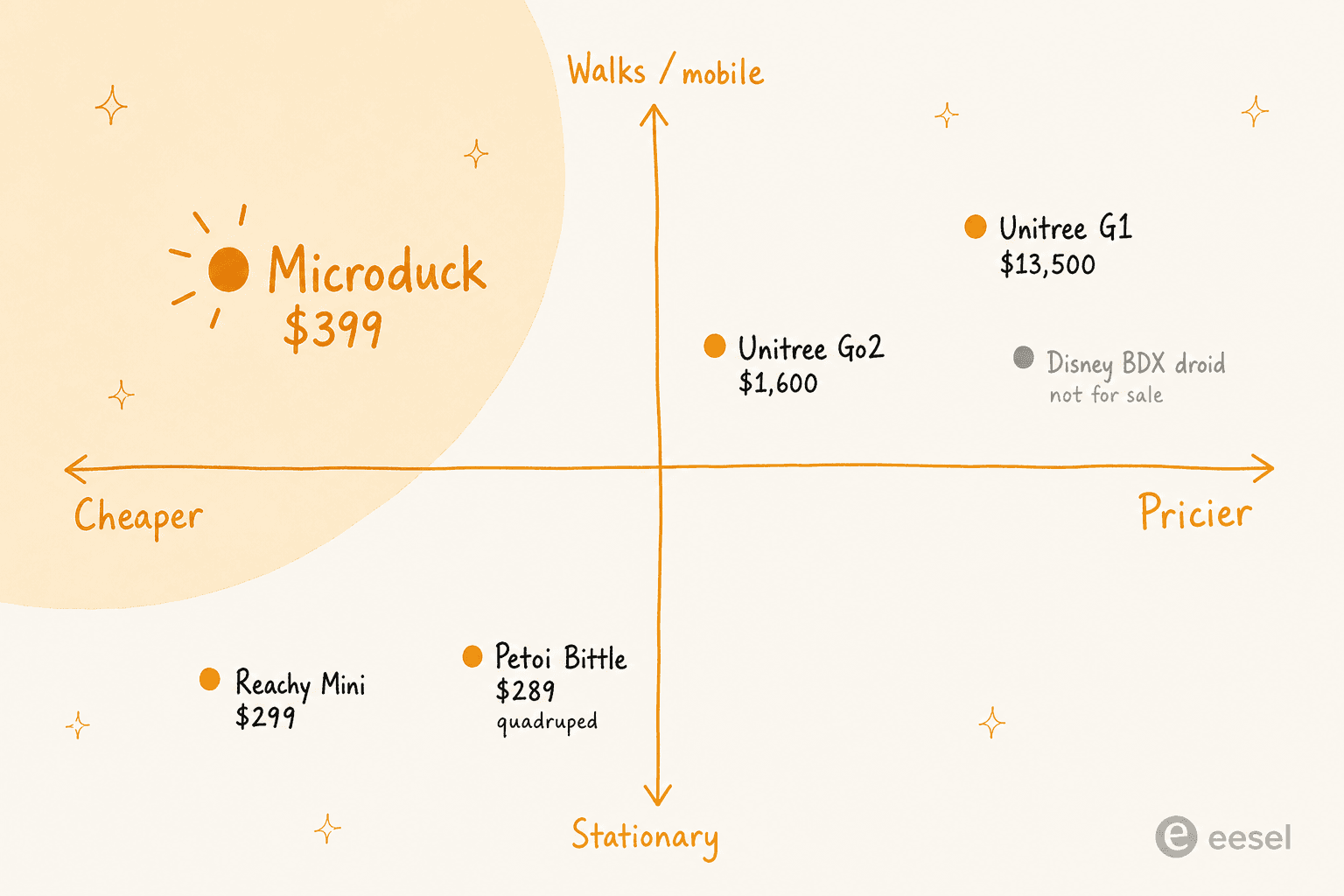
The one-line position: the cheapest walking biped you can actually pre-order and train yourself. Everything else in the small-robot conversation is either not a biped, not for sale, or an order of magnitude pricier.
| Robot | Maker | Price | Form | For sale? |
|---|---|---|---|---|
| Microduck | Pollen Robotics | $399 | Walking biped | Yes, pre-order |
| Reachy Mini | Pollen Robotics | $299 / $449 | Desktop, stationary | Yes |
| Unitree G1 | Unitree | ~$13,500 | Full-size humanoid | Yes |
| Unitree Go2 | Unitree | ~$1,600 | Quadruped dog | Yes |
| Disney BDX droid | Disney Research | Not sold | Expressive biped | No, prototype |
| Petoi Bittle | Petoi | $289 | Quadruped kit | Yes |
The comparison everyone reaches for is the Disney BDX droid, and it's fair: same shrunken-biped look, same RL-in-simulation training idea. The difference is you can't buy a BDX droid, and you can pre-order a Microduck. At the top end, a Unitree G1 humanoid is roughly 34 times the price. Microduck isn't competing on payload or polish, it's competing on access: a student or a hobbyist can put one on a personal credit card.
What people are actually saying
The launch landed with genuine enthusiasm and genuine doubt, and the split is clean. The Hacker News thread hit 763 points and 246 comments in about two days, which is real developer attention, not just press pickup.
The strongest positive is that the simulator and RL loop work without a fight, which practitioners contrast against wrestling with heavier research toolchains:
"Having tried (and failed) to use Issac to do the same thing, the fact that their simulator actually works out of the box, 'batteries included', is a big deal for home hobbyists."

The sharpest doubt is the one Pollen would probably concede: a $399 armless biped is a platform to learn on, not a robot that does chores. As one commenter put it, comparing it to a polished consumer toy:
"I would describe the Microduck as more of a toy than Beni. Autonomous cameraman is a real application... I think you'll struggle to get Microduck to do anything genuinely useful."
Both takes are right, and they're not really in conflict. Microduck is a teaching platform for physical AI, and on that axis it's excellent value. If you grade it as a household appliance, it will disappoint. The framing over on X was blunter and, I think, correct: as one post put it, it's basically a $399 physical AI toy, and robotics is getting ridiculously accessible.
Is it worth pre-ordering?
Here's my read after going through the docs, the repos, and the launch thread. Buy it if you want to learn or do reinforcement-learning robotics on something that walks, and you're comfortable that the fun is in the training loop, not in unboxing a finished product. The open-source stack is real, the sim-to-real recipe is documented, and nothing else at this price stands on two legs.
Skip it if you're picturing a helpful little household robot. It has an hour of battery, a beak instead of hands, and 1 GB of RAM. It's a workbench, not a butler. And factor in the wait: a spring delivery is the realistic case, not Christmas.
That said, the deeper thing Microduck gets right is the sharing model. Hugging Face turned "download a model someone else trained" into a habit, and Microduck extends that to physical behaviors, so a walking gait or a recovery policy someone tunes can be published and reused. If that library fills out, the cheap little duck becomes a lot more capable than its spec sheet suggests.
Try eesel
Microduck and eesel sit at opposite ends of the same idea, and the contrast is useful. A Microduck is infrastructure you train from scratch: you own the hardware, write the policies, and teach it every skill yourself. Fun for a robotics project, wrong shape for a business problem.
eesel is the other bet. Instead of a robot you train, it's an AI teammate that shows up already trained for a job, and the current roster is a support helpdesk teammate and an AI blog writer. You plug it into the apps you already use and it starts doing real work from day one, no reinforcement-learning loop required.

So if the physical-AI moment has you curious about what "an agent that acts" looks like in software (the kind I unpack in our AI agent examples), that's the eesel version: hire the teammate, skip the training, keep the results. It's free to try.