


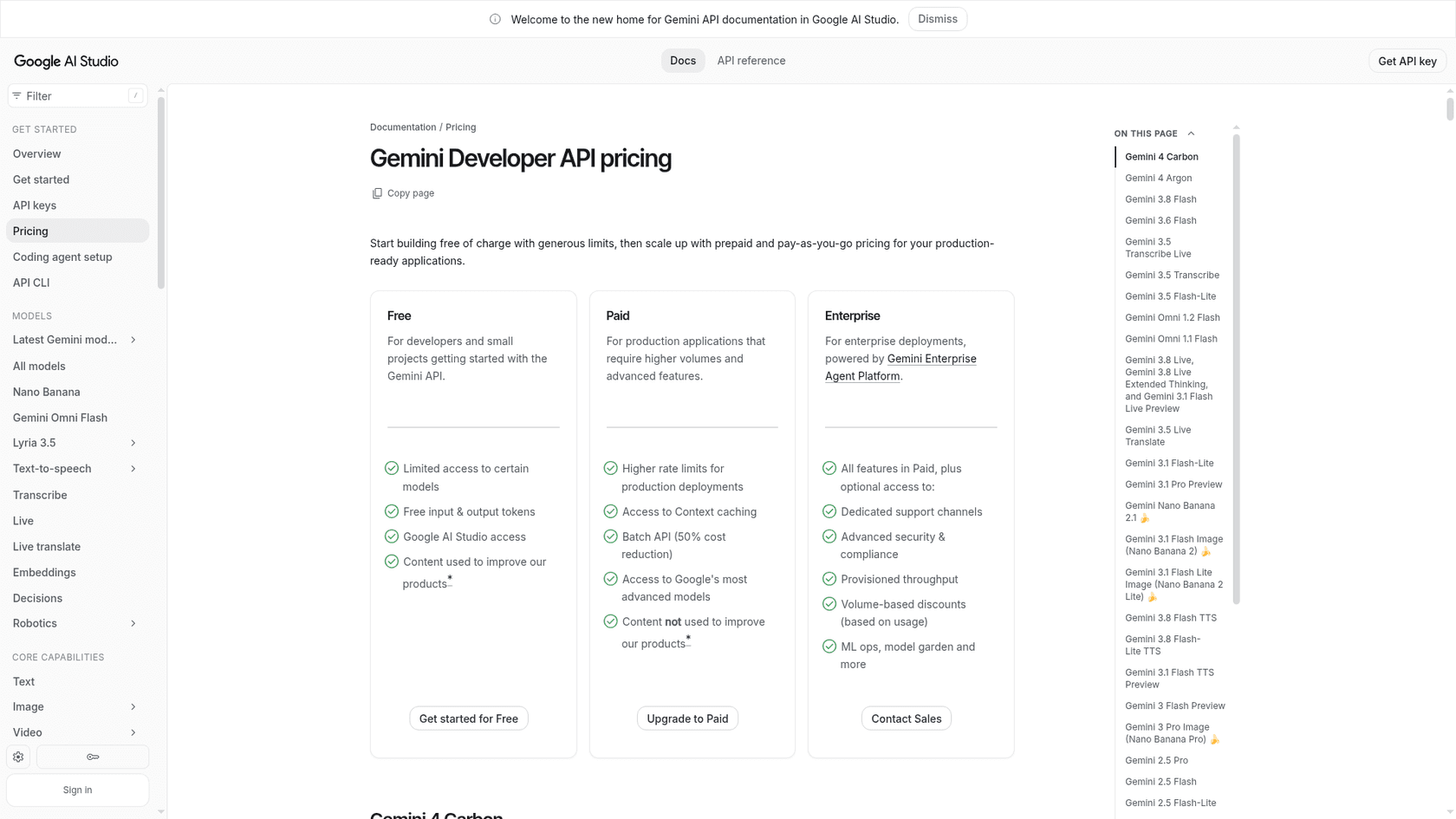
Gemini 4 Hydrogen costs $1.50 per million input tokens and $7.50 per million output tokens, flat across its 1M context. That price tag isn't what decides your bill. The thinking level is: on Artificial Analysis a task costs $0.29 at low and $3.16 at xhigh, 11x apart on the same rate card. Batch and Flex halve the rate, Priority adds 80%, and Carbon and Argon double on December 1, which makes Hydrogen Google's default cheap Gemini 4 model. For support replies it's under a cent a ticket, and eesel keeps that off your invoice with fixed plans.
I checked Google's pricing page on 13 November 2026, the day after launch. If you'd rather not manage model plumbing at all, the eesel CLI lets a coding agent upload approved knowledge and run test questions against an eesel teammate before anything goes live. Connecting the helpdesk itself still needs an admin's approval.
The sections below are the money side only. My Gemini 4 Hydrogen overview covers the model and the Hydrogen review covers how it performed.
What is the full Gemini 4 Hydrogen rate card?
Here is every Hydrogen price Google publishes, per million tokens. Google bills every token the model processes, including thinking tokens, so thinking is priced as output.
| Tier | Input | Output (thinking included) | Cached input | Data used to improve Google products |
|---|---|---|---|---|
| Free tier | Free | Free | Free | Yes |
| Standard (paid) | $1.50 | $7.50 | $0.075 | No |
| Batch | $0.75 | $3.75 | $0.0375 | No |
| Flex | $0.75 | $3.75 | $0.0375 | No |
| Priority | $2.70 | $13.50 | $0.135 | No |
| Contributor (invite-only preview) | $0.75 | $3.75 | $0.0375 | Yes |
Three details in that table matter more than the headline numbers:
- One price across the whole window. There's no surcharge past 200K tokens. Google's own launch post says Hydrogen is "priced flat across its entire 1 million-token context window", so a long document costs the same per token as a short chat.
- Caching is implicit only. Cached input is 95% off ($0.075), but Google lists explicit caching as not supported, so you can't pin a cache yourself. Keep your prompt prefix stable and hope it hits.
- Batch and Flex have no free tier. The free tier is rate limited, and Google says it uses that data to improve its products.
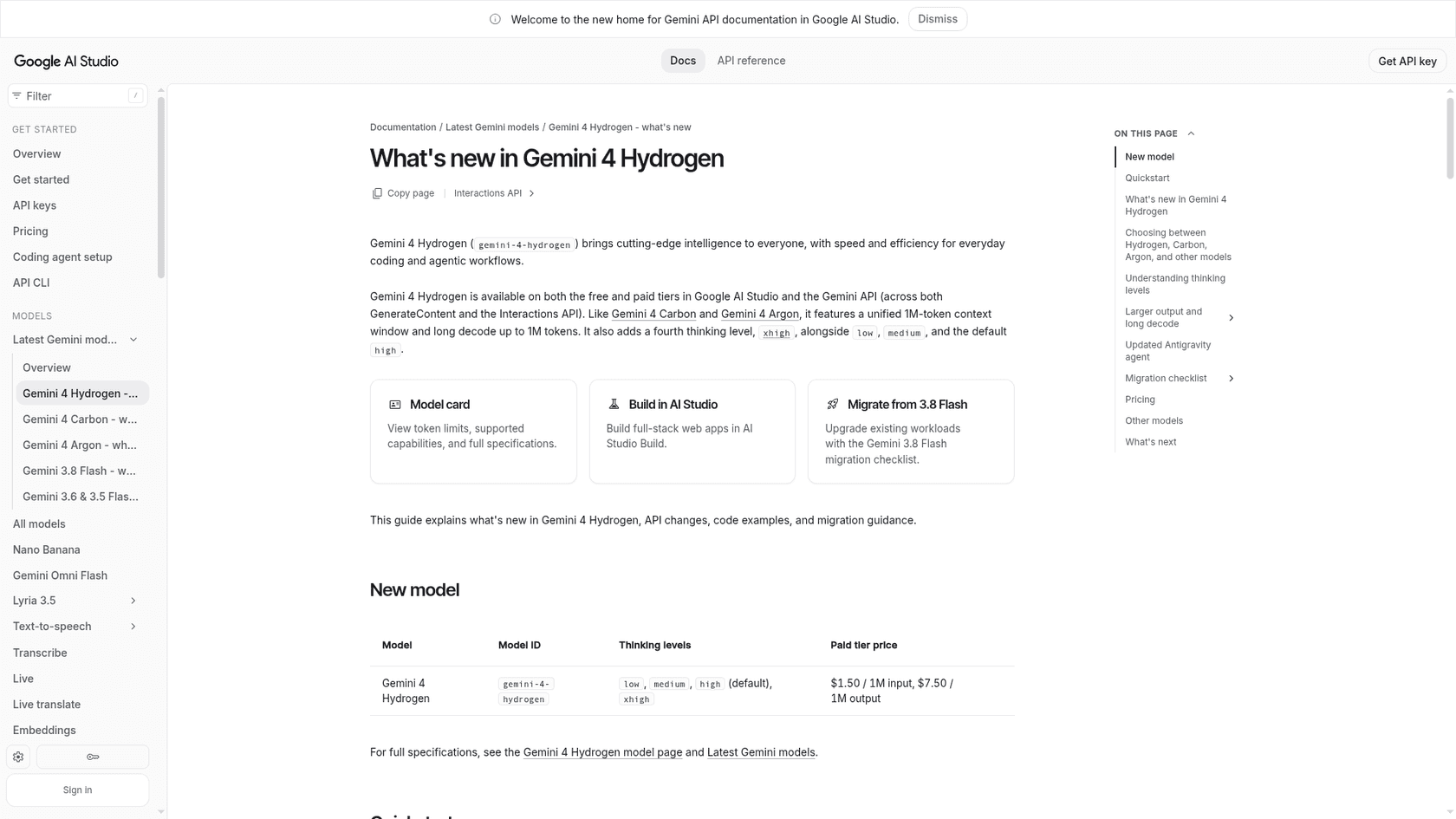
The model id is gemini-4-hydrogen. It has four thinking levels (low, medium, high and xhigh) and high is the default, which is the part people tend to miss. If you don't set a level, you pay the $1.87 rate in the next section, not the $0.80 one.
What does a task cost at each thinking level?
This is where the real bill is decided. Artificial Analysis runs every model through the same set of tasks and records what each run costs, thinking tokens included. For Hydrogen, the four levels look like this:
| Thinking level | Index score | Cost per task | Time per task | Cost per index point |
|---|---|---|---|---|
| low | 27 | $0.29 | 1.3 min | $0.011 |
| medium | 41 | $0.80 | 3.7 min | $0.020 |
| high (default) | 51 | $1.87 | 8.3 min | $0.037 |
| xhigh | 54 | $3.16 | 13.0 min | $0.059 |
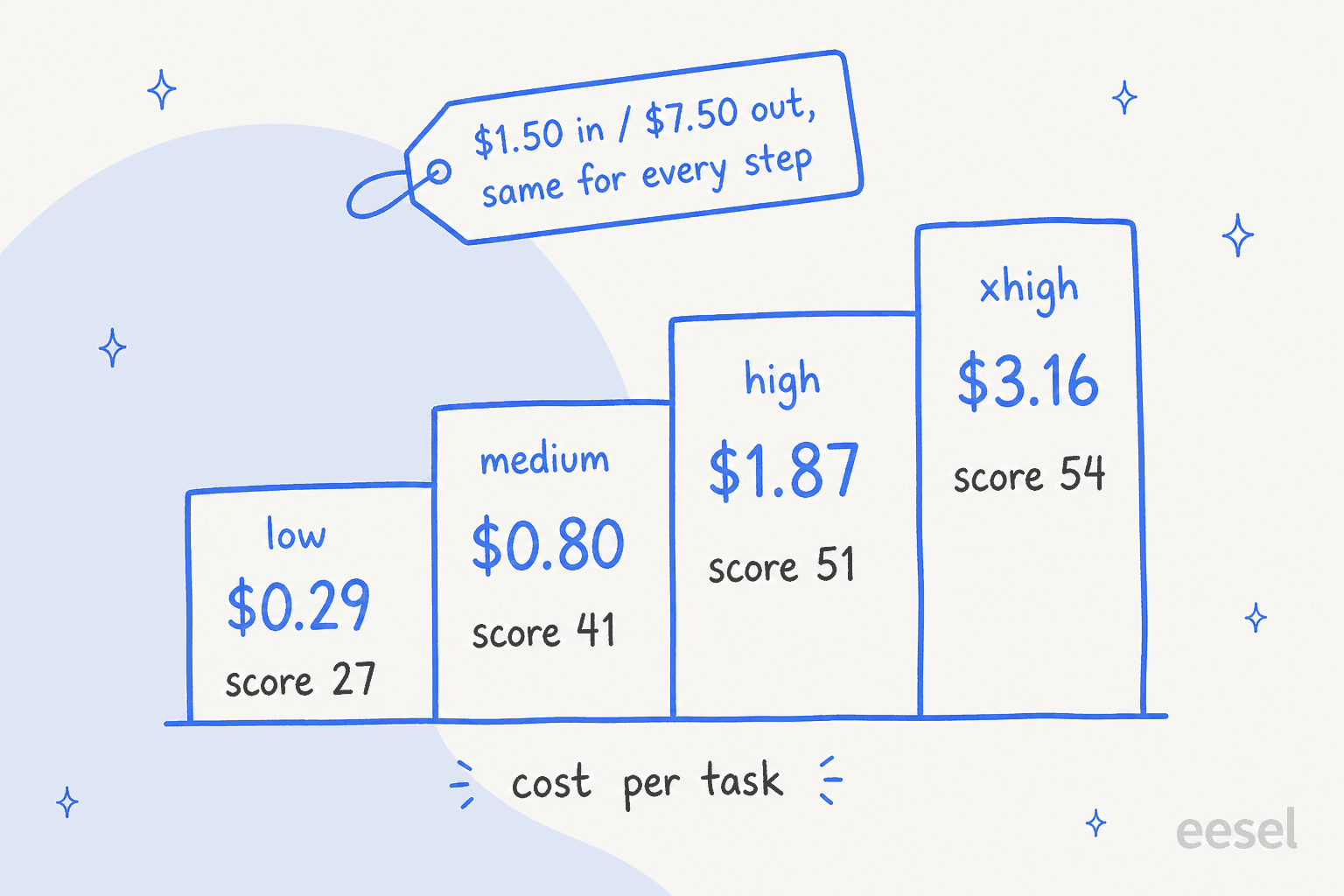
The token price never moves, and the cost per task still swings 11x. The reason is output length: Artificial Analysis counts roughly 110M output tokens across its index at high and about 304M at xhigh, and it calls xhigh "very verbose". Output is the expensive side of the card at $7.50 per million.
Three things I'd take from the table:
- Medium is the efficient point. It gets 80% of high's score (41 against 51) for 43% of the cost ($0.80 against $1.87).
- Xhigh is a luxury. Going from high to xhigh buys 3 more points for $1.29 more per task, a 69% price rise.
- The default isn't the cheap option. Choose the level before you choose the tier, because a tier discount of 50% is smaller than the gap between low and high.
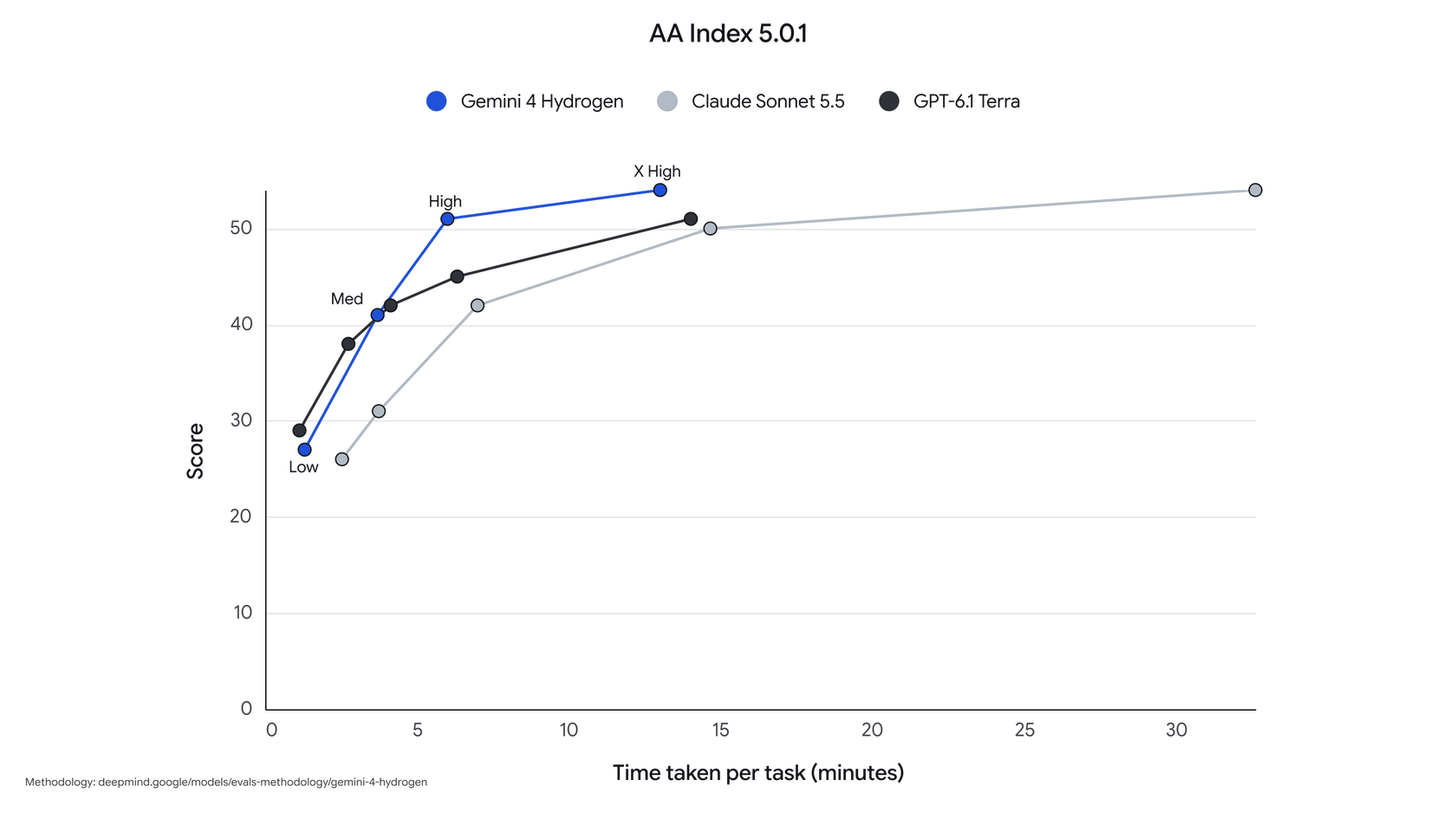
For context, Artificial Analysis lists GPT-6.1 Terra at 51 for $0.96 a task and Claude Sonnet 5.5 at 55 for $10.02. So Hydrogen at high matches Terra's score at about twice the cost, while Sonnet 5.5 costs more than five times as much for four more points. Gemini 3.8 Flash scores 31 at $7.77 a task, at its current promo price. One early user on Hacker News measured something similar against that model:
"My use case benchmarks 37% more expensive per task but 40-60% of the total time per task (median and p90 had the same improvement)."

Their numbers come from their own eval at medium reasoning, so treat them as one data point and not a rule. Still, it matches what I'd expect: Hydrogen is faster and cheaper per point, and not always cheaper per task.
Which tier should you use: Standard, Batch, Flex, Priority or Contributor?
Each tier is a multiplier on the Standard card, so the choice is mostly about what your work can tolerate.
- Standard ($1.50 / $7.50) is the default for anything interactive, such as a support chat.
- Batch and Flex ($0.75 / $3.75) are half price. Use them for work that can wait: nightly ticket tagging, backfills, evals. Check Google's docs for each lane's latency terms before you commit a customer-facing flow to one.
- Priority ($2.70 / $13.50) costs 80% more than Standard. It only makes sense where a slow response loses you money.
- Contributor ($0.75 / $3.75) matches Batch on price, with "speed and reliability equivalent to Standard", but it is an invite-only private preview and Google uses your data. For anything with customer details in it, I wouldn't.
Here is how that multiplier plays out on the Artificial Analysis cost per task. These are my own arithmetic, assuming the Artificial Analysis figures are priced at the Standard rate and every part of a task bill scales with the card:
| Thinking level | Standard | Batch / Flex | Priority |
|---|---|---|---|
| low | $0.29 | $0.145 | $0.52 |
| medium | $0.80 | $0.40 | $1.44 |
| high | $1.87 | $0.94 | $3.37 |
| xhigh | $3.16 | $1.58 | $5.69 |
Read down a column and the thinking level is the bigger lever. Going from high on Standard ($1.87) to medium on Standard ($0.80) saves more than moving high to Batch ($0.94) does, and you can do both. Medium on Batch is $0.40 a task, about a fifth of the default.
What changes on December 1 and January 1?
Hydrogen's own price doesn't change. Its neighbours' do, and that reshuffles where Hydrogen sits in the Gemini lineup. All figures below are Google's published prices per million tokens, input / output.
| Model | Until Nov 30, 2026 | Dec 1 to Dec 31, 2026 | From Jan 1, 2027 |
|---|---|---|---|
| Gemini 4 Hydrogen | $1.50 / $7.50 | $1.50 / $7.50 | $1.50 / $7.50 |
| Gemini 4 Carbon | $2.00 / $10.00 | $4.00 / $20.00 | $4.00 / $20.00 |
| Gemini 4 Argon | $2.00 / $10.00 | $4.00 / $20.00 | $4.00 / $20.00 |
| Gemini 3.8 Flash | $0.75 / $3.75 | $0.75 / $3.75 | $1.50 / $7.50 |
Neither Carbon nor Argon has a free tier. Two consequences follow:
- From December 1, Carbon and Argon cost 2.67x Hydrogen on output. Today they're only 1.33x. That's the date a lot of "should I just use the bigger one" decisions flip, since Google's launch post says Hydrogen passes Argon on the Artificial Analysis index at its default level, 51 to 50.
- From January 1, Hydrogen and Gemini 3.8 Flash have the same input and output price. Google calls Hydrogen the "Recommended upgrade from Gemini 3.8 Flash and earlier Gemini 3 and 2.5 models". Hydrogen's cached input stays at $0.075, while 3.8 Flash's goes to $0.15, but 3.8 Flash supports explicit caching and Hydrogen doesn't.
Today is 13 November, so December 1 is about two and a half weeks away and January 1 about seven. Some builders had already read the new price as a step up, and one on Hacker News described the knock-on effect on a 3.8 Flash workload:
"costs are already high for our workload on 3.8 Flash (which in itself was already a 40% increase compared to 3.7 flash due to being more verbose and thinking more) and this now doubles cost once again."
That reader is right that Hydrogen is double 3.8 Flash's current price. What the calendar adds is that it stops being double on January 1, when 3.8 Flash catches up. If you're on 3.8 Flash and your bill will rise on January 1 no matter what, then testing Hydrogen now is free of regret, and at medium it may well come out cheaper per task. For the full picture on that model, see my Gemini 3.8 Flash review and the Gemini 3.5 Flash-Lite post for the cheaper end.
What else can show up on a Hydrogen bill?
Tokens aren't the whole invoice. Three other line items are worth knowing about before you ship:
- Search grounding. Grounding with Google Search is available on Standard and Priority only. You get 5,000 free search requests a month, shared across all Gemini 3 and newer models, then $14 per 1,000, with a cap of 1,500 requests a day. Google warns that one customer request can trigger several billed search queries. Maps grounding has the same $14 per 1,000 after 5,000 free.
- Grounding counts toward tokens too. Google bills internal tool instructions and function declarations as tokens when grounding is on.
- No explicit cache. Because you can't pin a cache, your hit rate depends on keeping prompts byte-for-byte stable at the front. For the support example below, moving from 0% to 70% cached input takes the monthly bill from $105 to $65.
A caution on the free tier: it's useful for prototyping, but Google uses that data, so keep real customer messages out of it. The rate limits are on Google's rate limits page.
Gemini 4 Hydrogen cost calculator
Enter your own volume and token counts. The widget prices the same job on every Hydrogen tier and shows Carbon and Argon on both sides of December 1, and Gemini 3.8 Flash on both sides of January 1. Cached share is the part of your input that hits the implicit cache.
What does Hydrogen cost on real workloads?
Here are the numbers for a support-reply agent. The token counts are my own illustrative assumptions, stated so you can swap in yours: each ticket reads 4,000 tokens of which 1,200 (30%) hit the cache, and writes 600 tokens including thinking, across 10,000 tickets a month.
The arithmetic on Standard. Fresh input is 2,800 tokens at $1.50 per million, which is $0.0042. Cached input is 1,200 tokens at $0.075 per million, which is $0.00009. Output is 600 tokens at $7.50 per million, which is $0.0045. That adds up to $0.00879 a ticket, or $87.90 for 10,000 tickets.
| Option | Monthly cost for 10,000 tickets | Versus Hydrogen Standard |
|---|---|---|
| Hydrogen Standard | $87.90 | baseline |
| Hydrogen Batch / Flex (or Contributor) | $43.95 | 0.5x |
| Hydrogen Priority | $158.22 | 1.8x |
| Carbon or Argon until Nov 30 | $117.20 | 1.33x |
| Carbon or Argon from Dec 1 | $234.40 | 2.67x |
| Gemini 3.8 Flash until Dec 31 | $44.40 | 0.51x |
| Gemini 3.8 Flash from Jan 1 | $88.80 | 1.01x |
Three lessons from that:
- At this shape the whole month is under $100. On Hydrogen it is cheap enough that the model is rarely your real support cost, which matches what I found when pricing Carbon pricing for the same ticket shape.
- The thinking level can swamp the tier. If a higher level means 2,400 output tokens instead of 600 (my assumption, not a Google figure), the Standard bill rises to $222.90. At 6,000 output tokens it's $492.90. That's a 10x jump in output giving a 5.6x jump in total, so one setting costs more than every tier discount combined.
- Grounding can rival the tokens. If each ticket triggers one billed Google Search query, then 10,000 tickets use 5,000 free requests and 5,000 paid ones: 5,000 x $14 per 1,000 = $70. That's close to the $87.90 token bill, and it assumes the free allowance isn't already used up by other Gemini 3 or newer models in your project.
An agent running Artificial Analysis-style tasks. 100 tasks a month at medium is $80 on Standard and $40 on Batch. At xhigh it's $316 on Standard, $158 on Batch and $569 on Priority. Same model, same card, and a 14x spread between medium on Batch ($40) and xhigh on Priority ($569).
For readers weighing models rather than tiers, my AI model for support tickets post and the Claude Sonnet 5.5 pricing and GPT-6.1 Terra pricing guides run the same per-task logic.
If you want the rest of the Google field, my Gemini alternatives guide covers it.
Which Google plan includes Hydrogen?
Not every route to Hydrogen is a per-token bill. If you're a person and not an API, a subscription may be the cheaper way in. Here's what Google lists on its subscriptions page for the US:
| Plan | Price | Hydrogen access |
|---|---|---|
| Free | $0 a month | Gemini app auto-selects Hydrogen "when it's the appropriate model for the prompt" |
| Google AI Plus | $4.99 a month | Includes Hydrogen, 2x Free usage |
| Google AI Pro | $19.99 a month | Access to Hydrogen; headline model is Argon |
| Google AI Ultra | $99.99 or $199.99 a month | "Highest access to Gemini 4 Hydrogen", plus Carbon (5x or 20x Pro limits) |
| Gemini Enterprise Business | from $21 per seat a month, up to 300 seats | Business tier |
| Gemini Enterprise Standard / Plus | from $30 per seat a month | Business tier |
In Google Antigravity, the coding tool, a free individual plan exists, but Hydrogen there is for paid Google AI Pro and Ultra subscribers. Google's Orchestrator mode, where Carbon plans and Hydrogen does the work inside one session, is Ultra only. Google says on Terminal-Bench it reached near-Carbon success while using 24% less quota and finishing 19% faster. For more on the top plan, my Google AI Ultra guide has the detail. Companies wanting API consumption pricing go through Google Cloud instead.
Plans and API tokens are billed separately: a Pro subscription doesn't pay for your production agent's tokens.
Is Gemini 4 Hydrogen worth the price?
Yes, with three conditions.
- Set the level on purpose. Start at
mediumfor anything that isn't a hard reasoning task, and move up only when the extra score earns the extra cost. Leaving it at thehighdefault costs 2.3x for ten points. - Use Batch or Flex for anything that can wait. Half off is the cleanest saving on the card.
- Check the calendar. If you're deciding between Hydrogen and Carbon or Argon, the December 1 jump decides it in Hydrogen's favour unless you need the top score. If you're on 3.8 Flash, January 1 makes the move free in price terms.
I wouldn't pick Hydrogen as the cheapest option on the market, since GPT-6.1 Terra scores the same 51 at $0.96 a task, and I'd test it against your own tickets before moving anything. The OpenAI API pricing and Anthropic API pricing guides are the other two price lists I'd keep beside this one.
What does Hydrogen pricing mean for a support team?
Less than the headlines suggest. A cent a ticket isn't what decides whether AI support pays off. Whether the answers are right is, and hallucinations in support are the cost to plan for. So are the handoff rules, the knowledge the agent reads, and how it fits the helpdesk you already run. Those costs live in the AI customer service cost around the model, and none of them shrinks because a thinking level is lower. The number to track is cost per resolution, not cost per token.
Here are two eesel customers, because both show where the effort actually goes:
- smava, a Berlin loan comparison site, runs three eesel agents on one Zendesk across two brands. In a month it handled about 27,000 tickets, categorised about 14,600 and prepared about 15,300 draft replies from roughly 820 macros and help center articles. If I priced every one of those tickets as a single call of the 4,000-in, 600-out shape above, Hydrogen Standard would be about $237 a month. The real token figure is higher, because several agents and many searches run per ticket, but the work that mattered was writing the rules for a regulated finance team, not choosing a model.
- MentorShow, a French online learning platform, runs eesel inside HubSpot. Between 8 August and 8 September 2026 eesel read about 1,200 conversations and tickets, ran 837 knowledge base searches and wrote 432 drafts in French, English or Spanish. MentorShow told eesel it gets 5,000 to 13,000 tickets a month. The hard part was nine ticket types to skip, a member record to read and a list of things never to promise.
Neither team had to pick a thinking level or watch a December 1 price date. That's the practical difference between a model and a teammate.
Try eesel
If you're pricing Gemini 4 Hydrogen because you want AI answering tickets, you can skip most of this maths. Hydrogen is infrastructure; eesel is the employee. The eesel AI helpdesk teammate learns from your past tickets and help center, tests itself on your real past tickets through simulation before it replies to anyone.
It plugs into Zendesk, Freshdesk and the other helpdesks you already run.
Pricing is a fixed monthly credit plan where one ticket or chat is one credit however many replies it takes, starting at $299 a month for 500 credits. Every feature and unlimited seats are included, and you can start free with 100 credits and no card. When Google moves a price on December 1, your invoice stays where it is. Try eesel on a slice of your queue and see how it handles your own tickets.