


Gemini 4 Hydrogen is Google's fast, cheap model for everyday coding and tool-using agents, released on 12 November 2026 under the API ID gemini-4-hydrogen. It costs $1.50 input and $7.50 output per million tokens, and on default high thinking scores 51 on the Artificial Analysis index, one point above Gemini 4 Argon, at about $1.87 per task against $9.95 for Argon.
Use it as the worker next to Carbon or Argon, or on its own for day-to-day agents. It isn't the pick for the hardest reasoning. eesel puts the right model behind each job in an AI helpdesk teammate, and the eesel CLI lets a coding agent test it on your own tickets.
What is Gemini 4 Hydrogen?
Hydrogen is the third model in the Gemini 4 family. Google describes it as "built for rapid execution across diverse agentic workflows," while its two bigger siblings handle deep, long-horizon reasoning. The model card says Hydrogen is adapted from Gemini 4 Carbon, which is why it shares Carbon's design: one 1,048,576-token window shared by input, thinking, and output, and long outputs of up to 1 million tokens.
The basics, taken from Google's own documentation:
- Model ID:
gemini-4-hydrogen. - Released: 12 November 2026, available everywhere on day one.
- Inputs and outputs: text, images, audio, video, and PDFs in; text out.
- Output length: 65,536 tokens per request by default, and up to 1 million through background execution.
- Thinking levels:
low,medium,high(default), and a newxhigh. - Knowledge cutoff: March 2026.
One launch-day detail I liked: unlike Carbon, which went to vetted cyber defenders first and only reached the paid API later, Hydrogen shipped in the API, the Gemini app, and Search at once. If you want the history, my Carbon review and Argon review cover how those two arrived.
Where does Hydrogen sit in the Gemini 4 family?
Think of the family as a planner and a worker. Carbon is the strongest model and spends the most tokens thinking. Argon handles most advanced work with less spend. Hydrogen is the quick, cheap executor, and Google's docs recommend it as the upgrade from Gemini 3.8 Flash and earlier models.
| Model | API ID | Role (per Google) | Price per 1M in/out |
|---|---|---|---|
| Gemini 4 Carbon | gemini-4-carbon | Strongest model, hardest problems | $2/$10 through 30 Nov, then $4/$20 |
| Gemini 4 Argon | gemini-4-argon | Most advanced long-horizon work, fewer tokens than Carbon | $4/$20 |
| Gemini 4 Hydrogen | gemini-4-hydrogen | Fast, everyday coding and agents | $1.50/$7.50 |
| Gemini 3.5 Flash-Lite | gemini-3.5-flash-lite | Classification, routing, sub-second latency | See Google's pricing page |
Hydrogen is cheaper than Carbon even at Carbon's introductory price. It is also a step above the previous generation's cost: Google lists Gemini 3.8 Flash at $0.75/$3.75 through 31 December, rising to $1.50/$7.50 on 1 January 2027, which is where Hydrogen already sits.
The pairing is the real idea. Google's migration notes say to route planning turns to Carbon and execution turns to Hydrogen in one session:
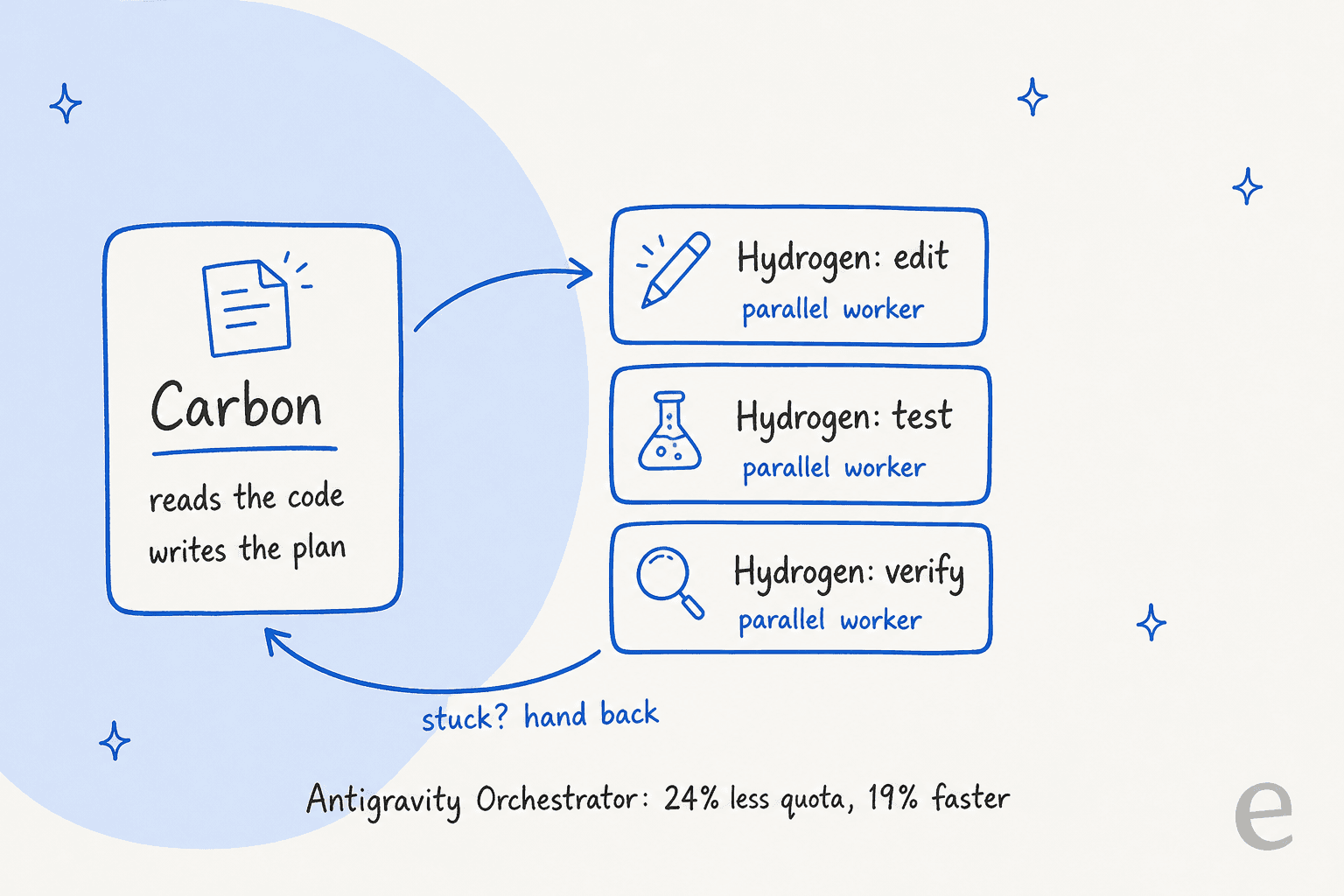
Google ships this as Orchestrator in Antigravity, its coding tool. Carbon explores and plans, Hydrogen writes edits and runs tests, and the work goes back to Carbon when Hydrogen hits friction. Google reports near-Carbon task success with 24% less quota and 19% faster completion. One caveat: Google's main launch post names Terminal-Bench 4.0 for that result, while the Antigravity post says 4.1, so treat the benchmark version as unclear.
What does Hydrogen do well?
Google's headline claim is that Hydrogen beats Argon on the Artificial Analysis index at its default setting (51 against 50), and reaches 54 on xhigh. Independent numbers from Artificial Analysis confirm the 51 and the 54. Against Gemini 3.8 Flash, Google reports:
- 2.5 times faster at the default setting.
- Terminal-Bench 4.1 up from 18.2% to 57%, a more than threefold jump.
- Fabricated claims cut by more than 5x, because it flags missing context instead of guessing.
- Parallel tool calls: it batches file reads and searches instead of opening files one by one.
Here is Google's own benchmark table against Claude Sonnet 5.5 and GPT-6.1 Terra. These are vendor-reported numbers, so read them as Google's best case:
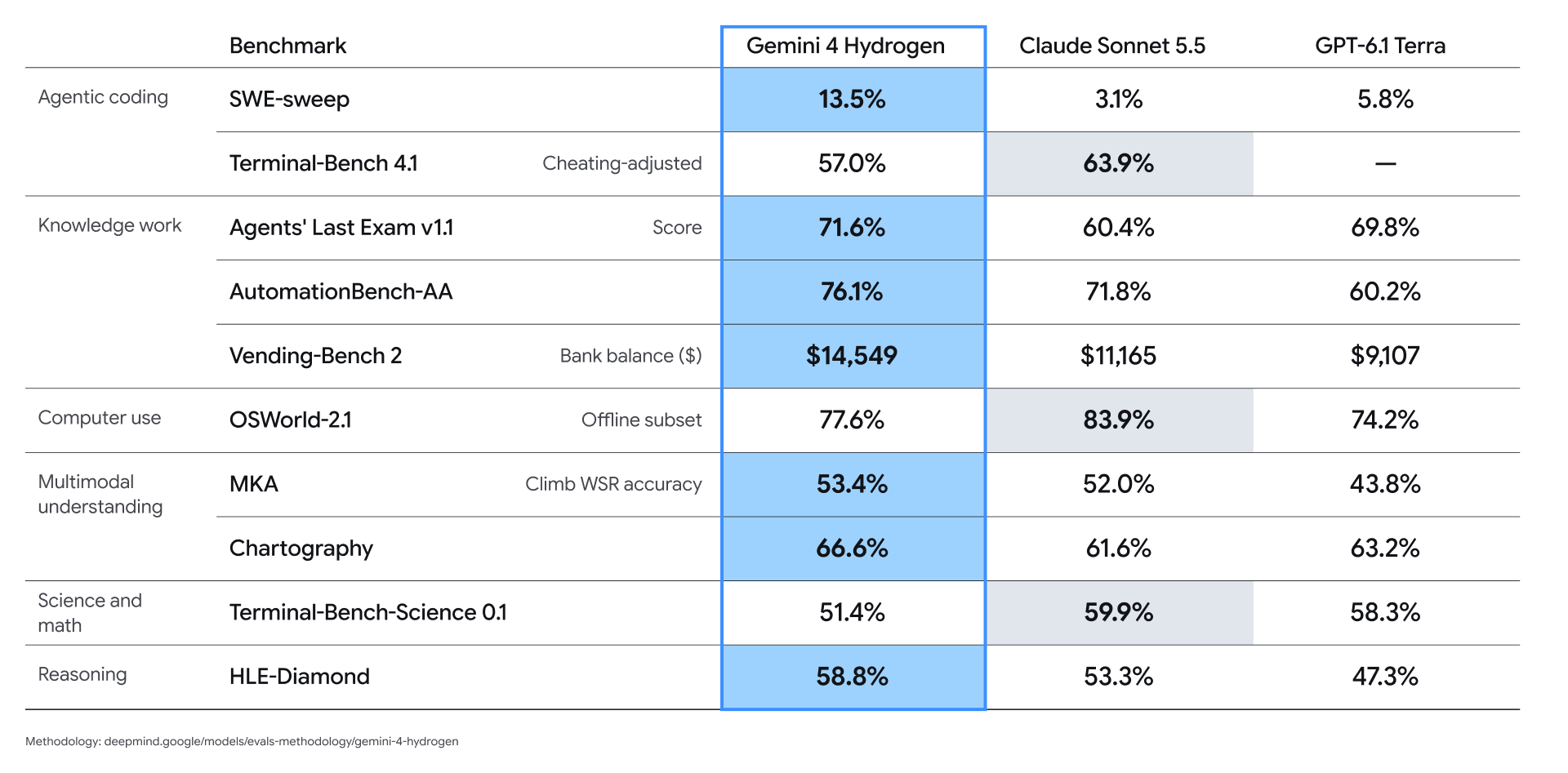
The pattern is clear if you read the columns, not just the bold cells. Hydrogen leads on repository bug fixing (SWE-sweep 13.5% against 3.1% and 5.8%), knowledge-work agents (Agents' Last Exam 71.6%), and chart and document understanding (66.6% on Chartography). It trails Claude Sonnet 5.5 on terminal tasks (57.0% against 63.9%), computer use (OSWorld-2.1, 77.6% against 83.9%), and science (51.4% against 59.9%).
Early customers named by Google point the same way, toward speed. Box reports about twice the speed of 3.8 Flash with 12% fewer tokens, and STAN reports 28% lower latency with 23% fewer tokens. Those are vendor-selected partner results, which is a different thing from a neutral test, so I weight them lightly.
What do the four thinking levels cost?
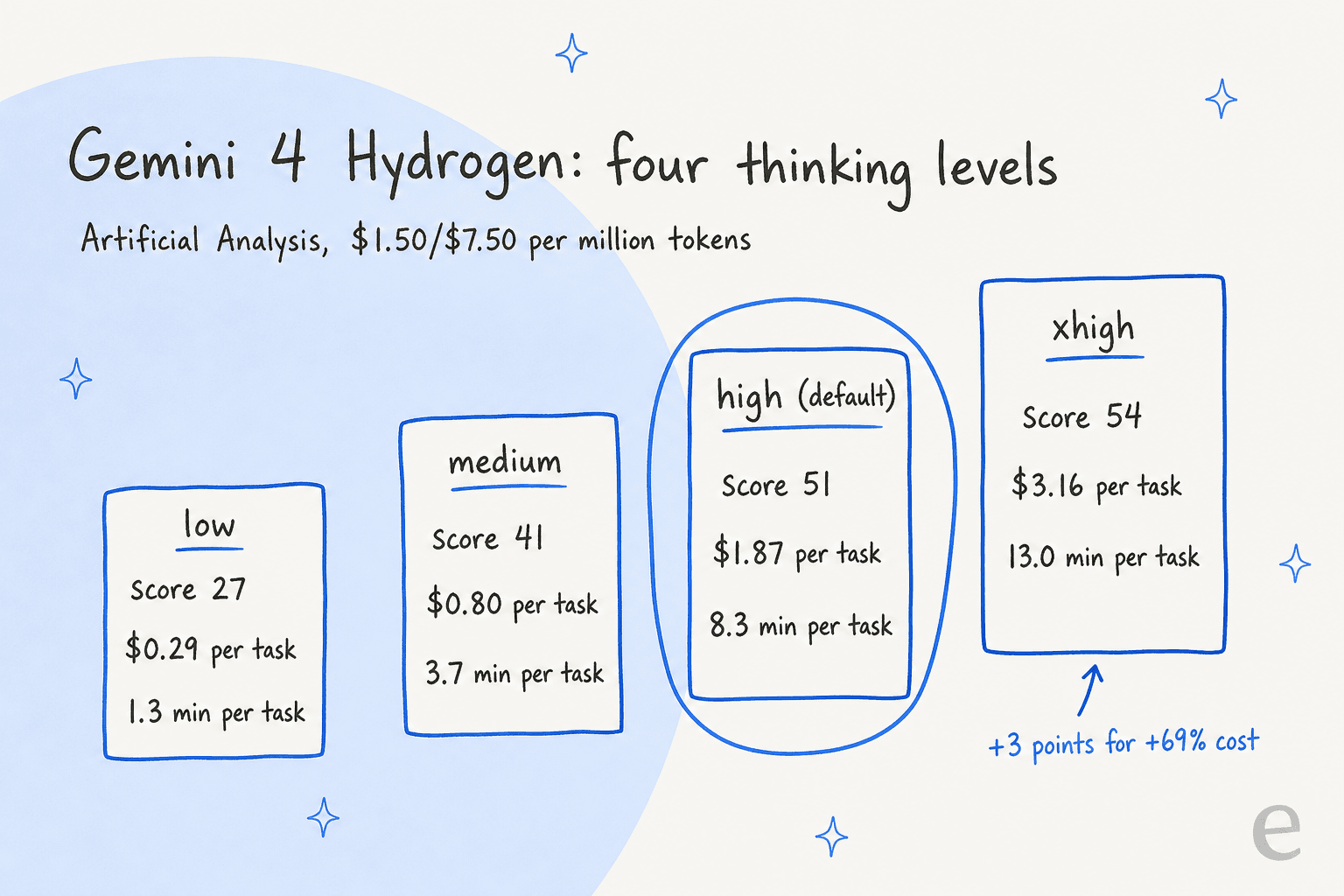
The thinking level is the main dial. Higher levels reason longer, which costs tokens and time. Artificial Analysis ran all four on its v5.0.1 index, and the shape is worth a look:
Three things stand out:
- Medium to high is where the score jumps: 41 to 51 for $1.07 more per task. That is the biggest gain per dollar.
- High to xhigh is a small gain at a large price: 3 more points for 69% more cost, and 13 minutes per task instead of 8.3.
- Honesty improves with depth. Artificial Analysis's Omniscience test counts how often a model gives a wrong answer instead of saying it doesn't know. Hydrogen's rate falls from 18.8% on low to 12.5% on medium, 8.7% on high, and 8.5% on xhigh.
Plug in your own volume to see what each level costs a month. This uses Artificial Analysis cost per task at list price, with Argon and Carbon shown for scale:
How does Hydrogen compare with other fast models?
Artificial Analysis publishes cost per task, which is the number that contradicts sticker prices. Here is Hydrogen next to its siblings and two rivals, all on index v5.0.1:
| Model and setting | AA index | Cost per task | Price per 1M in/out |
|---|---|---|---|
| Gemini 4 Hydrogen (high) | 51 | $1.87 | $1.50/$7.50 |
| Gemini 4 Hydrogen (xhigh) | 54 | $3.16 | $1.50/$7.50 |
| Gemini 4 Argon (high) | 50.4 | $9.95 | $4/$20 |
| Gemini 4 Carbon (medium) | 58.3 | $6.59 | $4/$20 list |
| Claude Sonnet 5.5 (max) | 55 | $10.02 | $2/$10 |
| GPT-6.1 Terra (max) | 51 | $0.96 | $1/$5 |
Artificial Analysis, checked 13 November 2026. Argon and Carbon rows are from my 11 November check; Carbon is at list price, so its $2/$10 promo halves the cost until 30 November.
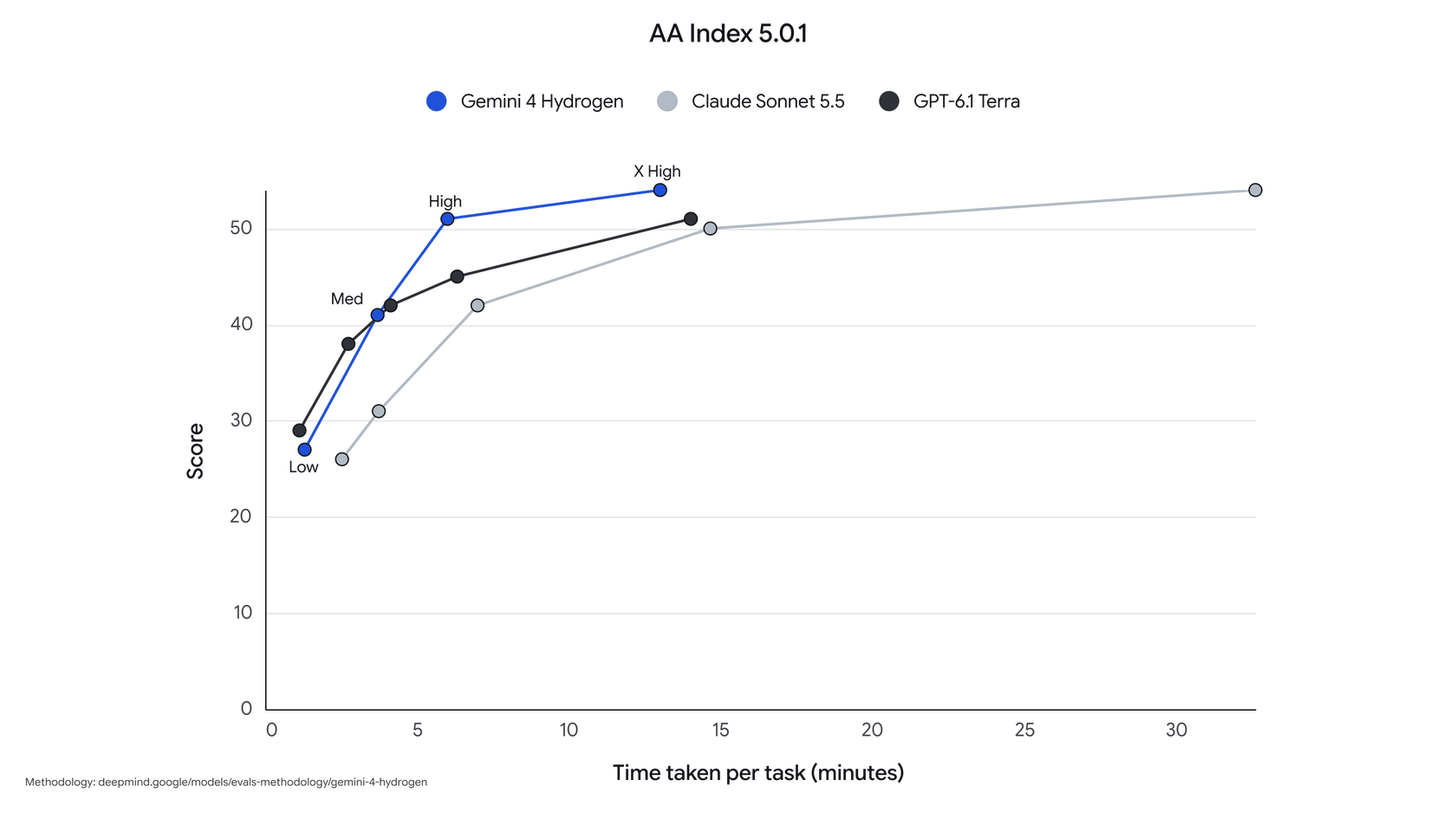
Two honest readings. First, Hydrogen at xhigh scores 54 for $3.16 per task, while Sonnet 5.5 at max scores 55 for $10.02, and takes 33 minutes against Hydrogen's 13. Second, GPT-6.1 Terra is cheaper per task at the same score of 51, so if cost is the only thing you track, my Terra review is worth reading next to this one. Hydrogen's edge is speed: 8.3 minutes per task on high against 14.2 for Terra at max.
The chart from Google shows the same trade in one picture:
One more cost note. Artificial Analysis says Hydrogen is very verbose: at xhigh it generated 304 million output tokens across the index, against a median of 72.8 million for comparable models. Output tokens are the expensive ones at $7.50 per million, so the per-token price flatters it. Use cost per task, not the price card, when you budget.
How do I access and call Gemini 4 Hydrogen?
Google opened every door at once:
| Where | Who gets it |
|---|---|
| Gemini API and Google AI Studio | Free and paid tiers |
| Android Studio | Via the Gemini API |
| Gemini for business | Via the API or the model dropdown |
| Gemini app | Model dropdown; free users via automatic model selection |
| Google Search | All users globally |
| Google Antigravity | Paid Google AI Pro and Ultra subscribers; Orchestrator for Google AI Ultra |
| Gemini in Google Sheets | Google AI Pro and Ultra first |
Google's launch post doesn't name Vertex AI separately, so if you buy through Google Cloud, check the model list in your own project before you plan around it.
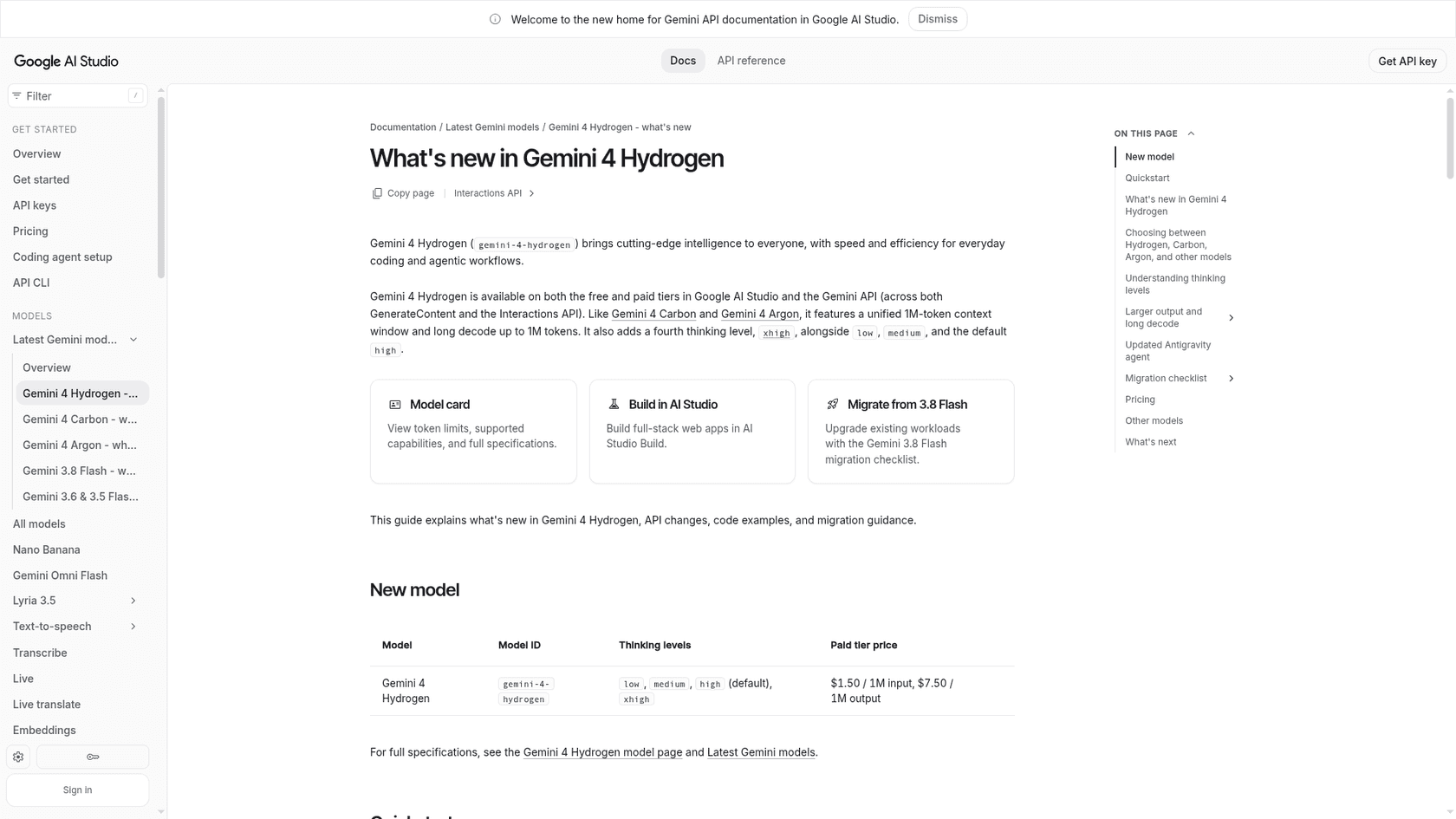
A minimal call with Google's Python SDK looks like this, using the Interactions API from the quickstart:
from google import genai

client = genai.Client()

interaction = client.interactions.create(
    model="gemini-4-hydrogen",
    input="Audit this retry queue for race conditions.",
    generation_config={"thinking_level": "xhigh"},
)
print(interaction.output_text)
If you are migrating from Gemini 3.8 Flash, Google's checklist has changes that will break old code. The ones I would check first:
- Thinking default is
high, notmedium, andminimalnow returns an error. - Remove
temperature,top_p, andtop_k. The server ignores custom values. - No explicit caching. Remove
cachedContents. Implicit caching runs by default on prompts of at least 4,096 tokens, with a 95% discount on cache hits. - Declare tools natively. Asking the model to emit raw-text JSON tool calls with zero declared tools can return
MALFORMED_FUNCTION_CALL. - Raise low output caps. Thinking tokens count toward
max_output_tokens, so an old cap of 8,192 can cut answers short. For anything past 64K tokens, setbackgroundtotrue.
If your stack already speaks to coding agents over the Model Context Protocol, my guide to the AI agent MCP server explains how that side works, and agentic coding CLIs covers the terminal tools that call models like this.
What does Gemini 4 Hydrogen cost?
Google's pricing page lists one flat rate across the whole window:
| Item | Paid tier, per 1M tokens |
|---|---|
| Input | $1.50 |
| Output, including thinking tokens | $7.50 |
| Cached input (implicit caching only) | $0.075 |
| Grounding with Google Search | 5,000 free requests a month shared across Gemini 3 and newer models, then $14 per 1,000 |
There is also a free tier, rate-limited, where content may be used to improve Google's products. On the paid tier it is not. I only verified the Standard tier on the page; Google also lists Batch, Flex, and Priority tabs for other models, and I haven't confirmed Hydrogen's rates there.
Because thinking tokens bill as output, the thinking level changes your bill more than the sticker price does, as the widget above shows. A dedicated breakdown will follow in my Hydrogen pricing post; for broader context, the Gemini pricing guide and Gemini alternatives roundup compare the wider lineup.
What are the limits?
No model is free of trade-offs, and Google's model card is fairly direct about Hydrogen's:
- Hallucinations still happen. Google lists them as a known limitation. Even at 8.7% on high, roughly one hard factual question in twelve gets a wrong answer rather than an "I don't know."
- Higher levels use more tokens and time. The card says so, and xhigh can overthink simple prompts, per the docs.
- More refusals of harmless prompts. Compared with Gemini 3.8 Flash, the card shows unjustified refusals up by 5.57 percentage points, especially on multimodal prompts. Google also says false refusals on HealthBench Pro stay under 0.4%, so the two figures measure different sets.
- The safety report isn't out yet. The model card says the full report arrives "in the coming days."
- Computer use and science trail Sonnet 5.5, as the table above shows.
- Output is text only. It reads images, audio, and video, but doesn't generate them.
Who should use Gemini 4 Hydrogen?
| You are... | My take |
|---|---|
| Building coding agents with parallel workers | Use Hydrogen as the worker, with Carbon or Argon as planner. |
| Running day-to-day coding in Antigravity | Hydrogen directly, or Orchestrator if you are on Ultra. |
| Reading PDFs, charts, and spreadsheets at volume | Hydrogen on high. It leads Google's multimodal tests. |
| Migrating from Gemini 3.8 Flash | Yes. Google recommends it, and the code changes are small. |
| Debugging a hard cross-system bug | Use Carbon instead. |
| Optimising purely for cost per task | Compare GPT-6.1 Terra first. |
| High-volume classification and routing | Stay on Flash-Lite, per Google's own advice. |
What are people saying about Hydrogen?
The launch thread on Hacker News reached 388 points. The most useful comment came from a user who had already tried it as a subagent:
"I have found it a good subagent workhorse for code implementation, with some higher level model doing the spec and review."

That matches how Google positions it. The loudest complaint was the same one Carbon got: the names.
"Nobody is going to intuitively understand “Oh yes, Hydrogen is smaller than Carbon”, even though it is."
On the Antigravity thread, the objection was about value, not capability:
"The only reason to do this is to save usage on the subscription. but because the value for money is so terrible in antigravity, you’re better off just using Claude Opus or GPT Sol for everything."
That is one commenter's view, and it is about subscription quota rather than the API. It is still a fair warning that access plan matters as much as model quality. Reaction, in short: curious about the model, impatient with the branding, skeptical about quota.
What does Hydrogen mean for support teams?
Hydrogen is infrastructure; eesel is the employee. A model with a low made-up answer rate and a fast first token is the right kind of engine for a support agent, but the model is maybe a third of the result. I work on the team at eesel that has spent years putting AI on live support queues, and the lessons are consistent: a mid-market customer that left us for a cheaper tool told my team they would have stayed if support had been faster and better. Speed and accuracy both decide whether an agent survives past the pilot.
The model-per-job idea Google describes for code is how I'd think about a queue too. A heavy model suits back-office work like auditing articles. A fast one suits live replies. smava, a German loan comparison company, runs three eesel agents in one Zendesk: one categorises every ticket, one drafts the reply from the macro library, and per-brand agents prepare customer-ready answers. In one month that meant about 27,000 tickets, 14,600 categorised, and 15,300 drafts prepared. SamCart goes the other way: separate agents for Freshdesk email tickets and its website chat, each with its own tone, answering from the same 280 help center articles.
What makes those work isn't the model name:
- The right knowledge. Your help center and past tickets, not general training data.
- A hard handoff when the docs have no answer, which enforces "I don't know" instead of hoping.
- Testing on history. Simulate the agent on real past tickets before go-live.
- A place in your helpdesk. It should live in Zendesk or Freshdesk, where tickets already are.
For the full comparison of models on this job, see which LLM is best for support, and the guide to AI hallucinations in support. The wider shift is covered in my piece on frontier AI.
Try eesel
If a fast, careful model is what caught your eye, the eesel AI helpdesk teammate gives your queue that without you picking models. It learns from your past tickets and help center, hands off to a person when the answer isn't in your docs, and you can test it on real ticket history before it replies to anyone. If you're weighing a customer support AI rollout, that is the first thing I would try.
Developers can drive the same workspace from the eesel CLI: a coding agent such as Claude Code or Codex uploads approved knowledge like exported macros, adjusts the instructions, and checks the answers on test questions before anything goes live. Connecting the helpdesk itself still needs an admin to approve it.
Pricing is a fixed monthly credit plan, with a free plan of 100 credits and no card. There is no per-token bill, so a model's price changes don't move what you pay. Try eesel on a slice of your queue.
Frequently Asked Questions
What is Gemini 4 Hydrogen?
gemini-4-hydrogen, with a 1 million token context window.