


Gemini 4 Carbon went live on the Gemini API on 10 November, and it earns its spot at the top. On high thinking it scores 60 on the Artificial Analysis index, ahead of Claude Opus 5.5 at max effort. The surprise is the default medium setting: 58 points, a 4% made-up answer rate against 65% for Opus 5.5 at a similar cost, and cheaper per task than low or high.
The costs are time and tokens. It waits about a minute before the first word, takes 25.6 minutes per benchmark task on high, and the $2/$10 price doubles on 1 December.
My verdict: 4.5/5 for hard reasoning and research, 2/5 for anything a person waits on. For a support queue, Carbon is a back-office model, not the one that answers live. eesel runs its AI helpdesk teammate on faster models and tests it on your past tickets first. With the eesel CLI, a coding agent can even upload your help articles and run test questions before anything goes live.
How I reviewed Gemini 4 Carbon
This review lands one day after general availability, so I'm working from three kinds of evidence, in this order of trust:
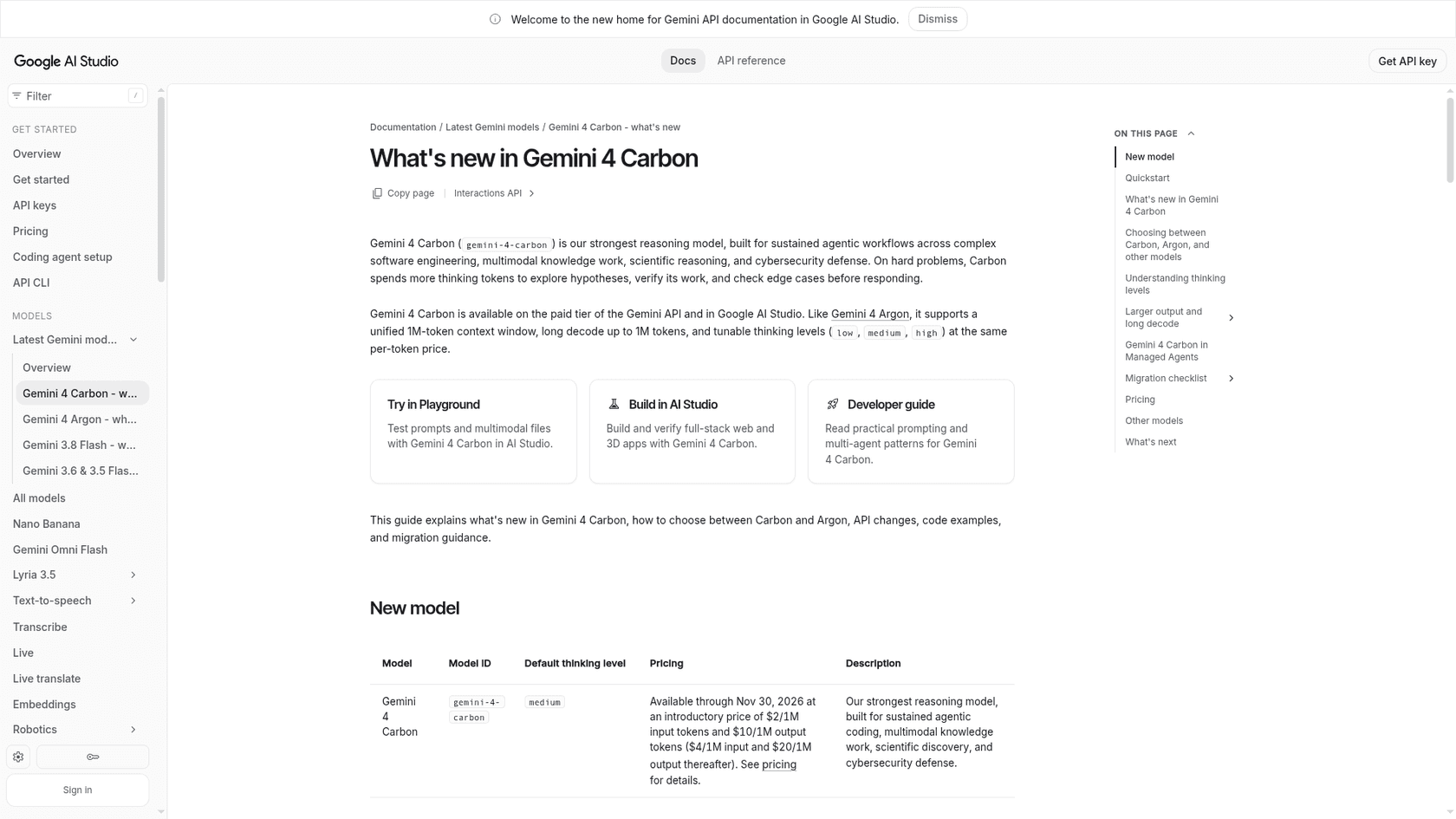
- Google's own documentation. The what's new page, the API pricing page, the release notes, and the two launch posts from 28 October and 10 November.
- Independent measurement. Artificial Analysis has run Carbon at low, medium, and high thinking through its v5.0.1 index, which gives me cost per task, time per task, and hallucination rates I can compare with other models on the same scale.
- Early users. The Hacker News thread on the general availability post had 145 comments within a day, which is where the speed and access complaints first showed up.
I didn't run my own benchmark. Where I give an opinion, it comes from how these numbers map onto jobs I know well, mostly AI that answers customers, since that's the work I see every day at eesel. Two weeks ago, when Carbon was limited to vetted cyber defenders, my Gemini 4 Carbon guide covered the launch claims. This post is about what it's like now that anyone with a paid API key can call it.
What changed since the 28 October announcement?
Three things moved between the announcement and the launch:
- Access. Carbon is now on the Gemini API paid tier, in Google AI Studio and Android Studio, and in Gemini for business. In consumer products (the Gemini app, Antigravity, AI Mode in Search) it's limited to Google AI Ultra subscribers.
- Price. The introductory $2 input and $10 output per million tokens runs only until 30 November. That's 20 days. From 1 December it's $4 and $20, the same card as Argon.
- Scores. Artificial Analysis moved from v5.0 to v5.0.1 and now scores Carbon on high at 60, up from 59.4, with separate runs for low and medium.
The cyber version stays gated. "Carbon for cyber" with the strongest security abilities is still only for organisations in the Fairwind Program, much like the gated cyber models from OpenAI and Anthropic, such as GPT-5.6-Cyber and Claude Mythos 5.2.
What Gemini 4 Carbon does well
It tops the index, and the default setting is the sweet spot
On the Artificial Analysis v5.0.1 index, Carbon on high scores 60.0. The closest models I checked are Claude Opus 5.5 at max effort (59.1) and GPT-6 Astra at max (56.9).
The more useful finding is about the three thinking levels. You'd expect low to be cheapest and high to be best. That's only half true:
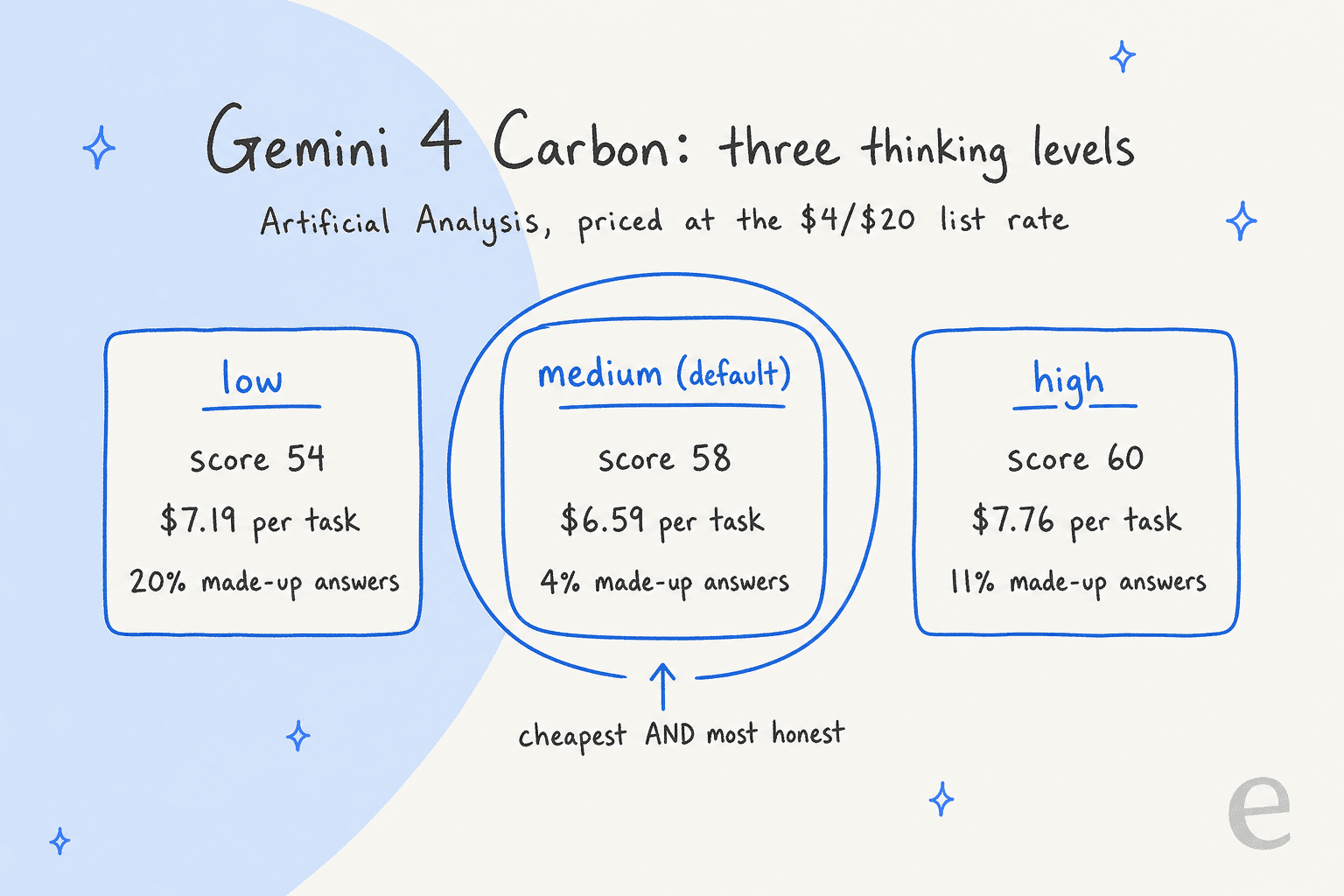
Medium is cheaper per task than low. On the Hacker News thread, ponyous spotted the same oddity, and another commenter offered the likely reason:
"Less capable models tend to loop more and end up costing more per task, even though they cost less per token."

So the default isn't a compromise. It's the setting I'd start every evaluation on, which matches Google's own advice to test all three and keep the lowest one that meets your bar.
It makes things up less than any rival at its level
The Artificial Analysis Omniscience test asks hard factual questions and counts how often a model answers wrongly instead of saying it doesn't know. Here's how the top tier compares:
| Model and setting | AA index | Made-up answer rate | Cost per task (list) |
|---|---|---|---|
| Gemini 4 Carbon (medium) | 58.3 | 4.2% | $6.59 |
| Gemini 4 Carbon (high) | 60.0 | 11.4% | $7.76 |
| Gemini 4 Argon (high) | 50.4 | 4.3% | $9.95 |
| Claude Opus 5.5 (max) | 59.1 | 50.3% | $10.04 |
| Claude Opus 5.5 (xhigh) | 57.4 | 65.0% | $6.05 |
| GPT-6 Astra (max) | 56.9 | 49.8% | $6.24 |
| GPT-6.1 Sol (max) | 54.6 | 51.9% | $1.27 |
Artificial Analysis v5.0.1, checked 11 November 2026. Cost per task is at each model's list price, so Carbon's $2/$10 promo halves its figures until 30 November.
Opus 5.5 at xhigh is the fairest comparison, at a similar score and cost. Carbon on medium makes up an answer about one time in 25, against roughly two in three for Opus. Google's own honesty test points the same way: on a 375-task agentic honesty benchmark, Carbon passed 92% of tasks against 70% for Argon, and declined to fill in missing experimental data 98% of the time.
Documents, research, and long jobs
This is where Google's partner quotes cluster. In the launch post, Box says Carbon scored 100% on its public sector tasks, Glean says it led every frontier model Glean tested on task completion, and Hebbia calls it the strongest model it has evaluated for deep financial research. Google also says Carbon ranks #1 on Cursor's, Perplexity's, and Zapier's agent benchmarks at more than twice lower cost per task than the next best outside model. Those are Google-reported claims, and I'd treat them that way.
The technical basis is real, though. Input, thinking, and output share one 1,048,576-token window, and with background execution a single response can run past 64K tokens up to the full window. One early user on Hacker News described the difference on a hard read:
"I have this unfinished paper draft that I keep feeding to various top AI's to see what it picks up on and what suggests to edit, and while Astra/Fable/Opus/Argon so far has been mediocre, Carbon's answer surprised me with some interesting points all the other AI's missed."
That's one person's test, as they say themselves, but it fits the design: Carbon spends more thinking tokens per turn to explore and check its work.
Coding, with two caveats
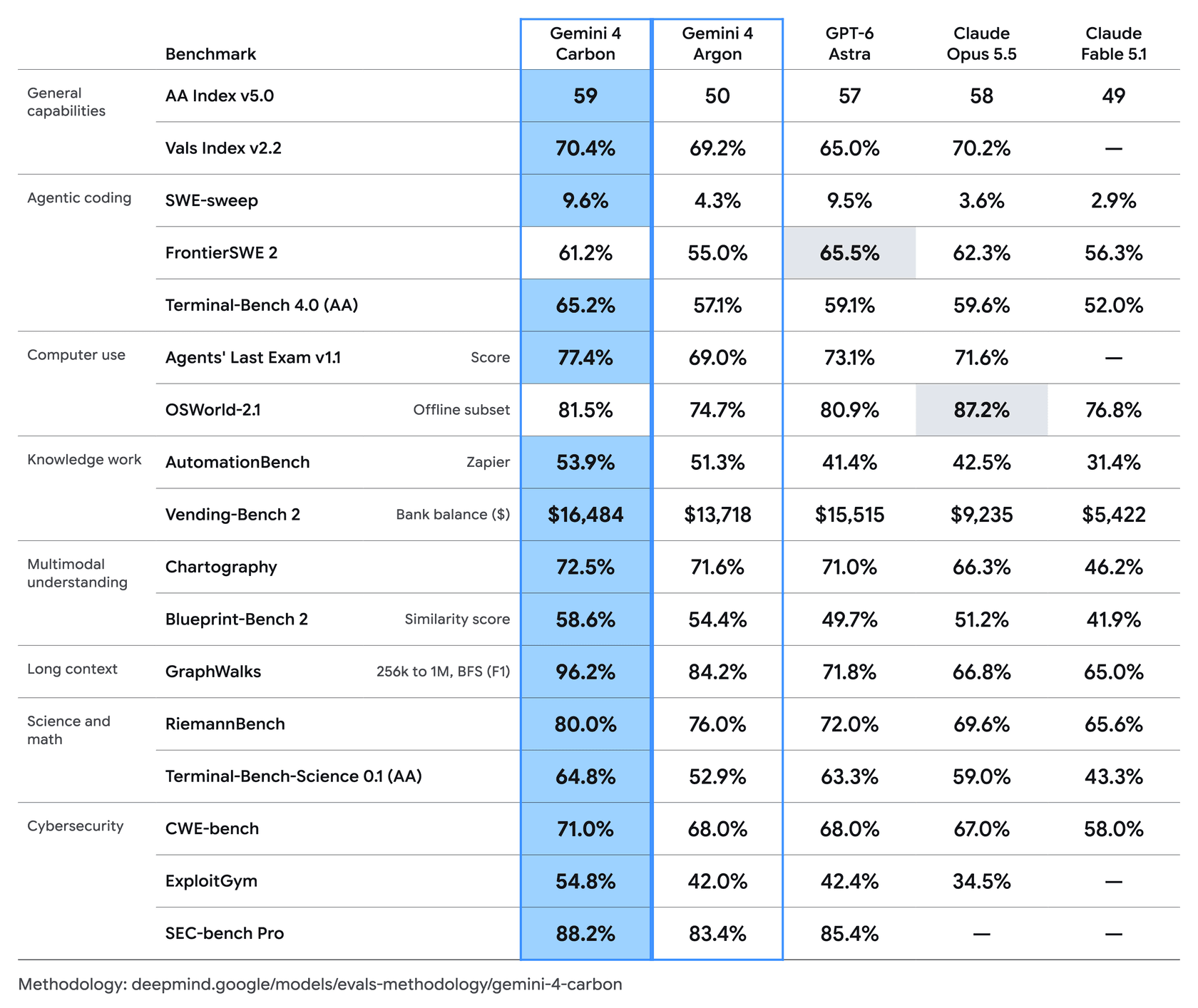
Carbon scores 65.2% on Terminal-Bench 4.0 on high, ahead of Opus 5.5 at max (59.6%) and Sol at max (56.1%). HubX told Google that across 16 real bug fixes in a 14,000-test codebase, Carbon resolved 94% with zero regressions.
The caveats: open-weight Kimi K3.1 Pro scores a little higher on Terminal-Bench 4.0 (67.2%) at half Carbon's list price per token. And Google's own table from the October launch shows Carbon trailing GPT-6 Astra on FrontierSWE 2 (61.2% against 65.5%) and Opus 5.5 on OSWorld-2.1 (81.5% against 87.2%).
Prompt injection resistance
Carbon was the first model to reach 0% attack success on the Gray Swan indirect prompt injection benchmark, which matters for any agent that reads web pages, emails, or tickets written by strangers. Google is careful to add that its own red teaming still finds attacks that work in some cases. I'd read that as "best measured so far," not "solved."
Where Gemini 4 Carbon falls short
It's slow, and you feel it
This is the biggest practical cost. Artificial Analysis measured about 67 seconds before the first answer token and 80 tokens per second after that. On high, an index task takes 25.6 minutes against a median of 12.8 for comparable models. Google's own migration checklist says hard prompts "can take several minutes" and recommends HTTP timeouts of at least 15 minutes.
Early users on launch day saw worse, probably from launch traffic:
"Not sure how anyone is able to praise this model when so far we're seeing a p75 TTFT of 60s and a TPS of 10. Model is completely unusable at the moment."
Launch-day throughput tends to improve. The thinking time won't, because it's the point of the model.
It's wordy, so the per-token price misleads
To run the full index, Carbon on high generated 205 million tokens, against a median of 72.8 million for similar models. Every thinking token is billed as output. That's why a model at $4/$20 costs more per task than GPT-6 Astra at $10/$50.
Subscription users feel this as quota. "I was barely able to complete a single project with Ultra 5x using Carbon," wrote kevmo314 on Hacker News.
The price doubles on 1 December
At $2/$10 the per-task numbers above halve, which makes medium about $3.30 a task. That lasts 20 days. Here's what a month of Carbon work looks like at both prices:
Two smaller billing details from the pricing page: there's no free tier, and explicit context caching isn't supported. Implicit caching kicks in on prompts of at least 4,096 tokens and takes 95% off cached input. The Gemini 4 Carbon pricing breakdown goes through Batch, Flex, and Priority rates.
Access is uneven for subscribers
The API is open to any paid developer. Consumer access is a different story. In the Gemini app, Carbon sits behind Google AI Ultra, and Hacker News users on lower plans reported the same message:
"With Plus subscription this is in the list of available models, but says: 'Unavailable - Gemini 4 Carbon is currently available to Ultra plan subscribers.'"
Others on the thread reported different models on their Workspace and personal accounts. If you want to try Carbon cheaply, the API or AI Studio with a paid key is the reliable route.
Some API habits have to change
Coming from older Gemini models, Google's migration checklist lists a few breaking points: temperature, top_p, and top_k are ignored; explicit caching calls need removing; max_output_tokens should be at least 32,768 because thinking eats into it; and synchronous responses stop at 65,536 tokens, so longer outputs need background set to true. None of it is hard, but it isn't a drop-in swap from Gemini 3.
Gemini 4 Carbon vs Argon, Opus 5.5, and Fable 5.2
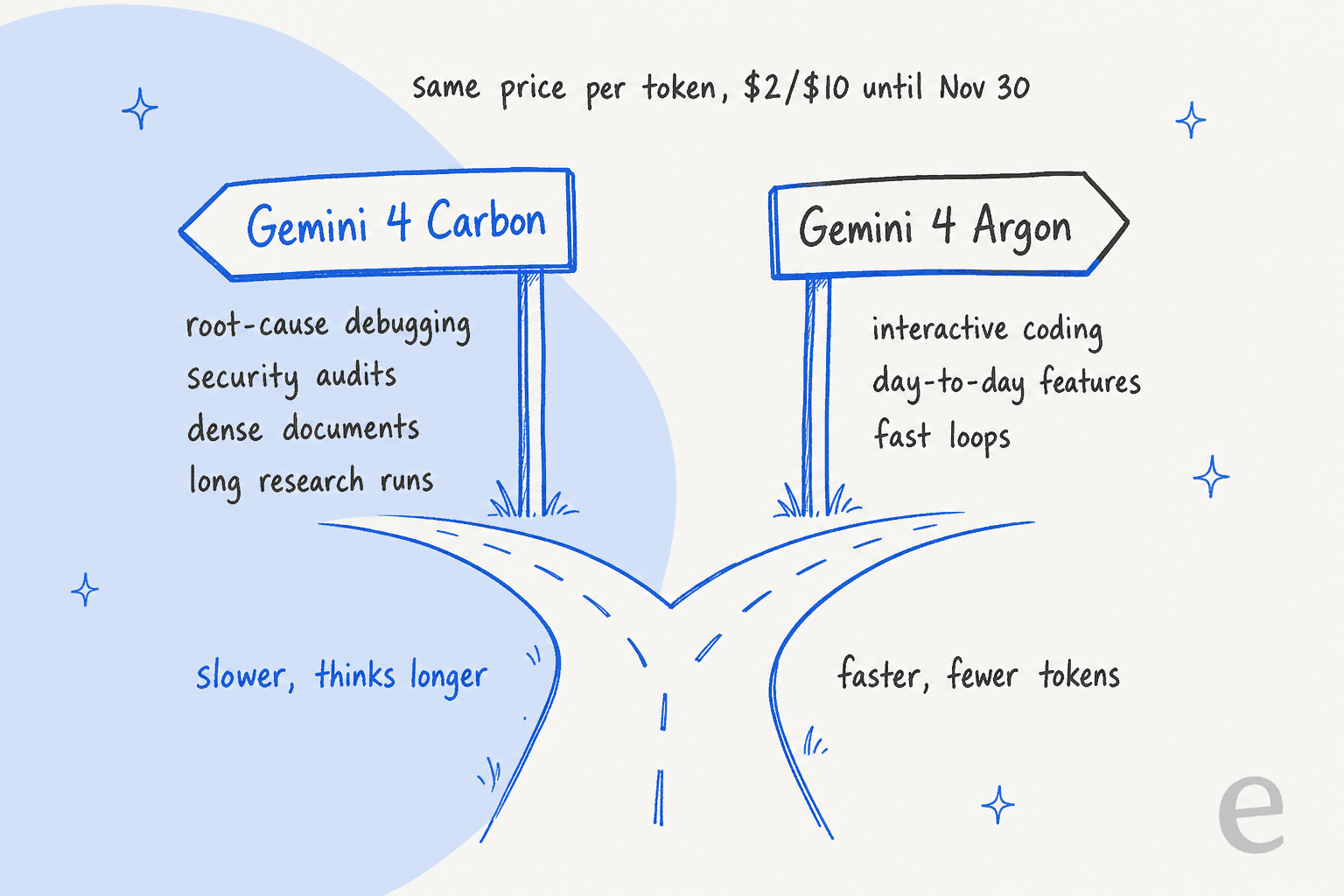
Google's own guidance is clear that Carbon doesn't replace Argon. Both cost the same per token. Carbon thinks longer.
Against the rest of the top tier:
- Gemini 4 Argon. Ten points lower on the index, nearly the same made-up answer rate, and faster per turn. Pick it for interactive work. The Argon alternatives roundup covers its rivals.
- Claude Opus 5.5. Similar score and cost at xhigh, faster per task (16 minutes against Carbon's 24 on medium), but it makes up answers far more often on the Omniscience test. It's still ahead on computer use. See my Opus 5.5 review.
- Claude Fable 5.2. Released 9 November at $8/$40. Artificial Analysis hadn't published Fable 5.2 in the set I pulled, so I can't put it in the table. One Hacker News user ran Carbon on a personal benchmark and found it "matches Fable 5.2," but "still slower and more costly." My Fable 5.2 review has the Anthropic side.
- GPT-6.1 Sol. About 91% of Carbon's top score at roughly a sixth of the cost per task. If your bill matters more than the last few points, Sol is the value pick. My Sol review explains why.
If none of these fits, the Gemini 4 Carbon alternatives post goes model by model.
What are people saying about Gemini 4 Carbon?
The general availability thread on Hacker News reached 266 points and 145 comments on launch day. The reaction splits three ways.
Impressed on hard problems. Several users said Carbon caught things other models missed, and one commenter simply said they found Carbon "waaay better than Argon." Simon Willison noted that the pelican-on-a-bicycle test was solid, adding that every Gemini model for the past year has drawn good pelicans.
Frustrated by access and naming. The loudest complaints were about consumer plans, and a few about the names:
"Carbon and Argon are such similar names this is the first time I've registered they are different models. Google branding strikes again"
Worried about speed and quota. Beyond the latency numbers above, Ultra users talked about rationing it. "Too afraid to use it though since my quota would drop like a rock," wrote one.
Who should use Gemini 4 Carbon?
| You are... | My take |
|---|---|
| Debugging a hard, cross-system bug | Use Carbon. This is the job it was built for. |
| Synthesising dense PDFs, spreadsheets, or long research | Use Carbon on medium, with background execution for long outputs. |
| Doing interactive, day-to-day coding | Use Argon, or Opus 5.5 if you want faster turns. |
| Watching cost per task closely | Use GPT-6.1 Sol, or wait to see December pricing on your own traffic. |
| Running security audits on your own code | Carbon works, but the strongest cyber version needs Fairwind approval. |
| Answering customers live in chat | Don't. A minute before the first word is too slow. |
The broader pattern holds across every frontier AI release this year: the smartest model isn't always the right model for a job. Speed and cost per task decide more real deployments than index points.
What this review means for support teams
The 4% made-up answer rate is the most interesting number here if you put AI in front of customers. I work on the team at eesel that has spent years putting AI agents on live support queues, and the failure that costs trust is the confident wrong answer.
But the second failure is speed, and I've watched it lose deals. One buyer ran a methodical 67-test evaluation of eesel, found the answers solid, and still walked away because the chat widget was slow and often got stuck. Good answers didn't matter once customers had to wait. Carbon's minute-long think would make that problem worse, not better.
So I'd split the work. A slow, careful model like Carbon belongs in back-office jobs: auditing help articles for contradictions, reviewing weeks of tickets for patterns, drafting policies. The model replying to customers needs to be fast, and its accuracy comes mostly from the system around it:
- The right knowledge. Your past tickets and help center, not general training data.
- A hard handoff. When the docs don't cover a question, route to a person. That enforces "I don't know" instead of hoping the model says it.
- Testing on history. Run the agent on real past tickets and compare its replies with what your team sent, before go-live.
- The helpdesk it lives in. The agent should work inside Zendesk or HubSpot, where the tickets already are.
Two eesel customers show what that looks like in practice. smava, a German loan comparison company, handles about 27,000 Zendesk tickets a month across two brands; eesel categorised 14,600 of them and prepared 15,300 draft replies in a month, working from 820 macros and help center articles kept apart by brand. MentorShow, a French online learning platform, gets an analysis and a draft reply on every HubSpot ticket, with 432 drafts written in a month in French, English, or Spanish.
The guide to AI hallucinations in support goes deeper on each step, and which LLM is best for support compares the speed side.
Try eesel
Carbon is infrastructure; eesel is the employee. If Carbon's habit of checking its work is what caught your eye, the eesel AI helpdesk teammate gives your queue that same caution without the minute-long wait. It learns from your past tickets and help center, hands off when the answer isn't in your docs, and you can simulate it on your real ticket history before it replies to anyone.
Developers can drive the same workspace from the eesel CLI: a coding agent uploads approved knowledge such as exported macros and policies, adjusts the instructions, and checks answers on test questions. Connecting the helpdesk itself still needs an admin to approve it.
Pricing is a fixed monthly credit plan where one ticket or chat is one credit, with a free plan of 100 credits and no card. There's no per-token bill, so a model's promo ending on 30 November doesn't change what you pay. Try eesel on a slice of your queue.