

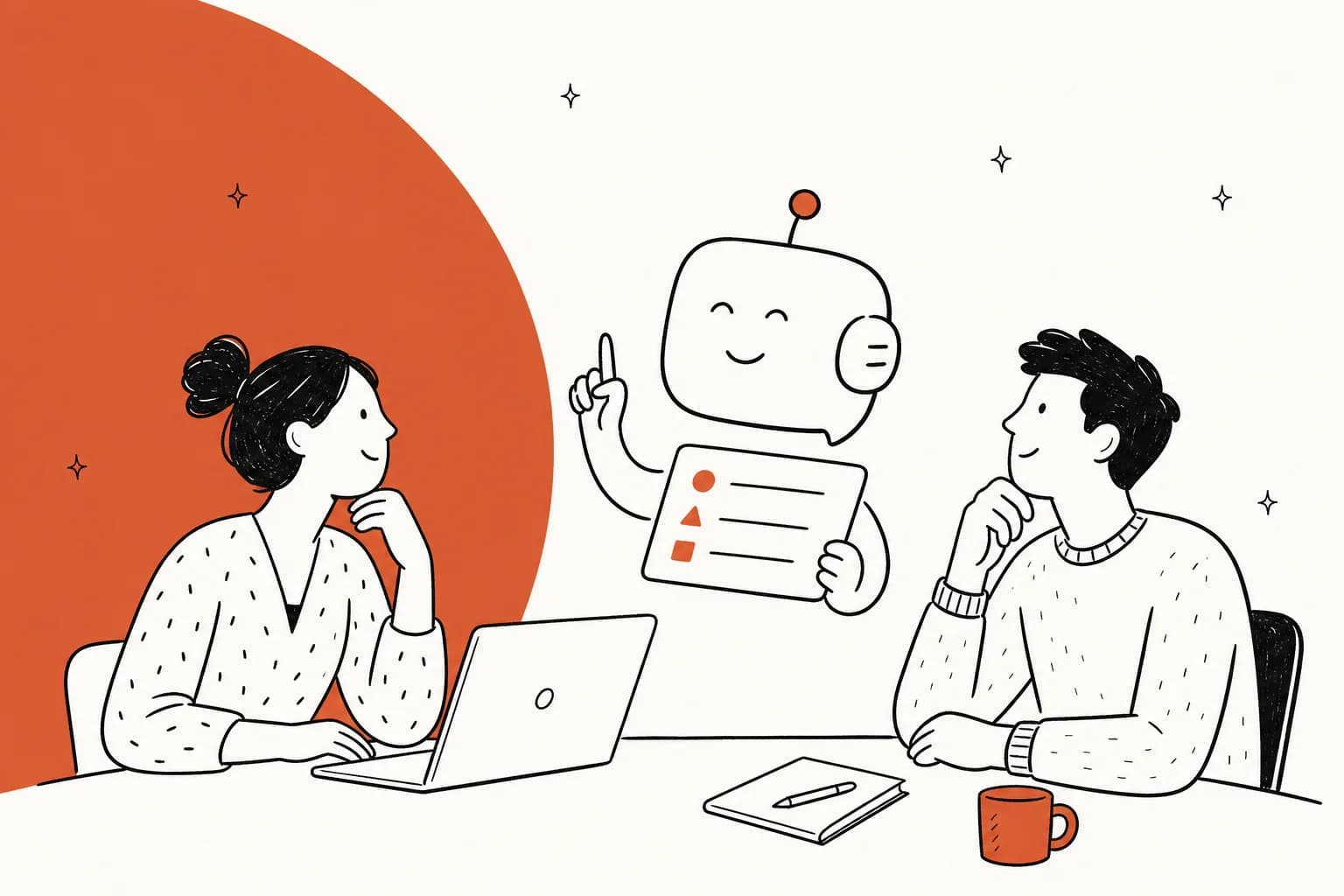
My verdict at a glance
I've spent years building the "drop an AI agent into Slack and your helpdesk" plumbing that Claude Tag is now selling, so I read this less as a spectator and more as someone who's shipped the same primitives. Here's how it scores, dimension by dimension.
The one-line takeaway: score it against the job. As an internal teammate it's an 8.4; as a customer support agent it isn't really competing.
What Claude Tag is (the 30-second version)
If you want the full mechanics, I wrote a separate Claude Tag explainer. The short version: Claude joins your Slack workspace as a member. An admin grants it access to channels and connects it to your tools, data, and "even codebases." From then on anyone can tag @Claude with a plain-language request and hand off the work.
Anthropic frames it as "the beginning of an evolution of Claude Code", the same agent made "more proactive" and able to work "better with a full team." The internal shorthand was blunter: "Claude Code made multiplayer, async, and proactive." Andrej Karpathy went bigger, calling it the "3rd major redesign of LLM UIUX." That framing matters for a review, because the thing you're grading isn't a chat feature, it's a bet on a new way of working.
What's genuinely good
The multiplayer model actually earns the name
Most "AI in Slack" tools are a private chat with extra steps. Claude Tag isn't. Within a channel there's one Claude that everyone interacts with, and anyone can pick up where the last person left off. One Hacker News commenter called this "the most important difference from other products," and I agree, it's the piece competitors will scramble to copy.
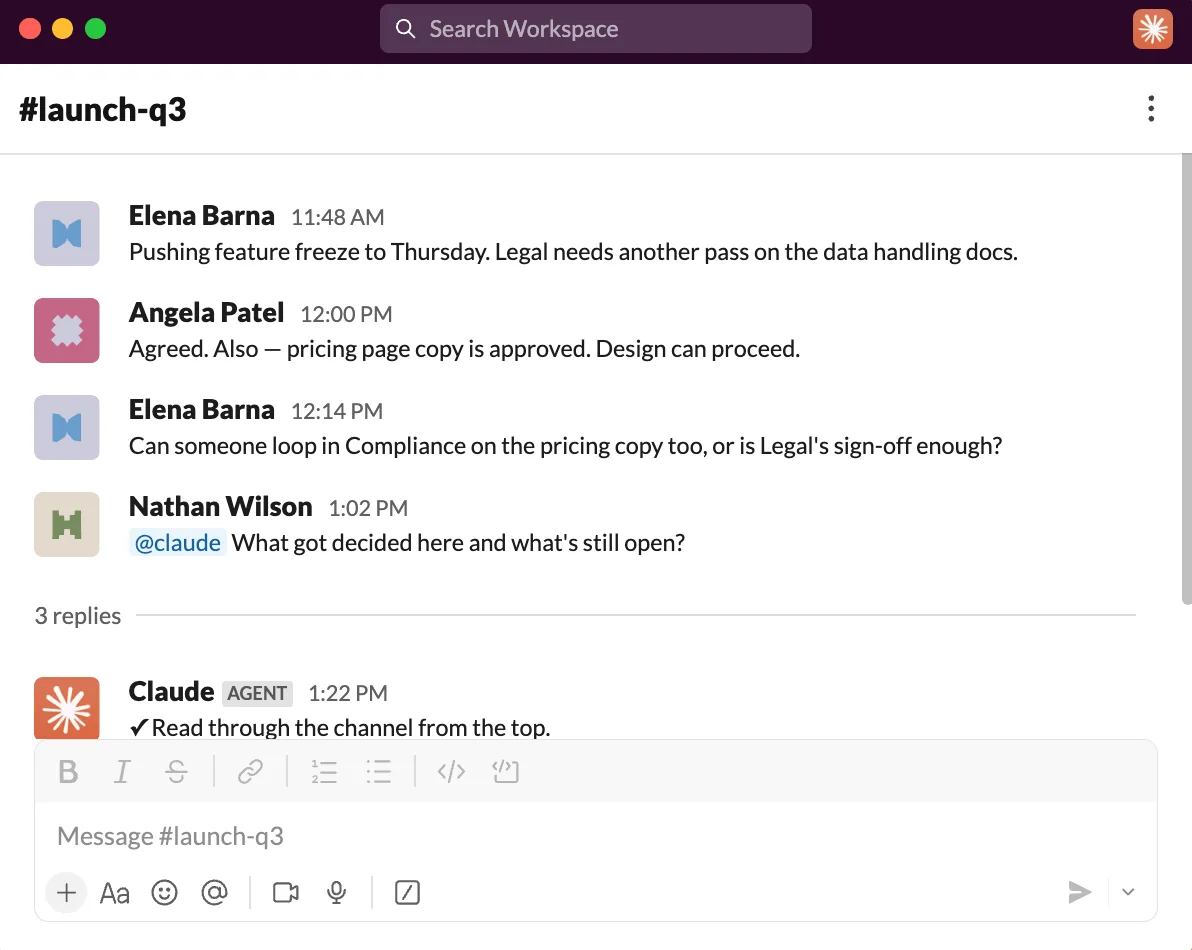
The obvious worry, a coworker hijacking your task, got a real answer from an Anthropic engineer on HN: Claude distinguishes a thread's initiator from later participants and "patiently waits for a resolution while correcting any misunderstandings." Because it has its own identity, "a coworker cannot enter a thread and commandeer your identity." That's the right design, not a hand-wave.
Agent identity is the best-designed part
This is the part I keep coming back to as someone who wires up integrations. Claude Tag doesn't borrow your credentials, it "acts as itself": posting in Slack as the Claude app, opening PRs as the Claude GitHub App, querying a warehouse under an admin-provisioned service account. Noah Zweben on the Claude Code team summed the shift up to Help Net Security: agent identity replaces "what can this user do?" with "what can this agent do in this compartment?"
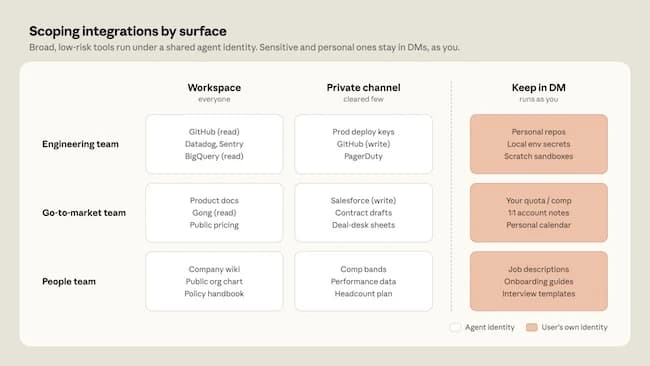
Admins set a baseline identity per workspace and override it per channel, so engineering's Claude reaches GitHub and the warehouse while a sales channel's Claude is confined to the CRM. Private channels get their own identity and never leak into the wider workspace, and every action is logged. This is exactly the permission and confidence scoping any team putting an agent near real systems should demand. Anthropic shipped it on day one, and that's rare.
Async + ambient mode make the "teammate" pitch real
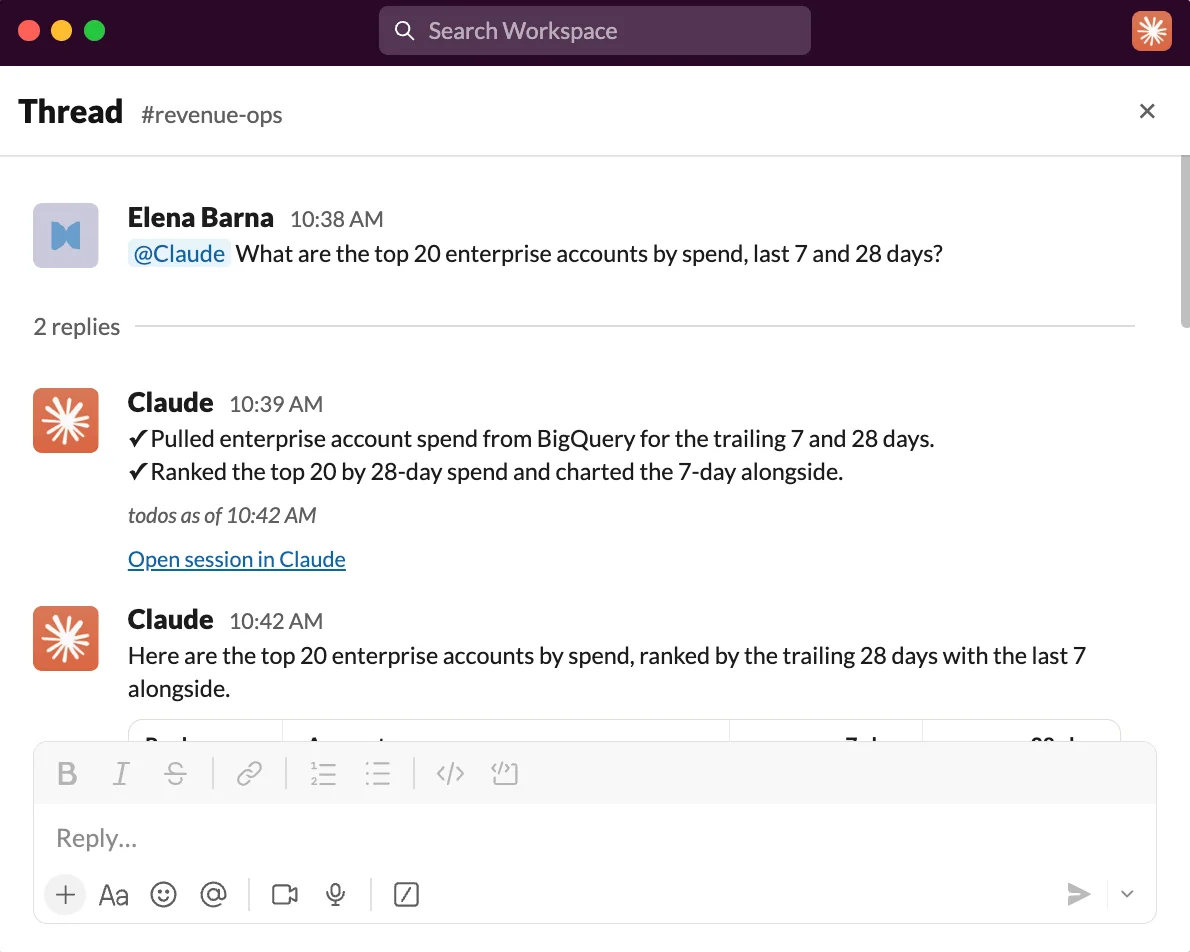
You set a task and move on; Claude works over hours, schedules its own follow-ups, and in "ambient" mode proactively flags what's gone quiet and tags you back. The published examples are concrete, pull the top 20 accounts by spend and chart them in-channel, or turn a bug report into a draft PR without leaving Slack.
For internal engineering and ops, that's a real productivity story, and it's the same shape as our own guides to AI for agent productivity and Slack enterprise search.
Where it falls short
Pricing you can't forecast (the biggest risk)
Here's the soft spot. Anthropic hasn't published a per-seat or per-token price; Claude Tag runs on token-based spending, with admins setting spend limits at the org and channel level. One HN reader summarized it as "Claude integration to Slack is now billed as API usage", and another replied "nailed it."
There's a generous on-ramp, a launch-credit line quoted on HN puts it at $25,000 per Enterprise org and $2,500 per Team org with 10+ paid seats. But the steady-state cost is the open question, put most sharply here:
"Wowza this will be a token guzzler. Assuming Claude is parsing every message posted on multiple slack channels, compacting knowledge etc."

A builder who'd shipped a similar Slack bot pushed back that real sessions stay short so cost is manageable, but the honest answer is nobody has run this at scale yet. If you forecast spend, an always-on agent billed on raw tokens is the line item to model before a wide rollout, and it's why some teams prefer a predictable per-ticket cost for anything customer-facing.
Memory can build on sand
Persistent memory is a headline feature, and also the one I'd watch hardest. A practitioner on HN put the concern precisely:
"It's quite bad at distinguishing what it should 'learn' from experimental or just wrong data… It builds and builds on a foundation of sand."
For internal work a wrong memory is an annoyance a colleague catches in seconds. That tolerance disappears the moment the audience is a customer, which is the core of my support verdict below.
Slack-only, Teams left out, governance still thin
At launch it's Slack-only. If your company runs on Microsoft Teams, you're waiting, and one admin on HN flagged that even for Slack the native audit tooling and per-member access controls "really need to step up," or "Microsoft will eat their lunch for enterprise non-programming use." If your AI teammate needs to live across an internal helpdesk or a Teams IT support bot, that surface gap is real today.
The 65% claim, and how much to trust it
Anthropic put a striking number up front: 65% of its product team's code now runs through its internal version of Claude Tag. Product lead Cat Wu phrased it as "merges 65% of product PRs." It's an eyebrow-raiser, but treat it carefully: "writes 65% of code" and "merges 65% of PRs" aren't the same metric, and no denominator or time window is published. The HN peanut gallery went straight for it:
"Given the reliability and general product quality of the Anthropic product team's code, this doesn't sound like a selling point."
As a review data point, it's suggestive, not proof. There are no independent evals of reliability, task-completion rate, or token efficiency yet.
What the community makes of it
The reaction split cleanly. Believers see a new interaction model, Kevin Weil called it "such a good idea," and Anthropic's Alex Albert said it feels "less like using a tool and more like managing a team." Skeptics aimed at the price model and the "one Claude everywhere" design; Anthropic's own Joanne Jang needled the "monotheistic" single-identity model that, by design, partitions what Claude knows per channel. That tension is real: the boundary that keeps #gtm private also means it doesn't know what #general knows.
Who should turn it on, and who should wait
Claude Tag for customer support: the honest verdict
Here's where I'll be opinionated, because building AI agents for the helpdesk is the thing I actually do.
Claude Tag validates a bet eesel made years ago: the right shape for AI at work is a teammate that lives where you already are, remembers your context, and acts on its own. For an internal support chatbot or an IT service desk in Slack, watch this whole category, it's moving fast.
But customer-facing support is a different job. The two loudest worries about Claude Tag, unpredictable token cost and learning from wrong data, are exactly the two things a customer deployment cannot tolerate. A bot that quietly learns a wrong answer and repeats it to a customer isn't an internal annoyance, it's a refund, a churned account, or a compliance problem. Building these agents, I've watched confident-sounding models give wrong answers with total conviction, which is the whole reason we simulate every eesel rollout against a company's real past tickets before it replies to anyone. You see the projected resolution rate and the exact answers it would have sent, fix the gaps, then go live.
That's the whole reason a support-built tool exists. eesel is the AI helpdesk agent version of the same teammate idea: it plugs into Zendesk, Freshdesk, Gorgias, Front and Slack, trains on your solved tickets rather than just your help center, routes by confidence so low-certainty cases get drafted instead of sent, and bills per ticket so cost is something you can budget. Gridwise saw it resolve 73% of tier-1 requests in the first month; Smava runs a fully automated agent on 100,000+ German-language tickets a month. Different job, different guardrails.
If you're shopping that category, our guides to the best AI for Slack support, the cheapest AI apps for helpdesk, and the full list of Claude Tag alternatives go deeper than a single review can.
Try eesel for customer support
Claude Tag is the right shape for an AI teammate inside your team's Slack. When the audience is your customers, you want that same teammate built for the helpdesk: eesel connects to your existing tools in minutes, learns from your past tickets, and lets you simulate the rollout on real historical conversations before a single reply goes out, so you see the resolution rate before you commit, not after.
It works the same way across your helpdesk, drafting and sending replies, triaging, and escalating, with full oversight while you hand it more autonomy over time:

You can try eesel free, no credit card, and run a simulation on your own tickets to see what it would resolve before you turn it on.
Frequently Asked Questions
Is Claude Tag worth it in 2026?
How much does Claude Tag cost?
What is Claude Tag and how does it work?
@Claude in a channel, hand off a task, and it works asynchronously under its own identity, then replies in the thread. It runs on Claude Opus 4.8. Our full Claude Tag explainer walks through the mechanics.