


The short answer on Claude Tag pricing
Let me put the whole thing in one table before the details, because most of the "pricing" you'll find quoted online is really one of four separate numbers getting mixed together.
| What you're actually paying for | The number | Notes |
|---|---|---|
| Claude Tag feature license | $0 flat | No per-seat or per-feature fee published |
| The tokens Claude Tag burns | Usage-based | Billed like API usage, capped by admin spend limits |
| The plan you need underneath | Enterprise or Team | Beta is gated to these two tiers |
| Launch credit (early on-ramp) | $25k / $2.5k | Enterprise org / Team org with 10+ seats (per HN) |
So when someone asks "how much is Claude Tag?", the correct answer is "your existing Claude subscription, plus a token bill that depends entirely on how hard your team leans on it." That's very different from a tool like Zendesk's AI pricing or a flat per-seat AI copilot, and it's the single most important thing to understand before you roll it out.

What you actually pay for
1. The feature itself has no sticker price
This trips people up, so I'll be blunt: Anthropic hasn't published a per-seat or per-token price for Claude Tag. It's in beta, and the launch materials talk about capabilities, not a rate card. There is no "Claude Tag plan" you buy. If you go looking for a pricing page the way you would for Slack's own tiers, you won't find one yet.
2. You pay in tokens, billed like API usage
Here's the model that actually matters. Claude Tag runs on token-based spending. As it reads a channel, remembers context, and runs a task, it consumes tokens, and you're billed for them. Admins set spend limits at both the org and the channel level to keep it bounded. One Hacker News reader summed it up cleanly:
"Claude integration to Slack is now billed as API usage."

Another replied simply, "nailed it." That's the mental model to carry: Claude Tag pricing is API-style usage pricing wearing a Slack coat. If you already budget for Claude API costs, this is the same line item, now driven by team chatter instead of your own scripts.
3. You need Enterprise or Team underneath
Claude Tag is gated to Claude Enterprise and Claude Team plans, and it's Slack-only at launch. So the true entry cost is your seat subscription on one of those tiers plus the token spend on top. Enterprise buyers also get role-based access control over who can invoke @Claude, which matters when the agent can reach real systems. If your team runs on Microsoft Teams, you're waiting, and that surface gap is a real cost in itself if you'd otherwise need a Teams IT support bot.
4. The launch credit is generous, and temporary
The one concrete dollar figure in circulation comes from a launch-credit line quoted on Hacker News: $25,000 per Enterprise org, and $2,500 per Team org with 10+ paid seats. That's a real on-ramp, enough to run light-to-moderate usage for months without seeing a bill. But it's a credit, not a price. Treat the free-feeling window as an extended trial, and model what happens the month after it runs dry, because that's your steady-state Claude Tag pricing.
Estimate your own Claude Tag token spend
Since there's no rate card, the useful thing I can give you is a way to sanity-check the order of magnitude. Anthropic runs Claude Tag on Claude Opus 4.8, so plug in Opus-tier token rates and your own channel activity. The widget below is a rough model, not a quote, but it turns "usage-based, who knows" into a number you can react to.
Slide the channels and tasks up to what a busy engineering org looks like and the number climbs fast. That's not a knock on the tech, it's the nature of usage-based pricing on an always-on agent. Which brings me to the part I've actually lived through.
Why the pricing model is the whole story
I ship the integration and billing plumbing at eesel, so I read pricing models for a living. The thing I keep flagging about Claude Tag isn't the rate, it's the shape. Usage-based token billing means your cost tracks activity you don't fully control: a noisy launch week, a chatty channel, an agent that decides to compact a lot of memory. One HN reader put the worry in plain terms:
"Wowza this will be a token guzzler. Assuming Claude is parsing every message posted on multiple slack channels, compacting knowledge etc."
A builder who'd shipped a similar Slack bot pushed back that real sessions stay short, so cost stays manageable. Both can be true. The honest position is that nobody has run this at your scale yet, so you're the one absorbing the forecasting risk during beta.
I've watched exactly this dynamic play out on the buying side. In one eesel sales call, a very-high-volume operator got tangled trying to model a per-interaction bill and projected roughly $30,000 a month at scale before we'd even finished the pricing conversation. When the meter runs on volume you can't cap without capping the product's usefulness, buyers get nervous, and they're right to. That's not a Claude Tag-specific flaw, it's what usage-based pricing does to a spreadsheet. It's also why eesel sells a predictable monthly price sized to ticket volume for the customer-facing side, where volume spikes are the norm, not the exception.
For internal work, the risk is smaller. Engineering and ops tasks are bounded by real human handoffs, and admins can cap channel spend. That's a reasonable place to accept usage pricing.
What you get for the spend
To be fair to the price, here's what the tokens buy, because it's a capable product for internal work.
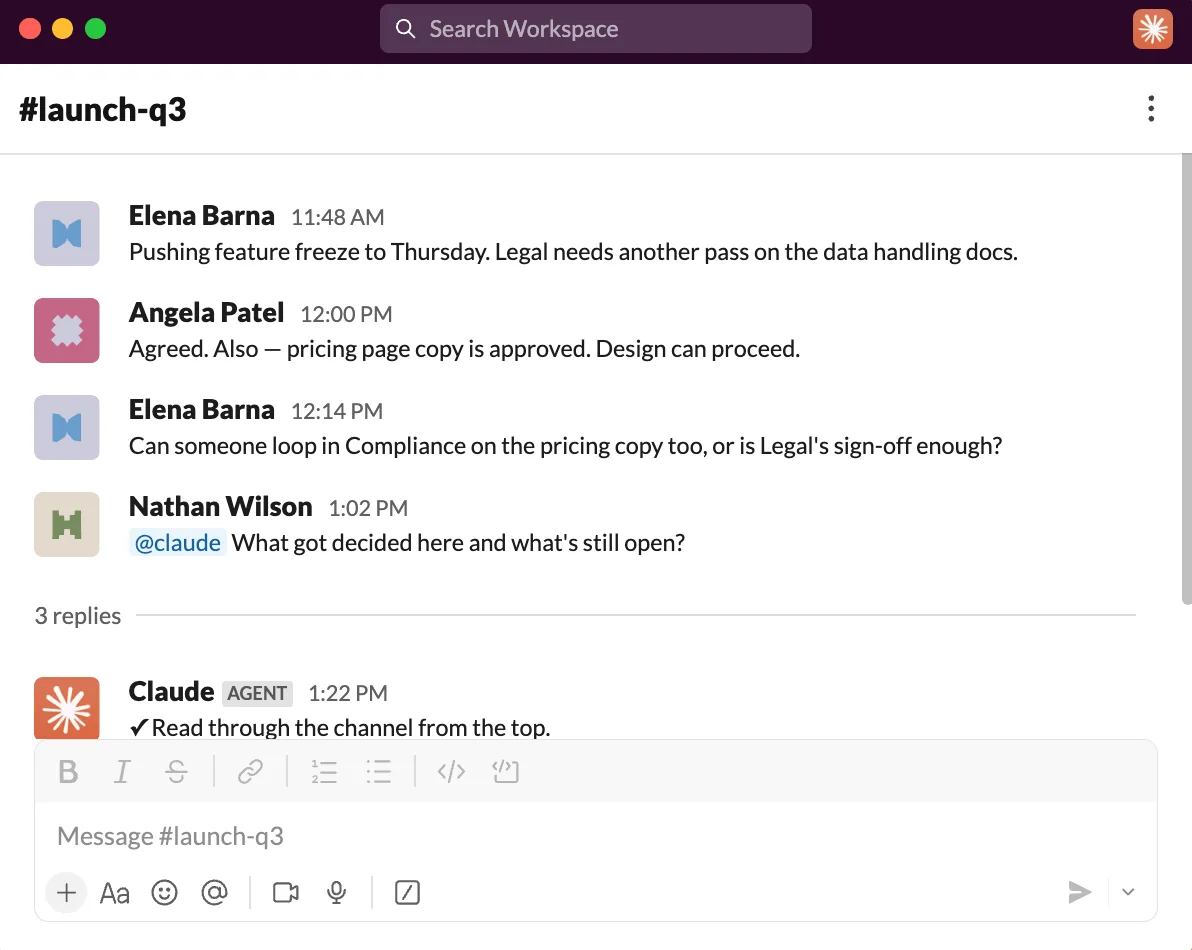
- A multiplayer agent. One shared Claude per channel that the whole team can steer, not a private chat per person. An Anthropic engineer explained on Hacker News that Claude distinguishes a thread's initiator from later participants, so a coworker can't hijack your task.
- Async, ambient work. You hand off a task and move on; Claude works over hours, schedules its own follow-ups, and flags what's gone quiet. This is the same shape as our guides to AI for agent productivity and Slack enterprise search.
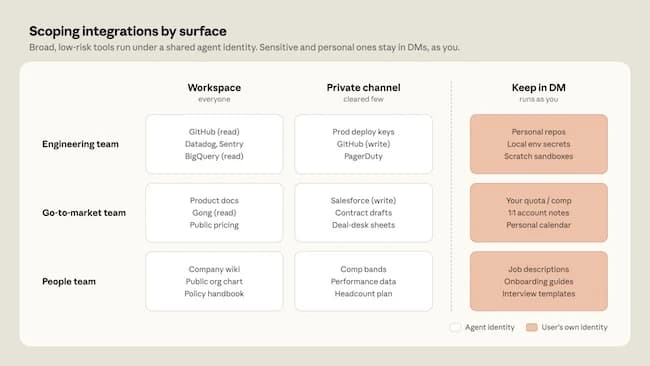
- Agent identity and scoping. Claude acts as itself under per-channel service accounts, not your credentials, and every action is logged. It's the permission and confidence scoping any team putting an agent near real systems should demand, and it's the best-designed part of the product.
- RBAC on Enterprise. Admins control who can invoke
@Claudeand what each channel's agent can reach.
Anthropic backs the value with a striking internal number: product lead Cat Wu said the team merges 65% of product PRs through its internal version. Treat that carefully (no denominator or time window is published), but it signals the tool earns its keep for engineering. Whether your org's usage justifies your token bill is the question only the estimator above can start to answer.
When a flat, per-ticket price wins instead
Here's the line I'd draw. Claude Tag's usage pricing is fine when the work is internal and bounded. It's the wrong tool the moment the audience is a customer.
Two reasons, both about cost shape:
- Support volume spikes are uncontrollable. A product outage or a viral moment can 5x your ticket volume overnight. On token-based billing, your worst week is also your most expensive week, exactly when you can least afford a surprise. A per-resolution or flat model keeps November's bill legible next to March's, and the AI vs offshore cost comparison shows how much that predictability is worth.
- You can't simulate the cost before you commit. Claude Tag has no way to replay your historical tickets and show you what it would have cost and resolved. A support-built AI helpdesk agent can, so you walk into the rollout knowing the number, not discovering it on the invoice.
This is why, for anything customer-facing, I'd point you at tools built for the helpdesk rather than an internal Slack teammate. My Claude Tag alternatives roundup covers both sides, and the best AI for Slack support is the narrower list if Slack is where your support actually happens.
For a broader buyer's view, the best Slack-integrated helpdesk roundup is worth a look, and larger teams should read the best helpdesk for enterprise guide.
An AI teammate for Slack with a bill you can actually forecast
If what you want is an AI teammate in Slack that also closes support tickets, this is squarely what I build. eesel plugs into Slack and your helpdesk, trains on your own past tickets and help center, and uses one credit per ticket, not per token it happens to burn. You can simulate it on your historical tickets before it ever replies live, so you see the resolution rate and the cost up front, no beta-pricing guesswork. It's the predictable-cost answer to the exact forecasting problem Claude Tag leaves open.
Try eesel free, or learn more about AI for Slack support.
The bottom line on Claude Tag pricing
Claude Tag doesn't have a price you can quote, it has a model: your Enterprise or Team subscription, plus token-based usage, softened at the start by a real launch credit. For internal engineering and ops, that's a reasonable deal, and the product is well-built. For customer support, usage-based token billing is the wrong shape, and a per-ticket price you can forecast, simulate, and cap will serve you better.
If you're weighing it up, read the full Claude Tag review for the quality verdict, the Claude Tag explainer for how it works, and the alternatives roundup if the token bill gives you pause.
And if your AI teammate needs to live across an internal helpdesk or a Teams IT support bot too, factor that surface gap into the real cost.