
Zendesk can provide controls that support a GDPR program; it cannot make your support operation compliant by itself. Your company normally decides the purpose and handling of customer data, so it must set the lawful basis, privacy notice, retention, access, and escalation process. Zendesk's Trust Center is evidence for a vendor review, not a legal conclusion.
For an AI agent, map the exact information it receives, the systems it can call, and the cases it must hand to a person. Get legal advice for high-impact decisions. This guide is operational guidance, not legal advice.
Start with the data flow, not the AI label
Write down a representative ticket journey: customer message, Zendesk fields and attachments, knowledge sources, model request, reply, audit record, and deletion path. Include any API action that might expose order, account, or payment data. That simple map makes the vendor questionnaire far more useful than a generic “is your AI GDPR compliant?” question. GDPR defines a controller as the party that determines the purposes and means of processing, and a processor as the party processing on its behalf. In a typical support deployment the subscriber is likely the controller and Zendesk a processor, but confirm roles and contractual terms for your arrangement. The GDPR text and counsel, rather than a vendor page, are the authority on that assessment.
Use that map to decide which vendor evidence you need: the applicable contract, hosting commitments, access controls, and deletion process for the products you actually use. These are controls to validate against your use case, not a substitute for choosing an appropriate lawful basis or publishing an accurate notice.
What to check in a Zendesk AI agent review
Contracts and subprocessors
Confirm the signed customer agreement, DPA, and current subprocessor list with procurement or counsel. Zendesk says that protections in its customer agreement and DPA apply to generally available AI features, and that direct LLM providers are subject to restrictions on training from Service Data. For direct providers, Zendesk describes zero-data-retention endpoints: requests and responses exist only to serve the request and are not retained by the provider. Read the current generative AI documentation rather than relying on an old sales deck.
Data minimization and retention
Do not make every ticket, attachment, or internal note available just because the integration can see it. Restrict source access and define retention and deletion processes with the privacy owner. Zendesk's deletion policy covers cancellation, termination, or migration and distinguishes product data, backups, logs, and AI-agent data. Do not present those timelines as the response process for an individual erasure request in an active account. Third-party products are outside that policy's scope and need their own review.
Rights requests and accountability
Your support team needs an owner and a documented route for access, correction, objection, restriction, and deletion requests. Zendesk's AI-agent privacy guide describes product-specific help for some of these tasks; for example, its messaging-data deletion API does not also remove expressions annotated to intents. Confirm the right process for the product and data involved. Keep the request, decision, action evidence, and applicable response deadline together in one case record.
Automated decisions and human intervention
An AI-written answer about a return policy is not automatically an Article 22 decision. Article 22 concerns decisions based solely on automated processing that produce legal or similarly significant effects. A workflow that denies credit, changes access, or makes another such decision needs closer assessment. Do not claim that a confidence setting or a “human in the loop” checkbox settles that analysis. Define what the agent may do, what it must escalate, who can override it, and how a customer reaches that person.
A practical Zendesk rollout
- Pick one narrow, well-documented topic only after its authentication, account-access, and policy risks have been assessed. A password reset is not automatically low risk.
- Remove sensitive fields and sources that the topic does not need.
- Review the connected actions before testing. A test message can still invoke an integration; approvals are selective safeguards, not proof that every action is held.
- Test the expected answer, the ambiguous case, and the request for a human.
- Keep a sample of resolved and escalated conversations for quality and privacy review.
- Revisit the map whenever you add a knowledge source, channel, procedure, or action.
Use the same teammate from a terminal when engineering needs evidence
The eesel CLI is useful when a support lead and an engineer need to inspect the same configured teammate. It is not a separate sandbox: changes in the CLI and dashboard apply to the same workspace and agent. Get the data owner’s approval and review connected action permissions before uploading, connecting, or chatting with production data.
For example, a coding agent such as Claude Code, Codex, or Cursor can inspect connected sources, upload a redacted policy document, ask a controlled test question, then return the JSON result for review:
npx @eesel/cli integrations --agent support
npx @eesel/cli approvals --agent support
npx @eesel/cli files upload ./redacted-retention-policy.pdf --agent support --dry-run
npx @eesel/cli files upload ./redacted-retention-policy.pdf --agent support
npx @eesel/cli chat "How long do we keep closed-ticket data? Cite the approved policy." --agent support
npx @eesel/cli approvals --agent support
npx @eesel/cli activity --agent support
Use Node.js 18.17 or later. The CLI prints JSON, so a script can save the answer and activity evidence for the privacy owner in an approved location. Check whether the answer distinguishes ordinary ticket retention from account-cancellation deletion, cites the approved policy, and routes an individual rights request to the responsible team. If it confuses those cases, a coding agent can propose a narrower instruction; apply it only after approval and rerun both questions. approvals lists held actions, not every permitted action. This is evidence gathering, not a compliance certification or an automatic deletion workflow.
Questions to take to your privacy review
| Question | Evidence to collect |
|---|---|
| What data enters the agent? | Field, attachment, source, and API inventory |
| Why is each item needed? | Use-case owner and documented purpose |
| Where can it go? | DPA, subprocessors, hosting region, and integration permissions |
| How does it leave? | Redaction, retention, export, and deletion procedure |
| What happens when the agent is unsure? | Escalation design, agent logs, and human owner |
Try a scoped Zendesk AI teammate
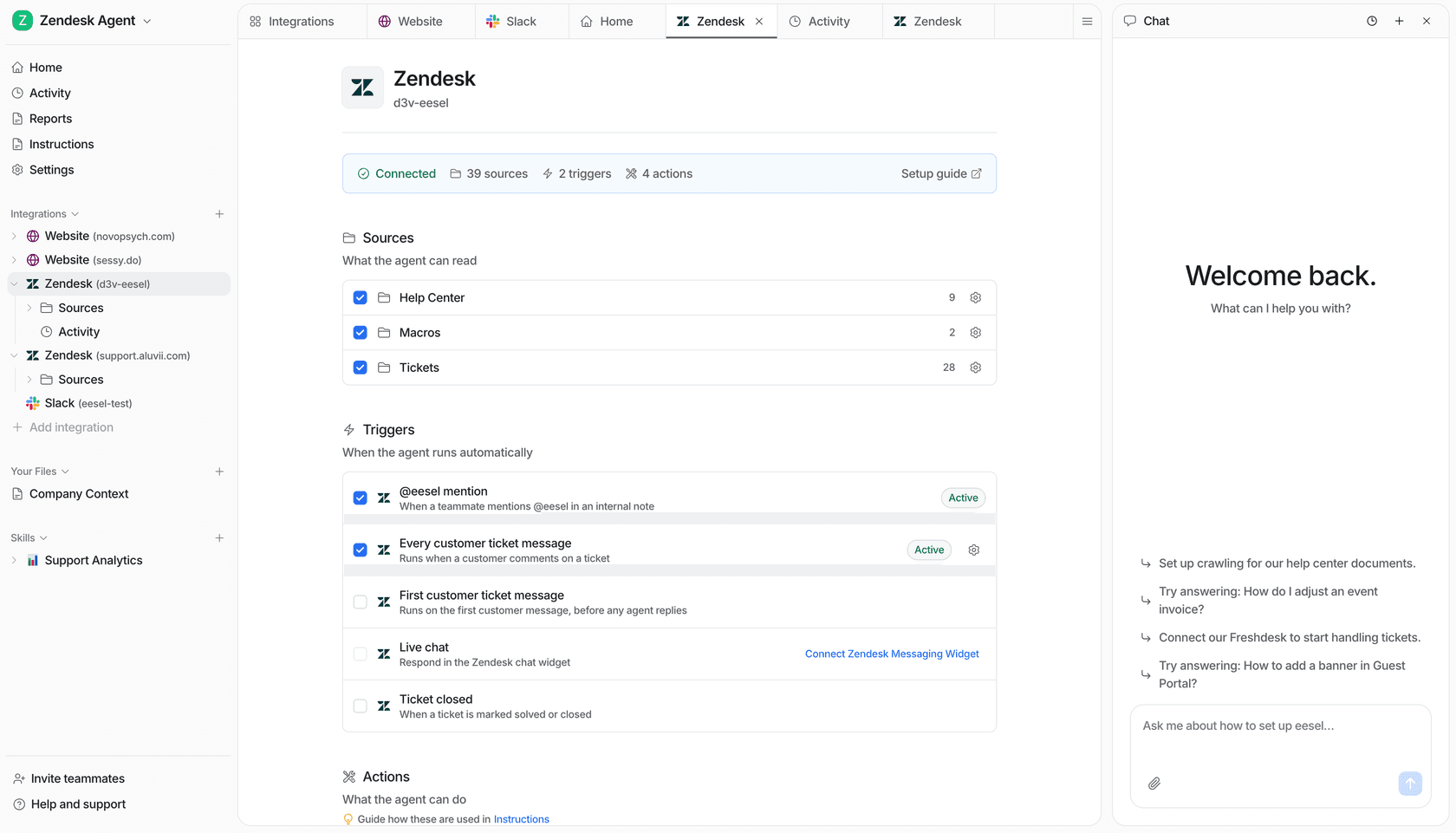
If your aim is to put an AI teammate in Zendesk without handing it a blank cheque, start with one job and one source set. eesel can connect to Zendesk, let your team inspect its configuration and activity, and let humans review held actions where that safeguard applies. Test the answers and escalation behavior against your own policy before expanding its scope.
Frequently asked questions
Is Zendesk AI agent GDPR compliant?
Zendesk provides contractual, security and product controls that can support a GDPR program, but compliance depends on the controller's purpose, notices, retention, access and human-review processes.
Who is the controller for Zendesk AI agent data?
Under GDPR, controller status depends on who determines the purposes and means of processing. In a typical support deployment, that is the subscribing organization; confirm your roles and contract with counsel.
Does Zendesk train third-party AI models on ticket data?
Zendesk says third-party LLM providers cannot use Service Data to train their models. Check the current product terms and your configured features during vendor review.
How do I handle a Zendesk deletion request?
Document the request, verify identity, use the relevant Zendesk deletion or redaction workflow, then record the outcome and applicable retention exceptions.