The 8 best DeepSeek V4 Flash alternatives in 2026

Kurnia Kharisma Agung Samiadjie

Katelin Teen
Last edited August 4, 2026
Why I am not ranking these by score
I write about search intent for a living, and "deepseek v4 flash alternatives" is a shopping query with a hidden assumption baked in: that you are looking for something better. On the two boards that measure this model, you mostly are not.
Artificial Analysis has Flash at max effort scoring 50 and describes it as "amongst the leading models in intelligence and well priced when comparing to other open weight models of similar size." Luna scores 51. Gemini 3.6 Flash scores 50. You would be trading sideways on intelligence and paying more for the privilege.
What you would actually be buying is a capability or a compliance answer. So that is how this list is ordered: by the gap it closes, with the honest cost of the switch attached to each one. If you want the pure spec read on the model you are leaving, the DeepSeek V4 Flash overview and the Flash review cover it, and Flash vs GPT-5.6 covers the closest head-to-head in detail.
The numbers, in one place
Every figure below is from Artificial Analysis or the vendor's own pricing page, checked on 4 August 2026. "Index run" is what it cost AA to evaluate that model on the full Intelligence Index, which is the closest thing to a real cost-per-task figure any of them publish.
| Model | AA Index | Input /1M | Output /1M | Index run | Output speed | Time to first token | Tokens to run index | Input types | Context | Weights |
|---|---|---|---|---|---|---|---|---|---|---|
| DeepSeek V4 Flash 0731 (max) | 50 | $0.14 | $0.28 | $72.02 | 113 t/s | 1.31s | 210M | text | 1M | MIT |
| GPT-5.6 Luna (max) | 51 | $0.20 | $1.20 | $174.06 | 181 t/s | 132.75s | 130M | text, image | 1.05M | closed |
| Gemini 3.6 Flash (high) | 50 | $1.50 | $7.50 | $726.70 | 213 t/s | 15.69s | 59M | text, image, speech, video | 1M | closed |
| Gemini 3.5 Flash-Lite | 36 | $0.30 | $2.50 | $153.08 | 366 t/s | 8.41s | 43M | text, image, speech, video | 1M | closed |
| Claude Haiku 4.5 (non-reasoning) | 24 | $1.00 | $5.00 | not published | 90 t/s | 0.96s | not published | text, image | 200K | closed |
| Kimi K3 (max) | 57 | $3.00 | $15.00 | $2,437.41 | 36 t/s | 2.85s | 130M | text, image | 1M | kimi-k3 licence |
| DeepSeek V4 Pro | 44 | $0.435 | $0.87 | not published | not published | not published | not published | text | 1M | open |
| Qwen3.7-Flash | not listed | $0.03–$0.20 | $0.13–$0.80 | not published | 59 t/s | not published | not published | text, image, video | 1M | closed |
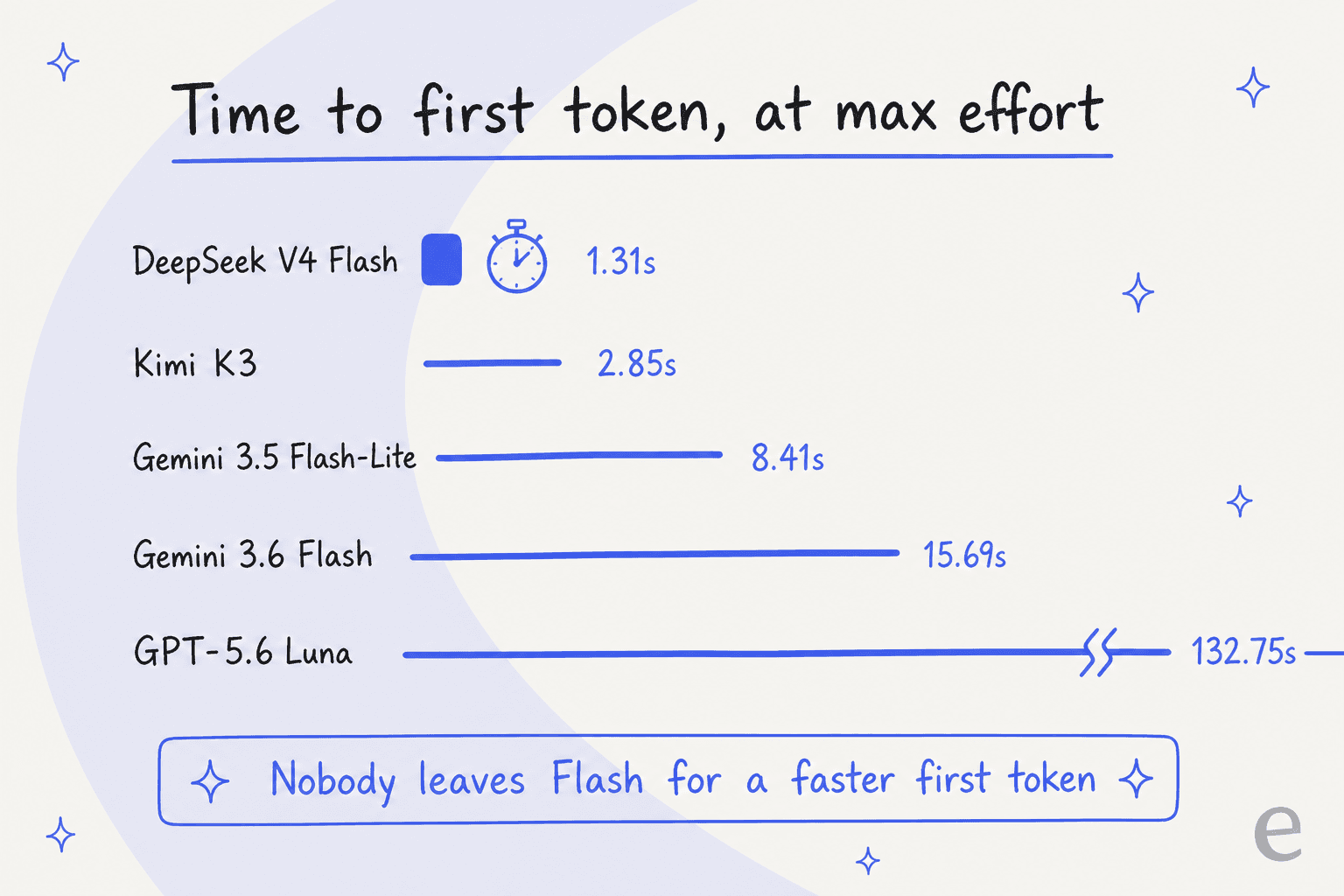
Two things jump out of that table. Flash has the fastest first token in the group by a factor of two over everything except Haiku, and it is the only model here that is both open-weight and actually cheap. Everything else is a trade.
Pick by the gap, not by the score
Before the list: this is the decision in five clicks. Choose what is actually blocking you and you get the pick plus what the switch costs.
What are you actually switching for?
Flash is already the cheapest and the quickest to first token. So pick the gap.
Flash has no documented image input. Luna takes text and images, scores one point higher on the AA index at 51, and runs at 181 tokens per second. It is also the cheapest vision-capable model in this comparison at $0.20 input and $1.20 output.
Cost of switching: about 3x the real bill across cache-heavy, reasoning-heavy and long-prompt shapes, and a 132.75s time to first token at max effort. Do not put it on an interactive path without dialling effort down.
You keep the exact model and move the inference. The weights are MIT-licensed, and a public production config now runs the 0731 checkpoint on a single AMD MI300X at 168.6 tokens per second single-stream, which is faster than the first-party API's measured 113.
Cost of switching: hardware. 156.67 GiB of weights need to sit in HBM, and a single MI300X is hard to buy on its own. If you would rather not run GPUs, Gemini's paid tier states outright that your content is not used to improve its products.
366 tokens per second, the fastest in this group, and the most concise: 43M output tokens to run the AA index against Flash's 210M. Takes text, image, speech and video in. Good for classification and triage at volume.
Cost of switching: intelligence. Index 36 against Flash's 50, so it is a different class of task. And no computer use at any price.
The reliability pick. AA-Omniscience hallucination rate of 51% against Flash's 84%, Omniscience Index of 18 against Flash's -16, and the highest raw intelligence here at 57.
Cost of switching: about 29x the cost per task and 36 tokens per second. There is no budget K3 either. The K3 (low) row scores 47, three points below Flash, at 8x the cost. Reasoning cannot be turned off.
Stay in the family. Pro still clearly wins recall and long-context needle-finding: SimpleQA-Verified 57.9 against Flash's 34.1, MRCR at 1M context 83.5 against 78.7, and LMArena's human voters rank it 1458 against Flash's 1436.
Cost of switching: 3.11x on cache-miss input and output, and no cheap run. DeepSeek's own effort-mapping table serves a low request on Pro at high.
1. GPT-5.6 Luna
Best for: the closest like-for-like swap, and the cheapest way to add image input.
What it actually is
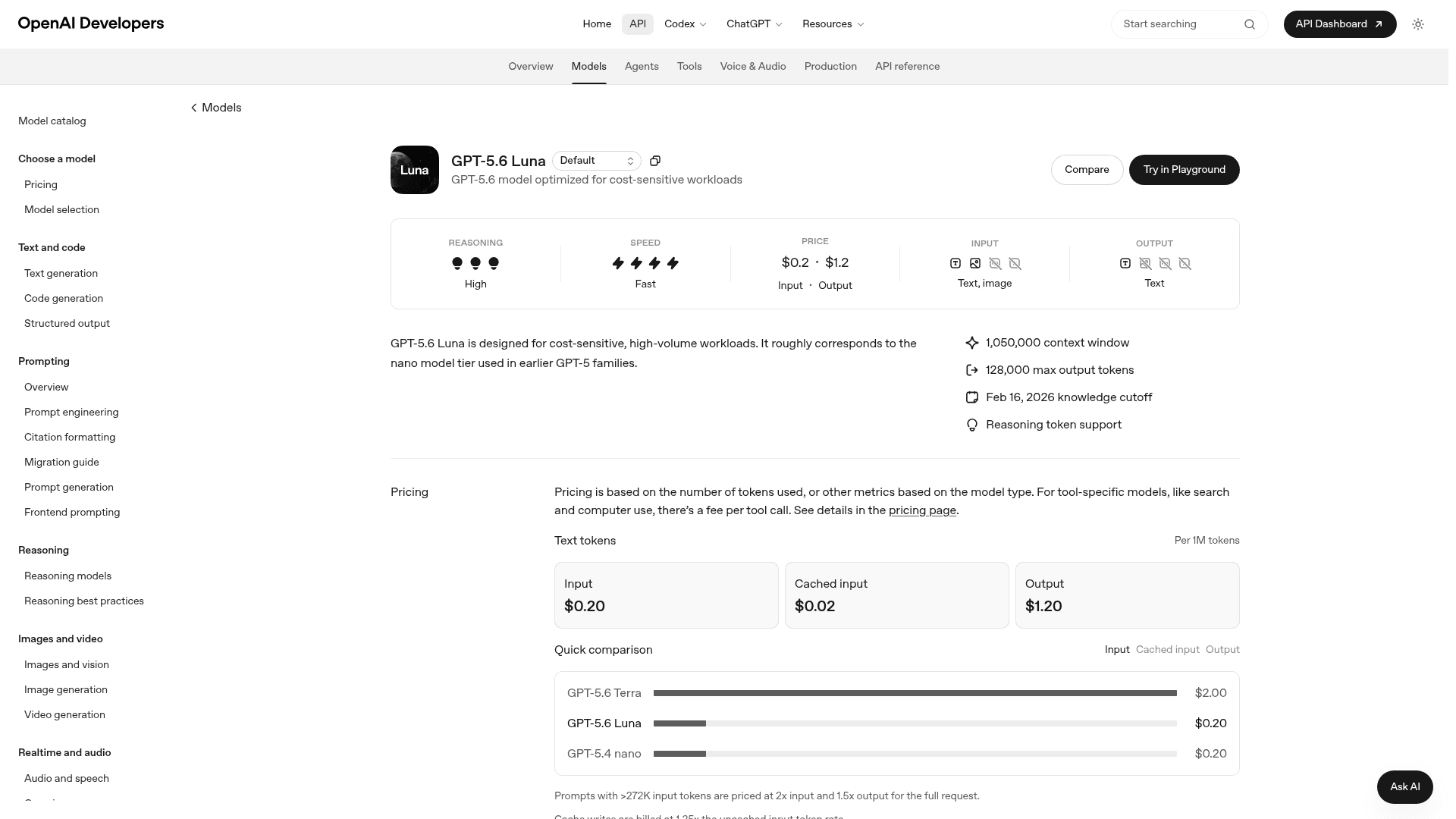
Luna is the budget tier of the GPT-5.6 family, described on its own model page as "optimized for cost-sensitive workloads." The reason most Flash comparisons get this wrong is that gpt-5.6 aliases to Sol, the frontier tier, so people accidentally benchmark a $0.14 model against a $5 one. Against Luna specifically, the intelligence question is a tie: 51 to 50 on the AA index.
It carries a 1,050,000-token context window, 128,000 max output tokens, a 16 February 2026 knowledge cutoff, and reasoning token support. Text and image in, text out.
Pricing
$0.20 input, $0.02 cached input, $1.20 output per million. There is a real discount ladder underneath that most write-ups miss:
| Tier | Input /1M | Cached /1M | Output /1M |
|---|---|---|---|
| Standard | $0.20 | $0.02 | $1.20 |
| Batch | $0.10 | $0.01 | $0.60 |
| Flex | $0.10 | $0.01 | $0.60 |
| Fast mode | $0.40 | $0.04 | $2.40 |
| Long context (>272K) | $0.40 | $0.04 | $1.80 |
On Batch or Flex, Luna's input at $0.10 is actually cheaper than Flash's $0.14. If your workload is overnight-friendly and input-heavy with short outputs, which describes a lot of ticket classification, Luna can come out ahead. Flash has no batch discount at all.
Where it beats Flash
Image input, published latency you can plan against, and a data-handling story you can hand to a security reviewer. Also web search, which is worth being precise about: Flash does have a server-side web_search tool, but only on the Flash-only Responses API, not the chat-completions path. The widely repeated "DeepSeek has no web search" line is out of date.
Where it does not
The receipts on Hacker News put the real gap at 2x to 3x, not the 4.3x the output column suggests, because Luna's cached input is cheap too. But 3x is still 3x. And the latency figure is brutal:
"2x to 3x the price… 2 to 5 times faster inference"

That "faster inference" is throughput, not responsiveness. At max effort Luna's time to first token is 132.75 seconds. Fine for a batch job, wrong for a chat widget.
There is also an asymmetric cliff to plan for: prompts over 272K input re-price the whole request at 2x input and 1.5x output, not just the overflow. Cache writes bill at 1.25x the uncached rate.
Verdict
If the reason you are leaving Flash is image input or a compliance conversation, this is the first thing to try, and the batch rate makes it cheaper than people assume. I would not put it on an interactive surface at max effort. The full tier breakdown is in the GPT-5.6 pricing guide, and GPT-5.6 review covers the family.
2. Gemini 3.5 Flash-Lite
Best for: high-volume classification, triage, and anything where tokens-per-second is the bottleneck.
What it actually is
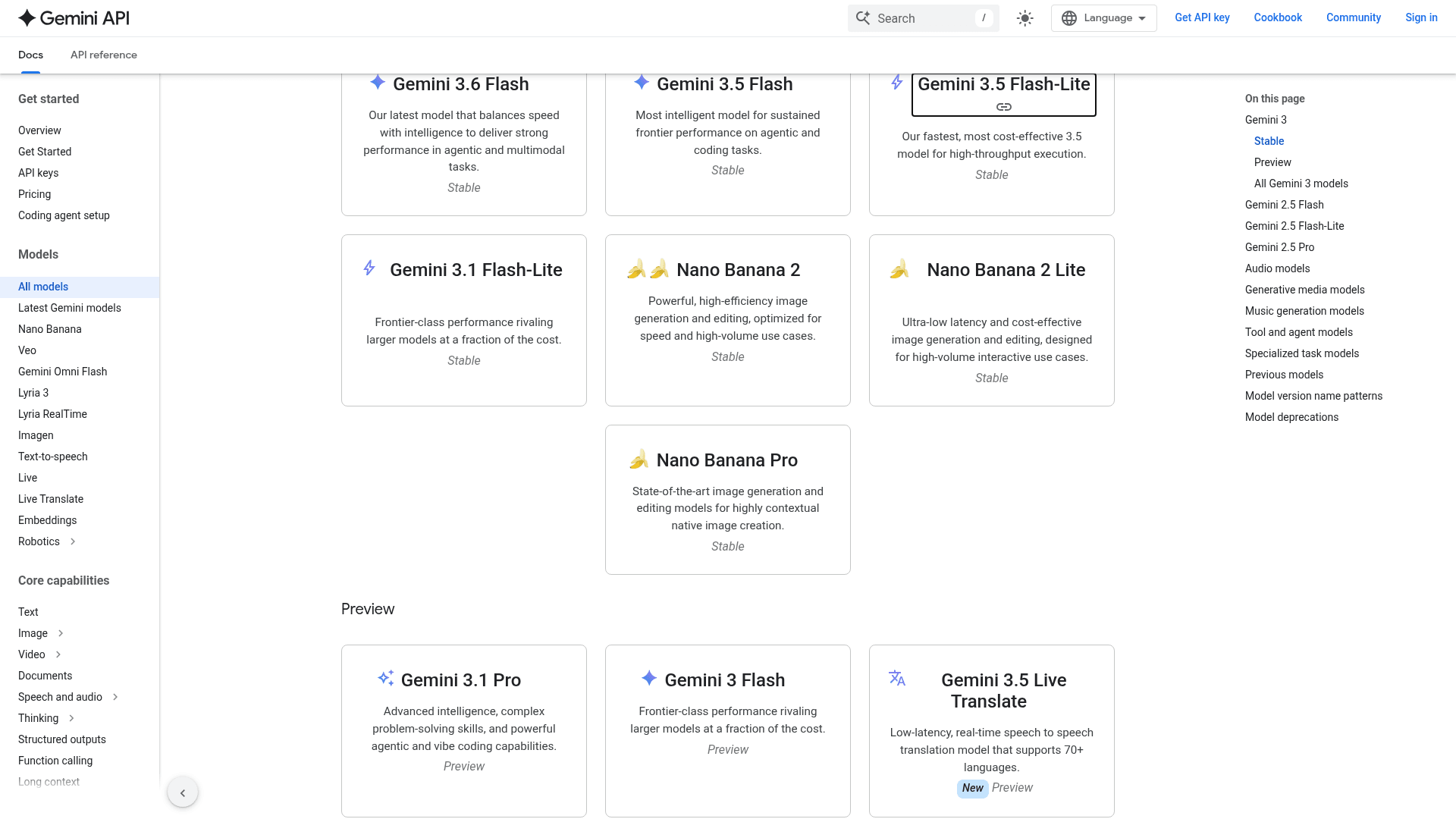
Google's cheapest generally available model in the 3.5 line, described on its own model page as "our fastest, most cost-effective 3.5 model for high-throughput execution." Model code is gemini-3.5-flash-lite, 1,048,576 input context, 65,536 output, and it takes text, image, speech, video and PDF in.
Pricing
$0.30 input and $2.50 output per million on Standard. Batch and Flex halve both to $0.15/$1.25. Priority is $0.54/$4.50. Context caching is $0.03.
Where it beats Flash
Two numbers. 366 tokens per second, the fastest here, and 43M output tokens to run the AA index against Flash's 210M. AA calls it "fairly concise" and calls Flash "very verbose." That concision is why a model with a nominally 9x higher output rate only cost $153.08 to run the index against Flash's $72.02, roughly 2x, not 9x.
Multimodal input is native across four modalities. And Google's paid tier is explicit where DeepSeek's is silent: the pricing page lists "Content not used to improve our products" as a paid-tier property, against "Content used to improve our products" on the free tier.
Where it does not
Intelligence Index 36 against Flash's 50. That is not a small gap, it is a different weight class, and Flash-Lite is going to be worse at anything agentic or multi-step. No computer use at any price. Time to first token is 8.41s, six times Flash's.
Verdict
If you are running intent classification or sentiment analysis over a firehose, this is the right shape and the concision saves real money. If you are running an agent, it is not. More in the Gemini 3.5 Flash-Lite overview.
3. Gemini 3.6 Flash
Best for: matching Flash's intelligence with a third of the output tokens, plus computer use.
What it actually is
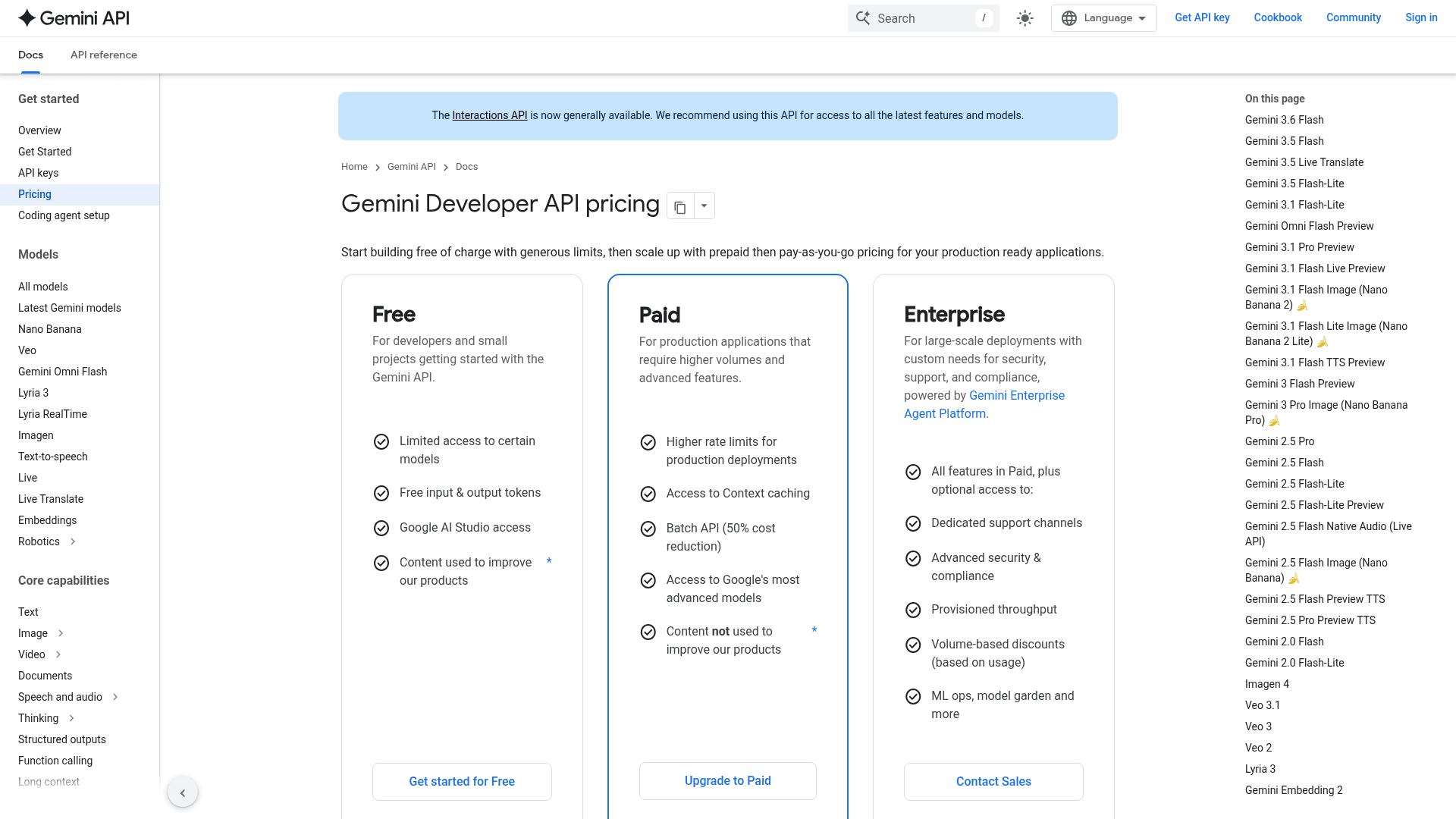
Google's workhorse Flash tier, launched 21 July 2026, positioned as the model that "balances speed with intelligence to deliver strong performance in agentic and multimodal tasks." Knowledge cutoff moved to March 2026. Computer use is built in. 1M context, 65K output.
Pricing
$1.50 input, $7.50 output per million. Batch halves both to $0.75/$3.75.
Where it beats Flash
This is the entry that changed how I read the whole comparison. Gemini 3.6 Flash scores exactly the same 50 as Flash, and gets there on 59M output tokens against Flash's 210M. On the rate card that is a 26.8x gap on output. On AA's actual index-run bill it is $726.70 against $72.02, which is 10.1x.
10x is still 10x, so this is not a cheaper model. But the direction matters: every verbosity comparison in this post moves in Flash's disfavour, and if you have been budgeting off the per-token column you have been overestimating your savings.
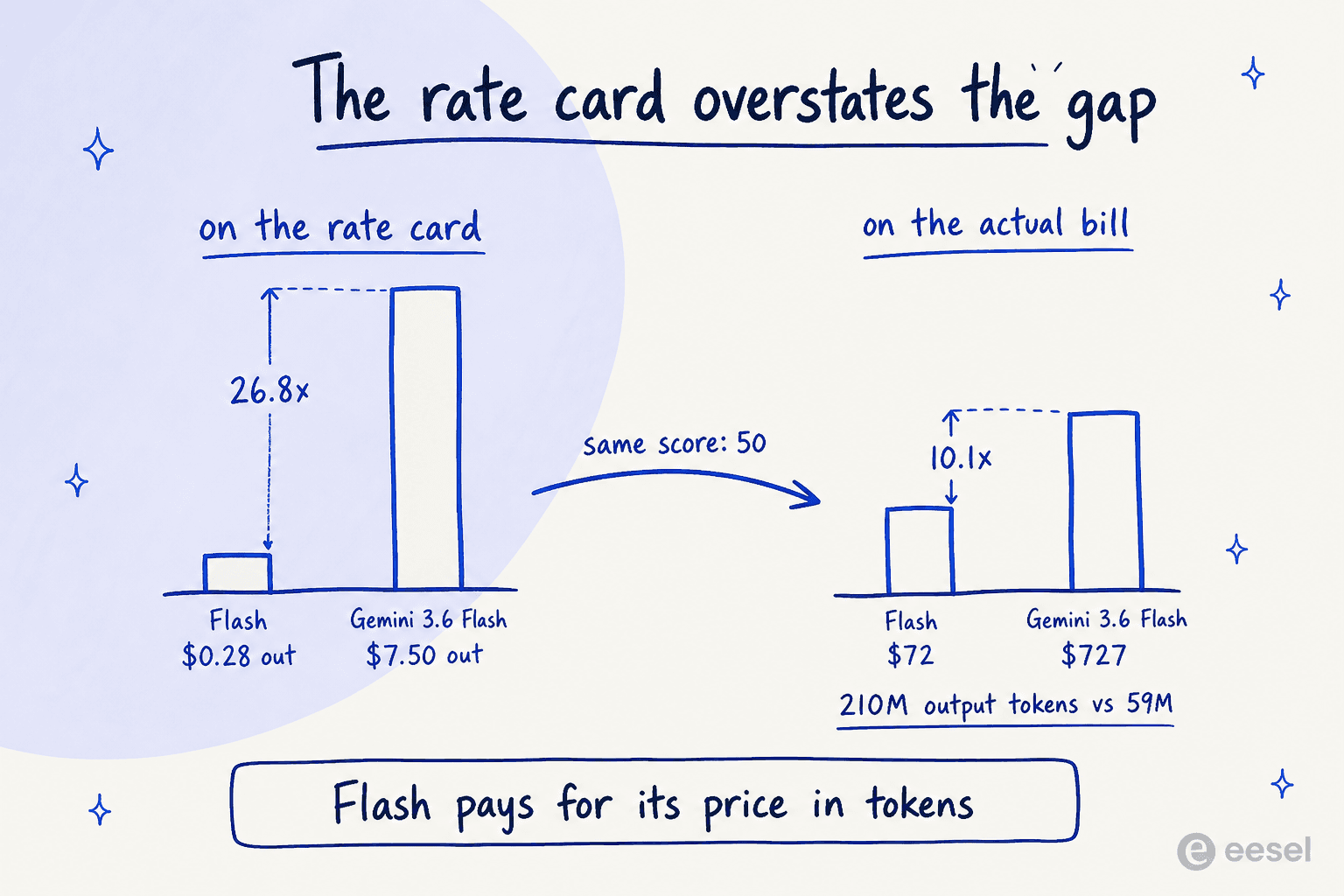
It also brings four input modalities, 213 tokens per second, and computer use, which nothing else on this list offers at this tier.
Where it does not
10x the cost per task at parity on intelligence. Time to first token of 15.69s. Closed weights, so self-hosting is off the table.
Verdict
The pick when the model is doing agentic work over a mixed-media knowledge base and you want the token count down. Read the Gemini 3.6 Flash overview, or the review for the eval detail.
4. Claude Haiku 4.5
Best for: the fastest first token in the group, and the easiest security review.
What it actually is
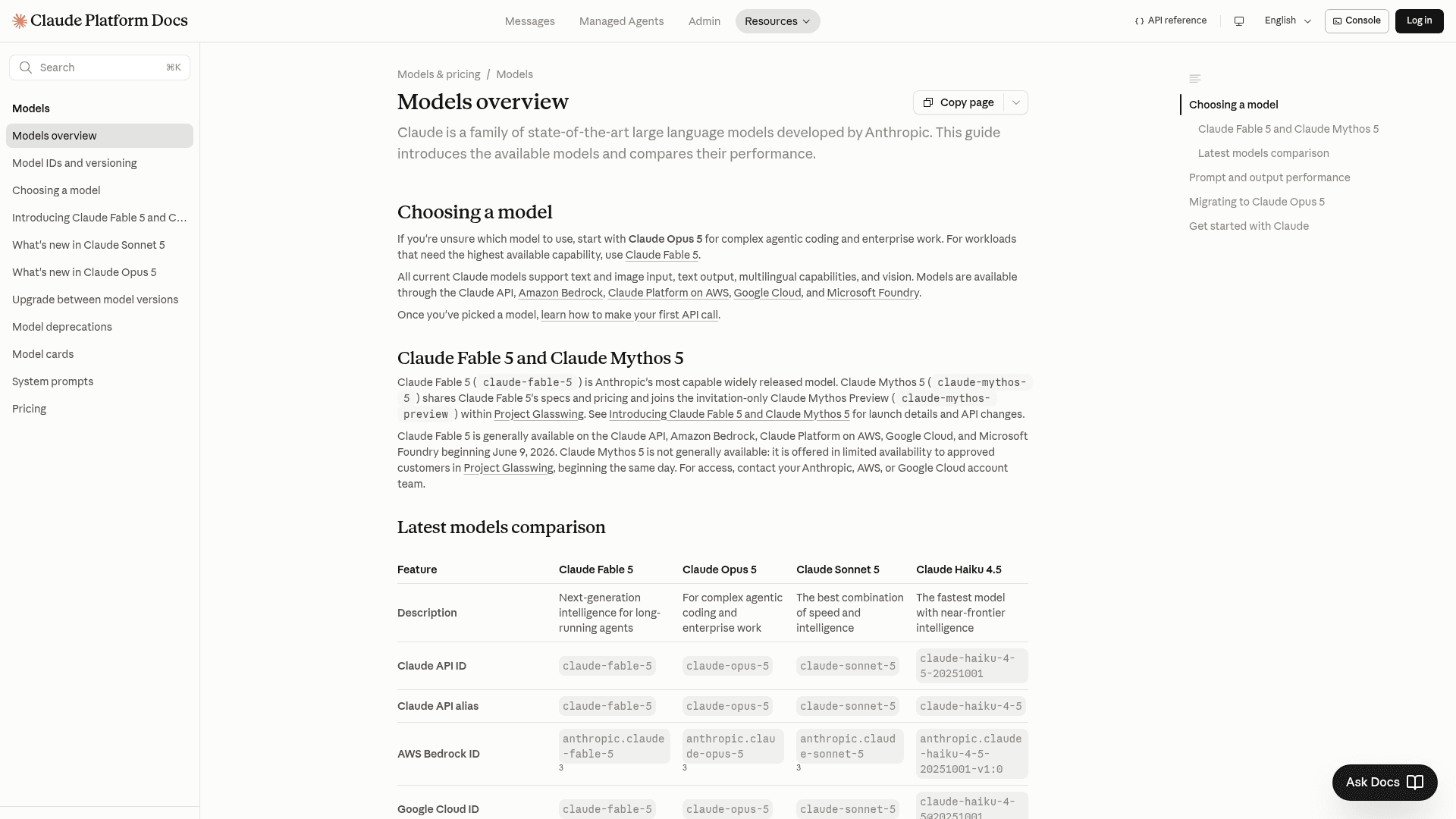
Anthropic's small model, claude-haiku-4-5, described in the docs as "the fastest model with near-frontier intelligence." Text and image in, 200K context, knowledge to July 2025. Available on the Claude API, Amazon Bedrock, Google Cloud and Microsoft Foundry.
Pricing
$1.00 input, $5.00 output per million.
Where it beats Flash
0.96 seconds to first token, the only figure on this page that beats Flash's 1.31s, at 90.2 tokens per second. AA calls that TTFT "very competitive" against a 1.43s median in its price tier.
The other thing it beats Flash on is procurement. Multi-cloud availability through Bedrock and Google Cloud means data residency and contracting are somebody's solved problem, not yours. In my experience that is the actual blocker more often than any benchmark:
Blocked outright on HIPAA/BAA during the demo, described as a hard blocker, not a soft concern.
A US healthcare and physical-therapy platform on Zendesk running roughly 500 tickets a month
That deal did not stall over a hallucination rate.
Where it does not
Intelligence Index 24 non-reasoning, the lowest here, and the smallest context window at 200K against everyone else's 1M. AA does not publish an index-run cost for it, so cost-per-task is unknown. Anthropic ships a reasoning variant too, but the 24 is the non-reasoning row and that is what the $1/$5 buys you at default settings.
Verdict
Choose this when responsiveness and contracting matter more than raw capability, which is most customer-facing chat. Do not choose it for agentic work. OpenAI API vs Anthropic API covers the developer-experience side, and Claude Sonnet 5 pricing covers the tier above.
5. Kimi K3
Best for: the one case where paying 29x more is defensible: answers you cannot afford to be wrong.
What it actually is
Moonshot AI's flagship, launched 16 July 2026. 2.8T total parameters with 104B active, 1M context, native vision for images and video. Open weights shipped on 27 July as promised, 1,561 GB across 96 shards, under a kimi-k3 licence with riders for large MaaS operators and very large products.
Pricing
$3 input, $0.30 cache-hit input, $15 output per million. That is Claude Sonnet territory, not budget territory.
Where it beats Flash
Reliability, and it is not close. AA-Omniscience hallucination rate 51% against Flash's 84%. Omniscience Index 18 against Flash's -16, where a negative score means more incorrect answers than correct ones. Accuracy 46% against 37%. Highest raw intelligence in this comparison at 57.
If your use case is a regulated vertical or an AI agent touching money, that delta is the entire argument.
Where it does not
Cost, and not by the sticker margin. The output rate is 54x Flash's, but AA's cost per task is $0.03 against $0.86, so the real gap is 29x because K3 is wordier per point of intelligence. Whole-index run: $72.02 against $2,437.41.
36 tokens per second, the slowest here. And there is no budget K3: AA lists a separate K3 (low) row at Intelligence Index 47, three points below Flash, costing $0.24 per task, which is 8x Flash, and it is not faster. Moonshot's own quickstart confirms reasoning cannot be switched off, so the effort levels are a latency control rather than a cost tier.
One more thing worth naming for anyone comparing data policies: Moonshot's terms are explicit and permissive where DeepSeek's are silent. Section 4 reads that "unless otherwise expressly agreed in writing, Customer Content may be used for the foregoing purposes," with opt-out only via a negotiated enterprise agreement. Data sits in Singapore.
Verdict
Buy it when a wrong answer costs more than 29x the token bill, which is a real situation and a narrower one than most buyers think. Otherwise the maths does not work. I went through this head-to-head properly in Flash vs Kimi K3, and there is a Kimi K3 review and a pricing guide too.
6. DeepSeek V4 Pro
Best for: staying in the family when you need recall rather than reasoning.
What it actually is
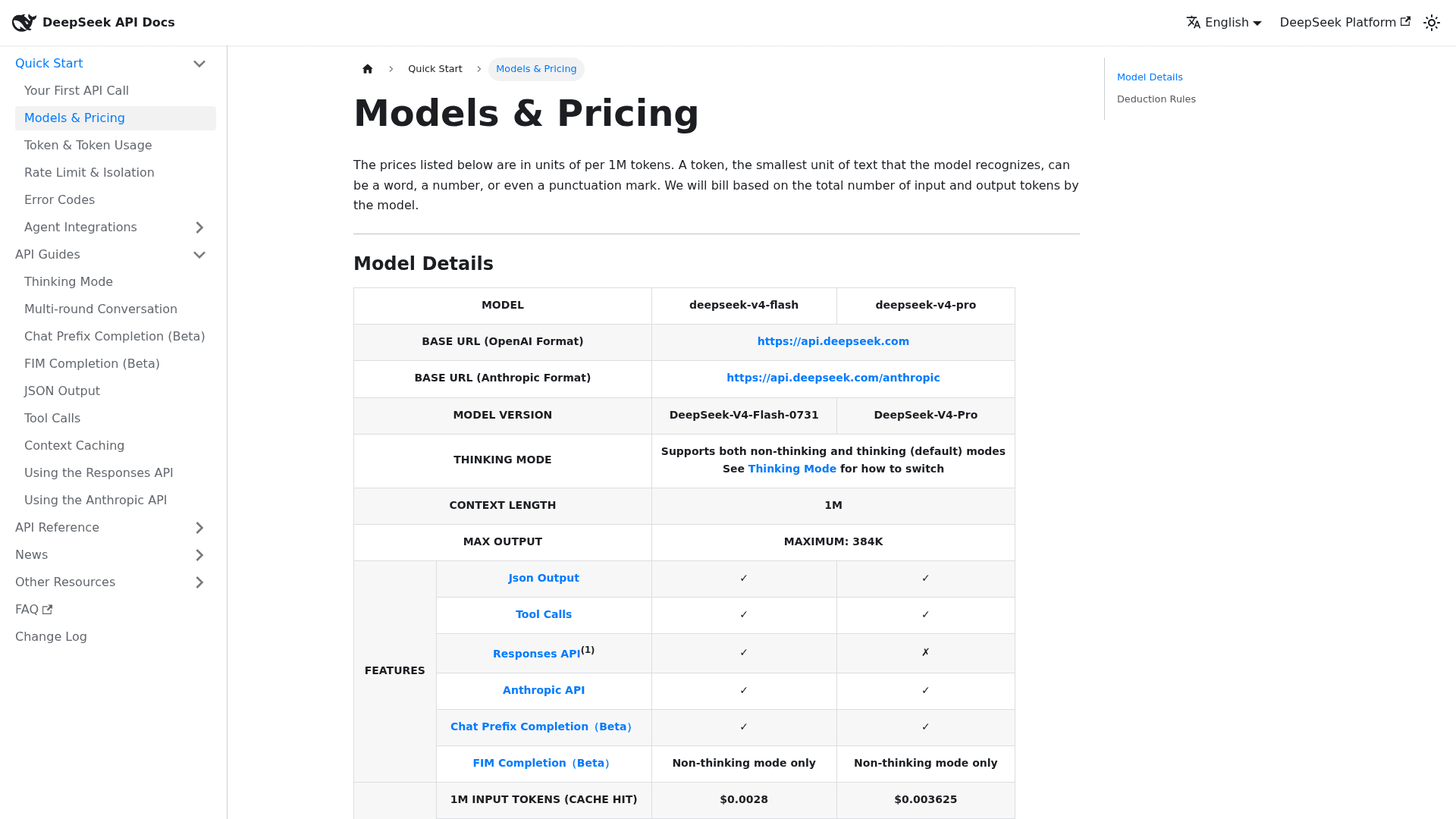
The larger V4 tier, deepseek-v4-pro, 49B active parameters against Flash's 13B. Still on the April preview build with no 0731 equivalent, which is the whole reason this comparison is strange.
Pricing
$0.435 cache-miss input, $0.003625 cache-hit input, $0.87 output per million. That is 3.11x Flash on cache-miss input and output, but only 1.29x on cache hits.
Where it beats Flash
Recall and long-context needle-finding, which is what the extra active parameters buy. From DeepSeek's own cross-mode table at max effort: SimpleQA-Verified 57.9 against 34.1, GDPval-AA Elo 1554 against 1395, BrowseComp 83.4 against 73.2, and MRCR at 1M context 83.5 against 78.7.
And the human vote agrees with Pro, not the automated index. LMArena Text ranks Pro at 1458±4 against Flash's 1436±4 on roughly 49,000 votes each. Two boards, both right, measuring different things.
Where it does not
Flash 0731 beats the Pro preview on all nine agentic rows DeepSeek publishes, DeepSWE 54.4 against 12.8 being the widest. AA has Flash at 50 and $0.03 per task against Pro at 44 and $0.05. Worth flagging honestly: two of those nine rows are DeepSeek's own internal sets and the harness is unreleased.
There is also no cheap Pro run. DeepSeek's published effort-mapping table serves a low request on Pro at high, so you pay 3.11x and cannot dial reasoning down. That mapping was due to change in early August 2026.
Verdict
A narrow but real pick: pick Pro for retrieval-heavy work over long documents, stay on Flash for agentic and coding work. Full detail in Flash vs V4 Pro.
7. Self-hosting the Flash weights
Best for: keeping the model and fixing the residency problem in one move.
What it actually is
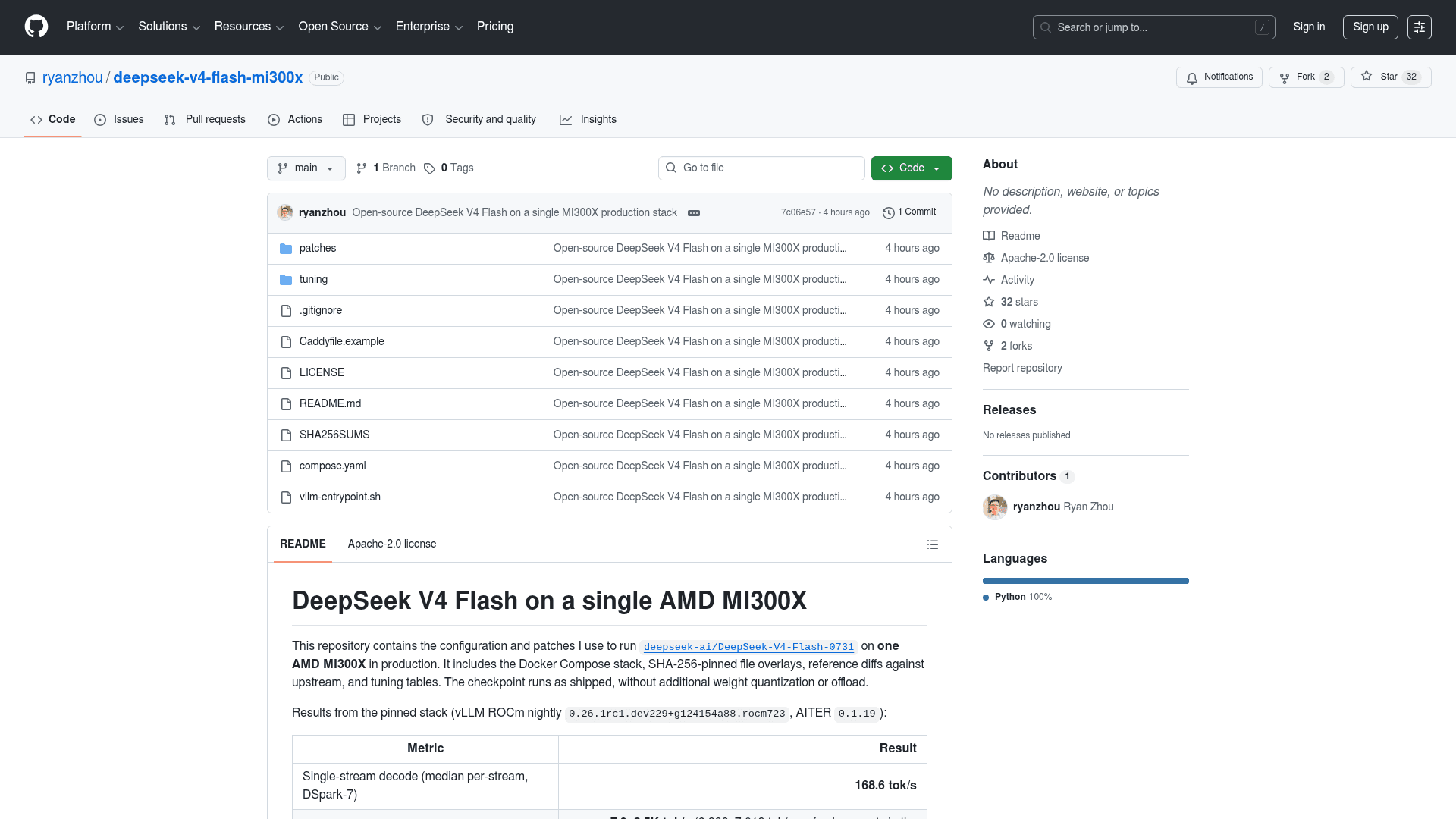
Not a different model. The same MIT-licensed DeepSeek-V4-Flash-0731 checkpoint, running on hardware you control. This entry earns its place because a production configuration went public today and hit the Hacker News front page at 165 points.
Pricing
Hardware, not tokens. Which is the entire point if your blocker is a security review rather than a budget.
Where it beats Flash's API
The published numbers on a single AMD MI300X, from the repo's pinned vLLM ROCm stack:
| Metric | Result |
|---|---|
| Single-stream decode | 168.6 tok/s |
| Prefill with tuned kernels | ~7.9–8.5K tok/s |
| 8 concurrent streams | 542 tok/s aggregate, 90.3 tok/s median per stream |
| 64-stream burst | 830 tok/s aggregate, no OOM |
| Context validated | 256K (architecture supports 1M) |
| Weights in HBM | 156.67 GiB, no extra quantization |
168.6 tokens per second on one card beats the 113 tok/s Artificial Analysis measures on DeepSeek's own API. The repo is explicit that the "checkpoint runs as shipped, without additional weight quantization or offload," so that is not a speed-for-quality trade.
It also answers the objection I hear most often, which is not about the model at all:
Phil asked whether it uses "some kind of other ChatGPT or something if it doesn't know the answer" and whether that can be turned off. Gil asked whether the knowledge stays closed to their org.
A technical evaluator at a B2B semiconductor-hardware company who needed assurance the AI answers only from their org's approved knowledge, not general training data
Self-hosting is the only option on this page that answers that question with a network diagram instead of a terms-of-service reading.
Where it does not
Hardware you have to source, and the community is blunt about it:
"I don't think you can buy a single 'MI300X' unit, right? Only the box with x8 of these at a cost of ~250K EUR."
There is a workaround in the same thread:
"The MI350P is the one you want: It's a PCIe card, but it has less memory: 144GB. Luckily, DeepSeek V4 Flash will run in 144GB too because it's 256 MoE exports are native MXFP4 quantized."
Two more honest caveats. The repo describes the checkpoint as 304B parameters where AA publishes 284B total, so the parameter count in the wild is inconsistent. And DeepSeek reportedly gets 15K tok/s/gpu on H800 in its own DSpark paper, per xorfish in the same thread, so there is headroom left on this config.
Verdict
If your reason for shopping is data residency, this belongs at the top of your list, not the bottom. You are not trading model quality at all. Related reading: open-source AI agents, custom AI models, and build vs buy.
8. Qwen3.7-Flash
Best for: the cheapest sticker price, if your prompts really are small.
What it actually is
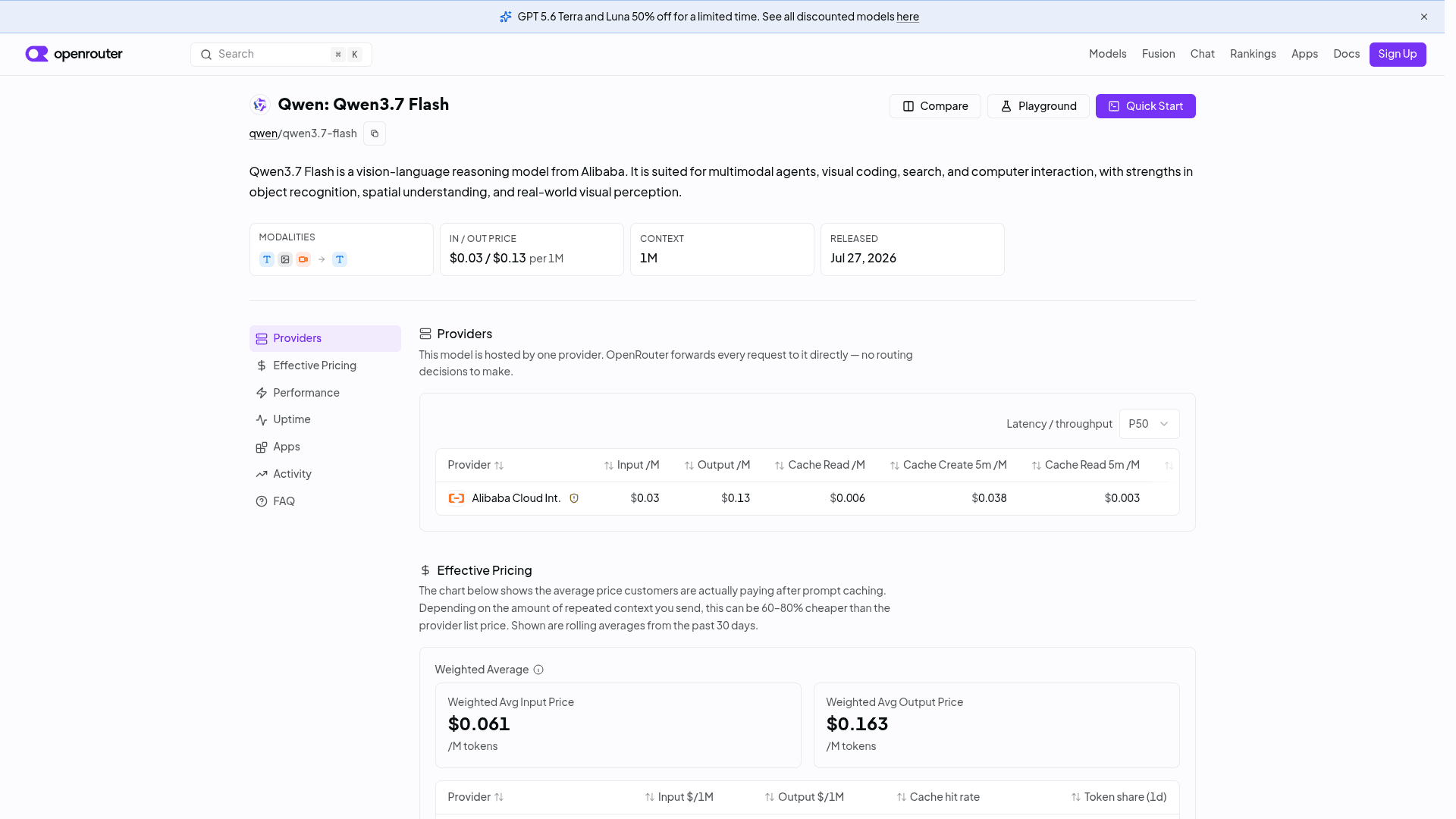
Alibaba's vision-language reasoning model, released 27 July 2026, described on OpenRouter as suited to "multimodal agents, visual coding, search, and computer interaction." 1M context, text plus image plus video in.
Pricing
This is where it gets interesting, and where the naming collision with DeepSeek's "Flash" causes real confusion. Pricing is bracketed by prompt size, so the headline rate and the 1M context cannot both be true in the same call:
| Prompt size | Input /1M | Output /1M |
|---|---|---|
| Under 32K | $0.03 | $0.13 |
| 32K–256K | $0.10 | $0.40 |
| 256K–1M | $0.20 | $0.80 |
6.7x swing on input. And OpenRouter publishes the rolling 30-day average of what customers actually pay: $0.061 input and $0.163 output, above the list rate, which tells you real traffic is landing in the upper brackets.
Where it beats Flash
The under-32K bracket at $0.03/$0.13 is really cheaper than Flash's $0.14/$0.28, roughly 4.6x on input. It takes images and video where Flash takes neither. Cache read is $0.006.
Where it does not
Almost nothing is independently verified, and that is the story rather than a footnote. Qwen published no benchmarks, no architecture, no parameter count. It is not listed on Artificial Analysis at all, so there is no comparable index score in the table above. Weights are closed.
The only third-party eval I trust is Roboflow's vision benchmark, which places it #22 of 23 overall at 61.7% while ranking it #1 of 23 on cost. It identifies far better than it localises.
"Flash" here means cheap, not fast: 59 tokens per second against Flash's 113 and Flash-Lite's 366. Tool-call error rate is 8.88%, P99 end-to-end latency is 90.19 seconds, and OpenRouter notes it is "hosted by one provider" with "no routing decisions to make," so there is no fallback if that provider has a bad day.
Verdict
Take it only if your prompts really do sit under 32K and you need vision on a budget. Above that the brackets erase the advantage, and the missing eval data means you are buying on faith. The bracket maths is worked through in Qwen 3.7 Flash pricing, and the Qwen 3.7 Flash overview covers the specs.
The thing none of these eight will do
Every model here is the bottom layer. That is worth saying plainly, because the switching decision people bring me is usually framed as a model choice and almost never is one.
An 84% hallucination rate does not mean the model gets 84% of tickets wrong. It is an AA-Omniscience figure measured on questions with no supplied context, which is exactly the opposite of how a support agent should be run. Wire the same model to RAG over a verified help centre and the number that matters changes completely.
That is the argument behind RAG vs LLM and hallucination prevention. The fix is grounding and guardrails, not a better base model.
The buyer objection that actually decides these deals is not accuracy in the abstract. It is control. One CX lead put it better than any benchmark could:
"The AI will never be able to answer 100% of the questions, but if it tries and just answers 'sorry I don't know this,' I cannot go and check all my 7,000 tickets to see if the AI actually made a good answer, then the point is a little bit gone. I need an AI who is only handling the tickets that it's confident to handle and all the other ones, leave them alone."
A CX lead at a DTC supplements brand on Gorgias and Shopify, around 7,000 tickets and 30,000 orders a month
No entry in the table above solves that. Confidence scores, escalation rules, ticket-type exclusion and a human in the loop do, and those live in the layer above the API.
I have written about confidence thresholds and containment rate separately, because they are the part that decides whether any of this works.
The second thing none of these does is tell you the number you are actually budgeting. Token rates are inputs. Cost per resolution is the output, and the two are not proportional once you add retrieval, retries, and the human time spent cleaning up.
What I would actually do with a support queue
Shopping models for a support queue is the wrong first step, and I say that as someone who spent this week reading eight model cards. The question is not which model hallucinates least, it is what your accuracy looks like on your own tickets, and you cannot get that from a leaderboard.
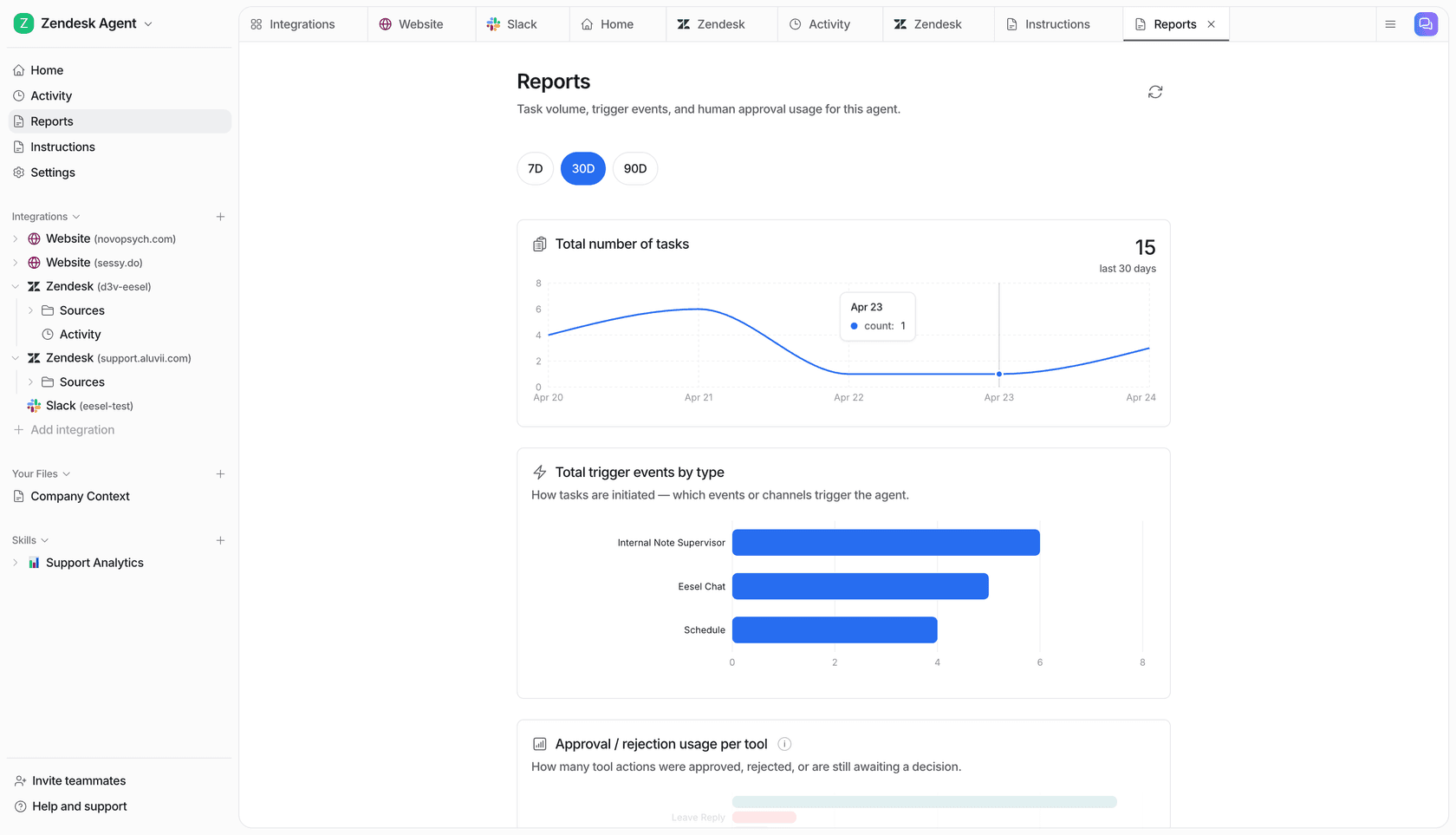
That is the specific thing eesel does that a raw API cannot. It plugs into Zendesk, Freshdesk, Gorgias, Front or Help Scout in a few minutes, grounds every reply in your help centre, past tickets and macros, and then runs a simulation across your real historical tickets so you see the actual resolution rate before a customer does. If it does not clear your bar, you do not deploy it.
Pricing is 40¢ per ticket handled, no seat fees, and you are never charged for tickets your humans take. Route 200 of your 1,000 monthly tickets to start and you pay $80. Try eesel free with $50 of usage and no credit card.
I am not claiming eesel makes a base model smarter. I am claiming the thing you are shopping for, a model you can trust in front of customers, is not a model at all. And the reason I am confident about that is that we have watched our own agent fail in ways no benchmark catches: the worst pattern we ever logged was an agent narrating "executing Zendesk searches" for around ten turns without ever hitting the API. Nothing kills trust in a teammate faster than lying about what it did, and no index score would have predicted it.
So which one should you pick?
- Need image input → GPT-5.6 Luna. Cheapest vision-capable option here, ties Flash on intelligence, costs about 3x in practice. Keep effort low if latency matters.
- Need data residency → self-host the Flash weights. Same model, MIT licence, 168.6 tok/s on one MI300X. Cheapest managed fallback is Gemini's paid tier, which states in writing that your content is not used for training.
- Need throughput → Gemini 3.5 Flash-Lite at 366 tok/s and the most concise output in the group. Accept index 36.
- Need fewer output tokens at parity → Gemini 3.6 Flash. Same score of 50 on 59M tokens instead of 210M, at 10x the task cost.
- Need reliability → Kimi K3. Hallucination 51% against 84%, at 29x the cost per task. Do not bother with K3 (low).
- Need recall over long documents → DeepSeek V4 Pro. Wins SimpleQA-Verified 57.9 to 34.1, and LMArena's voters agree.
- Need the lowest sticker price → Qwen3.7-Flash, but only under 32K prompts, and only if you are comfortable with almost no independent evals.
- Need none of the above → stay on Flash. It is the cheapest, the quickest to first token, and it is open. Just watch for that pending 2x peak-hour surcharge, which will apply during 9:00–12:00 and 14:00–18:00 Beijing time once DeepSeek announces a start date.
If you are picking a model to answer customer tickets, the best AI support agent explainer and AI customer service cost are more useful next reads than any of the model pages above. If you are picking one to write with, best LLM for blog writing is the one I would start with.
Sources
- Artificial Analysis model pages, all figures checked 4 August 2026: DeepSeek V4 Flash 0731
- GPT-5.6 Luna on Artificial Analysis
- Gemini 3.6 Flash and Gemini 3.5 Flash-Lite on Artificial Analysis
- Kimi K3 and Claude 4.5 Haiku on Artificial Analysis
- DeepSeek API pricing and the Responses API guide
- OpenAI platform pricing and the GPT-5.6 Luna model page
- Gemini Developer API pricing and the model catalogue
- Claude models overview and Claude pricing
- Moonshot AI model pricing
- OpenRouter, Qwen3.7 Flash and Roboflow Vision Evals
- DeepSeek V4 Flash on a single AMD MI300X and its Hacker News thread
- eesel's internal customer-call dossier, quoted under anonymised descriptors
Frequently Asked Questions
What is the best DeepSeek V4 Flash alternative?
Is there a cheaper alternative to DeepSeek V4 Flash?
Which DeepSeek V4 Flash alternative supports image input?
Can I self-host DeepSeek V4 Flash instead of switching models?
Does DeepSeek train on API data from paying customers?
How much does DeepSeek V4 Flash cost compared to alternatives?
Is DeepSeek V4 Flash safe to put in front of customers?
Should I use DeepSeek V4 Pro instead of Flash?
low request is served at high. Full breakdown in Flash vs V4 Pro.

Article by
Kurnia Kharisma Agung Samiadjie
Kurnia is a software engineer and writer at eesel AI with two years of SEO experience, writing about AI tools, helpdesk software, and customer support. He pairs a developer's understanding of how these products are built with search-driven research into what actually ranks and resonates with the people searching for them.