8 best Gemini 3.8 Flash alternatives in 2026

eesel Team
Last edited September 8, 2026
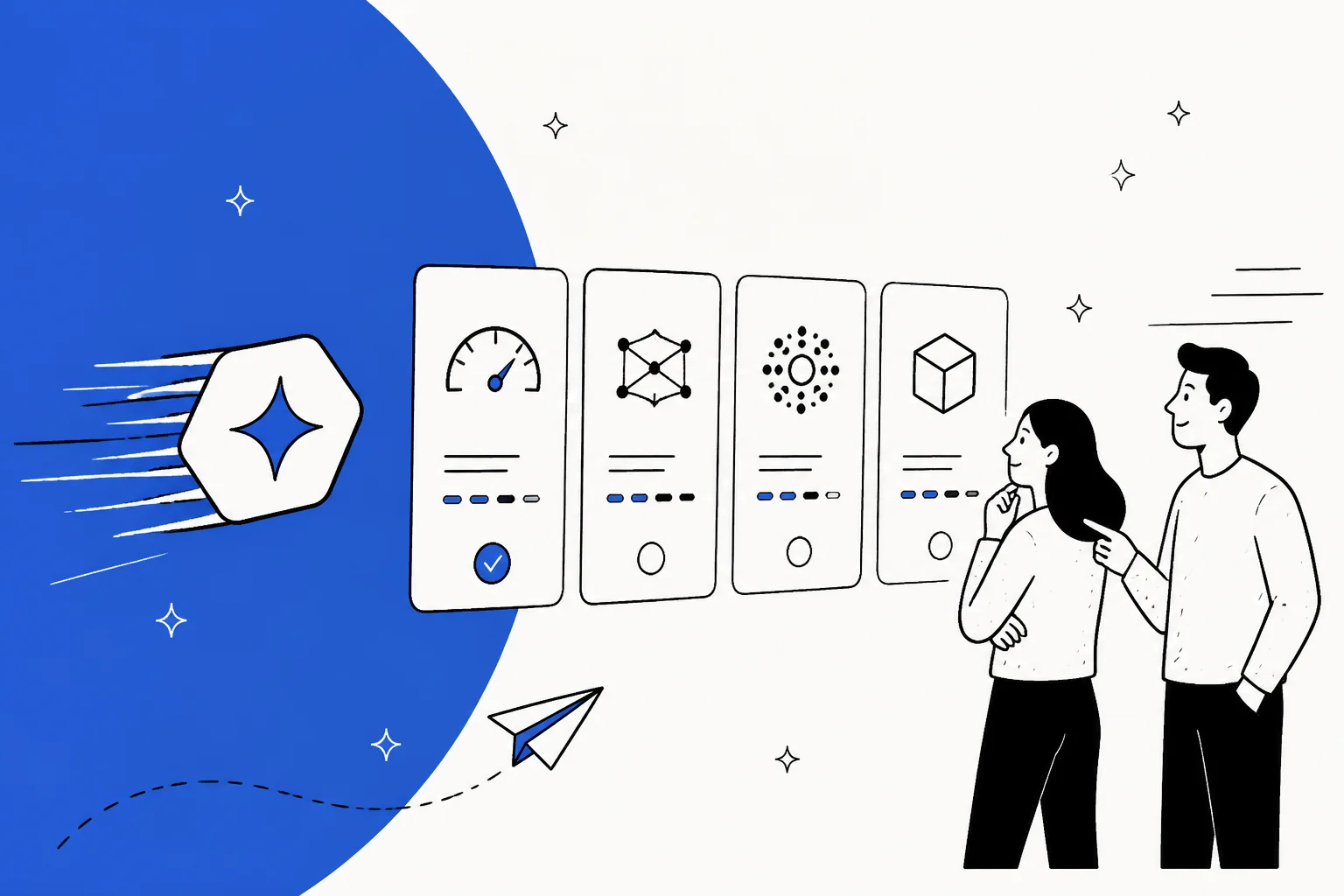
Google's Gemini 3.8 Flash (GA September 2, 2026) is fast and cheap on paper, but it is really 3.7 Flash trained a bit further at the same price, and it spends more tokens to get there. Two things push people to shop around: it takes 13.3 seconds to first token (class median is about 3), which is rough for anything a human waits on, and Google itself tells efficiency-minded teams to stay on 3.7 Flash.
If you want a straight swap, here are the eight I would actually consider in 2026, and who each is for:
- Gemini 3.7 Flash – same price, less token bloat. Google's own recommendation for efficiency.
- OpenAI GPT-5.6 – the leaner frontier option; the Terra tier is the real head-to-head, and it burns fewer tokens per task.
- DeepSeek V4 Flash – the lowest real cost here, MIT open weights, strong tool use.
- Kimi K3 – open-weight reasoning that punches up, but it is pricey per token and thinks a lot.
- Qwen 3.8 Flash-Next – an open preview of Qwen's next architecture; brilliant at long context, deliberately under-trained.
- Claude Haiku 4.5 – the pick when reliability and a clean safety record matter more than the sticker.
- GLM 5.3 Flash – the cheapest true multimodal option here.
- Gemini 3.5 Flash-Lite – for high-volume classification and OCR where 3.8 Flash is overkill.
One thing before you pick: if you are choosing a fast model to run a support queue, you are shopping at the wrong layer. The model is the engine; you still have to build the knowledge base, testing, and escalation around it. eesel gives you the finished support teammate and swaps the model underneath for you.
I build eesel's product, so I have wired a lot of these models into real workflows. Below is what actually bites once they leave the benchmark chart.
Why look past Gemini 3.8 Flash at all?
Gemini 3.8 Flash is a good model. It ranks #3 of 196 for output speed at 302 tokens/second and scores a 59 on Artificial Analysis's Intelligence Index, well above the median. For an overnight batch job that grinds through a big backlog, it is hard to beat at the price.
The catch is what that "harder work" costs you. Google's own launch note is unusually blunt about it:
"These performance gains stem from a core design choice: 3.8 Flash works harder. On complex tasks, it exhibits greater diligence, executing extra reasoning steps, and calling tools iteratively. At times, the model might use more tokens to maximize performance, especially at higher effort levels."
Then the line that should decide your upgrade: Google recommends developers who care about compute efficiency "continue to rely on Gemini 3.7 Flash, which remains fully supported for efficiency-first workloads." A vendor telling you its previous model is still the right pick is rare enough to take at face value.
Two numbers turn that into a real reason to look around. First, Artificial Analysis clocks a 13.3-second time to first token against a roughly 3-second class median. Throughput is not the same as responsiveness, and 13 seconds of dead air is a dealbreaker for a chat widget or a support reply. Second, it burns 120M output tokens to run the AA Index versus a 71M median, which AA itself flags as "very verbose." Wordier output means a bigger bill on the exact output rate that doubles in January 2027.
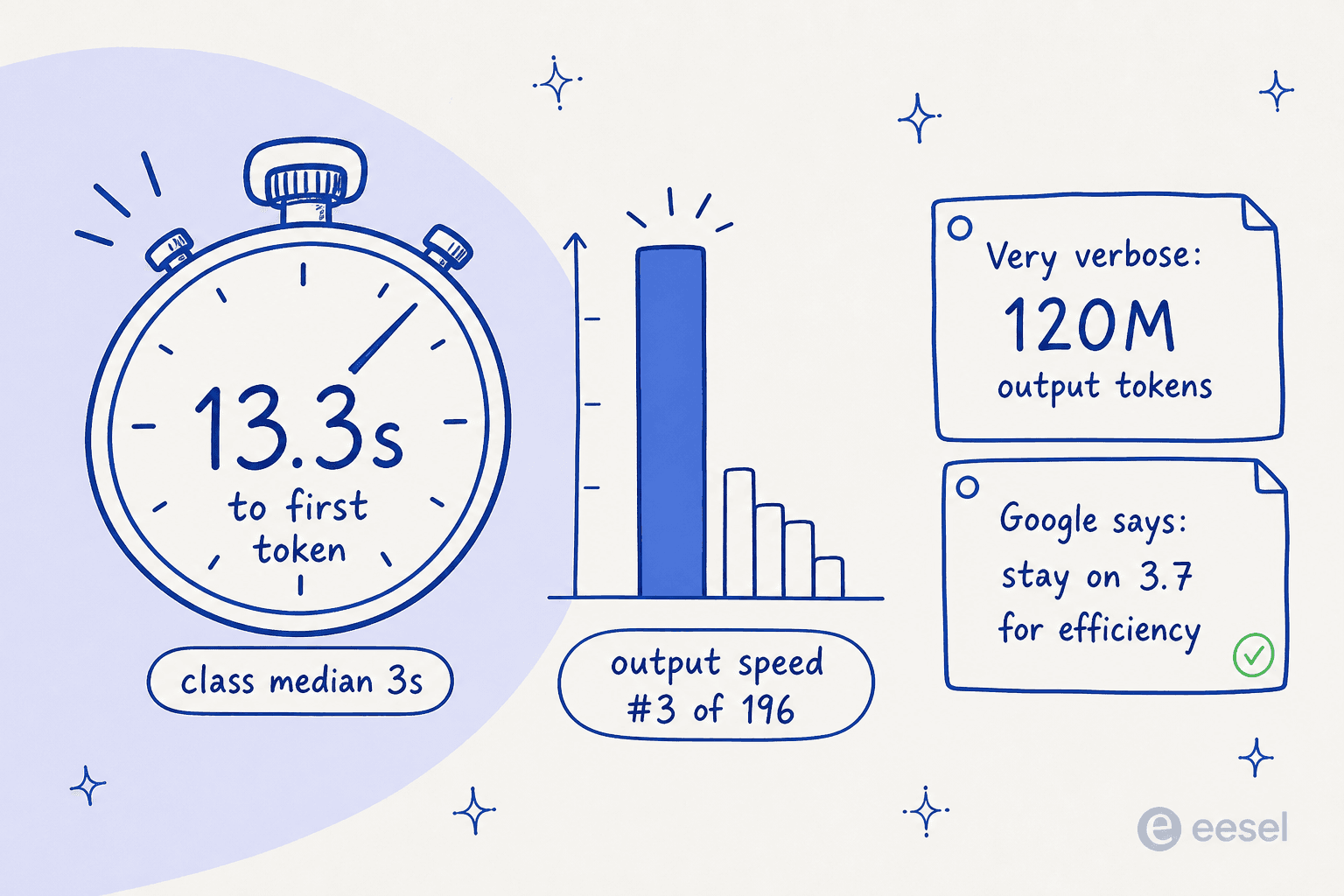
So this is not "3.8 Flash is bad." It is that "fast and cheap" hides a latency wall and a token-bloat tax, and for a lot of workloads a different model, sometimes Google's own older one, is the better trade.
How I picked these alternatives
I kept the list to models that are actually in the same job as Flash: fast, affordable, high-volume workhorses you would reach for to power an agent, a classifier, or a coding assistant, not $30-per-million flagships. For each one I weighed four things:
- Real cost per task, not just the sticker rate. A model that is half the price per token but twice as wordy is not cheaper. Verbosity is where a lot of "budget" models quietly claw the money back.
- Latency you can live with. Time to first token matters more than peak throughput the moment a human is on the other end.
- Open vs closed. Several of these ship open weights you can self-host, which changes the data-residency and cost math completely.
- What real users report, from Hacker News and Reddit threads, not the launch-day benchmark posts.
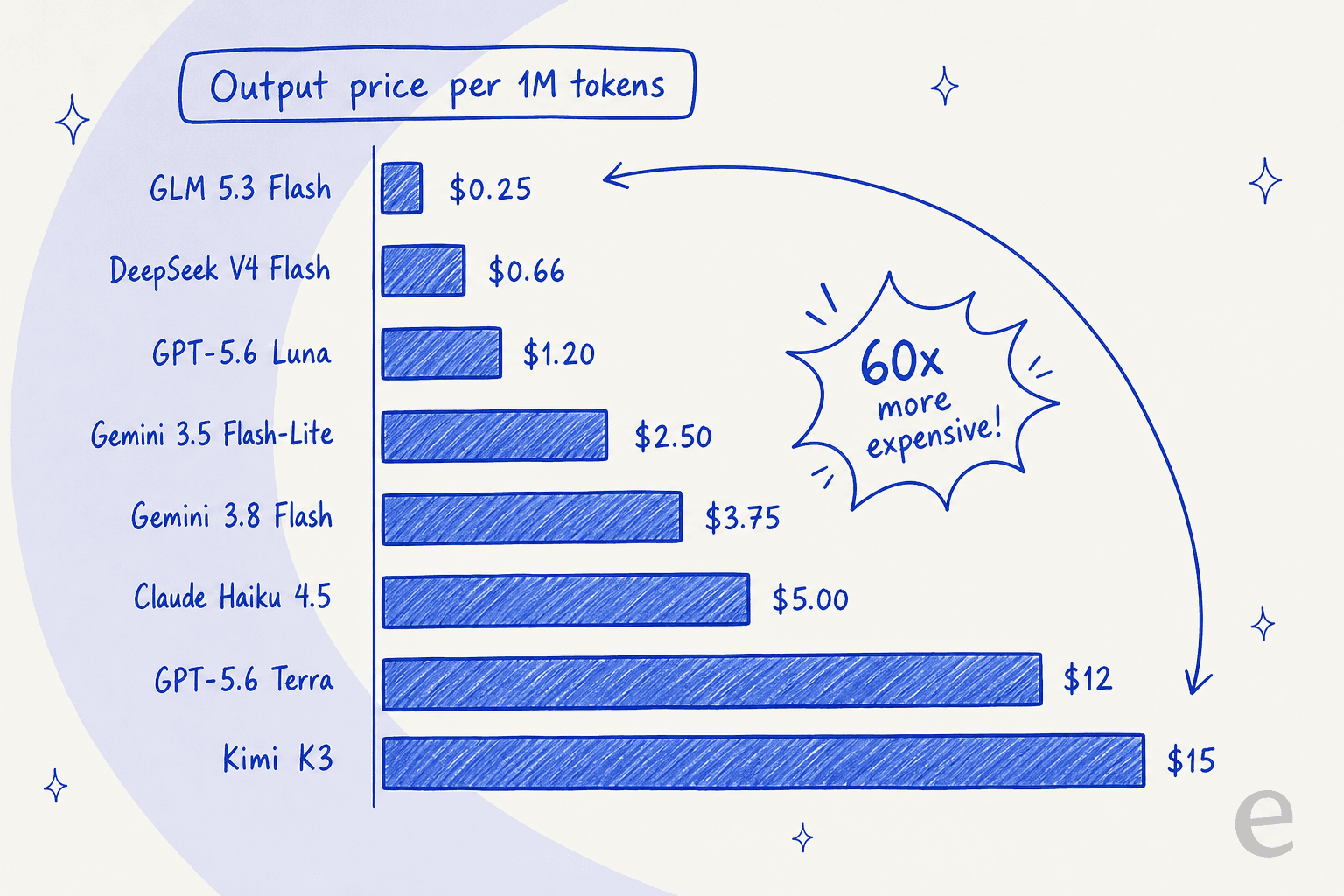
Prices below are per 1M tokens, standard tier, as listed on each vendor's own pricing page. Reasoning and thinking tokens bill at the output rate on every model here, so the output column is the one that usually decides your bill.
Gemini 3.8 Flash alternatives at a glance
| Model | Best for | Input / Output ($/1M) | Open weights | Context | The main catch |
|---|---|---|---|---|---|
| Gemini 3.7 Flash | Efficiency-first, same price | $0.75 / $3.75 | No | 1M | Doubles Jan 2027; dropped minimal |
| OpenAI GPT-5.6 (Terra) | Leaner frontier swap | $2.00 / $12.00 | No | 400K | Long-context tier costs 2x |
| DeepSeek V4 Flash | Lowest real cost | $0.22 / $0.66 (off-peak) | Yes (MIT) | 1M | Peak surcharge; hallucinates; text only |
| Kimi K3 | Open-weight reasoning | $3.00 / $15.00 | Yes | 1M | Pricey per token; can't stop thinking |
| Qwen 3.8 Flash-Next | Long context, open preview | ~$0.03-$0.20 in / $0.13-$0.80 out | Yes | 1M | Under-trained preview; single provider |
| Claude Haiku 4.5 | Reliability + safety | $1.00 / $5.00 | No | 200K | Costlier than the budget pack |
| GLM 5.3 Flash | Cheapest multimodal | $0.075 / $0.25 (promo) | Yes | 200K | Promo ends; smaller ecosystem |
| Gemini 3.5 Flash-Lite | High-volume OCR / classification | $0.30 / $2.50 | No | 1M | Weaker on hard reasoning |
The spread on the output column is the whole story: from $0.25 to $15 per million, a 60x gap for models that all sit in roughly the same "fast and cheap" bracket.
1. Gemini 3.7 Flash
Best for: teams who want everything Flash is good at, minus the extra token spend, at the same price.
The most honest alternative to Gemini 3.8 Flash is the model it was built on, and Google is the one telling you so. Because 3.8 is 3.7 Flash trained further, they bill identically, and the only real difference is that 3.8 does more work (and spends more tokens) per task. If you are not chasing the last few points on a hard reasoning benchmark, 3.7 Flash gives you the same speed and a smaller bill.
Developers using it as a cheap-and-tireless auditor rate it highly:
"I've been using 3.7 Flash to audit the work of Opus High, and Flash finds lots of subtle and insidious defects even while all the unit tests are green... it is blazing fast in Antigravity CLI. Easily 10x faster than Opus."

Pros: identical price to 3.8 Flash, less token bloat, a full 1M-token context window, and the same broad multimodal input (text, image, audio, video, PDF).
Cons: the introductory rate doubles to $1.50/$7.50 on January 1, 2027, same as 3.8. And 3.7 dropped the minimal thinking level, so the cheapest floor for OCR and ticket classification is gone; low is the new bottom.
Pricing: $0.75 in / $3.75 out per 1M through end of 2026.
Verdict: if you are already reaching for 3.8 Flash, benchmark 3.7 Flash on your own prompts first. Nine times out of ten it does the job for less, which is exactly why Google keeps recommending it.
2. OpenAI GPT-5.6
Best for: teams who want a non-Google frontier model that gets to the answer with fewer tokens.
GPT-5.6 comes in three flavours, and the tier that actually competes with Flash is Terra, not the cheaper Luna. The reason to consider it over Gemini is efficiency: GPT models tend to reach the same answer with far less output, which offsets a higher sticker rate on any output-heavy job. One developer put the trade plainly:
"Sol high is almost the same speed if you take into account drastically lower token use. Look at the artificial analysis speed vs token use. Gemini is 7x faster but 5x more tokens."
That is the whole GPT-vs-Gemini-Flash decision in one line. Raw tokens/second favours Gemini; tokens-per-finished-task often favours OpenAI. If your bill is dominated by output, do the math on both. For the full rundown of tiers, our OpenAI models list breaks them down.
Pros: real frontier reasoning, a huge tooling ecosystem, and less verbosity than Gemini Flash on comparable tasks. Luna ($0.20/$1.20) is a real budget floor if you want to trade down.
Cons: OpenAI charges a long-context tier that doubles the rate past the short-context window, the same 200K-style cliff xAI uses. Gemini and Anthropic do not. Watch your rate limits too if you are running high volume.
Pricing: Terra $2.00 in / $12.00 out; Luna $0.20 / $1.20; Sol $5.00 / $30.00 per 1M (short context).
Verdict: the strongest all-round alternative if you are not tied to Google, especially when your workload is output-heavy and the token count, not the per-token price, is what is killing you.
3. DeepSeek V4 Flash
Best for: the lowest real cost per token of any hosted model here, and anyone who wants open weights.
DeepSeek V4 Flash is the price disruptor. A 284B-total / 13B-active mixture-of-experts model with MIT-licensed weights (~167GB, runs at home under $10k), it lists at $0.22 in / $0.66 out off-peak, a fraction of Gemini Flash. And it holds up on real work, not just cost:
"I benched DS4 flash and Pro vs opus 4.8 xhigh on 16 work-related tasks a month ago across 4 days. Opus 4.8 came out as a winner by 1 task only [...] But flash performed as well or better (as in being more thorough) in 13 out if 16."
There are two honest gotchas. DeepSeek repriced in August 2026 and now runs a peak/off-peak surcharge, with peak hours at 01:00-04:00 and 06:00-10:00 UTC, so a US or EU queue mostly bills off-peak, but a batch job scheduled into Chinese business hours pays double. And it hallucinates more than you would like:
"DeepSeek V4 hallucinates like crazy and often forgets explicitly mentioned parts of the context."
One more thing to know: Flash is text only, with no documented image input, so if your workload involves screenshots this decides it. And on data, DeepSeek's paid-API terms are silent on training use rather than protective, and data sits in the PRC under PRC law, so it is not a drop-in for regulated customer data.
Pros: the lowest real per-token cost here, MIT open weights, a strong tool-use profile, and fully visible reasoning text you can steer.
Cons: the peak surcharge, a real hallucination rate, no image input, and PRC data residency.
Pricing: $0.22 in / $0.66 out per 1M off-peak (double at peak). Pro tier runs higher.
Verdict: the best pure cost play on this list, and stronger than "cheap means weak" would suggest. Pair it with retrieval and heavy testing to keep the hallucinations in check, the same way you would with any RAG-backed setup.
4. Kimi K3
Best for: open-weight reasoning that competes with the flagships, if you can absorb the per-token cost.
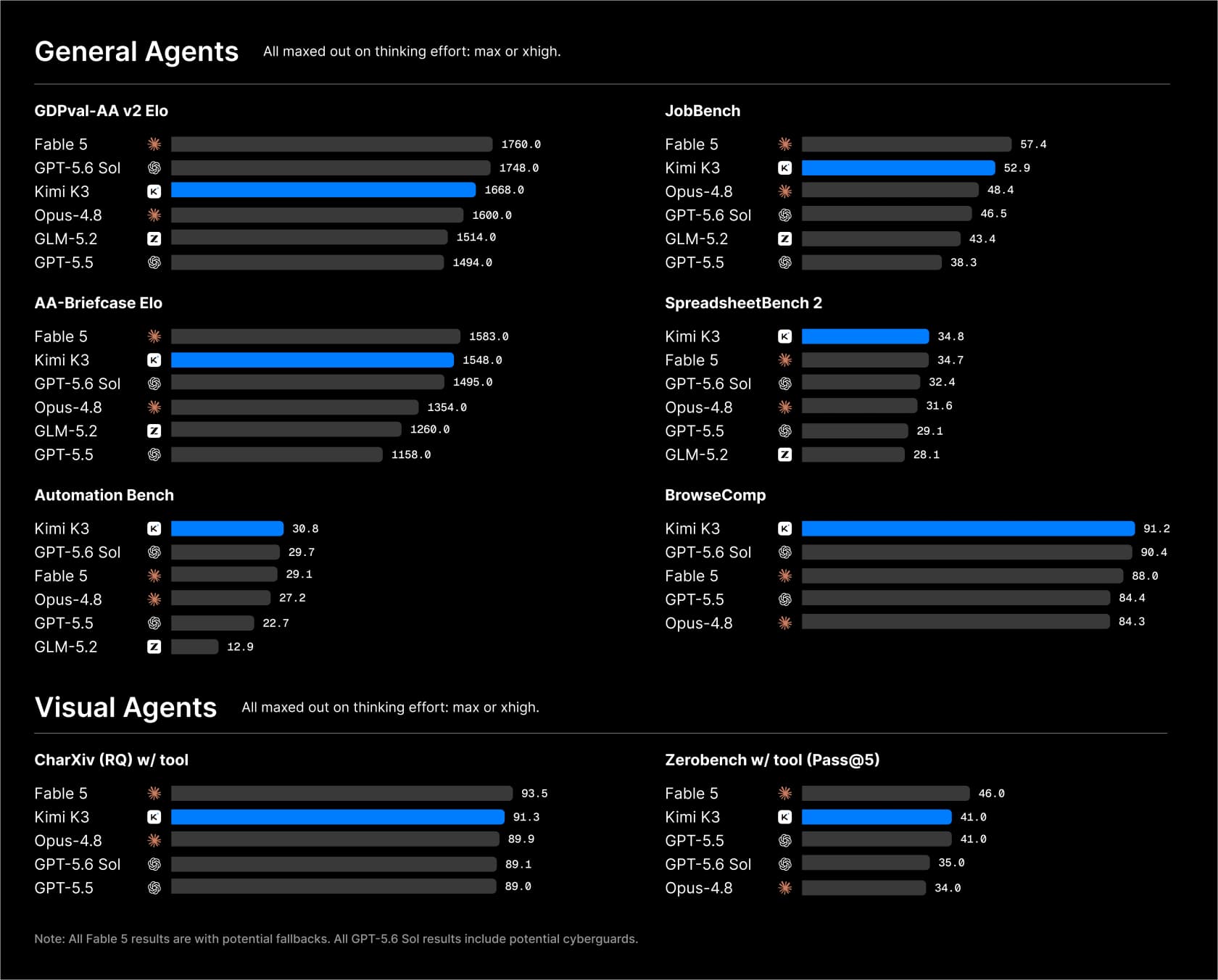
Kimi K3 from Moonshot AI is the reasoning heavyweight of the open-weight world: 2.8T total / 104B active params, a 1M-token context, native vision, and open weights that shipped on time. On Artificial Analysis it lands an Intelligence Index of 57, top-five territory, and it leads several agent benchmarks like BrowseComp outright.
The problem is the price and the thinking. At $3 in / $15 out, it sits in Claude Sonnet's band, roughly 50x DeepSeek Flash's output rate, and it cannot stop reasoning. There is a low setting, but it is a latency control, not a cost tier, and it scores worse than DeepSeek Flash while costing 8x more. Users feel the slowness:
"Faster iterations are way better for me, I hate waiting for 5-10 minutes on small changes. I tried to use recent versions of Kimi and GLM, but they use too much thinking for no reason and are pretty slow because of it."
Pros: flagship-level reasoning, native image and video input, a 1M-token window, and open weights with community quants already available.
Cons: expensive per token, no way to turn reasoning off, and slower than you would expect for a "Flash" competitor (it is not one; it is a frontier model). Public image URLs are not accepted either, only base64 or an uploaded file id.
Pricing: $3.00 in / $15.00 out per 1M ($0.30 cache-hit input).
Verdict: the pick when you need real reasoning and want the option to self-host, not when you need cheap-and-fast. If your bar is "as good as a flagship but I own the weights," K3 clears it; if your bar is "replace Flash on cost," it does not. Full breakdown in our Kimi K3 review.
5. Qwen 3.8 Flash-Next
Best for: long-context, high-cache workloads where throughput at scale matters, on open weights.
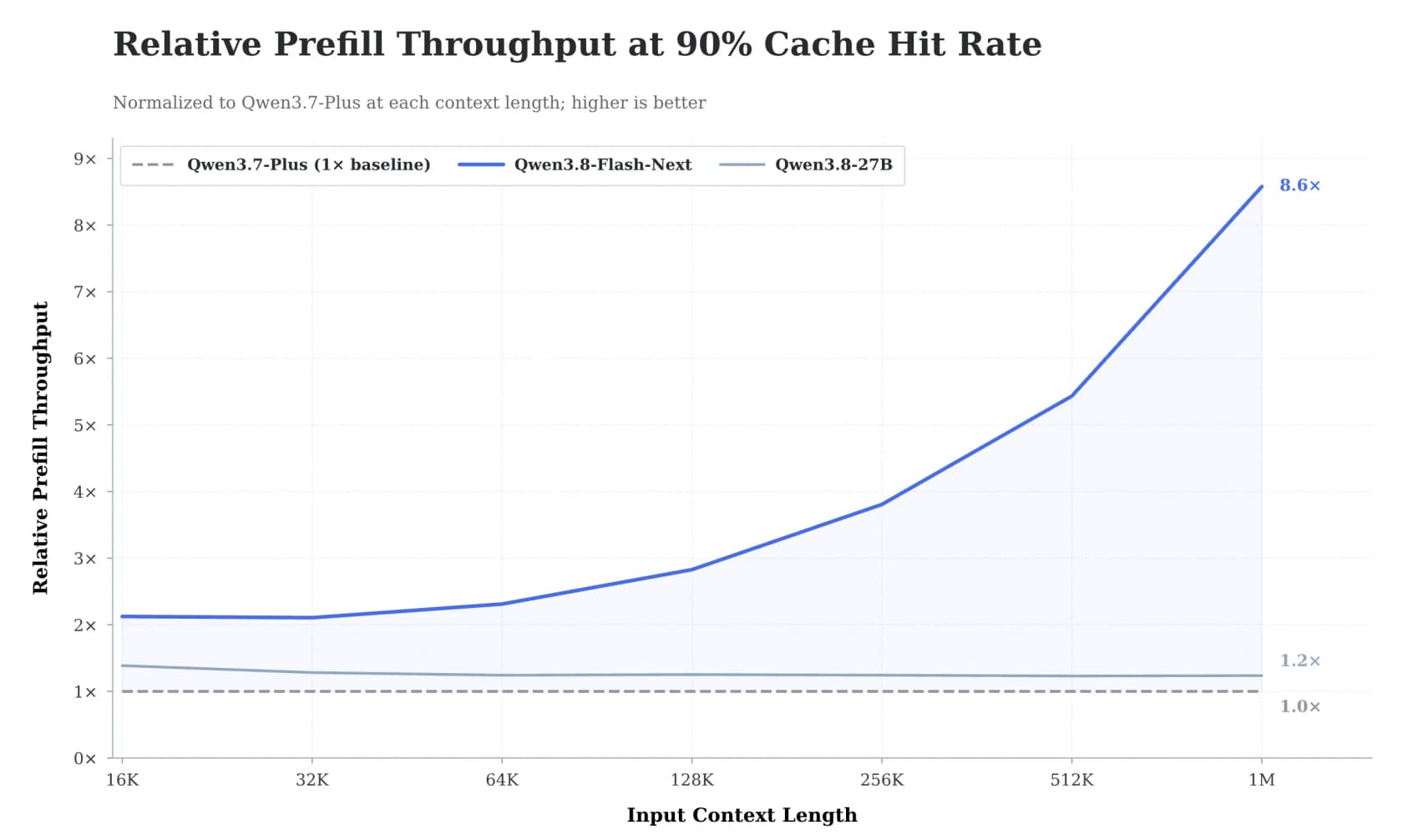
Alibaba's Qwen 3.8 Flash-Next is the most interesting oddity here. It is a preview of Qwen's next architecture, and its party trick is prefill throughput: with Qwen Sparse Attention it hits 8.6x the throughput of Qwen3.7-Plus at a 1M-token context. For a heavy long-context, high-cache-hit workload, that scaling is real and hard to match. It ships open weights and prices on brackets, from about $0.03/$0.13 per 1M on short prompts up to $0.20/$0.80 on the largest.
The catch is what "preview" means. It is deliberately unfinished:
"This model is a preview of Qwen's upcoming Qwen4 architecture... They said the model is intentionally under-trained since it is mainly for R&D purposes of proving the new architecture."
On top of that, Simon Willison ran it and came away preferring a smaller dense model, blaming the low-bit quant needed to fit it, and the hosted API currently has a single provider, so there is no failover. Artificial Analysis also flags it as "very verbose," 200M output tokens to finish its Index versus a 110M median.
Pros: exceptional long-context throughput, open weights, very cheap on short prompts, and a preview of where Qwen is heading. Our Qwen pricing guide has the full bracket table.
Cons: intentionally under-trained, a quantization quality hit, single-provider hosting, and verbose output that pads the bill.
Pricing: bracketed, roughly $0.03-$0.20 in / $0.13-$0.80 out per 1M by prompt size.
Verdict: a research-grade preview, not a production default. Reach for it if long-context throughput is your bottleneck and you can self-host; otherwise wait for the finished Qwen4 line. More options in our Qwen alternatives roundup.
6. Claude Haiku 4.5
Best for: teams who will trade a slightly higher price for reliability and a cleaner safety record.
Claude Haiku 4.5 is Anthropic's fast, small model, and it is the one I reach for when the priority is a model that behaves predictably rather than the absolute cheapest token. At $1 in / $5 out it costs more than the budget pack, but it comes with Anthropic's flat pricing (no long-context surcharge), a strong instruction-following profile, and the tooling maturity of the wider Claude ecosystem.
It matters here because two safety metrics actually regressed on Gemini 3.8 Flash: multilingual safety and unjustified refusals both moved the wrong way versus 3.7, and Google noted non-English safety "regressed slightly." If you serve a multilingual audience or a regulated one, a model with a steadier safety story is worth the premium.
Pros: flat pricing with no context cliff, reliable instruction-following, a mature ecosystem, and a strong safety posture. Good fit for anyone already building on Claude.
Cons: pricier than DeepSeek Flash, GLM, or the Gemini Flash line, closed weights, and a smaller 200K context window than the 1M-token models here.
Pricing: $1.00 in / $5.00 out per 1M.
Verdict: the "reliability tax is worth it" pick. If you have been burned by a cheap model hallucinating in front of customers, Haiku 4.5 buys back a lot of peace of mind. See how it stacks up in our Claude alternatives guide.
7. GLM 5.3 Flash
Best for: the cheapest true multimodal model here.
Z.ai's GLM 5.3 Flash is the first native multimodal model in the GLM-5 series, and on its launch promo it is the cheapest paid model here: $0.075 in / $0.25 out per 1M (list $0.15/$0.50). It ships open weights and, unlike DeepSeek Flash, actually takes images. Early testers rate the price-to-quality ratio highly:
"Noticeably cheaper even than Gemini Flash 3.7, while being only slightly worse performing. That's actually really impressive."

There is a GLM Coding Plan too ($18/$80/$168 a month) that works inside Claude Code, Cursor, Cline and 20-plus agent tools, which makes it a very cheap coding backend if you live in an IDE.
Pros: production-grade quality at a rock-bottom price, native multimodal input, open weights, and a dedicated coding subscription. The free GLM-4.7-Flash and 4.5-Flash tiers are a nice on-ramp.
Cons: the 50% launch discount ends, after which the rate doubles to $0.15/$0.50 (still cheap). The ecosystem is smaller than OpenAI's or Google's, and the flagship GLM-5.3 reasoning model is a separate, pricier SKU.
Pricing: $0.075 in / $0.25 out per 1M on promo; $0.15/$0.50 list.
Verdict: the value champion for multimodal work. If DeepSeek Flash's text-only limit rules it out for you, GLM 5.3 Flash is the cheapest way to keep image input without paying Gemini Flash rates.
8. Gemini 3.5 Flash-Lite
Best for: high-volume classification, tagging, and OCR where full Flash is overkill.
Sometimes the right alternative to Gemini 3.8 Flash is a smaller Gemini. Gemini 3.5 Flash-Lite is Google's budget, high-throughput model: $0.30 in / $2.50 out, a 1M-token context, and multimodal input. It is the answer when you are doing a lot of cheap, well-scoped work, extracting fields, tagging tickets, running OCR, where you do not need a heavyweight reasoner spending 120M tokens to think about it.
It is also the model that kept the cheap floor 3.7 and 3.8 Flash gave up. Flash-Lite still supports the ultra-low thinking settings that make classification economics work, which is exactly the workload that got more expensive when the newer Flash models dropped minimal.
Pros: cheaper than full Flash, a huge 1M-token context, strong throughput (~490 tokens/second), multimodal input, and it stays inside the Google/Vertex ecosystem you may already use.
Cons: weaker on hard reasoning and agentic tasks than the full Flash models, no computer use, and the same introductory-then-higher pricing pattern across the Gemini 3.x line.
Pricing: $0.30 in / $2.50 out per 1M (standard).
Verdict: the right downgrade, not a compromise. For high-volume, low-complexity jobs, Flash-Lite does the work for a third of the price and keeps you on Google infrastructure.
The layer you're actually shopping at
Here is the thing I keep coming back to, because I build this for a living. If you are picking a fast, cheap model to power a customer-support agent, comparing Flash against DeepSeek against GLM is the wrong question. The model is the engine. It is not the car.
A raw model API gives you a text-in, text-out endpoint. To turn that into something that resolves tickets, you still have to wire in your knowledge base, build retrieval so it stops hallucinating, write escalation rules, test it against real cases before it touches a customer, and monitor and retrain it forever. That is weeks of engineering, and you own all of it, including swapping the model every six weeks when the next Flash ships.
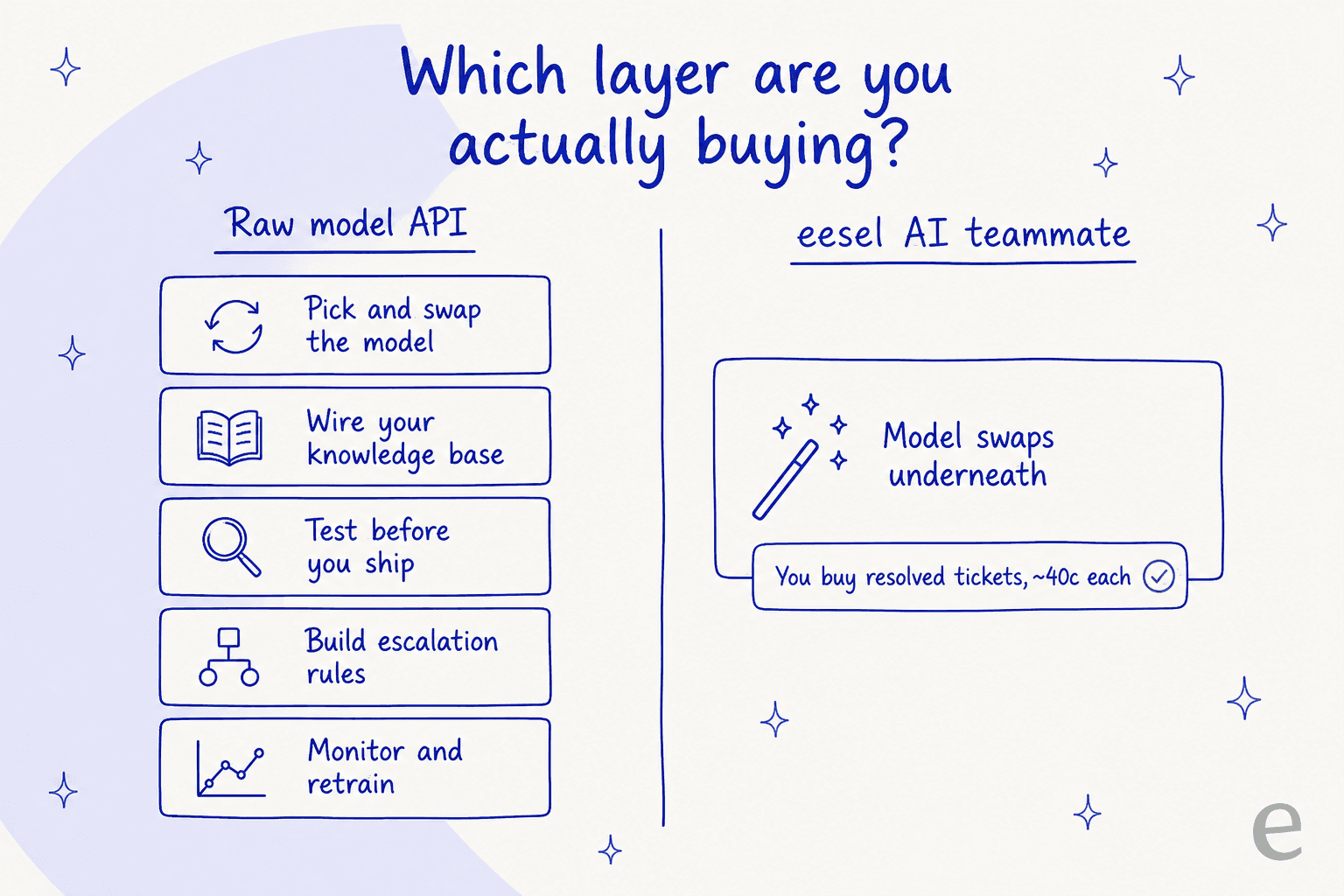
This is the distinction worth holding onto: a model is infrastructure; a teammate is the employee. If your goal is a working AI coding assistant or a research pipeline, then yes, pick the best model and build. But if your goal is "answer support tickets well," the faster and cheaper path is to buy the finished teammate and let someone else obsess over which Flash is winning this month.
Try eesel for customer support
If you landed here because you want a fast, cheap model to handle support, eesel is the layer above the model that actually does the job. It is an AI teammate platform, and the ready-to-work teammate for this is the AI helpdesk agent: it joins your existing queue, trains on your past tickets and knowledge base, and starts resolving conversations, no model wrangling required.
Two things make it fit this exact problem. First, it is model-agnostic by design, so the "is Gemini 3.8 Flash or DeepSeek Flash better?" question becomes eesel's problem, not yours; we pick and swap the underlying model as they improve. Second, and this is the scar every one of these fast models teaches you, eesel simulates every rollout against your historical tickets before it goes live, so you see the real resolution rate and catch the confident-but-wrong answers before a customer does. Prefer to drive it from a terminal or a script? There is a full eesel CLI so coding agents and CI pipelines can operate the same teammate. Billing is one fixed monthly price, from $299/month for 500 credits (1 credit per ticket or chat), so you never do token math. It is free to try with 100 credits, no card.