The 8 best Laya AI alternatives in 2026

Rama Adi Nugraha

Katelin Teen
Last edited September 21, 2026

Why people go looking for Laya AI alternatives
I build integrations and APIs for a living, so I have a soft spot for Laya. The design is honest engineering: instead of asking a giant autoregressive model to "please reply only in JSON" and then praying, Laya runs a bidirectional encoder over your state, evaluates typed questions in a single forward pass, and returns calibrated probabilities. No token generation means no hallucinated fields and no malformed JSON, by construction. It's Apache 2.0, it runs at $0.00 per 1M tokens self-hosted, and it's pitched squarely as the open answer to TypeSafe's closed Jev.
The trouble starts in Laya's own limitations section, which the Hacker News thread seized on immediately. Out of the box, the base model scores about 0.35 on the typed-decisions benchmark, barely above the 0.318 random baseline. The impressive 0.766 number only appears after you fine-tune on the benchmark's train split. That's a big asterisk, and the practitioners in the thread said so plainly:
"Idk, your limitations section sure makes it seem less drop in and less general than Jev. Like the point here isn't your ML aptitude it's how easy is it for developers to drop this into a product and use it. I'm more than capable of training a bert classifier... I don't want to manage GPUs / CPUs now. I don't want to maintain my corpus and retrain as my product's data distribution shifts... I do just want a reasonably good general classifier served to me with a great devex and calibrated confidence scores."

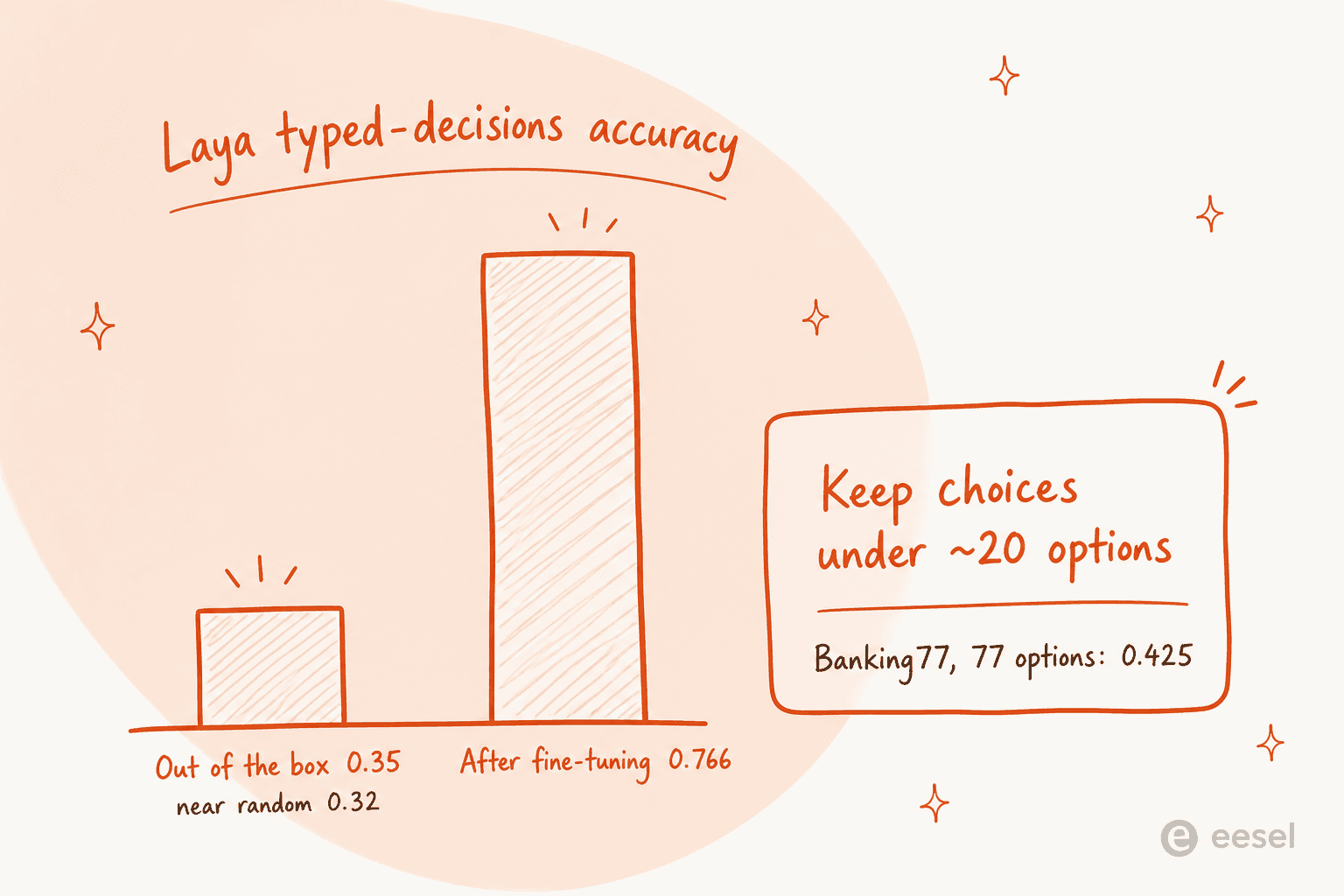
There's a second ceiling worth knowing before you commit. Laya's choice questions degrade past about 20 options, because the candidate labels share a fixed token budget. On Banking77, a 77-label intent set, Laya scored 0.425 while Jev managed 0.870. Plenty of real routing problems have more than 20 buckets, so that's not an edge case for everyone.
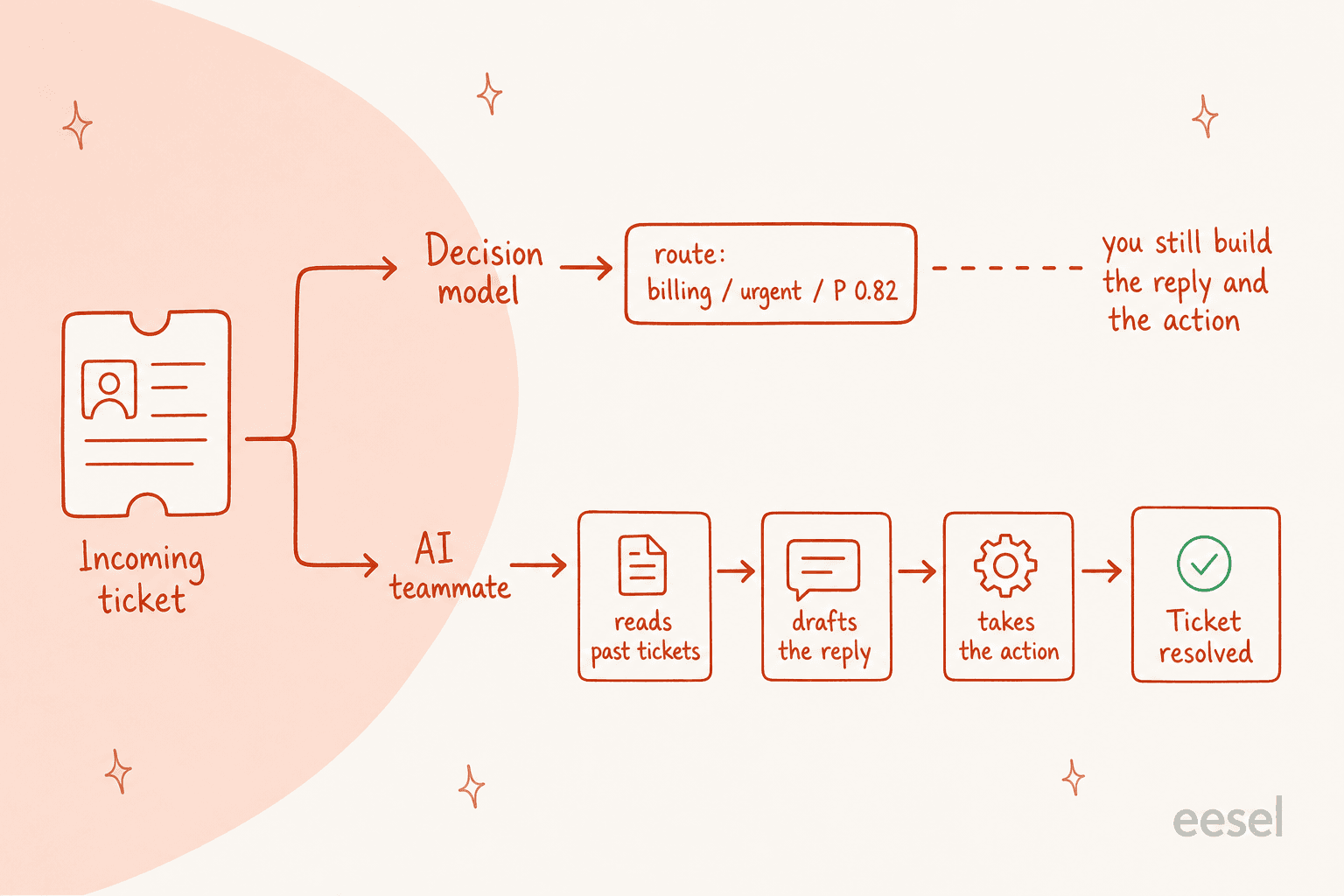
And then the framing point, which is the one I care about most. Even at its best, Laya answers a question. It tells you this ticket is billing, urgent, P(0.82). It does not write the reply, refund the order, or escalate to a human. That's fine if you're building the surrounding product yourself, and a dealbreaker if you thought you were buying an outcome. One commenter put the appeal of the whole category well:
"The ability to knock out any arbitrary classification problem in minutes instead of in a week is a big deal... I don't want to spend a week to create a dataset, finetune a model, and set up infrastructure to run the model, every time I have a small routing or classification problem."
That's the tension every alternative below resolves differently: how much do you want to run yourself, and do you want a decision or a resolution?
How I picked these alternatives
I weighed each option on five things:
- What it actually does - pure classifier, typed-decision API, constrained-output library, or a full teammate that acts.
- Self-hosted vs managed - do you run the weights, or hit an endpoint?
- The confidence story - can you trust the score enough to auto-act, or is it a black box? Laya's whole pitch is calibration, so alternatives get held to that bar.
- Real cost - license, per-call, and the engineering time nobody puts on the quote.
- Multilingual reach - Laya covers 100+ languages, so global support teams need to know what they'd give up.
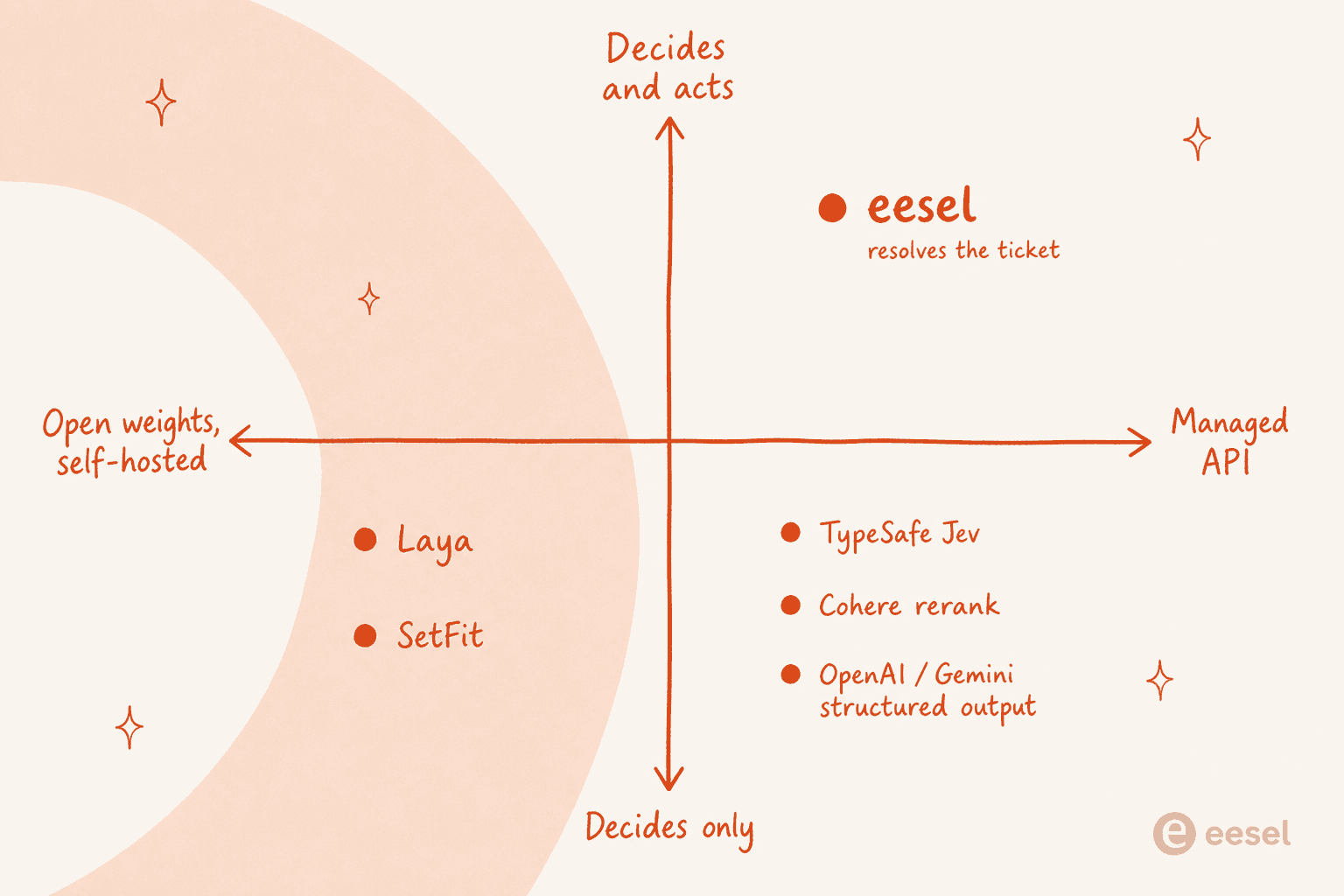
Here's the landscape in one picture before we get into each tool.
Laya AI alternatives at a glance
| Tool | Best for | Type | Self-host? | Decides or acts | Billing unit | Starting price |
|---|---|---|---|---|---|---|
| eesel | Actually resolving support tickets | AI teammate | Managed | Decides and acts | Per ticket / interaction | Free to start |
| TypeSafe Jev | A managed twin of Laya | Decision API | Managed | Decides | Per 1M tokens | $0.042 / 1M in, output free |
| SetFit | Few-shot classification you own | OSS classifier | Yes | Decides | None (compute) | $0 (Apache 2.0) |
| Cohere | RAG relevance + classification | Managed API | VPC / on-prem option | Decides | Per search / per 1M | ~$2.00 / 1K searches |
| OpenAI Structured Outputs | Teams already on GPT | LLM feature | Managed | Decides | Per 1M tokens | No surcharge over model |
| Google Gemini | Cheapest managed structured classification | LLM feature | Managed | Decides | Per 1M tokens | Flash-Lite is cheapest |
| Outlines / Instructor | Schema safety on your own LLM | OSS libraries | Yes | Decides | None (compute) | $0 (Apache-2 / MIT) |
| Cloudflare Workers AI | Edge inference, incl. Jev | Managed catalog | Managed | Decides | Neurons | Free tier, then metered |
1. eesel
Best for: teams who realise the decision was only step one, and what they actually need is the support ticket resolved.
Let me be honest up front, because the blog skill I write under insists on it: eesel is not a decision model, and if you specifically need a 33ms typed-classification primitive to drop into your own pipeline, one of the tools below is a better literal swap. But most people who evaluate Laya for a support use case don't want a label, they want the outcome the label was supposed to lead to. That's the gap eesel fills.

eesel is an AI teammate platform: you hire ready-to-work teammates for specific jobs, and the current roster is an AI helpdesk teammate and an AI blog writer. The helpdesk teammate does the whole loop a decision model can't: it reads your years of past tickets and your help center, drafts the reply, takes the action, and routes or escalates when it isn't sure. Routing is a feature of it, not the whole product.
Here's where our years of running AI on live support queues actually matter to this comparison. Laya's own data shows something worth pausing on: on the multilingual sweep, its English model scored 0.000 accuracy on Khmer while reporting 0.952 mean confidence. A model can be confidently, calibratedly wrong. We learned that the hard way watching bots give assured answers that were flat wrong, which is exactly why every eesel rollout is simulated against your historical tickets before it ever touches a live conversation. You see the real deflection rate on your own data first, not a benchmark number.
For the developers who liked Laya's programmability, eesel exposes the same teammate through the eesel CLI and MCP, so you can install it, wire up knowledge sources, set instructions, run a simulation, and check activity from a terminal or a script. Coding agents like Claude Code, Codex, and Cursor can drive it the same way. It's the same teammate a non-technical support lead configures in the dashboard, just operated as code.
Pros:
- Decides and resolves, across Zendesk, Freshdesk, Slack, email, and 100+ other tools.
- Simulates on your real ticket history before go-live, so confidence is grounded in your data.
- Coachable in plain language, plus a full CLI and MCP surface for the programmatic crowd.
Cons:
- Not a raw classification primitive, if you truly need one model call in your own stack, it's the wrong shape.
- It's a managed teammate, not weights you can run air-gapped.
Pricing: Free to start, then usage-based, so you pay for tickets handled rather than per token guessed.
Verdict: if the routing decision was always in service of resolving a support queue, skip the primitive and hire the teammate. If you genuinely need a standalone classifier, read on.
2. TypeSafe Jev
Best for: the exact Laya use case, but managed, with nothing to fine-tune or host yourself.
Jev is the model Laya was built to answer, so it's the most natural alternative on the list. TypeSafe, founded by Diogo Almeida (a co-inventor of RLHF at OpenAI), calls it the first public "System 1 model": you send unstructured state plus typed questions, and it returns typed probabilistic decisions in one parallel pass, with the same three primitives Laya borrowed, noul, choice, and score.
The trade against Laya is clean. Jev is closed and metered, but it's genuinely drop-in with no training step, which is the thing the Hacker News crowd kept saying Laya lacked. Laya's own benchmarks claim it's 7.8x faster and better calibrated than Jev, but those are Laya's numbers on Laya's setup, and they only hold after the fine-tuning that Jev doesn't ask of you. On a 77-way task, remember, Jev actually beat Laya 0.870 to 0.425.
Pros:
- No weights, no GPU, no fine-tuning, the drop-in experience Laya isn't.
- Strong on high-cardinality choice tasks where Laya falls off.
- Output tokens are free, so read-heavy decisioning is cheap.
Cons:
- Closed and proprietary, no air-gapped or on-prem option.
- Still early access, no public pricing page beyond the rate below, and a waitlist.
Pricing: $0.042 per 1M input tokens, output free, billed through the API.
Verdict: if you liked Laya's concept but not its fine-tuning homework or its GPU, Jev is the managed version of the same idea. Just know you're trading openness for convenience. For a full head-to-head on the managed side, my Jev alternatives roundup goes deeper.
3. SetFit
Best for: teams happy to label a few examples and train, who want a classifier they fully own.
If Laya's fine-tuning requirement is the sticking point, SetFit reframes it as the feature. It's a Hugging Face framework (with Intel Labs and the UKP Lab) for few-shot text classification: it contrastively fine-tunes a sentence-transformer body, then trains a small classification head on the embeddings. No prompts, no verbalizers.
The headline result is the good part: with just 8 labeled examples per class, SetFit is competitive with fine-tuning RoBERTa Large on a full 3,000-example set, at an order of magnitude fewer parameters and far faster training. It runs on a CPU or a modest GPU, it's Apache-2.0, and multilingual support comes free by swapping in a multilingual sentence-transformer body. Since you were going to fine-tune Laya anyway, SetFit is arguably the more mature, better-documented path to the same "small fast classifier" destination.
Pros:
- Genuinely few-shot, ~8 examples per class gets you moving.
- Fully open (Apache-2.0), self-hosted, $0 inference, same as Laya.
- Small enough to train and serve on commodity hardware.
Cons:
- Classifier only, no calibrated "decisions" API, no noul/choice/score primitives.
- No built-in language router, you pick the multilingual body yourself.
- You still bring labeled data and run the two-stage fit.
Pricing: free, Apache-2.0. pip install setfit and you're off.
Verdict: the closest true open-source spirit-sibling to Laya for classification. If the calibrated-confidence layer and the multilingual router aren't dealbreakers, SetFit is a lower-drama way to own a classifier.
4. Cohere
Best for: the RAG-relevance and classification jobs people reach for Laya to do, delivered as a managed, enterprise-friendly API.
Several of Laya's showcased use cases, RAG passage relevance filtering especially, are exactly what Cohere has quietly owned for years. Its Rerank models score how relevant each passage is to a query, and its Embed and Classify endpoints handle the "which bucket does this text belong in" work, all without you training or hosting anything.
Cohere's retrieval stack is the part practitioners actually love. Teams routinely describe Rerank as the reason they stay, even when they generate with another vendor's model, because relevance ranking is the job it was built for.
Where it differs from Laya: this is a managed API, not weights, though Cohere is unusually accommodating on that front, offering VPC and on-prem "Model Vault" deployments for teams that need data to stay put. That's a middle path Laya (fully self-host) and Jev (fully closed) don't offer.
Pros:
- Rerank is best-in-class for RAG relevance, a marquee Laya use case.
- 100+ language support on Embed 4 and Rerank 4.
- VPC / on-prem option for regulated teams, plus a free developer tier.
Cons:
- Managed and metered by default, not the $0 self-host Laya offers.
- Aimed at enterprises, so getting the retrieval stack into production is real engineering work, not a one-line install.
Pricing: Rerank 4 Fast is $2.00 / 1K searches, Rerank 4 Pro $2.50 / 1K, Embed 4 $0.12 / 1M tokens (text). Free trial tier for developers.
Verdict: if what you wanted from Laya was relevance ranking or classification and you'd rather not run a GPU, Cohere is the grown-up managed answer, especially if you need an on-prem story.
5. OpenAI Structured Outputs
Best for: teams already on GPT who want typed, schema-guaranteed decisions without adding a new model.
You don't strictly need a dedicated decision model to get typed output. OpenAI's Structured Outputs feature makes a GPT-5.6 model adhere to a JSON Schema you supply, so the response is guaranteed to match your types (or return an explicit refusal), and it plugs straight into Pydantic or Zod.
The honest caveat is the one the whole "can't hallucinate" debate turned on: schema-valid is not the same as correct. A model can hand you a perfectly typed answer that's simply wrong, and unlike Laya, a general LLM gives you a fuzzier confidence signal (you can read logprobs, but it's not the calibrated distribution Laya is built to produce). You're also paying full LLM latency and token cost per call, which is the 500ms-plus overkill Laya explicitly set out to replace for simple reflex decisions.
Pros:
- No new model to adopt if you're already on OpenAI.
- Guaranteed schema adherence, with explicit refusals for safety.
- Structured Outputs itself adds no surcharge over the base token rate.
Cons:
- Full LLM cost and latency for what Laya does in 33ms.
- Confidence via
logprobsis a proxy, not calibrated decision probabilities.
Pricing: no feature surcharge, you pay the underlying model's token rates (GPT-5.6 flagships run from $0.20 to $5.00 per 1M input).
Verdict: the path of least resistance if GPT is already in your stack and your decision volume is modest. At high volume, the per-call cost is exactly what pushes people toward a purpose-built decision model.
6. Google Gemini
Best for: the cheapest managed route to structured classification, with a model that names it as a first-class use case.
Gemini's structured output works on the same principle as OpenAI's, you pass a response schema and Gemini adheres to it, and Google's docs explicitly call out "structured classification" as a supported use case rather than a hack.
The reason Gemini earns its own slot over OpenAI is price at the bottom of the range: the Flash-Lite tier is aimed squarely at high-volume, low-cost classification, which is the economic pressure that sends people to Laya in the first place. If you want managed structured decisions but the token math on a flagship model scares you, Gemini's small models are the cheapest managed lever here. The same "typed but not necessarily correct" caveat from the OpenAI section applies, this is a general LLM, not a calibrated decision model.
Pros:
- Structured classification is a documented, first-class use case.
- Flash-Lite pricing is built for high-volume, cheap decisioning.
- Big multilingual coverage without extra setup.
Cons:
- Still LLM latency and a proxy confidence signal, not Laya's calibration.
- Locks you into Google's API surface.
Pricing: no feature surcharge over Gemini's model token rates, with Flash-Lite as the cheapest tier.
Verdict: the best managed pick when cost-per-decision is the whole game and you don't need calibrated confidence. Effectively OpenAI's structured output with a cheaper floor.
7. Outlines and Instructor
Best for: teams that want to keep their own LLM (open or hosted) but enforce a schema at decode time.
If your objection to Laya is "I don't want a whole separate model, I just want my existing model to stop returning garbage," two open-source libraries solve that directly. Outlines (by dottxt) enforces structure at decode time, so the model can only emit tokens that fit your schema, working across OpenAI, Ollama, and vLLM. Instructor wraps model calls with Pydantic and validation, and it's become the default way to get typed output across 15+ providers.
These aren't decision models, they're guardrails around whatever model you already run. That's their strength (bring your own weights, no new dependency to serve) and their limit (you inherit your base model's latency, cost, and lack of calibrated confidence). Outlines is Apache-2, Instructor is MIT, both free. Note that dottxt also sells a paid hosted API on top of the open library, if you'd rather not run it.
Pros:
- Keep your existing model, just make its output type-safe.
- Fully open (Apache-2 / MIT), self-hosted, active projects.
- Outlines' decode-time enforcement is genuinely hard to break.
Cons:
- Not a model, no speed or cost win over the LLM underneath.
- No calibrated decision probabilities, no multilingual router.
Pricing: free and open-source. Outlines has a paid dottxt hosted API if you want it managed.
Verdict: the right tool if the real problem was schema safety, not decision speed. Pair with a small local model and you get most of Laya's "never malformed" guarantee without adopting a new model.
8. Cloudflare Workers AI
Best for: teams that want small models (including Jev itself) running at the edge, billed by usage.
Cloudflare Workers AI is a slightly different animal, it's a catalog of 65+ hosted models you run at the edge, near your users, with no infrastructure of your own. It's relevant here for one specific reason: it hosts typesafe/jev, so if the decision-model concept is what you're after, Cloudflare is one of the ways to actually call it.
The pitch against self-hosting Laya is latency and ops: your decision runs at an edge location close to the request, and you never touch a GPU. The pitch against Laya's $0 cost is honesty, you pay per use (in Cloudflare's "Neurons" unit), though there's a free tier to start. It's less a like-for-like Laya swap and more a deployment surface for the whole category.
Pros:
- Edge inference, low network latency, zero infrastructure to manage.
- Hosts Jev and dozens of other small models in one billing surface.
- Free tier, then transparent Neurons-based metering.
Cons:
- Metered, not the free self-host Laya gives you.
- You're picking from Cloudflare's catalog, not running arbitrary custom weights.
Pricing: free allocation, then metered in Neurons.
Verdict: more of a "where to run it" answer than a "what to run" one. If edge latency and no-ops matter more than the last cent of cost, it's a clean way to deploy a decision model without a GPU.
Which one should you actually pick?
The map at the top says it best: your two real questions are how much do you want to run yourself, and do you want a decision or a resolution. This little chooser walks you to the shortlist.
Try eesel
If you found Laya while trying to make a support queue smarter, here's the shortcut: the routing decision was never the goal, closing the ticket was. eesel is the AI helpdesk teammate that makes the triage call and acts on it, drafting the reply, taking the action, and escalating when it's unsure, live inside Zendesk, Freshdesk, Slack, and 100+ other tools.
The part that answers Laya's own biggest caveat: because a confident model can still be wrong, eesel simulates every rollout on your historical tickets before it touches a real customer, so you see the true resolution rate on your data, not a benchmark. And for the developers who liked Laya's programmability, the eesel CLI and MCP let you drive the same teammate from a terminal, a script, or a coding agent. Start free.
Frequently Asked Questions
What is Laya AI and why look for alternatives?
Is there a free alternative to Laya AI?
What is the closest managed alternative to Laya AI?
How much does a Laya AI alternative cost?
Can a Laya AI alternative actually resolve support tickets?


Article by
Rama Adi Nugraha
Rama is a software engineer at eesel AI with two years of experience writing about B2B SaaS, AI tools, and customer support technology. Based in Bali, Indonesia, he brings a developer's perspective to product comparisons — cutting through marketing copy to what the integrations and APIs actually do.