The 8 best AWS Strands Harness alternatives in 2026

Alicia Kirana Utomo

Katelin Teen
Last edited September 24, 2026
Why people look past Strands Harness
Let me be fair to the incumbent first, because Strands Harness earns its attention.
It comes from the AWS Strands Agents team, and the pitch is that your agent idea "just works" the way Claude Code or Codex does locally, except you own it and can deploy it anywhere. One import, pip install strands-harness or npm install @strands-agents/harness, and you have a working agent with shell and file tools, web access, sub-agent handoff, long-term memory, sessions, and Agent Skills baked in. It defaults to Amazon Bedrock but happily runs Anthropic, OpenAI, Google, or Ollama models.
The cost story is the real headline, and it is worth reading precisely rather than rounding up.
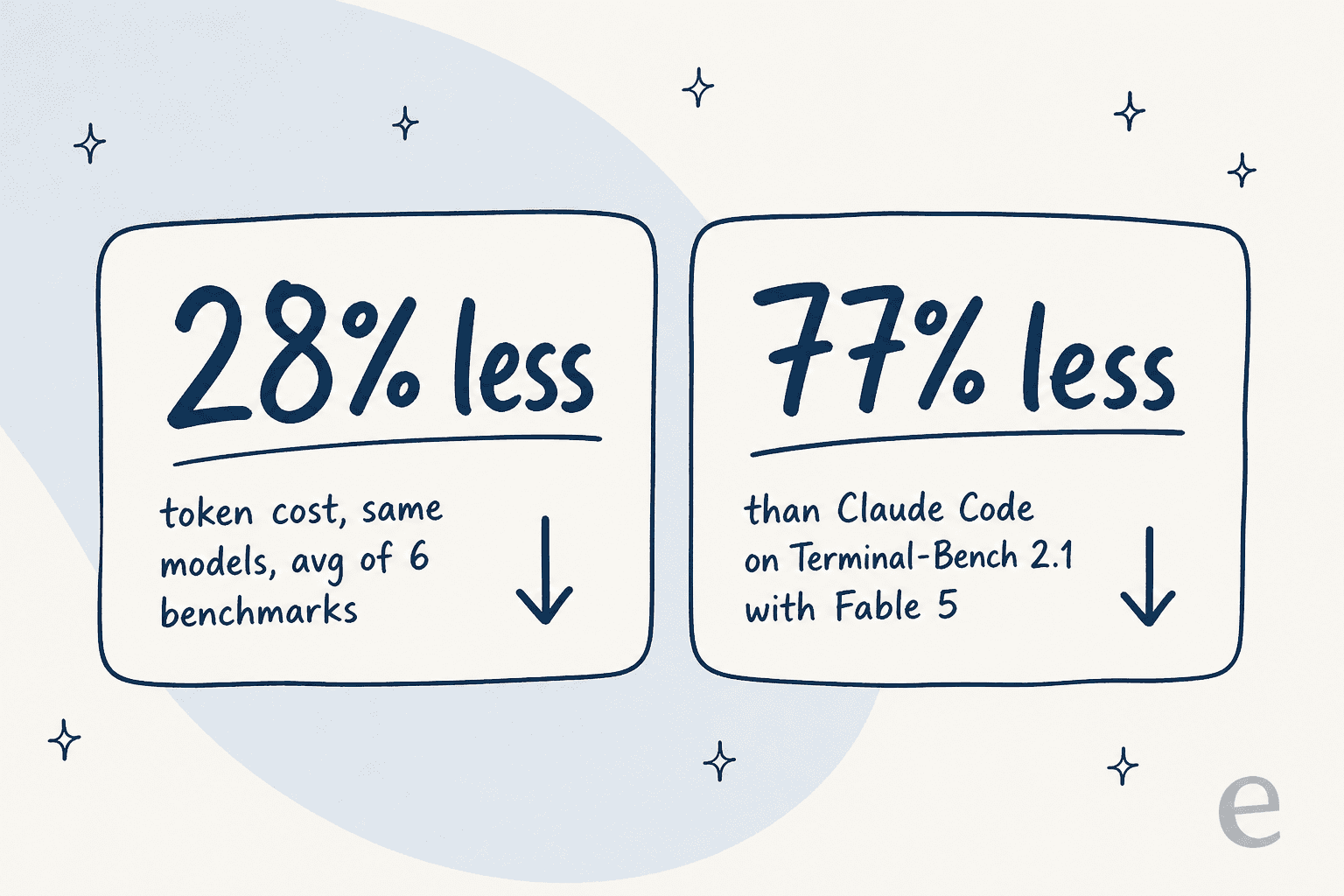
AWS says Strands Harness costs 28% less when using the same Claude or GPT models across six benchmarks, driven mostly by its default context management: tool results over roughly 1,500 tokens get truncated, summarization kicks in past 85% of the context window, and prompt caching is on by default. With Fable 5 on Terminal-Bench 2.1, it says the harness cost 77% less than Claude Code and scored higher.
So why shop at all? A few honest reasons:
- It is brand new. It launched days ago, and AWS has a benchmark paper still to come. New is exciting, but "days old" is a real risk if you are putting it in production this quarter.
- The defaults lean AWS. Bedrock is the default provider. That is a feature if you live on AWS and friction if you do not.
- A general-purpose harness might be more than you need. If you want to define your own agent architecture step by step, a framework gives you that control where a pre-built harness abstracts it away.
- You might not want to build at all. If the agent you are picturing is a customer-support agent, the harness is the wrong altitude entirely. More on that at the end.
Harness or framework: the fork that decides everything
Before the list, internalize this one distinction, because it saves you from comparing two tools that were never doing the same job.
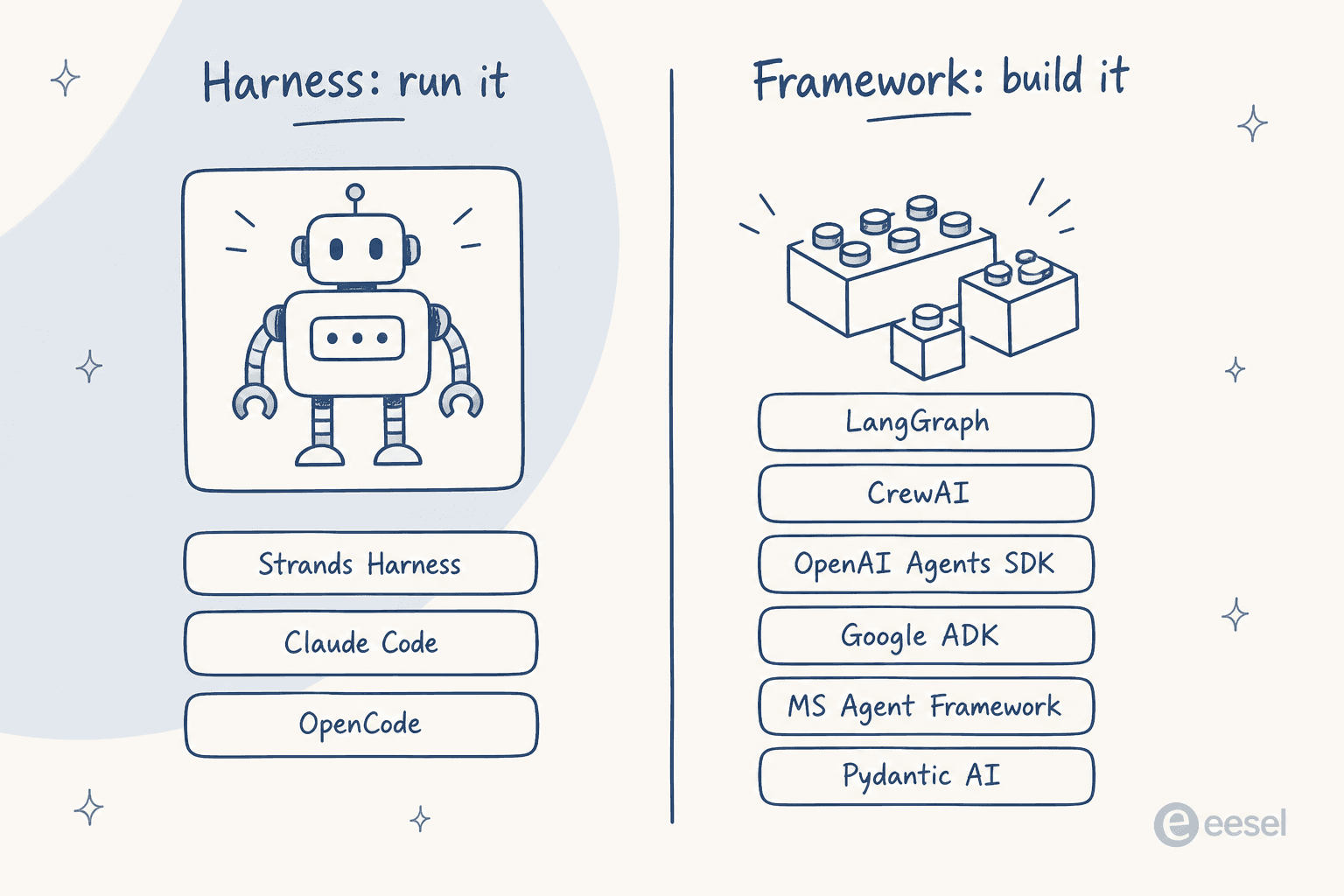
A harness hands you a finished agent. The agent loop, the tool set, the context management, the prompts, all assembled. You point it at a model and a task and it runs. Strands Harness, Claude Code, and OpenCode live here. You trade fine-grained control for "it just works."
A framework hands you the parts. You write the loop, wire the tools, design the prompts, and decide the control flow. LangGraph, CrewAI, the OpenAI Agents SDK, Google ADK, Microsoft Agent Framework, and Pydantic AI live here. You trade "it just works" for control over exactly how your agent behaves.
Strands Harness sits on the harness side. So if what you actually want is to hand-build bespoke agent logic, a framework is your real alternative, and if you want a ready agent to run and deploy, another harness is. Keep that in mind as you skim the picks.
How I compared them
I anchored every pick to the same set of questions, the ones that actually bite once you are past the demo:
- Harness or framework? Which job it does, per the fork above.
- License and language. Open source or proprietary, and Python, TypeScript, .NET, or all three.
- Model providers. Locked to one vendor, or model-agnostic.
- Extensibility. MCP support, tools, sub-agents, memory, human-in-the-loop.
- Deployment and cost. What you host, and what you actually pay beyond model tokens.
Here is the whole field at a glance.
| Tool | Type | License | Language(s) | Model providers | Cost model | GitHub stars |
|---|---|---|---|---|---|---|
| AWS Strands Harness | Harness | Apache 2.0 | Python, TypeScript | Bedrock (default), Anthropic, OpenAI, Google, Ollama | Free; pay model + hosting | New |
| OpenCode | Harness | MIT | TypeScript | 75+ via Models.dev | Free; BYO key | ~210k |
| Claude Code | Harness | Proprietary | CLI + IDEs | Claude (Bedrock/Vertex on some surfaces) | Claude plan or API usage | Closed |
| LangGraph | Framework | MIT | Python, JS/TS | Multi-provider via LangChain | Free OSS; LangSmith from $0 | ~42k |
| CrewAI | Framework | MIT | Python | Multi-LLM | Free OSS; enterprise quote-only | ~59k |
| OpenAI Agents SDK | Framework | MIT | Python | 100+ LLMs | Free; pay model | ~30k |
| Google ADK | Framework | Apache 2.0 | Python, Java, Go | Model-agnostic (Gemini-tuned) | Free; pay model + GCP | ~22k |
| Microsoft Agent Framework | Framework | MIT | .NET, Python, Go | Foundry, Azure OpenAI, OpenAI | Free; pay model + Azure | ~14k |
| Pydantic AI | Framework | MIT | Python | Model-agnostic (string swap) | Free; pay model | ~20k |
Now the eight, in the order I would actually reach for them.
1. OpenCode
Best for: teams who want a fully open, no-lock-in harness with the widest possible model choice.
OpenCode is the open-source AI coding agent that runs in your terminal, IDE, or desktop, built by Anomaly. It is the closest open peer to Strands Harness on the harness side of the fork, and it is enormous: the repo (recently moved from sst/opencode to anomalyco/opencode) sits around 210k GitHub stars, with the homepage citing 16M monthly developers.
Install is one line (curl -fsSL https://opencode.ai/v2/install | bash), or npm, bun, or brew. The thing that sets it apart is model reach: 75+ providers through Models.dev, local models included, and you can even log in with GitHub to use a Copilot account or with OpenAI to use a ChatGPT subscription. It is LSP-aware, supports multiple parallel sessions, and can generate share links for any session.
Pros:
- Fully open (MIT), radically provider-agnostic, and a massive community.
- Reuses subscriptions you already pay for, so there is no mandatory new spend.
- Privacy-first: it does not store your code or context.
Cons:
- It is a general coding agent, not a build-your-own-app framework.
- You supply and manage your own model access, and quality varies across 75+ providers, which is exactly why OpenCode offers its curated Zen model set.
Pricing: free and open source. You bring your own model key (free models are included), with optional hosted Zen models on top.
My take: if your reason for leaving Strands Harness is "I want something open that I fully control," OpenCode is the first stop. It is the alternative that most directly matches the "assembled agent, run it anywhere" feeling, minus any AWS gravity.
2. Claude Code
Best for: teams standardizing on Anthropic's frontier models who want a polished, deeply extensible harness.
Claude Code is Anthropic's agentic coding tool, and it is the harness Strands Harness explicitly benchmarks itself against. It reads and edits across a whole codebase, runs shell commands, traces bugs, and opens pull requests, and it runs across many surfaces, from the terminal to VS Code, JetBrains, a desktop app, and the web.
Its real strength is the extensibility stack around it: MCP servers, sub-agents, Skills, hooks, slash commands, CLAUDE.md project memory, and the Claude Agent SDK for building your own agents on the same harness. It is a mature, well-supported tool rather than a thin wrapper.
Pros:
- Deep first-party integration with Anthropic's frontier models.
- The most mature extensibility surface of any harness here.
- Many surfaces, from terminal to IDEs to web.
Cons:
- It is proprietary, so you cannot inspect or self-host the harness.
- It is built to run Claude models and generally needs a paid Claude plan or metered API spend, with no free open path.
Pricing: most surfaces need a Claude subscription (Pro or Max) or Anthropic API usage. Some surfaces also support Amazon Bedrock and Google Vertex.
My take: Strands Harness beating Claude Code on cost does not make Claude Code a bad pick. If you are all-in on Claude and want the richest ecosystem of subagents and skills, this is still the harness to beat. Just know you are choosing polish and lock-in over openness.
3. LangGraph
Best for: engineering teams building reliable, long-running production agents that need fine-grained, auditable control.
LangGraph from LangChain is where the list crosses the fork into frameworks. You build a StateGraph out of nodes and edges, mixing deterministic steps with model-driven ones in the same graph. In LangChain's own taxonomy, LangGraph is the low-level runtime that sits under a harness, which tells you exactly how much control it hands you.
It is trusted in production by Klarna, Uber, and J.P. Morgan, and it is built for the unglamorous parts: durable persistence so agents resume after a failure, human-in-the-loop interrupts, and short- plus long-term memory.
Pros:
- Fine-grained, deterministic control over the agent's execution path.
- Durable, resumable execution built for long-running workflows.
- Battle-tested at real scale.
Cons:
- It is deliberately low-level, so you write more of the loop by hand. LangChain itself steers beginners to its higher-level prebuilt agents.
- Much of the production value (deployment, observability, auto-fix) lives in the paid LangSmith platform.
Pricing: the library is free and open source (MIT). LangSmith pricing is $0/seat for Developer, $39/seat for Plus, and custom for Enterprise, metered in compute and storage units ($1.50 and $1.00 respectively).
My take: if Strands Harness feels too finished and you want to own the control flow, LangGraph is the serious choice. It is the opposite trade from a harness: maximum control, more code, and a platform bill if you want the managed pieces.
4. CrewAI
Best for: teams who think in "a crew of specialists dividing a job" and want to model that fast.
CrewAI is a Python multi-agent framework with a vocabulary that maps cleanly onto human teams: agents, tasks, crews, and flows. It has ~59k GitHub stars, more than LangGraph, and the company markets an "Enterprise Agent Build & Runtime" that it claims is used by 65% of the Fortune 500 (a vendor self-report, so weight it accordingly).
Agents come with memory, knowledge, and structured Pydantic outputs; tasks run in sequential, hierarchical, or hybrid processes with human-in-the-loop triggers; and flows manage state and resume long-running work. The enterprise console adds RBAC and triggers into Gmail, Slack, Salesforce, and more.
Pros:
- The role-based model is fast and readable, so you stand up a working crew in minutes.
- Large community, plenty of examples and cookbooks.
- Memory, knowledge, and HITL built into the agent concept.
Cons:
- The opinionated crew abstraction gives you less deterministic control than a low-level graph runtime.
- The governed enterprise runtime is demo-gated with no public pricing, so you cannot self-serve a cost estimate the way you can with LangGraph.
Pricing: the framework is free and open source (MIT). Enterprise runtime pricing is quote-only as of this writing.
My take: CrewAI is the friendliest on-ramp to multi-agent work. If your mental model is already "a researcher hands off to a writer hands off to an editor," you will be productive here faster than anywhere else. Just go in knowing the enterprise tier is a sales conversation, not a pricing page.
5. OpenAI Agents SDK
Best for: Python teams who want a minimal, provider-agnostic SDK to stand up agents with almost no ceremony.
The OpenAI Agents SDK is a lightweight Python framework, described by OpenAI as the "production-ready upgrade" of its earlier Swarm experiment. It has a very small primitive set: agents, handoffs, guardrails, and sessions. Hello-world is genuinely a few lines, pip install openai-agents and you are running.
The pleasant surprise is that it is provider-agnostic, supporting the OpenAI Responses and Chat Completions APIs plus 100+ other LLMs. It ships built-in MCP tool calling, built-in tracing, function tools with automatic Pydantic schemas, and even sandbox and realtime-voice agents.
Pros:
- Tiny, learnable primitive set; quick to get productive.
- Provider-agnostic across 100+ models, so you are not locked to OpenAI.
- Built-in tracing and MCP support.
Cons:
- Python-only here; TypeScript users need OpenAI's separate JS SDK, and there is no Java or Go port.
- The richest tracing and evaluation experience assumes you use OpenAI's own platform tooling.
Pricing: the SDK is free and open source (MIT). You pay only for model usage.
My take: this is the framework I would hand a Python developer who wants to build one agent this afternoon without reading a manual. It is less about durable production plumbing and more about getting a clean, model-agnostic agent running fast.
6. Google ADK
Best for: teams building enterprise agents they intend to deploy on Google Cloud.
Google's Agent Development Kit is a code-first, open-source framework now on ADK 2.0. It is primarily Python (with sibling adk-java and adk-go kits, so it genuinely spans three languages), and you install it with pip install google-adk. You define agents, tools, and workflow orchestration directly in code, with sequential, parallel, and loop workflow primitives.
Two things stand out. First, its managed context: ADK auto-filters irrelevant events, summarizes older turns, and tracks token usage rather than blindly concatenating strings, which is the same instinct behind Strands Harness's context defaults. Second, the deploy story: one command ships agents to Vertex AI Agent Engine, Cloud Run, or GKE with auth and Cloud Trace built in. It is model-agnostic but, in its own words, "optimized for Gemini."
Pros:
- Strong enterprise deploy path with observability and auth baked in.
- Structured context management out of the box.
- Real multi-language reach across Python, Java, and Go.
Cons:
- The smoothest managed path runs through Google Cloud and Vertex.
- It is heavier and more opinionated than a minimal SDK if you are outside the Google ecosystem.
Pricing: the SDK is free and open source (Apache 2.0). You pay for model usage plus ordinary Google Cloud costs if you use the managed hosting.
My take: if you are already on Google Cloud, ADK is the natural fit and the deploy-to-Vertex path is a real advantage over rolling your own hosting. If you are not, weigh whether you want to adopt that much Google gravity to replace an AWS-leaning harness.
7. Microsoft Agent Framework
Best for: .NET and Azure shops that need durable, governed, production-grade agents.
Microsoft Agent Framework is Microsoft's consolidation of its two earlier agent projects, AutoGen and Semantic Kernel, into one supported foundation. It ships migration guides from both, and the community read on it is straightforward: it is the successor you are meant to move to, a point AWS-adjacent and Microsoft-watching developers have hashed out in Hacker News threads. It supports .NET and Python first-class, with a separate Go SDK.
Interestingly, it has its own "Agent Harness" concept, so it straddles the fork more than most. The production plumbing is the selling point: graph-based workflows with checkpointing, streaming, and time-travel, built-in MCP, native OpenTelemetry, human-in-the-loop, and durable hosting on Azure Functions.
Pros:
- Enterprise durability and governance are built in, not bolted on.
- First-class .NET support, which almost nothing else here offers.
- Backed by Microsoft with a clear migration path off AutoGen and Semantic Kernel.
Cons:
- The deepest hosting and identity story assumes Azure.
- As a fresh merge of two frameworks, it is still stabilizing, with multiple breaking changes landing through late 2026.
Pricing: the framework is free and open source (MIT). You pay for model usage plus any Azure compute if you deploy there.
My take: for a .NET-first team, this is the obvious answer, and there is no real competition for that niche on this list. For everyone else, the Azure lean and the still-settling API mean I would wait a release or two before betting production on it.
8. Pydantic AI
Best for: Python teams who want type safety and FastAPI-style ergonomics in their agents.
Pydantic AI comes from the Pydantic team, the people whose validation library already sits under the OpenAI SDK, the Anthropic SDK, Google ADK, and LangChain. The pitch is "how Python does AI": a typed agent loop where every model is a string swap away.
The core primitive is a generic Agent that is typed in its dependencies and output. You pass an output_type and every run comes back validated; you inject typed dependencies for testability; and @agent.tool turns a function's signature and docstring into a validated tool schema. MCP is a core capability, observability is OpenTelemetry-native, and durable execution runs on seven engines including Temporal and AWS Lambda.
Pros:
- End-to-end type safety moves whole classes of agent bugs from runtime to write-time.
- Model-agnostic with a one-string provider swap.
- The most "Pythonic," FastAPI-familiar way to build agents.
Cons:
- Python only, so it is a non-starter for polyglot or .NET-first shops.
- Its fullest capability set is spread across companion packages (Harness, Graph, Evals, Logfire, Gateway), so the full experience means adopting more of the Pydantic stack.
Pricing: the framework is free and open source (MIT). You pay for model usage, with optional paid Logfire and Gateway add-ons.
My take: if your team already loves FastAPI and Pydantic, this will feel like home, and the type guarantees are a real edge for agents that return structured data. It is my pick for developers who care most about correctness and testability.
The option most Strands comparisons ignore: don't build it
Here is the thing every "Strands Harness alternatives" list quietly assumes: that you should be building an agent at all.
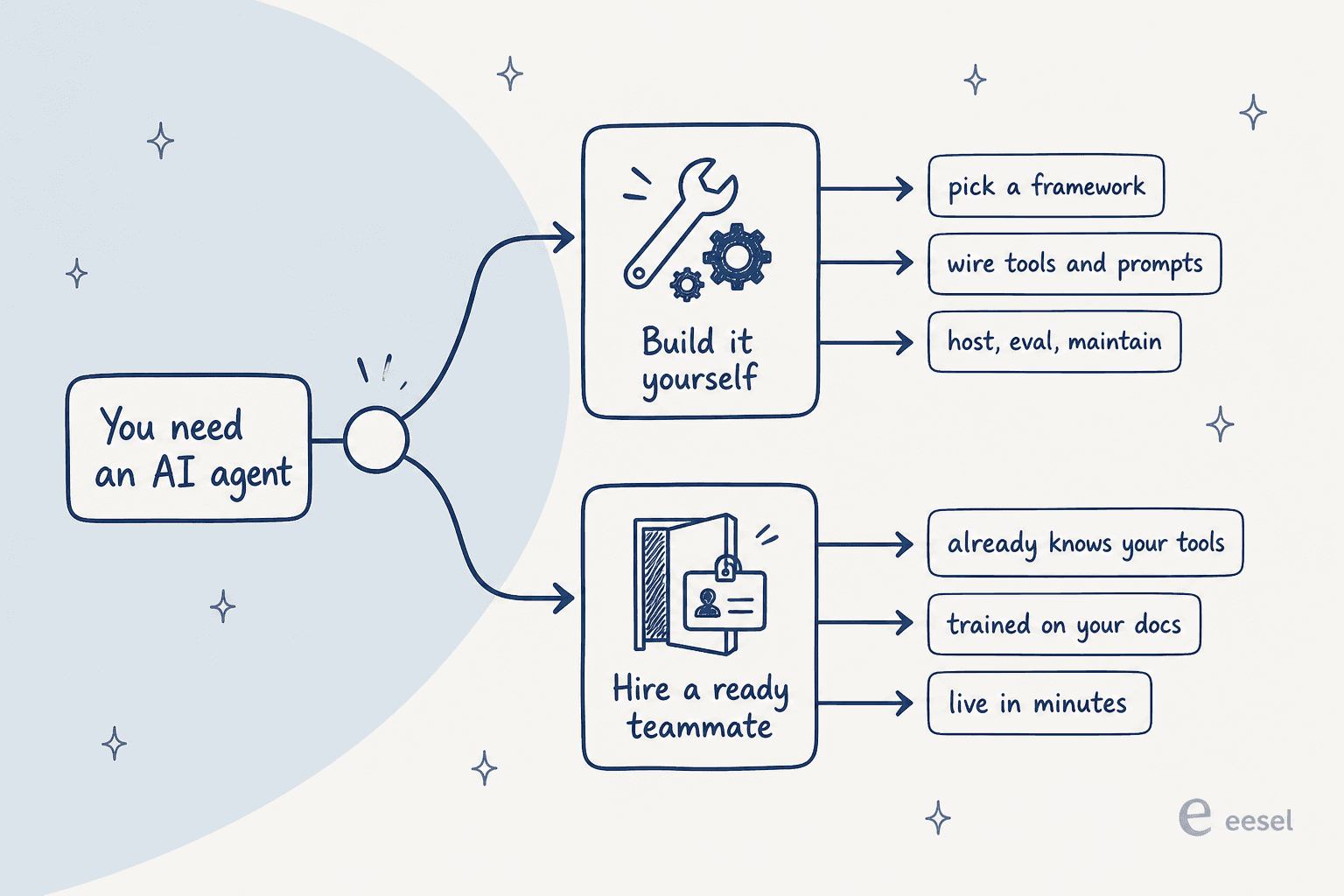
Every tool above is infrastructure. A harness or a framework hands you the plumbing, and you are still the one who picks the model, wires the tools, writes the prompts, evaluates the outputs, hosts the thing, and maintains it as models and APIs shift under you. That is the right trade when the agent is core intellectual property. It is a strange trade when the agent's job is a well-understood role that thousands of companies need done the same way.
Customer support is the clearest example. At eesel, this is the loss I see most often on technical accounts: a team decides to build their own support agent on the raw Claude or OpenAI API, and a few months later they are maintaining a bespoke system instead of shipping their actual product. One customer put the decision plainly:
"We could try to write our own LLM application but we didn't want to invest our time into that. We wanted something that we would not have to maintain."
The distinction I would hold onto: a harness or framework is infrastructure; what you often actually need is an employee. You do not build a new hire from primitives. You hire one who already knows the tools and the job.
Try eesel
That is the gap eesel fills. eesel is an AI teammate platform, and you hire ready-to-work teammates for specific jobs rather than assembling one from parts. The current roster is an AI helpdesk teammate and an AI blog writer, and each arrives with the skills, integrations, and company context for its role.
For support, the AI helpdesk teammate joins the queue you already run, learns from your past tickets and help center, and, crucially, lets you simulate a rollout against your historical tickets before it ever answers a live customer. That simulation exists because we have watched confident-sounding bots quietly give wrong answers, and testing against real history first is how you avoid it. There is no harness to assemble and no context pipeline to maintain.
And if you love the terminal, you are not giving that up. The eesel CLI puts the same teammate in your shell: npx @eesel/cli init chat-bubble --site https://your-site.com sets one up with no account needed. Every command prints JSON, so a coding agent like Claude Code, Cursor, or Codex can run your whole setup for you, --dry-run shows the exact write before it happens, and it is the same agent as the dashboard, not a separate copy. You can also drive it from any MCP client or let it reach your own APIs through Network Access. It is the agent-friendly surface Strands Harness fans will feel at home in, pointed at a job that is already done rather than one you have to build.
So: if you want to build a general agent, Strands Harness and the frameworks above are a strong field, and OpenCode is the open harness I would start with. If the agent you actually need is a support teammate, skip the build and try eesel free.
Frequently Asked Questions
What is AWS Strands Harness?
AWS Strands Harness is a fully-assembled, general-purpose AI agent you can run with one line of Python or TypeScript, released under an Apache 2.0 license in September 2026. It is built on the Strands Agents SDK and defaults to Amazon Bedrock, though it also runs Anthropic, OpenAI, Google, and Ollama models. If you would rather not assemble one, an AI teammate like eesel ships ready to work.
What is the best open-source alternative to Strands Harness?
For an open agent you run in a terminal, OpenCode is the standout, with a permissive MIT license and 75+ model providers. For building your own agent logic, the strongest open frameworks are LangGraph, CrewAI, and Pydantic AI. Each is covered in this roundup of Strands Harness alternatives.
Is AWS Strands Harness free to use?
The harness itself is free and open source under Apache 2.0, so there is no license fee. You still pay for the underlying model tokens from whichever provider you point it at, plus any cloud compute you run it on. That build-and-host cost is exactly why some teams choose a managed teammate instead.
Should I build my own agent or buy one?
Build when the agent is core intellectual property and you have engineers to maintain it. Buy when the job is a well-understood role, like customer support, where a teammate that already knows your tools and docs beats a bespoke build you have to keep alive. eesel's AI helpdesk teammate is the buy option for support.
What is the difference between an agent harness and an agent framework?
A harness is a pre-assembled agent you run, like Strands Harness, Claude Code, or OpenCode. A framework is a set of primitives you assemble into your own agent, like LangGraph or the OpenAI Agents SDK. Most Strands Harness alternatives are actually frameworks, which is a different job.


Article by
Alicia Kirana Utomo
Kira is a writer at eesel AI with a Computer Science background and over a year of hands-on experience evaluating AI-powered customer service tools. She focuses on breaking down how helpdesk platforms and AI agents actually work so that support teams can make better buying decisions.