The 9 best Elementum AI alternatives in 2026

Rama Adi

Katelin Teen
Last edited August 25, 2026

Why teams look for Elementum AI alternatives
I build integrations for a living. Which means I read vendor docs the way other people read contracts, and Elementum's docs are unusually revealing. What the company gets right comes first here, because it is real.
The core architectural claim holds up. CloudLink is Elementum's connector layer, and it really does query your warehouse in place: "A CloudLink does not copy or move your data. Your data stays in Snowflake." There is one carve-out, documented and honest about itself, which is a small dedicated platform schema inside your own warehouse for Elementum's operational data. For a CIO sitting under a data-residency mandate that is a materially different posture from a vendor replicating your tables into its own cloud. And the homepage aims straight at that buyer: "Trusted by CIOs who demand open, governed AI."
The model story is open too. Elementum's AI overview docs name OpenAI, Anthropic, Snowflake Cortex, Gemini via Vertex, Amazon Bedrock, and any OpenAI-compatible custom endpoint, and you bring your own key for all of them. Elementum staff explicitly cannot create or modify AI providers inside a customer org. Set against vendors that resell tokens at an undisclosed markup, that is a better deal, and a cleaner audit trail.
The company is also not a shell. Nader Mikhail founded it, the board includes Frank Slootman and Michael Scarpelli, and Snowflake Ventures invested in September 2025. Customers listed on the about page: Sanofi, Under Armour, Elevance Health, and Snowflake itself.
So why do people end up searching for alternatives anyway? Four reasons, and all of them checkable.
The AI will not run without a data warehouse
This is the big one. It is stated plainly in the docs, too, not buried anywhere. A CloudLink can connect to a warehouse or to a REST API, but AI services require a data-warehouse CloudLink and cannot run on an API connection. Snowflake, BigQuery and Databricks are the warehouses named. Nothing else appears, so no Redshift, no Postgres, no SQL Server, no Fabric.
Underneath that sits the setup gate. Before you connect anything you whitelist six Elementum IP addresses in your data platform's network policy, and Snowflake needs RSA key-pair auth for change tracking and Cortex. The docs describe the platform as "designed for business users, not engineers," and in fairness the app builder does look approachable. Step one is still a firewall change on your warehouse. Somebody technical has to hand the business user a connected warehouse before any of the no-code part begins.
Retrieval reads tables, not documents
Here is the fact that reframes the whole shortlist. Elementum's AI search indexes standard Snowflake tables using Cortex embeddings. No help-centre crawl. No ticket ingestion, no wiki connector, and no document store either. Index freshness is governed by Target Lag, which is a warehouse concept rather than a knowledge-base one.
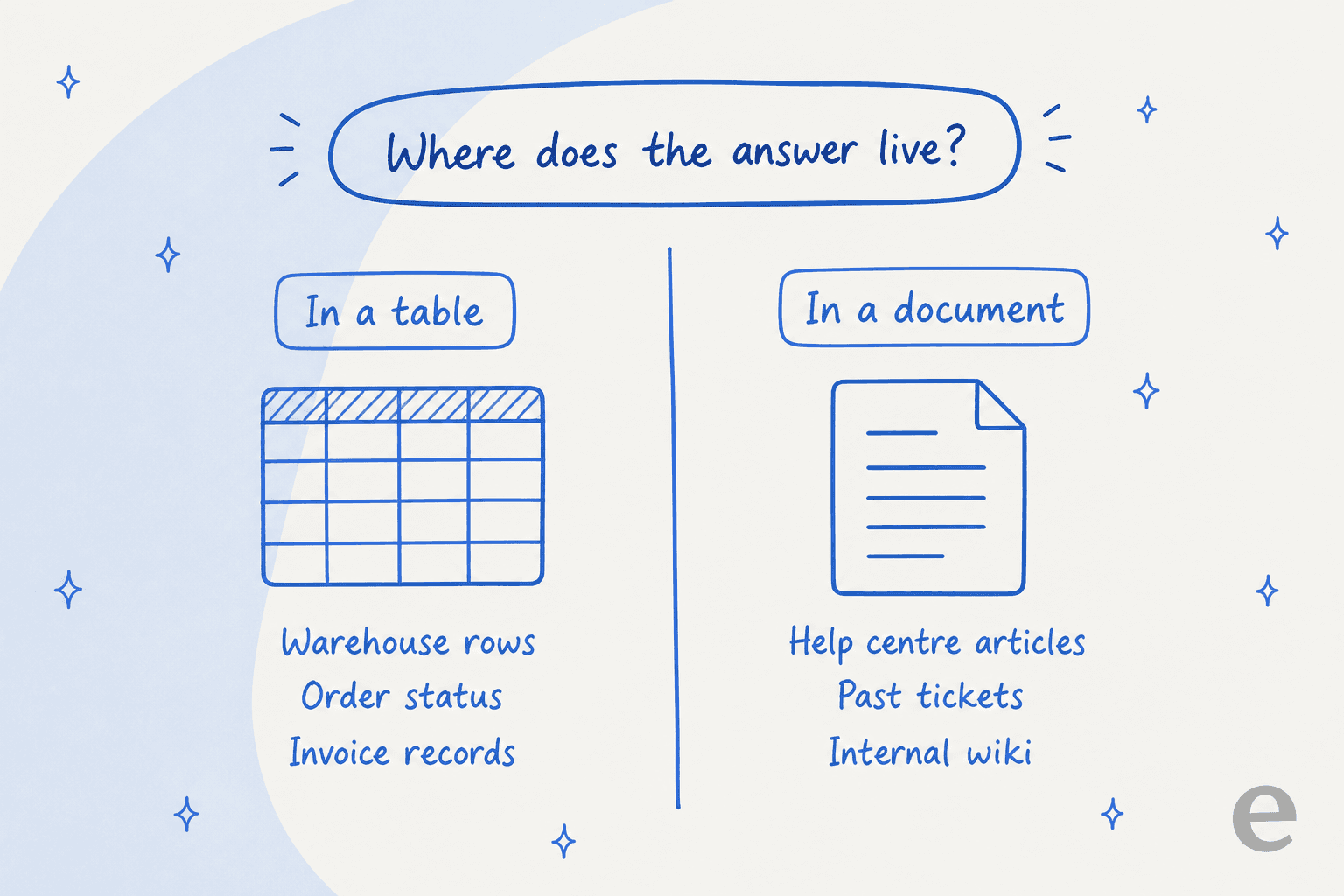
Ask "what is the status of purchase order 4471" and Elementum is well built for it. Then ask "what is our parental leave policy in Germany." That answer lives in a PDF in an HR wiki, which Elementum has no documented way to read. In practice most of the volume hitting an internal helpdesk is the second kind, and that is why AI knowledge base tooling and warehouse orchestration keep getting compared, and keep disappointing whoever picked the wrong one.
Four channels, and none of them is email
Elementum agents deploy to exactly four surfaces. In-app workflow buttons, Microsoft Teams as a one-to-one chat with a single agent, Slack with a different agent per channel, and phone through Twilio. Email is not among them. Neither is a web chat widget, or WhatsApp, or SMS, and also not an agent embedded in a helpdesk.
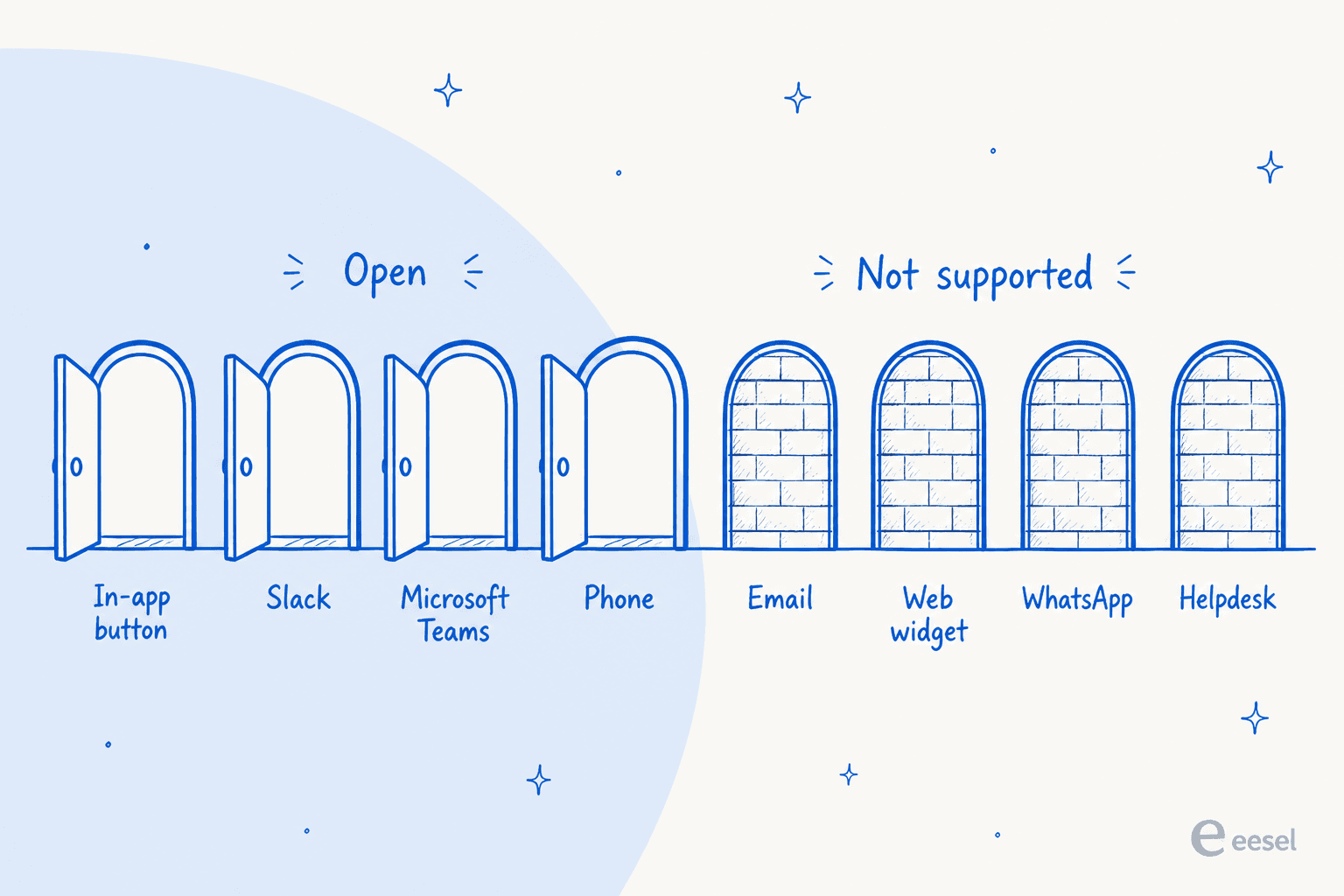
Same story on connectors. Across six agent documentation pages there is no named integration for Zendesk, Jira, ServiceNow, Workday, Okta or Salesforce. An agent can call eight tools, and six of them act only on Elementum's own apps and tables. Writing to anything outside means either an MCP connection to an external server, or a Send API Request action that you wire per endpoint. For an engineering team that is a perfectly respectable escape hatch. It is still not a connector, and the thing worth flagging here is that you want to know that before a procurement cycle starts, not during one.
You cannot price it, and you cannot dry-run it
Elementum's /pricing URL returns a hard 404. There is no pricing link in the navigation either, and the terms of service state that "All fees and pricing information will be Elementum's Confidential Information." One real rate card exists, vendor-supplied, sitting on G2: a free proof of concept, then a pilot starting at $10,000 for one month, and go-live starting at $3.00 per credit with unlimited users. A credit is defined as "units of compute and storage." No conversion from a credit to a workflow run, or a query, or a row, is published anywhere. So even the one published number cannot be turned into a monthly bill. And that card is stamped 12 November 2024, which predates the entire AI repositioning.
Testing is the other gap. Approval routing and assignment exist as workflow stages, which is real human-in-the-loop, so credit where it is due. But the docs describe no confidence gate, no dry run, and no replay against historical records. You test manually, record by record, and then you read the automation log.
That one hits close to home. A Spanish insurance brokerage we work with ran more than 560 of their own real Spanish-language conversations through a custom agent inside 48 hours, before it ever touched a live queue, and they changed the routing rules twice on the back of what came out. I have watched enough confident-sounding bots answer confidently and wrongly to think that pass is the single most valuable hour in a rollout. Where a platform cannot offer it, the first month of production becomes the test.
The reviews are for a different product
One last thing to know before you read anyone's star rating. Elementum was founded in 2012 as a Flextronics-incubated supply-chain company, and the archived homepages track the drift neatly: "Supply Chain Orchestration" in 2019, then "How ESM Gets Done" in 2022, "AI Driven Workflows native to Snowflake" in 2024, and the current AI-native positioning in 2026.
The public review record never caught up. G2 holds 3.3 out of 5 from three reviews, the newest dated April 2022, and one of those three is excluded by G2 as a seller business partner, so the score effectively rests on two. Capterra holds 4.3 from 28 reviews. Every single one lands inside a six-week window in June and July 2020, and nearly all are labelled incentivized or vendor referred. Reddit and Hacker News have nothing at all, and neither do Trustpilot or X.
Read the bodies and it is unambiguous. What they describe is an incident management system for supply-chain claims and complaints:
"Really helpful to follow up and solve incidents related to Logistics. Very easy to use. All users were able to add incidents and push on how to resolve them."

The most useful review in the set is the critical one. The complaint there is structural rather than cosmetic:
"not solving anything more than we did before." / "too many emails generated after someone comments. most users are getting numb to the notifications."
G2 says the quiet part out loud on the product page: "There are not enough reviews of elementum for G2 to provide buying insight." That is not a knock on the current product. It just means the usual shortlist ritual, which is read the reviews and check the price, does not work here. You evaluate on architecture instead.
How I picked these nine
Four rules, and I applied them identically to every tool.
- It has to answer employee or customer requests, or orchestrate work over your own data. Those are Elementum's two halves, and I wanted real options for both of them.
- I read the vendor's own docs and pricing page, not a roundup. Every price below traces back to the vendor's own surface, or a marketplace listing they authored, or a review platform they supplied.
- I state the billable unit. A number with no unit attached is decoration.
- I say which channels and connectors actually exist. After the Elementum exercise, this is the check I trust most.
One disclosure up front. I work at eesel, and eesel is first on the list. I have tried to earn that by being specific about what it does not do, which turns out to be a fair amount.
Elementum AI alternatives compared
| Tool | Best for | Published price | Billable unit | Free tier | Reads docs and tickets | Channels | Warehouse required | Dry run before go-live | Security |
|---|---|---|---|---|---|---|---|---|---|
| Elementum | Warehouse-native governed workflows | None, quote only | Credit ("compute and storage") | Free PoC | No, Snowflake tables only | In-app, Slack, Teams, phone | Yes | No | SOC 2 Type II |
| eesel | Ticket volume in an existing helpdesk | From $299/mo (500 credits) | Credit (1 ticket or chat) | 100 free credits | Yes, help centre plus past tickets | Helpdesk, email, chat widget, Slack, Teams | No | Yes, simulation on ticket history | SOC 2, HIPAA via add-on |
| Moveworks | Large enterprise employee front door | $150 a user a year on AWS | Total headcount, flat annual | No | Yes | Chat, portal, intranet, mobile | No | No public dry run | Enterprise, ServiceNow-owned |
| Atomicwork | ITSM plus AI on one contract | From $25,000 a year | Credit, or $1 to $3 an outcome | No | Yes | Slack, Teams, portal, email | No | No public dry run | Enterprise |
| Siit | Small internal ops teams | $23 an admin, $89 for AI | Admin seat | 14-day trial | Docs only, 3 wikis | Slack, Teams, portal | No | Yes, playbook shadow mode | SOC 2, GDPR |
| Aisera | Cross-functional enterprise agents | None, quote only | Not published | No | Yes | Chat, voice, portal | No | No public dry run | SOC 2, ISO 27001, HIPAA |
| Leena AI | HR and finance back office | $300,000 a year on SAP | Users, 1,000 included | No | Yes | Chat, voice, Slack, Teams | No | No public dry run | Enterprise |
| Espressive (Resolve) | ServiceNow front end | None, quote only | Employee headcount | No | Yes | Teams, Slack, portal | No | No public dry run | Enterprise |
| Glean | Permissions-aware knowledge search | None, quote only | Seat plus FlexCredits | No | Yes, 100+ connectors | Web, Slack, Teams, API | No | Agent testing in builder | Enterprise, permissions-enforced |
| n8n | Building the orchestration yourself | $20 a month, free self-host | Workflow execution | Yes, Community Edition | Only what you wire | Anything you build | No | Yes, re-run single steps | SOC 2, GDPR, self-hostable |
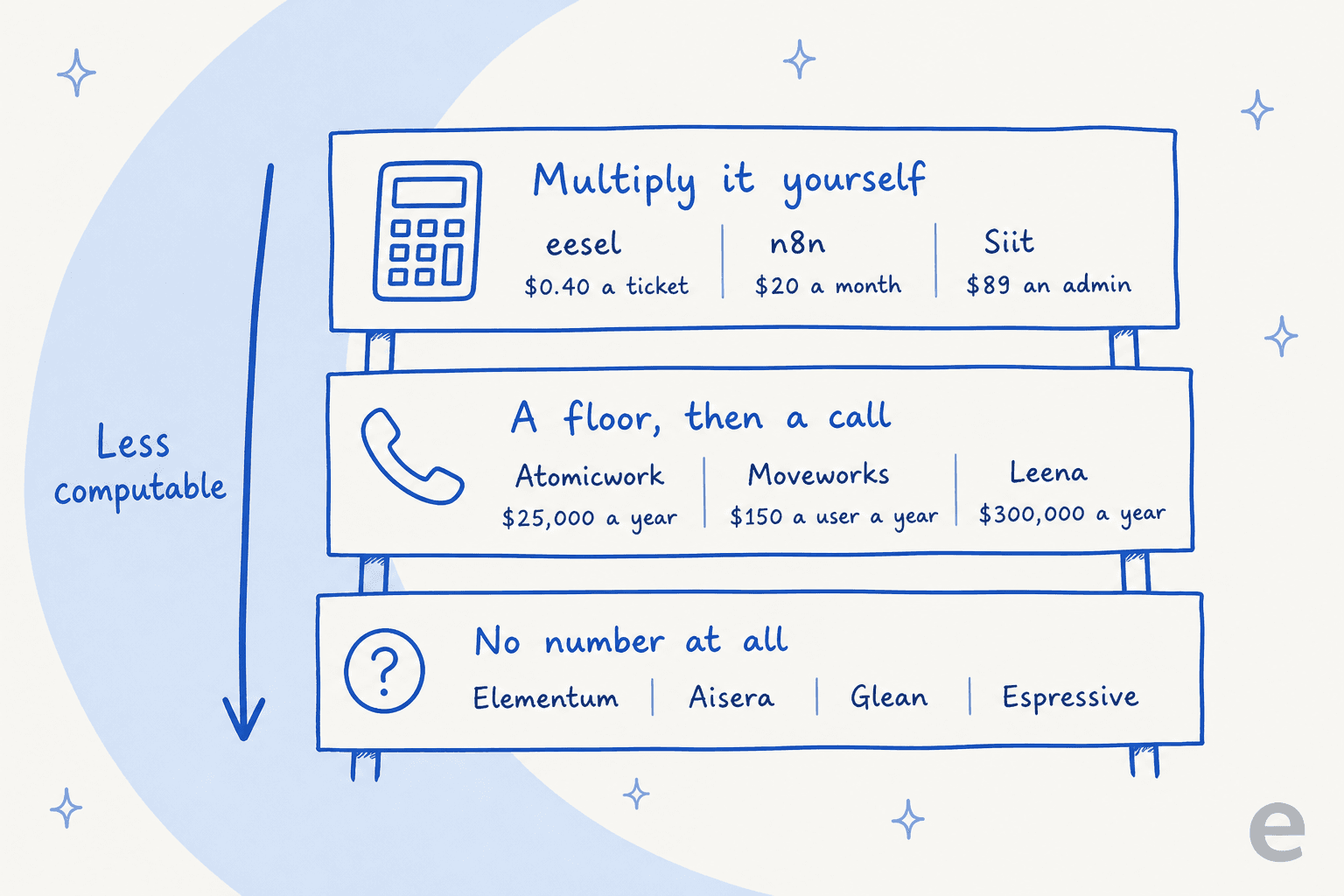
Notice what the pricing column is doing. Three vendors publish a number you can multiply on the spot, three publish a floor and then a phone call, and four publish nothing at all. That split matters more than any feature row here, because a vendor that will not publish a unit is a vendor whose bill you cannot model before you commit.
1. eesel
Best for: teams whose volume is tickets and conversations, not warehouse rows.
eesel sells AI teammates you hire, rather than a platform you configure. The current roster is an AI helpdesk agent and an AI blog writer, and also an e-commerce agent. For anyone comparing against Elementum the helpdesk teammate is the relevant one.
The architectural contrast is the whole point here. Elementum indexes warehouse tables; eesel's teammate reads help centre articles, past tickets, macros, wiki pages and files, and it searches every connected source at once instead of one integration at a time. It joins the queue you already have in Zendesk, Freshdesk, Jira Service Management, Front, Gorgias, Help Scout, Kustomer or Slack, which means nobody has to rebuild that queue as an app.
What it does well. Setup is measured in minutes rather than implementation phases, and the onboarding is knowledge-first. Connect the tools, and years of ticket history becomes usable context straight away. The Simulation skill is the piece I would not give up: it replays the agent against your own historical tickets, so you see the answers it would have sent before it sends any of them. There are real numbers behind that too. Gridwise reports 73% of tier-1 requests resolved in the first month, Smava runs over 100,000 tickets a month fully automated in German, and Design.com runs 50,000 a month on Freshdesk.
Where it falls short. eesel is not an ITSM platform and does not pretend to be one, so no CMDB, no asset management, no device fleet. There is no Zoho Desk connector and no Elementum connector either. And it does not do the thing Elementum does best, which is query your Snowflake warehouse in place, so if your requirement is really governed orchestration across data-cloud tables then this is the wrong tool. HIPAA is available as an add-on (talk to us), not in the base product.
Pricing. One fixed monthly price sized to volume: 500 credits for $299 a month, 1,000 for $499, 2,500 for $999 and 5,000 for $1,899, with 1 credit per ticket or chat however many replies it takes. There is no platform fee and no per-seat fee, and every integration and channel is included. You start with 100 free credits. Paying a year upfront gets two months free, and add-ons such as SSO and MFA (from $199 a month) and data residency ($500 a month) are priced separately. The plans are on the pricing page.
"We could try to write our own LLM application but we didn't want to invest our time into that. We wanted something that we would not have to maintain."
Karel, GENERAL BYTES
My take: pick eesel when the answers live in documents, the requests arrive as tickets, and you want to see the agent's work against your own history before it goes live. Skip it if what you need is warehouse-native orchestration, or a full ITSM platform with asset management. The deciding factor is where your answers live.
2. Moveworks
Best for: enterprises over roughly 5,000 employees that want one front door and can absorb a headcount-based contract.
Moveworks is the closest thing to what Elementum's Intelligent Front Door page describes, and it is built by a company that has been doing only that for years. Its Reasoning Engine takes a natural-language request end to end across IT, HR, finance and CRM, surfaced in chat, portal, intranet and mobile, in over 100 languages. ServiceNow acquired it for $2.85 billion, a deal that closed in December 2025, so 2026 is the first full year it renews under ServiceNow contracting.
What it does well. The proof points are unusually specific for this category. Amadeus cut support-team calls 44% in under a year, and gave back over 16,000 hours a month. CVS Health saw a 50% reduction in live agent chats inside 30 days. Across the base: 350+ organisations, 10% of the Fortune 500, and a typical 8-week time to value. It reads documents as well, which is the capability Elementum lacks.
Where it falls short. The licensing metric is total company headcount, so you pay for every employee whether they open a ticket or not. It is finance-friendly and adoption-hostile at once, and it makes Moveworks expensive for organisations where only one department will ever use it. No free tier, no trial, no self-serve. And the ServiceNow acquisition means packaging will drift toward bundled ServiceNow AI SKUs over time, which is worth a clause in your contract.
Pricing. Quote-based, though a real number does exist. The AWS Marketplace listing publishes $150 per user per year on a 12-month contract, in the 1,000 to 2,500 user band. Procurement data puts median annual contract value around $130,000. The main discount lever is a multi-year deal, roughly 15% to 25% a year on two years.
My take: Moveworks is the low-regret enterprise pick, and at 5,000 employees that $150 a user figure is a real, multipliable starting point, which is more than Elementum offers. Skip it under about 1,000 employees, where headcount licensing stops making sense. Worth reading alongside Aisera vs Moveworks if you are running that exact bake-off.
3. Atomicwork
Best for: teams that want the service desk and the AI on one contract, with the AI meter actually published.
Atomicwork calls itself "Enterprise ITSM + ESM, with the AI Workforce to run it." After ServiceNow it is the heaviest product here: ITSM, ESM, ITAM and a CMDB, plus AI Coworkers that get governed like employees, with an identity, skills, a budget and a lifecycle. The assistant is named Atom.
What it does well. It publishes the most transparent AI meter in this whole comparison, and after the Elementum credit exercise that is something I have come to value a lot. A credit is defined right on the page as the unit drawn each time an AI Coworker completes a job, and running alongside it there is an outcome-based model with three named rates. There is a bring-your-own-platform option too: run the AI Coworkers on an existing ServiceNow or Jira Service Management instance, no platform fee, no migration.
Where it falls short. The floor is real. $25,000 a year is the entry point, and the plans were re-cut recently in the customer's disfavour. Included AI Coworker counts dropped on every tier. The extra-Coworker rate doubled to $499 a worker a month, and Enterprise stopped being unlimited Coworkers. Only the Professional tier publishes a number, with Business and Enterprise both quote-only. Credits also scale with "steps taken, tools called, output length, and reasoning complexity," which is honest of them, and harder to forecast than a flat per-ticket rate.
Pricing. Professional from $25,000 a year, with 25,000 credits, 2 AI Coworkers, and up to 250 end users. Additional Coworkers are $499 a month each. On the outcome side: $1 per resolved knowledge query with a 25,000 a year minimum, $2 per access request with a 12,000 minimum, and from $3 per service resolution with an 8,000 minimum. Worth noticing that $1 times 25,000 is that same $25,000 floor, approached from a different direction.
My take: Atomicwork is the right answer when you are replacing the ITSM tool and adding AI in the same purchase, and its published meter makes it far easier to model than Elementum. Skip it if you already like your service desk, because then you are buying a whole platform to get one agent. The deciding factor is whether you are replacing the desk or just staffing it.
4. Siit
Best for: a two-person internal ops team supporting a few hundred employees in Slack.
Siit is a Paris-based internal help desk living inside Slack and Microsoft Teams. Employees ask in the chat tool they already have open, Siit turns that ask into a tracked request, and on the top tier its agents answer from the company wiki and also execute the change in Okta, Google Workspace, JumpCloud or Jamf. The founders met at Aircall in 2016. The company raised a $5 million seed led by StageOne and Seventure.
What it does well. The billing unit is the friendliest on this list. Siit meters admins instead of employees, so a two-person IT team supporting 400 people pays for two. Its own customer stories lean into exactly that shape: Unit runs IT for 200 employees with 2 people, and Monzo is cited at a 160-to-1 employee-to-admin ratio. It is explicitly not IT-only either, with a category-based service catalog covering HR, Finance, Legal and Facilities, plus HRIS-driven triggers that fire on start dates.
Where it falls short. There are really two Siits here, and the price you see advertised is the one without AI. Every AI feature sits on the $89 Pro tier: the IT Agent, the Triage Agent, AI article suggestions, agent analytics, and SLA management is stapled to the same plan as well. Essentials at $23 is chat intake and a catalog, and it does not even include the integrations row. Knowledge comes from exactly three wikis, which are Notion, Confluence and Slab, so a Guru or SharePoint estate means recreating content. There is no historical-ticket ingestion at all. The review base is almost entirely companies in the 51 to 1,000 employee range.
Pricing. Three published tiers, all per admin per month billed annually. Essentials $23, Standard $45, and Pro $89. Custom is quote-only. If you are comparing Siit against anything else on this list, $89 is the like-for-like number, not $23. Worth flagging too that Capterra lists the starting price as $45, which is the middle tier, so treat the vendor's own page as the authority.
My take: Siit is the cheapest credible way off Elementum for a small internal team, since six admins on the full AI tier still lands near $6,400 a year, against Atomicwork's $25,000 floor. It ships something Elementum does not, too: a shadow mode that logs what a playbook would have done before it does it, though that dry-runs the rules you wrote rather than replaying your ticket archive. Skip it if your wiki is not Notion, Confluence or Slab. The deciding factor is whether you are metering admins or metering the whole company.
5. Aisera
Best for: large enterprises that want one agent platform spanning IT, HR, finance and customer service.
Aisera is the most heavily funded company on this list, at roughly $171 million raised and a $1.6 billion valuation as of its 2023 Series E. The architecture: a Universal Agent orchestrating Domain Agents for IT, HR, Finance and Customer Service, plus narrow Task Agents, and an LLM Gateway that runs either its own AiseraLLM or any leading foundation model.
What it does well. The compliance surface is the broadest here: SOC 2, GDPR, ISO 27001, CSA STAR Level 1, CCPA and HIPAA, all wrapped in a governance framework Aisera calls TRAPS. Its orchestration backbone is built on open standards including A2A and MCP, so it is a real peer to Elementum's openness pitch, and it reads documents on top of that. It is cross-functional by design as well, not an IT tool stretched sideways.
Where it falls short. Pricing is a wall. aisera.com/pricing returns a 404 with no redirect. There is no plan name or tier card anywhere on the site, and the demo path now 301-redirects onto Automation Anywhere's domain, which makes the buying motion harder to read than it was a year ago. Same as Elementum, then: no modelling a bill before a sales call.
Pricing. Not published. No free tier, no self-serve signup, and no trial. The only route is a quote request. Our full Aisera pricing breakdown covers what buyers report, and Aisera competitors covers the rest of the field.
My take: Aisera is the right swap when the appeal of Elementum was breadth and enterprise governance rather than warehouse-native execution, and its certification list does outrun Elementum's SOC 2 Type II. Skip it if opacity was your objection in the first place, because you are trading one quote-only vendor for another one. The deciding factor is whether governance breadth is worth another blind procurement cycle.
6. Leena AI
Best for: HR and finance back-office automation across Workday, SAP and Oracle.
Leena AI ships pre-built "AI Colleagues". Iris for IT, Harrison for HR, and also Fiona for Finance. They answer employee questions and execute transactions across the systems you already run, through more than 200 pre-built connectors including ServiceNow, Workday, SAP, Oracle and Salesforce. The pitch is "pre-built, pre-trained, pre-integrated, live in 45 days," and the company has raised roughly $40.1 million, with Bessemer leading its Series B.
What it does well. Elementum names no third-party connector at all; Leena's connector library is its entire product thesis. The ServiceNow connector on its own automates ITSM workflows, manages records across any table, and orders service-catalog items over REST with OAuth 2.0. It reads documents too, and it is priced somewhere you can actually find.
Where it falls short. That price, once you find it, is large. And the published edition is the narrow one, which is a trap worth naming. The priced $300,000 tier covers help desk management only, while the seven-module bundle, the one with onboarding and knowledge management and the workflow builder, is marked price upon request. There is a domain trap here as well. leenaai.com is a parked domain listed for sale; the real site is leena.ai.
Pricing. No pricing page on the vendor's own site. A real vendor-authored rate card does sit on the SAP partner listing though: $300,000 a year plus a $50,000 setup fee, 1,000 users included, minimum one-year term. Work it out and that is $25 per employee per month before setup, though Leena never states a per-employee rate itself. AWS Marketplace carries a per-module card too. Full detail in our Leena AI pricing writeup.
My take: Leena AI is the pick when the work is HR and finance transactions inside enterprise systems of record, and on connectors it beats Elementum outright. Skip it under about 1,000 employees, where the published floor prices you out on arithmetic alone. See Leena AI alternatives for the cheaper end of that shape.
7. Espressive, now part of Resolve
Best for: ServiceNow shops that want a better conversational layer without replacing the backend.
Espressive built Barista, a conversational virtual support agent for employee self-help and service desk deflection, and it was a 2024 Forrester Leader in the category. Founder Pat Calhoun came out of ServiceNow as an SVP, which is why Barista was always built to sit in front of ServiceNow instead of competing with it. One status change to note before you shortlist. Resolve acquired Espressive on 10 September 2025, espressive.com now redirects, and Barista is merging into Resolve's agent lineup as RITA and Jarvis.
What it does well. The ServiceNow integration is what reviewers single out as living up to the marketing. Barista auto-identifies ServiceNow knowledge articles, and it uses ML-based ingestion to raise deflection. Reported outcomes are strong: 80% to 85% employee adoption, and 70% to 80% ticket deflection in real departments. Systems of record run past ServiceNow to Jira, Oracle, Salesforce, SAP and Workday.
Where it falls short. The acquisition is the main risk. The standalone Barista brand is being absorbed, and the roadmap belongs to Resolve now. Pricing is fully quote-gated, so no public price, no self-serve tier, no free trial, and licensing is per employee in scope rather than per active user, which means cost scales with headcount and not with adoption. The G2 footprint is thin at 16 reviews.
Pricing. Not published. The most concrete public signal is a reviewer's estimate, not a rate card. One Business Services Technology Manager on PeerSpot put it at "about two full-time entry-level employee salaries per department," which implies a five to six figure annual commitment per department. Treat that as one reviewer's experience and not a list price.
My take: Espressive is the strongest choice when ServiceNow is your system of record and you want deflection sitting in front of it, a job Elementum has no documented connector for. Skip it if brand and roadmap stability matter this cycle, because the product is mid-absorption right now. See Espressive alternatives for the rest of that shortlist.
8. Glean
Best for: "where is that document" across every SaaS tool the company owns.
Glean indexes everything a company knows across its SaaS apps into a knowledge graph, then layers permissions-aware search on top, plus an assistant and a no-code agent builder. More than 100 connectors feed it, from Slack and Google Workspace through to wikis and source repos. Every result is permissions-enforced, so a user only ever sees what they already have access to in the source system.
What it does well. This is the exact inverse of Elementum's retrieval design, and where document search was your unmet need, Glean is the strongest answer on this list. Permissions enforced at the source is a real engineering achievement, and it is the thing enterprise security teams ask about first. Gartner named it a Market Shaper for no-code agent builders, and the agent builder lets you test before you deploy.
Where it falls short. It is expensive, and it does not hide that especially well. Pricing is quote-only. The model layers per-seat licensing under a pooled FlexCredits consumption meter, and the docs do price actions in credits, but no credit-to-dollar conversion is published anywhere. Seats are designed to go out to every employee, which is Moveworks-style headcount economics. And Glean is a knowledge layer rather than a service desk, so it will find the policy, and it will not close the ticket.
Pricing. Not published. Commonly reported figures put seats around $40 to $50 a user a month, with a roughly 100-seat minimum and a $50,000 to $60,000 annual floor, though Glean confirms none of that. One Hacker News commenter summed the positioning up bluntly: "the pricey one aimed at big companies." Our Glean pricing page has the detail.
My take: Glean is right when the problem is retrieval breadth, wrong when the problem is resolution, and no other tool here comes close on connector count. Skip it if you need something that does the work rather than finds the answer. See Glean alternatives if the floor is the blocker.
9. n8n
Best for: engineering teams that wanted Elementum's orchestration and would rather own it.
n8n is an open-source, self-hostable workflow automation platform aimed at technical teams. Visual node canvas, and you can drop into JavaScript or Python anywhere in a flow. Around 197,000 GitHub stars, 4.7 out of 5 on G2, and named enterprise users including Microsoft, NVIDIA, Vodafone and Mercedes-Benz.
What it does well. If the appeal of Elementum was governed orchestration where you keep control of the data, n8n gets you there for a rounding error, since you can self-host the Community Edition on your own infrastructure for free, with your own model keys. It solves the testing problem outright as well. Re-run single steps instead of the whole workflow, mock data, replay, and read a logs view rather than clicking through. Human-in-the-loop guardrails and AI governance are built in, and enterprise controls cover SSO, SAML, LDAP, RBAC and log streaming to your SIEM.
Where it falls short. It is a canvas, not a worker, and that is the entire trade. Nothing arrives knowing your business. No employee front door, no service catalog, no ticket object, and no retrieval over your help centre unless you build it yourself. Your team's time is the real price in this option, and on our own workflow research the n8n Zendesk node cannot post a reply, which is the kind of gap you only find out about mid-build.
Pricing. The clearest card here. It bills on workflow executions, where one execution is a full workflow run whatever the step count, and users are unlimited on every plan. Annual rates: Starter $20 a month for 2,500 executions, Pro $50 for 10,000, Business $800 for 40,000 self-hosted, and Enterprise on request. The Community Edition is free and unmetered on your own infrastructure.
My take: n8n is the honest version of "we will build it ourselves," and at $20 a month it is the cheapest way to test whether the orchestration idea holds up before you sign a five-figure pilot. Skip it if nobody on the team wants to own the workflows six months from now, because that person is who ends up carrying it. See Microsoft Teams and n8n for the pattern in practice.
What this actually costs at three sizes
Vendor rate cards are easy to compare and hard to translate. So here is the same organisation, priced three ways, using published numbers only. Every figure below is the vendor's own list rate, before any negotiation.
A 300-person company, 800 employee requests a month. Siit on the $89 Pro tier, the one with the AI in it, is $2,136 a year for two admins. eesel at 800 tickets a month fits the 1,000-credit plan at $499 a month, so $5,988 a year, and you size the plan to the requests you actually route to it. Atomicwork's floor is $25,000. Moveworks at $150 a head is $45,000, and Leena's published edition is $300,000 plus a $50,000 setup fee. Elementum's last published pilot was $10,000 for one month. The spread between the cheapest and the most expensive credible option here is about 140x, which tells you these are not the same purchase.
A 3,000-person company, 6,000 requests a month. Moveworks lands near $450,000 at list, though the 1,000 to 2,500 band pricing does suggest real volume discounts above it. Atomicwork's outcome model at $1 per resolved knowledge query works out at $72,000 a year, if all 6,000 monthly requests are knowledge lookups, which they will not be. eesel at 6,000 requests a month is above the 5,000-credit plan ($1,899 a month, $22,788 a year), so full routing is a talk-to-us quote. Siit at 6 Pro admins is $6,408, although at this size you would likely be quoted Custom.
A 15,000-person enterprise with a Snowflake estate. Elementum's actual home turf, this one, and the honest answer is that nobody in this comparison can quote it, Elementum included. The dependency is what you can budget for: a warehouse contract, then the model spend you owe OpenAI or Anthropic directly under bring-your-own-key, and whatever the credit rate turns out to be. Three bills, and one of them nobody will show you until you are in a room.
The pattern across all three is the same. Tools that meter the work scale with volume, and tools that meter headcount scale with hiring. If your automation rate in year one is going to be 30% rather than 90%, volume-based pricing (credits, outcomes) carries that risk for you. Per-employee pricing does not.
Try eesel
If you got here because "single AI-powered front door" sounded like it would answer your tickets, and you have since worked out that it indexes warehouse tables, eesel is built for the other half of that problem. It reads your help centre, your past tickets and your macros on day one. It joins the queue you already run in Zendesk, Freshdesk, Jira Service Management, Front, Gorgias, Help Scout, Kustomer or Slack. And it does the thing Elementum's docs describe no equivalent of: simulate it against thousands of your own historical conversations, and read the replies it would have sent, before it sends a single one.
The commercial shape is the opposite too. 1 credit per ticket, counted per conversation and not per reply, on a fixed monthly price from $299 for 500 credits, with no platform fee and no per-seat fee. 100 free credits to start, and no sales call required for it. Route 200 of your 1,000 monthly tickets and the 500-credit plan covers it. The whole card is on the pricing page, worked numbers already there, which after two weeks inside Elementum's documentation felt like a small luxury.
Try eesel free, or book a demo if you would rather walk through the simulation on your own ticket history first.
Frequently Asked Questions
What are the best Elementum AI alternatives in 2026?
How much does Elementum AI cost?
Does Elementum AI connect to a helpdesk like Zendesk or ServiceNow?
Which Elementum AI alternative is cheapest for a small internal IT team?
Can Elementum AI read my help centre or past tickets?
Do I need Snowflake to use Elementum AI?
Are the Elementum AI reviews on G2 and Capterra reliable?


Article by
Rama Adi
Rama is a software engineer at eesel AI with two years of experience writing about B2B SaaS, AI tools, and customer support technology. Based in Bali, Indonesia, he brings a developer's perspective to product comparisons — cutting through marketing copy to what the integrations and APIs actually do.