

Where Leena AI actually publishes its price
Start with what is not there. Leena AI's footer lists Products, Agentic AI Architecture, Differentiators, Compare, Resources and Company. There is no pricing entry anywhere in the nav or the footer, and the direct URL 404s.
The two pages that look like they should carry numbers do not. Pricing for IT Service Delivery and Pricing for Enterprise Service Delivery each render a headline, four benefit bullets, and a first name / last name / email / phone form. Both say Leena AI offers personalized quotes tailored to your organisation's needs. Here is what that page actually looks like when you land on it expecting a table.
So far this is the standard enterprise wall you hit across AI service desk vendors. The interesting part is that Leena AI resells through four enterprise marketplaces, and marketplace listings have to carry a rate to be transactable. Three of the four do:
| Channel | Publishes a price? | What it meters |
|---|---|---|
| Microsoft Marketplace | Yes, per user per year | Seats |
| SAP partner listing | Yes, per year plus setup | A 1,000-seat block |
| AWS Marketplace | Yes, per module per term | Modules |
| UKG Marketplace | No | Not stated |
Worth flagging one trap before you go looking yourself: leenaai.com is not the company. It is a parked domain listed for sale at $20,000. The live site is leena.ai.
This marketplace-only pattern is common enough in the category that I now check it first. I have priced the rest of this shortlist the same way and the rate cards land in very different places, from Moveworks to Aisera to Glean.
If you are early enough to still be building a shortlist rather than pricing one vendor, my roundup of AI tools for IT support is the better starting point, and Workativ sits closest to Leena AI on scope.
The full Leena AI pricing table
Microsoft Marketplace, the only real per-employee rate
This is the single most useful page for anyone pricing Leena AI, and it is the one nobody cites. The header states the floor outright at $300.00 per user per two years, and the Plans and Pricing tab breaks out both terms.
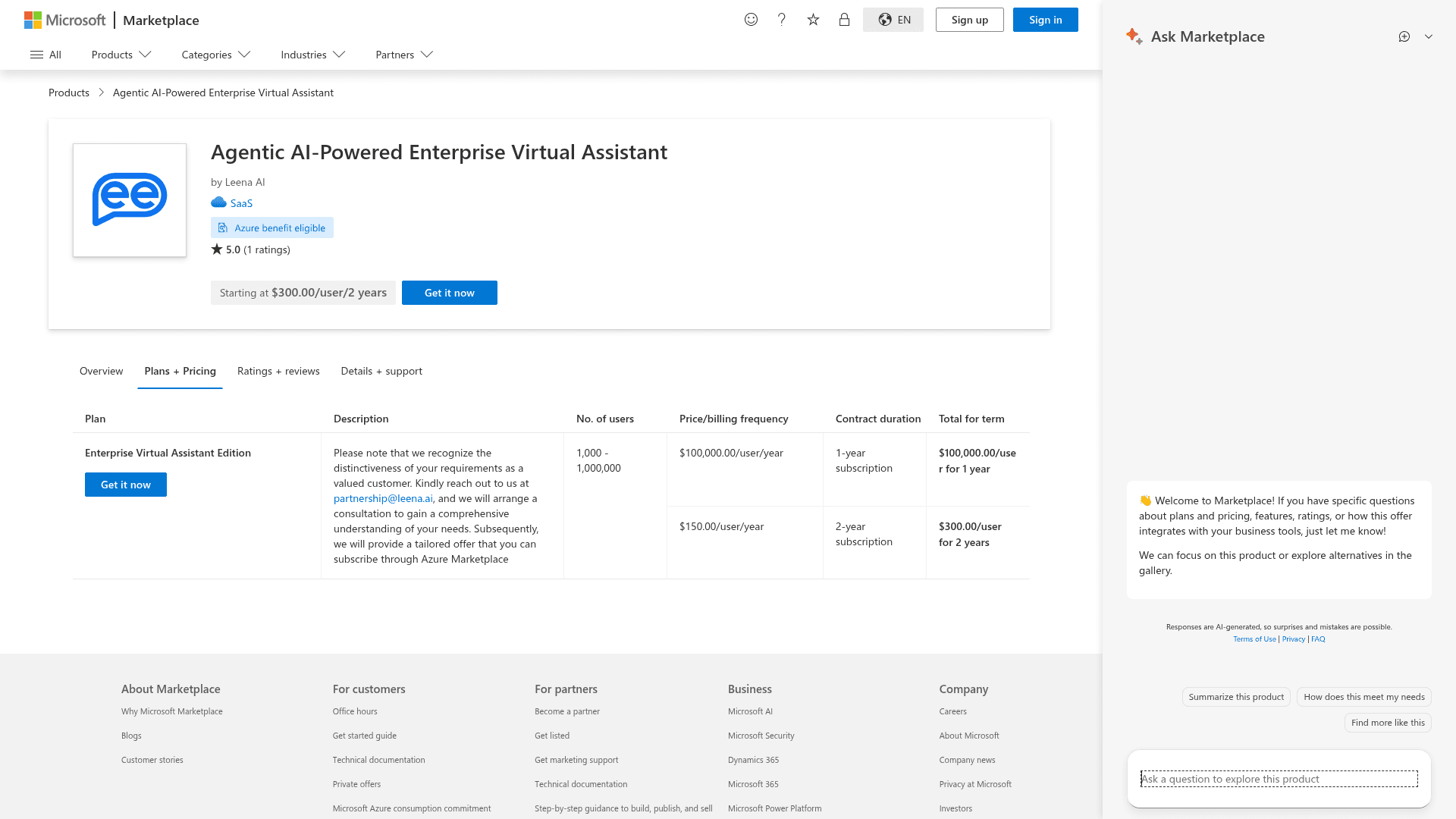
Transcribed cell for cell:
| Plan | Users | Rate | Term | Total for term |
|---|---|---|---|---|
| Enterprise Virtual Assistant Edition | 1,000 to 1,000,000 | $100,000.00/user/year | 1-year subscription | $100,000.00/user for 1 year |
| Enterprise Virtual Assistant Edition | 1,000 to 1,000,000 | $150.00/user/year | 2-year subscription | $300.00/user for 2 years |
Handle that first row with care. $100,000.00 per user per year against a 1,000-user minimum implies a $100 million floor, which is not a real offer. It reads as a total contract value typed into a per-user field. I mention it only because it is sitting on the live listing and will confuse anyone who reads the table top to bottom. The row that means something is the second one: $150.00 per user per year, billed as $300.00 per user across two years, minimum 1,000 users. That works out to $12.50 per employee per month, and a two-year floor of $300,000. The monthly division is mine; Leena AI states the annual and two-year forms only.
SAP partner listing
The SAP listing sits under Employee Experience Management and works with SAP SuccessFactors HCM Core. It carries two editions and prices only one of them.
| Edition | Price | Setup fee | Unit | Seats | Minimum term |
|---|---|---|---|---|---|
| Enterprise Virtual Assistant Edition | USD 300,000.00 per year | + USD 50,000.00 | USD per Users | Includes 1000 Users | 1 year |
| Price Upon Request Edition | Not stated | Not stated | Not stated | Includes 1000 Users | Not stated |
The two editions differ in scope, not just price, and this is the detail I would put in front of a procurement team. The unpriced Price Upon Request Edition lists seven modules: Help desk Management, Onboarding Solution, Knowledge Management, Workflow Builder, Employee Engagement, IT Service Delivery, and Document Management. The priced Enterprise Virtual Assistant Edition lists exactly one: Help desk Management. So the published $300,000 buys the narrower of the two bundles, and the full suite is the one you still have to call about.
AWS Marketplace, priced per module
AWS is a different shape again. It is a contract, not a subscription: you buy a fixed entitlement for the term, and every module is its own line.
| Dimension | Cost per 24 months |
|---|---|
| Knowledge Management | $300,000.00 |
| Case & Incident Management | $400,000.00 |
| Workflows / Transactions Automation | $300,000.00 |
| Document Management | $300,000.00 |
| Employee Engagement Survey Platform | $300,000.00 |
| ESD, HR_IT Transactions | $300,000.00 |
| Implementation Cost | $200,000.00 |
Two things stand out. Ticketing is the priciest module at $400,000, which tells you where Leena AI thinks the value sits. And implementation is a separate priced dimension, not a bundled service. That echoes the SAP listing's standalone $50,000 setup fee, except the two setup figures are four times apart. A 4x spread on the same line item across two of the vendor's own listings is the clearest signal in the whole dataset that these are negotiable anchors rather than a real price list. AWS also offers a 36-month contract that saves up to 33% and a private offer route, so treat every number above as a ceiling.
The billing unit is headcount, not usage
This is the sentence I would want a buyer to leave with, because it decides whether the price is good or terrible for you specifically, and it has nothing to do with the size of the number.
SAP states the unit explicitly as USD per Users with 1,000 users included. Microsoft states $150.00/user/year. So the meter counts people you employ, not questions they ask. There is no published per-ticket, per-resolution or per-conversation rate anywhere across the four marketplaces, the site, or the review sites.
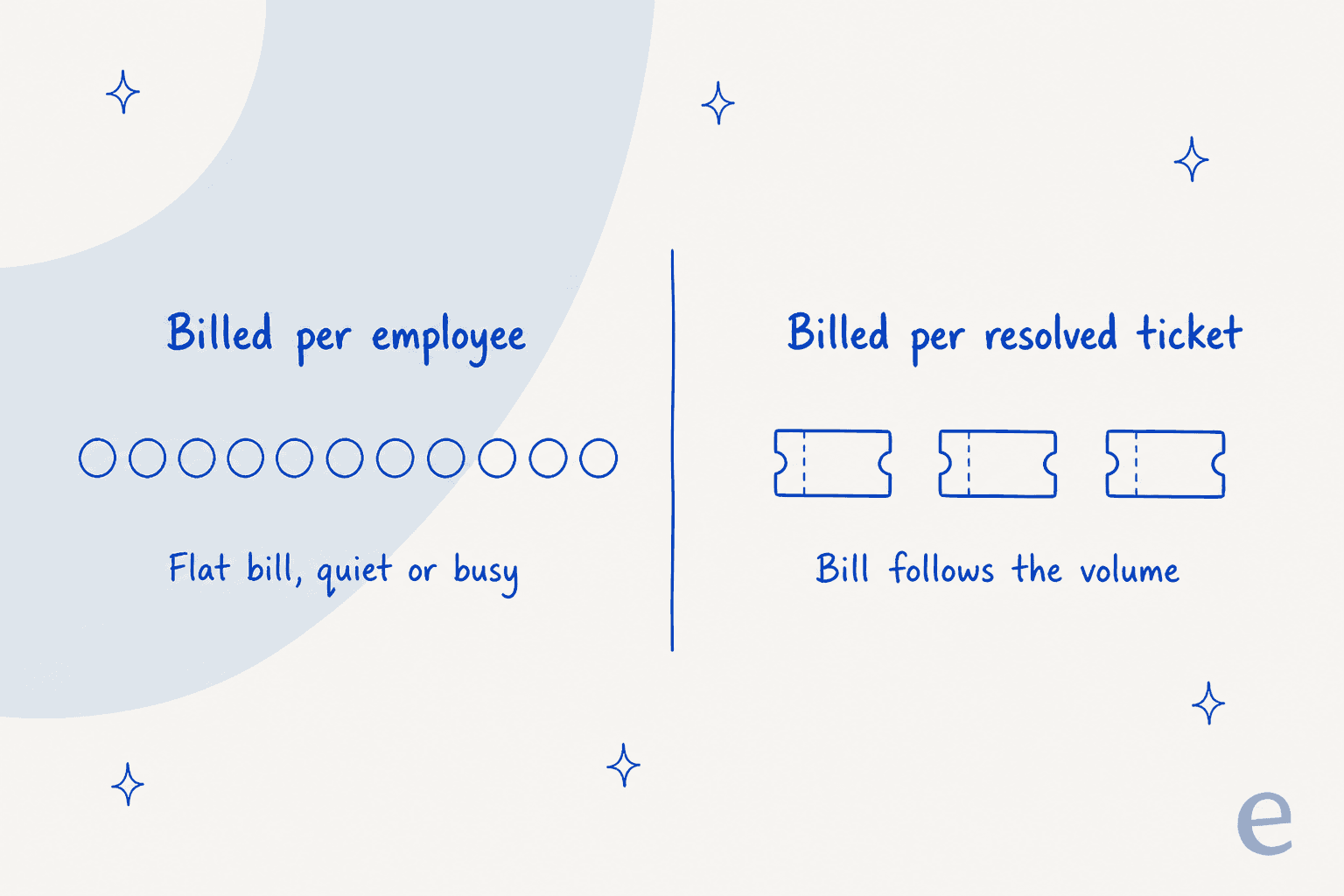
Headcount pricing is defensible, and I want to be fair about why. It makes the bill predictable, which finance teams like. It removes any incentive for the vendor to let volume creep. And for an ITSM platform covering IT, HR and Finance across an entire org, headcount is a reasonable proxy for scope. It also fits how these deployments actually get used: a lot of the value shows up in employee onboarding questions and self-service portal traffic that never becomes a ticket at all, and a per-ticket meter would miss all of it.
But run the two failure cases. A 4,000-person company whose internal queue is already quiet pays $600,000 a year for a service that handles maybe a few hundred tickets a month. A 1,200-person company drowning in tier-1 requests pays $180,000 and gets enormous value. Identical rate card, wildly different deal, and the variable that decides it is one Leena AI does not charge for. If your ticket-per-employee ratio is low, a headcount meter is the worst possible unit for you, and no amount of negotiation on the rate fixes the shape.
So before you take a quote, go count. Pull twelve months of internal ticket volume out of whatever you run now and divide by headcount. That single ratio decides more about whether this deal is good than any line on the rate card, and it is the first thing I would ask for. My write-up on AI and IT tickets covers what share of that volume is realistically automatable once you have the number.
Three doors, and a $200,000 swing in year one
Here is the finding I did not expect. Normalise the three published rate cards to a 1,000-seat deployment for the first twelve months and they do not agree with each other, at all.
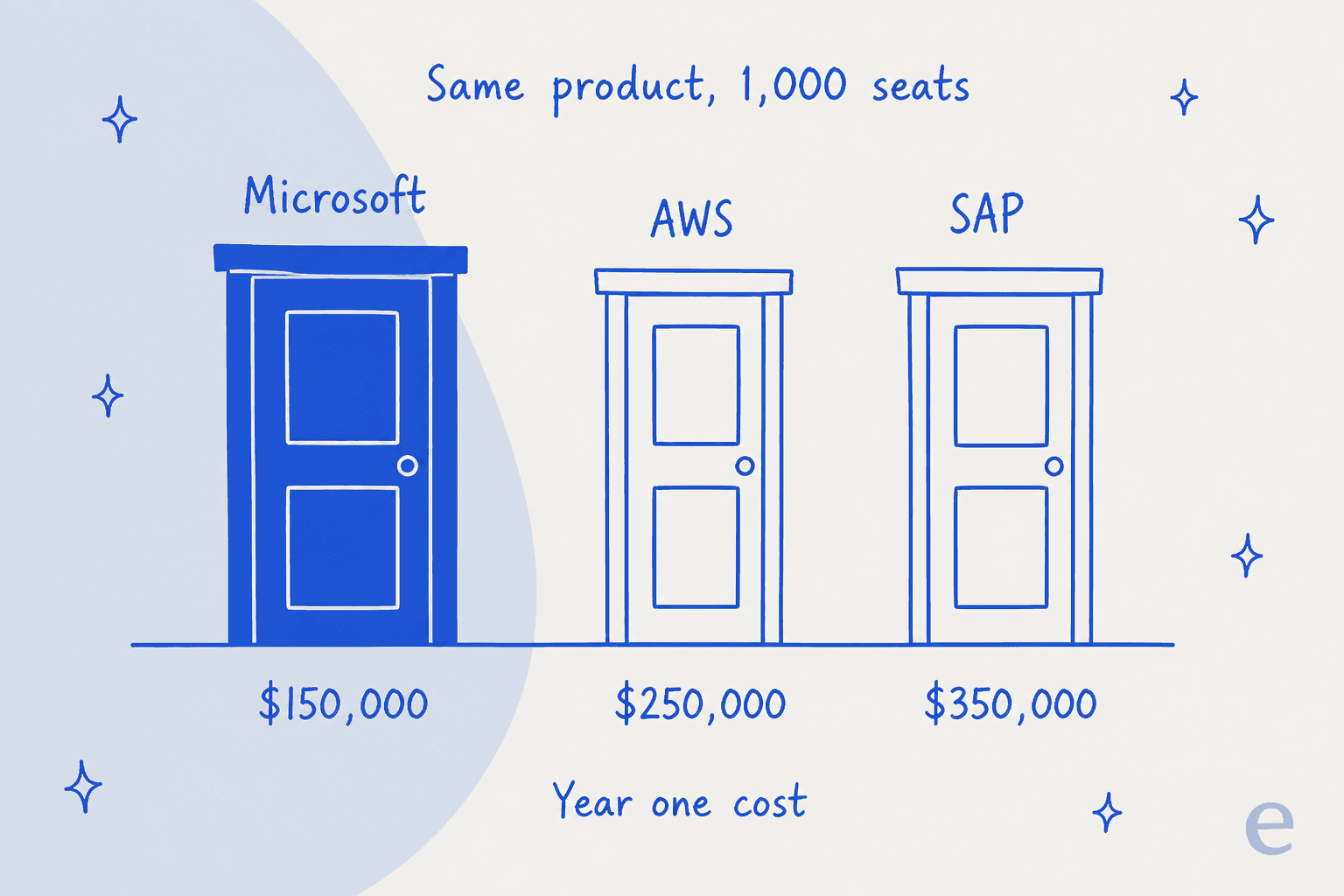
- Microsoft, $150,000. $300.00 per user across two years times 1,000 seats is $300,000, annualised to $150,000. No setup fee is published on this listing.
- AWS, $250,000. One module at $300,000 plus $200,000 implementation is $500,000 per 24 months, annualised to $250,000. Add a second module and it jumps again.
- SAP, $350,000. $300,000 for the year plus the $50,000 setup fee in year one.
Those are annualisations of published figures, not quotes I was given, and the AWS line assumes a single module since AWS states no seat count at all. But the spread is real and it is the practical takeaway: the procurement path you pick is worth more than the discount you negotiate. G2 reviewers report a 10% average discount on Leena AI. Choosing Microsoft over SAP is worth 57%.
Plug your own numbers in. Note that the three doors do not even meter the same thing, which is why the outputs diverge so hard.
The term is the discount lever, not the volume
Most enterprise software gives you 15 to 20% for paying annually. Leena AI's published ladder is far steeper than that, and it moves on term length rather than seat count.
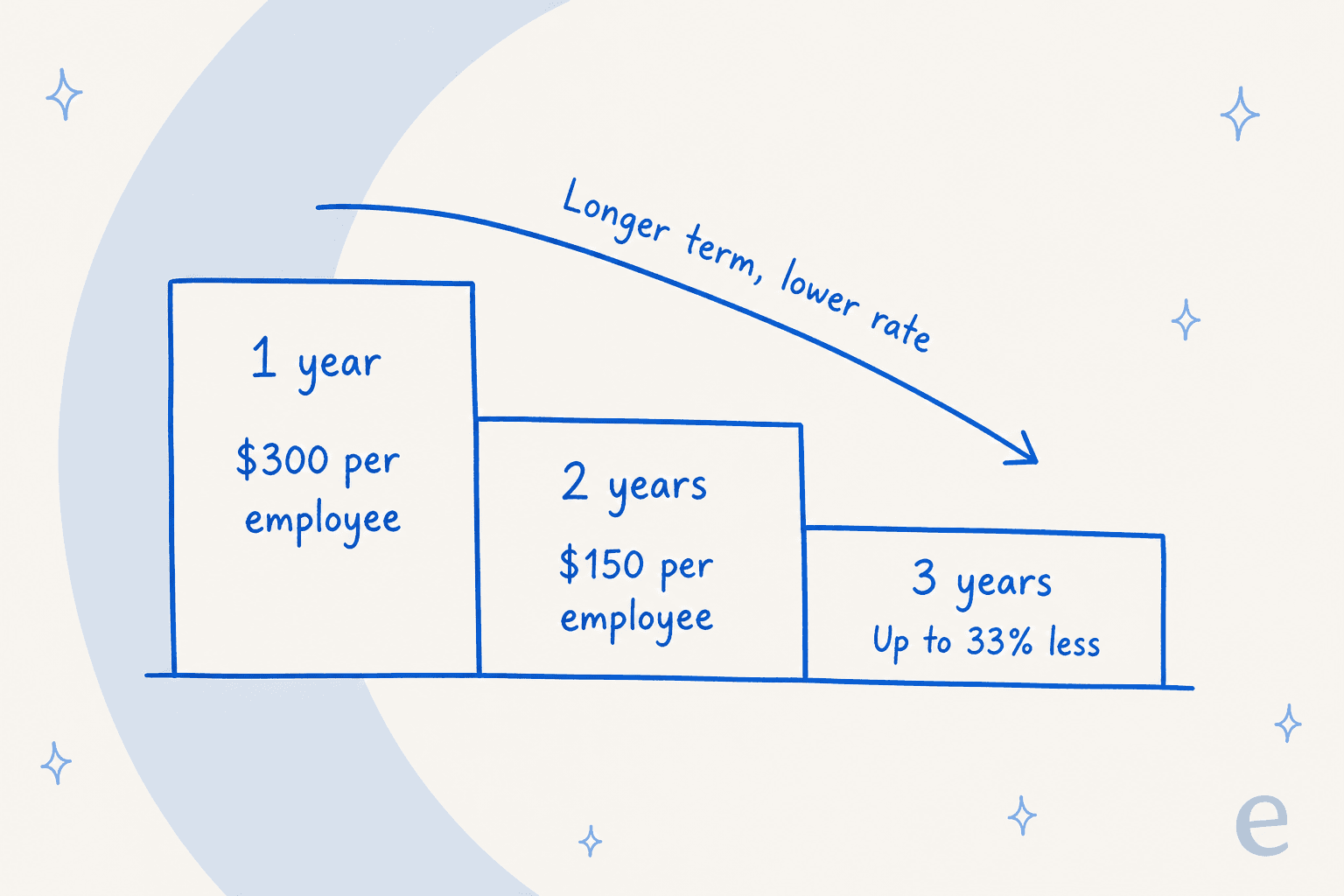
| Term | Per employee per year | Source |
|---|---|---|
| 1 year | $300 | SAP, $300,000 across 1,000 included users |
| 2 years | $150 | Microsoft, stated directly |
| 3 years | Up to 33% less again | AWS, saving stated but no figures |
Doubling the commitment halves the rate. That is an unusually aggressive term discount, and worth reading as information rather than a bargain: a vendor prices multi-year lock-in that hard when retention past year one is the thing it most wants to secure. Notice too that seat count never appears as a discount axis. Microsoft quotes the same $150.00 whether you buy 1,000 seats or 1,000,000. There is no published volume break at all, which is unusual for a per-seat enterprise product and means a 50,000-employee org has no listed advantage over a 1,000-person one.
Set against the cost of AI customer service generally, this is the enterprise end of the market behaving exactly as you would expect. The steep term ladder is the tell that this is a committed-spend product, not something you scale into gradually.
What Leena AI does not publish
I want to be precise here, because "no pricing page" gets used to imply things that are not true. The rate card exists. These specific things do not, and each one is a question to take into the call:
- No overage rate. Nothing states what your 1,001st employee costs, or what happens when you pass a contract entitlement.
- No per-ticket or per-resolution rate. The meter is headcount only, on every listing.
- No monthly option. Shortest published term is one year on SAP and 24 months on AWS.
- No named tier ladder. There is no Starter / Growth / Enterprise structure anywhere.
- No small-team entry point. The floor of every published configuration is 1,000 seats.
- No 36-month figures. Only the "up to 33%" saving is stated.
- No definition of the 70% self-service ratio. Both the AWS and SAP listings state Leena AI guarantees a 70% self-service ratio in the contract, which is an unusual commitment and a real point in its favour. No measurement method or remedy is published, so ask what happens at 62%.
Also ignore two numbers that circulate. Capterra lists a $1 per feature per month starting price, but that listing is unclaimed and still describes the superseded Leena Engage survey tool, so it is a placeholder floor rather than a price. And the aggregator ranges floating around ($10 to $100 per user) do not survive contact with the $150.00 the vendor published itself.
For what it is worth, the gaps above are the norm rather than the exception at this end of the market. I hit the same missing overage rates and undefined units pricing Workativ, Enjo and Ravenna, so treat a published rate card as the start of the diligence rather than the end of it.
What buyers report on cost and timeline
The rate card is only half of what you pay. G2's reviewer-reported data fills in the rest, and it is more useful than the star rating.
| Signal | Reported figure |
|---|---|
| Time to return on investment | 17 months |
| Time to implement | 3 months |
| Average discount | 10% |
| Perceived cost tier | $$$$$ |
Two of those deserve a second look. A 17-month payback sits past the end of a one-year contract, which means on SAP's minimum term you would be renewing before you broke even. And the three-month implementation runs against the 45-day go-live Leena AI advertises on its homepage. Neither is damning for an enterprise platform of this scope, but both belong in the business case rather than the vendor's slide.
Users are direct about the transparency itself:
"While the overall experience is smooth, I felt that the platform can be slightly overwhelming for first-time users, especially those without an HR or technical background. Setting up complex workflows or custom intents might require some initial training or support. Also, pricing transparency could be improved - it's not very clear from the website what features come in which plan."

And the best public account of an actual rollout, which is the one I would read twice before signing an implementation line, adds the cost nobody quotes:
"We have implemented Leena AI. Was easy to get our ServiceNow and Workday integrated, but we have a few custom applications where we have to get the APIs built internally. That was a pain, but had to do it. After our HR & IT universal assistant launch, we have started building more agents. We have a COE that is now continuously building other agents in the leena ai platform. We recently launched an onboarding agent and off-boarding agent."

Read that as a budget line. The standard connectors landed easily, which matches the 200+ integrations claim. The custom apps came back to their own engineers. And a permanent centre of excellence is now building agents continuously, which is real headcount that appears on no rate card. If your stack is mostly Workday, ServiceNow and SAP, that internal cost is small. If it is mostly bespoke internal apps, it is the largest number in your business case and it is yours to carry.
One more, on the customisation cycles:
"It felt like it could have give a better deeper customization in experience and lacked few features which were required for our use cases. For the customization were we wanted to tweak few things, the cycles were bit lengthy."
For context on the 4.6 out of 5 across 151 G2 reviews: 128 of those reviewers are in Asia against 5 in North America, and a large share carry the Incentivized or G2-invite tags. The score is real, the sample is narrow.
Worked examples at three sizes
Sticker prices are abstract. Here is what three real shapes of company actually face, all on the cheapest published door.
A 1,000-person company, the exact floor. $150,000 a year on Microsoft's two-year term, $300,000 committed. If your internal IT and HR queue runs 1,500 tickets a month, that is roughly $8.33 per ticket. Defensible against a loaded agent hour, and the 70% self-service guarantee is doing real work in that business case. Buy it.
A 4,000-person company with a quiet queue. $600,000 a year, for maybe 800 tickets a month. That is $62.50 per ticket, and no negotiation on the rate closes that gap because the problem is the unit. Look at anything metered on volume instead. This is the case where AI for ITSM tools with usage pricing win outright.
An 800-person company. There is no offer. Not "expensive", not "call us for a startup rate": every published configuration on every marketplace starts at 1,000 seats. This is the single most common reason people end up searching for Leena AI alternatives, and the same floor disqualifies Moveworks and Aisera, two of the rivals Leena AI names itself. If you are here, your real shortlist is the tier below, which I cover in best internal helpdesk software.
So is Leena AI worth the money?
For the right buyer, yes, and I would say so plainly. If you have 1,000-plus employees, already run SAP SuccessFactors, Workday or ServiceNow, want to deflect internal IT and HR tickets rather than customer ones, and can sign a multi-year six-figure contract, this is a strong package. The 200+ pre-built connectors mean it can act rather than only answer, which is the hard part of automated IT ticketing. Buying through an existing SAP, Azure or AWS relationship is an unusually clean procurement path. And a contractual 70% self-service ratio is something almost nobody else in the category will put in writing. Of everything on the best AI for IT support shortlist, that guarantee is the strongest single argument in its favour.
Three things would stop me. The floor rules out most companies. The meter charges for employees rather than work, so a low ticket-per-employee ratio makes even a fair rate a bad deal. And you cannot test it before you commit: there is no self-serve trial, no monthly term, and Microsoft's own plan text says to email partnership@leena.ai for a consultation before you can subscribe. Even the marketplace with a published rate routes you through a sales call.
That last one is what I would push hardest on. On our side, the highest-volume trial we ever ran was a Benelux facilities-tech team that put 329 real chats through the AI in 20 days, on live Zendesk tickets in Dutch and English, before deciding anything. A second customer ran 282. Those teams knew what they were buying because they had already watched it work on their own traffic. A rate card cannot tell you that, and neither can a demo.
eesel, for teams that want the bill and the proof up front
I work on eesel, so take the comparison with that in mind, and I will name where Leena AI is straightforwardly ahead: eesel has no HRIS or identity action connectors, so no Okta, Entra, Workday or BambooHR, and Jira Service Management is the only ITSM integration. Against a 200-connector platform built for Finance and HR transactions, that is a real structural difference, not a quibble. If you need an agent to provision accounts in Workday, Leena AI does that and eesel does not.
Where eesel is different is the shape of the deal, which is exactly what this post has been about. There is no seat count, no employee minimum and no platform fee: it is one fixed monthly plan from $299 for 500 credits (1 credit per ticket or chat), dashboard questions mostly free, with two months free if you pay a year upfront. A quiet month does not cost you more. And before it answers anything live, eesel's simulation replays hundreds of your past tickets and scores its answers against what your team actually sent, so you see the gaps on your own history rather than in production. Free to start, 100 credits, no card.
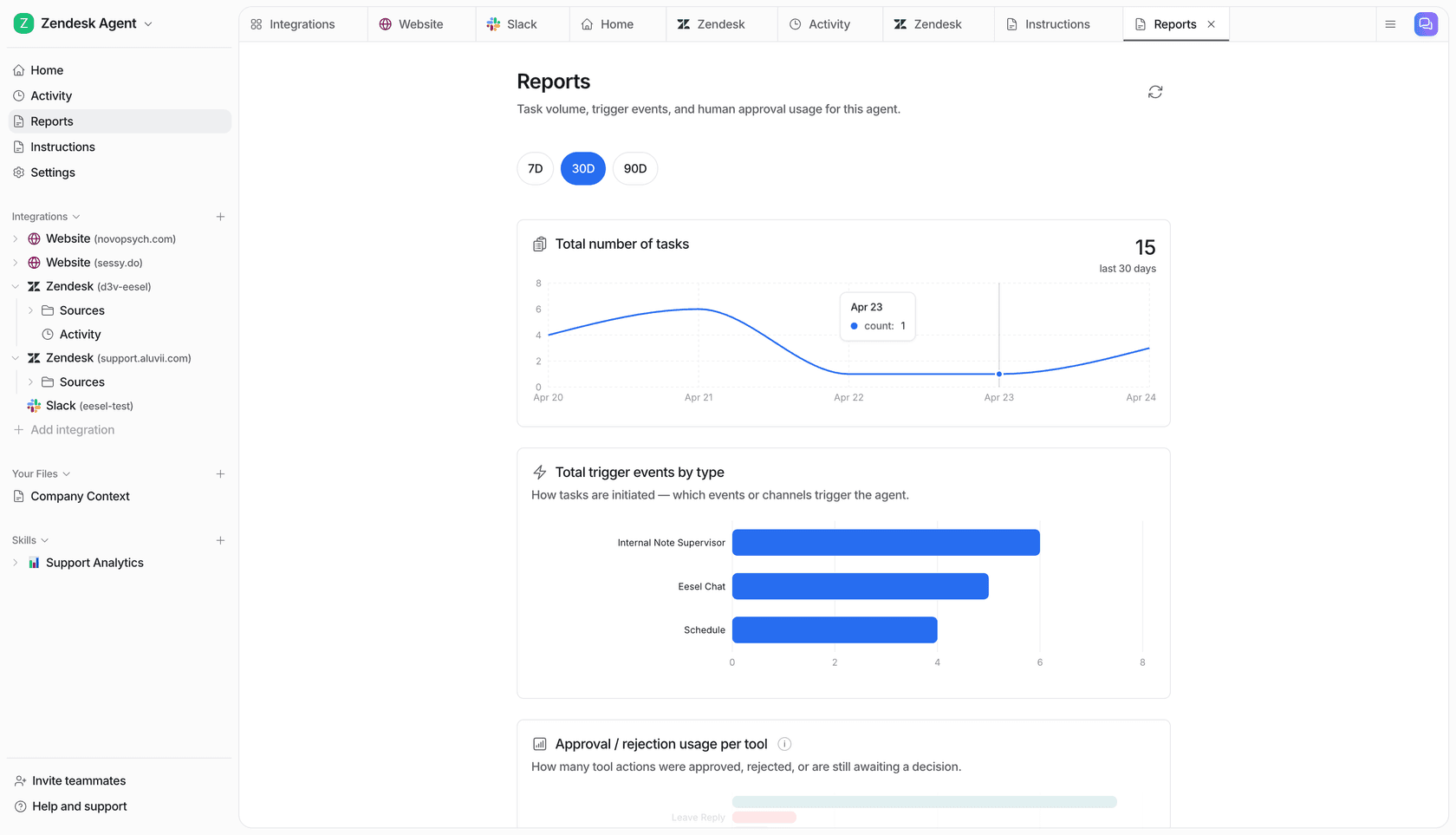
That Reports view is the point, really. It is the same number your bill is made of, which means you can see what you are spending as it happens rather than reconciling it against a two-year entitlement. If your queue is internal and mostly knowledge questions, that is a much cheaper way to find out whether AI helps you at all, and it works the same way whether you sit on Freshservice or Jira Service Management.
If you are still mapping the category rather than picking, start with AI for service desk and my breakdown of what an AI employee can actually take off a queue. Otherwise: Try eesel on your own tickets and see what it does before anybody signs anything.
Frequently Asked Questions
How much does Leena AI cost?
Does Leena AI have a pricing page?
leena.ai/pricing returns a 404, and the two URLs that contain the word "pricing" are lead-capture forms with no numbers on them. The real Leena AI pricing lives on the Microsoft, SAP and AWS marketplace listings the company sells through. This is a common pattern in AI for ITSM and one worth checking before you accept a "contact sales" wall.Is there a free trial or a free plan for Leena AI?
What is the minimum team size for Leena AI?
Does Leena AI charge per ticket or per resolution?


Article by
Rama Adi
Rama is a software engineer at eesel AI with two years of experience writing about B2B SaaS, AI tools, and customer support technology. Based in Bali, Indonesia, he brings a developer's perspective to product comparisons — cutting through marketing copy to what the integrations and APIs actually do.