Serval vs Risotto (2026): which AI IT support tool fits?

Rama Adi Nugraha

Katelin Teen
Last edited September 22, 2026

Why I am comparing these two
I build integrations and agents for a living, and I have spent the last few years watching AI agents work live support queues, both ours and our customers'. That experience left me with one strong bias: the scary failure mode is not an agent that says "I don't know", it is a confident agent that quietly does the wrong thing. It is exactly why every rollout I ship gets simulated against real historical tickets before it touches a live conversation.
I mention this because it is the lens I brought to both tools. Serval and Risotto are two of the sharpest new names in AI IT support, they solve a real and expensive problem, and I wanted to know where each one actually earns its keep under the marketing copy. I read both companies' docs, pricing, feature pages, funding history, and every verifiable review I could find. Here is the honest read.
If you are shopping more broadly, it is also worth seeing how these stack up against the wider field of AI IT support tools and internal helpdesk software before you commit.
Serval vs Risotto at a glance
Here is the whole comparison in one table before we dig into each tool. If you are also weighing the incumbents they aim at, we have deeper looks at ServiceNow's AI and Jira Service Management's AI.
| Dimension | Serval | Risotto |
|---|---|---|
| Best for | Enterprises replacing ServiceNow / JSM with one AI-native platform | Mid-market teams that live in Slack and want fast tier-1 deflection |
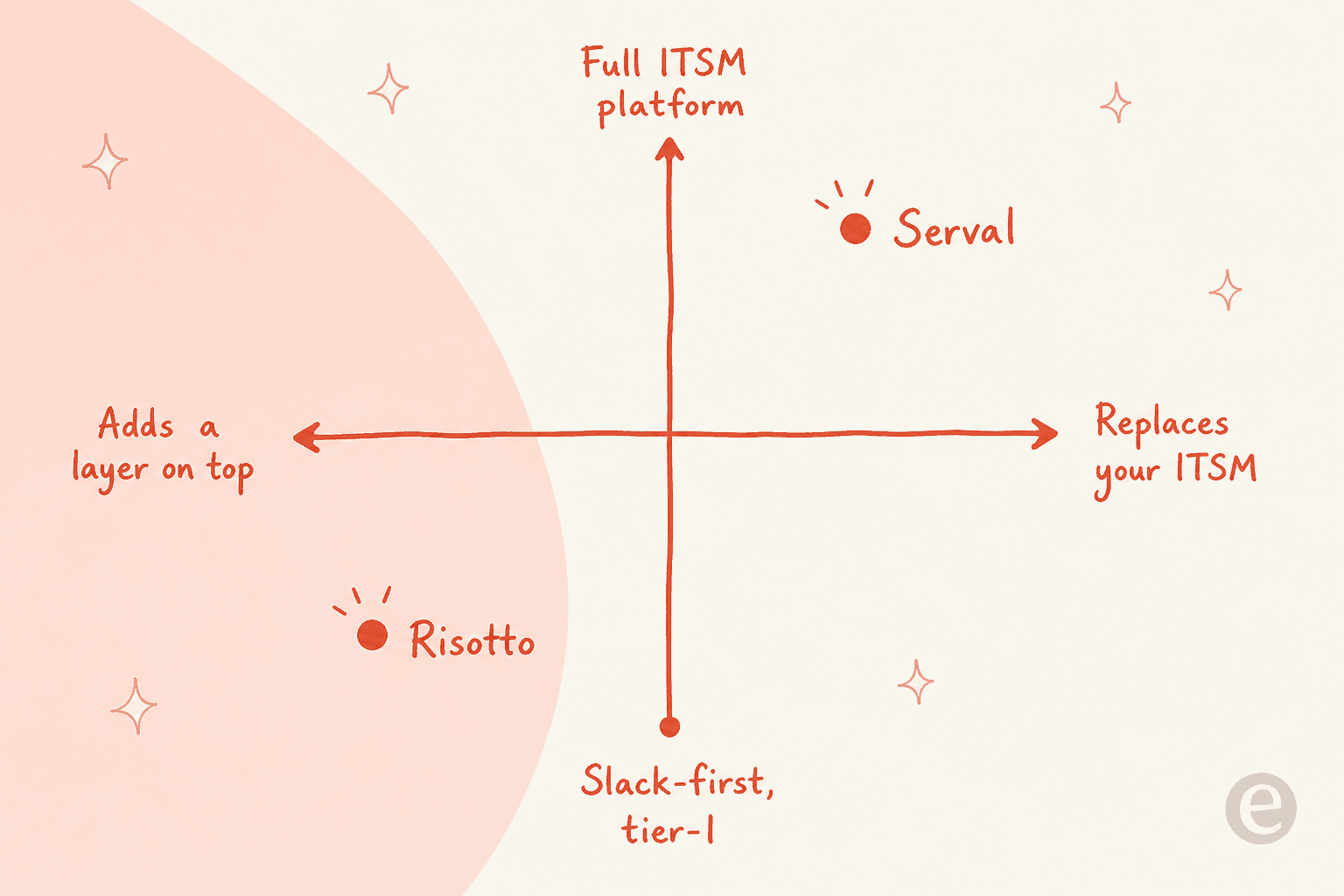
| Category | Full AI-native ITSM / ESM platform | Slack-first internal IT help desk |
| Founded / stage | 2024, San Francisco; $127M raised, ~$1B valuation | 2024, YC W24; small, early-stage |
| Where it lives | Slack, Teams, email, web portal, phone | Slack and Microsoft Teams |
| System of record | Yes, its own ticketing + CMDB | No, layers on your existing ticketing |
| Automation claim | "50% of tickets automated. Guaranteed." | 20 to 60% tier-1 auto-solve; 55% at Gusto |
| Workflow building | Code, written by an AI admin agent (Catalyst) | Rules engine + emoji-driven knowledge capture |
| Asset management (CMDB) | Yes (HAM, SAM, CMDB) | No |
| Proactive agents | Yes | No |
| CLI / API | Full API + Serval CLI + webhooks | API + MCP server |
| Pre-launch simulation | Not offered | Not offered |
| Pricing | Quote-only, single platform fee | $1,250/mo flat (<250 emp) or $90/user/yr on AWS |
| Free trial | No (guided pilot instead) | 30-day free trial |
| Compliance | SOC 2 Type II | SOC 2 Type II; HIPAA on Enterprise |
| Deployment | Cloud (99.9% SLA) or self-hosted | Cloud |
What Serval is
Serval calls itself AI for enterprise service management, and it means it literally: this is built to be your service desk, not an add-on to one. CEO Jake Stauch, an ex-Verkada founder, frames it to Computerworld as AI-native "from day one, rather than layering agents onto two decades of custom tables, business rules, and workflow logic." Investors are convinced: Serval raised a $47M Series A led by Redpoint, then a $75M Series B led by Sequoia at a roughly $1B valuation. Sequoia's partner put it bluntly: "The last time we heard customer feedback this strong was 16 years ago when we partnered with ServiceNow."
The two-agent architecture
The part I find clever is the two-agent design, which Serval treats as its core safety story. There is a Catalyst admin agent that builds automations, and a separate help desk agent that end users talk to. The help desk agent can only call workflows an admin has already published, so it cannot invent new actions on the fly.
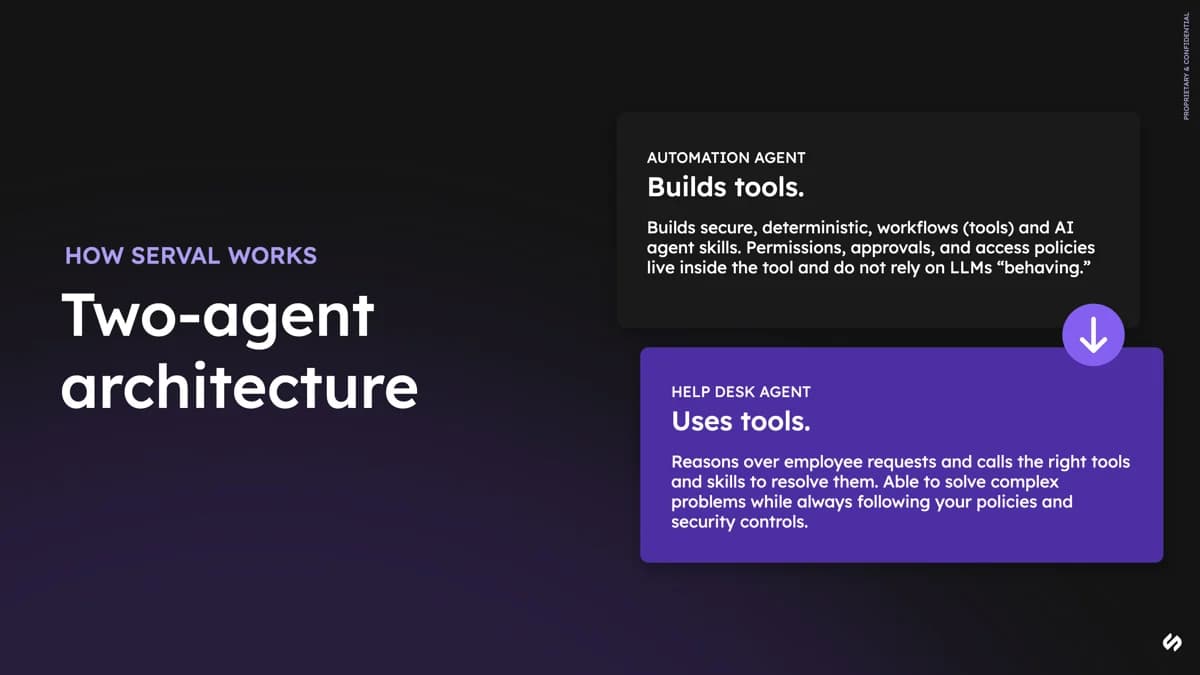
Stauch's example to TechCrunch captures why this matters: "You don't want someone to go into Slack and say, 'Hey, I want to delete all the data at the company,' and the very helpful AI agent responds, 'Great, I'll delete all the data.'" Permissions and approvals live inside each workflow, not in the LLM's judgement. It is a smart answer to the trust problem, even if, as we will see in the reviews, it is not a perfect one.
Catalyst writes code, not drag-and-drop
Serval's bet is that the best way to build automations is to let AI write actual code. Describe a workflow in natural language and Catalyst builds it, ranging from a password reset to a multi-step HR onboarding journey. Because the output is deterministic code, Serval promises "no hallucinations or surprises" once a workflow is published, with version control and approval gates around it.
For teams that like to keep automations in source control, there is a real Serval CLI: pull workflows to your local machine, edit them in your own tools, and push them back with version history. That is a level of programmability most ITSM tools do not offer, and it is a genuine draw for platform-minded IT teams.
The rest of the platform
Because Serval wants to be your system of record, it ships the full ITSM surface: AI-native ticketing with request, incident, problem, and change types; asset management with a real CMDB (hardware, software, and configuration items); just-in-time access management with least-privilege policies; and proactive agents that hunt for problems before anyone files a ticket. Together AI credits it with automating 95% of just-in-time access, and Perplexity says its admins save one to two hours a day each.
Serval is also not just IT. Stauch notes that IT is now a minority of the teams using Serval, with HR help desk, Legal, Finance, and Security on board too. The customer wall is heavy: Ramp, Perplexity, Mercor, Cribl, Together AI, plus Spotify, Fox, and Live Nation.
What Risotto is
Risotto is the tidier idea: turn any Slack channel into an automated IT help desk in about 60 seconds. It came out of YC's Winter 2024 batch, built by three ex-HelloSign colleagues, one of whom, Alex Confer, ran IT at Gusto and Dropbox and got tired of manually provisioning the same SaaS accounts over and over. The whole product reflects that origin: it is opinionated about Slack (though it runs in Microsoft Teams too), and it is opinionated about access management.
It layers on, it does not replace
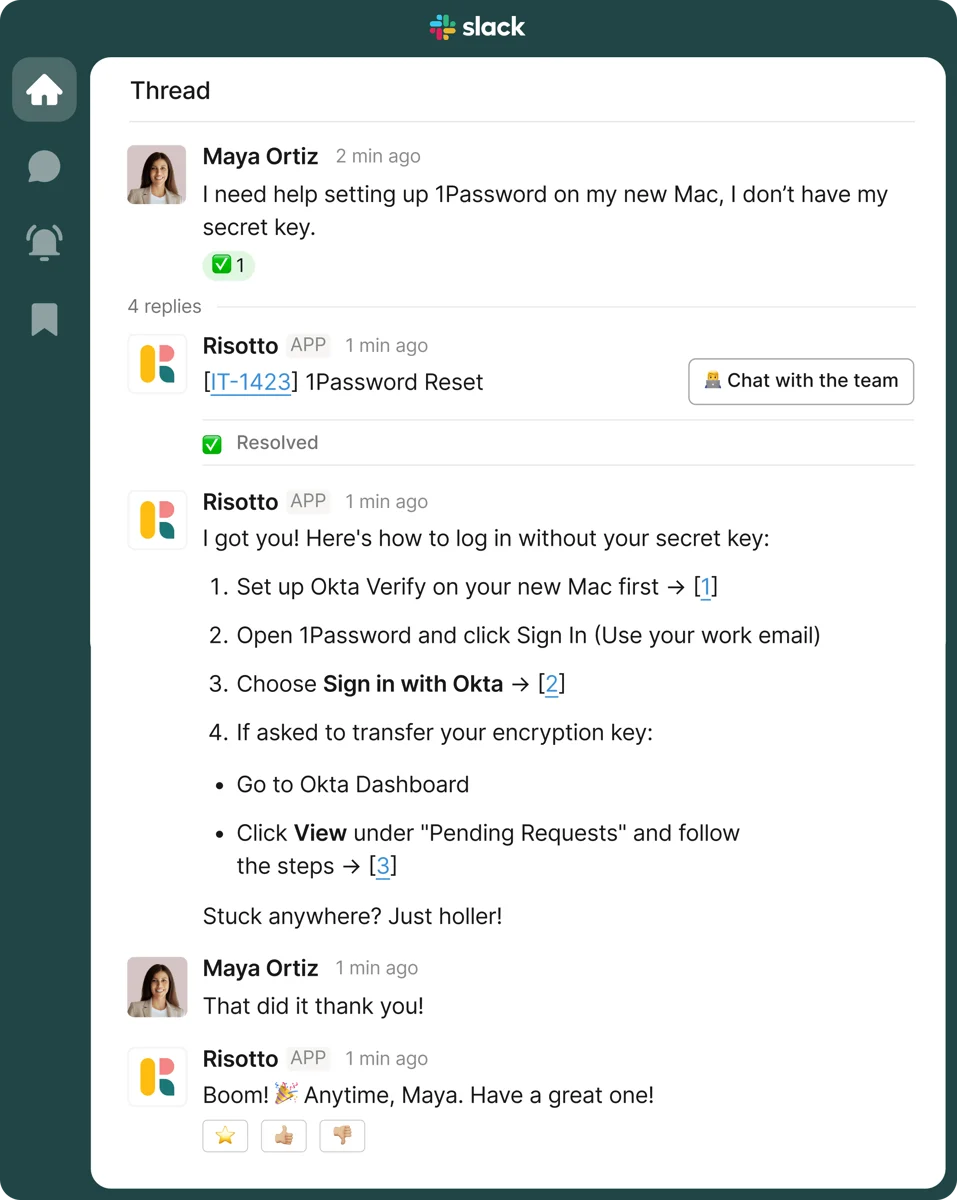
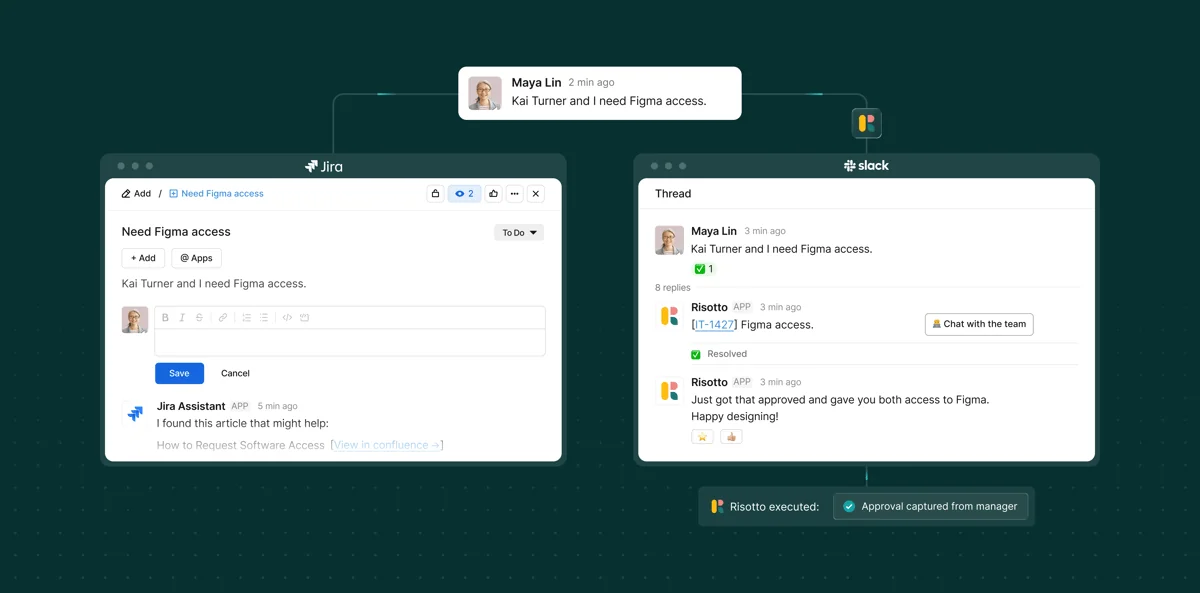
The important design choice is that Risotto is not trying to be your system of record. Its own comparison pages are explicit: "Keep Zendesk for ticketing", or keep the Freshservice AI you already pay for, and let Risotto take the work they cannot. It creates a ticket per conversation and keeps a two-way sync with Jira, Freshservice, or Zendesk running in the background, so your existing SLAs and workflows keep working.
Access management and the emoji trick
Like Serval, Risotto leans hard into software access. It integrates with Okta to grant time-based, policy-gated access straight from a Slack approval, and it helps run the quarterly access reviews that SOC 2 demands.
My favourite detail is the knowledge loop. When a human resolves a question in chat, they drop a writing-hand emoji, and Risotto captures the thread, writes a doc, and adds it to your knowledge base so the same question gets answered automatically next time. It is a low-friction way to grow the knowledge base that fits how people already work in Slack. It also searches across Notion, Confluence, and internal wikis for answers rather than relying on templated replies.
The proof points are solid for a company this young. Gusto auto-resolves 55% of tickets, doubled its resolution rate on day one, and reports 114,000 hours of wait time saved with a 5-hour AI resolution time versus 35 hours for humans.
Pricing: transparent-ish vs fully quote-only
This is where the two diverge most, and where the "which is right for me" answer often gets decided.
| Serval | Risotto | |
|---|---|---|
| Model | Single negotiated platform fee | Flat plan + quote-only Enterprise |
| Published price | None | $1,250/mo (Startup, <250 employees) |
| Alt. published rate | None | $90/user/year on AWS Marketplace |
| Free trial | No | 30 days |
| Commercial motion | 4-week guided pilot, dedicated engineer | Self-serve trial into demo |
| Guarantee | 50% automation, contractual | None (uses ROI case studies) |
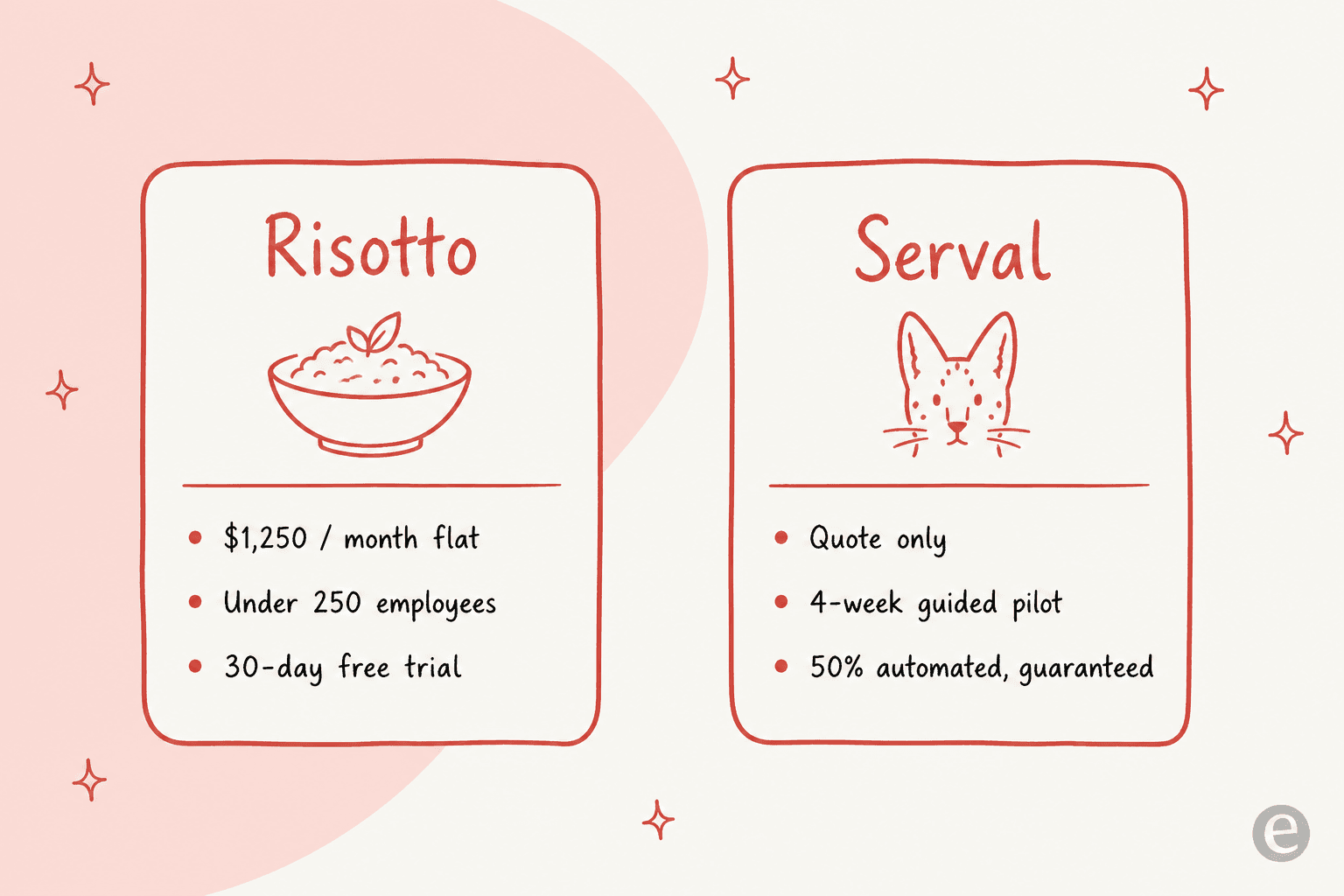
Risotto is the more transparent of the two. Its Startup plan is a flat $1,250/month, billed annually, for companies under 250 employees, with a real 30-day free trial. The AWS Marketplace listing exposes a $90-per-user-per-year figure, and Enterprise is a custom quote. For a 150-person company, that flat fee is easy to reason about.
Serval publishes no numbers at all. The pricing page sells a four-week guided pilot with a dedicated deployment engineer and a "50% of tickets automated, guaranteed" outcome. Analysts at Sacra read the underlying model as seat-based enterprise pricing. That guarantee is a strong signal of confidence, but the lack of a public number tells you exactly who this is for: larger companies with a procurement process, not a five-person IT team wanting a card-on-file signup.
Neither, notably, charges per resolution. If you want to see what a fully transparent per-ticket price looks like, that is a different model again.
Deployment: guided pilot vs live in a day
The pricing difference mirrors a deployment difference.
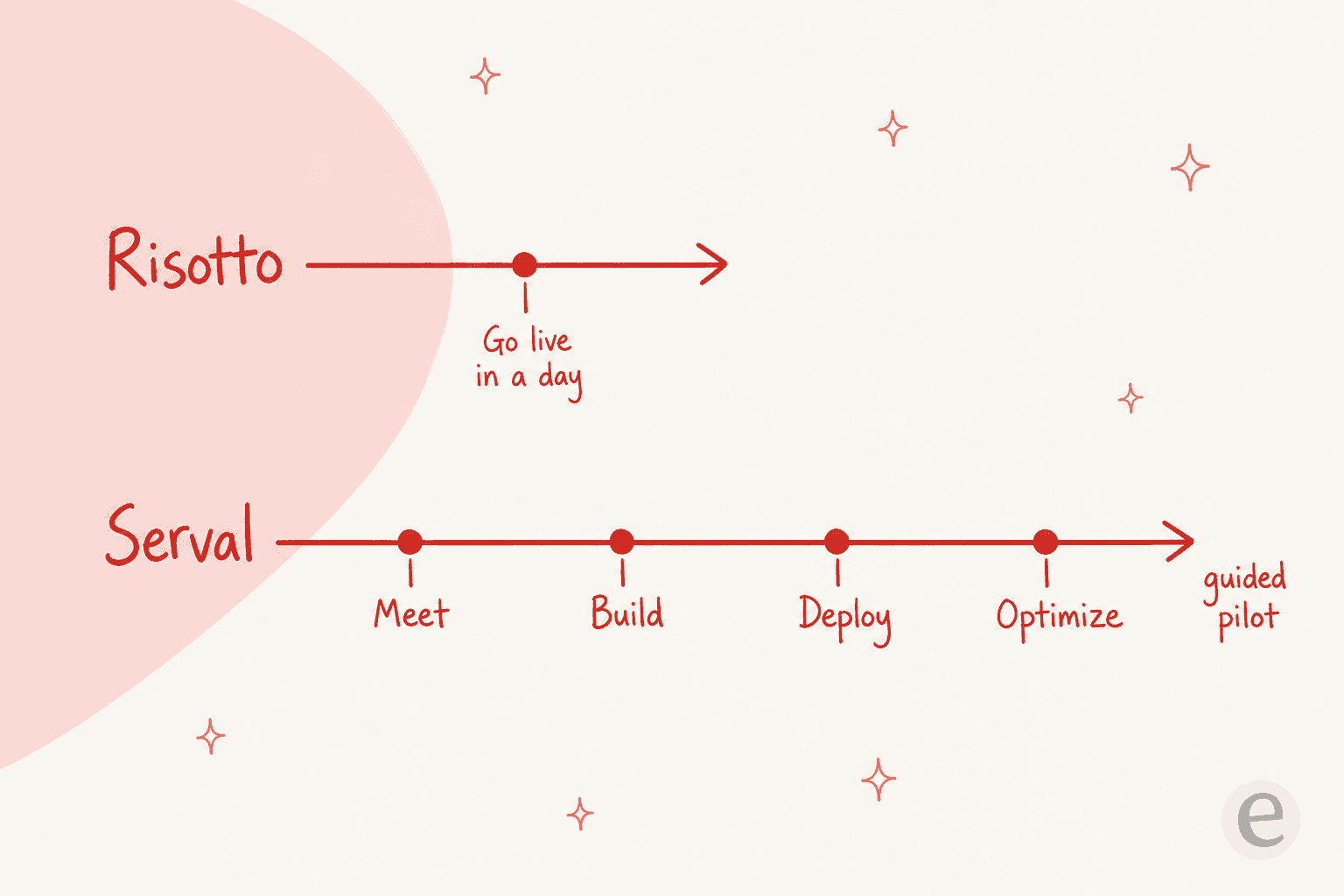
Risotto pitches speed: connect Slack, your identity provider, and your docs, and most customers are live within a day. That is believable given how narrow its initial job is.
Serval runs a structured four-phase pilot, Meet, Build, Deploy, Optimize, with a Serval engineer on the ground the whole time. That is the right call for a platform replacing your system of record, where the "build" phase means recreating real workflows and connecting real systems. One enterprise reviewer still reported initial setup "in about 48 hours", but the honest read is that Serval is a heavier lift because it is doing a heavier job.
Here is the thing both approaches skip, and it is the one I care about most: neither lets you test the agent against your own historical tickets before it goes live. Serval's pilot is a supervised real-world trial and Risotto's is a fast switch-on, but in both cases the first time the AI meets your actual ticket patterns, it is answering a real person. After years of watching agents behave differently in production than in a demo, that is the step I would want back.
What real users say
Community feedback on both is thin, because both are new, which is common across the young field of AI internal support tools. I will be upfront about the quality of what exists.
Serval sits at 4.9/5 on G2, but every one of those ten reviews is tagged incentivized and seller-invited, all posted in a single month. A uniform score built entirely from solicited reviews is not something I would lean on. The useful part is inside the "what do you dislike" fields, where the criticism is specific and, to Serval's credit, still published:
"Often, the agent will say something is set up or configured, but it will silently fail. [...] I'd like the agent to flag issues and suggestions before a human does."

That is the exact silent-failure risk I opened with, from a real operator. Others flagged a learning curve ("a lot under the hood... it can feel a little overwhelming") and gaps in pulling logs into SIEM tools. None of this is disqualifying for a young platform, but it is worth knowing the two-agent safety design does not eliminate the "confidently wrong" problem entirely.
Risotto's G2 rating is 4.8/5 from four reviews, which read as more organic and carry concrete numbers. One admin's line stuck with me:
"We have an IT team that is comprised of 2 people for an org of 600! Risotto has saved us nearly 16000 hours in manpower over the last 3 months, handling 25% of our ticket volume without escalation."
The sharpest Risotto criticism was that its access logic can be "too eager", jumping to provision access when the user only needed guidance. Both critiques point the same direction: an AI agent that acts on your systems needs a way to check its work, not just act.
Which one should you pick?
Neither tool is wrong, they are aimed at different teams. If you have not yet ruled out the incumbents, it is also worth skimming the Jira Service Management alternatives first. Then use this to narrow it down.
Where eesel fits
Here is the honest boundary: Serval and Risotto are both internal IT tools. They shine when the person asking for help is your own employee. If any part of your support is customer-facing, or you run a mixed queue where the same team answers staff and customers, that is a different job, and it is the one eesel is built for.
eesel is an AI helpdesk teammate that joins your existing queue rather than replacing it. It plugs into the tools you already run, Zendesk, Freshdesk, Slack, Confluence, Google Docs, and your past tickets, and drafts or sends replies with your company context already loaded. Like Risotto it layers on instead of demanding a migration; like Serval it can take real actions through your systems.

The difference I keep coming back to is the simulation step. Before eesel answers a single live conversation, you can run it over thousands of your real historical tickets and see exactly how it would have replied, what it would have resolved, and where it would have escalated. That is the dry run both Serval and Risotto skip, and it is the direct answer to the silent-failure complaint one Serval reviewer raised.
And because this comparison is squarely in developer-tool territory, it is worth saying eesel is programmable the same way Serval is. There is a real eesel CLI plus an API, MCP support, and webhooks, so the same teammate you configure in the dashboard can be driven from your terminal, wired into scripts, or operated by a coding agent like Claude Code or Cursor. If you liked Serval's push-and-pull workflow model, you will feel at home. You can try eesel free, no sales call required.
Frequently Asked Questions
What is the difference between Serval and Risotto?
How much do Serval and Risotto cost?
Is Serval or Risotto better for a small IT team?
Do Serval and Risotto replace ServiceNow or Jira?
What is the best alternative to Serval and Risotto?


Article by
Rama Adi Nugraha
Rama is a software engineer at eesel AI with two years of experience writing about B2B SaaS, AI tools, and customer support technology. Based in Bali, Indonesia, he brings a developer's perspective to product comparisons — cutting through marketing copy to what the integrations and APIs actually do.