Jira Service Management is a capable ITSM platform. It's also, for a meaningful slice of teams, more than they need -- or more than they can afford to configure and maintain. The free plan covers small teams well; the paid tiers get expensive fast; and AI features don't arrive until Premium at $51.42 per agent per month.
The teams that look for alternatives tend to have one of four problems. They're not on the Atlassian stack, so the tight Jira-Confluence integration that makes JSM valuable doesn't apply. They've hit the complexity wall -- setup, permissions, and workflow configuration require specialist knowledge most IT teams don't have in-house. They need AI deflection but don't want to pay the Premium jump just to unlock it. Or they want something employees will actually use, which usually means meeting people in Slack rather than asking them to navigate a portal.
Five alternatives below, matched to those specific situations.
Why teams leave Jira Service Management
Before the alternatives: a fair read on where JSM falls short.
The AI tier wall. JSM's AI virtual agent -- the thing that answers employee requests without a human -- is Premium-only. The jump from Standard ($20/agent/month) to Premium ($51.42/agent/month) for a 10-agent team is $315/month more. That's a significant commitment before you've proven the deflection rate is worth it.
Atlassian-dependent value. JSM's strongest argument is ecosystem integration -- the link between an IT incident and the Jira Software ticket, the Confluence knowledge base powering the help center, the developer who filed the alert and the agent who resolved it all on one platform. For teams not already on Jira and Confluence, that argument evaporates. What's left is a capable but complex ITSM tool with a steeper setup curve than alternatives at the same price.
Setup and admin overhead. The Gartner Peer Insights score is 4.5/5 from 1,458 reviews -- genuinely positive. But the consistent criticism across those reviews is the learning curve. Non-technical admins struggle. Advanced workflows often need ScriptRunner plugins. Default reporting is thin. One sysadmin on Reddit was unambiguous: "In my experience you have to spend a lot of time as a team to customize JSM, the portal, the forms, the flows, etc to get everything to work..."
Slack integration that stops at notifications. JSM sends ticket updates to Slack. It does not resolve requests from Slack. Employees who live in Slack still have to open a browser, find the portal, and submit a ticket -- which is where the gap between "tool exists" and "tool gets used" opens up.
Quick comparison
| Tool | Best alternative for | Starting price | AI deflection |
|---|---|---|---|
| Freshservice | Full ITSM without Atlassian dependency | $19/agent/mo | Freddy AI on all paid plans |
| ServiceNow | Enterprise with complex multi-team workflows | Quote-based | Now Assist + Moveworks EmployeeWorks |
| Zendesk | Teams using both customer + internal support | $55/agent/mo (Suite Team) | AI Agents in all Suite plans |
| HappyFox | Mid-market IT teams on a budget | $24/agent/mo | Autopilot + Assist AI for Slack/Teams |
| eesel AI | AI-first deflection on top of existing tools | $0.40/task | 73% tier-1 resolution rate |
Freshservice
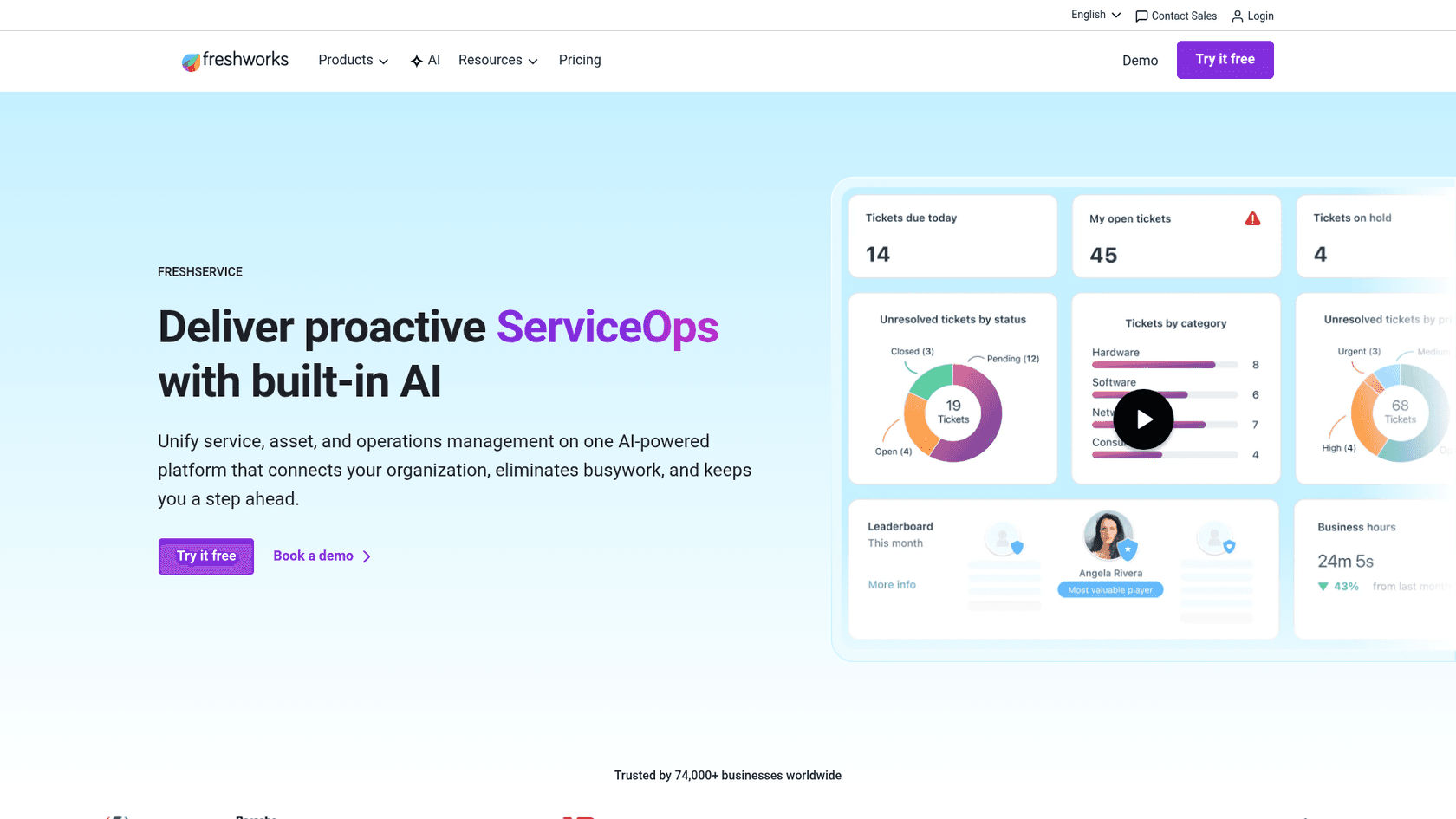
Freshservice is the most direct JSM alternative for IT teams. It covers the same ITSM stack -- incident, problem, change, release, service catalog, asset management -- but ships with AI baked in at lower price points and sets up faster for teams outside the Atlassian ecosystem.
74,000+ businesses use it. A Forrester Total Economic Impact study found 356% ROI in under 6 months. The University of Oxford uses it. So does Databricks, Porsche, and Marvel.
The concrete improvement Village Roadshow reported: "Freshservice has helped us cut IT costs by 60% annually while improving service quality and speed." -- Arul Arogyanathan, CIO, Village Roadshow.
Why it's a strong JSM alternative
The headline difference from JSM: Freddy AI ships on all paid plans, not just the top tier. Freddy AI Agent handles tier-0 requests -- password resets, access provisioning, troubleshooting guides -- on Slack, Teams, the employee portal, and Microsoft 365 Copilot, in 40+ languages, with a 66% deflection rate in Freshworks' benchmarks. Compare that to JSM's AI virtual agent being Premium-only.
IT asset management is included on Growth and Pro plans -- hardware tracking, software discovery, CMDB -- all linked to ticketing without a separate integration. Freshservice also extends cleanly to non-IT departments: the Enterprise Service Management module lets HR, Finance, Legal, and Facilities run their own service desks on the same platform.
If you're coming from JSM and using Confluence for your knowledge base, Freshservice connects to Confluence as an external source, so you don't need to migrate documentation.
Pricing vs JSM
| Plan | Price | Key inclusions |
|---|---|---|
| Starter | $19/agent/mo (annual) | Incident management, service catalog, basic automations |
| Growth | $49/agent/mo (annual) | + Problem management, ITAM, Freddy AI |
| Pro | $99/agent/mo (annual) | + Change management, ESM, advanced analytics |
| Enterprise | Custom | Freddy AI bundled, higher limits |
14-day free trial, no credit card required.
What to watch
The Growth-to-Pro gap is steep -- change management requires Pro at $99/agent/month. Teams evaluating Freshservice who need full ITIL coverage from day one should model the Pro cost before committing to Starter. A 10-agent team on Pro pays $990/month annually.
Freshservice also lacks the native developer-tooling integration that JSM has with Jira Software and Bitbucket Pipelines. If your IT team works closely with engineering and needs incident-to-code traceability in one place, that connection is harder to replicate outside Atlassian. The Freshservice AI vs Jira AI comparison goes deeper on these tradeoffs.
ServiceNow
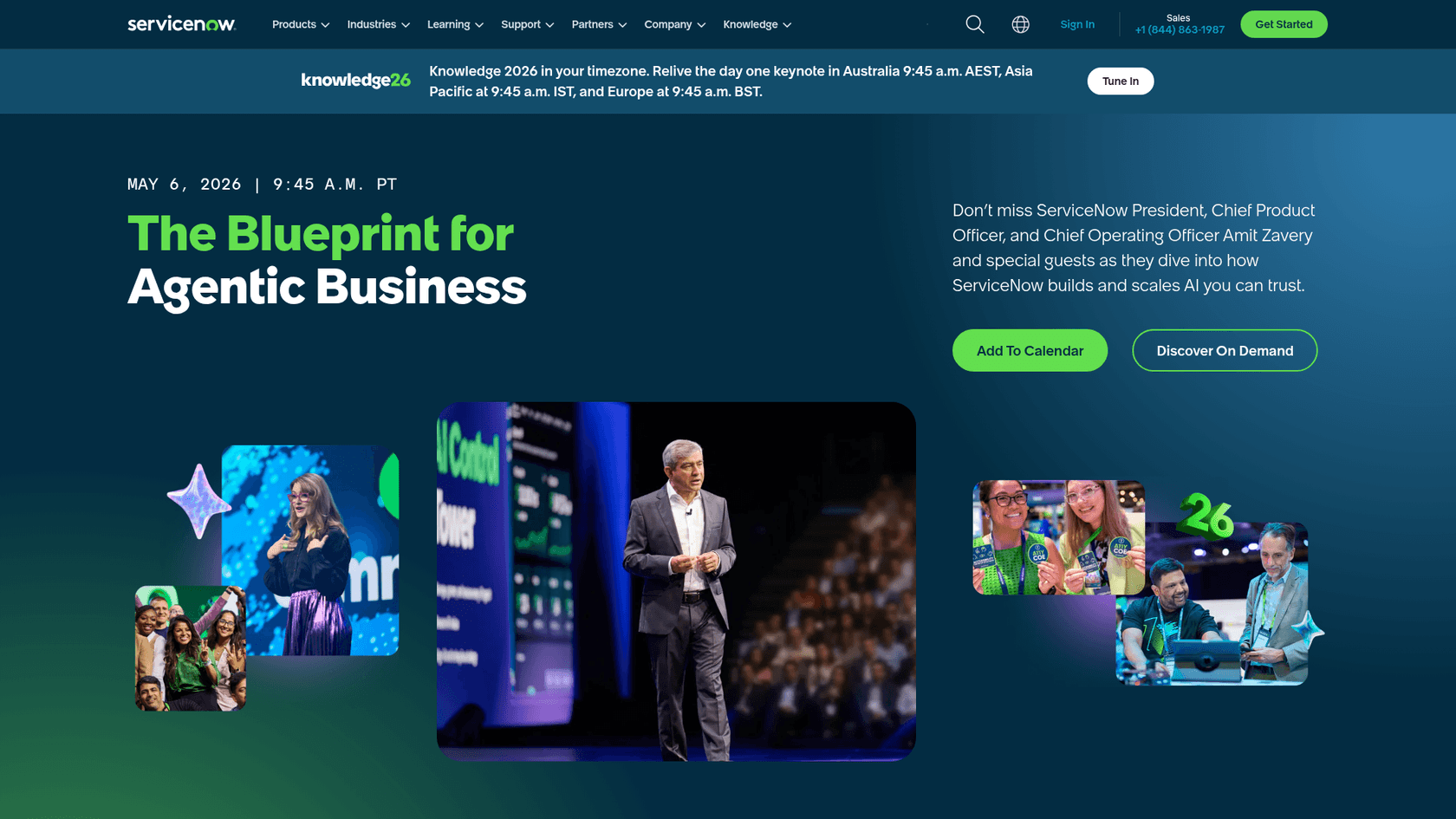
ServiceNow is the alternative for when JSM isn't the problem -- scale is. 85% of the Fortune 500 use it. The 98% renewal rate says they're not switching. By February 2026, ServiceNow's own IT team reported that its Autonomous Workforce handles 90%+ of employee IT requests end to end.
The February 2026 launch of EmployeeWorks -- which folds Moveworks into the platform after ServiceNow acquired the company in December 2025 -- makes the AI layer for employee support substantially more capable than before.
Why it's a strong JSM alternative
Where JSM has complexity limitations, ServiceNow has complexity as a feature. For large IT organizations managing hundreds of services, thousands of assets, and dozens of teams, the depth of ServiceNow's workflow engine, change management, and AI governance is the point. Astra Zeneca's team attributed "30,000+ hours reclaimed annually" to the platform. Pure Storage reported "7x faster case resolution".
The AI story in 2026 is built around the L1 Service Desk AI Specialist -- an autonomous agent that resolves common IT requests using enterprise knowledge bases and historical incident data. For ITSM teams who've outgrown what JSM's Premium virtual agent handles, this is the next tier.
"What I like most about ServiceNow IT Service Management is its structured, consistent approach to incident management. It gives us a centralized place to log, track, and resolve application issues... while maintaining clear ownership and SLAs. The built-in workflows, notifications, and escalation mechanisms help ensure issues are handled within defined timelines, so nothing gets overlooked."

ServiceNow is also named a Gartner Magic Quadrant leader across four reports including the 2025 AI Applications in IT Service Management report, which matters for procurement teams who need external validation for vendor selection.
Pricing vs JSM
ServiceNow publishes three named ITSM tiers -- Foundation, Advanced, and Prime -- all ending in "Get Custom Quote." No public dollar figures exist. Analyst estimates from enterprise contract data place ServiceNow ITSM in the $80-150+ per user per month range when licensing, modules, and professional services are included -- but ServiceNow itself publishes none of these numbers.
What to watch
ServiceNow is not an upgrade from JSM for a 20-person IT team. The G2 community (4.4/5, 1,270 reviews) consistently flags "Learning Curve (72)", "Expensive (60)", and "Complexity (56)" as the top negatives. One reviewer put it directly:
"Pricing is another concern, since the platform is relatively expensive and the ROI tends to be clearer for larger organizations than for smaller teams."
The implementation timeline, dedicated admin requirements, and enterprise-only pricing model make ServiceNow the right alternative for large organizations leaving JSM, not teams under 200 people who found JSM too complex.
Zendesk
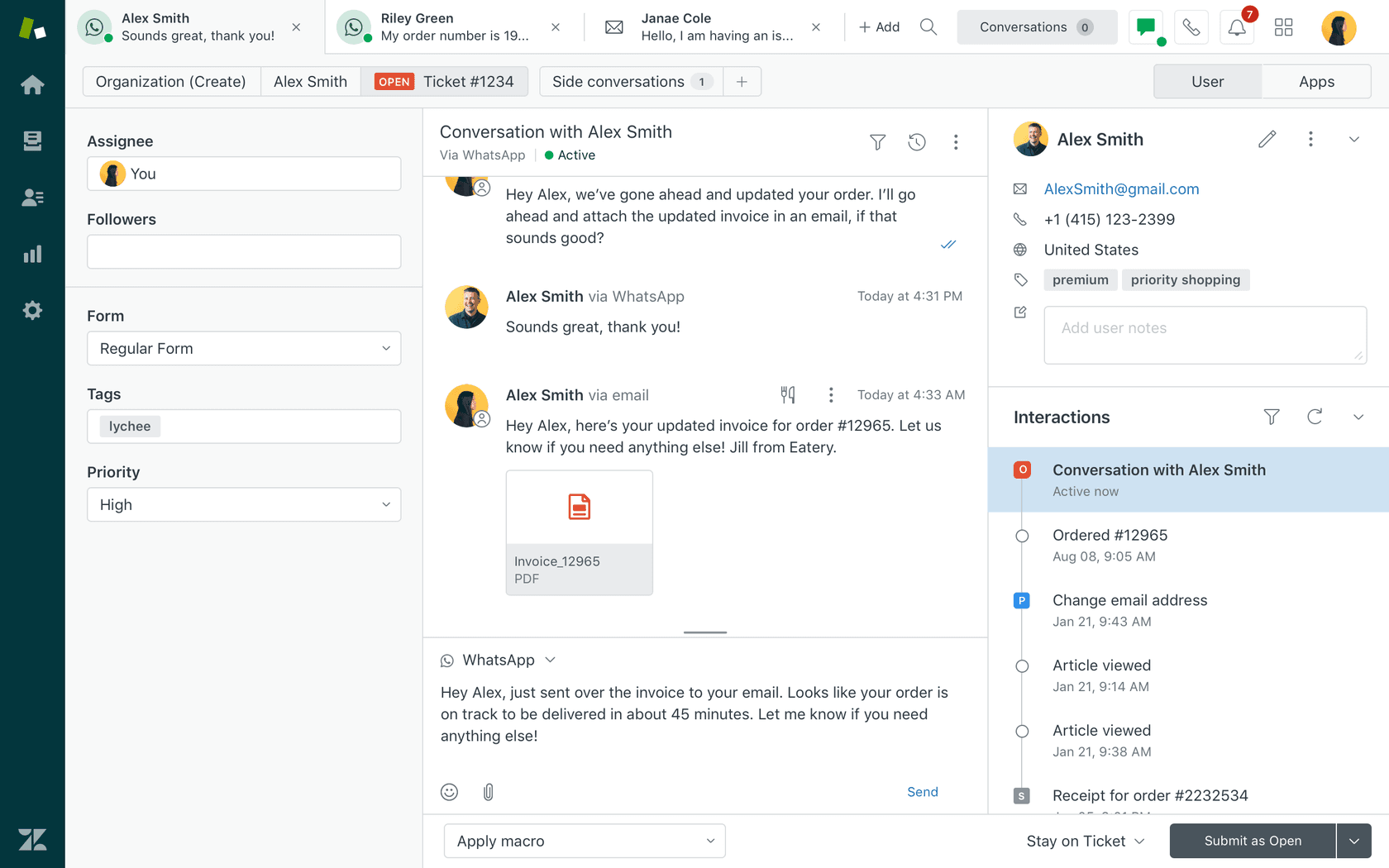
Zendesk is the alternative for teams managing both customer support and internal IT tickets who want one platform rather than two separate tools. 100,000+ companies use it across customer operations, and a growing number also run internal IT helpdesks on the same instance.
The Zendesk AI Agents layer and the March 2026 Forethought acquisition give it a serious AI story: 80%+ automation potential across channels, with AI agents included in all Suite tiers.
Why it's a strong JSM alternative
Zendesk's value as a JSM alternative is strongest for organizations that already use Zendesk for customer support and want to extend it to internal IT tickets. Instead of running JSM (internal) and Zendesk (external) in parallel, you get one knowledge base, one agent workspace, one set of automations, and one bill.
The Suite Team plan at $55/agent/month includes AI Agents for email and messaging, basic automation, and a knowledge base -- equivalent to JSM Premium features without needing to upgrade to the top tier. The Copilot add-on ($50/agent/month) adds proactive AI assistance for human agents handling the tickets that reach them.
Zendesk's marketplace has 1,800+ apps, including ITSM-adjacent integrations for asset management, HR systems, and monitoring tools. It won't match the native CMDB or full ITIL change management of Freshservice or JSM, but for teams that don't need formal ITIL process compliance, the coverage is usually sufficient.
G2 gives Zendesk 4.3/5 from 6,816 reviews, with the AI agent performance score at 96 overall (30 above category average) and 96% response accuracy.
Pricing vs JSM
| Plan | Price | AI agents |
|---|---|---|
| Support Team | $19/agent/mo | Add-on only |
| Suite Team | $55/agent/mo | Essential (included) |
| Suite Professional | $115/agent/mo | Essential + more ARs |
| Suite Enterprise | $169/agent/mo | Essential + most ARs |
| Copilot add-on | $50/agent/mo | Proactive agent assist |
Automated Resolutions (ARs) -- what Zendesk calls AI-resolved tickets -- are charged at $1.50 per AR beyond the included monthly allowance.
What to watch
Zendesk is not a native ITSM tool. Change management, problem management, CMDB, and the full ITIL workflow stack don't exist without third-party apps. For IT teams that need ITIL compliance, Zendesk is a heavy spend for partial ITSM coverage.
The pricing also steps up sharply -- Suite Team at $55/agent/month is 2.75x the JSM Standard price, without delivering 2.75x the ITSM depth. For teams looking specifically for a cheaper JSM alternative with richer ITSM features, Freshservice or HappyFox make more sense at these price points. Zendesk earns its place when the customer support and internal support consolidation is the real argument.
HappyFox
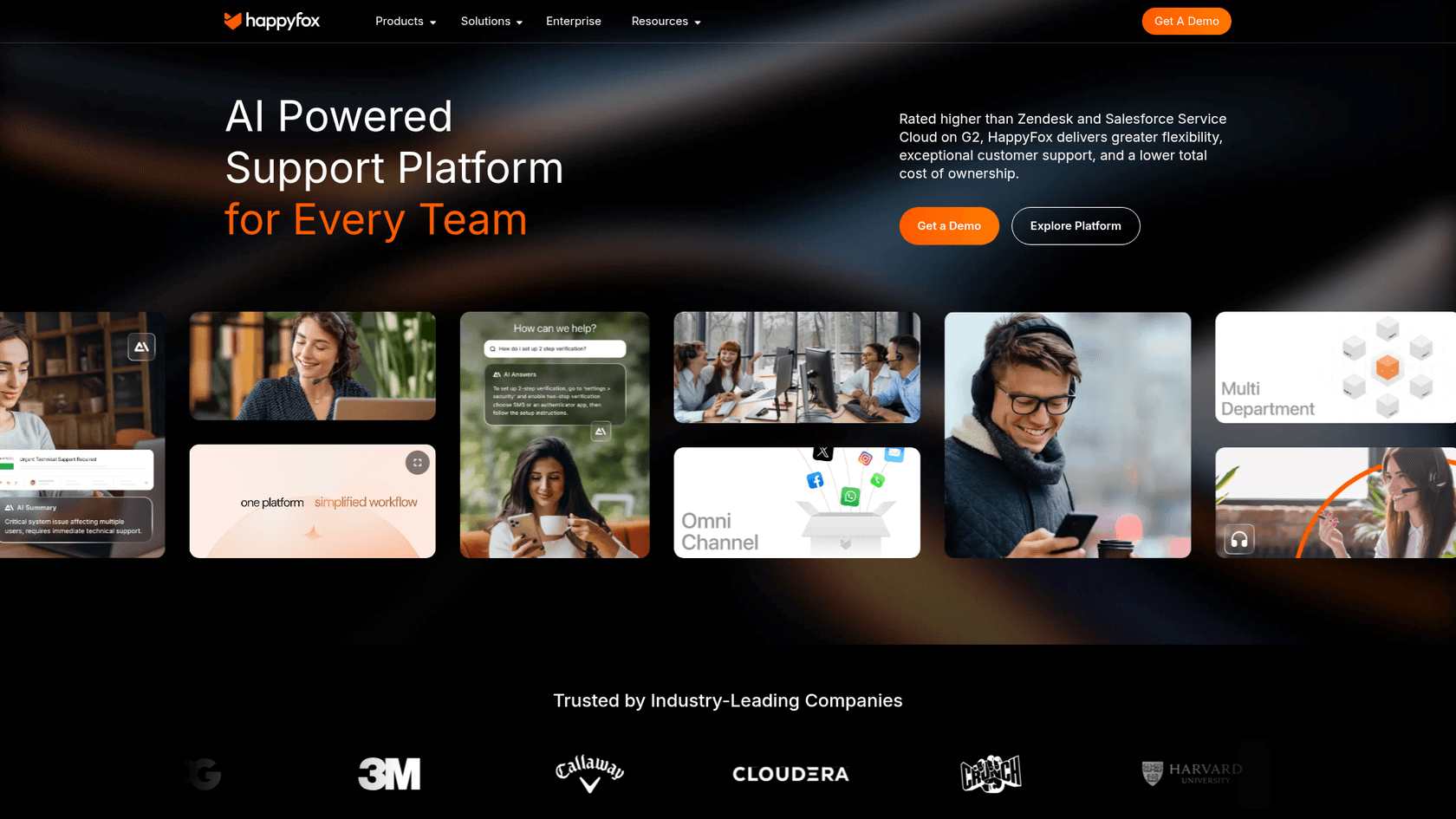
HappyFox is the mid-market alternative that most people overlook when they search for JSM alternatives. A Forrester TEI study found 401% ROI in three years for power users, and the platform positions explicitly as 50% cheaper than Zendesk for comparable features.
The dedicated Service Desk is a proper ITSM product -- incident management, change management, asset tracking, SLA enforcement -- not a customer support tool reconfigured for IT. That distinction matters when evaluating alternatives to a purpose-built ITSM platform like JSM.
Why it's a strong JSM alternative
The IT-specific integrations are the differentiator at HappyFox's price point. Jamf Pro (Apple fleet management), Microsoft Intune, NinjaOne (patch management and remote support), and Lansweeper (IT asset discovery) are native integrations. JSM handles most of these via Marketplace apps; HappyFox builds them into the core product.
The Slack integration also goes further. Assist AI is a conversational bot for Slack and Microsoft Teams that answers IT questions from the knowledge base and creates tickets when it can't resolve the request autonomously. Darwinbox's IT team reported a 3X improvement in first response time after deploying it.
For growing teams, HappyFox's unlimited-agent pricing model is genuinely useful. At $1,999/month (annual) for 20,000 tickets per year with unlimited agents, it's predictable regardless of headcount -- JSM's per-agent model gets painful as a team scales.
"HappyFox is probably the most intuitive helpdesk I've ever used."
G2 reviewer (reflecting consistent praise for the platform's usability over JSM's admin overhead)
Pricing vs JSM
| Plan | Price | Notes |
|---|---|---|
| Basic | $24/agent/mo (annual) | Max 5 agents, SLA, knowledge base |
| Team | $49/agent/mo (annual) | Min 5 agents, multi-brand, custom roles |
| Pro | $99/agent/mo (annual) | + Asset management, task management, load balancing |
| Enterprise PRO | Contact sales | Agent scripting, CSM, 24/7 phone |
| Unlimited agents -- Growth | $1,999/mo (annual) | 20,000 tickets/year, unlimited agents |
| Unlimited agents -- Scale | $3,999/mo (annual) | 150,000 tickets/year |
What to watch
HappyFox doesn't have JSM's developer-tool ecosystem. If your IT team works alongside engineering and needs Jira Software and Bitbucket connections in the service workflow, HappyFox doesn't replicate that. It's the better choice when IT and engineering run on separate tracks.
The Basic plan caps at 5 agents, so the actual entry cost for a real team is the Team plan at $39/agent with a 5-agent minimum ($195/month). Still meaningfully below JSM Premium for teams where AI deflection is the priority use case.
eesel AI
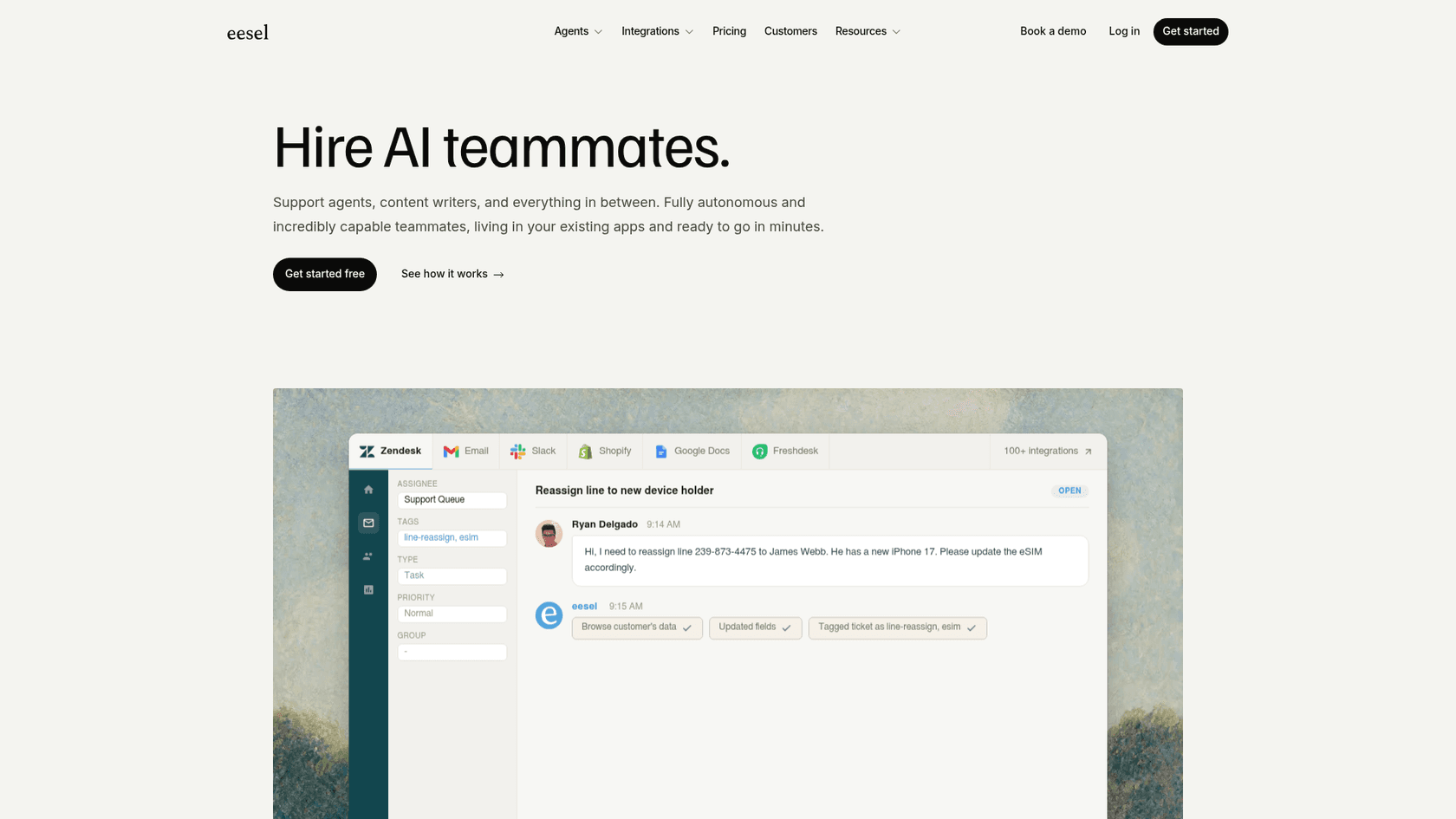
eesel AI is the alternative that doesn't replace JSM -- it replaces the part of JSM that employees interact with most: the initial request.
Most JSM setups have the same gap. Employees know the portal exists. They message IT on Slack instead. Tickets don't get filed, engineers don't have visibility, and the IT team spends time in their inbox rather than their queue. eesel addresses that gap directly: it sits inside Slack, intercepts the "can anyone help me with X?" message, and resolves it from the connected knowledge base before it becomes a ticket at all.
At Gridwise, 73% of tier-1 IT requests were resolved without human intervention in the first month. The independent test of 7 AI IT helpdesk tools in 2026 placed eesel first for Slack-native AI.
Why it's a strong JSM alternative
The framing is different from the other tools on this list. Freshservice, ServiceNow, Zendesk, and HappyFox are all "replace JSM with this." eesel is "keep JSM (or switch to something simpler) and add an AI front door in Slack." For teams that chose JSM because of the Jira integration and don't want to unwind that, eesel layers on top rather than competing.
The Slack integration is the core. Employees @mention the eesel bot or send a DM, and it answers from connected sources -- Confluence, Notion, Google Drive, SharePoint, past tickets, your help center. It creates a JSM ticket only when it can't resolve the request, transferring the full conversation context, cited articles, and attempted resolution so the agent doesn't start from scratch.
For teams not keeping JSM, eesel can sit on top of Freshservice or HappyFox just as easily. The knowledge sources, channel routing, and escalation rules don't care which ITSM system is underneath.
Before going live, a simulation run against thousands of past tickets surfaces the deflection rate you can expect, the categories the AI handles confidently, and the knowledge gaps to fix first. That's how to calibrate before switching to autonomous mode -- not after your employees have already seen a bad answer. The full methodology is covered in the ITSM + Slack guide.
Pricing vs JSM
| Option | Price | Notes |
|---|---|---|
| Pay per task | $0.40/task | Per resolved request (ticket, chat session) |
| Annual commitment | 25% off at $300+/mo | Discount applies even when usage exceeds minimum |
| Enterprise add-on | $1,000/mo + usage | Dedicated engineer, SSO, HIPAA, BAA |
| Free trial | $50 in credits | No credit card, all features unlocked |
At 500 tickets per month: $200. At 1,000 tickets: $400. Cost scales with volume, not headcount.
What to watch
eesel is not an ITSM system. Change management, CMDB, incident lifecycle, ITIL compliance -- none of these exist natively. For teams that need full ITIL process coverage, eesel is the front-end layer, not the whole stack. The AI for ITSM comparison covers where eesel fits versus native ITSM AI like Freddy and JSM's virtual agent.
The $250 default monthly spending cap means agents pause automatically when the cap is reached -- you can raise or lower it to match your expected volume. Commit to $300+/month annually to unlock the 25% discount.
How to choose
If your team is on Atlassian and the main complaint is the price of AI, the answer is probably to stay on JSM Standard and add eesel AI as the Slack front door. You keep the Jira + Confluence ecosystem connection and the $20/agent ticket infrastructure, and pay $0.40/task for AI deflection only on the volume you actually resolve.
If you're not on Atlassian and need full ITSM coverage, Freshservice is the most direct alternative. Easier to set up than JSM, AI on all paid plans, and ITAM included at Growth. The Freshservice alternatives guide covers other options if Freshservice doesn't fit either.
If you're managing both customer support and internal tickets, Zendesk is worth evaluating for consolidation. The AI agents are included in Suite plans, and having one knowledge base for customer-facing and internal support is genuinely valuable. The ITSM depth is shallower than JSM, but many teams don't need ITIL certification for their internal workflows.
If budget is the primary driver and you need IT-specific integrations (Jamf, Intune, NinjaOne, Lansweeper), HappyFox delivers the most IT-native coverage below the JSM Premium price point. The unlimited-agent model also removes per-seat growth risk.
If enterprise scale is the requirement, ServiceNow is the end state. The implementation overhead and opaque pricing are real, but the workflow depth and the 2026 Moveworks EmployeeWorks layer are unmatched.
Any of these five handles the core ITSM workflows. The real question is which one your IT team will actually use -- and whether your employees will file tickets through it, or just keep messaging IT on Slack and hoping someone sees it.