
IT service management has changed. What started as ticketing systems has evolved into AI-powered platforms that handle everything from password resets to complex infrastructure incidents with minimal human intervention.
Two platforms dominate this space: Freshservice with its Freddy AI assistant, and Jira Service Management powered by Atlassian Intelligence. Both promise to reduce ticket volume, speed up resolutions, and free your team from repetitive work. But they take very different approaches to getting there.
This comparison breaks down how each platform's AI actually works, what it costs, and which one fits your team's needs. We'll also look at a third option worth considering: AI-native alternatives like eesel AI that take a fundamentally different approach to autonomous support.
What is Freshservice AI?
Freshservice is a cloud-native ITSM platform built specifically for service management from day one. Unlike tools adapted from other use cases, every feature was designed around IT workflows.
The platform's AI layer, called Freddy AI, operates across three main areas: helping employees self-serve, assisting agents with ticket resolution, and providing insights to IT leaders. Freshservice claims 66% ticket deflection rates with AI-powered self-service, 77% faster resolution times with AI assistance, and 356% ROI within six months for typical deployments.
Freddy AI Agent handles conversational support directly in Slack and Microsoft Teams. Employees ask questions in natural language and get immediate answers drawn from your knowledge base, past tickets, and integrated documentation. When the AI cannot resolve something, it escalates to a human agent with full context.
Freddy AI Copilot works alongside your agents, suggesting responses, surfacing relevant knowledge articles, and automating routine tasks. The system learns from every interaction, improving its recommendations over time.
For IT leaders, Freddy AI Insights identifies trends, spots anomalies, and highlights knowledge gaps before they become problems.
What is Jira AI?
Jira Service Management comes from a different background. Built on top of the Jira platform that millions of development teams already use, it extends those workflows into IT service management.
Atlassian Intelligence (branded as Rovo in newer iterations) brings AI capabilities across the platform. The virtual service agent handles conversational support through your help center and connected channels. Rovo Search provides AI-powered enterprise search across all your Atlassian tools and connected third-party systems. Rovo Agents automate routine workflows and operations tasks.
The platform's strength lies in its ecosystem. If your team already uses Jira Software, Confluence, or Bitbucket, Jira Service Management connects seamlessly. Tickets can link directly to code changes, documentation lives in Confluence, and the entire development workflow integrates with service delivery.
Atlassian claims a 275% ROI over three years for enterprises switching to Jira Service Management, backed by a Forrester Total Economic Impact study.
AI capabilities comparison
Both platforms offer AI features, but their implementations differ significantly.
Ticket management and routing
Freshservice uses Freddy AI for automatic ticket classification, sentiment analysis, and priority suggestions. The system reads incoming requests and categorizes them without human intervention, routing complex issues to the right specialists while handling routine requests automatically.
Jira Service Management offers smart routing through Atlassian Intelligence, with similar issue detection and assignment predictions. The platform excels at connecting related issues across projects, useful for teams managing complex, interconnected systems.
Self-service and conversational AI
This is where Freshservice typically pulls ahead for IT use cases. Freddy AI's conversational interface operates natively in Slack and Teams, meeting employees where they already work. The 66% ticket deflection claim reflects strong natural language understanding tuned specifically for IT scenarios.
Jira's virtual service agent provides solid knowledge base integration but tends to require more configuration to achieve comparable results. The conversational capabilities are there, but getting them to match Freshservice's out-of-box performance takes more setup work.
Knowledge management
Freshservice automatically suggests relevant articles and can generate new knowledge base content from resolved tickets. The AI identifies patterns in successful resolutions and turns them into documented procedures.
Jira leverages Confluence for knowledge management, with AI-powered article recommendations. If your organization already uses Confluence extensively, this integration is powerful. If not, you are essentially adopting a second platform for documentation.
Predictive analytics
Freshservice offers anomaly detection and trend analysis with specific claims around resolution time improvements. The platform surfaces potential issues before they escalate and identifies recurring problems that need systemic fixes.
Jira provides predictive insights for issue resolution and workload forecasting, particularly useful for teams managing development and operations together.
Pricing and AI costs
Understanding what you actually pay for AI features requires looking beyond headline prices.
Freshservice pricing
| Plan | Monthly Cost (Annual) | AI Features |
|---|---|---|
| Starter | $19/agent | Basic automation only |
| Growth | $49/agent | Freddy AI Agent available as add-on |
| Pro | $99/agent | Enhanced AI capabilities |
| Enterprise | Custom | Full AI suite, 1,200 sessions/year per license |
Freshservice uses session-based AI pricing. An Enterprise license includes 1,200 Freddy AI Agent sessions per year per agent. A session counts as any interaction a unique user has with the AI within a 24-hour period. Additional sessions require purchasing more licenses or upgrading.
Jira Service Management pricing
| Plan | Monthly Cost | AI Features |
|---|---|---|
| Free | $0 (3 agents) | Limited AI |
| Standard | $20/agent | Rovo Agents, Search, Chat (25 credits/user/month) |
| Premium | $51.42/agent | Virtual Service Agent (1,000 conversations/month), AIOps |
| Enterprise | Custom (annual only) | Full AI, 150 Rovo credits/user/month |
Jira's pricing gets complex quickly. The virtual service agent only becomes available at Premium tier. Additional AI conversations beyond your monthly allowance cost $0.30 each. Rovo credits (used for AI operations) have their own limits and overage costs.
For a 20-agent team wanting full AI capabilities, Freshservice Enterprise typically works out cheaper and more predictable than Jira Premium with consumption overages. But if you only need basic AI assistance, Jira Standard at $20/agent includes more AI functionality than Freshservice Growth at $49/agent before add-ons.
Implementation and ease of use
Freshservice lives up to its "uncomplicated ITSM" positioning. Most teams get basic AI features running within days, not weeks. The no-code setup for Freddy AI means you don't need dedicated AI engineers or extensive training data to start seeing value.
Jira Service Management requires more upfront investment. The platform is powerful once configured, but getting there demands technical expertise and time. Teams without existing Atlassian experience face a steeper learning curve.
Integration complexity varies by your existing stack. Freshservice connects to most business tools through pre-built integrations. Jira excels when you are already in the Atlassian ecosystem but can require custom work for other integrations.
User feedback and ratings
Gartner Peer Insights shows both platforms performing well, with slight edges in different areas.
| Platform | Overall Rating | Reviews | AI-Specific Rating |
|---|---|---|---|
| Freshservice | 4.3/5 | 851 | 4.1/5 |
| Jira Service Management | 4.5/5 | 1,060 | 4.3/5 |
Freshservice users consistently praise ease of use and quick time-to-value. Common complaints focus on reporting limitations and occasional AI conversation quality issues.
Jira users love the ecosystem integration and flexibility. The main frustrations center on complexity, with many teams needing dedicated administrators, and recent price increases affecting smaller organizations.
Real-world performance often differs from marketing claims. Both platforms can achieve significant ticket deflection and resolution improvements, but results depend heavily on implementation quality and knowledge base maturity.
Who should choose Freshservice AI?
Freshservice fits teams that want powerful AI without complexity. Consider it if:
- You need conversational AI for employee self-service that works out of the box
- Your team lacks dedicated Atlassian expertise or resources for complex configuration
- You want predictable AI costs without consumption-based surprises
- Built-in asset management and IT operations management matter for your use case
- Quick deployment and fast time-to-value are priorities
Organizations like Databricks, Village Roadshow, and Oxford University use Freshservice specifically because it delivers enterprise capabilities without enterprise complexity.
Who should choose Jira AI?
Jira Service Management suits teams already invested in the Atlassian ecosystem. It is the right choice if:
- Your development team lives in Jira Software and you want tight integration between dev and ops
- You need highly customized workflows that go beyond standard ITSM processes
- You have technical resources to configure and maintain the platform
- You are already using Confluence for documentation
- Complex change management and deployment gating are core requirements
Companies like Sony Music, Breville, and Thumbtack leverage Jira Service Management to connect their entire software delivery pipeline.
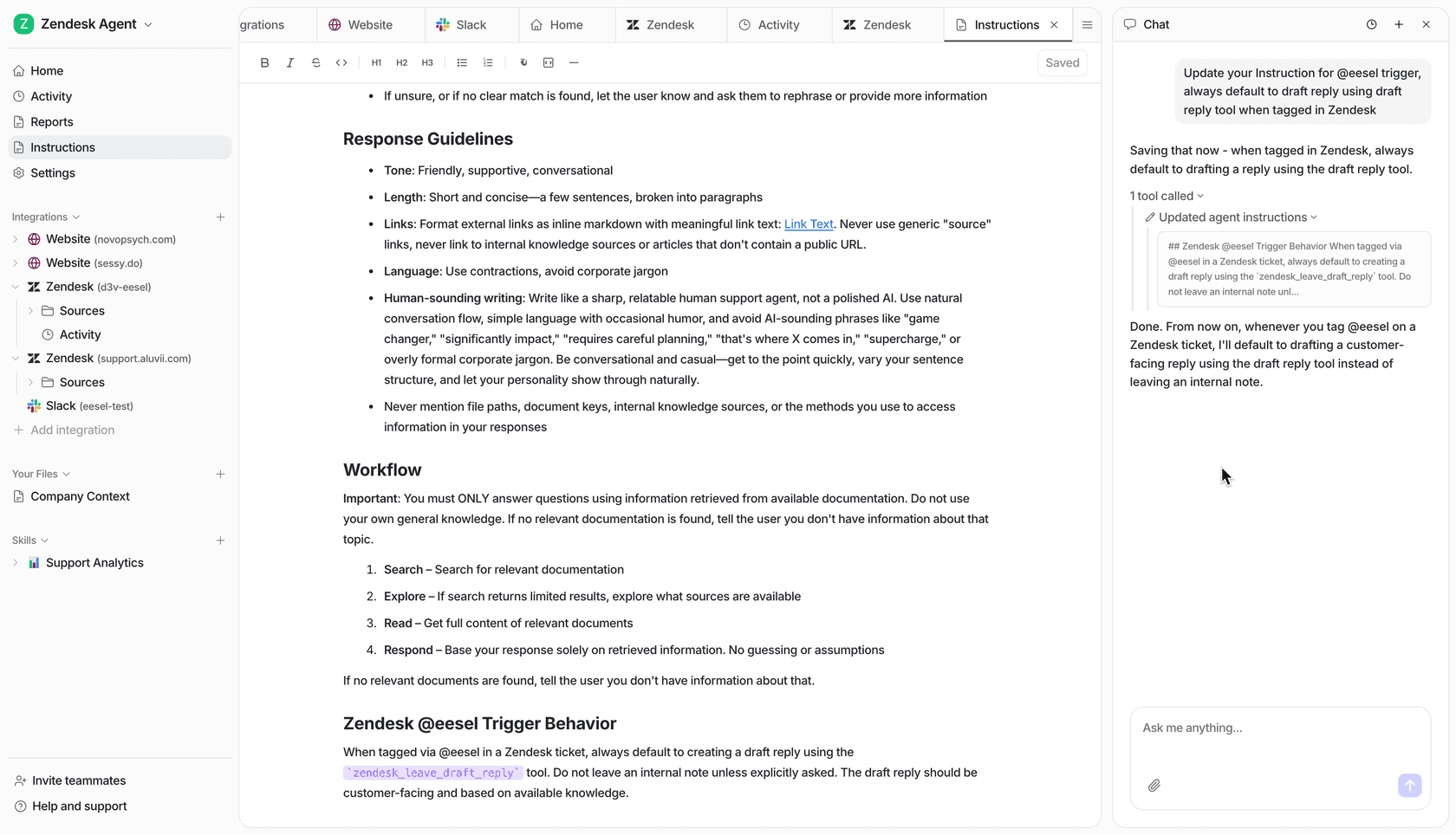
A modern alternative: eesel AI for autonomous support
Both Freshservice and Jira represent the "AI-added" approach: traditional ITSM platforms with artificial intelligence layered on top. There is another path worth considering.
eesel AI takes an "AI-first" approach. Instead of bolting AI onto legacy architecture, we built the platform around autonomous support from the ground up.
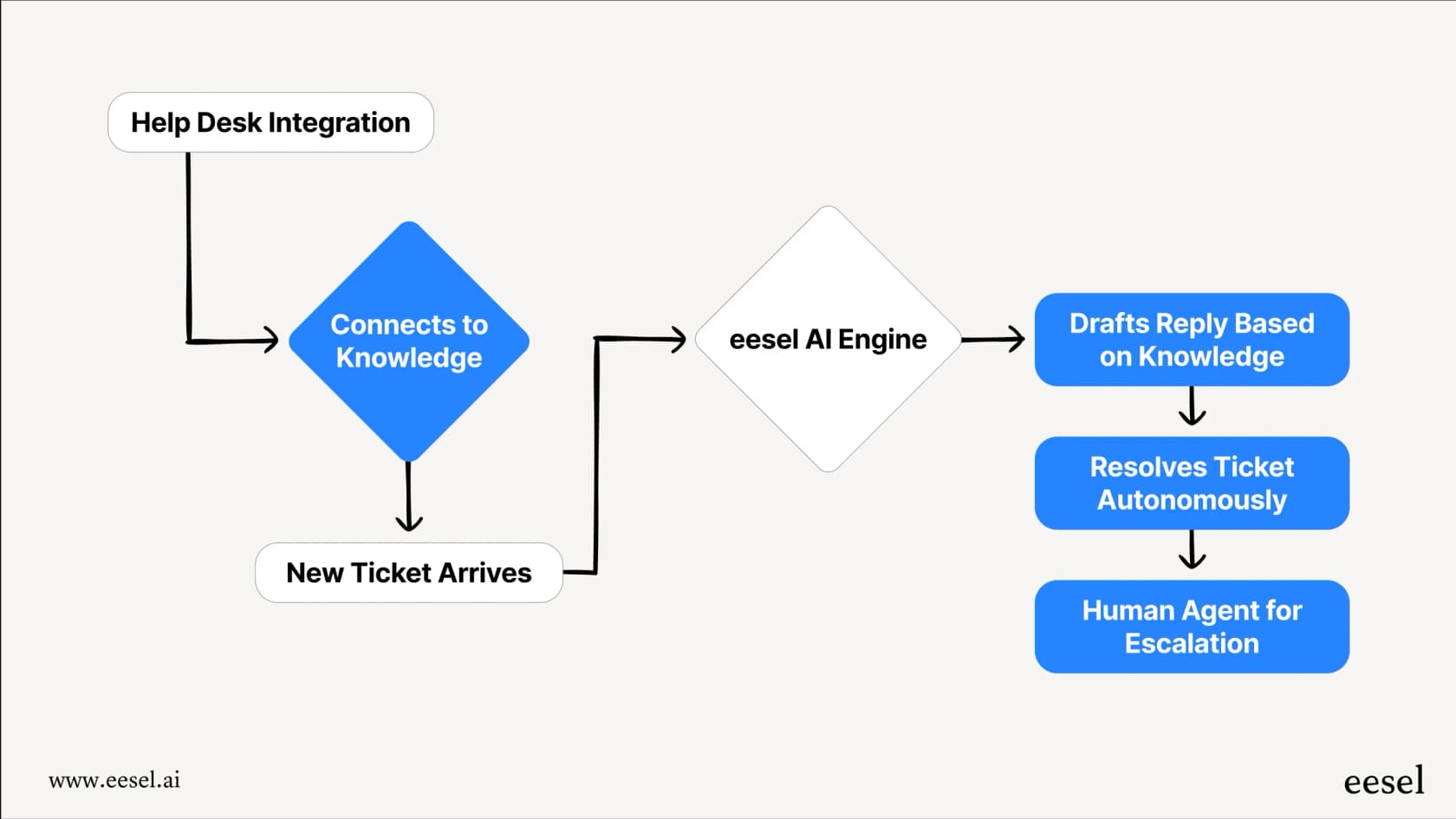
Here is the difference: traditional platforms require you to configure AI rules, build decision trees, and manually train models. eesel AI learns your business by connecting to your existing tools (Freshservice, Jira, Zendesk, Confluence, Slack, and 100+ others) and reading your past tickets, documentation, and knowledge base. Within minutes, not weeks, it understands your tone, policies, and common issues.
You start with guidance: eesel drafts replies for human review. As it proves itself, you level up to full autonomy where it handles frontline support end-to-end, escalating only the edge cases you define in plain English. No code, no rigid workflows.
For teams already using Freshservice or Jira, eesel AI integrates directly with both platforms. You keep your existing ticketing system while adding autonomous resolution capabilities that can handle up to 81% of requests without human intervention.
Our pricing starts at $299/month for 1,000 AI interactions with no per-agent fees. You pay for outcomes (interactions), not seats.
Choosing the right AI-powered ITSM platform
The decision comes down to your starting point and priorities.
Choose Freshservice if you want AI-powered ITSM that just works, with minimal setup and predictable costs. It is the safer bet for teams without extensive technical resources or Atlassian expertise.
Choose Jira Service Management if you are already in the Atlassian ecosystem and need deep customization. The platform rewards technical investment with powerful, tailored workflows.
Consider eesel AI if you want to move beyond traditional ITSM entirely. Our AI-native approach eliminates the configuration burden while delivering higher autonomous resolution rates than either traditional platform.
The best choice is the one that fits your team's capabilities today while scaling to your ambitions tomorrow. All three platforms offer free trials. Test them with real tickets from your queue before committing.