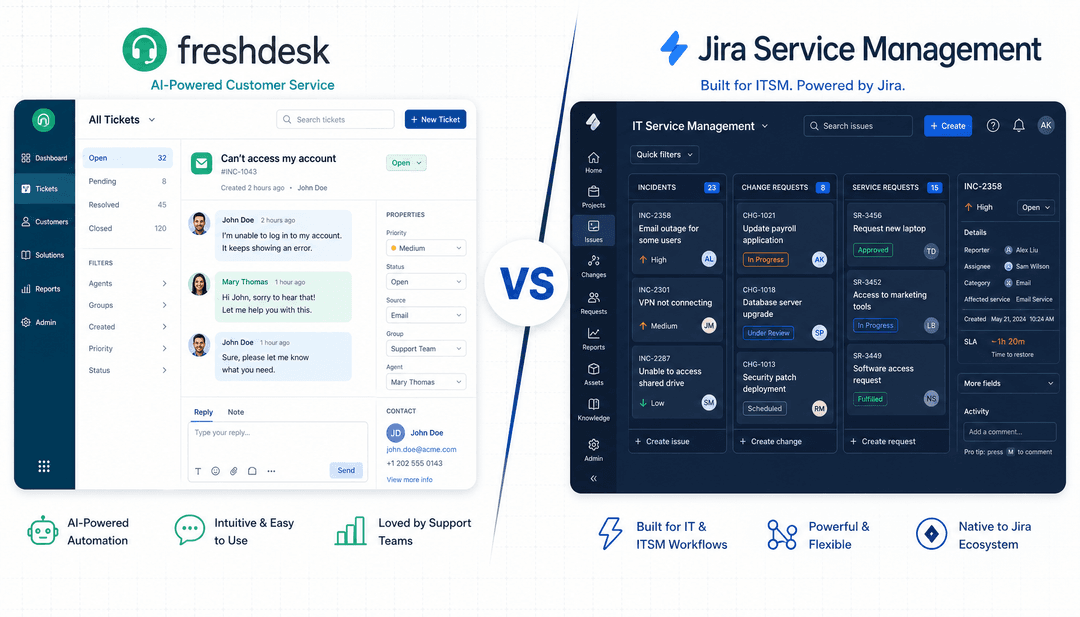

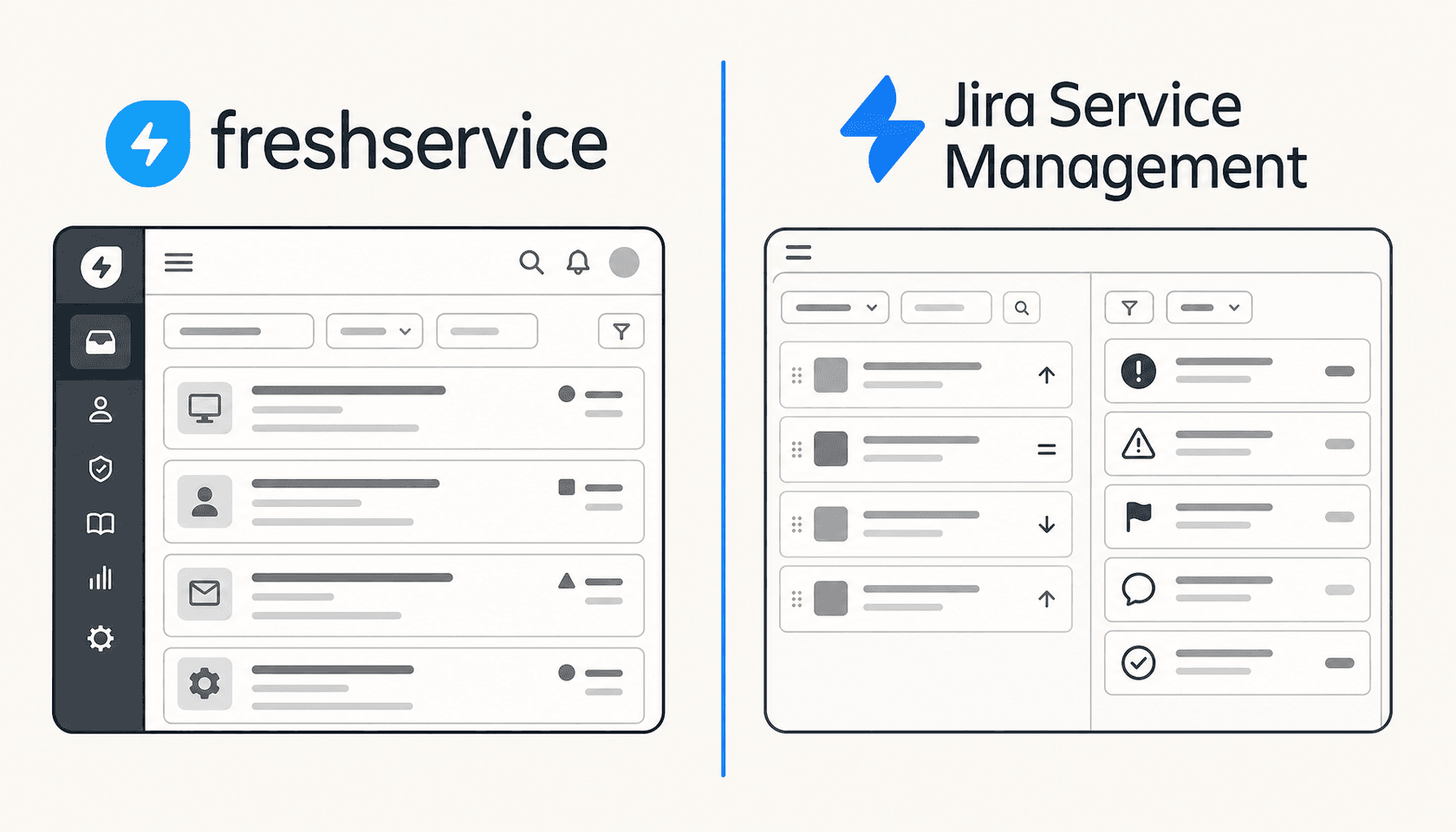
If you work in IT, the platform debate your team keeps coming back to is probably Freshservice vs Jira Service Management. Both are serious ITSM (IT Service Management) tools. Both cover incidents, problems, changes, and assets. Both have strong AI stories. But they attract different buyers, reward different working styles, and come with very different price tags.
The split is roughly this: Freshservice was built from the ground up as an ITSM platform - meaning the primary use case was always an IT service desk handling employee requests, incidents, and change management. Jira Service Management grew out of Jira Software, Atlassian's project and issue tracker for developers. JSM is technically excellent for teams that live inside the Atlassian ecosystem, but it carries the architectural weight and configuration complexity of its origins. IT administrators who aren't Jira power users often find it harder to tame than Freshservice.
This post compares both platforms in depth across the dimensions that matter for IT managers, service desk leads, and DevOps teams making a real purchasing decision in 2026: ITSM feature coverage, AI capabilities, ecosystem integrations, pricing, and setup burden. By the end you'll have a clear picture of which tool suits your situation and why.
What is Freshservice
Freshservice is a cloud-based ITSM platform by Freshworks, designed for mid-market and enterprise IT teams who want a modern alternative to legacy tools like ServiceNow or Ivanti. It is purpose-built for internal IT service delivery - not to be confused with Freshdesk, which is Freshworks' customer-facing support product.
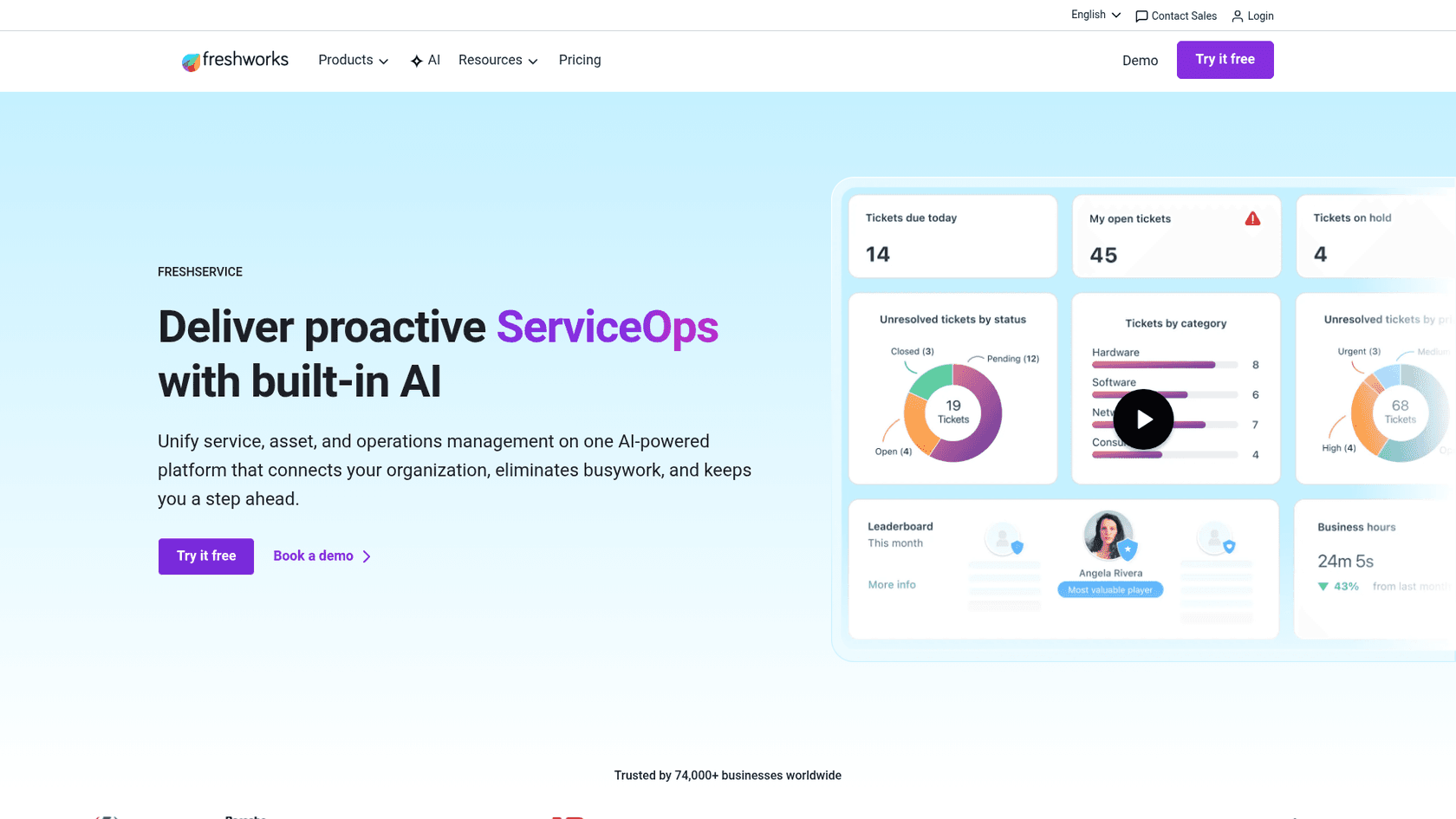
Freshservice covers the full ITIL stack: incident, problem, change, release, and asset management in one interface. It also extends into IT Operations Management (ITOM) - alert management, on-call scheduling, major incident coordination - and Enterprise Service Management (ESM), which lets HR, Finance, and Legal teams spin up their own service desks on the same platform. As of 2026, over 74,000 businesses use Freshservice globally, including Databricks, New Balance, University of Oxford, and Porsche.
The headline stat Freshworks leads with is a Forrester TEI study showing 356% ROI in under six months for typical customers. The AI pitch is Freddy AI - a suite of three distinct products for employees (self-service virtual agent), agents (reply suggestions and summarization), and IT leaders (anomaly detection and conversational analytics).
What is Jira Service Management
Jira Service Management (JSM) is Atlassian's ITSM platform, built on top of Jira and sold as part of the Service Collection bundle. That bundle also includes Customer Service Management, Assets (CMDB), and Rovo AI. JSM is positioned as the developer-friendly alternative to legacy ITSM: fast to spin up, AI-native, and purpose-built for teams that already use Jira Software, Confluence, and Bitbucket.
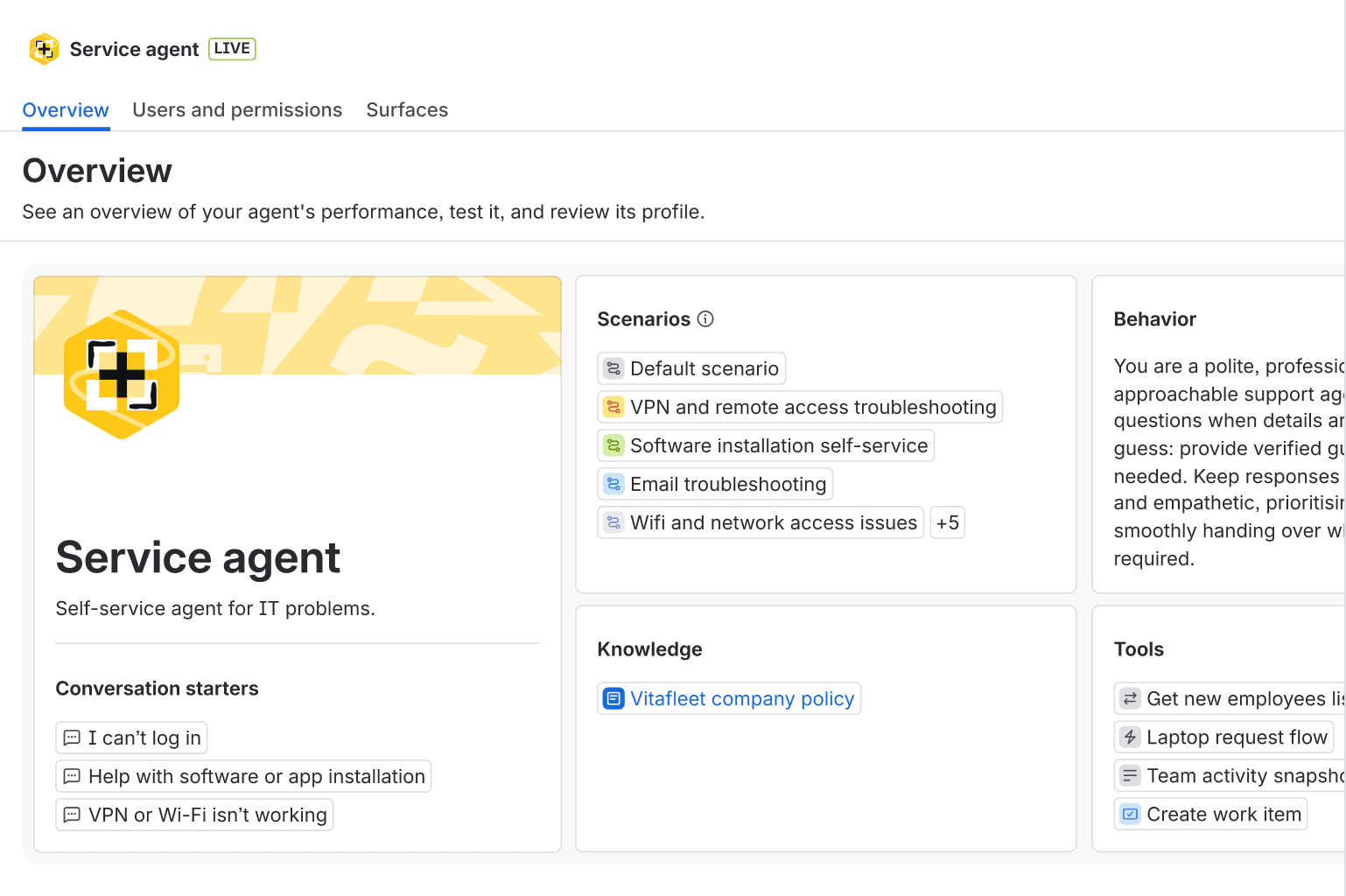
Over 60,000 customers use JSM globally. Atlassian claims 275% ROI over three years per a Forrester study, and JSM carries PinkVERIFY certification for ITSM best practices. The key differentiator is ecosystem density: JSM natively connects to Jira Software backlogs, Confluence knowledge bases, Bitbucket CI/CD pipelines, and the Atlassian Teamwork Graph - which means AI features automatically draw context from development activity without manual integration work.
The practical implication: JSM is the natural choice when your development and IT operations teams share an Atlassian workspace. For IT teams that operate independently of software development, the calculus changes considerably.
ITSM capabilities and ITIL compliance
Freshservice
Freshservice is built on ITIL best practices from the ground up, and this shows in how the product organizes itself. The five-stage incident lifecycle (Detect, Assess, Respond, Resolve, Learn) maps directly to ITIL terminology, which reduces adoption friction for IT teams already trained in ITIL concepts. Change management includes a visual Change Calendar, CAB approval workflows with hierarchical sign-off, and post-release review capabilities. Problem management includes a Known Error Database (KEDB) and automated problem-to-incident linking.
Key feature availability by plan:
- Incident Management: all plans (Starter and above)
- Service Catalog + SLA Management: Starter
- Problem Management, Change Management, Release Management: Growth ($49/agent/month) and above
- ITOM (alert management, on-call, major incident): Pro ($99/agent/month) and above
- ESM (multi-department workspaces): Pro and above
IT Asset Management (ITAM) in Freshservice is more comprehensive than many competitors. It covers automated hardware and software discovery, a continuously updated CMDB, SaaS management, contract management, purchase order tracking, and full asset lifecycle management from procurement to retirement. ITAM is licensed separately via Asset Units (packs of 500), so the total cost depends on how many assets you're tracking.
Reviewers consistently rate Freshservice's ITIL alignment as its strongest point. As one Capterra reviewer put it:
"Freshservice delivers ITIL-aligned processes with a modern, cloud-first approach, making deployment easier than with legacy ITSM tools."
Mohammed A., Operation Executive, Information Technology & Services, used 6-12 months. Capterra, Mar 2026

Jira Service Management
JSM is PinkVERIFY certified for ITSM practices and covers all four core ITIL processes. The difference in tone is palpable: where Freshservice uses explicit ITIL labels, JSM organizes features around developer concepts - deployments, sprints, backlogs - which can feel more natural for DevOps teams and less so for traditional ITSM practitioners.
One recurring Reddit thread sums up the divide well:
"Jira is a wonderful tool for project management that included -in some way- ITSM capabilities to get into the market. So, I wouldn't say it's a good ITSM tool."
r/ITIL commenter. Reddit

That criticism is dated but still echoes in enterprise IT departments. JSM's change management (available only on Premium and Enterprise) is genuinely powerful - AI risk scoring, deployment gating via CI/CD, and approval workflows that automatically pull in Bitbucket deploy data. But getting there requires both a Premium license and meaningful Atlassian ecosystem investment.
Key feature availability by plan:
- Request Management + Incident Management (basic): Free and Standard
- Assets/CMDB: Standard (5,000 objects), Premium (50,000), Enterprise (500,000)
- Full Change Management: Premium ($51.42/agent/month) and above
- Advanced AIOps (alert grouping, AI incident creation, PIR generation): Premium and above
- Virtual Service Agent: Premium and above
- Status Pages: Enterprise only
Notably, Assets/CMDB moved to Standard in 2026 - a significant improvement over the previous Premium-only gating. This makes JSM substantially more competitive for teams who need CMDB at a mid-market price.
Head-to-head: ITSM core
Both platforms are genuinely ITIL-compliant. Freshservice has deeper out-of-box ITSM structure, which means faster time-to-value for IT teams without a dedicated Atlassian admin. JSM has more powerful change management when you integrate it with the Atlassian dev toolchain, but that integration costs setup time and a Premium tier.
AI and automation
Freshservice - Freddy AI
Freshservice's AI layer is called Freddy AI and it breaks into three distinct products:
Freddy AI Agent is the employee-facing virtual assistant. It handles Tier 1 requests conversationally in Microsoft Teams, Slack, Microsoft 365 Copilot, and the self-service portal, in 40+ languages. For common requests like software provisioning, Freddy AI Agent can raise and fulfill requests automatically through ITAM integration - no human agent involvement needed. Freshservice reports 66% ticket deflection from organizations using this feature.
Freddy AI Copilot is the agent-side assistant. It suggests replies, summarizes long ticket threads, recommends field values (category, priority, routing), and generates knowledge base articles from resolved tickets. The reported impact: 41% faster first response time and a 77% decrease in average resolution time.
Freddy AI Insights gives IT leaders conversational analytics - ask questions about service desk data in plain English, surface anomalies and trends before they become problems.
The catch is the plan gating. Freddy AI is largely an Enterprise-tier feature:
| Feature | Starter | Growth | Pro | Enterprise |
|---|---|---|---|---|
| ServiceBot (Teams/Slack basic) | Yes | Yes | Yes | Yes |
| Freddy AI Agent (conversational) | No | No | Add-on | Included |
| Freddy AI Copilot | No | No | Add-on | Included |
| Freddy AI Insights | No | No | No | Included |
Enterprise pricing is custom (contact sales). One Capterra reviewer:
"The only thing I dislike is that depending on the license tier, it may be very limited on AI usage, API usage and a couple more features that are only available in higher tiers."
David V., Customer Support Manager, Information Services. Capterra, Mar 2026
Jira Service Management - Atlassian Intelligence and Rovo
JSM's AI strategy centers on Rovo, Atlassian's AI platform, plus Atlassian Intelligence embedded throughout JSM. The foundation is the Atlassian Teamwork Graph - a connected data layer that spans Confluence, Jira Software, Bitbucket, Slack, Splunk, and third-party tools. This means AI answers are grounded in context already flowing through your Atlassian workspace, without extra configuration.
Key AI components:
Rovo Search and Chat are available from Standard ($20/agent/month) - 25 Rovo credits/user/month at Standard, 70 at Premium, 150 at Enterprise. This includes enterprise search across all Atlassian tools and a conversational AI assistant.
Virtual Service Agent (Premium and above) automates Tier 1 support in Slack using intent-based flows and Confluence knowledge base content. 1,000 assisted conversations/month are included; overage is $0.30/conversation.
AIOps (Premium and above) handles the operations side: AI alert grouping and correlation, automated incident creation from alert clusters, AI-generated post-incident review (PIR) documents, Slack incident summaries, and active heartbeat monitoring.
Atlassian Intelligence cross-cutting features (Standard and above) cover triage, drafting, summarization, knowledge discovery, and the ability to build custom Rovo AI agents for specific workflows.
JSM's AI advantage is that basic AI capabilities are available from Standard - a much lower entry point than Freshservice's Enterprise lock. The trade-off is that Rovo credits are metered and the most powerful features (virtual agent, full AIOps, AI change management) still require Premium.
Head-to-head: AI
For teams willing to pay Enterprise, Freddy AI is a cohesive, purpose-built ITSM AI suite. For teams on mid-tier plans, JSM's Rovo starts delivering value sooner and at lower cost. If you're on a 20-50 agent team that can't justify Enterprise-level spend, JSM's AI story is currently stronger per dollar.
If you want meaningful AI on top of either platform without upgrading plans, see the section on adding AI on top below.
Integrations and ecosystem
Freshservice
Freshservice connects to the broader IT tooling world through its Orchestration Center - a no-code workflow automator with pre-built integrations for Jira, Azure AD, Datadog, Slack, Teams, Zoom, Riverbed Aternity, and more. The Freshservice-Jira integration is particularly well-documented: it syncs Freshservice incidents to Jira issues, surfaces status updates bidirectionally, and allows IT and development teams to collaborate across tools.
Freshservice is also part of the Freshworks ecosystem - which includes Freshdesk (customer support), Freshsales (CRM), and Freshchat (live chat). For organizations that want to standardize on Freshworks products, this creates a unified platform story.
Outside the Atlassian world, Freshservice generally has a broader native integration footprint. It connects natively to Microsoft 365 products (Teams, Azure AD, Intune) and has a Freshservice MSP mode for managed service providers with separate pricing. ITAM integrations include monitoring tools, cloud platforms, and network discovery agents.
The limitation is depth inside any specific ecosystem. If your DevOps team lives in Bitbucket and Confluence, Freshservice can integrate with those tools but it's not a native citizen.
Jira Service Management
JSM's integration story is the mirror image: deep Atlassian-native, broader-ecosystem-via-Marketplace. The native connections to Jira Software, Confluence, Bitbucket Pipelines, and Atlassian Analytics are seamless and require no configuration beyond standard Atlassian Cloud permissions. This is where JSM genuinely outperforms every competitor: change management that auto-creates records from Bitbucket deployments, problem management that links directly to Jira Software issues and commit history, and knowledge management through the full Confluence editor - these aren't integrations, they're the same data model.
The Atlassian Marketplace offers 1,000+ apps for connecting to tools outside the Atlassian universe. The catch is that "outside Atlassian" integrations often require paid Marketplace apps, which adds cost and a dependency on third-party maintainers. As one Software Advice reviewer noted:
"Not as easy to get integrating - you have to purchase apps or plugins to gain what should be relatively straightforward connections to 3rd party apps."
Richard R., IT Services, 11-50 employees. Software Advice, Jul 2025
Head-to-head: integrations
If your organization is Atlassian-first, JSM wins by a large margin. If you're a hybrid shop with a mix of Microsoft, Salesforce, Datadog, and other tools, Freshservice's native integration surface is broader. Neither platform is weak here - but the winner depends entirely on what you already use.
Pricing
Freshservice pricing
All prices are per agent per month, billed annually. Monthly billing is available at higher rates (not published by Freshworks).
| Plan | Price (annual) | Key features |
|---|---|---|
| Starter | $19/agent/month | Incident management, service catalog, SLAs, Teams/Slack ServiceBot, knowledge base |
| Growth | $49/agent/month | + Problem, change, release management, intelligent routing, workload management |
| Pro | $99/agent/month | + ITOM, advanced ITAM, ESM, sandbox environment, advanced analytics |
| Enterprise | Custom (contact sales) | + Freddy AI Agent, Freddy AI Copilot, Freddy AI Insights, full project portfolio, 1,200 AI sessions/year |
Notable limits and add-ons:
- Free tier: none (14-day free trial available, no credit card required)
- IT Asset Management: licensed separately via Asset Units (packs of 500; pricing on request)
- Freddy AI Agent sessions on Enterprise: 1,200/year per license; overage pricing not published
- Day passes for occasional agents: from $3/day (3 free at signup)
- Business Teams ESM and MSP mode: separate pricing pages
For a 10-agent IT team, Freshservice Growth costs $490/month annually - a reasonable entry point for full ITSM coverage. Getting to AI features requires Enterprise, which adds significant cost for smaller teams.
Jira Service Management pricing
JSM is now part of Service Collection, which bundles JSM + Customer Service Management + Assets + Rovo AI. Prices are shown monthly; annual billing saves up to 17%.
| Plan | Price (monthly) | Key features |
|---|---|---|
| Free | $0 | 3 agents, basic incident management, 500 automation runs/month, community support only |
| Standard | $20/agent/month | Up to 100,000 agents, Assets/CMDB (5,000 objects), Rovo AI (25 credits/user/month), 9/5 support |
| Premium | $51.42/agent/month | + Virtual service agent (1,000 convos/month), full change management, AIOps, 99.9% uptime SLA, 24/7 critical support |
| Enterprise | Contact sales (annual only) | + Up to 150 sites, unlimited automation, Atlassian Guard SSO/SCIM, 99.95% uptime, status pages, cross-product analytics |
Notable limits and add-ons:
| Feature | Included | Overage |
|---|---|---|
| Assets objects (Standard) | 5,000/month | $0.02/object/month |
| Assets objects (Premium) | 50,000/month | $0.02/object/month |
| Assets objects (Enterprise) | 500,000/month | $0.02/object/month |
| Virtual service agent conversations (Premium+) | 1,000/month or 12,000/year | $0.30/assisted conversation |
| Rovo Customer Service resolutions | Included | $1/resolution |
Customers (end users raising tickets) are always free - JSM charges only for agents. The Free plan is a genuine option for small teams testing the platform (up to 3 agents).
Pricing comparison at scale:
| Team size | Freshservice Growth | Freshservice Pro | JSM Standard | JSM Premium |
|---|---|---|---|---|
| 10 agents | $490/mo | $990/mo | $200/mo | $514/mo |
| 25 agents | $1,225/mo | $2,475/mo | $500/mo | $1,286/mo |
| 50 agents | $2,450/mo | $4,950/mo | $1,000/mo | $2,571/mo |
JSM is substantially cheaper at every tier before Enterprise. The value equation changes at Enterprise - Freshservice Enterprise includes Freddy AI natively, while JSM's full AI suite at Enterprise also requires custom pricing.
Ease of setup and administration
Freshservice is the consistently easier platform to configure and run day-to-day. The interface is clean and opinionated - workflows, SLA policies, and approval chains are set up through guided forms rather than freeform scripting. Most IT teams with ITIL familiarity can have a working service desk live within days. Multiple reviewers describe it as "fast time-to-value" compared to both ServiceNow and Jira SM.
The limitation: Freshservice's opinionated structure means you sometimes have to adapt your processes to fit the platform rather than building exactly what you want. Configuration is broad but not always deep.
JSM is harder to set up and harder to administer, and this gap is well-documented in reviews. The Jira permission model, project scheme architecture, and automation rule engine are flexible but complex. Teams that don't have a dedicated Atlassian admin often find themselves stuck. One Gartner reviewer captured the dynamic precisely:
"Administration can get complex beyond the basic ones and would require specialized knowledge and training. Out of the box reporting is limited and requires additional plug-ins. Also, licensing can get expensive and there were price hikes recently."
IT Manager, Insurance, $500M-$1B. Gartner Peer Insights, Feb 2026
That said, teams that invest in JSM configuration get genuinely sophisticated automation - low-code Jira Automation rules that can orchestrate complex multi-team workflows, dynamic forms that conditionally collect the right data, and AI-powered triage that draws on cross-product context.
The honest summary: if you want to be operational in a week, Freshservice. If you want maximum flexibility and already have Atlassian expertise, JSM's setup investment pays dividends at scale.
Side-by-side comparison
| Factor | Freshservice | Jira Service Management |
|---|---|---|
| Primary audience | IT service desks, ITSM-focused IT teams | DevOps teams, Atlassian-native organizations |
| ITIL compliance | Full, ITIL-native design | PinkVERIFY certified |
| AI availability | Enterprise tier (Freddy AI full suite) | Standard+ (Rovo AI); Premium+ (virtual agent, AIOps) |
| AI virtual agent | Enterprise only (or add-on) | Premium ($51.42/agent/month) |
| CMDB/Assets | Separate ITAM add-on (Asset Units) | Included in Standard (5,000 objects) |
| Change management | Growth+ | Premium+ only |
| Ecosystem strength | Freshworks suite, Microsoft 365 | Atlassian (Jira Software, Confluence, Bitbucket) |
| Starting price | $19/agent/month | Free (3 agents); $20/agent/month (Standard) |
| Free tier | None (14-day trial) | Yes, 3 agents |
| Setup complexity | Low - fast time-to-value | High - requires Atlassian expertise |
| Reporting | Limited out-of-box; common complaint | Limited out-of-box; common complaint |
| G2/Gartner rating | 4.5/5 (Capterra, 692 reviews) | 4.5/5 (Gartner, 1,458 reviews) |
| Best for | Mid-market IT teams, ITIL shops, Freshworks orgs | DevOps teams, software companies, Atlassian-native orgs |
When to pick Freshservice
Freshservice is the better choice when:
- Your IT team's primary job is running a service desk, not supporting software development. Freshservice's ITSM structure is cleaner and more purpose-built for this use case.
- You want fast time-to-value. If you need to go live within weeks rather than months, Freshservice's guided setup and opinionated defaults get you there faster.
- You're moving off a legacy tool like ServiceNow or Ivanti and want a modern alternative at a fraction of the cost. This is the most common Freshservice migration story.
- Your organization uses Microsoft Teams and Slack as primary communication tools. Freshservice's Teams and Slack integrations are native and smooth.
- You need ITOM features (alert management, on-call scheduling, major incident coordination) without separately buying PagerDuty or Opsgenie - these are built into Freshservice Pro.
- Your team is spread across IT, HR, Legal, and Facilities, and you want ESM capabilities to extend service management across departments.
- You're an MSP managing multiple customer environments - Freshservice has a dedicated MSP mode.
The important caveat: if AI deflection and ticket automation are the top priority, you'll need to either budget for Enterprise or add an external AI layer. Freddy AI's full capabilities are genuinely impressive, but they're gated behind the most expensive tier.
When to pick Jira Service Management
JSM is the better choice when:
- Your organization is already on Atlassian. If your developers use Jira Software and your documentation lives in Confluence, JSM is an extension of tools already in place - and the value of cross-product context (deployments, commits, Confluence articles) is immediate without any integration work.
- You're a software company or a DevOps team where IT operations and software development are closely intertwined. JSM's change management, which auto-creates records from Bitbucket deployments and links incidents to commit history, is the most developer-native implementation of ITSM change management available.
- You need CMDB at Standard pricing. With Assets now included at Standard, JSM is the most cost-effective way to get CMDB alongside request management.
- You have a larger agent count and pricing is a key constraint. JSM's per-agent cost is significantly lower at every equivalent tier.
- You want AI capabilities at mid-tier pricing. Rovo AI starts at Standard ($20/agent/month), while Freshservice's meaningful AI requires Enterprise.
- Your team has dedicated Atlassian administrators or is willing to invest in setup. JSM's configuration power is genuinely best-in-class once it's properly built out.
The watch-out: don't underestimate the setup cost. Teams without existing Atlassian expertise routinely underestimate how long it takes to get JSM running well. If the IT team doesn't have a JIRA admin, the first six months will feel rough.
Adding AI on top
Both Freshservice and Jira Service Management have meaningful AI stories in 2026, but both have gaps: Freshservice's Freddy AI is mostly Enterprise-gated, and JSM's virtual agent requires Premium plus active conversation budget management.
For teams that want AI ticket resolution, triage, or knowledge-based deflection without upgrading plans, eesel AI connects directly to both platforms as an AI layer on top of your existing ITSM setup. eesel works across Freshservice ticket deflection, Jira Service Management, and other helpdesks, using your existing knowledge base, past tickets, and documentation to handle Tier 1 requests autonomously in Slack or your self-service portal.
The practical use case: a 30-agent IT team on Freshservice Growth or JSM Standard that wants 50-60% ticket deflection without paying for Enterprise or Premium can add eesel's AI agent for a fraction of the cost. eesel uses task-based pricing ($0.40 per resolved ticket) rather than per-seat fees, which aligns cost directly to value delivered.
This also applies to teams who already have Freddy AI or Rovo but want higher deflection rates or better performance on specific ticket categories. As AI IT help desk tools have matured in 2026, the best outcomes typically come from layering purpose-built AI agents on top of an ITSM platform rather than relying solely on the platform's bundled AI.
If you're evaluating the AI capabilities of both platforms head-to-head, eesel benchmarks well against both Freddy AI and Rovo on real-world IT deflection tasks - particularly for teams on mid-tier plans where the built-in AI is either absent or metered.
Conclusion
Choose Freshservice if: You run a dedicated IT service desk, want fast time-to-value, need ITOM and ESM built in, or are migrating from ServiceNow. It's the cleaner ITSM tool for teams that don't live in the Atlassian ecosystem.
Choose Jira Service Management if: Your organization is already Atlassian-native, your IT team works closely with software development, you need CMDB at Standard pricing, or pricing at scale is a deciding factor. The setup cost is real but the long-term value for Atlassian shops is substantial.
Only for JSM if you have Atlassian admins: JSM's complexity is not a myth. Teams without dedicated Atlassian expertise consistently report longer setup times and more ongoing administration burden. If you don't have that capacity, Freshservice's lower setup friction is worth the higher per-agent cost.
For AI specifically: both platforms deliver meaningful automation, but neither fully covers every use case at mid-tier pricing. The most pragmatic path for teams that want high deflection rates today is pairing either platform with an external AI layer like eesel rather than waiting for a plan upgrade or an Atlassian roadmap release.
Frequently Asked Questions
What is ITSM and why does platform choice matter?
Does Jira Service Management require Jira Software?
How does Freshservice pricing compare to Jira Service Management at team scale?
Can I switch from Jira Service Management to Freshservice (or vice versa)?
Can I add AI automation on top of Freshservice or Jira Service Management without upgrading my plan?


Article by
Riellvriany Indriawan
Riell is a designer and writer at eesel AI with about two years of experience researching CX platforms, AI chatbots, and helpdesk software. She combines her design background with a sharp eye for how these tools actually look and feel in practice — making her comparisons unusually visual and user-focused.