Ema AI alternatives: 9 picks for support teams in 2026

Rama Adi

Katelin Teen
Last edited August 16, 2026
Why support teams end up looking past Ema
Let me be fair first, because Ema is a serious company and a lot of the criticism it gets online is lazy.
Ema was founded in February 2023 by Surojit Chatterjee, who was Coinbase's chief product officer through the 2021 IPO, and Souvik Sen, previously VP of engineering at Okta. It has raised over $61M, with Accel and Section 32 leading.
Its compliance stack is one of the strongest on this list. The trust page claims SOC 2 Type II, ISO 27001, ISO 27701, ISO 27017 and ISO 42001, plus single-tenant, on-prem and air-gapped deployment. Very few vendors here can match that.
And EmaFusion, its model-routing layer, is not marketing vapour. There's a real paper behind it: arXiv:2504.10681, published April 2025, reporting 94.3% accuracy against o3-mini's 91.7% at $5.21 per 1,000 prompt samples versus $16.29. As someone who has built routing layers, that's a strong result and I'd happily read it twice.
The problems are narrower than "Ema is bad", and all four are checkable.
One: support is no longer the front door
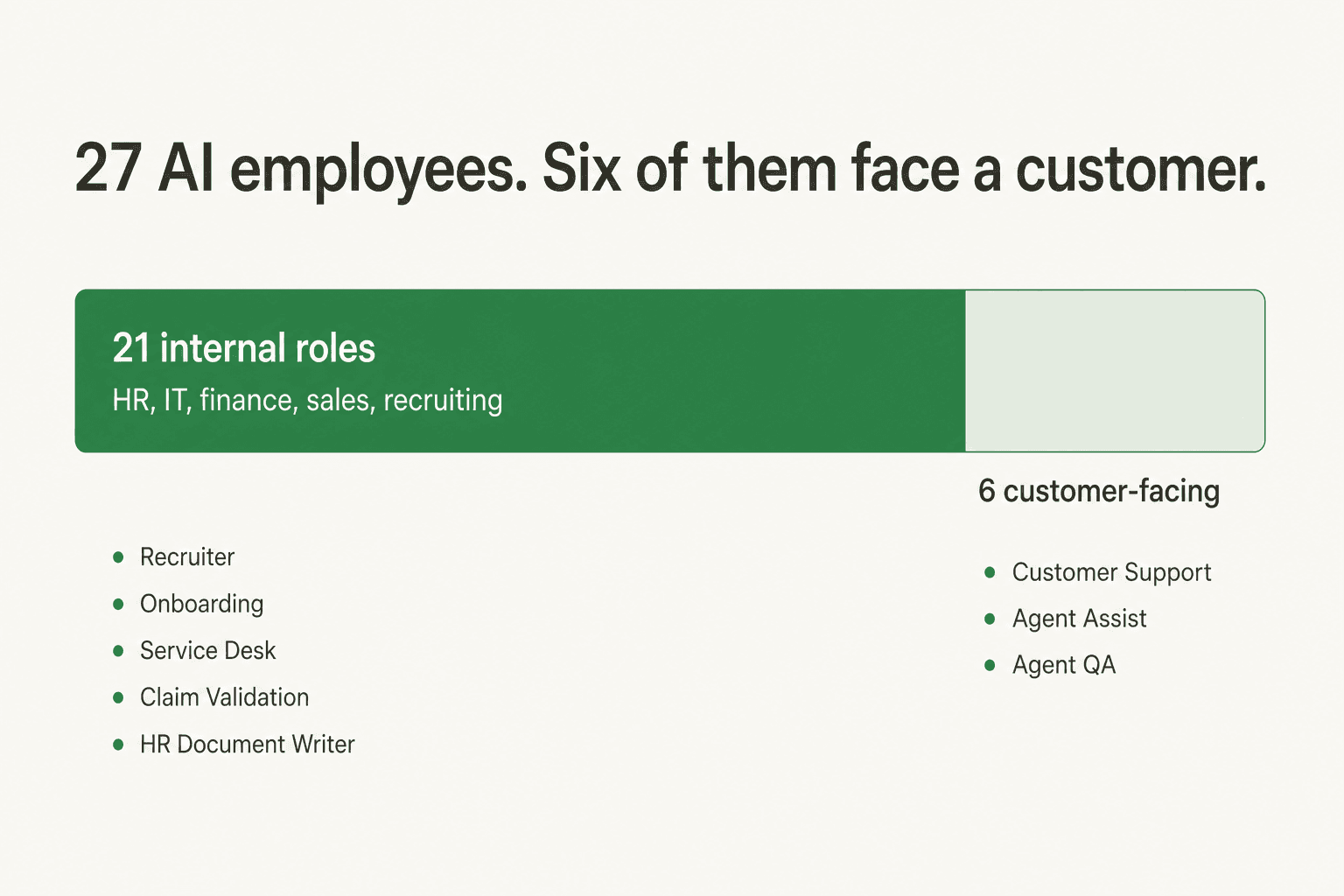
Ema's homepage H1 today reads "AI Employees for HR, IT, and Finance." Customer support does not appear in it. The catalogue backs that up: of the 27 named AI employees Ema sells, six are customer-facing and 21 cover HR, IT, finance, sales and recruiting. The site-wide banner currently advertises Ema Recruiter.
That's a strategy call, not a scandal. But it shows up in the artefacts. The customer support assistant page's CMS record reports it was last updated on 2 July 2025, and it still advertises "200+ enterprise applications" while the homepage claims 250+. The newer customer experience hub, updated 26 March 2026, quotes the resolution rate three different ways on one page: the product card says over 75%, both FAQ entries say over 85%, and the meta description says over 80%. Four of its six CX cards have no destination page and route to the demo form instead.
None of that is fatal. All of it tells you where the roadmap attention is going.
Two: your helpdesk is a tool, not a teacher
This is the one that actually decides the rollout, and it took reading the builder docs to find it.
All twelve helpdesks I checked are in Ema's integrations catalog under Ticketing. The catalogue is real, too: I counted 256 distinct named tools, which comfortably clears the "250+" claim. Ema can create a ticket, update a field, post a reply.
But Ema draws the line itself, in its data connectors docs: "Where Tools let an AI Employee act in external systems, connectors let it know about your content." And the supported-connectors table has exactly four rows.
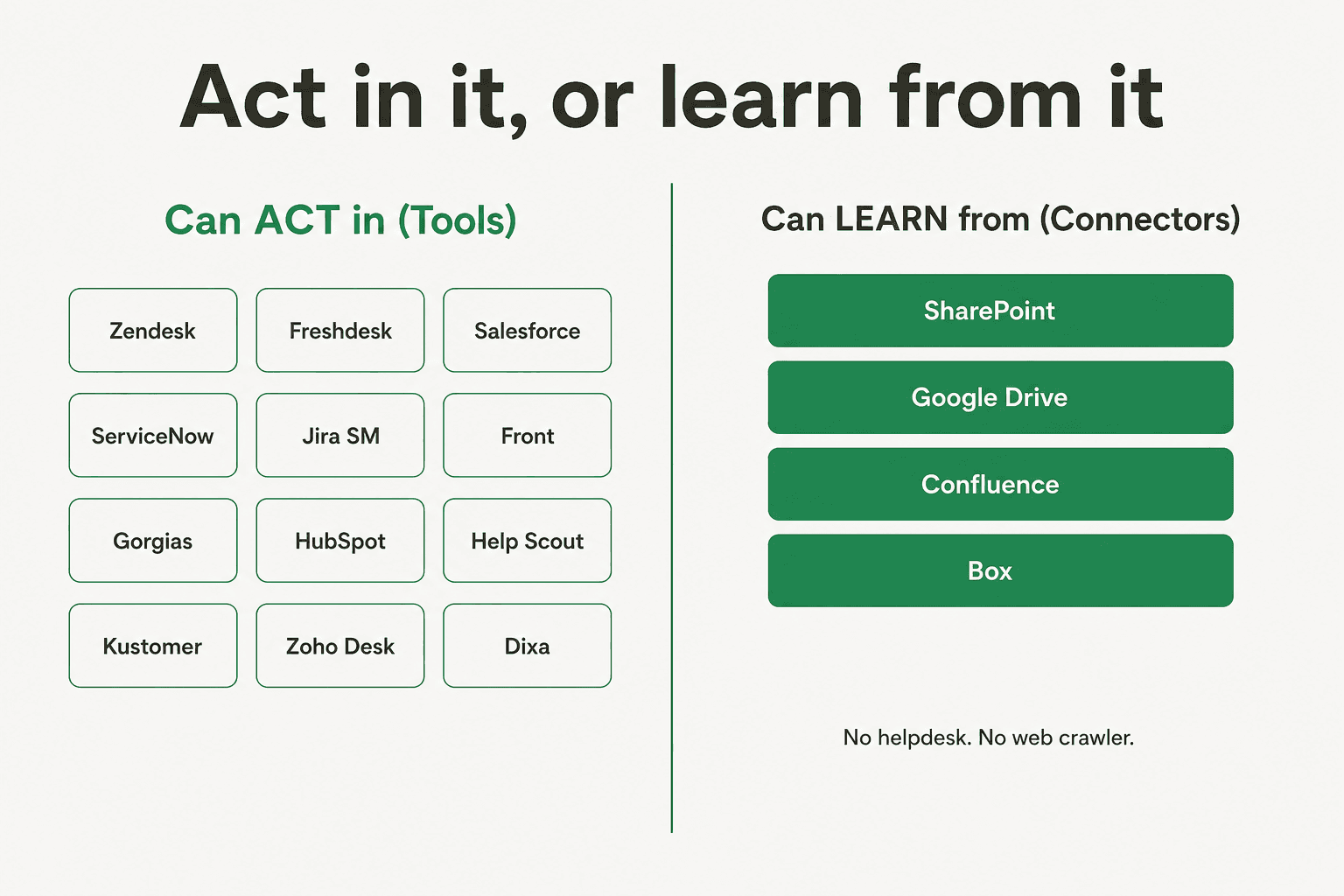
There's a second gap in that same table that's easy to miss: there's no public website crawler either. You cannot point Ema at your help centre URL and index it. Confluence covers internal wikis; everything else is files in folders.
To be scrupulous about this, Ema's marketing page does claim otherwise. The support assistant page says "connect your helpdesk, and Ema will ingest past tickets, learning patterns from previous resolutions," and the Moneyview case study describes training on millions of past tickets. So the capability may well exist as a services-delivered import. It just isn't in the product documentation, and the ingestion pipeline described there, list files, download, extract text, chunk, embed, is file-shaped from end to end. If ticket training matters to you, get the mechanism in writing.
Three: the rehearsal is a spreadsheet you build yourself
Ema does have an evaluation feature. You upload a CSV of test cases and map its columns through POST /datasets and POST /datasets/{id}/mapping. Your own historical tickets are explicitly allowed as content. But there's no importer, no connector, no one-click replay: the export and the cleaning are your job.
Scoring is a rubric-based LLM judge, and Ema says so twice, noting that rubric_scores is the only score an eval run produces. The deterministic assertions field is stored but, in Ema's own words, no shipped code evaluates it.
The dry run has a sharper edge. It mocks tool calls by echoing back the arguments rather than returning realistic data, which Ema concedes "proves wiring and argument-filling, not output handling." It's API-only, with no toggle in the chat composer. And the testing docs carry this line: "a dry run that reaches a send-email node sends a real email."
I don't think that's negligence. It's an honest doc telling you the shape of the tool. But if you've ever watched an AI agent talk to a real customer before you were ready, that sentence lands differently.
Four: you can't touch it without a sales call
There is no signup, no trial, no sandbox. The page source contains no "sign up", "free trial" or "log in". The route is a five-field HubSpot demo form. /pricing redirects to it.
Ema calls its model outcome-based with "no unused module, no tokenmaxxing", which is a good pitch, but there is no rate anywhere to check it against. And the delivery roster leans on system integrators: PwC, KPMG, Wipro, NTT Data and Teleperformance are named delivery partners. For a 200-person support org that's normal. For a 15-person team, it's a long road.
Independent verification is thin too. Ema's G2 profile is claimed but shows 0 reviews and an NPS of 0. There's no Capterra or Trustpilot listing. Its two Hacker News submissions drew zero comments between them. That's typical for enterprise vendors that sell entirely through demos, but it does mean you'll be relying on references rather than a review corpus.
What I actually checked for
I've been building integrations on this stuff for a while, and there's a thing I've learned to distrust: every vendor's accuracy number is measured on a corpus the vendor chose.
Here's the number that changed how I think about it. On a real-traffic trial for a German online jewellery retailer running about 1,000 tickets a month on Zendesk and Shopify, we measured 93% triage accuracy and 100% spam detection with zero false positives on the 22% of the inbox that was spam. Warranty claims produced 96.4% useful drafts. A good result by any reading.
We also measured a 7% factual error rate, and found that only 12% of drafts went out unedited.
The 88% that were "directionally right" and the 7% that were factually wrong were the same drafts. A rubric-scored spreadsheet grades the 88%. Only a replay over the tickets real customers actually sent surfaces the 7%. My colleague Amogh Sarda has a phrase for the failure mode this prevents: "if hard-fail it's silent-failure class (worst class for trust)."
So that's the ladder I graded everyone on.
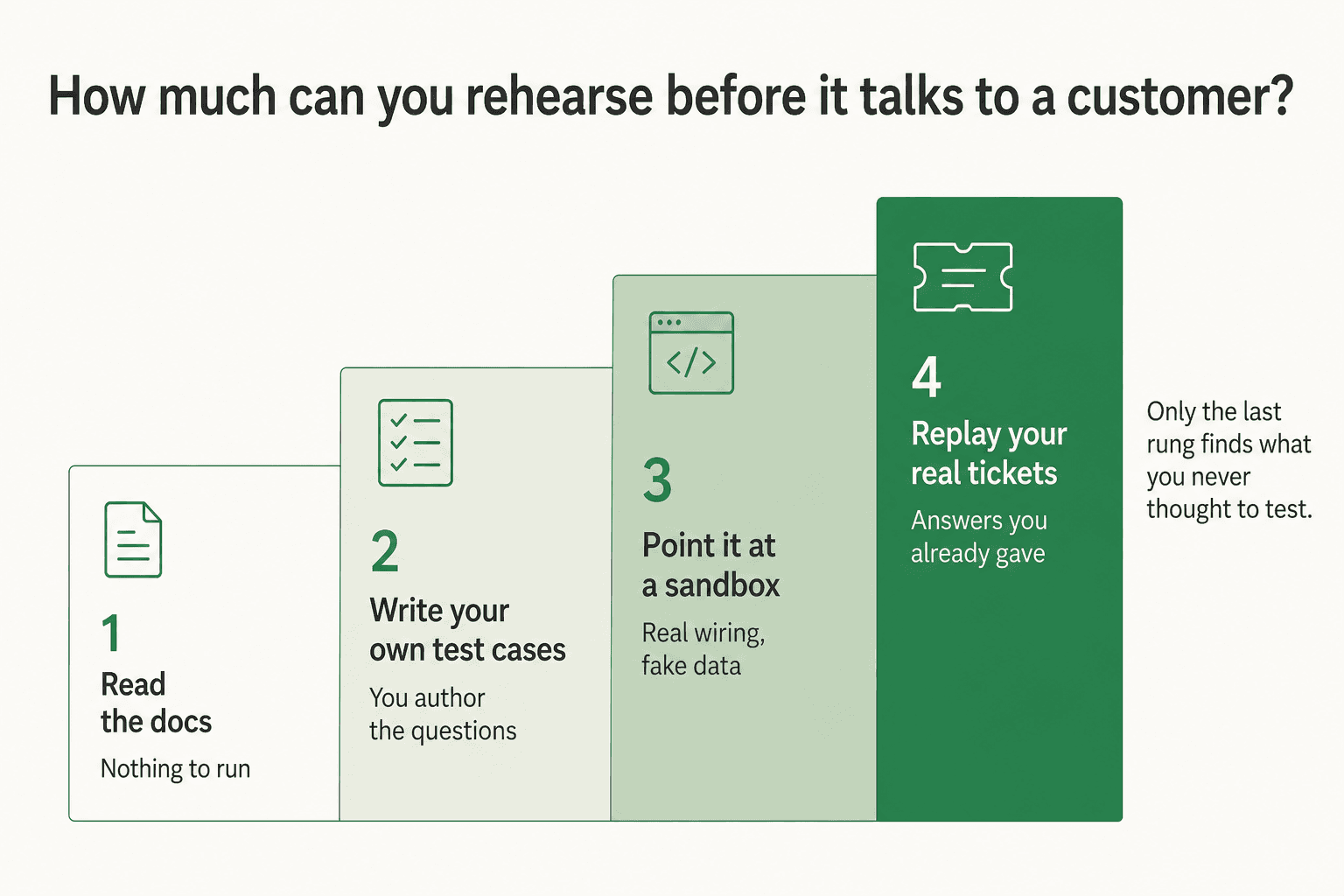
Rung four is the only one that finds the question you never thought to write down. A CX lead at a DTC supplements brand running about 7,000 Gorgias tickets a month put the buyer's side of it better than I can:
"The AI will never be able to answer 100% of the questions, but if it tries and just answers 'sorry I don't know this,' I cannot go and check all my 7,000 tickets to see if the AI actually made a good answer, then the point is a little bit gone. I need an AI who is only handling the tickets that it's confident to handle and all the other ones, leave them alone."
Alongside rehearsal, I scored each tool on knowledge sources, helpdesk coverage, whether a price exists in public, security posture, and how much independent review evidence a buyer can actually read. If you want the wider category rather than just Ema replacements, our roundups of the best AI agents and AI help desk software cover more ground.
Pick your shortlist
Different teams leave Ema for different reasons. Pick the one that sounds like you.
Which Ema alternative fits your problem?
Pick the reason you're actually looking.
eesel AI
The only tool of the nine whose docs describe replaying your own resolved tickets, finding the gaps by theme, filling them and re-running before you go live. Everyone else either hand-writes test cases or documents nothing.
Closest runner-up: Maven AGI, whose interaction-log ingestion is documented by OpenAI rather than by Maven.
eesel AI
Free usage, no card, no demo gate, and Gridwise proved out results inside a seven-day trial. Crescendo is the fastest of the sales-led options at a stated four weeks, and Leena AI quotes 45 days.
Avoid if you're in a hurry: Espressive, where reviewers report roughly six months to configure and launch well.
eesel AI or Atomicwork
These are the only two publishing real numbers. eesel is $0.40 per ticket handled with no platform fee. Atomicwork starts at $25,000/year for 25,000 credits, or $1 to $3 per outcome depending on type. Crescendo publishes $1.25 per solve but adds a $2,900 monthly service fee, which is $34,800 a year before a single solve.
Ema, Decagon, Sierra, Ada, Maven AGI, Leena AI and Espressive publish nothing.
Leena AI or Atomicwork
Leena ships pre-built IT, HR and finance colleagues and claims 45 days to go-live across 500+ enterprises. Atomicwork is the better call if you want to run an agent layer on top of ServiceNow or Jira Service Management without migrating off them.
Also worth a look: eesel, if the same team also owns a customer-facing queue.
Maven AGI or Sierra
Maven carries the deepest published stack here: SOC 2 Type 2, ISO 27001, 27017, 27018, 27701, 42001, HIPAA, PCI DSS, GDPR and CCPA. Sierra's badge row adds FedRAMP and EU AI Act.
Worth knowing: Ema itself is strong here, so if compliance is the only blocker, it may not be the thing to solve by switching.
The nine alternatives at a glance
Ema is in the first row so you can read the rest against it.
| Tool | Best for | Focus | Trains on your tickets | Rehearse pre-launch | Billing unit | Price published | Self-serve | Helpdesk connectors | Security | Funding |
|---|---|---|---|---|---|---|---|---|---|---|
| Ema (baseline) | Multi-department AI workforce | Internal-first | Marketing yes, docs no | CSV + LLM judge | Outcome-based | No | No | 12 as action tools | SOC 2 II, ISO 27001/27701/42001 | $61M+ |
| eesel AI | Tier-1 live this week | External + internal | Yes | Replay past tickets | Per ticket handled | $0.40/ticket | Yes, $50 free | 8 native | SOC 2 II in progress, GDPR | Not disclosed |
| Decagon | High-volume consumer CX | External | Not documented | Simulated conversations | Conversation or resolution | No | No | Zendesk, Freshdesk | Trust centre only | $250M Series D |
| Sierra | Fortune 500 brand agents | External | As build input | Scenarios, source unstated | Outcome, negotiated | No | No | Salesforce, Genesys | SOC 2, ISO 27001/42001, FedRAMP | $950M Series E |
| Ada | Multilingual self-service | External | No | Hand-written test cases | Conversation volume | No | No | Zendesk, Salesforce, ServiceNow | SOC 2, HIPAA, PCI DSS, AIUC-1 | ~$190M |
| Maven AGI | Agent layer over your helpdesk | External | Interaction logs, per OpenAI | Nothing documented | Not disclosed | No | No | Zendesk, Salesforce, Freshdesk | SOC 2 II, ISO 27001/42001, HIPAA | $78M |
| Crescendo | AI plus outsourced humans | External | No | Draft mode + rollback | Per solve | $1.25 + $2,900/mo | No | Zendesk, Freshdesk, Gorgias | SOC 2 II, ISO 27001, HIPAA | $50M |
| Leena AI | Pre-built HR and IT colleagues | Internal | No | Nothing documented | Per employee | No | No | ServiceNow, Salesforce | SOC 2, ISO, HIPAA | ~$40M |
| Atomicwork | Agent layer over ITSM | Internal | Not disclosed | Named, mechanism unpublished | Credits or outcomes | From $25,000/yr | No | ServiceNow, Jira SM | SOC 2, ISO 42001, HIPAA | ~$40M |
| Espressive | Enterprise employee self-service | Internal | No | Nothing documented | Per employee | No | No | ServiceNow, Jira | Not published | ~$53M |
1. eesel AI
Best for: support teams that want tier-1 automation running this week without a procurement cycle.
I work on eesel, so treat the enthusiasm accordingly, but the reason it leads this list is the specific thing this post is about rather than a general claim of being better.
eesel installs into the helpdesk your team already runs and reads three things on day one: your past resolved tickets, your help docs, and your team's workflows. That last sentence is doing the work. Most tools on this list read your help centre. Reading the tickets is what lets it answer the way your team answers, including the exceptions nobody ever wrote an article about.
Rehearsal check. This is the strongest answer of the nine and it's the product's own wording: run simulations on your past tickets, see how it handles each theme, find the gaps, fill them, re-run, and roll out only when you're confident. It pairs with confidence-based routing, so a low-confidence answer drafts instead of sending. A small-business founder described the loop on G2 better than our own marketing does: "when we re-test, it correctly incorporates the coaching."
Pricing. $0.40 per ticket handled, published on the pricing page. No platform fee, no per-seat cost, no minimum. 100 tickets is $40 a month, 1,000 is $400, 2,500 is $1,000. Annual prepay takes 25% off. Enterprise adds a flat $1,000/month for SSO, HIPAA and a BAA. $50 of free usage to start, no card. One honest note: tickets bill regardless of outcome, so it's per handled ticket, not per deflection.
Where it falls short. SOC 2 Type II is in progress rather than certified, monitored through Vanta, and there's no ISO 27001. Against Maven AGI or Sierra in a procurement review, that's a real gap. HIPAA and SSO sit behind the Enterprise fee.
The integration list is narrower too. Zendesk, Freshdesk, Salesforce, Jira Service Management, Front, Gorgias, HubSpot and Help Scout are native. Kustomer, ServiceNow and Zoho Desk are not, and Ema covers all three.
Verdict. Take it if your answers live in your ticket history and you want to see the agent work before you trust it. Skip it if you need ISO 27001 on paper this quarter, or if your helpdesk is ServiceNow. Proof point: Gridwise resolved 73% of tier-1 requests in month one, with results visible inside a seven-day trial, and Smava runs a fully automated German-language agent over 100,000+ Zendesk tickets a month.
2. Decagon
Best for: high-volume consumer brands replacing a brittle flow-builder with a real agent runtime.
Decagon is the best-funded pure-play CX agent company on this list, at $250M Series D and a $4.5B valuation as of January 2026. Its authoring model is the interesting part: Agent Operating Procedures, written in natural language, compile down to code. One runtime spans chat, voice, email, SMS and custom API surfaces.
Rehearsal check. Partial. The Optimize phase documents simulated conversations, unit testing and versioning before production, plus A/B testing across agent versions. But nothing says the simulated conversations come from your history, and the A/B test runs on live traffic, which makes it a post-launch instrument. Founder Jesse Zhang frames the whole area as an evals problem:
"Every AI agent needs a rigorous evaluation engine. You can't just test responses. We evaluate entire agent workflows to ensure real performance at scale"
Which I agree with. The open question is whose conversations the engine runs on.
Pricing. Nothing published; /pricing is a 404. The demo form gates on monthly ticket volume in four bands, so volume is the pricing dimension. Decagon does publish the philosophy: you pick per-conversation, charged whether or not it resolves, or per-resolution at a higher unit rate. Its own glossary is admirably candid that per-resolution billing creates grey areas over what counts as resolved.
Where it falls short. No self-serve and no published rate of any kind, so you can't estimate cost before a sales cycle. Integration coverage is undocumented publicly beyond Zendesk and Freshdesk. G2 sits at roughly 4.9 across about 18 reviews, which is a strong score on a small base.
Verdict. Take it if you're doing serious consumer volume and want the most credible independent CX agent runtime money can buy. Skip it if you need to model cost before committing, or if the answers you need are buried in ticket history rather than documentation. Proof point: Duolingo reports 80% deflection and Chime 70% resolution across chat and voice.
3. Sierra
Best for: Fortune-500-scale brands that want a code-first agent platform with outcome-aligned billing.
Sierra raised $950M in May 2026 at a valuation above $15B and says it serves over 40% of the Fortune 50. Ghostwriter is the standout: feed it SOPs, call transcripts, whiteboard photos and plain-English goals, and it builds the agent from them. That's the closest anyone here gets to learning from your history without calling it that.
Rehearsal check. Scenarios yes, your history unclear. The Agent SDK lists "Simulations, verify agent behavior across a wide range of scenarios; catch regressions before production", and voice gets its own simulation suite. But Sierra never states whether those scenarios are authored or replayed, and its τ-voice benchmark work points toward synthesised conversations. Separately there's a genuine sandbox story for safe tool execution, which is a different thing from backtesting.
Pricing. Outcome-based, quote-gated, no figures. Sierra's own explainer is worth reading because it's unusually honest: outcome criteria are negotiated per contract, and real invoices are often blended, since "routing or greeter-style interactions may align better with consumption-based pricing."
Where it falls short. For all the outcome messaging, there's no rate, no minimum and no contract floor in public, and Sierra concedes the model is "more complex than seat-based or consumption pricing." /security and /trust both 404, so the compliance badge row on the homepage is the primary source. G2 sits around 4.1 to 4.3 across 17 reviews, the lowest of the well-funded set. And Sierra publishes no containment or resolution rate at all.
Verdict. Take it if you're an enterprise brand with engineers who want an SDK and a vendor that will co-design the outcome contract. Skip it if you're mid-market, because the contracting overhead alone will outweigh the gain.
4. Ada
Best for: large consumer brands wanting an AI layer over an existing helpdesk rather than a new one.
Ada is the Toronto veteran of this category, roughly $190M raised, and its documentation is the most transparent of any vendor here. That transparency is why it scores badly on my test: Ada tells you exactly what it does and doesn't do, and most vendors just don't say.
Rehearsal check. Simulations exist, and the test cases are hand-authored. Ada's docs spell out the three required fields per case, a name, a customer inquiry and a scenario, all written by you, and Ada lists "manual test case creation" as a limitation itself. The documented limits are worth knowing: web chat, email and voice only, up to 40 turns, pass/fail evaluations, production configuration only, 3,000 simulations a day. Plus this warning, verbatim: "Actions are not mocked, they execute against live systems."
Pricing. Fully quote-gated as of August 2026, with no currency symbol anywhere on the pricing page, just a contact-volume picker running to over 100 million. Worth noting: Ada's previously published fit floor of 300,000 annual conversations was removed from that page between mid-July and early August 2026, so don't quote it as current.
Where it falls short. Ada's knowledge inputs are authored content: a connected knowledge base, a website crawl, articles written inside Ada, and the Knowledge API capped at 50,000 articles. Your ticket backlog isn't among them. Past conversations reach the agent only through Coaching, where a human reads a transcript and writes an instruction. Also worth framing carefully: Ada scores 4.6 on G2 across 173 reviews, the largest review base here, but 1.8 on Trustpilot across 20, which is end users rating deployed chatbots rather than buyers rating the platform.
Verdict. Take it for multilingual self-service at genuine scale on top of Zendesk or Salesforce, where a big documented knowledge base is your real asset. Skip it if you were hoping to backtest against history. Proof point: Tilt reports 84% automated resolution on chat. Our Ada alternatives piece goes deeper on the trade-offs.
5. Maven AGI
Best for: mid-market CX teams that want an agent layer over Zendesk or Salesforce without changing helpdesk.
Maven AGI has the deepest compliance stack of the nine and the most interesting training story. Per OpenAI's own write-up, Maven ingests both knowledge bases and interaction logs from Salesforce, Zendesk, Freshdesk and Slack. Interaction logs is the closest any competitor here gets to eesel's ticket-history training, so I want to give it full credit. The catch is that the claim is sourced to OpenAI's page, not Maven's own site, which never restates it.
Rehearsal check. Nothing documented. This is the emptiest answer of the nine: no simulation, sandbox, dry run, shadow mode or scenario testing appears anywhere. The word "test" shows up only in outcome marketing copy. The single pre-purchase path is a demo.
Pricing. No pricing page at all, on any path, and the sitemap contains zero pricing URLs. One trap to avoid: Maven's glossary quotes $0.99 to $2.00 per ticket and $0.50 to $2.37 per resolution, but those are its framing of market benchmarks, not its own rate card.
Where it falls short. Roughly 16 G2 reviews against a 2023 founding is a thin independent record for a risk-averse buyer. Combined with no documented rehearsal step and no published rate, you're trusting the implementation rather than verifying it before you commit.
Verdict. Take it if compliance is your gating requirement and you want SOC 2 Type 2 plus five ISO certificates including 42001 on one contract. Skip it if you need to see the agent work before launch. Proof point: Exclaimer reports 18% lower ticket volume and 10+ hours saved weekly.
6. Crescendo
Best for: brands that want the AI and the outsourced support team from one vendor.
Crescendo is the odd one out, and deliberately so. It's a managed service, not pure software: AI assistants across voice, chat and email backed by its own human agent workforce, acquired along with the BPO PartnerHero. Someone else owns the outcome.
Rehearsal check. No historical replay, but genuine change safety, which I want to be fair about. Version control gives you draft mode where the live version stays read-only, version history with release notes, diff comparison between any two versions, and instant rollback through a review gate. That's better change hygiene than most of this list. What's missing is a backtest: testing appears under Best Practices as advice, "consider testing with sample queries", not as a feature.
Pricing. The most concrete of the sales-led set. The pricing page shows $1.25 per solve plus a $2,900 starting monthly service fee. Those stack, so the fee alone is $34,800 a year before a single solve. The Managed AI and Superhumans tier publishes no price. And "solve" is never defined on the page, which matters for a ticket that deflects then escalates.
Where it falls short. For a vendor headlining over 99.8% accuracy, there's almost no independent way to check it: its G2 profile shows zero reviews. You'll be relying entirely on references.
Verdict. Take it if you'd otherwise be hiring a BPO anyway and want one throat to choke. Skip it if you have a support team you're happy with, since you'd be paying for capacity you already have. See our Crescendo pricing breakdown for the full cost model.
7. Leena AI
Best for: large enterprises deflecting L1 IT and HR tickets before they reach the service desk.
If what drew you to Ema was the HR-and-IT-employee pitch rather than the support one, Leena AI is the closest like-for-like on this list. It ships pre-built, voice-enabled AI colleagues with names, Iris for IT, Harrison for HR, Fiona for finance, that answer employee questions and execute transactions across Workday, ServiceNow, SAP, Oracle and Salesforce.
Rehearsal check. Nothing documented. What Leena sells instead is a managed 45-day go-live, pre-built, pre-trained, pre-integrated, plus runtime guardrails: no irreversible action without a check, no escalation without a manager. So the rehearsal is the implementation engagement rather than a feature you drive.
Pricing. Quote-gated; leena.ai/pricing 404s and the two pricing URLs are lead forms. In place of a price Leena leads with ROI math: 4 to 10x measured return and roughly a three-month payback.
Where it falls short. G2 reviewers consistently flag heavy dependence on Leena's implementation team and long customisation cycles, which is the flip side of the pre-built pitch. Knowledge Studio connects to SharePoint, Confluence, ServiceNow, Drive, Box and Snowflake and inherits source permissions, which is a nice touch Ema doesn't match, but there's still no documented ticket-history training.
Verdict. Take it for a big internal deployment where you want a vendor to own the go-live and you have the headcount to work with them. Skip it if you want to self-serve, or if the same team also runs a customer queue and you'd rather one set of AI teammates covered both. Proof point: Leena claims 45 days to go-live, 70%+ of tickets auto-resolved, and 500+ enterprises covering 20M+ employees, with the largest independent review base here after Ada at 4.6 across 151 G2 reviews.
8. Atomicwork
Best for: IT orgs that want an AI layer over ServiceNow or Jira Service Management today, with the option to replace it later.
Atomicwork pairs Atom, a universal AI coworker living in Slack, Teams, browser, email and portal, with role-scoped coworkers governed through a control plane. Founded in 2022 by ex-ManageEngine and Freshworks people, which shows in how the product is shaped.
Rehearsal check. Partial and unpublished. The governance pillar promises you can "test every Coworker's operating procedure, skills and tools before production", and the overview lists pre-production testing as a capability. But no mechanism is described anywhere: nothing says whether that replays your tickets, uses scenarios you write, or is simply a staging environment. A gate exists; its shape isn't public.
Pricing. Refreshingly concrete for this category. The pricing page shows Professional from $25,000/year including 25,000 credits, five AI coworkers, and $249/month for each additional one. Outcome pricing runs $1 per knowledge outcome, $2 per access outcome and from $3 per service resolution, each with an annual minimum. The bring-your-own-ITSM option is the clever bit: run the AI workforce on top of ServiceNow or Jira Service Management with no migration and no platform fee.
Where it falls short. The independent review base is very thin: roughly one recent G2 review and a single Capterra review from April 2025, against ServiceNow ITSM's 1,700+ on G2. The credit-to-outcome conversion above the $25,000 floor is also opaque. And the headline dashboard figures on the homepage are illustrative marketing numbers rather than audited benchmarks.
Verdict. Take it if you run ServiceNow or JSM and want agentic automation without a migration project, which is the cheapest way into an AI IT help desk on this list. Skip it if you need a deep independent track record. Proof point: Pepper Money reports 75% lower MTTR and replaced ServiceNow in six weeks; Zuora cut ticket volume 50% across 15 offices.
9. Espressive
Best for: ServiceNow-shop IT service desks wanting a stronger deflection layer in front of ITSM.
One thing to state before anything else, because it changes what you're actually buying: Espressive was acquired by Resolve on 10 September 2025. espressive.com now serves Resolve content, and Barista is being folded into Resolve's lineup, chiefly RITA for the employee assistant and Jarvis for workflows. Evaluating "Espressive" in 2026 means evaluating Resolve.
Barista's pedigree is real: founder Pat Calhoun was an SVP and GM at ServiceNow, and the product was built specifically to sit in front of ServiceNow ITSM as the system of record. Its mechanism is ML-based knowledge-base ingestion with auto-identification of ServiceNow KB articles.
Rehearsal check. Nothing documented. No simulation, sandbox, dry run or scenario testing appears anywhere across the Espressive or Resolve material, and the only pre-purchase route is a demo request.
Pricing. Quote-gated, sales-led, and charged on employees in scope, meaning the whole covered population rather than active users, sold as a platform licence plus paid add-ons that scale with integration and automation scope. There is no public figure of any kind and no self-serve tier.
Where it falls short. The brand, feature pages and roadmap are all in transition after the acquisition, which is a genuine risk on a multi-year contract: you're signing for Barista and receiving Resolve's roadmap. No SOC 2, ISO or HIPAA claim was documented for either entity in this pass, so treat compliance as unverified and ask directly. The independent review evidence is also sparse, with a G2 profile that won't render a public star average.
Verdict. Take it if you're a large ServiceNow shop, already comfortable with Resolve, and buying the deflection layer rather than the brand. Skip it if you need clarity on what the product will be called in 18 months. Resolve's own figures for the combined platform claim up to 90% fewer manual tickets and a 50% ticket-volume reduction in six months, and Espressive was named a Forrester Leader in 2024.
Where Ema is still the right answer
I've spent most of this post on where Ema doesn't fit a support queue, so let me be straight about where it does.
If your problem is that HR, IT and finance each want their own AI and you'd rather not buy three platforms, Ema is built for exactly that, and the 27-role catalogue is a real advantage rather than a distraction. If you're running a security review that needs ISO 42001 alongside SOC 2 Type II, Ema clears a bar most of this list doesn't. If you need air-gapped or on-premise deployment, it's one of the few here that offers it. And if you're a Wipro-scale enterprise with an SI already engaged, the delivery-partner model is a feature, not friction.
The read-across is really about scope. One buyer we work with, a CFO at a large SaaS company, demanded two months of reduced pricing during implementation and framed it as standard practice: "this is not just for you, but for any tech vendor." A universal platform means adopting a maintenance surface across four departments. Karel at GENERAL BYTES put the opposite instinct plainly: "We wanted something that we would not have to maintain." Neither is wrong. They're just different problems, and customer service automation is only one of them.
If the job in front of you is the support queue, buy for the support queue.
Try eesel for the support queue
If you got here because Ema stopped talking about customer support, the specific thing to check on any replacement is whether it can read the tickets your team already answered.
eesel plugs into Zendesk, Freshdesk, Gorgias, Front, Help Scout, HubSpot, Salesforce or Jira Service Management, learns from that ticket history plus your docs, and then lets you replay it across your past tickets to see coverage by theme before it sends a single live reply. Confidence-based routing keeps the uncertain ones as drafts. It's $0.40 a ticket with no platform fee, and $50 of free usage without a card or a sales call, which is enough to run a real simulation over your own history this afternoon.

The honest framing: if you need ISO 27001 signed off this quarter, or your helpdesk is ServiceNow, we're not your answer and one of the eight above will be. But if your answers live in your ticket history, start with the simulation and let the result decide.
Frequently Asked Questions
Does Ema AI do customer support, or is it an HR and IT product now?
How much does Ema AI cost?
/pricing URL redirects to a demo form, there is no free trial and no self-serve signup, so every quote comes through sales. Ema describes the model as outcome-based. If a published rate matters, eesel at $0.40 per ticket and Atomicwork at $25,000/year are the only two here with real numbers on the page.Can Ema AI train on my past support tickets?
Which Ema AI alternative is best for an internal IT or HR service desk?
What should I ask a vendor before buying any AI support agent?


Article by
Rama Adi
Rama is a software engineer at eesel AI with two years of experience writing about B2B SaaS, AI tools, and customer support technology. Based in Bali, Indonesia, he brings a developer's perspective to product comparisons — cutting through marketing copy to what the integrations and APIs actually do.