Crescendo AI alternatives in 2026: 8 options with real prices

Riellvriany Indriawan

Katelin Teen
Last edited August 16, 2026

Why I keep getting asked about this
I work eesel's support queue, so I spend my days inside the exact problem every vendor on this list is selling against. I have also watched a confident-sounding bot hand a customer an answer that was simply wrong. That is the reason every rollout now gets replayed against a company's historical tickets before it goes anywhere near a live conversation.
The job also means I hear a lot of switching stories. eesel has been putting AI agents on live support queues for years, across customers like Smava running over 100,000 German-language tickets a month through a fully automated Zendesk agent, and Gridwise, where 73% of tier-1 requests were resolved in the first month. Almost every one of those conversations lands in the same place. People rarely leave a vendor because the AI was bad. They leave over the shape of the deal.
The sharpest version of that I have heard came from a hardware support team I spoke to who had to move off their incumbent AI tool. Nothing about the tool was broken:
"Their vendor changed how they do business, so they're being forced to replace it. Not a pricing issue, purely a vendor-forced migration."
A B2B hardware support team migrating off an incumbent AI vendor, from eesel's internal customer call notes
Worth holding onto that one, because it comes back around to Crescendo.
What Crescendo actually is, and what changed
Fairness first. Crescendo is a real business doing a real thing well.
This company was assembled in a hurry, and at scale. In October 2024 it acquired the BPO PartnerHero, which brought in roughly 3,000 human support professionals and 200-plus customers at a point when Crescendo itself was about 20 people. The same announcement carried $50 million in venture financing at a $500 million post-money valuation, led by General Catalyst. Then in July 2026, Alorica founder Andy Lee took over as CEO and founding CEO Matt Price moved to strategic advisor.
Crescendo's own site claims 150+ brands and better than 99.8% accuracy, plus going live in four weeks. The published customer results are specific enough to check: Rachio reports 65% instant resolutions and 95% CSAT across a million-plus users, while Lovepop went from a seven-hour email reply time down to 18 seconds. Those are good outcomes by any measure.
Now here is the part that matters if you are shopping alternatives. Back in 2024, Crescendo described itself as neither a standalone AI tool nor a BPO, but a "vertically integrated Contact Center BPO service with outcome-driven pricing." The 2026 boilerplate from the same company reads "AI-native CX platform, built AI-native from day one," and the 3,000-person services arm gets reframed as operator expertise rather than a service. BPO and augmented AI, as words, are gone.
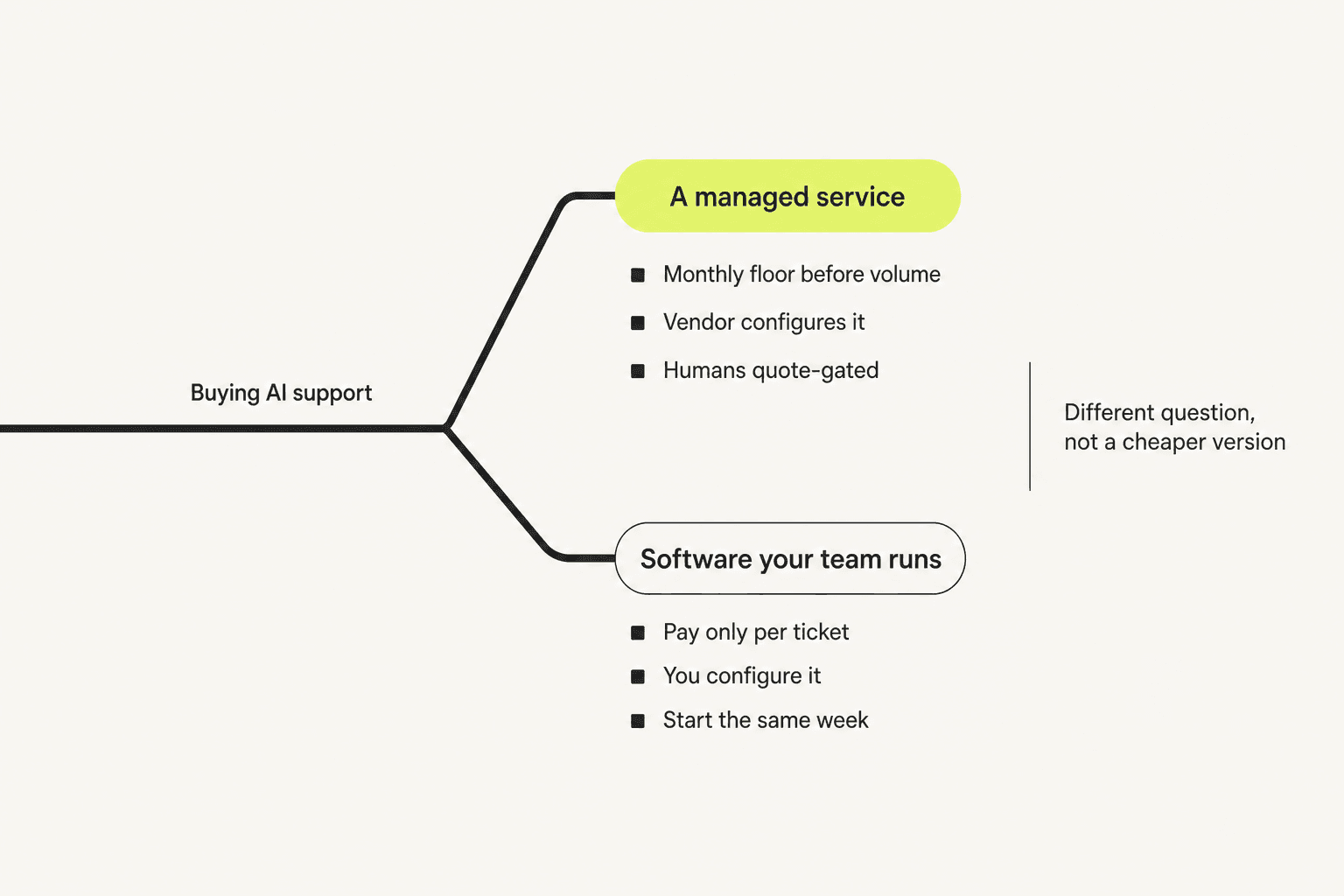
The commercial shape did not follow the rebrand, though. Still no self-serve signup. The humans are still quote-gated, and Crescendo staff still do the configuration for you. All fine, as long as you know that is the thing you are buying.
Why teams look for Crescendo alternatives
Four reasons come up, and roughly in this order.
The $2,900 floor before you resolve anything
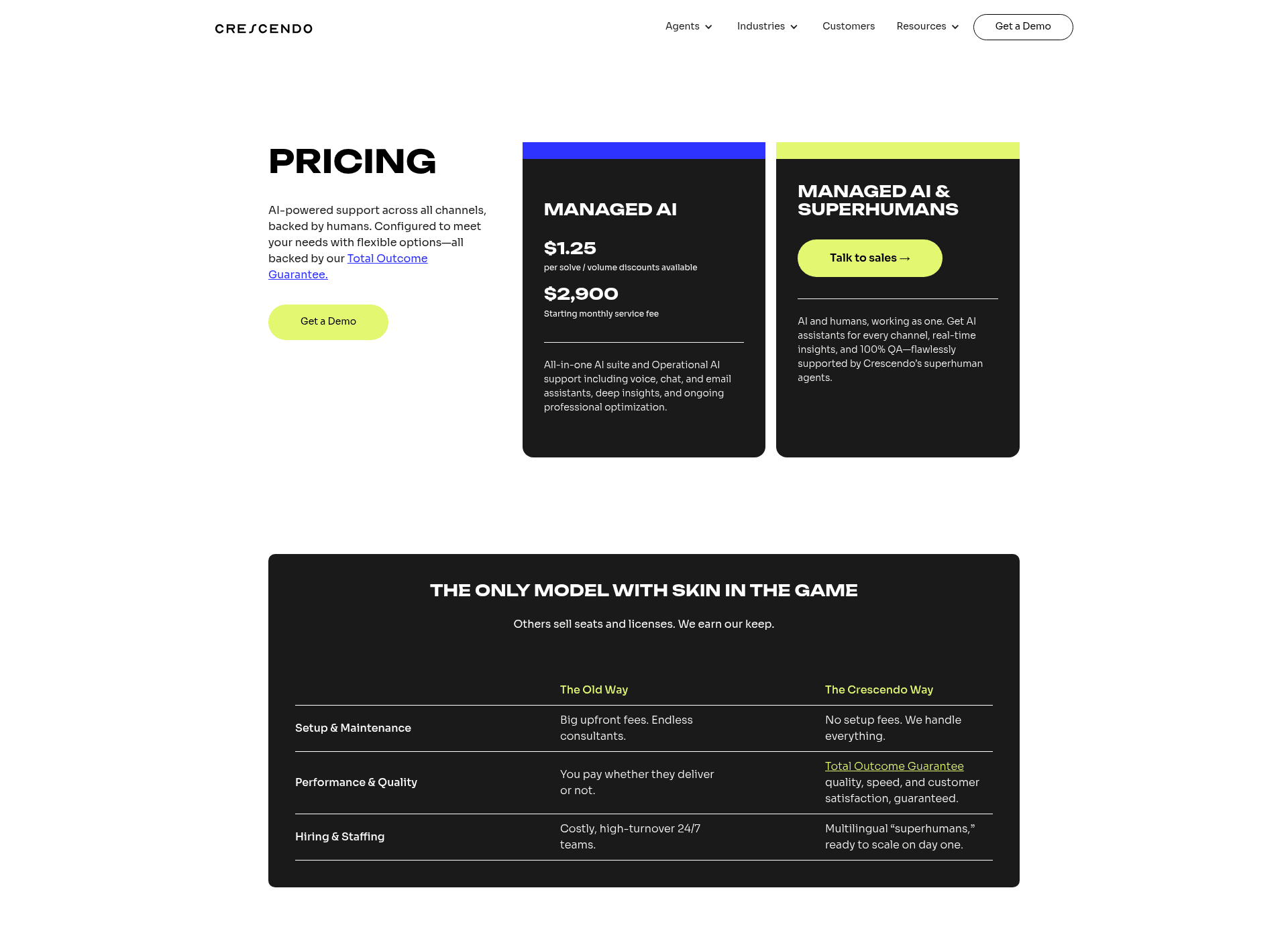
This is the big one. On the pricing page, two figures sit in the same card with no "or" between them: $1.25 per solve / volume discounts available and $2,900 Starting monthly service fee. That word "Starting" makes it a floor rather than a rate. What the fee actually buys is never itemized.
At the floor, that comes to $34,800 a year before a single ticket gets answered. What it does to your effective unit cost is entirely a question of volume:
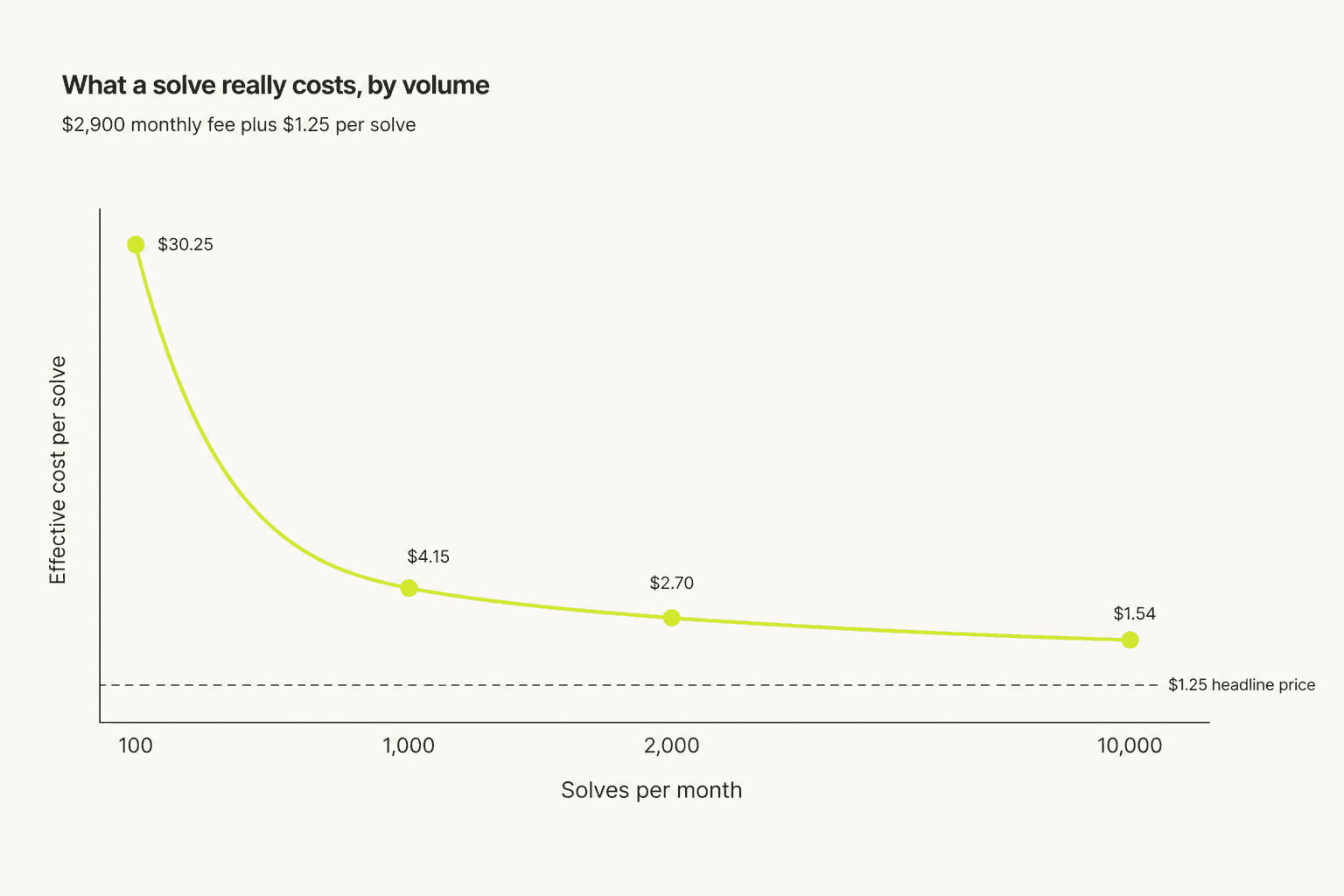
The curve never quite touches the headline number. Crescendo's demo form starts its volume bands at 0 to 100 monthly tickets, and down there the fee on its own works out to $29 a ticket, before the per-solve charge. To their credit, Crescendo's own comparison blog concedes the product is overkill for small teams and expensive at low volume. That is a straighter admission than most vendors bother with.
The unit is undefined
"Solve" appears exactly once on the pricing page, in the card's label. No tooltip, no footnote, nothing in a glossary. So nothing tells you what happens on a ticket that gets deflected and then escalated anyway, or whether a conversation that starts on chat and finishes over email counts once or twice.
That matters more than the number does, since every vendor meters something slightly different:
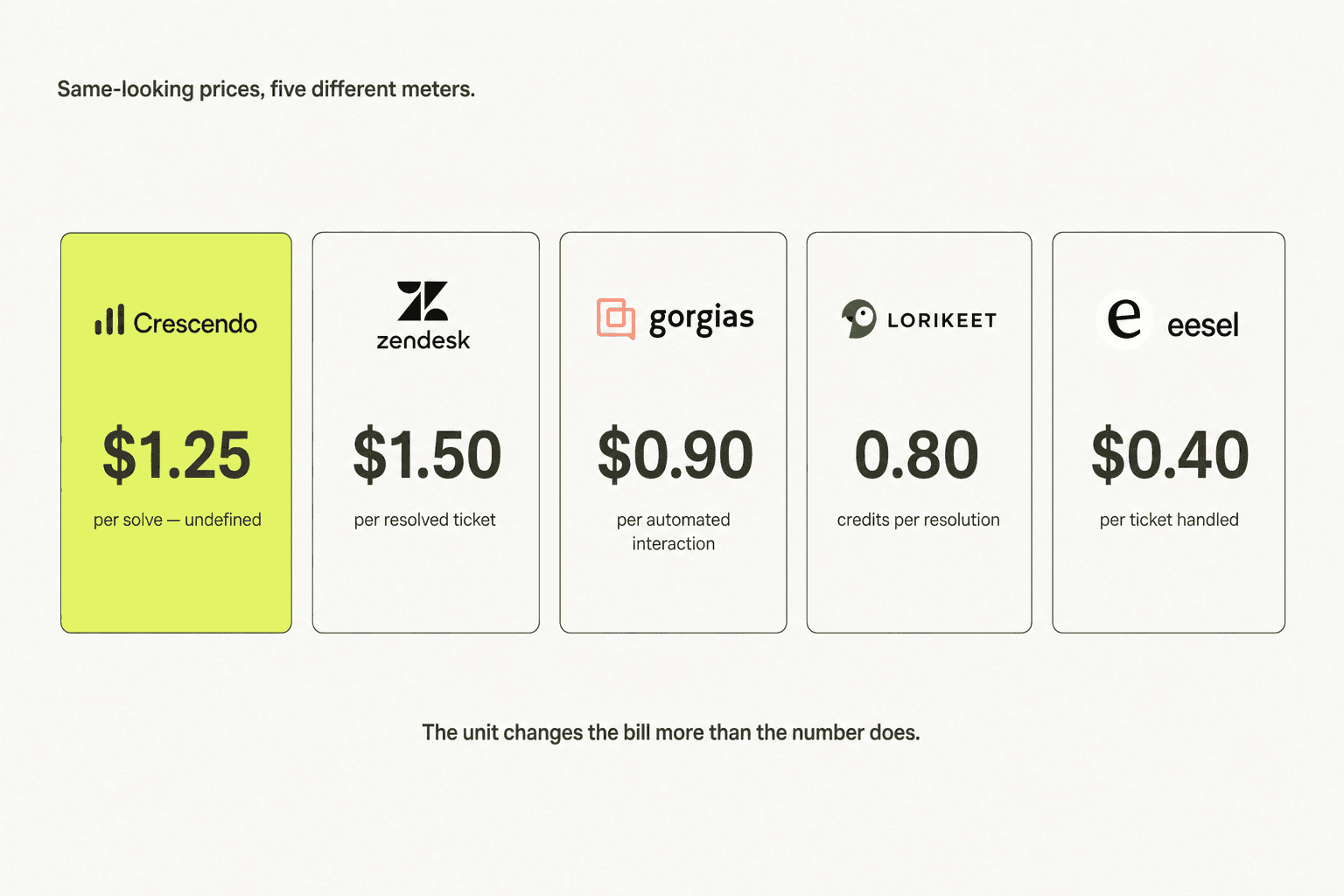
Their docs define a Zendesk automated resolution as a request "successfully resolved by an AI agent, without any escalation to a human agent." Over at Gorgias, an automated interaction is one the customer does not need a human for within 72 hours. An eesel task is any ticket handled, resolved or otherwise. Same ticket volume, three quite different bills, and not one of them is the same thing as a solve.
It does not learn from your past tickets
This one caught me off guard. Crescendo's own documentation lists nine knowledge connectors, with the sources being help centers, uploaded files, custom instructions and the bot's prior conversations. Resolved ticket history is not on the list.
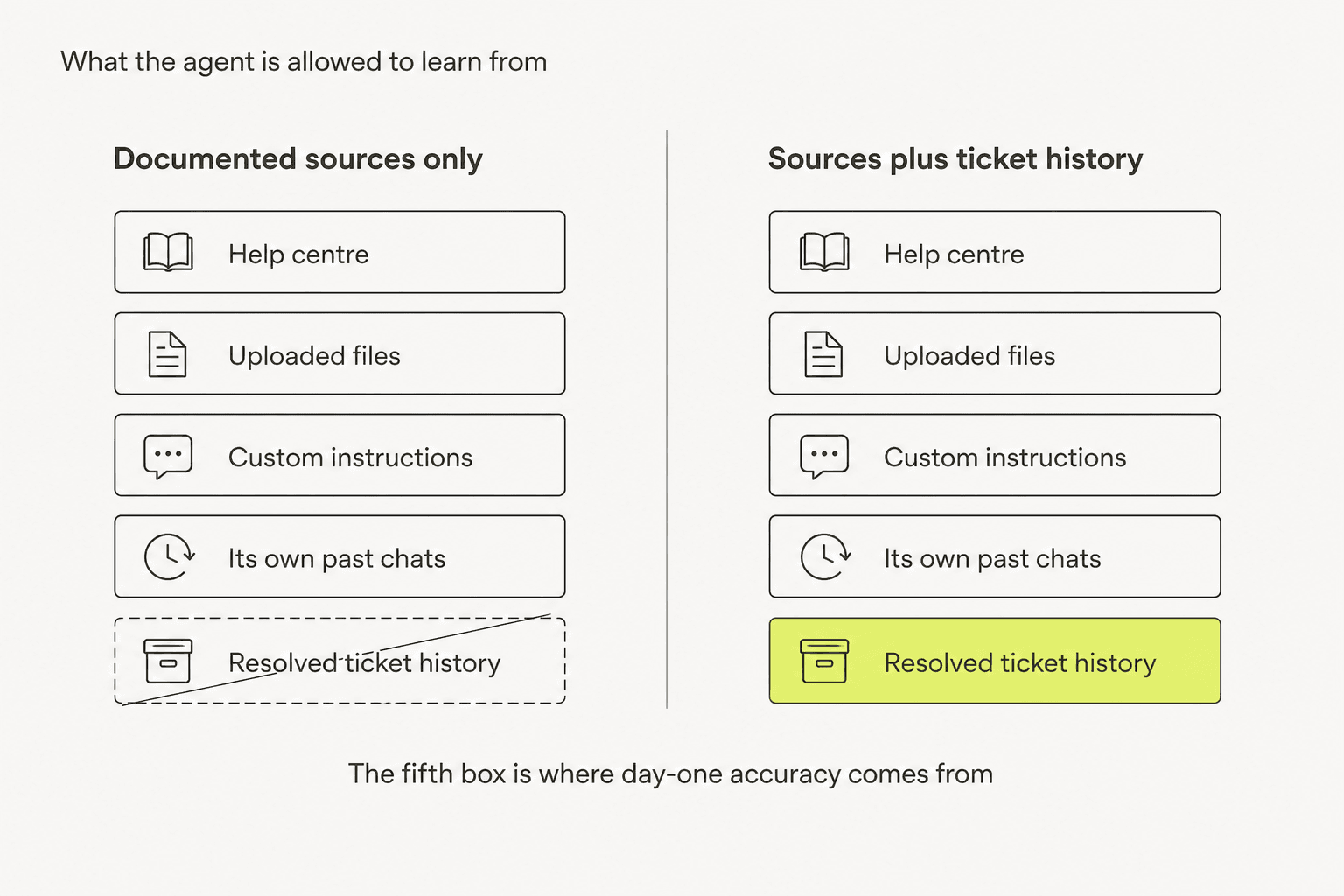
For most support teams, the help center is the tidiest slice of what they collectively know, and also the thinnest. The real answers live in years of solved tickets: the edge cases, the phrasing that actually lands with an unhappy customer. A vendor that cannot read any of that is starting from your documentation instead, which is usually the part that went stale first. It is also why ticket deflection numbers vary so wildly between tools that look near-identical on a feature grid.
There is no dry run either. The docs offer draft mode and version diffing, both of which are change-safety features, then relegate testing to a best-practices bullet suggesting you try out sample queries you have written yourself. Nothing replays your historical tickets to forecast a resolution rate ahead of launch.
You cannot check it the way you check everyone else
This one is structural, not a knock on the product. Crescendo has zero reviews on G2. No Capterra listing, no Trustpilot listing, and no Hacker News thread about it either. For a company claiming 150 brands, the normal due-diligence route just is not there.
For a managed service that matters more than it would for software. When part of the purchase is other people working your queue, reviews are exactly where you would find out how that tends to go, and there is nothing there to read.
What the wider community does say about outsourced AI agents in general, rather than about Crescendo specifically, is worth sitting with:
"AI agents require babysitting, and that needs to change or providers should offer free maintenance services. If you're an engineer or have a highly qualified engineering team with time to configure, implement, and maintain AI agents, then go for it. Otherwise, it's a mess."

That is the honest case for a managed service, and pretty much why Crescendo exists at all. The counter-case: you are trading the babysitting away for a vendor relationship you cannot research or self-serve out of, and cannot price without booking a call. Which of those trades is right comes down to whether anyone on your side actually wants to own the thing.
How I picked these eight
Four filters, and every tool below clears all of them.
- It has to be a real substitute for what Crescendo does, meaning autonomous resolution across at least chat and email, rather than a copilot that only drafts for humans.
- The commercial model has to be knowable. Published pricing, or a published billable-unit definition, ideally both. A vendor whose entire model is "contact us" still qualifies as long as the metering logic is documented somewhere.
- It has to be verifiable. Real docs, a real product surface I could open for myself, and third-party reviews where they exist.
- It has to serve a use case Crescendo does not serve well. In practice that means low volume, or teams who want to keep their own helpdesk and configure the thing themselves.
Traditional outsourcers are not on the list. If Crescendo's human layer is the thing you want rather than its software, this is the wrong page and you should go read about call center outsourcing instead. Upfront on the other bias too: eesel is the product I work on, it sits at number one, and you should read that entry with a healthy squint.
The 8 Crescendo AI alternatives at a glance
| Tool | Best for | Entry price | Billable unit | Floor / minimum | Trains on past tickets | Pre-launch simulation | Self-serve | Public price |
|---|---|---|---|---|---|---|---|---|
| Crescendo | Enterprises wanting AI plus outsourced humans | $1.25 per solve | "Solve" (undefined) | $2,900/mo | No | No | No | Partial |
| eesel AI | Keeping your helpdesk and starting this week | $0.40 per ticket | Ticket handled | None | Yes | Yes | Yes | Yes |
| Decagon | Large CX orgs with engineering support | Quote only | Not published | Not published | Not published | Yes, via Experiments | No | No |
| Sierra | Consumer brands wanting outcome pricing | Quote only | Outcome | Not published | Not published | Yes, via Experiments | No | No |
| Lorikeet | Fintech and healthtech, complex cases | $1,500/mo | Credit per resolution | $18,000/yr | Not published | Not published | No | Yes |
| Maven AGI | Layering over an existing helpdesk | Quote only | Not published | Not published | Yes, interaction logs | Not published | No | No |
| Ada | Enterprise multilingual at high volume | Quote only | Conversation, inferred | 300k conversations/yr | Yes, via Coaching | Not published | No | No |
| Gorgias | Shopify and ecommerce brands | $40/mo | Automated interaction | $40/mo | Yes | No | Yes | Yes |
| Zendesk AI | Teams already living in Zendesk | $1.50 per resolution | Automated resolution | Seat licence | Yes, Knowledge builder | No | Yes | Yes |
Two columns there do more work than the price column does, and they are billable unit and floor. A $0.90 rate with a $14,724 annual plan attached can end up costing more than a $1.50 rate with no minimum at all. Depends entirely on your volume.
Work out what you would actually pay
Plug your own numbers in. It runs the published rates against a monthly ticket volume and an assumed AI resolution rate, which is about the only honest way to compare meters that count different things.
The shape that surprises people: Crescendo's line barely moves at low volume, since the fee dominates everything, and it only starts to look competitive somewhere north of 10,000 tickets a month. Which lines up with what their own marketing says about fit.
1. eesel AI
Best for: teams who want to keep the helpdesk they already have and be live in days, not weeks.
What it does
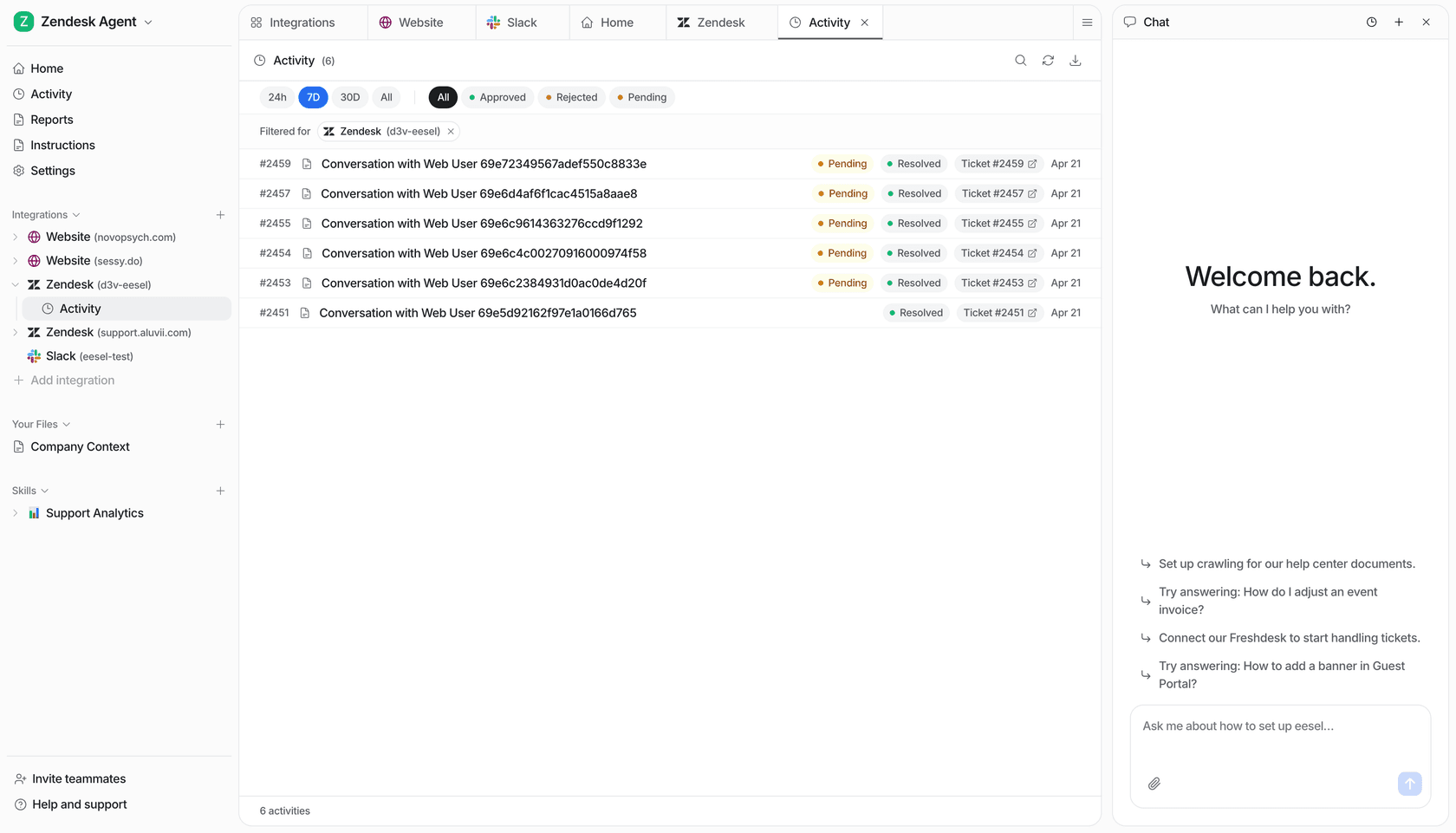
eesel makes the opposite architectural bet to Crescendo. Instead of replacing your CX stack it plugs into it: Zendesk, Freshdesk, HubSpot, Gorgias, Front, Slack and around a hundred other connections. Ticketing, routing, reporting, all of it stays where it already is.
Set against Crescendo, the two things that matter most are knowledge and testing. eesel trains on your solved ticket history and not only your help center, which is the difference that earlier diagram was about. Then, before anything goes live, simulation replays the agent over your real past tickets, so you see coverage by theme, find the gaps, fill them and re-run. A forecast, in other words, instead of a promise.
Rollout is deliberately gradual. You start in draft mode with every reply reviewed, then hand over autonomy on the ticket types you have come to trust, with confidence-based routing turning low-confidence answers into drafts rather than sends.
Pricing
| Line | Price |
|---|---|
| Free start | $50 in usage plus 2 blog generations, no card |
| Support ticket or chat session | $0.40 each |
| Dashboard lookups | Free |
| Blog post draft | $4.00 each |
| Annual commit | 25% off prepaid usage |
| Enterprise | $1,000/mo platform fee on top of usage |
The unit here is a ticket handled rather than a resolution, and eesel is explicit that tasks get billed regardless of outcome. Which cuts both ways. Nobody is gaming the definition of success, but you do pay on tickets the AI fails to solve. Outside Enterprise there is no platform fee, no seat fee, no minimum, so 200 tickets a month costs you $80.
Pros
- No monthly floor, so a low-volume team is not subsidising a fee.
- Training runs on resolved tickets, not just documentation.
- Simulation against your own ticket history before launch.
- 80+ languages and 100+ integrations out of the box.
- Signup is self-serve, with no sales call in the way.
Cons
- Billing is per ticket handled rather than per successful resolution, so a failed ticket still costs 40 cents.
- There is no human agent workforce. If outsourced staff is what you want, this replaces none of that half of Crescendo.
- SOC 2 is listed as in progress rather than certified, and HIPAA sits on Enterprise.
- Newer, and smaller, than the enterprise names further down this list.
My take: pick eesel when your helpdesk is fine and the AI is the piece missing from it, and especially under a few thousand tickets a month, which is where Crescendo's floor hurts the most. Skip it if the actual purchase is people to work the queue for you.
2. Decagon
Best for: large CX organisations with engineering time to spend on agent logic.
What it does
Decagon runs a single agent across chat, voice, email, SMS and custom API surfaces. The technical wedge is Agent Operating Procedures: natural-language instructions that compile down into executable code, letting CX operators author the logic while engineers hold onto guardrails and versioning.
The results Decagon publishes are the strongest set on this list. Chime reports 70% resolution across chat and voice. Duolingo reports 80% deflection, and ClassPass a 95% cost reduction with ten times the expected deflection.
Pricing
No public pricing. The /pricing URL 404s, and every path leads you to a demo form whose ticket-volume dropdown starts at under 9,999 and tops out at 250,000-plus. Those brackets tell you the ICP more clearly than a price would.
Pros
- Strongest published customer outcomes on this list, with real percentages attached.
- One agent across five channel types, one knowledge layer.
- Deeply capitalised: a $250M Series D at a $4.5B valuation in January 2026.
- Experiments and observability are built in for testing changes.
Cons
- Zero pricing transparency, so any budgeting requires a sales cycle first.
- No free tier and no self-serve, and no trial either.
- The volume brackets make it a poor fit under roughly 10,000 monthly tickets.
- AOPs are powerful, but they assume someone on your side is going to maintain them.
My take: if you are large enough that Crescendo's $2,900 fee reads as a rounding error, and you want the strongest published outcomes, Decagon is the serious call here. The Decagon pricing breakdown goes further into what the contracts look like. Skip it when you need a number before a meeting.
3. Sierra
Best for: consumer brands who want the outcome-based model Crescendo advertises, at real enterprise scale.
What it does
Sierra is the closest philosophical match to Crescendo's "pay for a job well done" pitch, and the one that has actually built a business on it. Here the agent runtime is the product, with channels, knowledge, escalation and analytics hanging off it.
Three pieces stand out from the rest. Ghostwriter builds agents out of SOPs, transcripts, whiteboard photos and audio recordings. Insights gives you deep research across conversations, plus multivariate experiments. And Horizon runs long-horizon agents that break outcomes into steps which improve over days or months.
Scale is not really in question. Sierra raised $950 million in May 2026 at over $15 billion, and says it serves more than 40% of the Fortune 50.
Pricing
Outcome-based, and unpublished. sierra.ai/pricing returns a 404, so the only route in is a contact form.
Pros
- Outcome pricing that is the company's core model rather than a marketing line.
- Ghostwriter lowers the build effort more than any tool here.
- Experiments let you A/B agent behaviour before committing.
- The engineering and capital runway is enormous.
Cons
- No published price, and neither a trial nor self-serve.
- Explicitly a poor fit for SMB and mid-market.
- Budget predictability gets hard when the unit is negotiated per deal.
- Implementation is measured in months, not weeks.
My take: the right swap when you like Crescendo's outcome model but want a vendor whose entire business is that model. The Sierra AI pricing piece and the Decagon versus Sierra comparison are the next reads from here. Skip it under a few hundred thousand conversations a year.
4. Lorikeet
Best for: fintech and healthtech teams who want published prices and complex case handling.
What it does
Lorikeet sells an "AI Customer Concierge" pointed squarely at regulated, complex companies, resolving problems end to end across phone, SMS, chat, email and WhatsApp. Its founding team is unusually relevant to that job. CEO Steve Hind led product at Stripe and Watershed, while co-founder Jamie Hall was a research tech lead at Google Brain working on factual grounding in language models.
The commercial model is the standout, though. Lorikeet publishes plan prices and per-ticket credit rates, plus a machine-readable pricing file, and charges only for successfully resolved tickets. The page states it plainly: unhappy with how a ticket got handled, and you do not pay for that ticket.
Pricing
| Plan | Price | Credits/year | Chat, email, SMS | Voice |
|---|---|---|---|---|
| Start | $1,500/mo annually | 18,000 | 0.95 credits | 1.50 credits |
| Scale | $4,000/mo annually | 48,000 | 0.80 credits | 1.20 credits |
| Enterprise | Custom | Custom | Custom | Custom |
Routing or analytics tagging runs 0.30 credits on Start and 0.25 on Scale. Automated QA is the same.
Pros
- Full public pricing, including per-action credit rates.
- You pay only for successful resolutions, with an explicit unhappy-ticket clause.
- Purpose-built for complex, regulated workflows rather than FAQ deflection.
- Voice is priced separately and transparently rather than bundled in vaguely.
Cons
- Annual billing only, with no published month-to-month rate.
- Start, at $18,000 a year, is a real commitment, and sits closer to Crescendo's floor than to usage pricing.
- Around 70 to 90 people, so a smaller support and services bench than the giants here.
- Credits across channels and actions will take a spreadsheet to model.
My take: the best pick when what pushed you off Crescendo was the pricing opacity and not the price itself. You get a rate card and a resolution-only meter, with a refund clause in writing. Skip it if you need to start small, or to bill monthly.
5. Maven AGI
Best for: enterprises who want an AI layer over the helpdesk they already run.
What it does
Maven AGI makes eesel's structural bet at enterprise scale. Agent Maven sits as an intelligence layer between your data, the models and your human team, deploying on top of Zendesk, Salesforce and Freshdesk instead of replacing any of them. It also ingests interaction logs alongside knowledge bases, which makes past conversations an input rather than an afterthought.
The headline claims: up to 93% of queries answered autonomously, and ten times faster resolution. Tripadvisor's Head of Data and AI says Maven autonomously handles 90% of incoming queries. ClickUp reported rep solves per hour up 25% one week into a trial.
Compliance is unusually broad for a company of this size: SOC 2 Type 2, ISO 27001, 27017, 27018, 27701 and 42001, plus HIPAA, PCI DSS, GDPR and CCPA.
Pricing
No public pricing. /pricing 404s, and everything routes you to a demo. Third-party marketplaces list it as custom, driven by conversation volume and by integration complexity.
Pros
- Sits on your existing helpdesk instead of replacing it.
- Training includes interaction logs, not just documentation.
- Very broad compliance stack for a company that has raised $78M.
- Named enterprise results with real percentages behind them.
Cons
- Quote-only, with no self-serve entry.
- Around 16 G2 reviews, so a thin independent record, though better than Crescendo's zero.
- No published billable unit, which means you cannot model cost ahead of a sales call.
- Enterprise-shaped implementation timelines.
My take: this is the enterprise version of the "keep your helpdesk" argument. See the Maven AGI pricing notes for what buyers report paying. Skip it when you want a rate card first.
6. Ada
Best for: enterprises running very high multilingual conversation volumes.
What it does
Ada is a standalone AI platform sitting above a helpdesk, without owning ticketing or the CRM record. The technical wedge is its Reasoning Engine, which orchestrates across multiple language models rather than betting everything on one, with multi-layer safeguards over the top.
Two features matter for anyone on their way out of Crescendo. Playbooks are multi-step procedures the agent reasons through on cases that need sequencing. Coaching lets you review past conversations and leave notes, then has the agent apply them automatically, which is a real answer to the "it does not learn from our tickets" problem.
Ada also leads with AIUC-1, an AI-specific compliance certification that few CX vendors carry, plus zero data retention with model providers.
Pricing
None published. The /pricing URL is a consultation form, and it is gated behind a stated floor of 300,000 annual conversations.
Pros
- Multi-model orchestration rather than a single-stack bet.
- Coaching turns human review into durable agent behaviour.
- Multilingual and omnichannel coverage is strong, voice included.
- AIUC-1 plus zero retention is a real differentiator on procurement forms.
Cons
- The 300,000 conversation floor rules out most teams outright.
- Zero published pricing of any kind.
- Enterprise-only sales motion with no trial.
- It is a separate platform contract on top of your helpdesk cost.
My take: the right call above 300,000 conversations a year across multiple languages, where that multi-model architecture earns its keep. The Ada CX pricing piece carries the third-party dollar bands. Skip it below the floor, since you would not clear qualification anyway.
7. Gorgias
Best for: Shopify and ecommerce brands who want the whole thing on one bill.
What it does
Gorgias is a helpdesk with an AI agent bundled into it, sold as one product on one bill and never priced per seat. For a DTC brand that collapses two purchases into one. The 254-app integration library is built around commerce workflows too, with order lookups, cancellations, discounts and returns all as first-class actions.
The billing definition is unusually clear here. An automated interaction is one where the customer does not need a human within 72 hours, and Gorgias states that when the AI hands over to a human, you are not charged twice.
Pricing
| Plan | Annual monthly rate | Helpdesk line | AI line | Included interactions | Effective AI rate | Overage |
|---|---|---|---|---|---|---|
| Starter | $40 (monthly only) | $10 | $30 | 30 | $1.00 | $1.50 |
| Basic | $77 | $50 | $27 | 30 | $0.90 | $1.50 |
| Pro | $471 | $300 | $171 | 190 | $0.90 | $1.50 |
| Advanced | $1,227 | $750 | $477 | 530 | $0.90 | $1.50 |
Extra tickets run $0.36 to $0.40. Voice starts from $25 a month, SMS from $17, both on annual billing.
Pros
- Starts at $40 a month, roughly 1.4% of Crescendo's floor.
- Helpdesk and AI on a single bill with a published split.
- The clearest billable-unit definition of any tool here.
- There is a free trial with no credit card on the self-serve plans.
Cons
- Really only makes sense for ecommerce, especially Shopify.
- The step from $0.90 included to $1.50 overage is a 67% jump at the cliff.
- Replacing your helpdesk is a bigger move than adding an AI layer.
- No pre-launch simulation against historical tickets.
My take: if you are a DTC brand who looked at Crescendo and blanched at that fee, this is the pragmatic landing spot. The full Gorgias AI pricing breakdown covers the overage traps. Skip it when you are not selling physical products.
8. Zendesk AI
Best for: teams already living in Zendesk who want the shortest possible path.
What it does
Already on Zendesk? Then the AI is a toggle, not a migration. AI agents cover messaging and email on every Suite plan, the natural-language agent builder is included from Team upward, and Knowledge builder generates a knowledge base out of your existing ticket history. That last one puts Zendesk on the right side of the past-tickets question.
Zendesk is also among the few vendors publishing its AI resolution rate instead of hiding it behind a quote.
Pricing
| Line | Price |
|---|---|
| Support Team | $19 per agent/mo annually |
| Suite Team | $55 per agent/mo annually |
| Suite Professional | $115 per agent/mo annually |
| Committed automated resolution | $1.50 |
| Pay-as-you-go resolution | $2.00 |
| Copilot add-on | $50 per agent/mo annually |
| Action credits | $200 per 100,000 actions |
An automated resolution is defined as a request resolved by AI without any escalation to a human. One thing worth flagging: the compare table still prints $1.50 and $2.00, while the AI agents FAQ describes a newer tiered-outcome model whose per-tier figures are not published anywhere.
Pros
- No new vendor and no migration, and no second contract either.
- Published per-resolution rate, unusual at this end of the market.
- Knowledge builder reads your ticket history to seed the knowledge base.
- The integration and app ecosystem is enormous.
Cons
- Seat licences on top of resolution charges, so the total is higher than the $1.50 suggests.
- Copilot only attaches to Professional and above at $50 per agent.
- Copilot writing tools are capped at 500 uses per instance per month regardless of headcount.
- Anything above Suite Professional has no public price at all.
My take: if you are on Zendesk and mostly want tier-1 volume gone, start here before looking outside. The Zendesk AI pricing breakdown covers the seat maths. Skip it when the reason you looked at Crescendo in the first place was Zendesk's native AI disappointing you, in which case a layer like eesel or Maven AGI sitting on top of the same Zendesk is the smarter move.
How to actually run this decision
Four questions, in order. They filter faster than any feature grid does.
1. Do you want to buy staff or software? If the honest answer is staff, stop reading listicles about AI platforms and go read about outsourcing tradeoffs instead. Crescendo's real competition in that world is other outsourcers, and the comparison turns on people management rather than model quality.
2. What is your monthly volume, honestly? Under about 3,000 tickets a month, any vendor with a four-figure monthly floor is charging you for capacity you are not going to use. Above 10,000 the floors stop mattering much and the per-unit rate takes over.
3. What does the vendor count as one billable thing? Ask for it in writing, before you sign. A resolution, a solve, an interaction, a handled ticket: four meters, four different invoices off the same month of traffic. And a vendor who will not define its unit on paper has just answered the question for you.
4. Can you see the answers before your customers do? This is the one people skip, then regret. Ask whether the tool can run over your own historical tickets and show you what it would have said. Draft mode and version diffing are useful things, but they are change-safety features and not a forecast. My notes on preventing support AI hallucinations go into the specific controls worth asking about.
One last thing worth weighing, this from a support team who had been burned by a vendor before:
"Prices more than doubled with our previous vendor. We wanted contractual price locks, and were happy to pay yearly to get one."
A budget-conscious buyer who had seen a prior vendor's price more than double, from eesel's internal customer call notes
Crescendo's own price history is a live example of why that instinct is sound. That same URL used to advertise $2.99 per resolution, month-to-month, with free setup and a published add-on list. Today it advertises $1.25 per solve with a $2,900 monthly fee, and the add-on list is gone, along with the FAQ and the contract-term language. So the headline number went down. Whether your bill went down with it depends entirely on your volume.
Try eesel for the half Crescendo does with software
If the thing you actually want from Crescendo is the automation and not the outsourced team, eesel AI is built for exactly that, and built to leave the rest of your setup alone while it does. It connects to the helpdesk you already run and learns from the tickets your team has already solved. Then it lets you simulate the whole thing against your ticket history, before a single customer sees an AI reply.
The commercial difference is the plainest part of it. No $2,900 floor, no platform fee, no per-seat charge and no minimum. Just 40 cents per ticket the AI handles, and you are never billed for the tickets your humans take. Route 200 tickets a month, pay $80, then scale once the numbers look right. Signup is self-serve with $50 of free usage and no card, so you find out what your resolution rate would be this week instead of after a demo cycle.
Try eesel free, or book a demo if you would rather go through your ticket history with someone first.
Frequently Asked Questions
How much does Crescendo AI cost?
What are the best Crescendo AI alternatives for small teams?
Is Crescendo AI a BPO or a software platform?
Can an AI support agent learn from my past tickets?
What happens if the AI answers a customer wrongly?
How long does it take to switch off Crescendo AI?
Are per-resolution prices comparable between vendors?


Article by
Riellvriany Indriawan
Riell is a designer and writer at eesel AI with about two years of experience researching CX platforms, AI chatbots, and helpdesk software. She combines her design background with a sharp eye for how these tools actually look and feel in practice — making her comparisons unusually visual and user-focused.