

Disclosure: This article is published by eesel AI, a competitor of Decagon. We encourage you to read Decagon's own materials for their perspective.
The pressure on support teams is real. Ticket volumes keep climbing, headcount budgets don't, and customers expect faster resolution. That gap has driven demand for AI agent platforms, and Decagon has become one of the most talked-about options in enterprise circles.
This review covers what Decagon actually does, where it delivers, where it falls short, and what you need to know before entering a sales process. By the end, you should have a clear picture of whether Decagon fits your team or whether a different approach makes more sense.
What is Decagon AI?
Decagon is an enterprise AI concierge platform for customer support automation. Founded in 2023 by Jesse Zhang (CEO, previously at Lowkey and Niantic) and Ashwin Sreenivas (previously at Helia and Scale AI), the company has raised $481M across four funding rounds -- the most recent being a $250M Series D in January 2026 at a $4.5B valuation. It crossed the unicorn threshold in mid-2025, two years after founding, and was named to the 2025 Forbes AI 50 list.
Decagon's customer roster spans fintech, retail, travel, and software: Chime, Duolingo, Rippling, Figma, Notion, Dropbox, ClassPass, Hertz, and others. The company currently operates from offices in San Francisco, New York, London, and Australia, with more than 300 employees.
The platform's positioning is "AI concierge": agents that resolve issues end-to-end rather than handing customers a knowledge base link. Results from published case studies back that framing. Chime results show a 70% combined chat and voice resolution rate. Duolingo's 80% deflection. ClassPass results show a 10x increase in chat deflection. Hunter Douglas results include $1M in revenue from fully AI-handled conversations.
These numbers come from well-resourced enterprises with dedicated engineering teams. That context matters for evaluating fit.
How does Decagon AI work?
Agent Operating Procedures
Decagon's core mechanism is a system called Agent Operating Procedures (AOPs). Instead of programming a decision tree or writing code, support teams write instructions in plain English. Decagon's platform compiles those instructions into executable agent logic that governs how the AI responds, takes action, or escalates.
The design splits responsibility: CX teams write the business logic (when to issue a refund, when to escalate to a human, how to handle specific complaint types), while engineers manage the underlying integrations and system guardrails. This means behavior changes can happen without waiting on an engineering sprint -- but the initial setup, and any integration work, still requires technical staff.
AOPs can trigger real backend operations: refunds and account changes, and querying third-party systems. They are not just conversational guides.
In 2024, Decagon introduced Trace View -- a tool that surfaces how a specific AOP executed for a given customer interaction. Agent Workbench, launched in Spring 2026, adds autonomous debugging and root-cause analysis for agents. Both tools exist because transparency into agent reasoning was a consistent complaint among early customers.
The Duet agent building tool, released in March 2026, assists CX teams in drafting and refining AOPs with AI suggestions, reducing the manual effort required to iterate on agent behavior.
Voice, chat, and email
Decagon Voice, launched in 2025, handles inbound phone calls using the same AOP logic that governs chat and email. The agent adapts tone per channel while running the same underlying procedures. Calls can end with a warm handoff to a human agent (with a summary), SMS follow-ups, or full resolution without escalation.
The Spring 2026 update added two significant capabilities: outbound voice (agents can initiate calls for renewals, follow-ups, or outreach) and persistent user memory (agents retain context across interactions so customers do not repeat themselves).
For telephony infrastructure, Decagon connects to telephony integrations including Amazon Connect, RingCentral, and SIP trunking for direct integration with existing phone systems.
Integrations
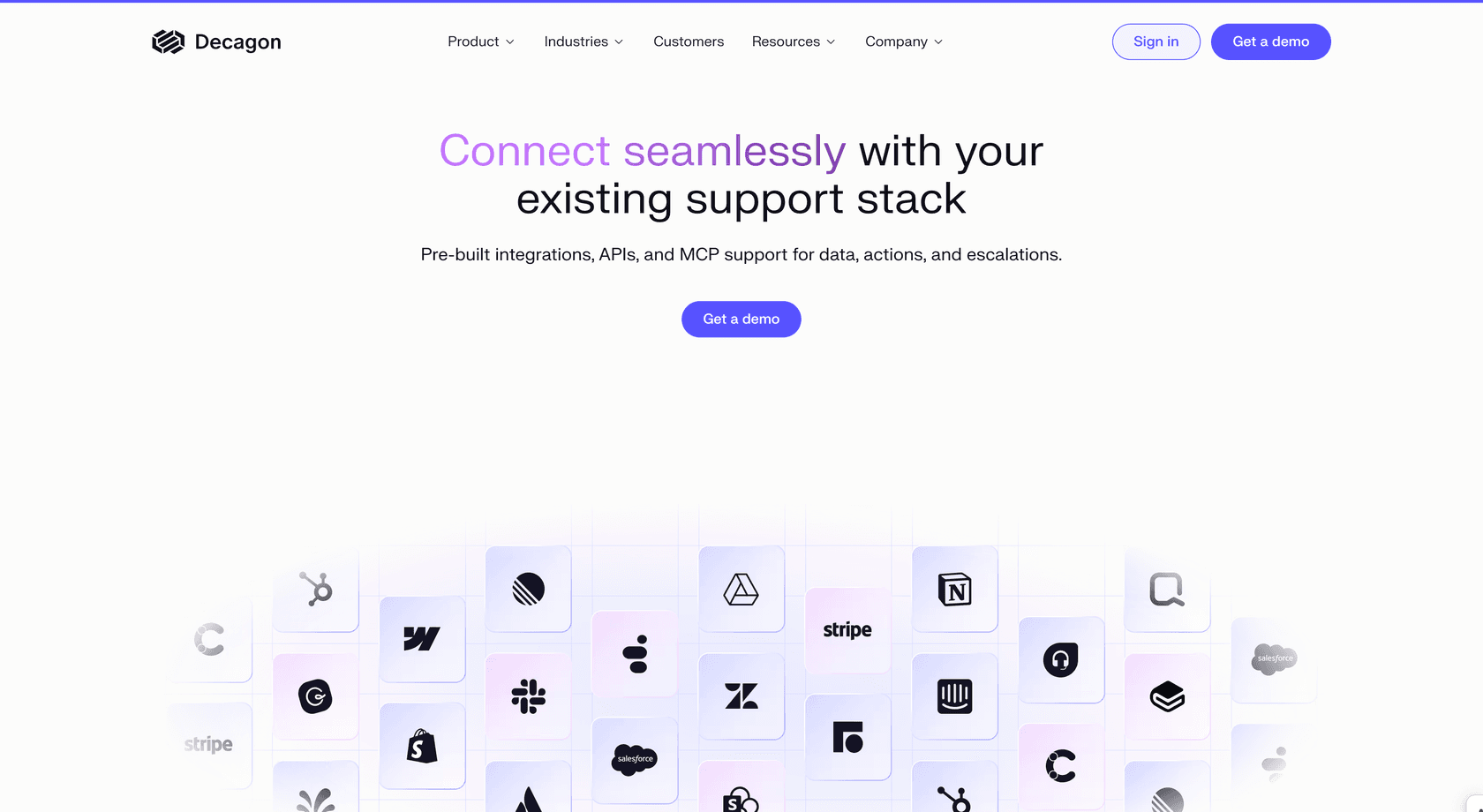
Decagon's integrations page lists connections to Zendesk, Salesforce, Confluence, and a range of CRM and knowledge base tools. The Zendesk integration supports two-way sync for ticketing, knowledge base content, and escalation handling.
The company describes some integrations as requiring "no custom code," though the practical meaning of that depends on how standard your existing setup is. Anything non-standard or API-based will require engineering involvement.
Since March 2026, 80% of traffic runs on models Decagon trained in-house rather than on third-party providers like OpenAI or Anthropic. Those models are trained specifically on customer support conversations, which Decagon says produces better performance for support use cases than general-purpose language models.
Real-world challenges
Decagon delivers strong results for the right profile of customer. Several consistent limitations also appear across user feedback.
Limited visibility into agent decisions
A recurring concern among Decagon customers is that it can be difficult to see why the agent made a particular decision. Trace View and Watchtower were introduced to address this, but based on community feedback, the experience of auditing agent behavior remains inconsistent in practice.
Decagon's chat page states that audit logs are available and that the AI's decision-making is fully traceable. The gap between that claim and day-to-day user experience appears to depend on how deeply a team uses the transparency tooling -- and whether they have staff with the time and technical familiarity to use it.
For teams where compliance or QA requires clear, readily accessible audit trails on every agent decision, this is worth stress-testing during a proof-of-concept.
Implementation requires engineering resources
Customer reviews consistently note that meaningful Decagon deployments require engineering involvement, even for integrations described as low-code. Writing AOPs is accessible to non-technical staff, but connecting those AOPs to backend systems -- refund processors, account management APIs, CRM records -- requires developers.
Implementation timelines range from four to twelve weeks based on customer case studies. Decagon assigns implementation engineers to guide the process, which helps, but does not replace internal technical capacity.
Teams without dedicated engineering bandwidth should factor that into their evaluation, particularly the ongoing cost of maintaining integrations as their systems change.
Generalist agent design
Decagon deploys a unified AI agent that handles all incoming issues across topics. For companies where most tickets fall into a predictable set of categories, that design works well. For companies with diverse support needs -- billing, technical troubleshooting, policy questions, account management, compliance inquiries -- a single generalist agent may produce weaker responses on specialized topics than a purpose-built agent would.
This is an architecture worth evaluating with realistic test cases during a POC, not only the curated scenarios in a vendor demo.
Performance during high-volume periods
Customer reviews on G2 and independent user reports describe performance degradation during spikes in ticket volume: slower response times, higher escalation rates, and occasional agent errors. This appears more common during sudden traffic surges than during sustained high volume. Decagon's case studies present best-case outcomes, so it is worth asking their sales team specifically about behavior during peak load periods before signing.
Decagon AI pricing
Decagon pricing is not publicly listed. All figures below are estimates based on industry research and customer disclosures. Actual pricing requires a direct conversation with their sales team.
Based on available data, Decagon uses two usage-based models on top of a fixed annual platform fee:
| Component | Estimated cost | Notes |
|---|---|---|
| Platform fee | ~$50,000/year | Fixed; applies to all contracts |
| Per-conversation | ~$0.99 per conversation | Covers voice, chat, and email interactions; most common model |
| Per-resolution | ~$0.50 per resolution | Pay only when the agent closes the issue without escalation |
The per-conversation model provides predictable monthly costs regardless of resolution rate. The per-resolution model aligns cost to outcome, but the per-resolution unit price is higher, and how "resolution" is defined is negotiated per contract.
Annual contract sizes vary significantly by volume:
| Company profile | Monthly ticket volume | Estimated annual cost |
|---|---|---|
| Small enterprise pilot | ~2,000 | ~$74K–$95K |
| Mid-size SaaS | ~15,000 | ~$230K–$270K |
| Large e-commerce | ~50,000 | ~$525K–$600K+ |
Implementation overhead adds to the total. Four to twelve weeks of setup, internal engineering time, and Decagon's professional services are not included in the per-conversation or per-resolution fees. No free trial or self-service option is available; the process starts with a sales discovery call.
For a more detailed look at how these two pricing models work in practice, eesel's pricing breakdown walks through each model and its tradeoffs.
Alternatives for more control
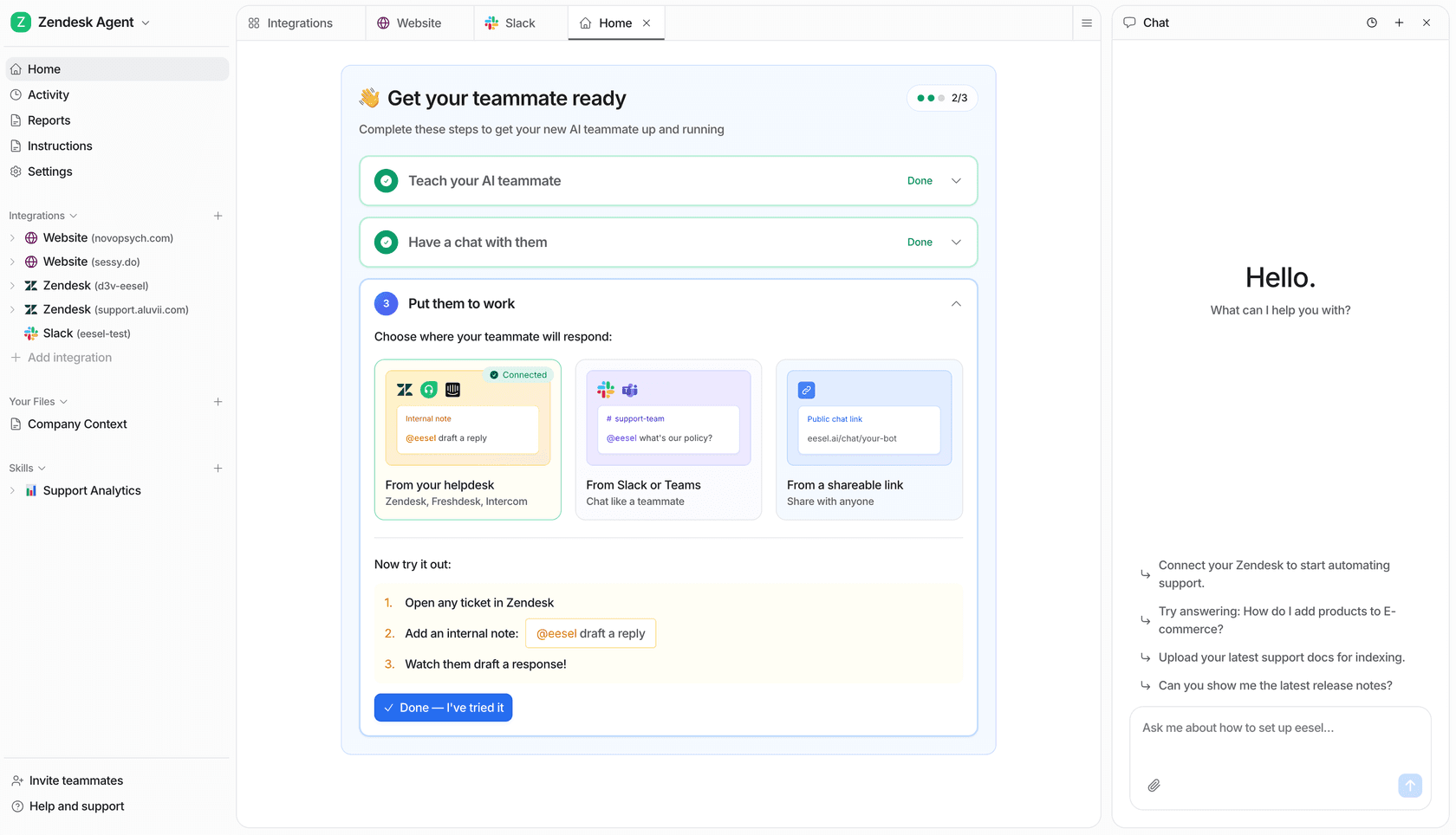
Decagon suits large enterprises with substantial ticket volumes, existing helpdesk infrastructure, and engineering teams available for a multi-week implementation. For teams outside that profile -- or teams that want to move faster with more hands-on control -- there are other options worth evaluating.
eesel AI is one alternative. It connects to Zendesk, Freshdesk, and Slack in one click, and starts learning from existing tickets, help center articles, and Google Docs immediately. Setup takes minutes rather than weeks, and no engineering team is required.
A few differences in approach:
- Agent transparency. You can sandbox test using your own past tickets before it handles any real customers. You see exactly how it will respond and adjust it until you're satisfied.
- Multiple specialized agents. Instead of a unified generalist agent, eesel lets you build specialized agents: one for Tier 1 tickets, one for internal Slack questions, one to support the sales team.
- Published pricing. eesel AI uses credit-based pricing from $299/month for 500 credits (1 credit per ticket or chat), with a free plan of 100 credits, available on the website without a sales call.
If Decagon is the right scale for your team, it can deliver strong results. If it is not, exploring alternatives before committing to an enterprise contract is a reasonable first step.
The final verdict
Decagon is a serious platform with strong results at enterprise scale. The combination of AOPs, omnichannel support across voice, chat, and email, and a growing suite of transparency and debugging tools makes it a credible choice for large companies with the engineering capacity to implement and maintain it.
The limitations are real. Implementation takes months, requires engineering investment, and pricing is not disclosed upfront. Decagon is built for organizations spending well over $100K annually on support infrastructure, with in-house teams available for ongoing tuning.
If that profile describes your organization, Decagon warrants a full proof-of-concept with realistic test cases and honest questions about peak-volume behavior. If it does not -- if you want automation that a non-technical support team can run, with published pricing and a faster path to production -- then evaluating other options before entering a sales process is the better starting point.
Ready to see what AI-powered support looks like without the enterprise contract? Start free and set up your first agent in a few minutes.
Frequently asked questions
Who is Decagon AI best suited for?
Decagon is built for large enterprises with high support volumes, existing helpdesk infrastructure, and in-house engineering teams. Annual contracts typically start above $95K and can run to $590K or more, so it is not a practical fit for most small or mid-sized businesses. Learn more at decagon.ai.
How does Decagon AI pricing work?
Decagon does not publish pricing. Based on industry research, they offer two usage-based models: a per-conversation fee (approximately $0.99 per conversation) and a per-resolution fee (approximately $0.50 per successful resolution), both on top of a fixed annual platform fee. To get actual figures, you need to contact the Decagon sales team directly.
How complex is the initial setup?
Implementation typically takes four to twelve weeks and requires dedicated engineers on your side. Decagon's Agent Operating Procedures let CX teams write agent logic in plain language, but the underlying integrations and guardrails still need technical staff to configure and maintain.
What channels does Decagon support?
Decagon covers voice, chat, and email under a single agent framework. Voice support launched in 2025, and outbound calling became available with the Spring 2026 proactive agents release.
What are good Decagon alternatives for smaller teams?
Teams that want AI-powered support without an enterprise contract can explore Decagon alternatives. eesel AI connects to Zendesk, Freshdesk, and Slack in minutes and offers published credit-based pricing from $299/month for 500 credits (1 credit per ticket or chat), with a free plan of 100 credits and no per-seat fees or weeks-long implementation.