The 7 best Ginzi alternatives in 2026

Rama Adi Nugraha

Katelin Teen
Last edited September 28, 2026

What happened to Ginzi, and why you are here
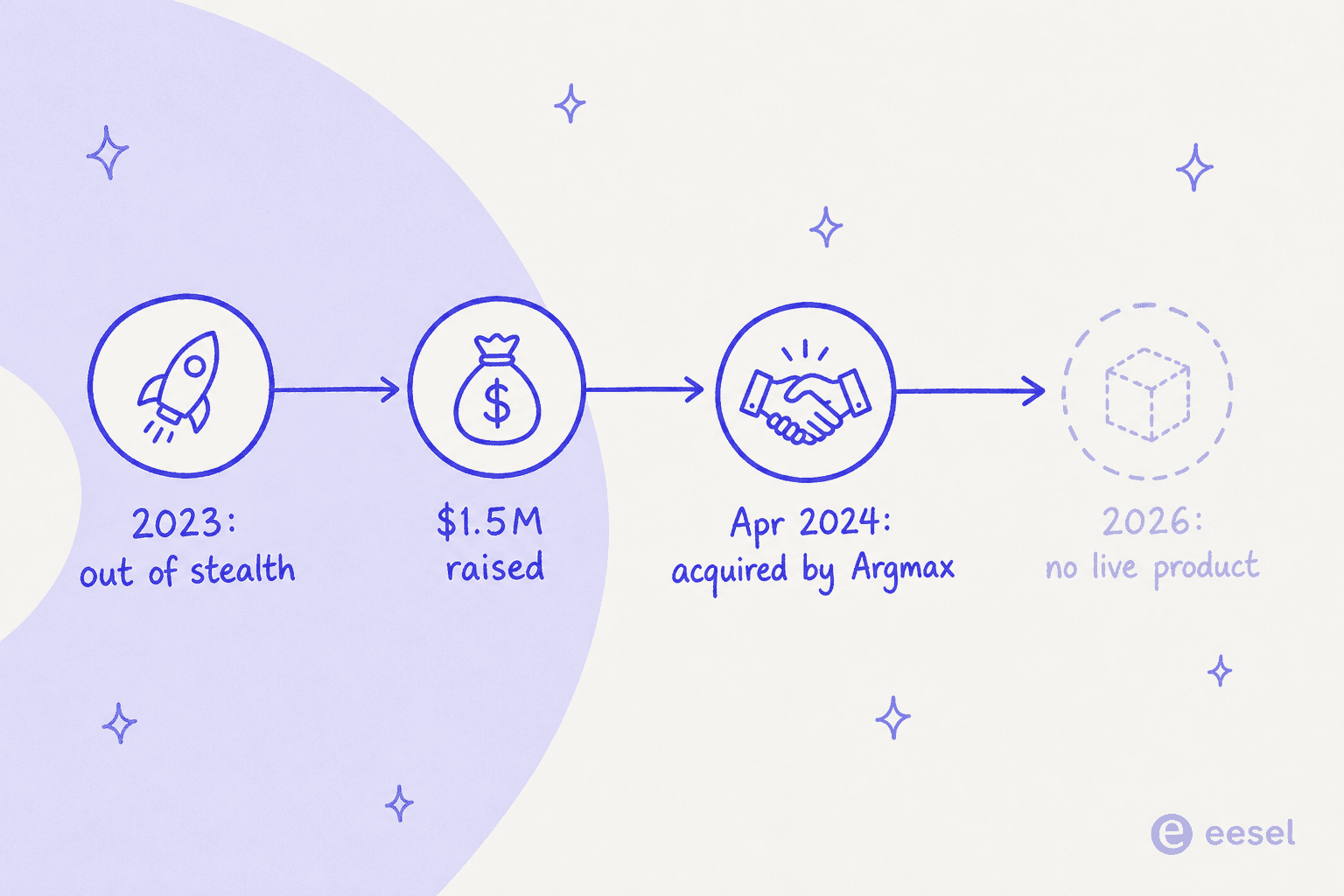
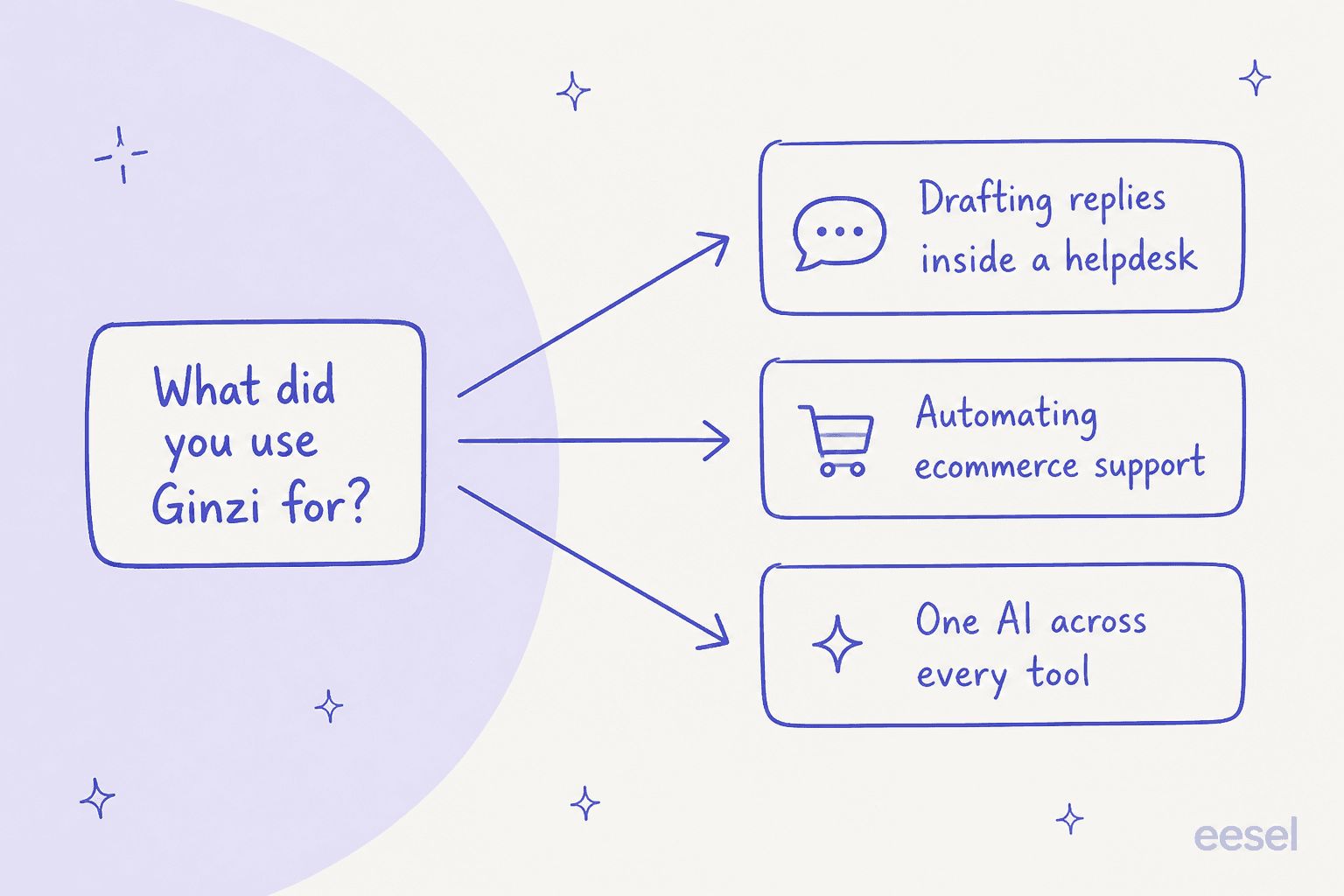
Ginzi was a small Tel Aviv startup, founded around 2021 and out of stealth in 2023, that raised $1.5 million before Argmax bought it. The pitch was clean: "answer each question once, we do the rest." Its two products, Ginzi Mail and Macro Craft, scanned your inbox and your Zendesk macros and suggested answers powered by ChatGPT, a bit like an AI copilot so agents could resolve tickets with one click.
The problem is what came after the acquisition. Argmax is a search and discovery ML consultancy focused on advertising and finance, and the deal reads like an acqui-hire: the founders' press quote thanked the team and investors rather than laying out a roadmap. Two years on, there is no Ginzi-branded support product you can buy. If your team was leaning on it, you have effectively lost your assist layer, and the honest move is to find a replacement that is actually maintained.
The good news is that this category has moved a long way since 2023. Ginzi's whole reason to exist, an AI that learns from your history and drafts replies, is now table stakes, and the better tools add the two things Ginzi never had: a way to test accuracy before going live, and support for helpdesks beyond Zendesk.
I have spent the last few years building AI that plugs into live support queues, and the single hardest-won lesson is that a confident-sounding bot is not the same as a correct one. We have watched AI give wrong answers that sounded perfectly reasonable, which is why I now treat "can I simulate this on my own past tickets first" as the most important question on this whole list, not a nice-to-have. Keep that in mind as you read.
The best Ginzi alternatives at a glance
Here is the whole list side by side before I get into each one. Pricing is the headline rate; the billing unit column is the one that actually decides your bill.
| Tool | Best for | AI billing unit | Starting price | Works with | Free option |
|---|---|---|---|---|---|
| eesel AI | Adding AI to your existing helpdesk | Per ticket/chat handled (credit) | $299/mo for 500 credits | Zendesk, Freshdesk, Gorgias, Front, Help Scout, HubSpot | 100 free credits |
| Zendesk AI | Teams already all-in on Zendesk | Per automated resolution | $19/agent/mo (Support Team) | Zendesk only | Trial only |
| Freshdesk | Freshworks shops on a budget | Per 72-hour AI session | $0 (up to 2 agents, 6 mo) | Freshdesk/Freshworks | Free plan |
| Gorgias | Shopify and ecommerce brands | Per resolved conversation | $10/mo (Starter) | Ecommerce stacks (Shopify) | Trial only |
| Help Scout | Small teams wanting simplicity | Per AI resolution | $25/user/mo (Standard) | Help Scout inbox | Free (5 users) |
| Front | Complex, multi-team operations | Per-seat + AI add-ons | $25/seat/mo (Starter) | Front inbox | Trial only |
| Chatbase | A ChatGPT-style bot on your docs | Per message credit | $40/mo (Hobby) | Website/widget, API | Free tier |
The theme: the tools that most resemble what Ginzi did are the ones that sit on top of a helpdesk (eesel), or that are the helpdesk's native AI (Zendesk, Freshdesk). The rest are worth knowing if your setup is more specific.
How I picked
I weighted this list toward the jobs Ginzi actually did. Three things mattered most:
- Does it learn from your own history? Ginzi's one real trick was drafting from past conversations. Anything on this list has to do at least that.
- Can you test before you trust it? This is the gap Ginzi left. The tools I rate highest let you run the AI against your past tickets and see what it would have said.
- Does it fit your stack? Ginzi was Zendesk-only. I gave credit to an AI helpdesk agent that either is your helpdesk or layers onto whatever you already run.
Now the seven.
1. eesel AI
Best for: teams that want to keep their current helpdesk and add the AI layer Ginzi used to be.
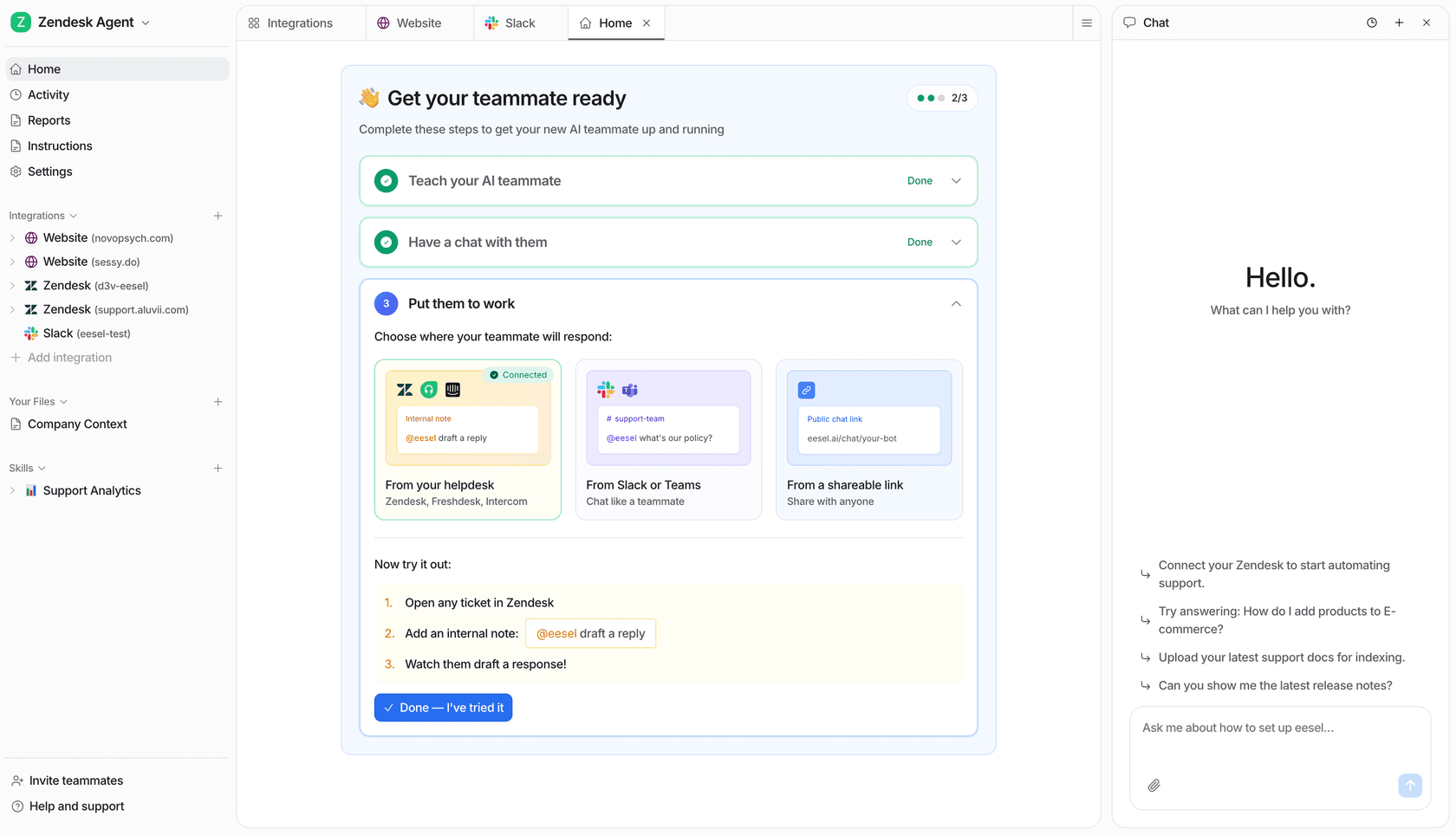
This is the closest thing to a like-for-like Ginzi replacement, and it is where I would start. eesel AI is an AI helpdesk teammate: you invite it into the tools you already use, it learns from your history and knowledge, and it either drafts replies for an agent to approve or answers on its own once you trust it. That is Ginzi's original pitch, "answer each question once," except it is maintained, and it is not locked to a single helpdesk.
Where it goes beyond Ginzi is the two gaps I called out above. First, coverage: eesel connects to Zendesk, Freshdesk, Gorgias, Front, Help Scout and HubSpot, so it fits whatever queue you run rather than forcing you onto one. Second, and this is the part I care about most, it has a simulation mode that replays hundreds of your past tickets and scores the AI's answers against what your team actually sent, before it ever touches a live customer.
It draws on your past tickets, help center, and connected docs from day one, drafts or auto-responds with a human sign-off in draft mode, works in 80+ languages, and runs skills for triage, tagging, and actions inside your helpdesk.
Pros
- Keeps your existing helpdesk, no migration.
- The simulation step directly fixes Ginzi's biggest weakness, no safe way to test.
- Fixed monthly pricing with no per-seat fee, so adding agents does not raise the bill.
Cons
- It is an AI layer, not a full helpdesk, so you still need a ticketing tool underneath it.
- Very small teams on light volume may find the entry plan more than they need.
Pricing
eesel sells fixed credit plans. There is a free tier with 100 credits and no card, then Teammate plans starting at $299/month for 500 credits, scaling up to $1,899 for 5,000. One ticket or chat handled is one credit, billed whether or not the AI resolved it, and every feature and unlimited agents are included at every tier. Optional overage runs $0.80 per credit.
Verdict: if your priority is replacing Ginzi without ripping out your helpdesk, and you want to prove the AI works before trusting it, this is the pick. The teams that skip it are the ones who would rather use their helpdesk's built-in AI and accept its limits.
2. Zendesk AI
Best for: teams already committed to Zendesk who want the native option.
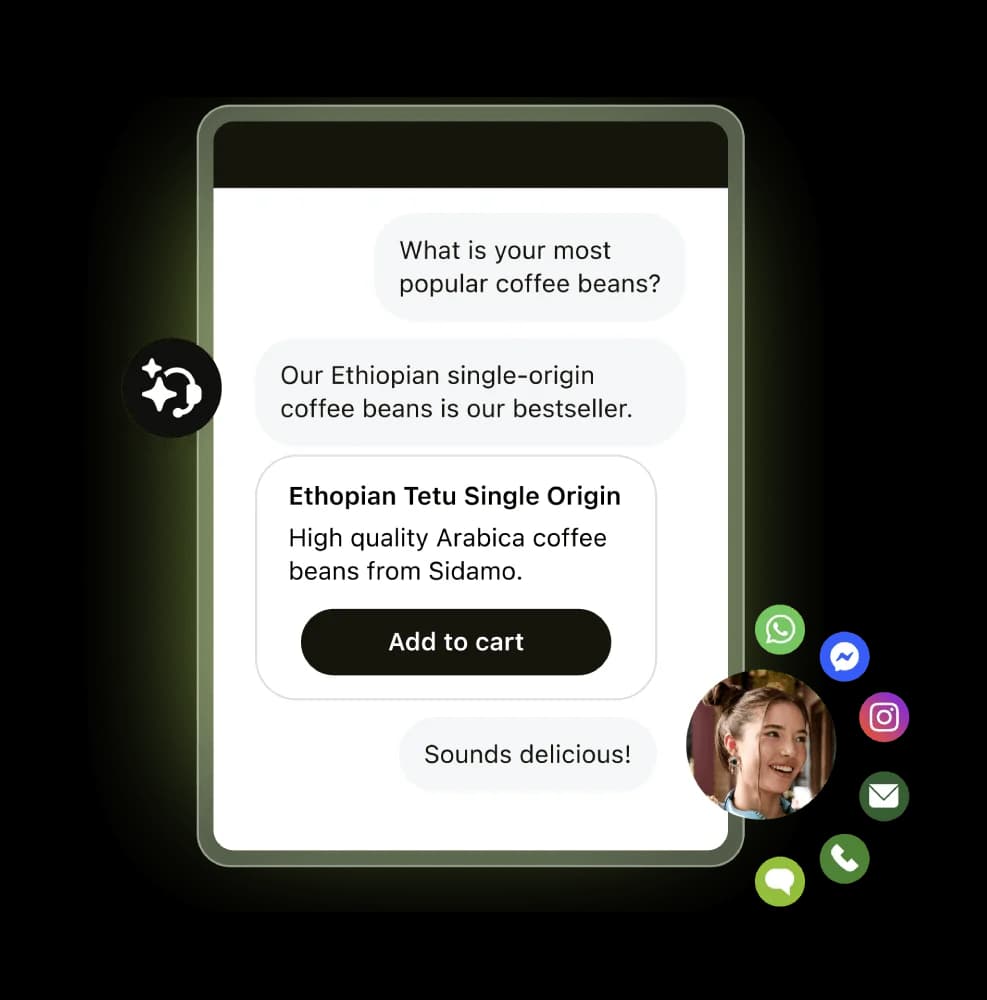
Since Ginzi lived inside Zendesk, the most obvious move is Zendesk's own AI. It has come a long way: Zendesk AI agents resolve tickets end to end, and Copilot drafts replies and suggests macros for human agents, which is the exact Ginzi use case. If you already run Zendesk, turning this on is the path of least resistance.
The catch is cost and gating. AI resolutions are metered on top of your seat price, and a lot of the Copilot features that mirror Ginzi are add-ons even on the Professional plan. Before you commit, it is worth running the AI vs human agent cost math, because there is real user friction around the pricing model:
"No, it's just terrible and a rip off. You can't even export the data on like what people ask the bot so you can sort it or manipulate it how you want. We stopped using it because ARs are a rip off."

Pros
- Native to Zendesk, so no extra integration to maintain.
- Genuinely capable AI agents and a mature agent workspace.
Cons
- Per-resolution billing on top of seats adds up fast.
- Copilot features are frequently add-ons, and quality leans heavily on a clean knowledge base.
Pricing
Published Suite plans are $19 (Support Team), $55 (Suite Team), and $115 (Suite Professional) per agent per month on annual billing, per the Zendesk pricing page. Included automated resolutions are capped (5 to 10 per agent per month), and anything beyond that is metered. Copilot writing tools are pooled at 5 uses per agent per month, capped at 500 per instance.
Verdict: the sensible default if you are staying on Zendesk forever and do not mind the metering. If the per-resolution math worries you, an AI layer on top of Zendesk with flat pricing is often cheaper at volume.
3. Freshdesk (Freddy AI)
Best for: budget-conscious teams, especially those already in the Freshworks world.
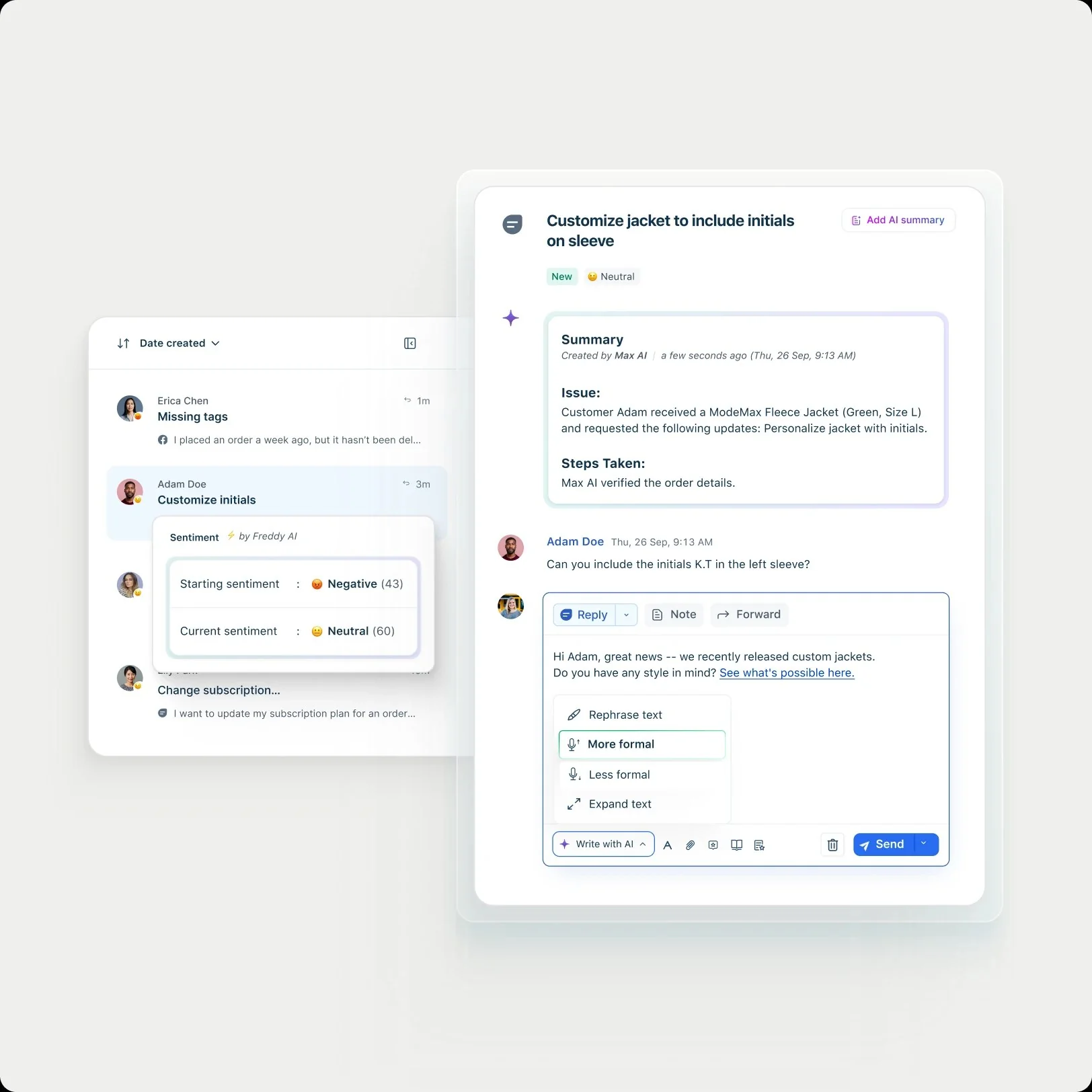
Freshdesk is the value option, and it is a full helpdesk rather than just an assist layer. Its AI, Freddy, splits into a customer-facing AI Agent and an agent-side Copilot. The Copilot is the direct Ginzi analog: it drafts replies and summarizes tickets, one flavour of AI for Freshdesk for your agents. Freshdesk also has a genuine free plan, which almost nothing else here offers.
The thing to understand is Freddy's billing unit, because it is unusual. An Email AI Agent session is a 72-hour window from the customer's first email, and every reply inside that window counts as one session. That is generous if conversations are short and awkward to forecast if they drag on.
Pros
- Free plan for up to 2 agents, and cheap paid tiers.
- Copilot covers the draft-and-assist workflow Ginzi did.
Cons
- The 72-hour session unit is hard to predict against real volume.
- Freddy Copilot is a $29 per-agent add-on on top of the plan.
Pricing
Standalone Freshdesk runs Free, then $19 (Growth), $55 (Pro), and $89 (Enterprise) per agent per month annually, per the Freshdesk pricing page. Freddy AI Agent gives you the first 500 sessions free on Pro and above, then $49 per 100 sessions. Freddy Copilot is $29 per agent.
Verdict: the best pick if budget is the deciding factor and you are open to running Freshdesk as your helpdesk. If you would rather keep your current tool, this is not a fit, since Freddy only works inside Freshworks.
4. Gorgias
Best for: Shopify and ecommerce brands.

If your support is ecommerce, Gorgias is worth a hard look. It is a commerce-first helpdesk with a deep Shopify integration, and its AI Agent can pull order data, process returns, and edit subscriptions right inside the ticket. That is a level of ecommerce action Ginzi never touched. The trade-off is that it is specialized: outside of a retail context, a lot of that value evaporates.
Users are clear-eyed about when it pays off:
"I've been around ecommerce for 10+ years and this is honestly how I'd choose: 40%+ tickets need Shopify actions, I'd lean Gorgias. Mostly conversational support, Zendesk is fine."
Pros
- Best-in-class Shopify and ecommerce actions.
- Usage-based pricing that scales on conversations, not seats.
Cons
- Overkill for non-ecommerce support.
- Each AI resolution also counts as a billable helpdesk ticket, so read the meter carefully.
Pricing
Plans start at $10/month (Starter, 50 tickets) and run to $750/month (Advanced), per the Gorgias pricing page. The AI Agent is a usage add-on at $0.90 per resolved conversation on annual billing ($1.00 monthly).
Verdict: the clear choice for a Shopify brand, and only for a Shopify brand. If you are not ecommerce, pick something more general.
5. Help Scout
Best for: small teams that value simplicity over configurability.

Help Scout is the friendly, email-first helpdesk. Agents pick it up in about an hour, and its AI Answers work like an AI knowledge base chatbot that resolves common questions from your docs. For a small team that found Ginzi and Zendesk overkill, Help Scout hits a nice middle ground of clean and capable.
One honest caveat: Help Scout moved to a usage-based pricing model, and not everyone was thrilled about the switch away from simple per-seat billing.
"We just received an email from HelpScout that they'll change their pricing to a completely new model. Whereas before you'd be charged by seat, you're now charged by customer interaction. It makes the costs unpredictable."
Pros
- Genuinely simple, fast to learn, and pleasant to use.
- A real free plan for up to 5 users.
Cons
- Less configurable than Zendesk or Freshdesk for complex workflows.
- AI Answers is metered per resolution on top of seats.
Pricing
Standard is $25, Plus is $45, and Pro is $75 per user per month on annual billing, with a free plan for 5 users, per the Help Scout pricing page. AI Answers is $0.75 per resolution.
Verdict: great for a lean team that wants low overhead. If you need deep automation or you are trying to keep a bigger existing helpdesk, look elsewhere.
6. Front
Best for: complex, multi-team customer operations.
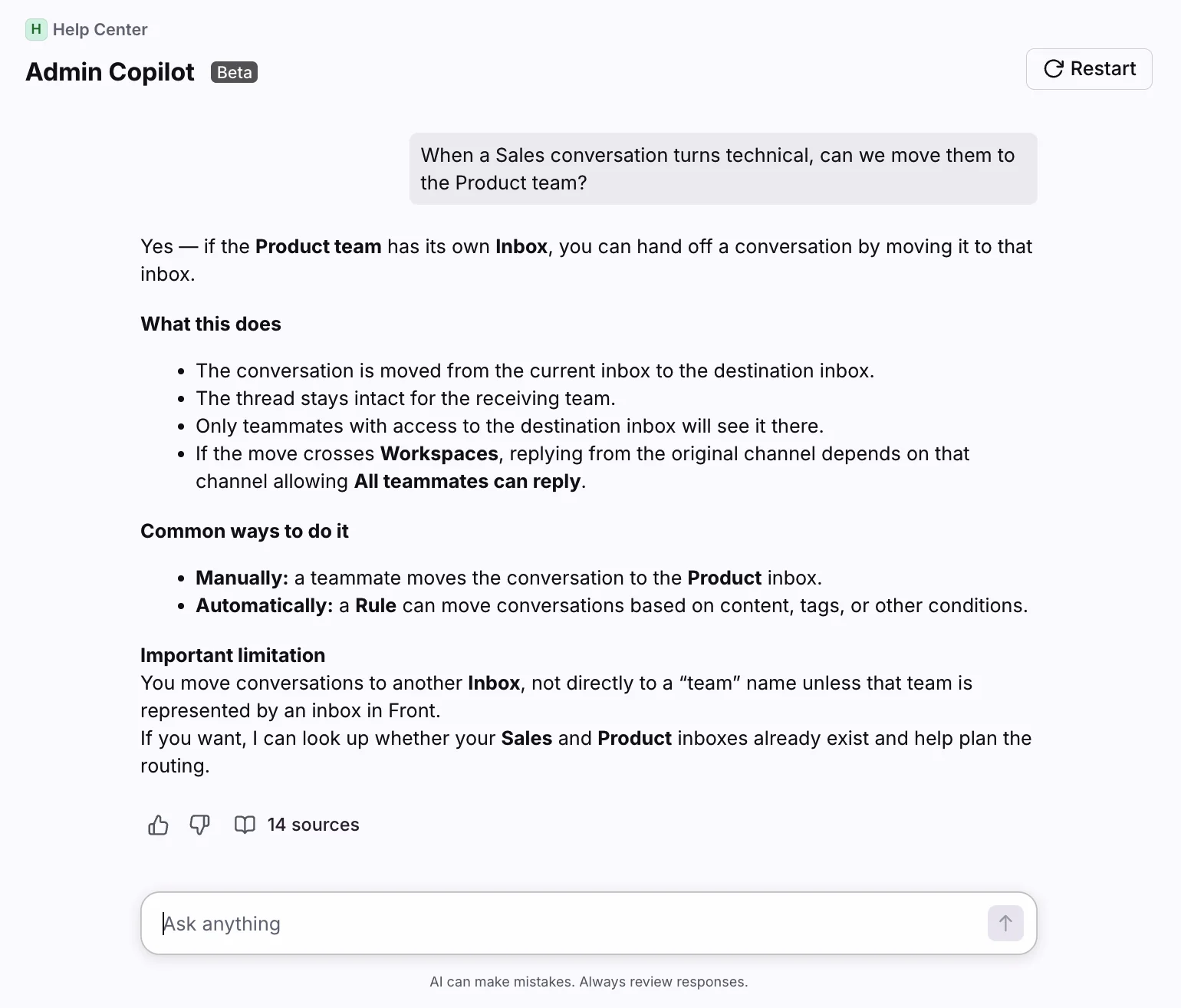
Front is built around a shared inbox that a whole team can work in together, with comments, assignments, and SLAs on top. Its positioning is explicitly against "AI for simple support," aimed at industries where a request spans several people. Front AI adds drafting, summaries, and Copilot to that, the kind of AI customer service workflow teams now expect. It holds a strong 4.7/5 on G2 across thousands of reviews.
Where it fits the Ginzi story: if your support is collaborative and messy rather than a clean ticket queue, Front's shared model handles that better than a straight helpdesk.
Pros
- Excellent for collaborative, cross-team work.
- Omnichannel inbox with a polished, email-like feel.
Cons
- AI is mostly sold as add-ons on top of seats, so costs stack.
- A 2-seat minimum and per-seat pricing make it pricier at scale.
Pricing
Starter is $25, Professional is $65, and Enterprise is $105 per seat per month annually, per the Front pricing page. Copilot, Smart QA, and Smart CSAT are bundled only on Enterprise; on lower tiers, Front AI is a paid add-on.
Verdict: the pick when your support is genuinely multi-team and conversational. For a standard ticket queue, its strengths are wasted and cheaper options do the job.
7. Chatbase
Best for: teams that mainly want a ChatGPT-style bot trained on their docs.
Ginzi leaned on ChatGPT under the hood, so if what you actually liked was "a GPT bot that knows my content," Chatbase is the direct version of that. You point it at your website, docs, and files, and it answers questions in a chat widget or over its API. It is more of a website chatbot builder than a helpdesk assist layer, but as an AI customer service chatbot for deflecting FAQs before they become tickets, it does the job.
The limit is scope. Chatbase is not built to live inside an agent's ticket workflow the way Ginzi's Macro Craft did; it is a customer-facing bot. Training is capped by data size on lower tiers, so a large knowledge base can push you up plans quickly.
Pros
- Fast to set up a doc-trained bot.
- Cheap entry point, with a free tier to try it.
Cons
- Website bot, not an in-helpdesk agent-assist tool.
- Training limits scale with plan, and it does not slot into your ticket queue natively.
Pricing
Chatbase runs a free tier, then Hobby at $40, Standard at $150, and Pro at $500 per month, gated by message credits and training size.
Verdict: a fine choice if you only wanted the "GPT on my docs" piece of Ginzi. For real agent-assist inside a helpdesk, one of the tools above fits better.
My recommendation
If you strip this back to the two jobs Ginzi did, drafting from your history and living inside Zendesk, the cleanest replacement is an AI layer that does both without a migration and lets you test it first. That is why eesel AI is my pick for most teams coming off Ginzi. If you are certain you will stay native, Zendesk AI or Freshdesk's Freddy are the sensible in-house routes, with Gorgias and Front as the specialists for ecommerce and complex operations.
The one thing I would not do is repeat Ginzi's original gap: turning on an AI and hoping it is right. Whatever you choose, insist on a way to see the AI's accuracy on your own past tickets before it replies to a real customer.
Try eesel AI
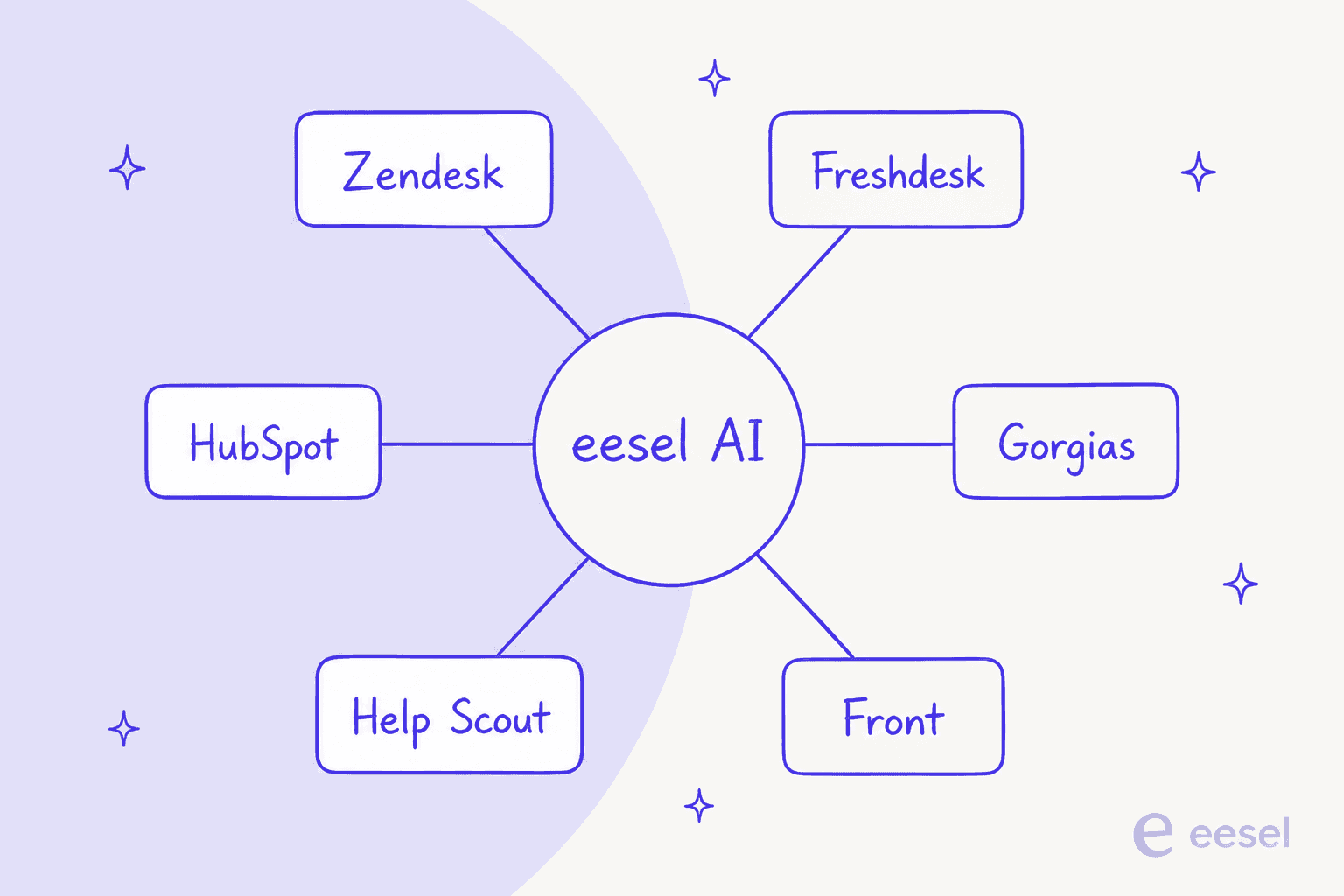
Ginzi's idea was right, and only its staying power was wrong. eesel AI is the same idea, an AI teammate that answers each question once and learns your history, but built to last and to fit your stack instead of a single helpdesk. It plugs into Zendesk, Freshdesk, Gorgias, Front, and more helpdesks, drafts or auto-sends replies, and, crucially, lets you simulate on hundreds of past tickets so you can see the accuracy before you commit. You can start free with 100 credits, no card, and there is a demo if you would rather be walked through it.
Frequently Asked Questions
Is Ginzi still available in 2026?
What is the best Ginzi alternative for a team already on Zendesk?
How much do Ginzi alternatives cost?
Do I need to replace my whole helpdesk to move off Ginzi?
What should I check before trusting an AI support tool with live replies?


Article by
Rama Adi Nugraha
Rama is a software engineer at eesel AI with two years of experience writing about B2B SaaS, AI tools, and customer support technology. Based in Bali, Indonesia, he brings a developer's perspective to product comparisons — cutting through marketing copy to what the integrations and APIs actually do.